 Скачать презентацию Stat 35 b Introduction to Probability with Applications
d12d06f4486ad28d09fbe0fd49ee9806.ppt
- Количество слайдов: 6



Stat 35 b: Introduction to Probability with Applications to Poker Outline for the day 1. Review list. 2. Gold, Farha, and Bayes’s rule. 3. P(flop 2 pairs). 4. P(suited king). Midterm is this Friday Feb 21. Homework 3 is due Feb 28. Project B is due Mar 8, 8 pm, by email to frederic@stat. ucla. edu. Same teams as project A.
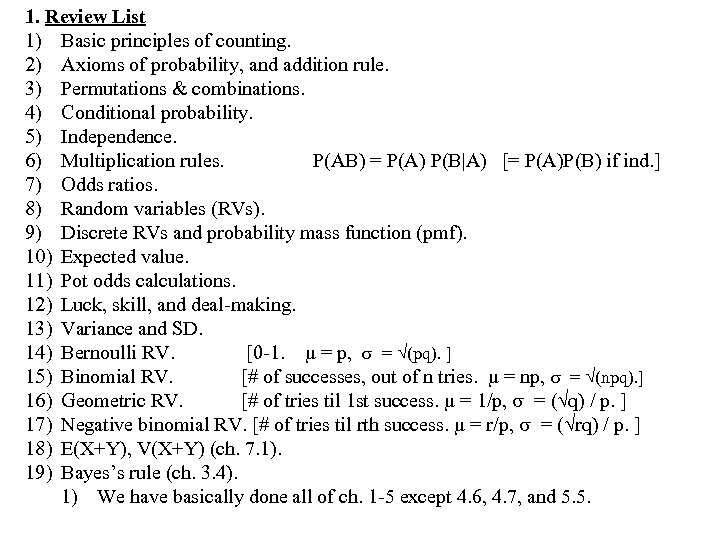
1. Review List 1) Basic principles of counting. 2) Axioms of probability, and addition rule. 3) Permutations & combinations. 4) Conditional probability. 5) Independence. 6) Multiplication rules. P(AB) = P(A) P(B|A) [= P(A)P(B) if ind. ] 7) Odds ratios. 8) Random variables (RVs). 9) Discrete RVs and probability mass function (pmf). 10) Expected value. 11) Pot odds calculations. 12) Luck, skill, and deal-making. 13) Variance and SD. 14) Bernoulli RV. [0 -1. µ = p, s = √(pq). ] 15) Binomial RV. [# of successes, out of n tries. µ = np, s = √(npq). ] 16) Geometric RV. [# of tries til 1 st success. µ = 1/p, s = (√q) / p. ] 17) Negative binomial RV. [# of tries til rth success. µ = r/p, s = (√rq) / p. ] 18) E(X+Y), V(X+Y) (ch. 7. 1). 19) Bayes’s rule (ch. 3. 4). 1) We have basically done all of ch. 1 -5 except 4. 6, 4. 7, and 5. 5.
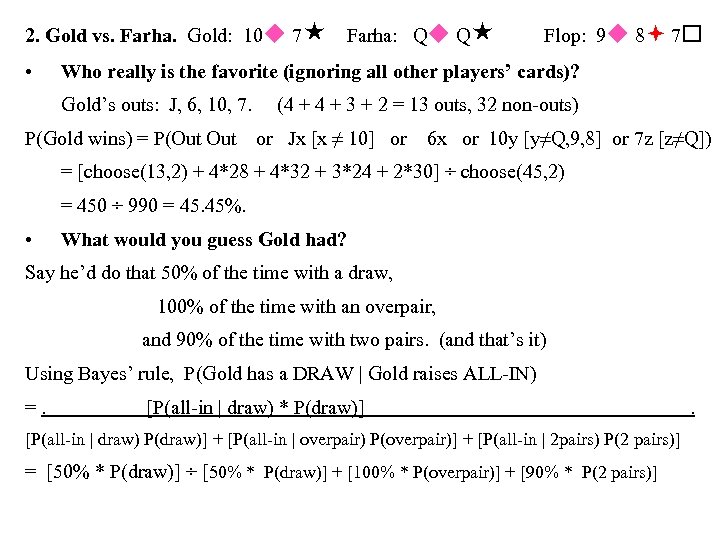
2. Gold vs. Farha. Gold: 10 u 7 • Farha: Qu Q Flop: 9 u 8 7 Who really is the favorite (ignoring all other players’ cards)? Gold’s outs: J, 6, 10, 7. (4 + 3 + 2 = 13 outs, 32 non-outs) P(Gold wins) = P(Out or Jx [x ≠ 10] or 6 x or 10 y [y≠Q, 9, 8] or 7 z [z≠Q]) = [choose(13, 2) + 4*28 + 4*32 + 3*24 + 2*30] ÷ choose(45, 2) = 450 ÷ 990 = 45. 45%. • What would you guess Gold had? Say he’d do that 50% of the time with a draw, 100% of the time with an overpair, and 90% of the time with two pairs. (and that’s it) Using Bayes’ rule, P(Gold has a DRAW | Gold raises ALL-IN) =. [P(all-in | draw) * P(draw)] [P(all-in | draw) P(draw)] + [P(all-in | overpair) P(overpair)] + [P(all-in | 2 pairs) P(2 pairs)] = [50% * P(draw)] ÷ [50% * P(draw)] + [100% * P(overpair)] + [90% * P(2 pairs)] .
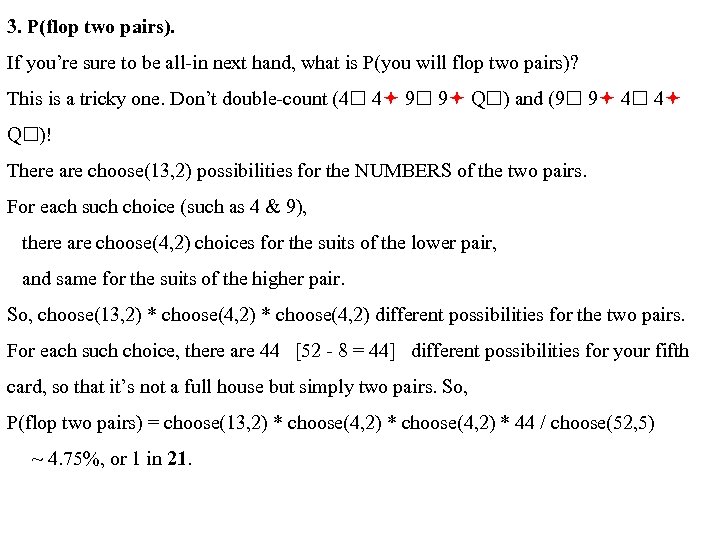
3. P(flop two pairs). If you’re sure to be all-in next hand, what is P(you will flop two pairs)? This is a tricky one. Don’t double-count (4 4 9 9 Q ) and (9 9 4 4 Q )! There are choose(13, 2) possibilities for the NUMBERS of the two pairs. For each such choice (such as 4 & 9), there are choose(4, 2) choices for the suits of the lower pair, and same for the suits of the higher pair. So, choose(13, 2) * choose(4, 2) different possibilities for the two pairs. For each such choice, there are 44 [52 - 8 = 44] different possibilities for your fifth card, so that it’s not a full house but simply two pairs. So, P(flop two pairs) = choose(13, 2) * choose(4, 2) * 44 / choose(52, 5) ~ 4. 75%, or 1 in 21.
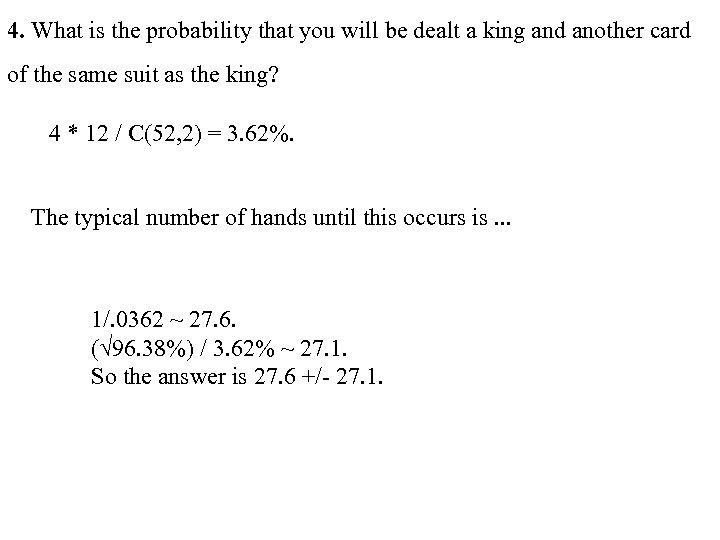
4. What is the probability that you will be dealt a king and another card of the same suit as the king? 4 * 12 / C(52, 2) = 3. 62%. The typical number of hands until this occurs is. . . 1/. 0362 ~ 27. 6. (√ 96. 38%) / 3. 62% ~ 27. 1. So the answer is 27. 6 +/- 27. 1.
Скачать презентацию Stat 35 b Introduction to Probability with Applications
d12d06f4486ad28d09fbe0fd49ee9806.ppt