


 Скачать презентацию Starter for 10 Place the statements
3982c818c5653810f0afd54a09fc5d19.ppt
- Количество слайдов: 14
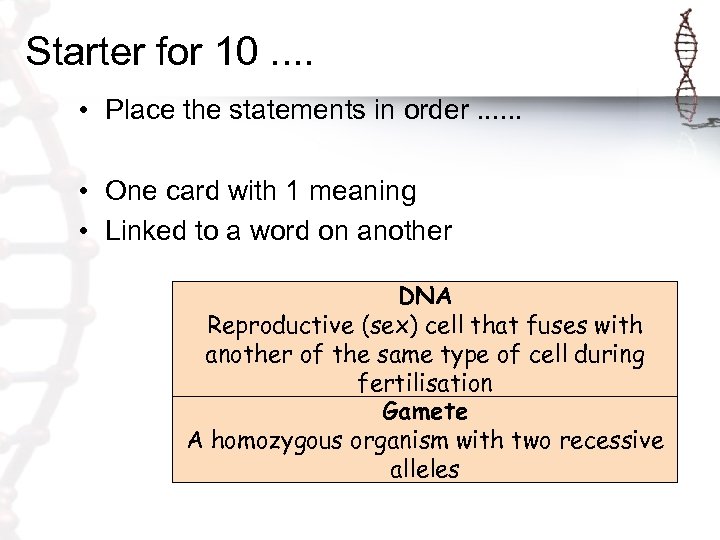 Starter for 10. . • Place the statements in order. . . • One card with 1 meaning • Linked to a word on another DNA Reproductive (sex) cell that fuses with another of the same type of cell during fertilisation Gamete A homozygous organism with two recessive alleles
 Higher Human Biology Unit 1 – Human Cells DNA
 Learning Outcomes Content • Explain the term genotype. • Describe what the DNA molecule is made up from and how it is bonded. Process • Model making! Benefit • Understand how inheritance is carried out. • Explain how CSI DNA works!
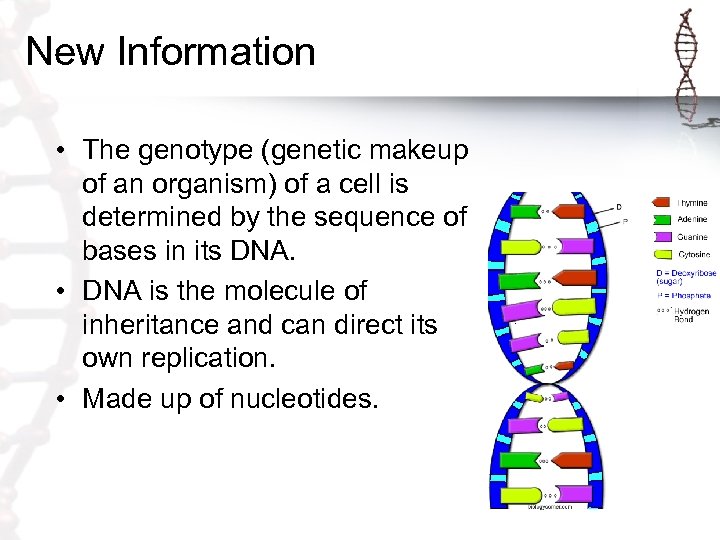 New Information • The genotype (genetic makeup of an organism) of a cell is determined by the sequence of bases in its DNA. • DNA is the molecule of inheritance and can direct its own replication. • Made up of nucleotides.
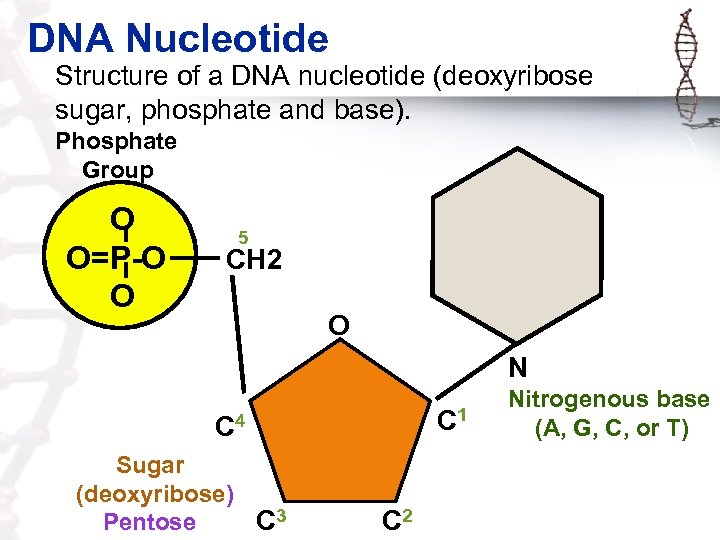 DNA Nucleotide Structure of a DNA nucleotide (deoxyribose sugar, phosphate and base). Phosphate Group O O=P-O O 5 CH 2 O N C 1 C 4 Sugar (deoxyribose) C 3 Pentose C 2 Nitrogenous base (A, G, C, or T)
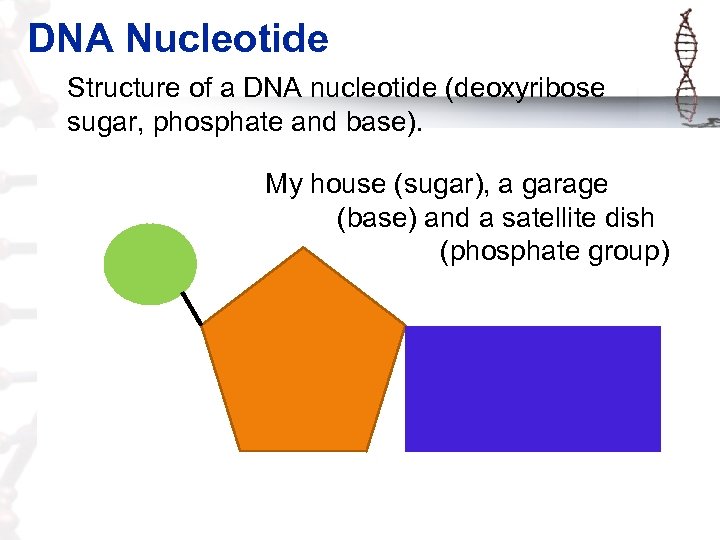 DNA Nucleotide Structure of a DNA nucleotide (deoxyribose sugar, phosphate and base). Phosphate Group O O=P-O O My house (sugar), a garage (base) and a satellite dish 5 (phosphate group) CH 2 O N C 1 C 4 Sugar (deoxyribose) C 3 Pentose C 2 Nitrogenous base (A, G, C, or T)
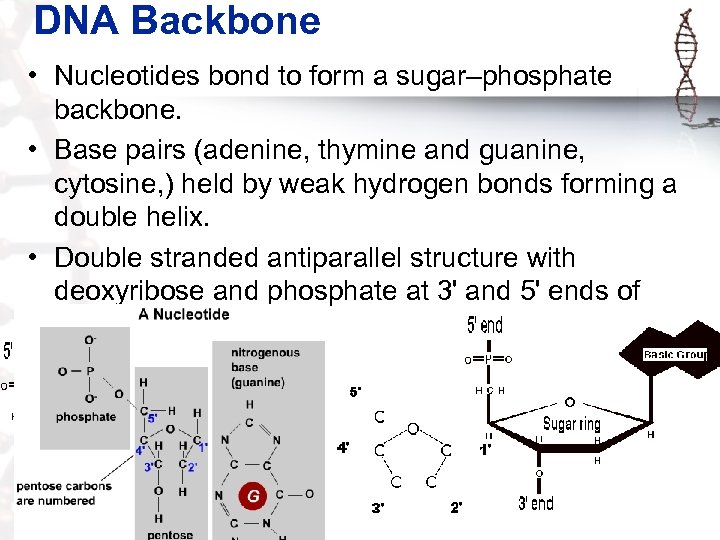 DNA Backbone • Nucleotides bond to form a sugar–phosphate backbone. • Base pairs (adenine, thymine and guanine, cytosine, ) held by weak hydrogen bonds forming a double helix. • Double stranded antiparallel structure with deoxyribose and phosphate at 3' and 5' ends of each strand.
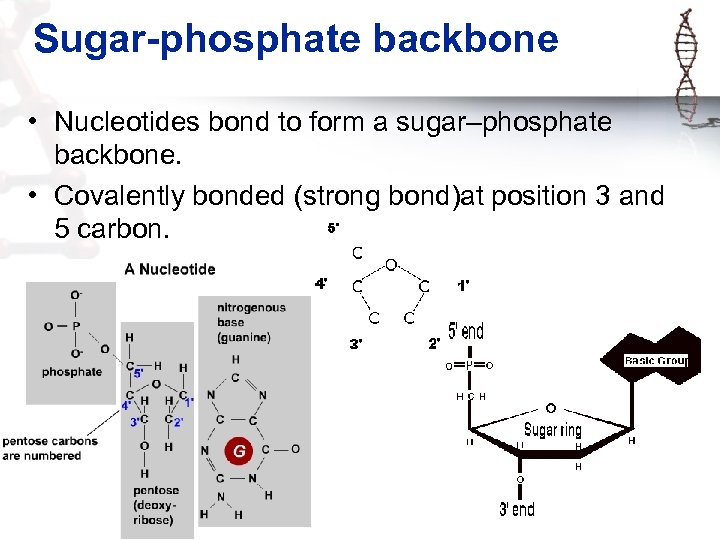 Sugar-phosphate backbone • Nucleotides bond to form a sugar–phosphate backbone. • Covalently bonded (strong bond)at position 3 and 5 carbon.
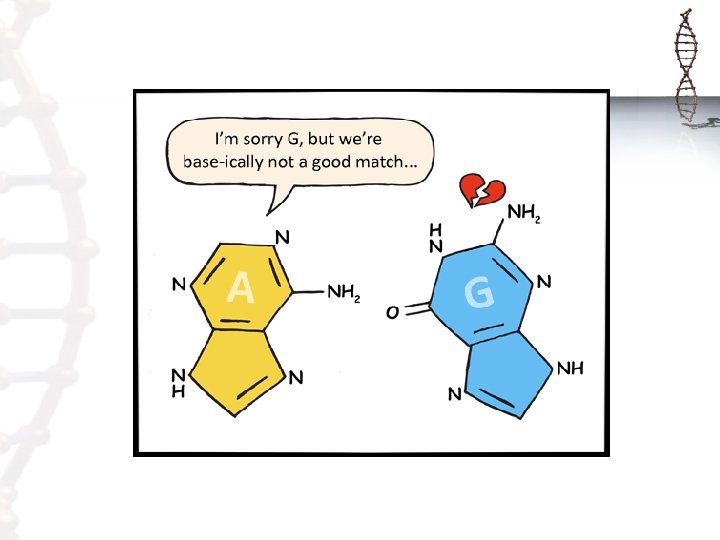
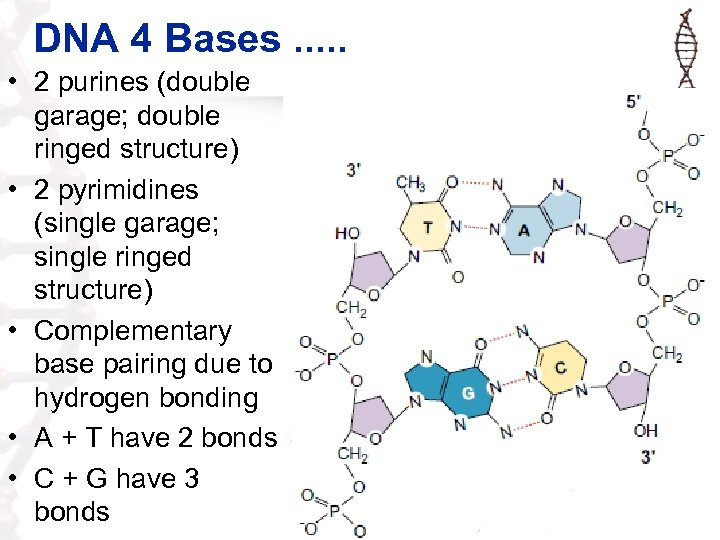 DNA 4 Bases. . . • 2 purines (double garage; double ringed structure) • 2 pyrimidines (single garage; single ringed structure) • Complementary base pairing due to hydrogen bonding • A + T have 2 bonds • C + G have 3 bonds
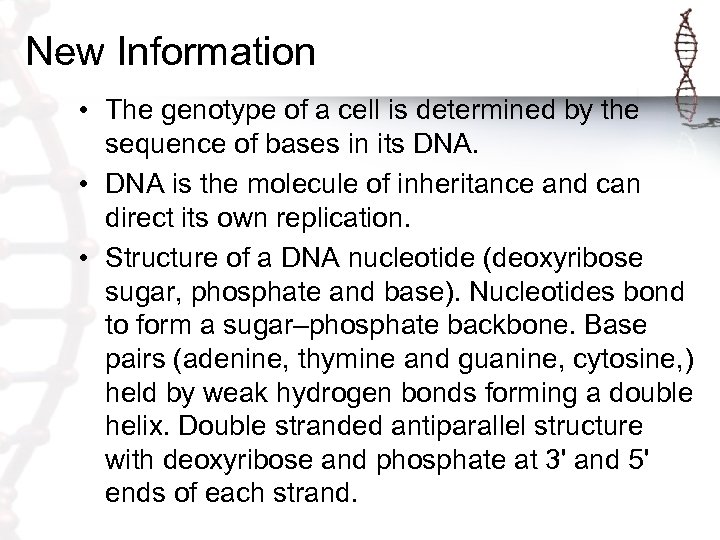 New Information • The genotype of a cell is determined by the sequence of bases in its DNA. • DNA is the molecule of inheritance and can direct its own replication. • Structure of a DNA nucleotide (deoxyribose sugar, phosphate and base). Nucleotides bond to form a sugar–phosphate backbone. Base pairs (adenine, thymine and guanine, cytosine, ) held by weak hydrogen bonds forming a double helix. Double stranded antiparallel structure with deoxyribose and phosphate at 3' and 5' ends of each strand.
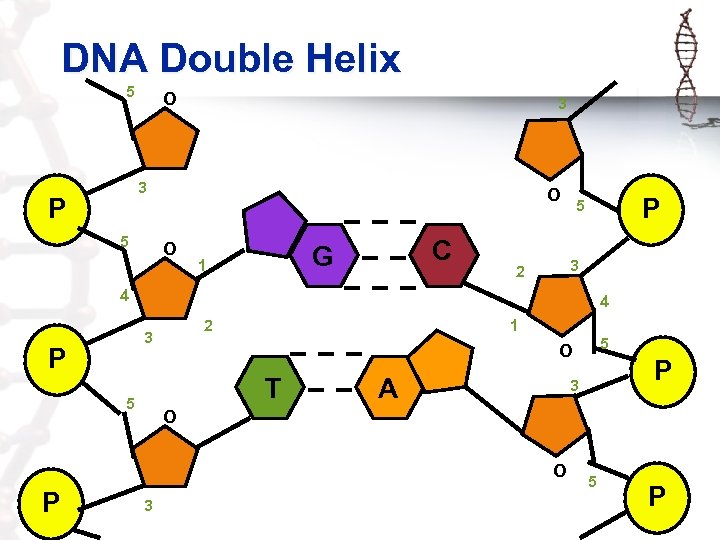 DNA Double Helix 5 O 3 3 P 5 O O C G 1 P 5 3 2 4 4 2 3 P 1 T 5 A P 3 O O P 5 O 3 5 P
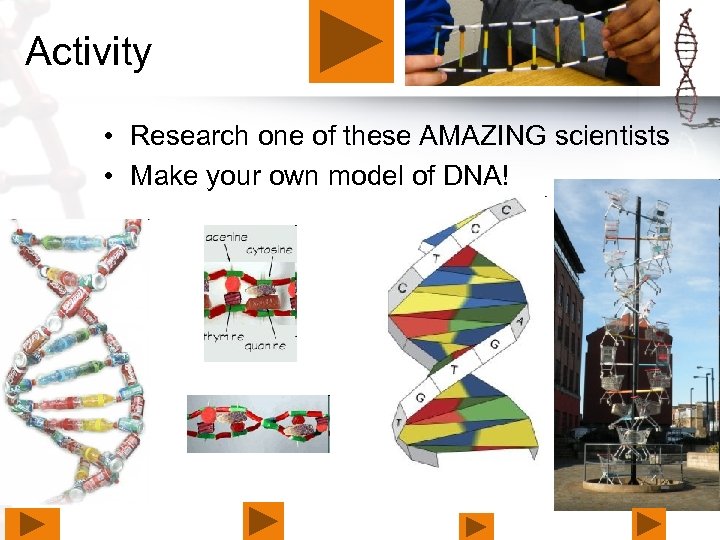 Activity • Research one of these AMAZING scientists • Make your own model of DNA!
 Review Comment on each others DNA model; • Positives comments • Improvements that could be made