


 Скачать презентацию Start To proceed through this tutorial please
b0f3acd681a3bc70fe10cb5d626b7e48.ppt
- Количество слайдов: 94
 Start
Start
 To proceed through this tutorial, please click on next or follow the instructions on screen. Next
 ◊ ◊ ◊ Maximise the capacity of those who lack or may lack capacity to make certain decisions for themselves Protect vulnerable adults who may have mental incapacity from abuse and neglect Provide clarity to families, informal carers and professionals as to when they may act or make decisions themselves Next
 MCA applies to people 16 years old or older though in some circumstances the Court of Protection will intervene for under 16 year olds. It covers people with the following: ◊ Dementia ◊ Learning disability ◊ Brain injury ◊ Severe mental illness ◊ Anyone planning for the future ◊ Temporary loss of capacity, for example because someone is unconscious, because of an accident, anaesthesia, alcohol or drugs Next
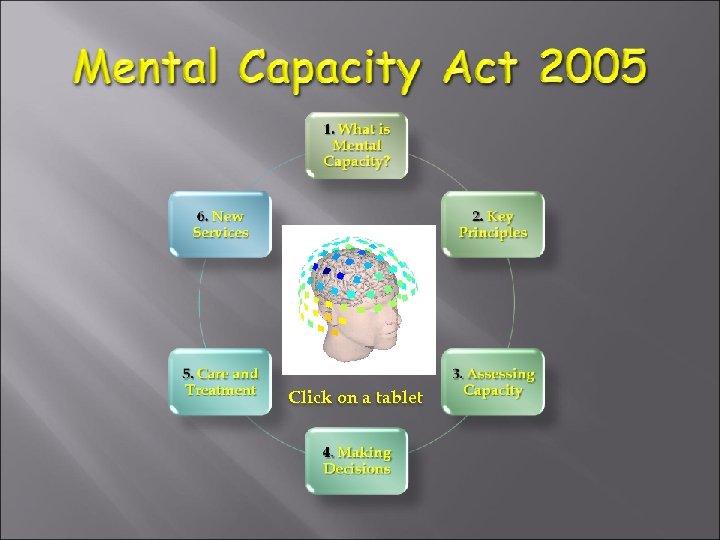 Click on a tablet
 Next
Next
 ◊ Mental capacity is the ability to make a decision ◊ Capacity can vary over time ◊ Capacity can vary depending on the decision to be made ◊ ◊ Physical conditions, such as location, can affect a person’s capacity Do not assume lack of capacity because of a person’s age, physical appearance, condition or an aspect of their behaviour Next
 ◊ ◊ ◊ An individual lacks capacity if they are unable to make a particular decision This inability must be caused by an impediment or disturbance of the mind or brain whether temporary or permanent Capacity can vary over time and type of decision Next
 Return To Menu
 Next
Next
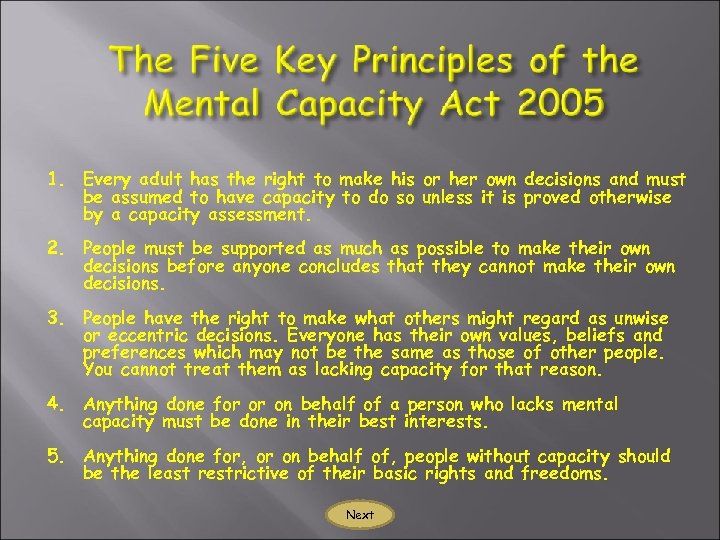 1. Every adult has the right to make his or her own decisions and must be assumed to have capacity to do so unless it is proved otherwise by a capacity assessment. 2. People must be supported as much as possible to make their own decisions before anyone concludes that they cannot make their own decisions. 3. People have the right to make what others might regard as unwise or eccentric decisions. Everyone has their own values, beliefs and preferences which may not be the same as those of other people. You cannot treat them as lacking capacity for that reason. 4. Anything done for or on behalf of a person who lacks mental capacity must be done in their best interests. 5. Anything done for, or on behalf of, people without capacity should be the least restrictive of their basic rights and freedoms. Next
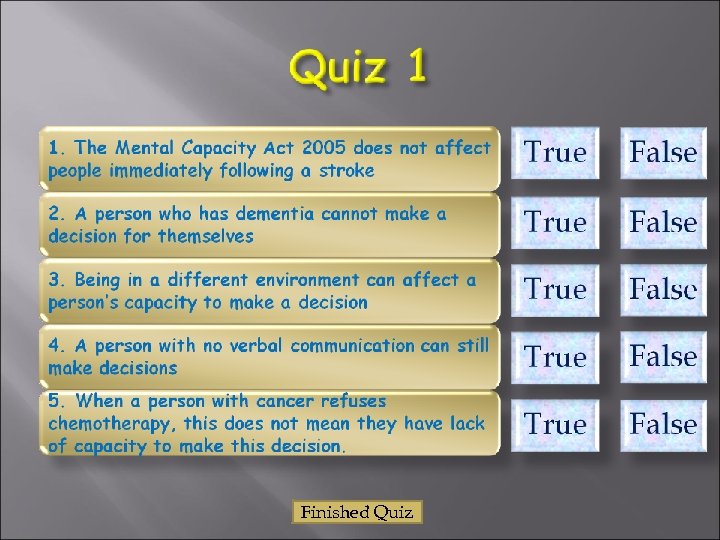 Finished Quiz
 Question 1 This is correct. The Mental Capacity Act 2005 affects people with a temporary loss of capacity, including people affected by a stroke. Return to Quiz
 Question 1 This answer is incorrect. The Mental Capacity Act 2005 affects people with a temporary loss of capacity, including people affected by a stroke. Return to Quiz
 Question 2 This is correct. A condition such as dementia does not automatically mean that a person is unable to make decision or have choices. Nor should assumption regarding lack of capacity be made because of a person’s age, physical appearance, or any aspect of their behaviour. Return to Quiz
 Question 2 This answer is incorrect. A condition such as dementia does not automatically mean that a person is unable to make decision or have choices. Nor should assumption regarding lack of capacity be made because of a person’s age, physical appearance, or any aspect of their behaviour. Return to Quiz
 Question 3 This is correct. A person’s capacity to make decisions can be affected by the environment. For example, a person who finds themselves in hospital after an accident may be confused by the surroundings and hence less able to make a decision. Return to Quiz
 Question 3 This answer is incorrect. A person’s capacity to make decisions can be affected by the environment. For example, a person who finds themselves in hospital after an accident may be confused by the surroundings and hence less able to make a decision. Return to Quiz
 Question 4 This is correct. Verbal communication is not essential in making a decision. There a wide variety of communication techniques which could be used to support a person with non-verbal communication in making an informed decision. Return to Quiz
 Question 4 This answer is incorrect. Verbal communication is not essential in making a decision. There a wide variety of communication techniques which could be used to support a person with non-verbal communication in making an informed decision. Return to Quiz
 Question 5 This is correct. Making a decision which many other individuals may feel unwise, does not mean a person is not able to make that decision. Everyone has the right to make unwise decisions as long as a person shows they have understood the possible consequences of their decision. Return to Quiz
 Question 5 This answer is incorrect. Making a decision which many other individuals may feel unwise, does not mean a person is not able to make that decision. Everyone has the right to make unwise decisions as long as a person shows they have understood the possible consequences of their decision. Return to Quiz
 Return To Menu
 Next
Next
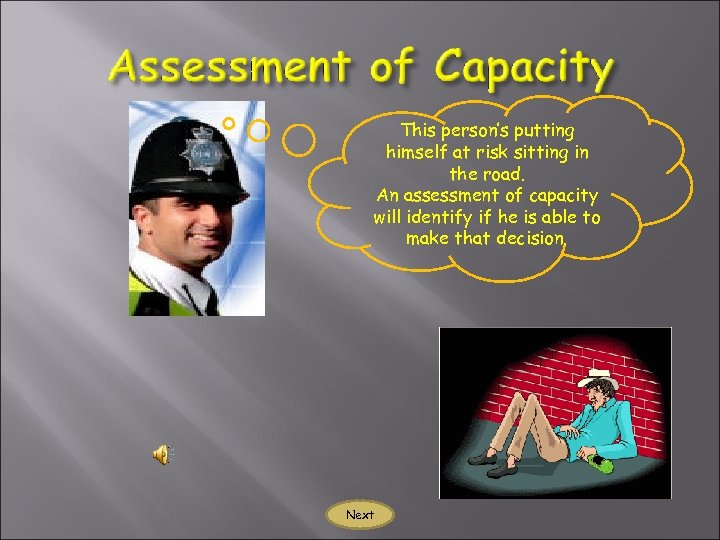 This person’s putting himself at risk sitting in the road. An assessment of capacity will identify if he is able to make that decision. Next
 ◊ Start from a presumption of capacity ◊ Doubts as to an individual’s capacity can occur because: ◊ Of the person’s behaviour ◊ Of their circumstances ◊ Of concerns raised by someone else ◊ ◊ ◊ Always assess in relation to the specific decision to be made The question of whether a person has the capacity to make particular decisions should be regularly considered, including when care plans are being reviewed. An unwise decision does not necessarily indicate lack of capacity Next
 Any assessment of a person’s capacity must consider their ability: ◊ to understand the information relevant to the decision ◊ to retain information for long enough to make the decision ◊ to use or weigh up the information relating to the decision ◊ to communicate their decision – by any means! If a person being assessed is unable to do any of the above, they are unable to make a decision for themselves. However remember that these assessments need to be decision and time specific. Anyone must be assessed at his or her best level of functioning. Next
 ◊ ◊ Anyone caring for or supporting a person who may lack capacity could be involved in the test to assess capacity The more significant the decision, the greater the number of people likely to be involved Expert testing by doctors or psychologists will be required in some cases, but even when used may not be the only form of capacity assessment, as capacity is time and decision specific Who you involve depends upon individual circumstances Next
 ◊ Provide all relevant information ◊ Do not give more detail than required ◊ Include information on the consequences of making, or not making, the decision ◊ Summarise and present options ◊ Consult with family and care staff on the best way to communicate Next
 ◊ Be aware of any cultural, ethnic or religious factors which may have a bearing. Make the person feel at ease ◊ Try and choose the best time of day for the person ◊ Try and ensure that the effects of any medication or treatment are considered ◊ Take it easy – one decision at a time ◊ Don’t rush, and be prepared to try more than once Next
 Always keep records of any assessment These include: ◊ Day-to-day e. g. . Following the Care Plan, Mrs Begum was helped to decide her choice of meals for the day ◊ Professional Records e. g. . 2 -stage test, assessment activities & outcomes, relevant care plan information, etc. ◊ Formal reports/certificates of capacity Next
 The next slide introduces the 2 stage assessment test which MUST be used and your records must show it has been used, even for day-to-day assessments of capacity. Next
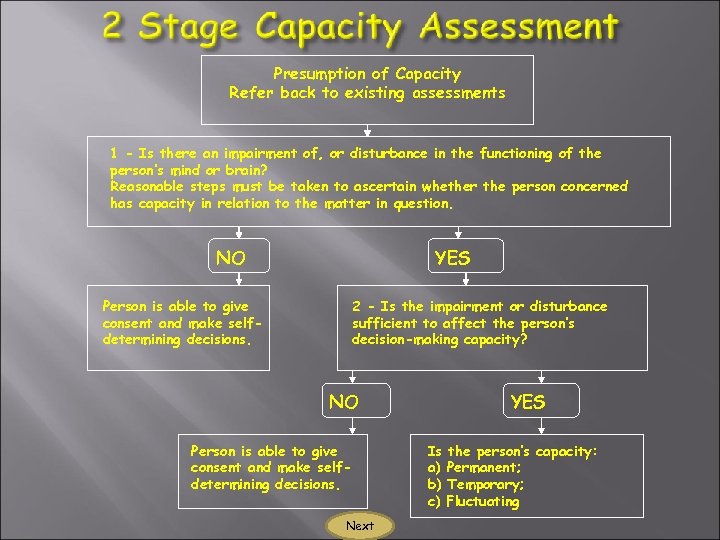 Presumption of Capacity Refer back to existing assessments 1 - Is there an impairment of, or disturbance in the functioning of the person’s mind or brain? Reasonable steps must be taken to ascertain whether the person concerned has capacity in relation to the matter in question. NO YES Person is able to give consent and make selfdetermining decisions. 2 - Is the impairment or disturbance sufficient to affect the person’s decision-making capacity? NO Person is able to give consent and make selfdetermining decisions. Next YES Is the person’s capacity: a) Permanent; b) Temporary; c) Fluctuating
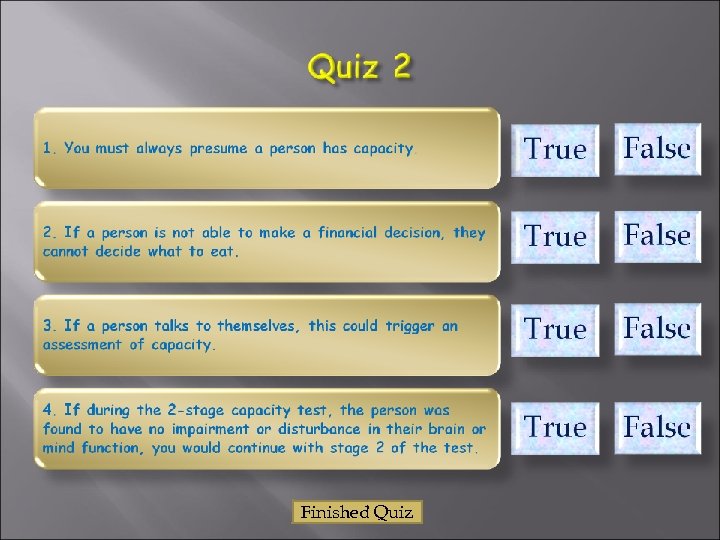 Finished Quiz
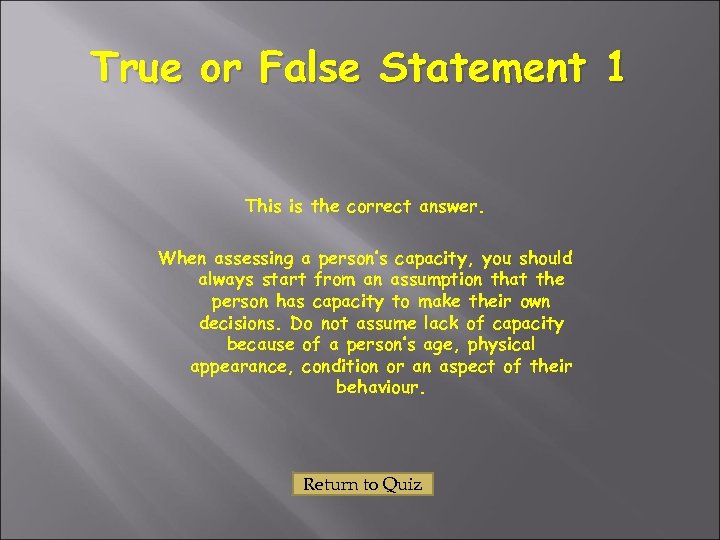 True or False Statement 1 This is the correct answer. When assessing a person’s capacity, you should always start from an assumption that the person has capacity to make their own decisions. Do not assume lack of capacity because of a person’s age, physical appearance, condition or an aspect of their behaviour. Return to Quiz
 True or False Statement 1 The correct answer is ‘True’. When assessing a person’s capacity, you should always start from an assumption that the person has capacity to make their own decisions. Do not assume lack of capacity because of a person’s age, physical appearance, condition or an aspect of their behaviour. Return to Quiz
 True or False Statement 2 The correct answer is ‘False’. Capacity can vary depending on the decision to be made. Some decision are easy as there is little information to weigh up, such as choosing what to wear. Other decisions are more complex as a lot more information needs to be considered, such as financial decisions. Return to Quiz
 True or False Statement 2 This is the correct answer. Capacity can vary depending on the decision to be made. Some decision are easy as there is little information to weigh up, such as choosing what to wear. Other decisions are more complex as a lot more information needs to be considered, such as financial decisions. Return to Quiz
 True or False Statement 3 This is the correct answer. Doubts as to an individual’s capacity can occur because: Of the person’s behaviour Of their circumstances Of concerns raised by someone else Return to Quiz
 True or False Statement 3 The correct answer is ‘True’. Doubts as to an individual’s capacity can occur because: Of the person’s behaviour Of their circumstances Of concerns raised by someone else Return to Quiz
 True or False Statement 4 The correct answer is ‘False’. When a person was found to have no impairment or disturbance in their brain or mind function, they are fully able to make their own decisions. Return to Quiz
 True or False Statement 4 This is the correct answer. When a person was found to have no impairment or disturbance in their brain or mind function, they are fully able to make their own decisions. Return to Quiz
 Time to take a break and get a cup of coffee Next
 Return To Menu
 Next
Next
 It varies depending on the individual’s circumstances and the type of decision involved. ◊ ◊ ◊ Family members, informal carers as well as Health and Social Care staff can be decision makers Deputies appointed by the court and people who have been granted Lasting Power of Attorney can be decision makers Doctors and Solicitors can be decision makers, however are unlikely to be decision makers for social activities and day-to-day care Next
 In determining a person’s best interests, consideration must be given to what is best for that person in those particular circumstances. Whilst the views of other people will need to be taken into account, the focus must be placed firmly on the person lacking capacity. Priority should be given to what is objectively the best course of action for them in that particular situation. Next
 ◊ Avoid making assumptions about someone’s best interest merely on the basis of the person’s age, appearance, condition or behaviour ◊ Consider a person’s own wishes, feelings, beliefs and values and any written statement made by the person when they had capacity ◊ Take account of the views of family and informal carers ◊ Can the decision be put off until the person regains capacity? Next
 ◊ Involve the person in the decision making process ◊ Demonstrate that you have carefully assessed any conflicting evidence or views ◊ Provide clear, objective reasons as to why you are acting in the person’s best interests ◊ Take the least restrictive alternative or intervention This is not an exhaustive list, however by using this checklist the decision maker will ensure that decisions are made in the person’s best interests. Next
 Please click each for a detailed case study below to view explanations, then click the Next button to move on afterwards: ◊ Simple Decisions ◊ Moderately Complex Decisions ◊ Complex Decisions Next
 Following a discussion with the home manager, staff make a best interests decision on behalf of Esther, a care home resident with severe dementia. Esther has asked the staff to buy a Christmas present for her daughter; however, she cannot remember what her daughter likes. The staff uses Esther’s personal allowance to buy a present for her daughter, as they did in the past, when Esther was able to ask them to buy her daughter her favourite soap. They keep the receipt, give it to the home administrator and write down what they have done in Esther’s file. As they have sufficient information to explain why and what they did, staff will be protected if anyone asks why they bought such an expensive soap. Next
 Siobhan, who has a brain injury, lives in a group home with three other people. The staff are taking some of the service users sailing on the local reservoir where there is a centre which provides lessons for people with special needs. Siobhan’s mother, Mary, is extremely anxious about her daughter participating in such an activity but is also keen for Siobhan to have fun with her friends. Siobhan is a little nervous about the trip, but she is also very excited. Having discussed the trip with Siobhan, the staff think that she should be encouraged to participate in group activities and that if she decides on the day that she wants to sail then she should be encouraged to join in. Next
 They arrange to meet with Mary to discuss her concerns and agree that Patrick, Siobhan’s brother, of whom she is very fond, will accompany her on the trip. He will sail with her if she wants him to or sit with her while others sail if she decides that she does not want to join in. In the case, staff have considered Siobhan’s own wishes and taken account of her family’s views before making a best interests decision. Next
 Sharon is 25 and has a severe learning disability. She lives in a care home and is close to her mother who visits regularly. Sharon really enjoys her mother’s visits and looks forward to them. Sharon’s sister is very ill and needs a bone marrow transplant. Sharon lacks the capacity to agree to be a bone marrow donor. This case study is based on an actual case where the judge decided that Sharon could donate as it was to her emotional, psychological and social benefit. At a first glance, you might think that Sharon couldn’t possibly benefit from the procedure, you might be concerned that the procedure would hurt or distress her, and it would be in her sister’s interests, but not Sharon’s. Next
 However, the judge’s decision was based on evidence that if Sharon’s sister were to die this would have an adverse impact on Sharon’s mother with whom she had a very close relationship. Also, the death of her other daughter would significantly affect Sharon’s mother’s ability to visit Sharon, which would have a very bad effect on Sharon also had her own good relationship with her sister and the loss of that would be detrimental. Best interests go beyond what is in the person’s best interests medically. Such serious and complex cases should be decided by the Court. Next
 Return To Menu
 Next
Next
 What is meant by Care and Treatment? Acts in connection with personal care may include: ◊ Assistance with physical care, e. g. washing, dressing, changing catheter ◊ Help with eating and drinking ◊ Help with travelling ◊ Shopping ◊ Paying bills ◊ Household maintenance ◊ Other community care services Next
 What is meant by Care and Treatment? Acts connected to healthcare and treatment may include: ◊ Administration of medication ◊ Diabetes injections ◊ Nursing care ◊ Medical & dental treatment ◊ Emergency procedures Next
 The MCA 2005 creates a new criminal offence of ill-treatment and neglect for: ◊ ◊ ◊ People who have the care of a person who lacks capacity An attorney under a Lasting Power of Attorney (LPA) or Enduring Power of Attorney (EPA) definition A deputy appointed by the Court of Protection definition (all these will be explained in detail in the New Services Module) The penalty for this criminal offence may be a fine and/or a sentence of imprisonment for up to 5 years. The new criminal offence is part of a wider government policy to protect Vulnerable Adults. For more information, click here (link to the Multi-Agency Protection of Vulnerable Adults in Lincolnshire Policy). Next
 Section 5 of the MCA 2005, provides protection against civil and criminal charges to all who make decisions about the care and treatment in the best interest of a person who lacks capacity, providing they: ◊ ◊ ◊ Have taken reasonable steps to assess the person’s capacity Reasonably believe that the person lacks capacity Reasonably believe that the decision is in their best interests Each decision must always be the least restrictive and proportionate. The following slides show some practical examples about least restrictive options. Next
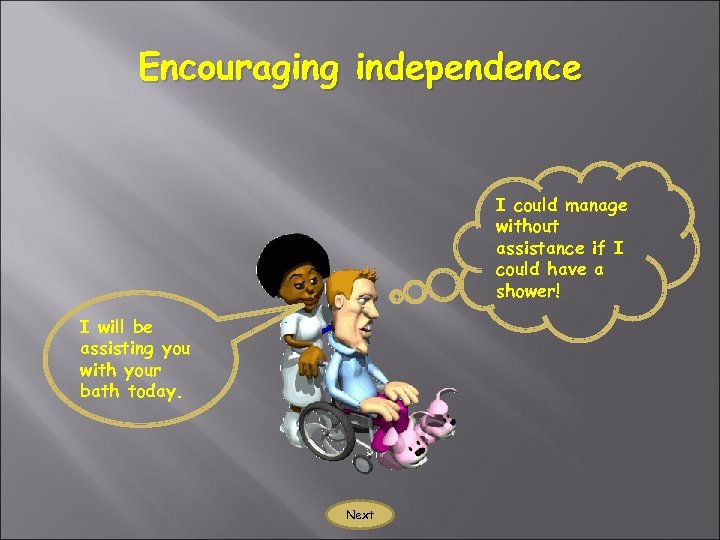 Encouraging independence I could manage without assistance if I could have a shower! I will be assisting you with your bath today. Next
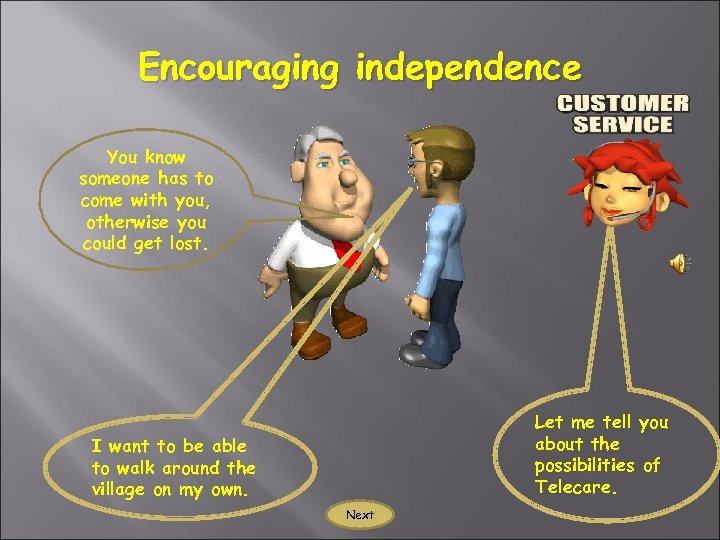 Encouraging independence You know someone has to come with you, otherwise you could get lost. Let me tell you about the possibilities of Telecare. I want to be able to walk around the village on my own. Next
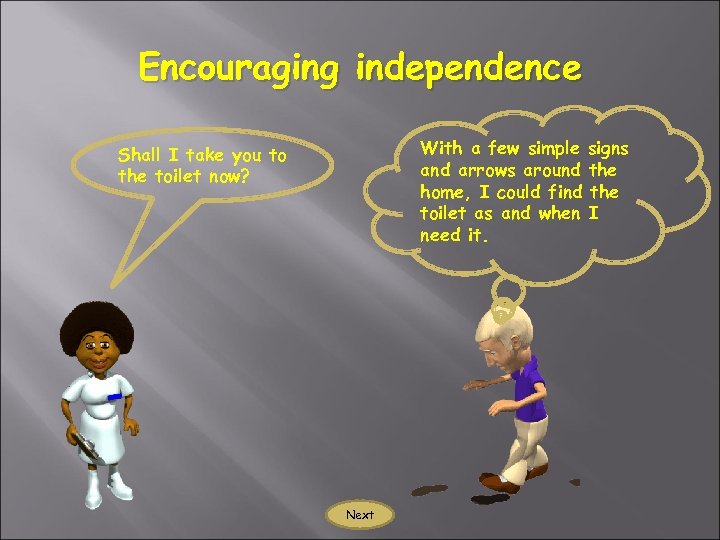 Encouraging independence With a few simple signs and arrows around the home, I could find the toilet as and when I need it. Shall I take you to the toilet now? Next
 ◊ ◊ ◊ Restraint should only be used as a last resort or in exceptional circumstances. The way in which it might be used must be accurately recorded in a Person’s care plan and all instances when restraint is used must be recorded in the case notes or file. The decision maker must reasonably believe the person lacks capacity. Restraint needs to be a proportionate or reasonable response to the Likelihood of the person suffering harm and the seriousness of that harm. Restraint can include physical restraint, locking a door and verbal warnings. Next
 The Bournewood Case is a legal case that tested the boundary between appropriate restraint or restriction and the loss of Human Rights under Article 5 of the European Convention of Human Rights - the Right to Liberty. Further guidelines around ‘Deprivation of Liberty’ will be available from 2008. Next
 Next
Next
 An advance decision is prepared when a person has capacity. It is a decision to refuse specific treatment and is binding. This must be written and witnessed if life sustaining treatment is being refused. An advance statement is an expression of an individual’s preferences and is not binding. Next
 Robert is a 73 year old man with Diabetes. Throughout his life, he has always chosen to smoke cigars and he enjoys a glass or two of Brandy every night. Equally, Robert has made an informed decision never to take insulin for his Diabetes. As a result, his eye sight is poor and he has lost all sensitivity in his hands and feet. By having made these choices throughout his life, Robert has made an Advance Decision to refuse treatment for his Diabetes. If Robert were to loose capacity to make decisions about the treatment of his Diabetes, staff at the residential unit, where Robert now lives, will need to take into account Robert’s advance decision under the new Mental Capacity Act 2005. Next
 ◊ ◊ There are special rules for people who are detained under the Mental Health Act 1983 – in some circumstances their refusal of treatment for a mental disorder may be overridden Advance decisions will also be withdrawn if the person made the decision whilst they had capacity and if they then did something which is clearly inconsistent with the advance decision Next
 As part of her beliefs as a Jehovah’s Witness, Mrs V made an advance decision never to have a blood transfusion. 10 years later following an accident, Mrs V ends up in hospital. Health professionals have assessed Mrs V and would like to recommend a blood transfusion. Mrs V’s friend is present who is able to tell the health professionals about Mrs V’s previous religion and life choices. She also tells them that she is no longer a practicing Jehovah’s Witness and married Mr A, who is Muslim. The health professionals decide to withdraw Mrs V’s advance decision not to accept a blood transfusion as there is evidence that Mrs V’s actions are inconsistent with the advance decision she made when she was a practising Jehovah’s Witness. Next
 Time to take a break and get a cup of coffee Next
 Return To Menu
 Next
Next
 Lasting Powers of Attorney Next
 Under a Lasting Power of Attorney (LPA), an individual can appoint another person (an attorney or donee) or more than one person to act on their behalf in relation to certain decisions regarding: ◊ Property & Financial Affair matters ◊ Personal Welfare matters, including Health Care The record of LPA is a formal legal document, which must be registered with the Public Guardian and on a prescribed form. Next
 The following people can be LPA’s: ◊ ◊ ◊ ◊ Friend Care staff Family Professional A person can be an attorney for more than one individual They must be over 18 years old People who are bankrupt are excluded from becoming an attorney in relating to another person’s Property and Affairs Next
 ◊ ◊ ◊ An attorney appointed to look after a person’s Personal Welfare can say what treatment an individual doesn’t want, however cannot demand treatment the Health Care Professionals do not believe to be clinically necessary or appropriate. There is a requirement that they must not be motivated to bring about the person's death. An attorney appointed to look after a person’s Property and Financial Affairs can only make certain gifts from the property & estate of the person lacking capacity, and must be reasonable & appropriate. Any appointed attorney will also be required to evidence that decision have been made in a person’s best interests. Next
 Peter and Graham have been partners for the last ten years. Peter’s father’s death from cancer was protracted and painful. Peter has been a heavy smoker and fears a similar death. He asks Graham to act as his attorney to make decisions about treatment on his behalf should he lack the capacity to do so in the future. Peter makes a personal welfare LPA, appointing Graham to refuse lifesustaining treatment on his behalf. Next
 Next
Next
 The MCA introduces 2 new organisations, click on each for a full description: ◊ The Court of Protection ◊ The Public Guardian Next
 The Court of Protection has been set up to deal with decision-making for adults (and children in a few cases) who may lack capacity to make specific decisions for themselves. As well as property and financial affairs, this new Court of Protection will also deal with serious decisions affecting healthcare and personal welfare matters. The Court of Protection too has the duty to make a decision in the best interests of the person lacking capacity. The Court can also hear cases in relation to LPAs and EPAs. Next
 The Public Guardian helps protect people who lack capacity by: ◊ Setting up and managing a register of LPAs and EPAs ◊ Setting up and managing a register of court orders that appoint deputies ◊ Supervising deputies ◊ Receiving reports from attorneys acting under LPAs and from deputies ◊ Providing reports to the Court of Protection, as requested ◊ Dealing with representations (including complaints) about the way in which attorneys or deputies carry out their duties Next
 ◊ An individual appointed by the Court of protection to make decisions on behalf of a person who lacks capacity ◊ Could be family member, informal carer or any other person the court thinks suitable ◊ 16 and 17 year olds who lack capacity may be dealt with by either the Court of Protection or the Family Court Next
 Sunita, a young Asian woman, has always been close to her older brother, who has severe learning disabilities and lives in a care home. Two years ago, Sunita married a non-Asian man, and her family cut off contact with her. She still wants to visit her brother and to be consulted about his care and what is in his best interests, but the family is not letting her. The Court of Protection gives Sunita permission to apply to the court for an order allowing her contact with her brother, as it is in Sunita’s brother’s best interest to continue a close relationship with his younger sister. Next
 Mrs Worrell has Alzheimer’s disease. Her son and daughter argue over which care home their mother should move to. Although Mrs Worrell lacks the capacity to make this decision herself, she has enough money to pay the fees of a care home. Her solicitor acts as attorney in relation to her financial affairs under a registered EPA, but he has no power to get involved in this family dispute – nor does he want to get involved. The Court of Protection makes a decision in Mrs Worrell’s best interests, and decides which care home can best meet her needs. Once this matter is resolved, there is no need to appoint a deputy. Next
 Next
Next
 Local service to represent the interests of: ◊ People who have been or are being assessed as lacking capacity to make a serious decision about medical treatment or care ◊ People who have no-one to speak for them ◊ People whose care is arranged by their LA or NHS ◊ People who have been in hospital for 12 weeks ◊ People whose carer/relative is implicated in allegations of mistreatment or neglect The IMCA has a right to information about the person who lacks capacity but is not a decision maker. Next
 Speaking Up The De. Wint Resource Centre 40 De Wint Avenue Lincoln LN 6 7 JA Tel – 0845 650 0081 Email - lincs@speakingup. org Website - www. speakingup. org Next
 Mental Capacity Act 2005 and Code of Practice – Department of Constitutional Affairs www. dca. gov. uk/legal-policy/mental-capacity/index. htm Free newsletter updates – email makingdecisions@dca. gsi. gov. uk to subscribe Further Mental Capacity Act 2005 Training Materials – Department of Health www. dh. gov. uk Mental Capacity Act 2005 Information booklets – Department of Constitutional Affairs www. dca. gov. uk/legal-policy/mental-capacity/publications. htm Public Guardian Office – www. guardianship. gov. uk Next
 This completes the tutorial. Please click anywhere on this slide to close the Power. Point, then remove the CD from the computer. Thank You.
 Under a Lasting Power of Attorney (LPA), an individual can appoint another person (an attorney or donee) or more than one person to act on their behalf in relation to certain decisions regarding: ◊ Property & Financial Affair matters ◊ Personal Welfare matters, including Health Care The record of LPA is a formal legal document, which must be registered with the Public Guardian and on a prescribed form. Next
 Enduring Powers of Attorney (EPAs) were established by the Enduring Powers of Attorney Act 1985. It is a legal document that enables someone (the donor) to appoint one or more persons (attorney(s)) to manage their financial affairs and property, either now or in the future. At the onset of the person’s incapacity, the attorney must register the EPA with the Public Guardian in order for their authorisation under the EPA to continue. No new EPAs can be set up after the MCA 2005 is implemented, however existing EPAs will continue to be valid whether registered or not. Next
 ◊ An individual appointed by the Court of protection to make decisions on behalf of a person who lacks capacity ◊ Could be family member, informal carer or any other person the court thinks suitable ◊ 16 and 17 year olds who lack capacity may be dealt with by either the Court of Protection or the Family Court Next