


 Скачать презентацию Start the solution of the task of human
41320efdbb38a4ddb28bdeab4e6e5043.ppt
- Количество слайдов: 64
 Start the solution of the task of human exploration of the Solar System and of Defending the Earth from Potentially Hazardous Objects David W. Dunham Moscow Institute of Electronics and Mathematics/Higher School of Economics 26 December 2012 at Institute of Applied Astronomy, St. Petersburg, Russia
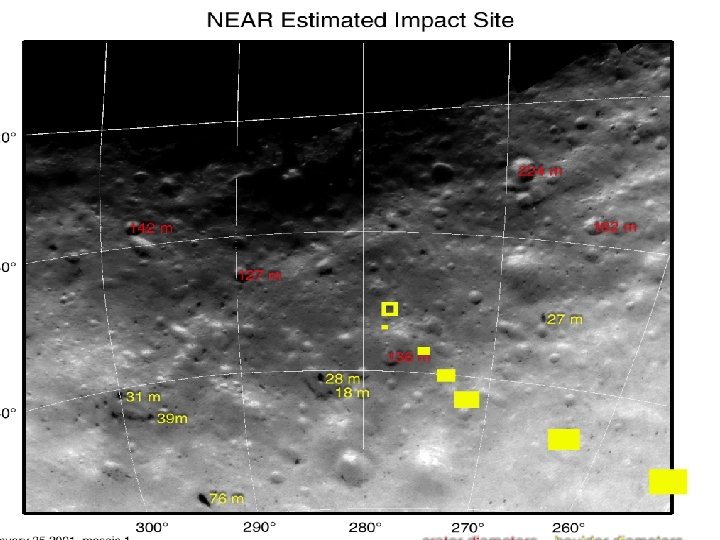
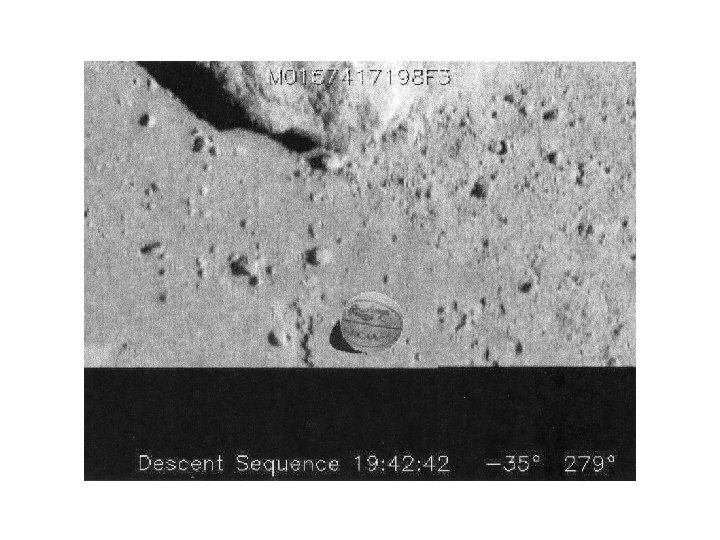
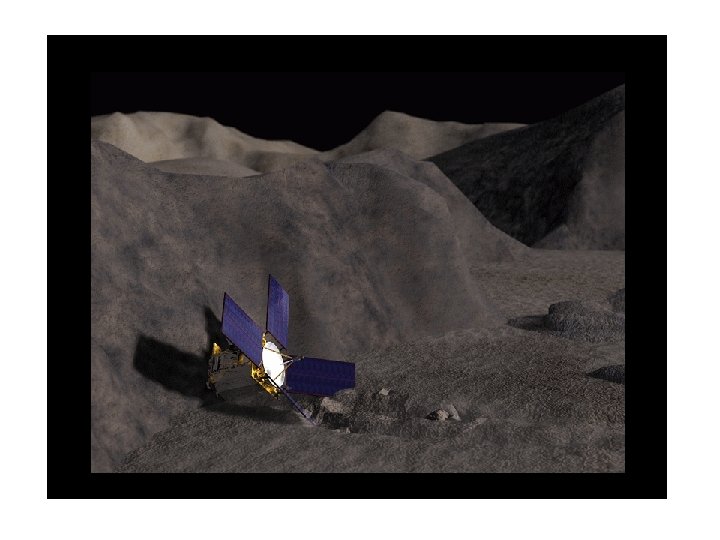
 Overview • Kinet. X and some administrative information • Attraction of the Sky – My early history, Occultations & Moonwatch • Libration Points – ISEE-3/ICE Mission; SOHO • Asteroids – NEAR Mission to Eros; Clementine • Work of the megagrant – extending human exploration and defense against hazardous objects • The US Team • A Historic Opportunity
 Kinet. X, Inc. FOUNDED 1992 IN CALIFORNIA HEADQUARTERS IN TEMPE, ARIZONA IRIDIUM NAVIGATION AND OPERATIONS IN 2003, SPACE NAVIGATION AND FLIGHT DYNAMICS (SNAFD) SECTION ESTABLISHED IN SIMI VALLEY, CALIF. BY SOME KEY MEMBERS OF THE JPL NAVIGATION SECTION WHO LEFT JPL SNAFD NAVIGATES MESSENGER (MERCURY ORBITER) AND NEW HORIZONS (MISSION TO PLUTO) – THE ENDS OF THE SOLAR SYSTEM! OTHER KINETX EMPLOYEES LIVE IN MARYLAND VIRGINA Page 3 I JOINED SNAFD IN 2009 TO PROVIDE TRAJECTORY
 US International Traffic in Arms Regulations (ITAR) • Technical Assistance Agreement (TAA) submitted to U. S. State Department on 28 October 2011 – It was approved “with provisos” on 12 January 2012 Page 4
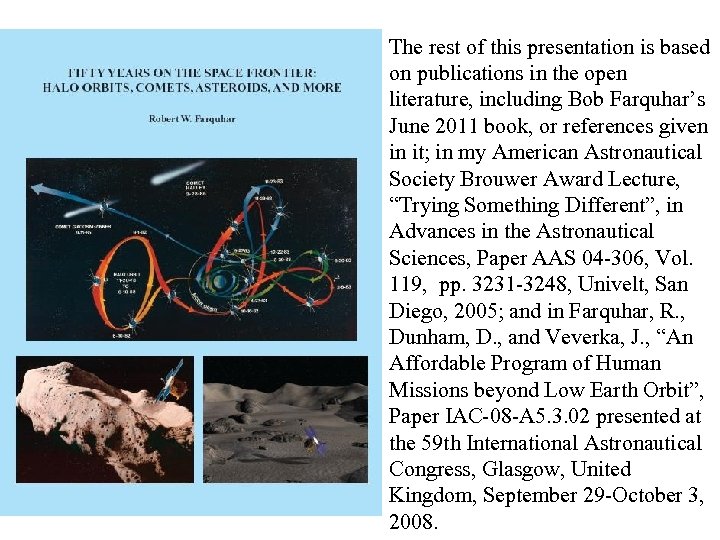 The rest of this presentation is based on publications in the open literature, including Bob Farquhar’s June 2011 book, or references given in it; in my American Astronautical Society Brouwer Award Lecture, “Trying Something Different”, in Advances in the Astronautical Sciences, Paper AAS 04 -306, Vol. 119, pp. 3231 -3248, Univelt, San Diego, 2005; and in Farquhar, R. , Dunham, D. , and Veverka, J. , “An Affordable Program of Human Missions beyond Low Earth Orbit”, Paper IAC-08 -A 5. 3. 02 presented at the 59 th International Astronautical Congress, Glasgow, United Kingdom, September 29 -October 3, 2008.
 Attraction of the Sky • My father worked on design for a modern fish harbor in Karachi, Pakistan 1954 -1955 • Desert Skies – I learned the Constellations • Oct. 29, 1957 - Capricorni/Moon Appulse • Moonwatch Project • Lunar Grazing Occultations • International Occultation Timing Association
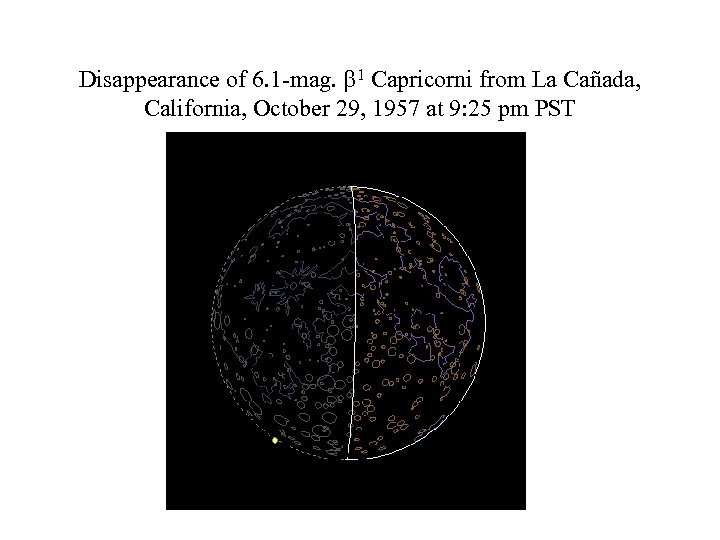 Disappearance of 6. 1 -mag. 1 Capricorni from La Cañada, California, October 29, 1957 at 9: 25 pm PST
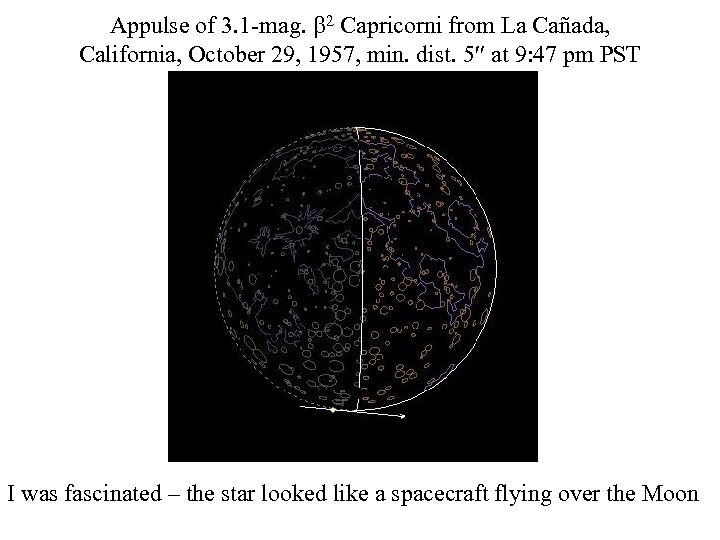 Appulse of 3. 1 -mag. 2 Capricorni from La Cañada, California, October 29, 1957, min. dist. 5 at 9: 47 pm PST I was fascinated – the star looked like a spacecraft flying over the Moon
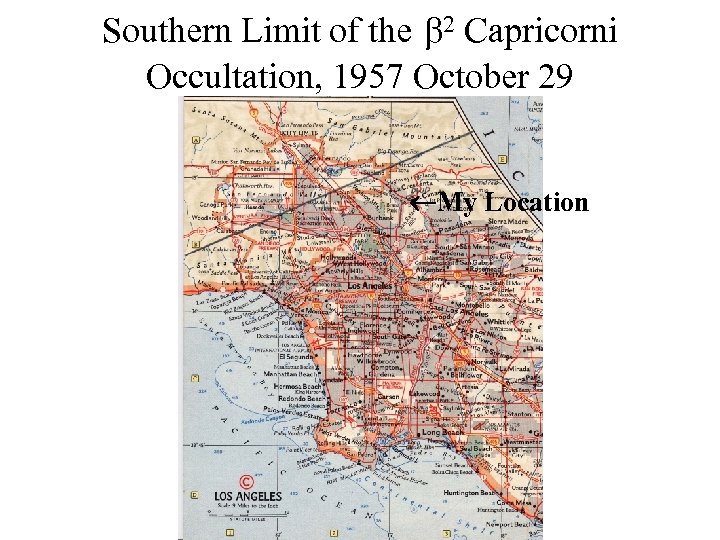 Southern Limit of the 2 Capricorni Occultation, 1957 October 29 My Location
 Lunar Grazing Occultations • First calculations in March 1962 for graze of Aldebaran south of San Jose, Calif. • First successful expedition, Len Kalish from Los Angeles to Castaic Junction, 1962 Sept. • First computer program written to calculate grazes using FORTRAN, late 1962 • My first success, 1963 March 31 near Roseville, Calif. , with Bruce Bowman, at this meeting • International Occultation Timing Association founded in 1975 • I observed a graze of 2 Cap with 12 others near Ashland, VA on 1977 June 5.
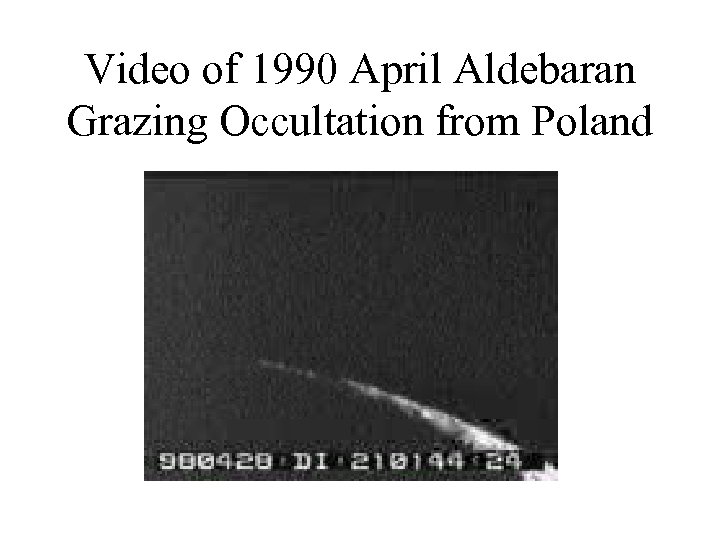 Video of 1990 April Aldebaran Grazing Occultation from Poland
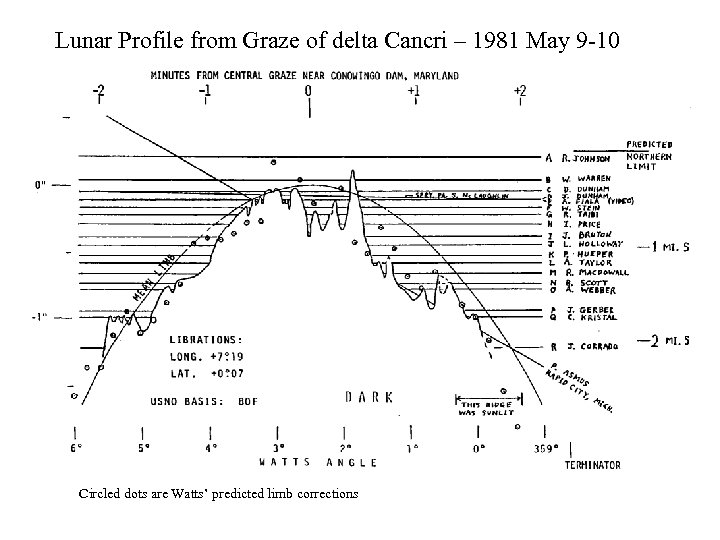 Lunar Profile from Graze of delta Cancri – 1981 May 9 -10 Circled dots are Watts’ predicted limb corrections
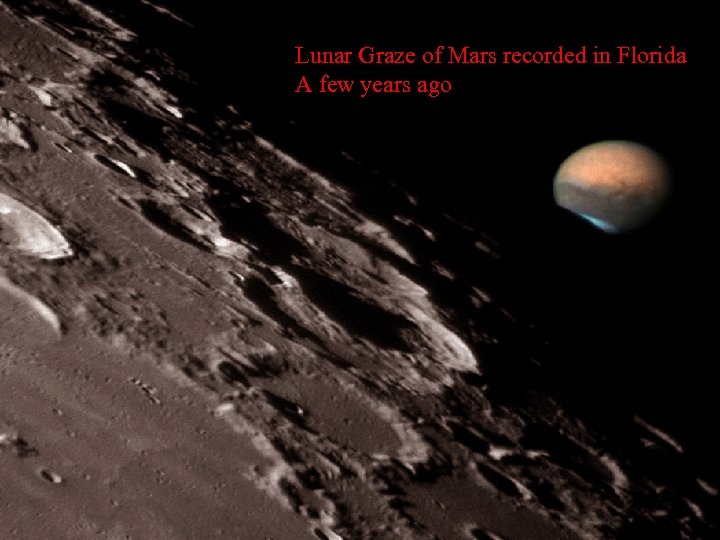 Lunar Graze of Mars recorded in Florida A few years ago
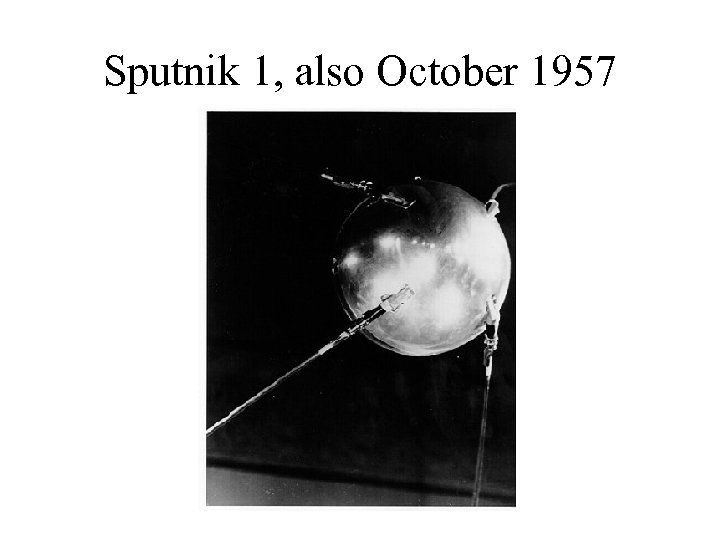 Sputnik 1, also October 1957
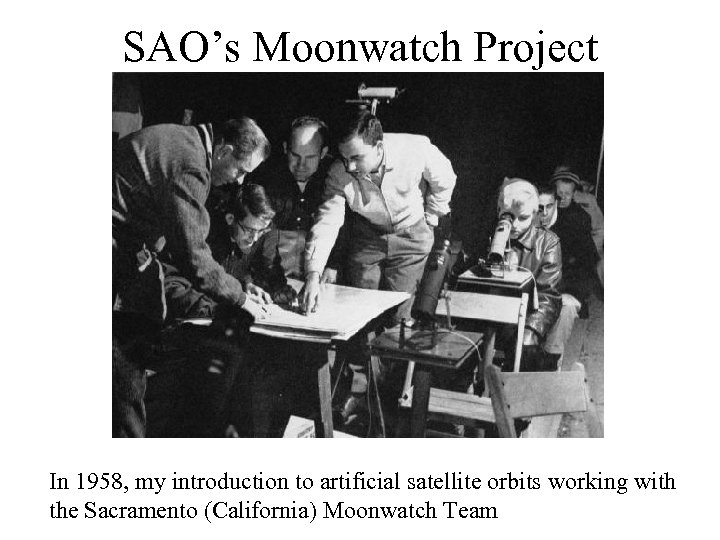 SAO’s Moonwatch Project In 1958, my introduction to artificial satellite orbits working with the Sacramento (California) Moonwatch Team
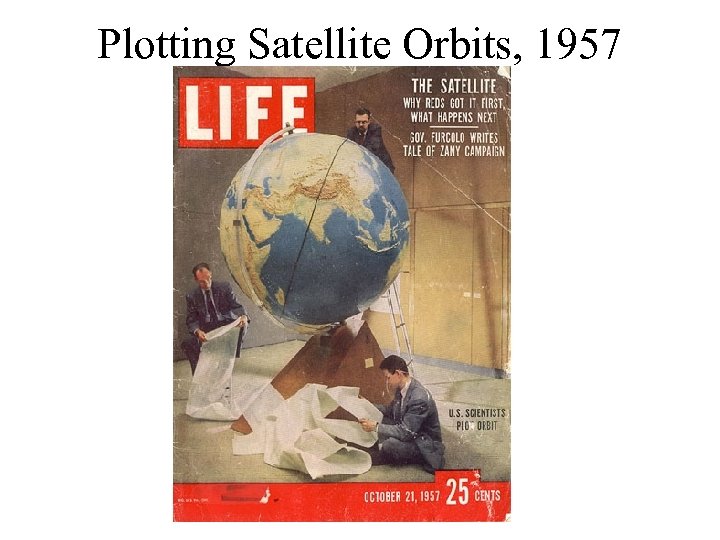 Plotting Satellite Orbits, 1957
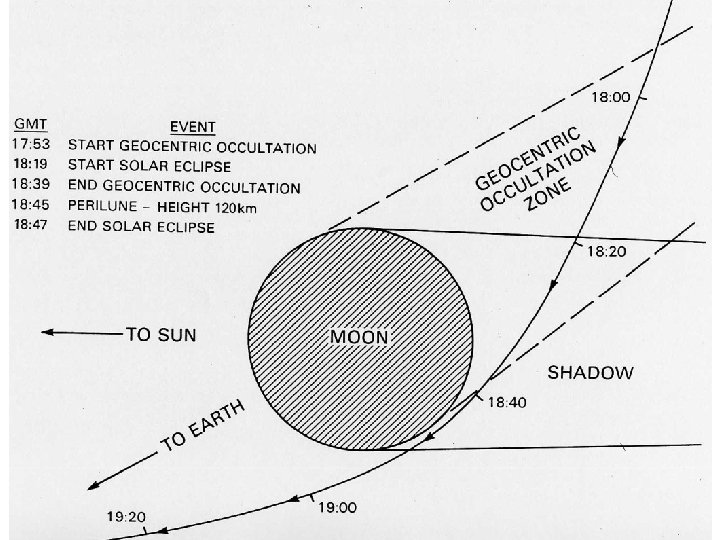
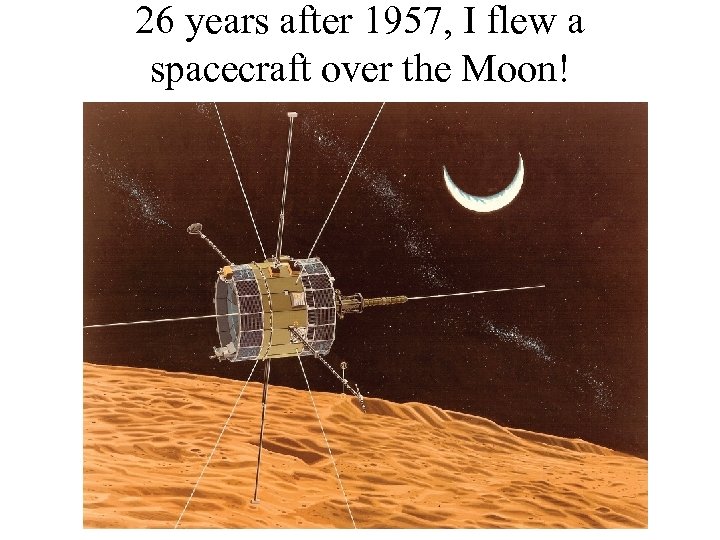 26 years after 1957, I flew a spacecraft over the Moon!
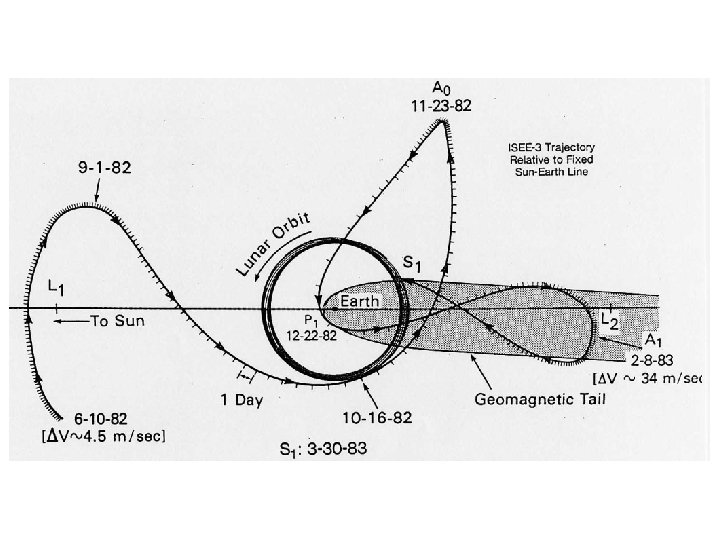
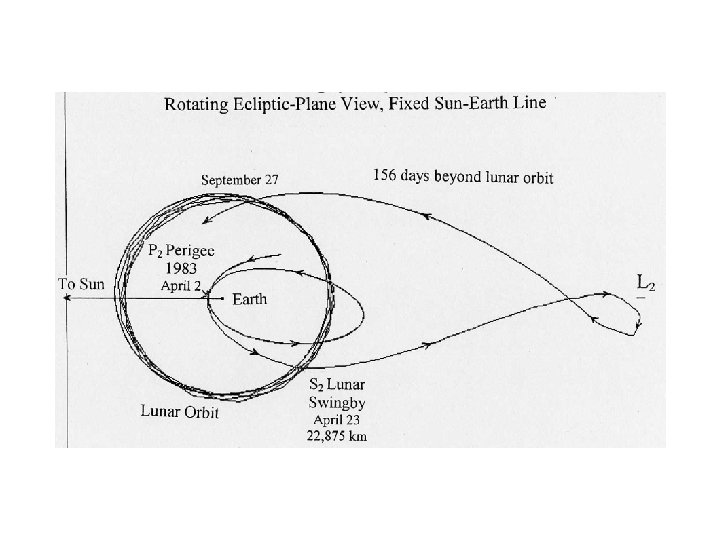
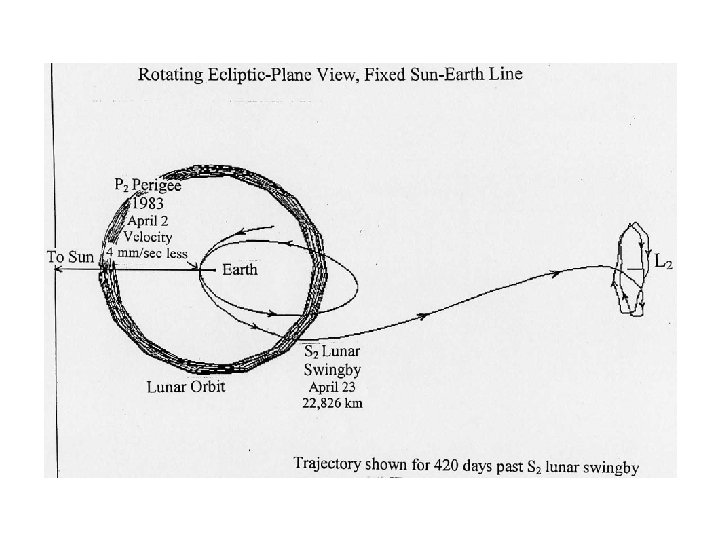
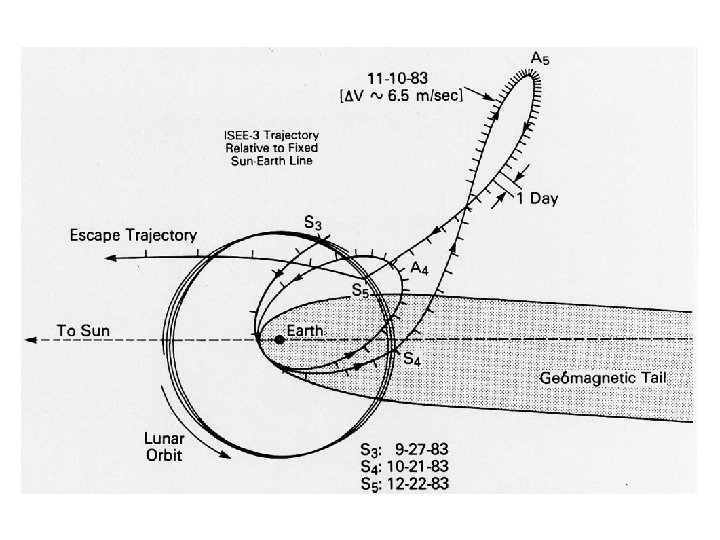
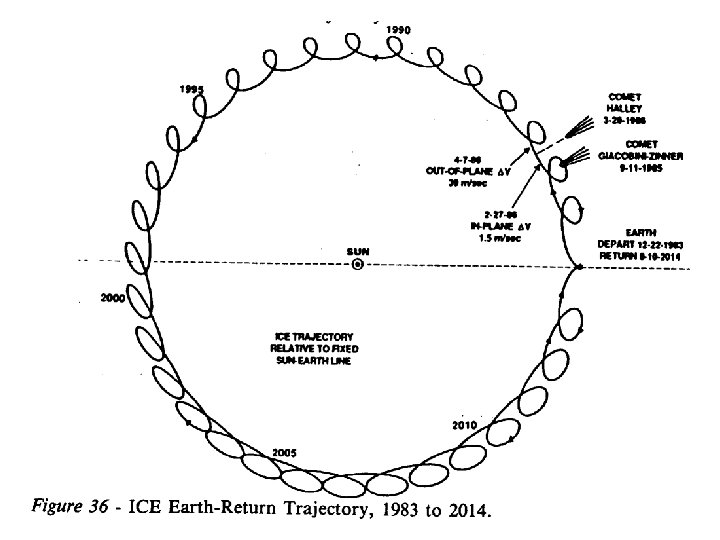
 International Sun-Earth Explorer 3/ International Cometary Explorer • • First Libration-Point Mission Finding a Way to Giacobini-Zinner – Double Lunar Swingby Orbits Printer Plots of the trajectories An Unused Trajectory to L 2 September 11, 1985 – the first comet flyby Earth return in 2014 – more than halfway
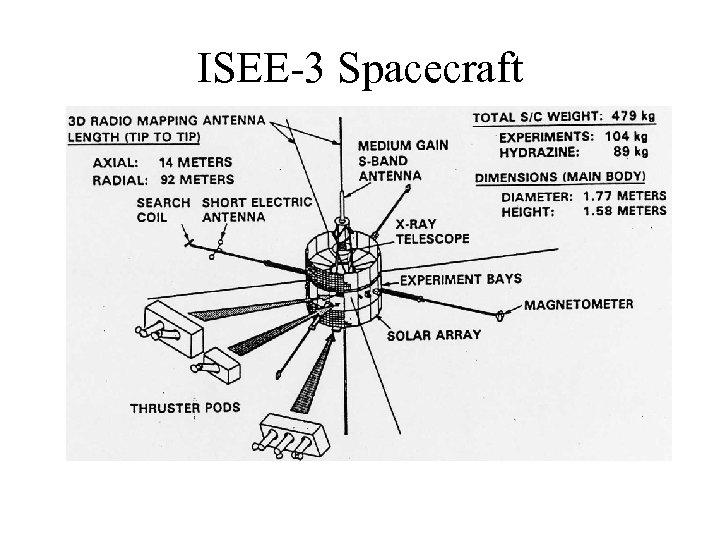 ISEE-3 Spacecraft
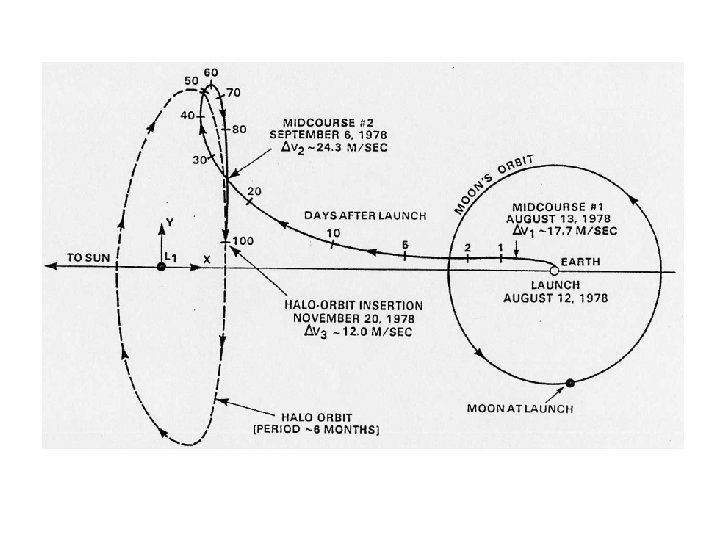
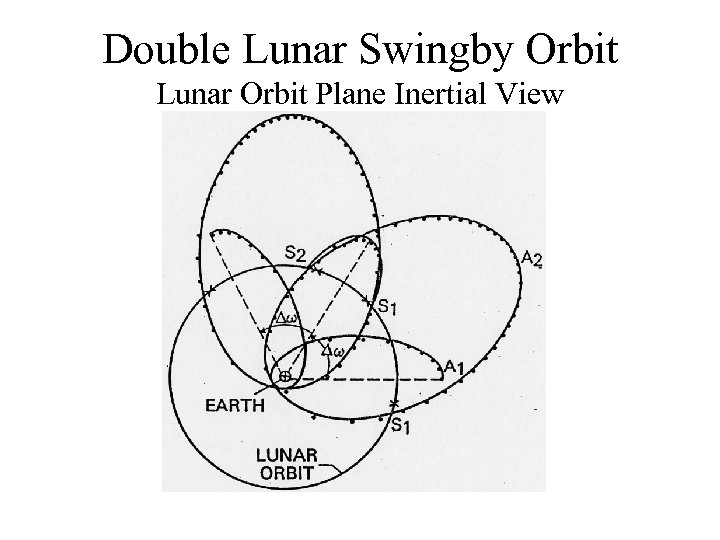 Double Lunar Swingby Orbit Lunar Orbit Plane Inertial View
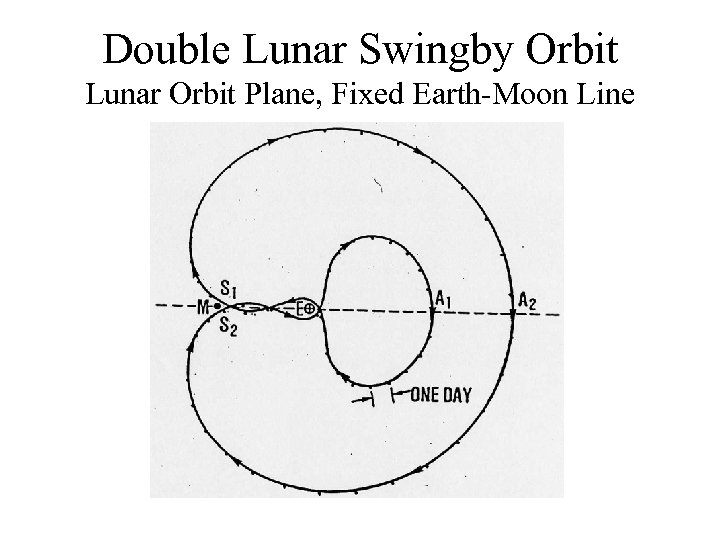 Double Lunar Swingby Orbit Lunar Orbit Plane, Fixed Earth-Moon Line
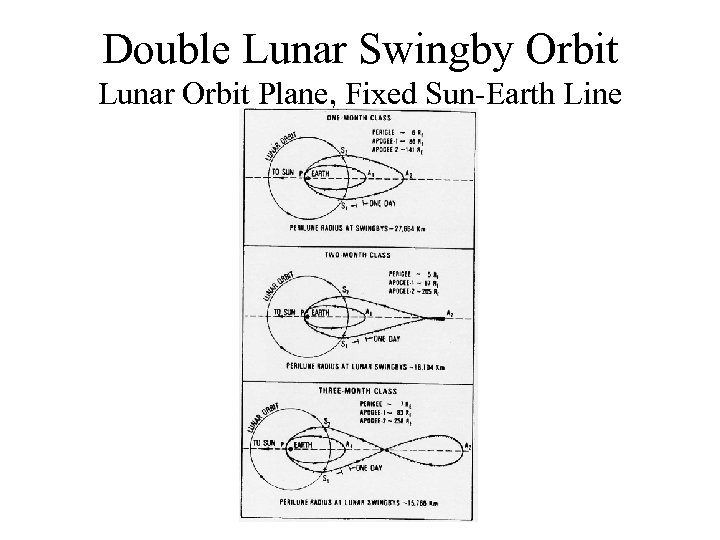 Double Lunar Swingby Orbit Lunar Orbit Plane, Fixed Sun-Earth Line
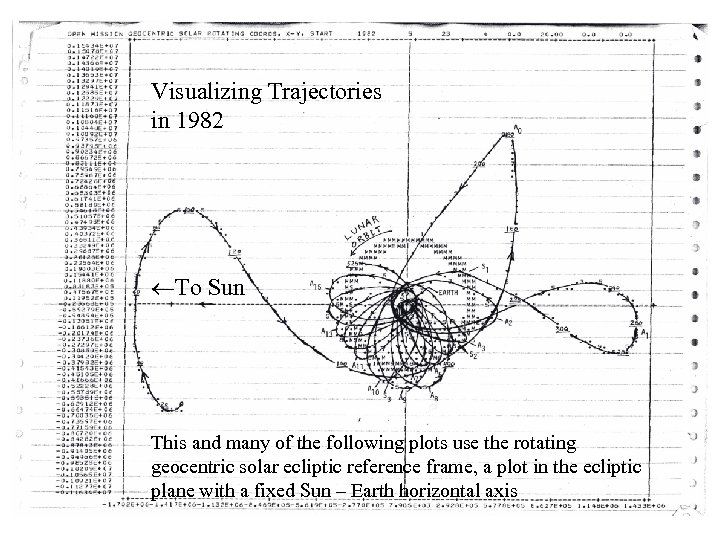 Visualizing Trajectories in 1982 To Sun This and many of the following plots use the rotating geocentric solar ecliptic reference frame, a plot in the ecliptic plane with a fixed Sun – Earth horizontal axis
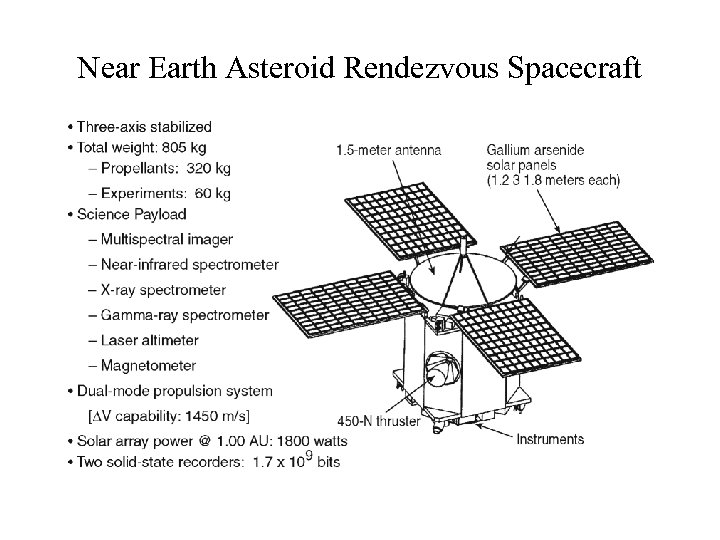 Near Earth Asteroid Rendezvous Spacecraft
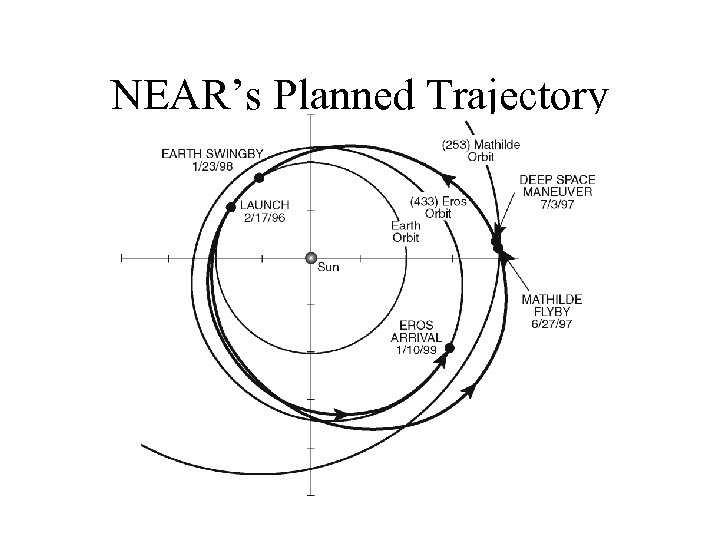 NEAR’s Planned Trajectory
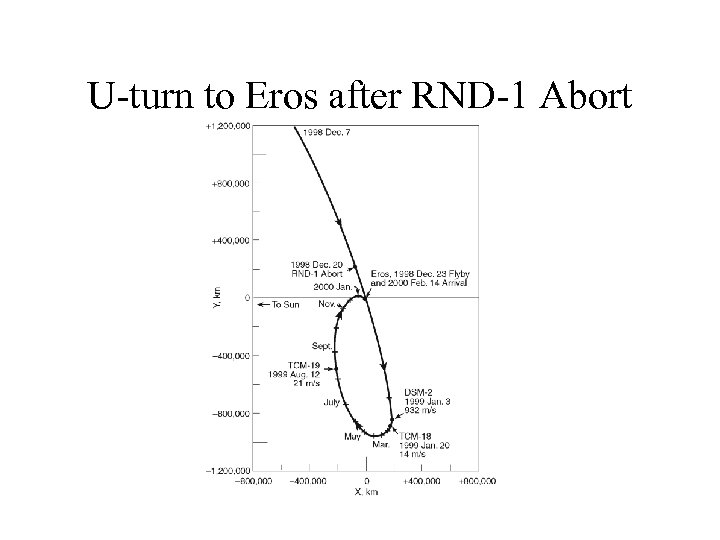 U-turn to Eros after RND-1 Abort
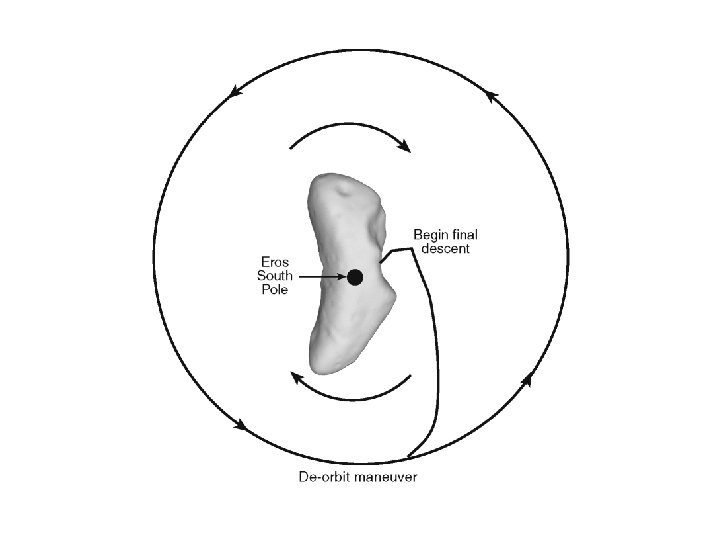
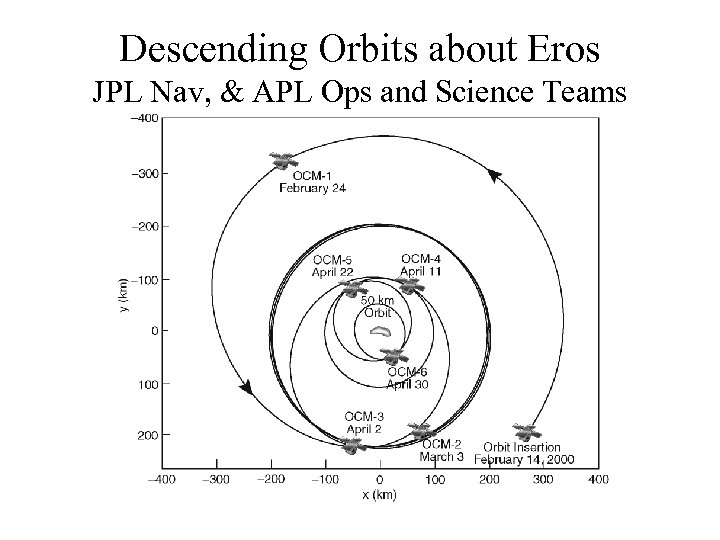 Descending Orbits about Eros JPL Nav, & APL Ops and Science Teams
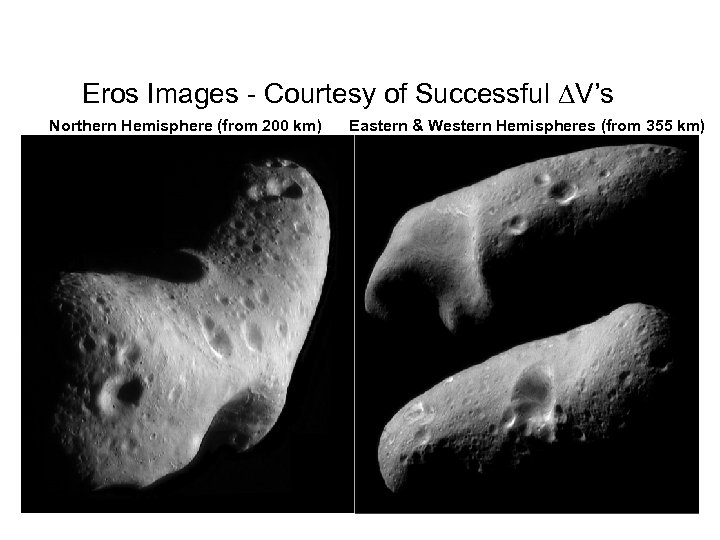 Eros Images - Courtesy of Successful V’s Northern Hemisphere (from 200 km) Eastern & Western Hemispheres (from 355 km)
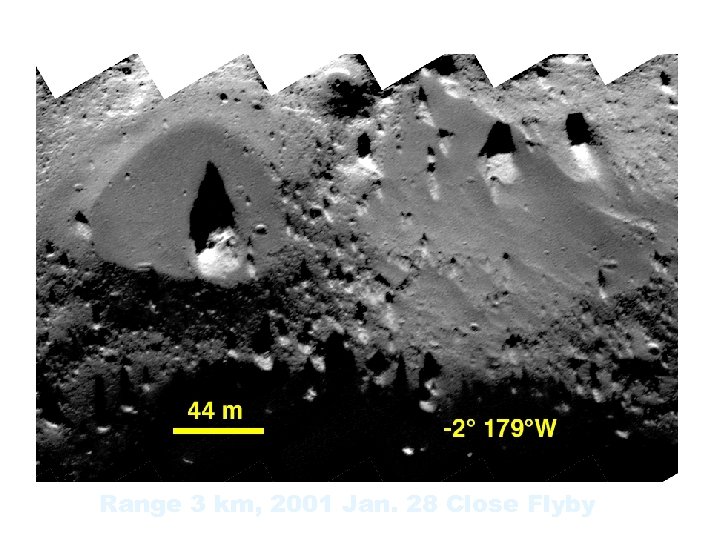 Range 3 km, 2001 Jan. 28 Close Flyby
 Overview • “Megagrant” received from the Russian Ministry of Education and Science to study orbital options for human exploration and planetary protection during 2012 -2013; I am required to be at MIEM at least 4 months of each year • Laboratory at MIEM, completed this month • Stepping Stone approach to exploration with reusable vehicles
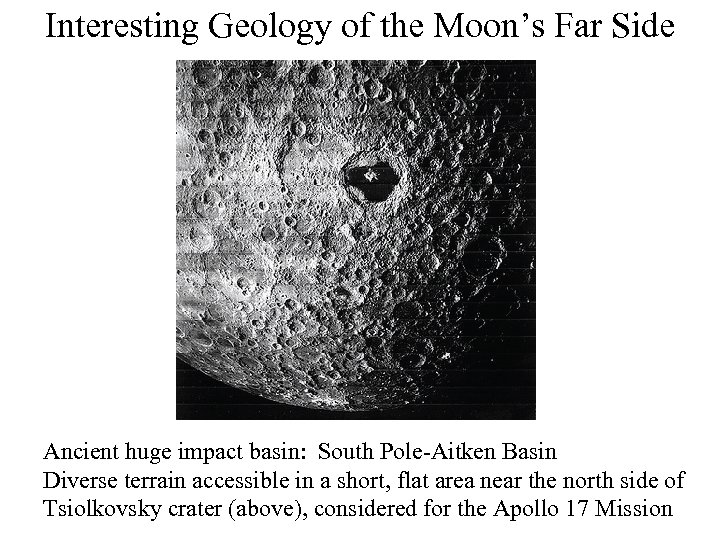 Interesting Geology of the Moon’s Far Side Ancient huge impact basin: South Pole-Aitken Basin Diverse terrain accessible in a short, flat area near the north side of Tsiolkovsky crater (above), considered for the Apollo 17 Mission
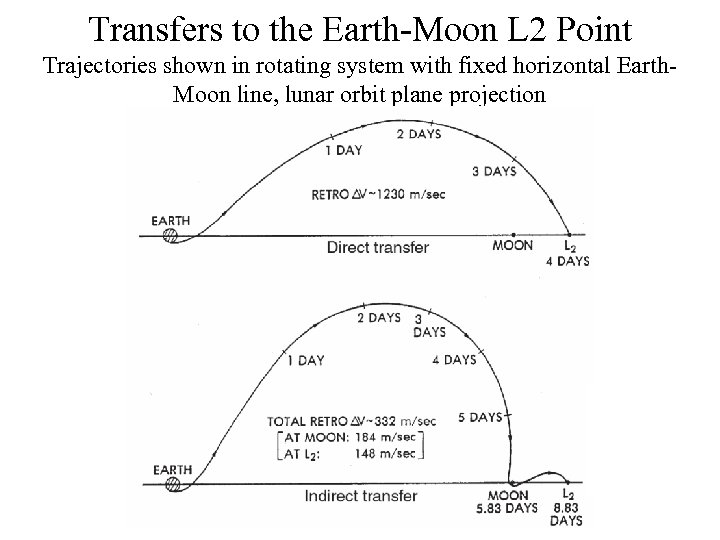 Transfers to the Earth-Moon L 2 Point Trajectories shown in rotating system with fixed horizontal Earth. Moon line, lunar orbit plane projection
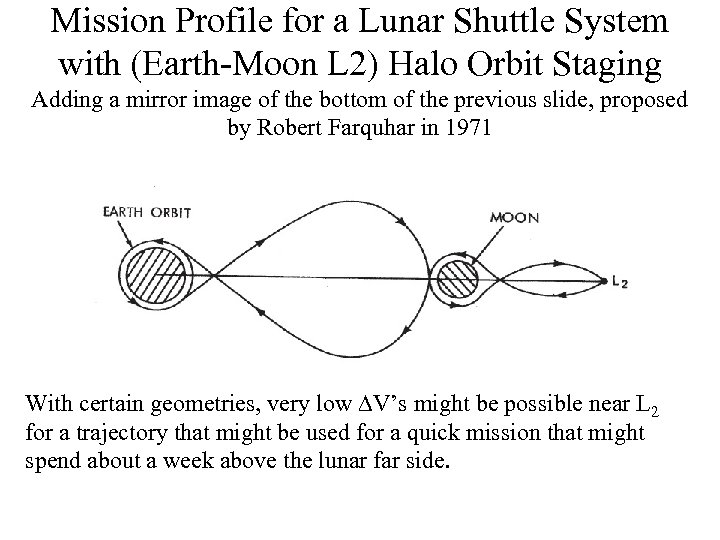 Mission Profile for a Lunar Shuttle System with (Earth-Moon L 2) Halo Orbit Staging Adding a mirror image of the bottom of the previous slide, proposed by Robert Farquhar in 1971 With certain geometries, very low V’s might be possible near L 2 for a trajectory that might be used for a quick mission that might spend about a week above the lunar far side.
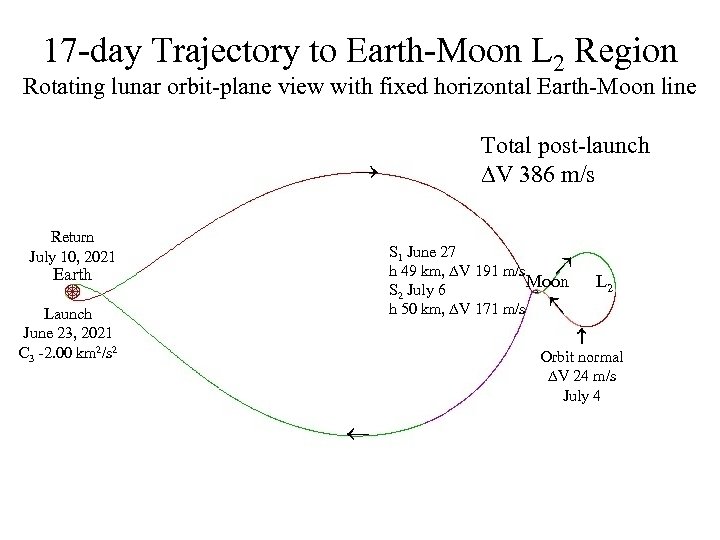 17 -day Trajectory to Earth-Moon L 2 Region Rotating lunar orbit-plane view with fixed horizontal Earth-Moon line Return July 10, 2021 Total post-launch V 386 m/s S 1 June 27 h 49 km, V 191 m/s Moon S 2 July 6 h 50 km, V 171 m/s Earth L 2 Launch June 23, 2021 C 3 -2. 00 km 2/s 2 Orbit normal V 24 m/s July 4
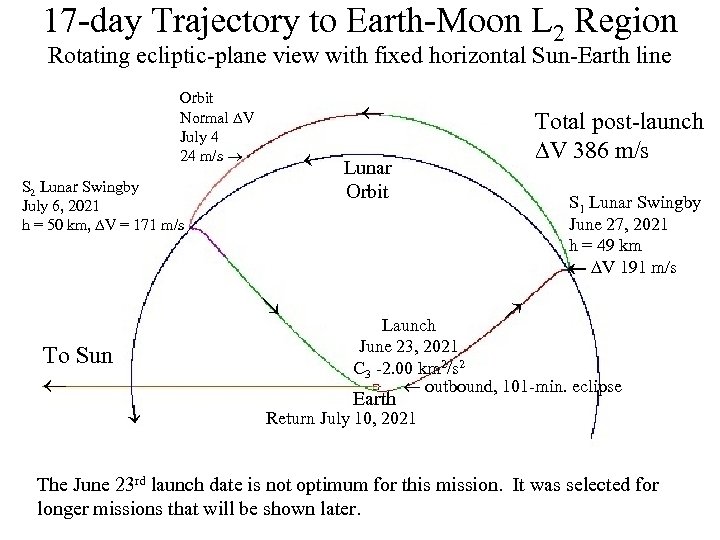 17 -day Trajectory to Earth-Moon L 2 Region Rotating ecliptic-plane view with fixed horizontal Sun-Earth line Orbit Normal V July 4 24 m/s Lunar S 2 Lunar Swingby July 6, 2021 h = 50 km, V = 171 m/s Orbit To Sun Total post-launch V 386 m/s S 1 Lunar Swingby June 27, 2021 h = 49 km V 191 m/s Launch June 23, 2021 C 3 -2. 00 km 2/s 2 outbound, 101 -min. eclipse Earth Return July 10, 2021 The June 23 rd launch date is not optimum for this mission. It was selected for longer missions that will be shown later.
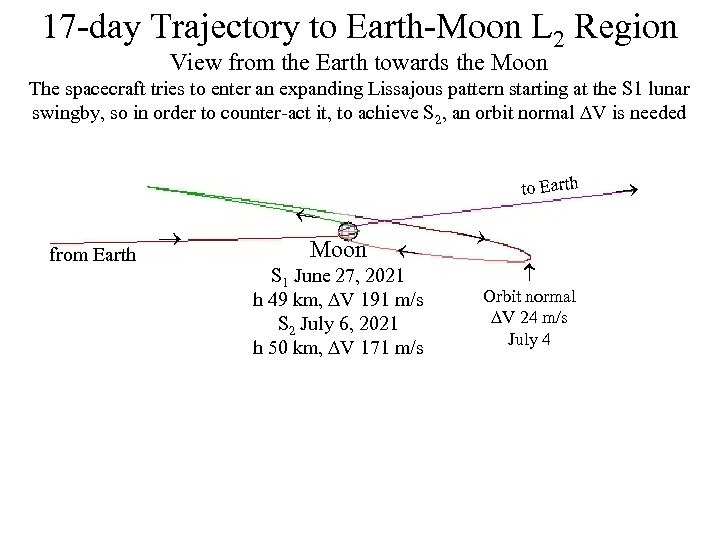 17 -day Trajectory to Earth-Moon L 2 Region View from the Earth towards the Moon The spacecraft tries to enter an expanding Lissajous pattern starting at the S 1 lunar swingby, so in order to counter-act it, to achieve S 2, an orbit normal V is needed from Earth to Earth Moon S 1 June 27, 2021 h 49 km, V 191 m/s S 2 July 6, 2021 h 50 km, V 171 m/s Orbit normal V 24 m/s July 4
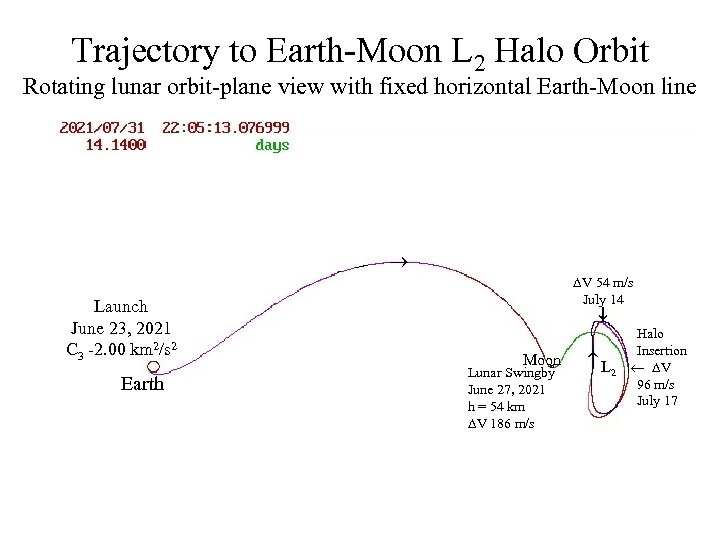 Trajectory to Earth-Moon L 2 Halo Orbit Rotating lunar orbit-plane view with fixed horizontal Earth-Moon line Launch June 23, 2021 C 3 -2. 00 km 2/s 2 Earth V 54 m/s July 14 Moon Lunar Swingby June 27, 2021 h = 54 km V 186 m/s L 2 Halo Insertion V 96 m/s July 17
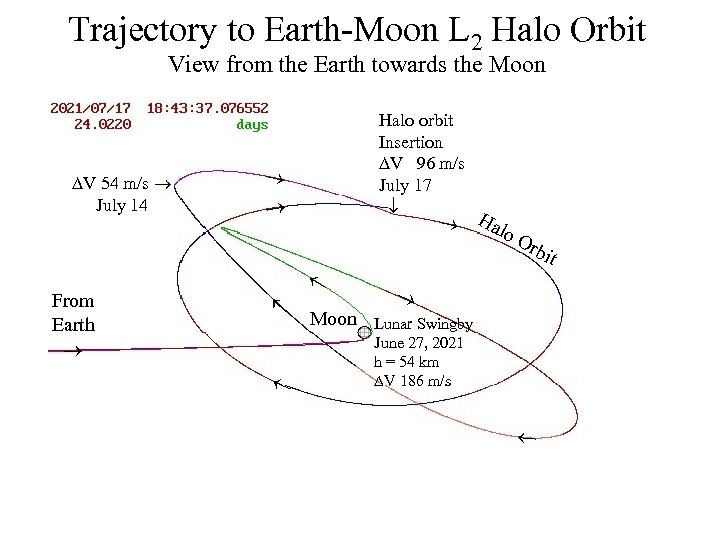 Trajectory to Earth-Moon L 2 Halo Orbit View from the Earth towards the Moon V 54 m/s July 14 From Earth Halo orbit Insertion V 96 m/s July 17 Moon Ha lo O rbi Lunar Swingby June 27, 2021 h = 54 km V 186 m/s t
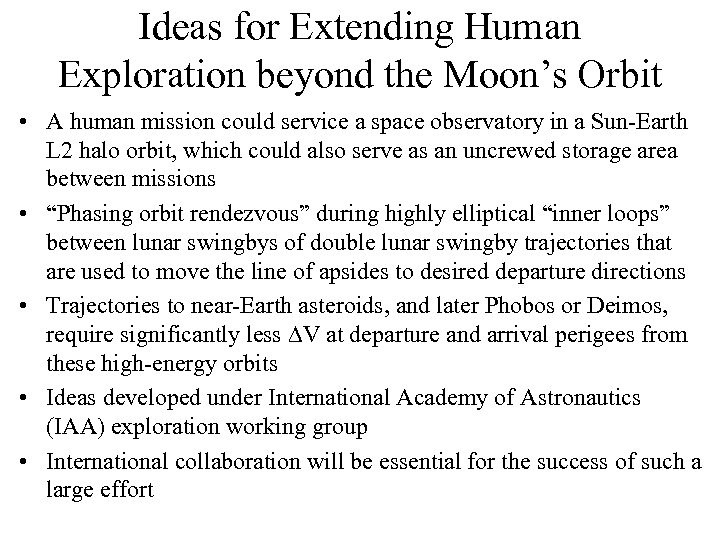 Ideas for Extending Human Exploration beyond the Moon’s Orbit • A human mission could service a space observatory in a Sun-Earth L 2 halo orbit, which could also serve as an uncrewed storage area between missions • “Phasing orbit rendezvous” during highly elliptical “inner loops” between lunar swingbys of double lunar swingby trajectories that are used to move the line of apsides to desired departure directions • Trajectories to near-Earth asteroids, and later Phobos or Deimos, require significantly less V at departure and arrival perigees from these high-energy orbits • Ideas developed under International Academy of Astronautics (IAA) exploration working group • International collaboration will be essential for the success of such a large effort
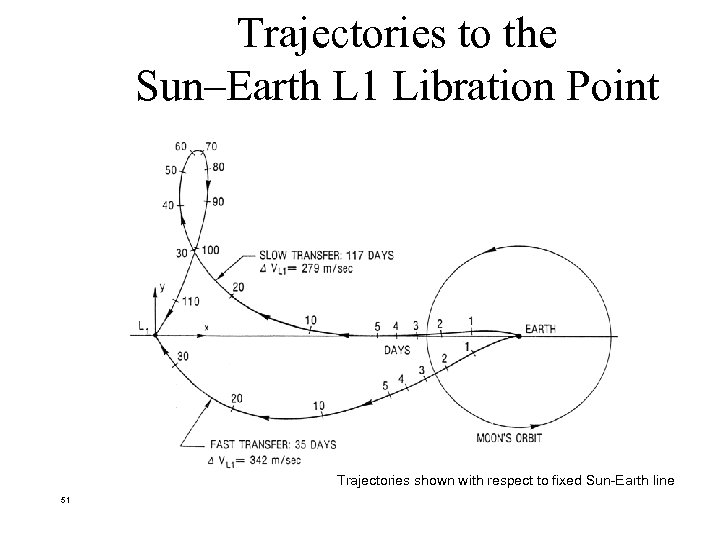 Trajectories to the Sun–Earth L 1 Libration Point Trajectories shown with respect to fixed Sun-Earth line 51
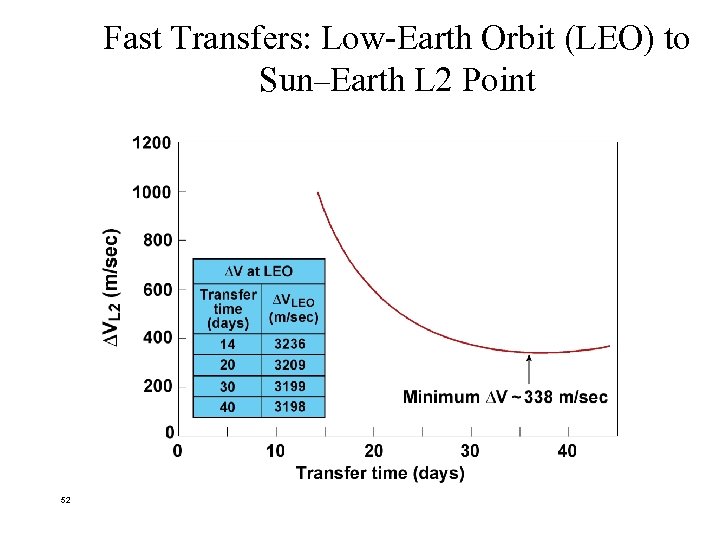 Fast Transfers: Low-Earth Orbit (LEO) to Sun–Earth L 2 Point 52
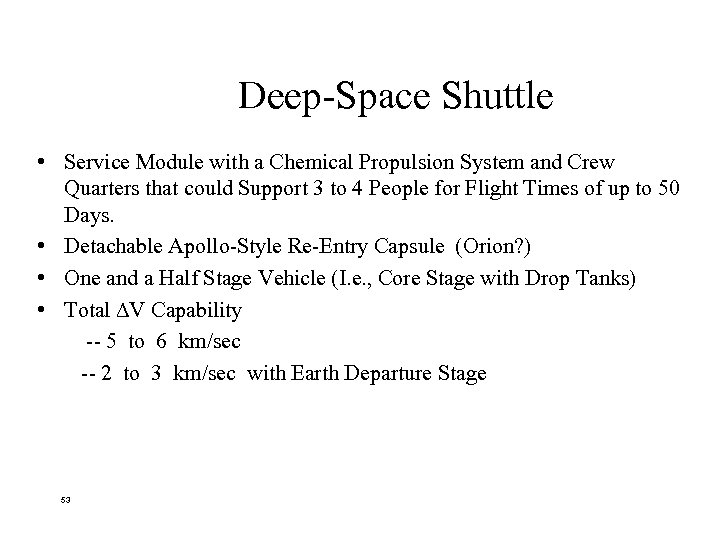 Deep-Space Shuttle • Service Module with a Chemical Propulsion System and Crew Quarters that could Support 3 to 4 People for Flight Times of up to 50 Days. • Detachable Apollo-Style Re-Entry Capsule (Orion? ) • One and a Half Stage Vehicle (I. e. , Core Stage with Drop Tanks) • Total ∆V Capability -- 5 to 6 km/sec -- 2 to 3 km/sec with Earth Departure Stage 53
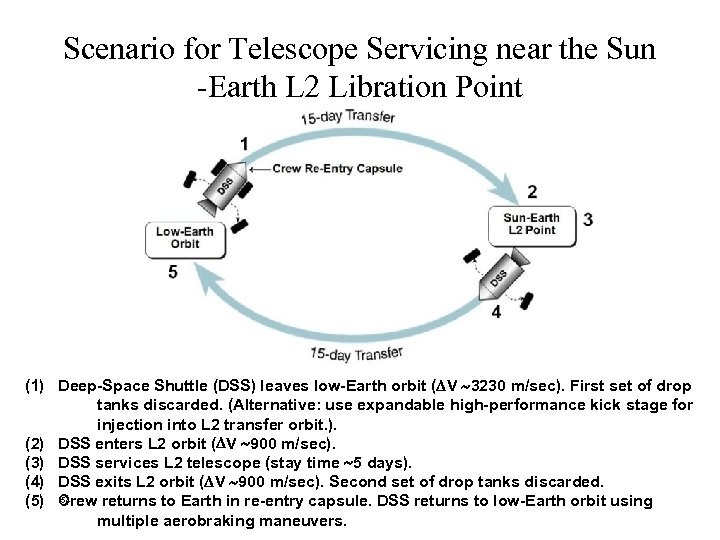 Scenario for Telescope Servicing near the Sun -Earth L 2 Libration Point (1) Deep-Space Shuttle (DSS) leaves low-Earth orbit ( V 3230 m/sec). First set of drop tanks discarded. (Alternative: use expandable high-performance kick stage for injection into L 2 transfer orbit. ). (2) DSS enters L 2 orbit ( V 900 m/sec). (3) DSS services L 2 telescope (stay time 5 days). (4) DSS exits L 2 orbit ( V 900 m/sec). Second set of drop tanks discarded. 54 (5) Crew returns to Earth in re-entry capsule. DSS returns to low-Earth orbit using multiple aerobraking maneuvers.
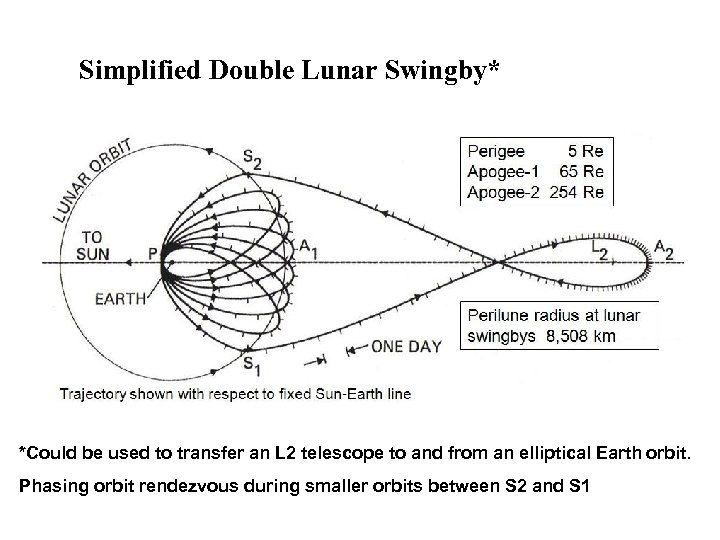 Simplified Double Lunar Swingby* *Could be used to transfer an L 2 telescope to and from an elliptical Earth orbit. Phasing orbit rendezvous during smaller orbits between S 2 and S 1
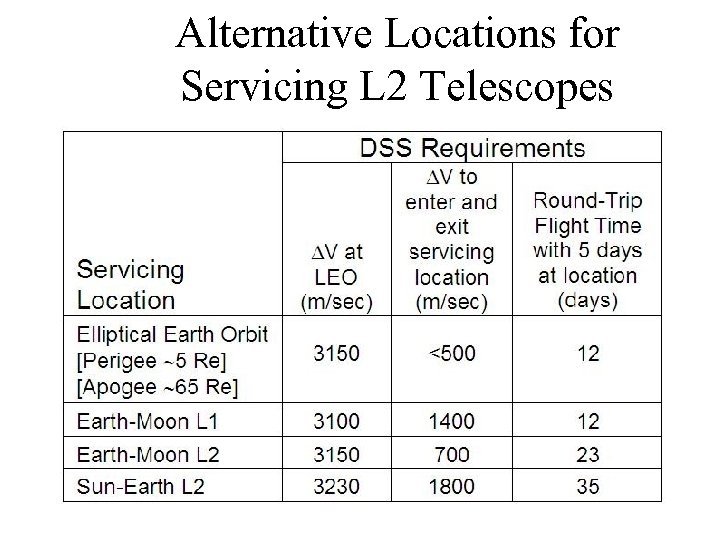 Alternative Locations for Servicing L 2 Telescopes 56
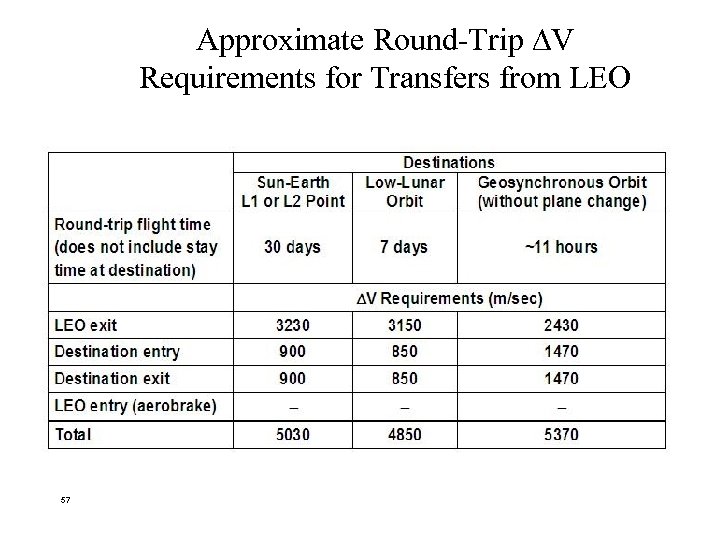 Approximate Round-Trip V Requirements for Transfers from LEO 57
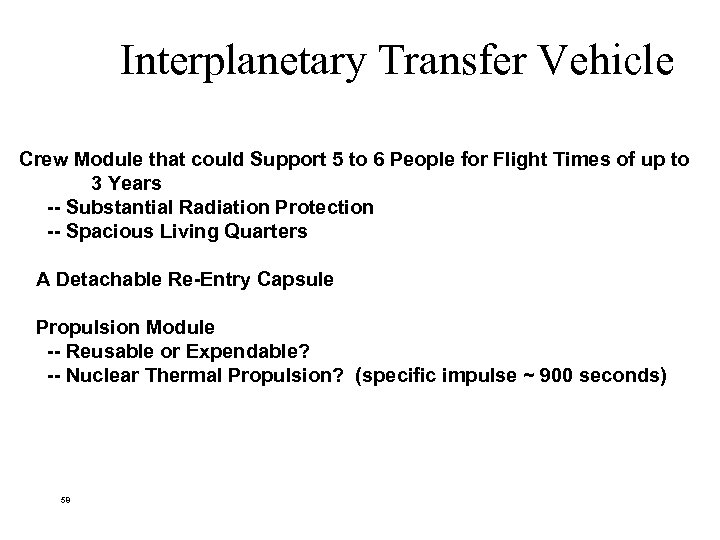 Interplanetary Transfer Vehicle Crew Module that could Support 5 to 6 People for Flight Times of up to 3 Years -- Substantial Radiation Protection -- Spacious Living Quarters A Detachable Re-Entry Capsule Propulsion Module -- Reusable or Expendable? -- Nuclear Thermal Propulsion? (specific impulse ~ 900 seconds) 58
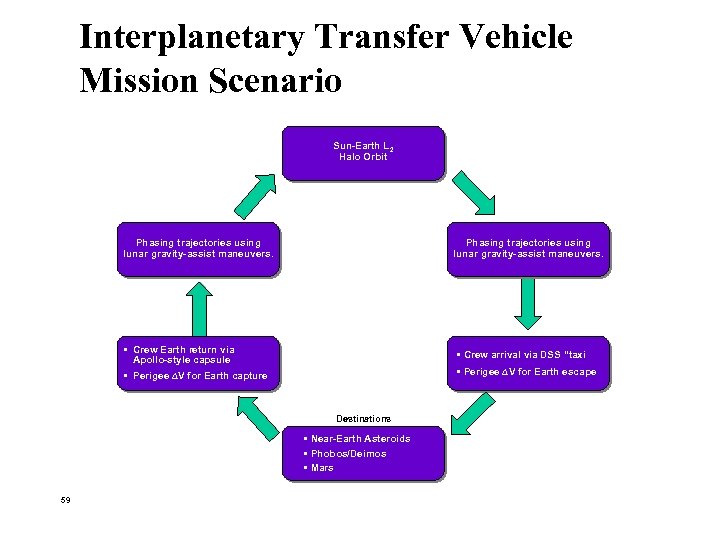 Interplanetary Transfer Vehicle Mission Scenario Sun-Earth L 2 Halo Orbit Phasing trajectories using lunar gravity-assist maneuvers. • Crew Earth return via Apollo-style capsule • Perigee ∆V for Earth capture • Crew arrival via DSS “taxi • Perigee ∆V for Earth escape Destinations • Near-Earth Asteroids • Phobos/Deimos • Mars 59
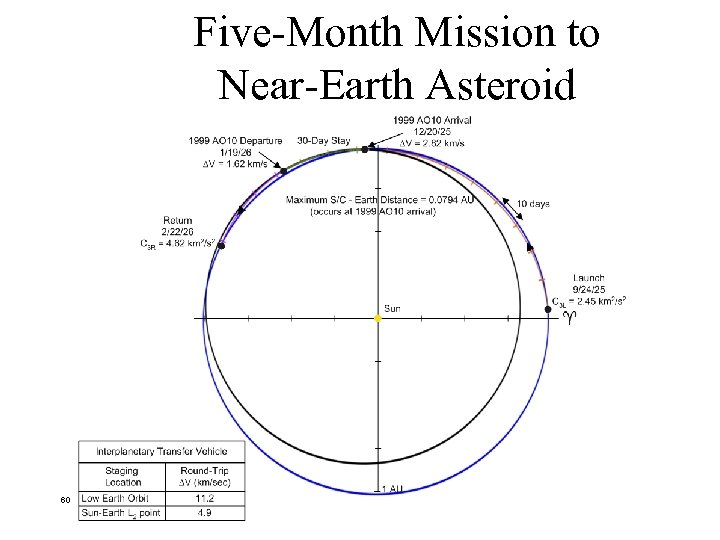 Five-Month Mission to Near-Earth Asteroid 60
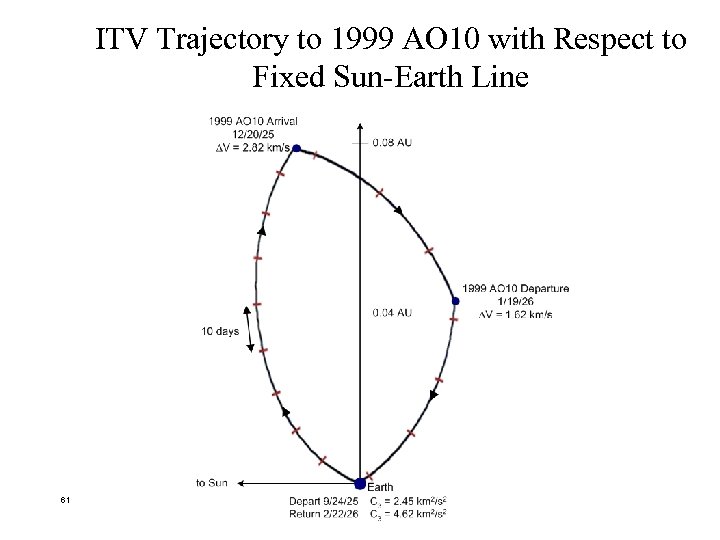 ITV Trajectory to 1999 AO 10 with Respect to Fixed Sun-Earth Line 61
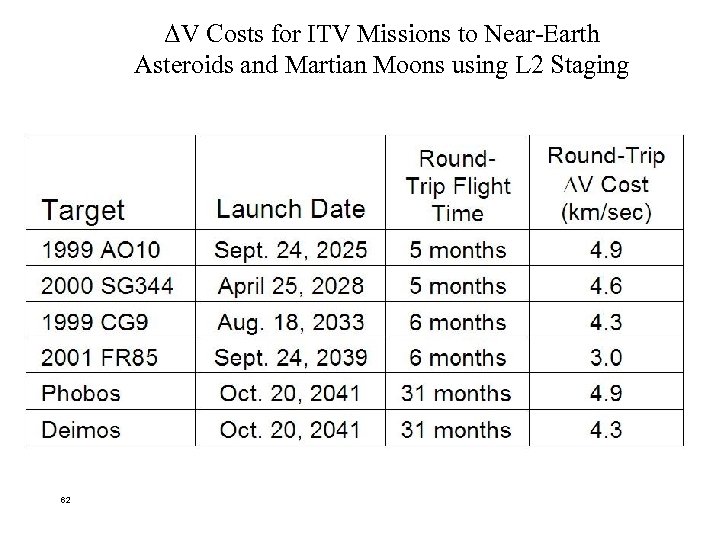 ΔV Costs for ITV Missions to Near-Earth Asteroids and Martian Moons using L 2 Staging 62
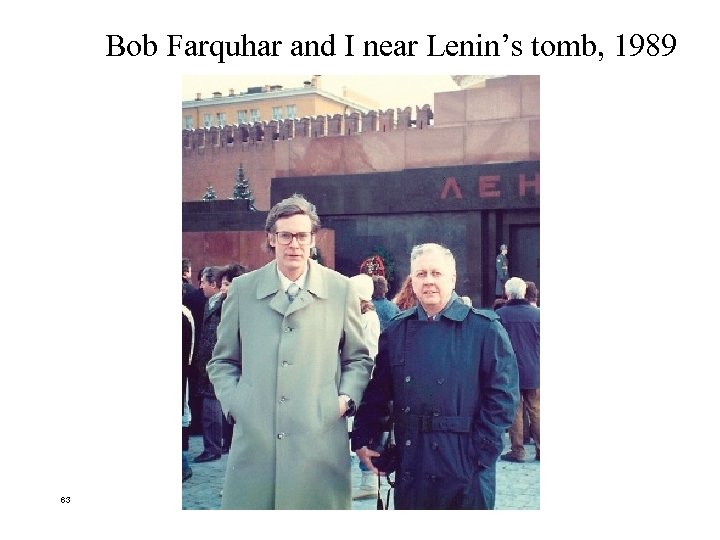 Bob Farquhar and I near Lenin’s tomb, 1989 63
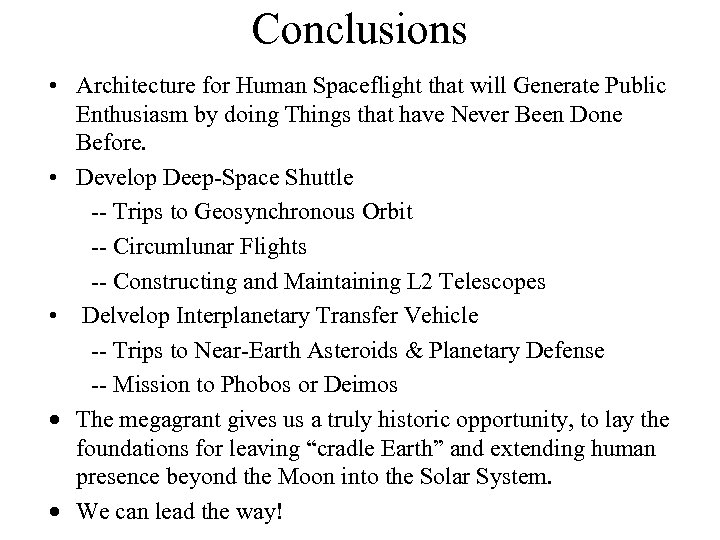 Conclusions • Architecture for Human Spaceflight that will Generate Public Enthusiasm by doing Things that have Never Been Done Before. • Develop Deep-Space Shuttle -- Trips to Geosynchronous Orbit -- Circumlunar Flights -- Constructing and Maintaining L 2 Telescopes • Delvelop Interplanetary Transfer Vehicle -- Trips to Near-Earth Asteroids & Planetary Defense -- Mission to Phobos or Deimos The megagrant gives us a truly historic opportunity, to lay the foundations for leaving “cradle Earth” and extending human presence beyond the Moon into the Solar System. We can lead the way!