 Скачать презентацию Starbucks Case Ordabayev Saniyaz 20142321 Agenda Mission
starbuckscasestudy-140203151109-phpapp01.pptx
- Количество слайдов: 32



Starbucks Case Ordabayev Saniyaz 20142321
Agenda Mission Statement Background Starbucks’ original vision in 1987 The evolution of Starbucks from 1991 -2008 Worldwide expansion from 20002001 Transformation of Starbucks with return of Schultz 2008 -2012 Financial Statements Evolution of Strategic Vision Broad Differentiation Teavana Video: Howard Schultz on Teavana Employee Training Starbucks Culture Community Service Ethical Sourcing Purchasing Coffee Beans Quality Control Lean 2012 Issues Facing Management Conclusion
Mission Statement To inspire and nurture the human spirit – one person, one cup and one neighborhood at a time
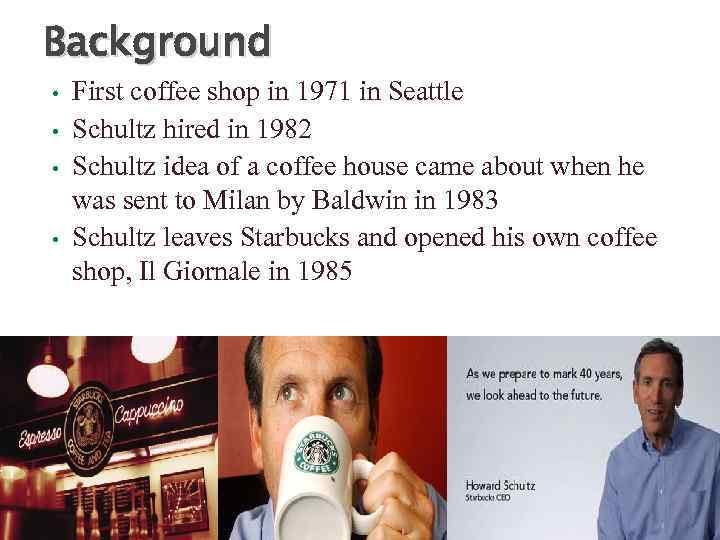
Background • • First coffee shop in 1971 in Seattle Schultz hired in 1982 Schultz idea of a coffee house came about when he was sent to Milan by Baldwin in 1983 Schultz leaves Starbucks and opened his own coffee shop, Il Giornale in 1985
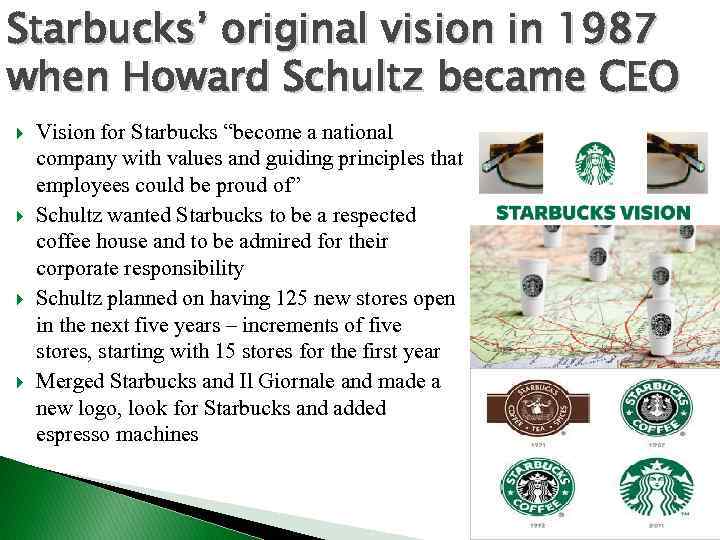
Starbucks’ original vision in 1987 when Howard Schultz became CEO Vision for Starbucks “become a national company with values and guiding principles that employees could be proud of” Schultz wanted Starbucks to be a respected coffee house and to be admired for their corporate responsibility Schultz planned on having 125 new stores open in the next five years – increments of five stores, starting with 15 stores for the first year Merged Starbucks and Il Giornale and made a new logo, look for Starbucks and added espresso machines
The evolution of the vision from 1991 to 2008 Entered California: Los Angeles, then S. F. Exceeded opening 125 stores, opened 161 by year 1992 Part-Time employee (20 hours+) receive health benefits Employees became partners Starbucks initial public offering in first year was most successful of IPO of the year Product line grew, joint ventures happened, licensed stores in areas from airlines, hotels, airports, etc.
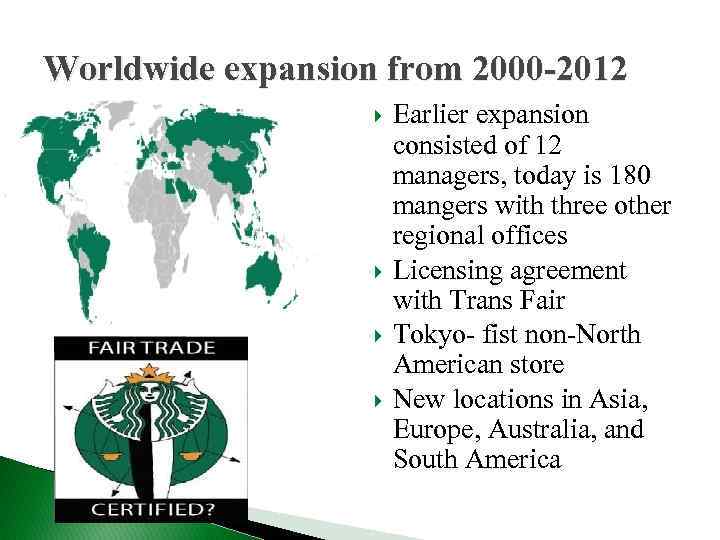
Worldwide expansion from 2000 -2012 Earlier expansion consisted of 12 managers, today is 180 mangers with three other regional offices Licensing agreement with Trans Fair Tokyo- fist non-North American store New locations in Asia, Europe, Australia, and South America
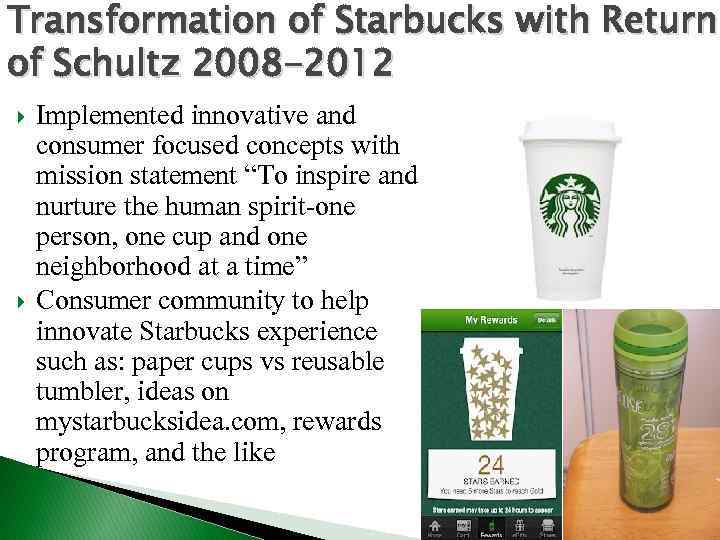
Transformation of Starbucks with Return of Schultz 2008 -2012 Implemented innovative and consumer focused concepts with mission statement “To inspire and nurture the human spirit-one person, one cup and one neighborhood at a time” Consumer community to help innovate Starbucks experience such as: paper cups vs reusable tumbler, ideas on mystarbucksidea. com, rewards program, and the like
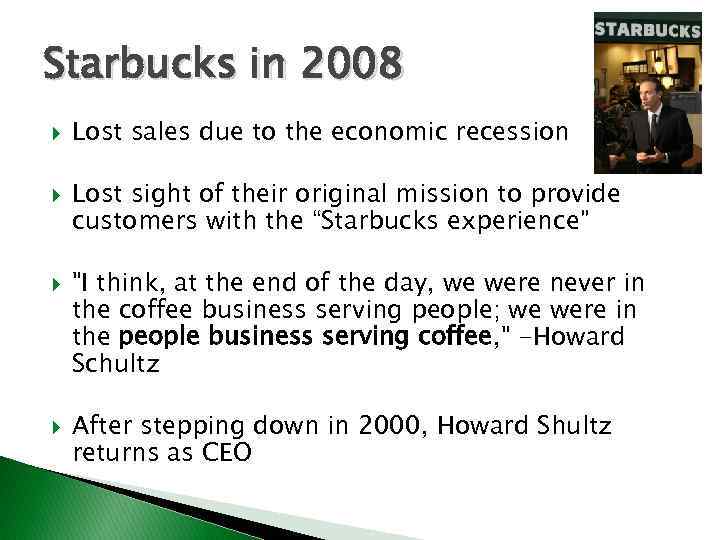
Starbucks in 2008 Lost sales due to the economic recession Lost sight of their original mission to provide customers with the “Starbucks experience” "I think, at the end of the day, we were never in the coffee business serving people; we were in the people business serving coffee, " -Howard Schultz After stepping down in 2000, Howard Shultz returns as CEO
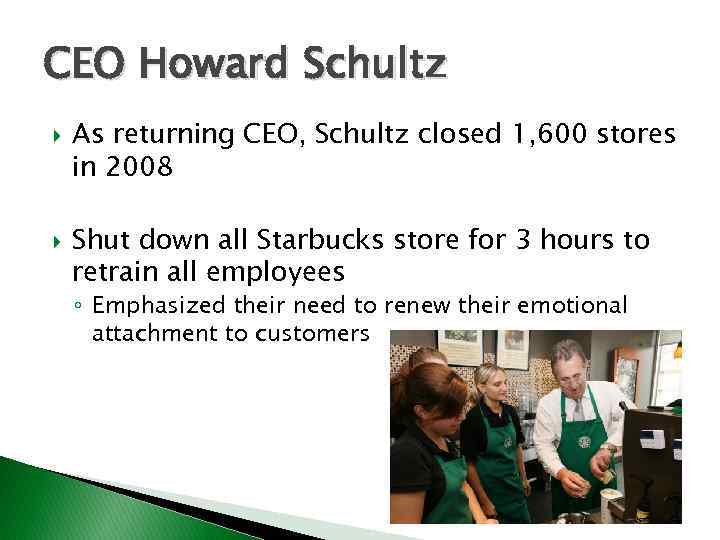
CEO Howard Schultz As returning CEO, Schultz closed 1, 600 stores in 2008 Shut down all Starbucks store for 3 hours to retrain all employees ◦ Emphasized their need to renew their emotional attachment to customers
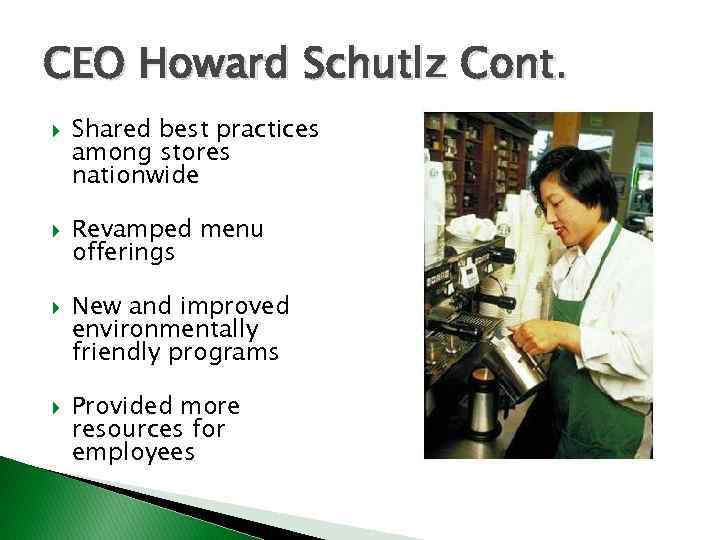
CEO Howard Schutlz Cont. Shared best practices among stores nationwide Revamped menu offerings New and improved environmentally friendly programs Provided more resources for employees
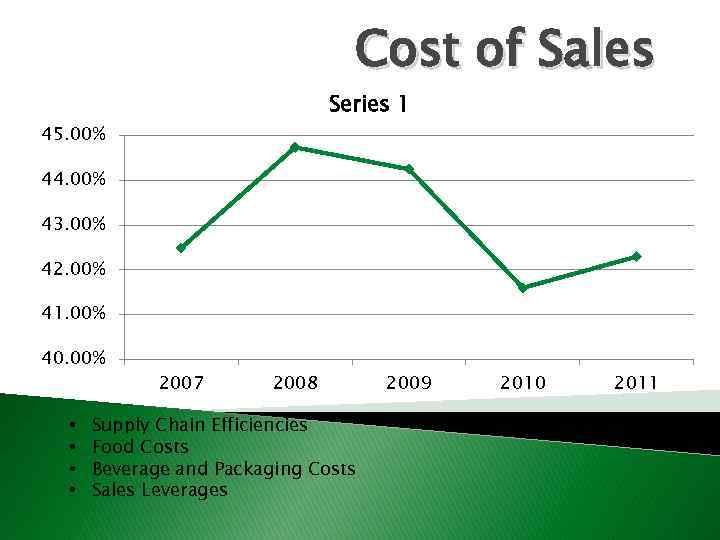
Cost of Sales Series 1 45. 00% 44. 00% 43. 00% 42. 00% 41. 00% 40. 00% • • 2007 2008 Supply Chain Efficiencies Food Costs Beverage and Packaging Costs Sales Leverages 2009 2010 2011
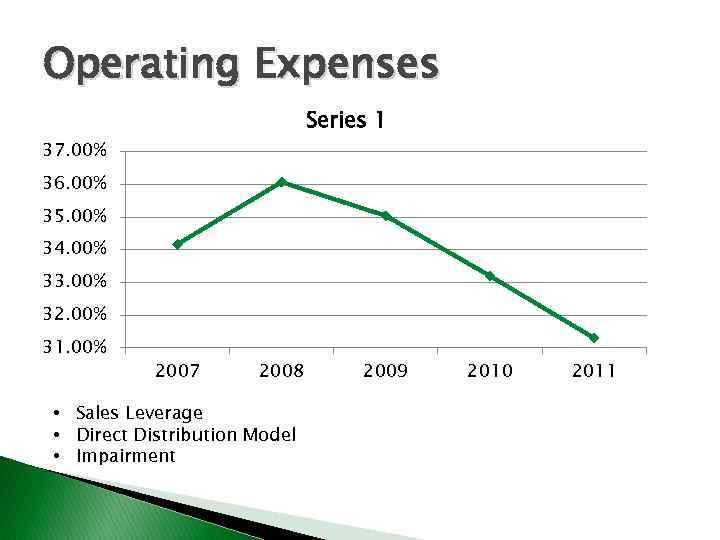
Operating Expenses Series 1 37. 00% 36. 00% 35. 00% 34. 00% 33. 00% 32. 00% 31. 00% 2007 2008 • Sales Leverage • Direct Distribution Model • Impairment 2009 2010 2011
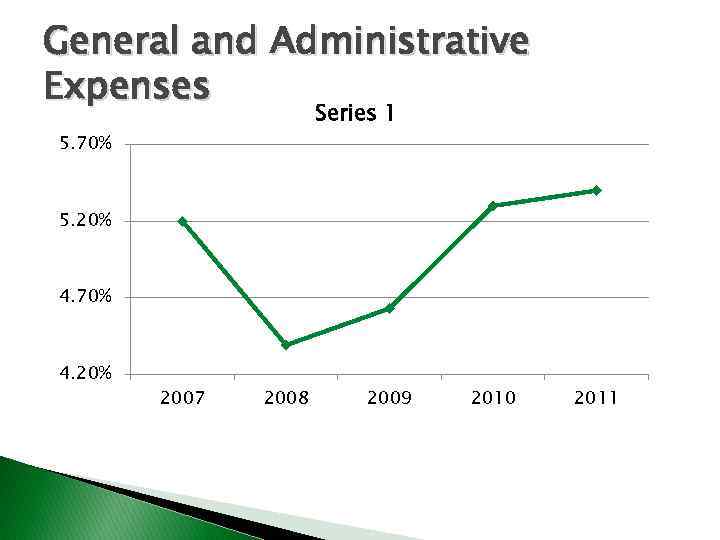
General and Administrative Expenses Series 1 5. 70% 5. 20% 4. 70% 4. 20% 2007 2008 2009 2010 2011
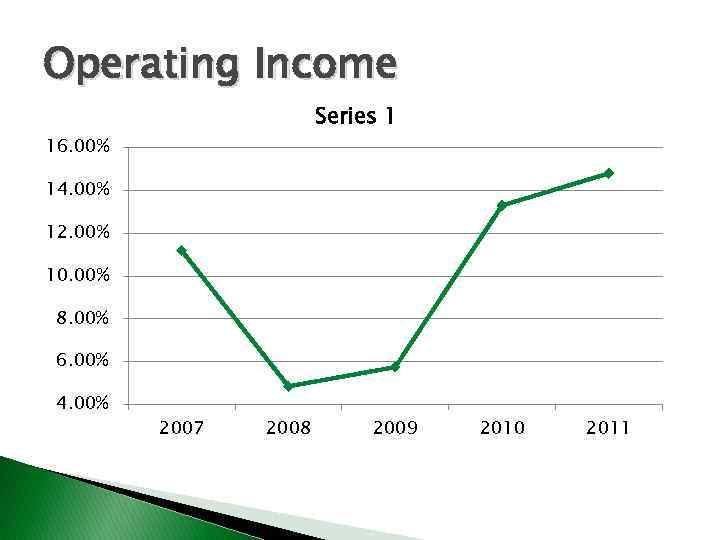
Operating Income Series 1 16. 00% 14. 00% 12. 00% 10. 00% 8. 00% 6. 00% 4. 00% 2007 2008 2009 2010 2011
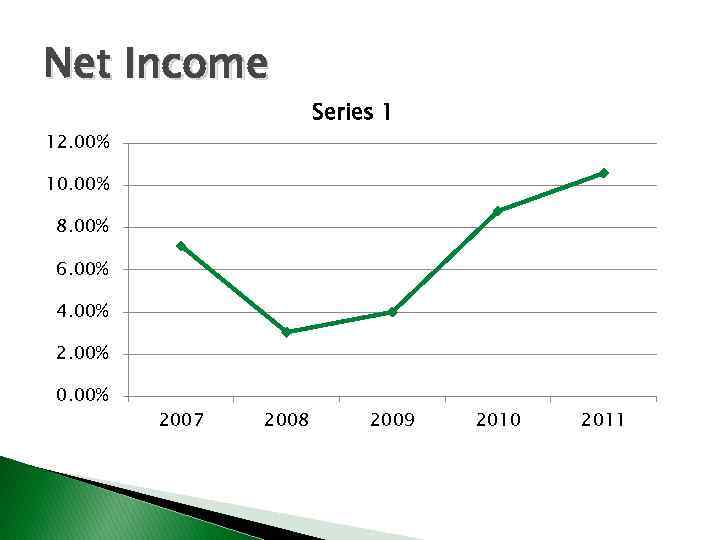
Net Income 12. 00% Series 1 10. 00% 8. 00% 6. 00% 4. 00% 2. 00% 0. 00% 2007 2008 2009 2010 2011
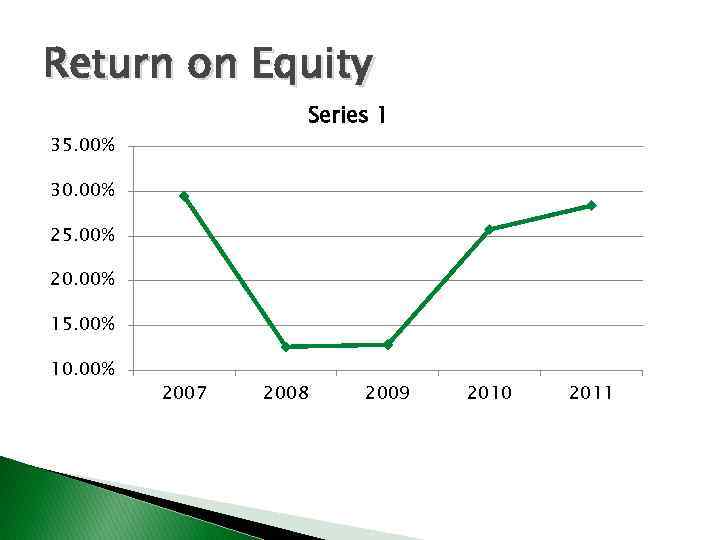
Return on Equity Series 1 35. 00% 30. 00% 25. 00% 20. 00% 15. 00% 10. 00% 2007 2008 2009 2010 2011
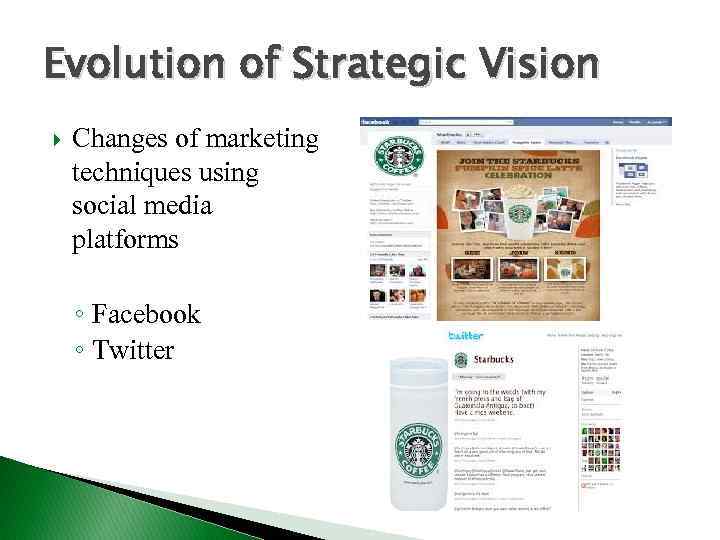
Evolution of Strategic Vision Changes of marketing techniques using social media platforms ◦ Facebook ◦ Twitter
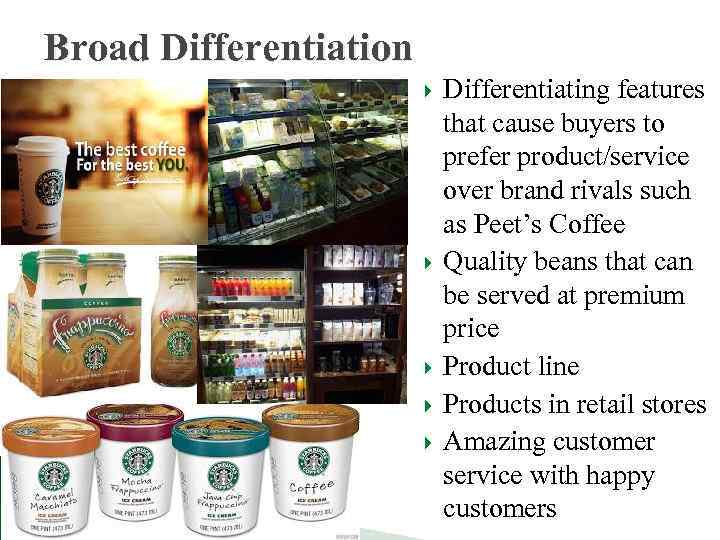
Broad Differentiation Differentiating features that cause buyers to prefer product/service over brand rivals such as Peet’s Coffee Quality beans that can be served at premium price Product line Products in retail stores Amazing customer service with happy customers
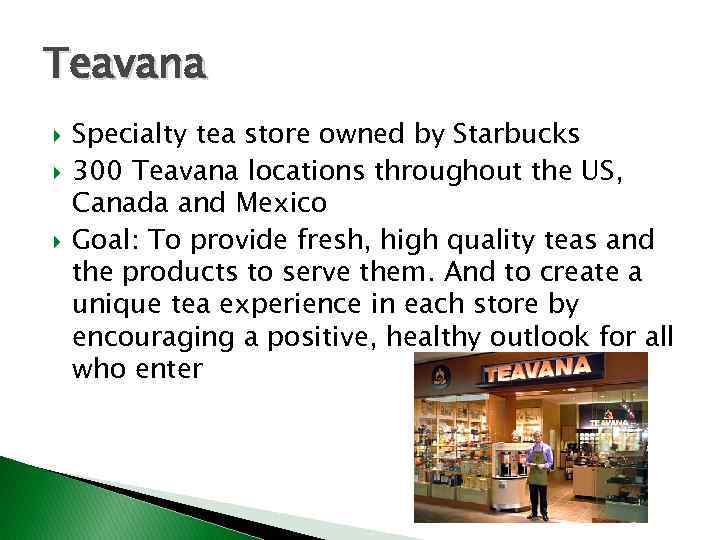
Teavana Specialty tea store owned by Starbucks 300 Teavana locations throughout the US, Canada and Mexico Goal: To provide fresh, high quality teas and the products to serve them. And to create a unique tea experience in each store by encouraging a positive, healthy outlook for all who enter
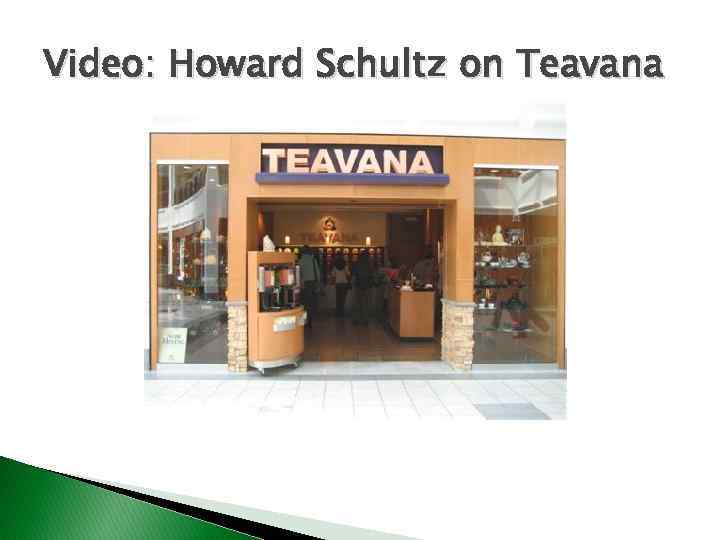
Video: Howard Schultz on Teavana
Employee Training Starbucks vice president for human resources is on a mission for “passionate people who love coffee” Starbucks employees are thoroughly equipped and trained to maintain the core values Management trainees are required to attend classes that last for an eight to twelve week period to ensure they understand the Starbucks mission centered on community
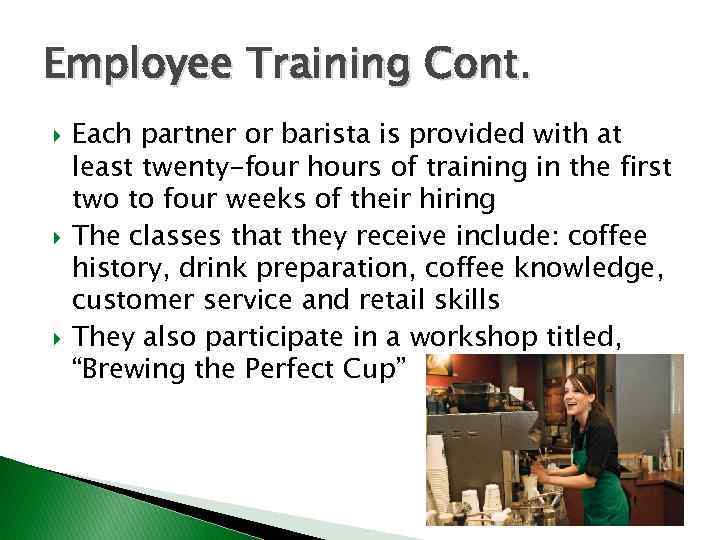
Employee Training Cont. Each partner or barista is provided with at least twenty-four hours of training in the first two to four weeks of their hiring The classes that they receive include: coffee history, drink preparation, coffee knowledge, customer service and retail skills They also participate in a workshop titled, “Brewing the Perfect Cup”
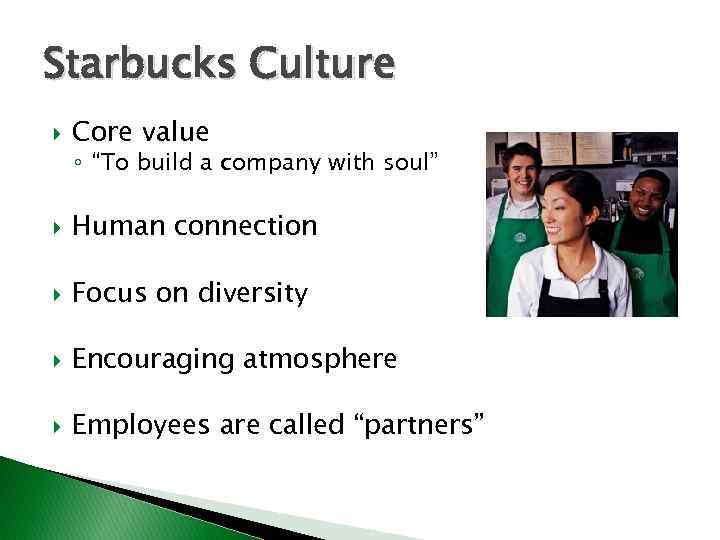
Starbucks Culture Core value ◦ “To build a company with soul” Human connection Focus on diversity Encouraging atmosphere Employees are called “partners”
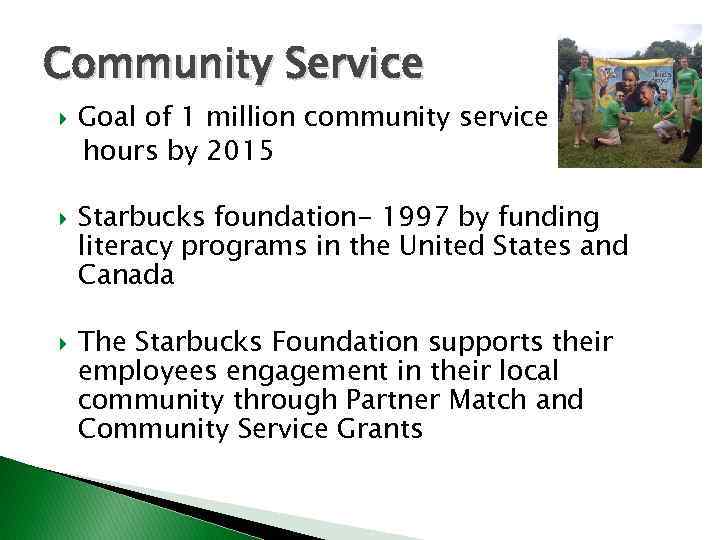
Community Service Goal of 1 million community service hours by 2015 Starbucks foundation- 1997 by funding literacy programs in the United States and Canada The Starbucks Foundation supports their employees engagement in their local community through Partner Match and Community Service Grants
Ethical Sourcing To ensure ethical sourcing of their coffee beans, Starbucks put a program into action called Coffee and Farmer Equity (C. A. F. E. ) ◦ A comprehensive coffee-buying program which guarantees coffee quality and the promoting of social, economic and environmental standards Starbucks goal regarding the purchase of coffee is to ensure that one hundred percent is ethically sourced by the year 2015
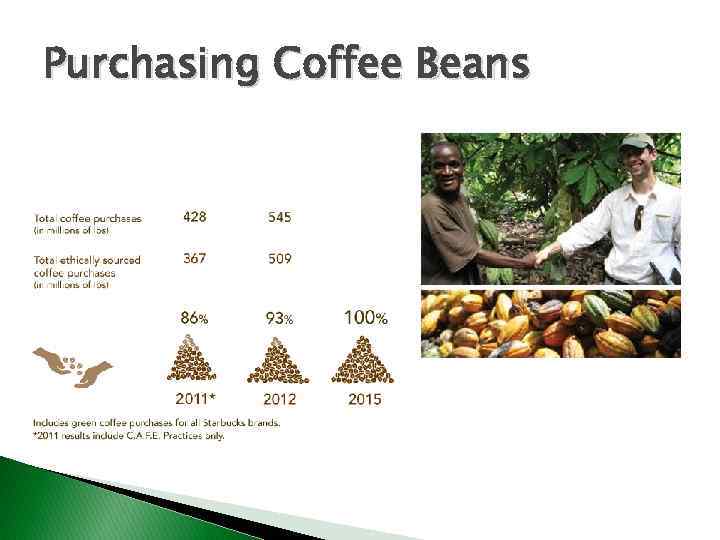
Purchasing Coffee Beans
Quality Control Starbucks invented Flavor. Lock technology Beans are sealed Flavor. Lock bags within two hours of roasting Baristas now grind the beans every time a new pot was brewed Set timers to signal once it was time to brew a new pot
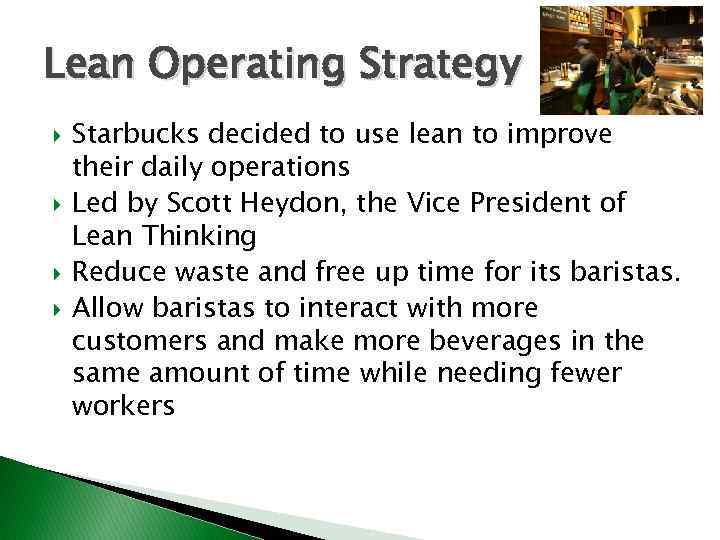
Lean Operating Strategy Starbucks decided to use lean to improve their daily operations Led by Scott Heydon, the Vice President of Lean Thinking Reduce waste and free up time for its baristas. Allow baristas to interact with more customers and make more beverages in the same amount of time while needing fewer workers
2012 Issues Facing Management Strong results for fiscal year 2011 Increased commodity costs Strong competitors Rollouts of new point-of-sale and inventory management system International market expansion Reorganization of leadership structure
Conclusion Strengthen the “Starbucks experience” Continue its quest to ethically source all of their coffee by 2015 Continue to take strategic action regarding the tea industry Further differentiate themselves from their competition
Thank You
Скачать презентацию Starbucks Case Ordabayev Saniyaz 20142321 Agenda Mission
starbuckscasestudy-140203151109-phpapp01.pptx