


 Скачать презентацию STAR Physics Overview and Future Upgrades Tim Hallman
3955d896ced96eb462abe95517dd1f3d.ppt
- Количество слайдов: 48
 STAR Physics Overview and Future Upgrades Tim Hallman International CCAST Summer School and Workshop On QCD and RHIC Physics Beijing, China August 9 -14, 2004 1
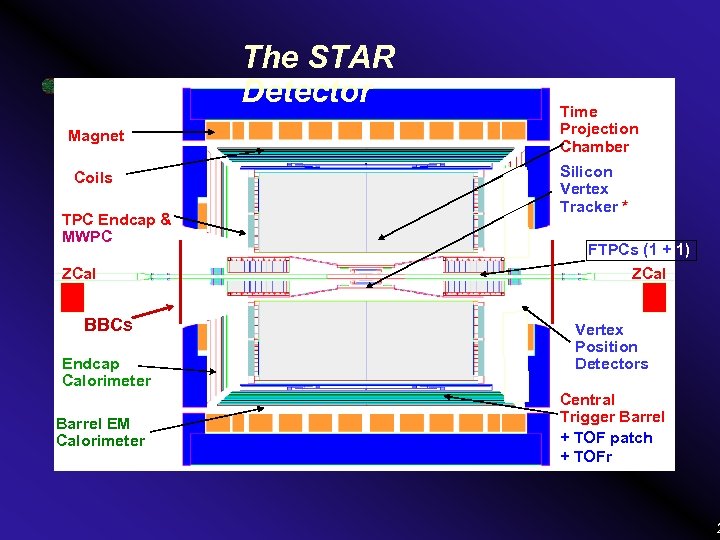 The STAR Detector Magnet Coils TPC Endcap & MWPC ZCal BBCs Endcap Calorimeter Barrel EM Calorimeter Time Projection Chamber Silicon Vertex Tracker * FTPCs (1 + 1) ZCal Vertex Position Detectors Central Trigger Barrel + TOF patch + TOFr 2
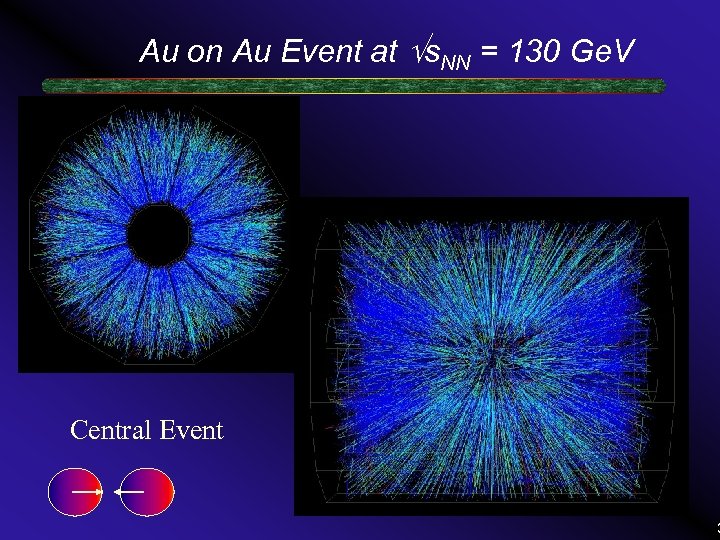 Au on Au Event at s. NN = 130 Ge. V Central Event 3
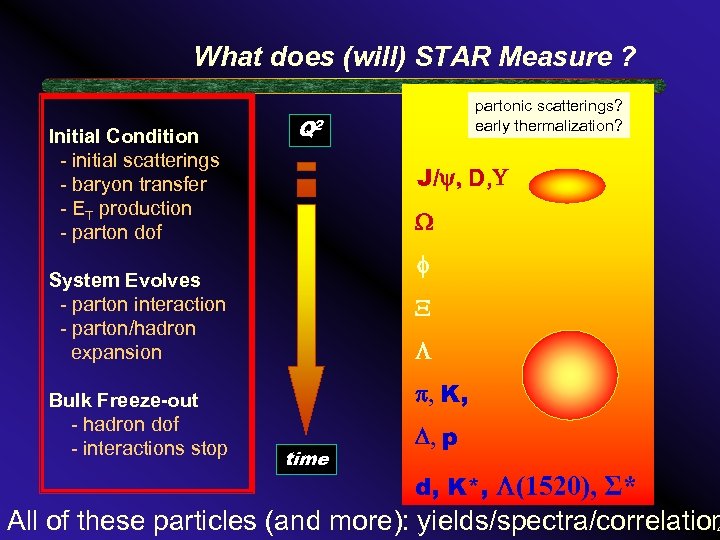 What does (will) STAR Measure ? Initial Condition - initial scatterings - baryon transfer - ET production - parton dof Q 2 J/y, D, f System Evolves - parton interaction - parton/hadron expansion Bulk Freeze-out - hadron dof - interactions stop partonic scatterings? early thermalization? X , K, time D, p d, K*, (1520), Σ* All of these particles (and more): yields/spectra/correlation 4
 STAR has produced a wealth of data from the first RHIC runs: Time for a critical evaluation of the evidence regarding formation of a QGP in RHIC Collisions ! Jamie Dunlop (BNL) Huang (UCLA) Peter Jacobs (LBNL) Mike Lisa (Ohio State U. ) Raimond Snellings (NIKHEF) Steve Vigdor (Indiana U. -- Chair) Nu Xu (LBNL) Zhangbu Xu (BNL) Focus group to help shape STAR’s discussion of: Predicted Signatures of the QGP Bulk Properties Hard Probes Open Issues (experimental and theoretical) 5
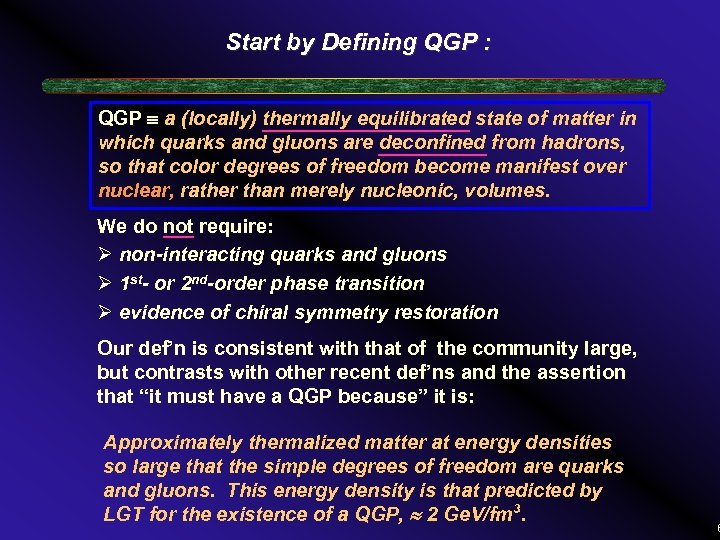 Start by Defining QGP : QGP a (locally) thermally equilibrated state of matter in which quarks and gluons are deconfined from hadrons, so that color degrees of freedom become manifest over nuclear, rather than merely nucleonic, volumes. We do not require: Ø non-interacting quarks and gluons Ø 1 st- or 2 nd-order phase transition Ø evidence of chiral symmetry restoration Our def’n is consistent with that of the community large, but contrasts with other recent def’ns and the assertion that “it must have a QGP because” it is: Approximately thermalized matter at energy densities so large that the simple degrees of freedom are quarks and gluons. This energy density is that predicted by LGT for the existence of a QGP, 2 Ge. V/fm 3. 6
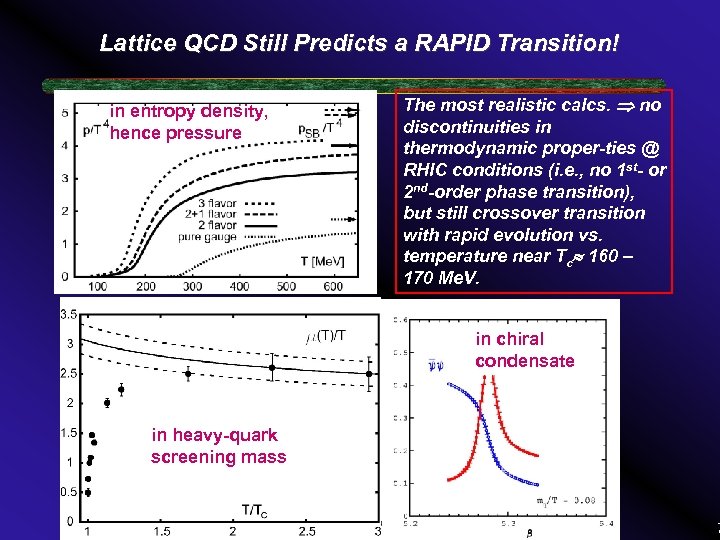 Lattice QCD Still Predicts a RAPID Transition! in entropy density, hence pressure The most realistic calcs. no discontinuities in thermodynamic proper-ties @ RHIC conditions (i. e. , no 1 st- or 2 nd-order phase transition), but still crossover transition with rapid evolution vs. temperature near Tc 160 – 170 Me. V. in chiral condensate in heavy-quark screening mass 7
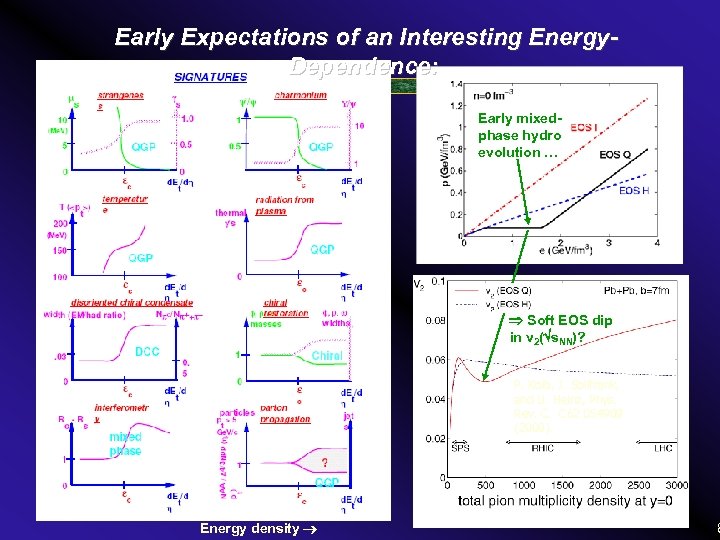 Early Expectations of an Interesting Energy. Dependence: Early mixedphase hydro evolution … Soft EOS dip in v 2( s. NN)? P. Kolb, J. Sollfrank, and U. Heinz, Phys. Rev. C. C 62 054909 (2000). Energy density 8
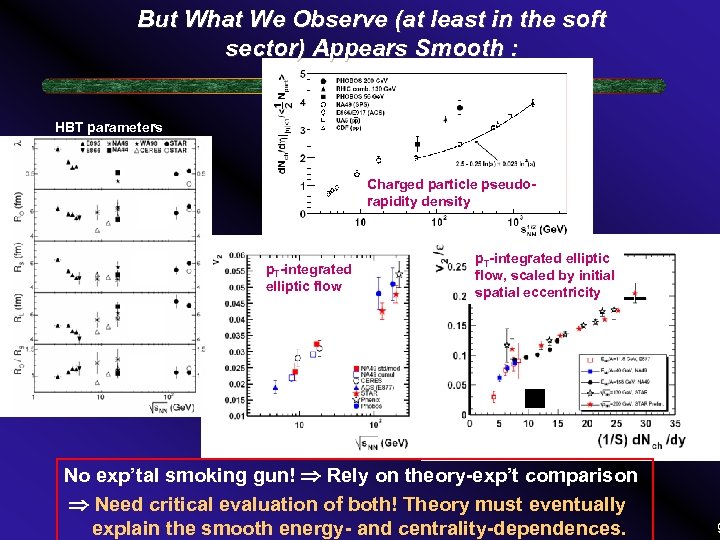 But What We Observe (at least in the soft sector) Appears Smooth : HBT parameters Charged particle pseudorapidity density p. T-integrated elliptic flow, scaled by initial spatial eccentricity No exp’tal smoking gun! Rely on theory-exp’t comparison Need critical evaluation of both! Theory must eventually explain the smooth energy- and centrality-dependences. 9
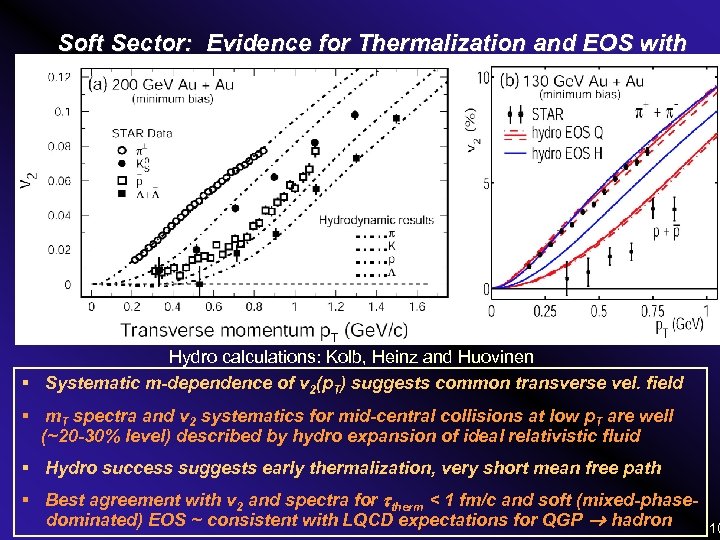 Soft Sector: Evidence for Thermalization and EOS with Soft Point? Hydro calculations: Kolb, Heinz and Huovinen § Systematic m-dependence of v 2(p. T) suggests common transverse vel. field § m. T spectra and v 2 systematics for mid-central collisions at low p. T are well (~20 -30% level) described by hydro expansion of ideal relativistic fluid § Hydro success suggests early thermalization, very short mean free path § Best agreement with v 2 and spectra for therm < 1 fm/c and soft (mixed-phasedominated) EOS ~ consistent with LQCD expectations for QGP hadron 10
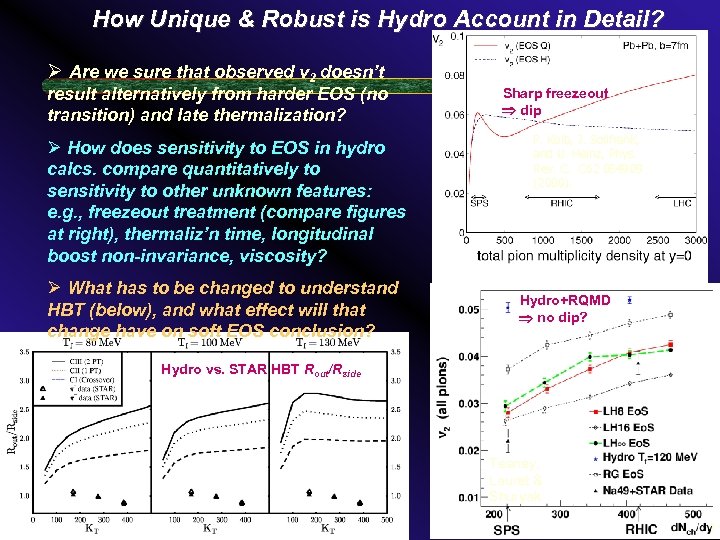 How Unique & Robust is Hydro Account in Detail? Ø Are we sure that observed v 2 doesn’t result alternatively from harder EOS (no transition) and late thermalization? Ø How does sensitivity to EOS in hydro calcs. compare quantitatively to sensitivity to other unknown features: e. g. , freezeout treatment (compare figures at right), thermaliz’n time, longitudinal boost non-invariance, viscosity? Ø What has to be changed to understand HBT (below), and what effect will that change have on soft EOS conclusion? Sharp freezeout dip P. Kolb, J. Sollfrank, and U. Heinz, Phys. Rev. C. C 62 054909 (2000). Hydro+RQMD no dip? Hydro vs. STAR HBT Rout/Rside Teaney, Lauret & Shuryak 11
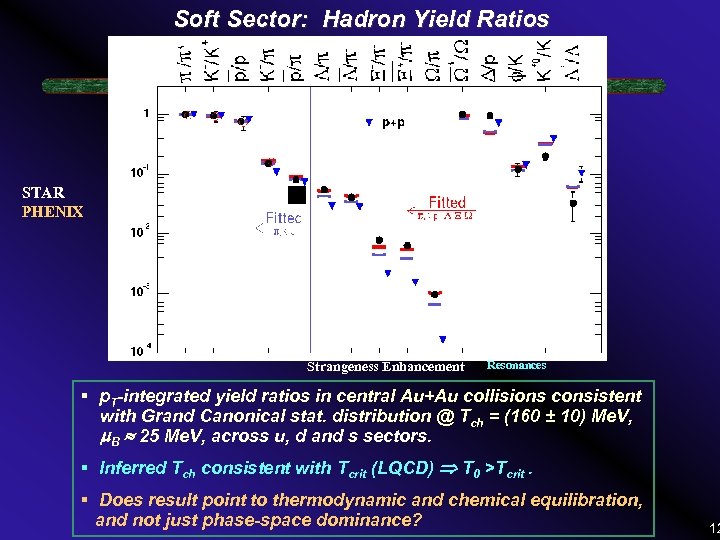 Soft Sector: Hadron Yield Ratios STAR PHENIX Strangeness Enhancement Resonances § p. T-integrated yield ratios in central Au+Au collisions consistent with Grand Canonical stat. distribution @ Tch = (160 ± 10) Me. V, B 25 Me. V, across u, d and s sectors. § Inferred Tch consistent with Tcrit (LQCD) T 0 >Tcrit. § Does result point to thermodynamic and chemical equilibration, and not just phase-space dominance? 12
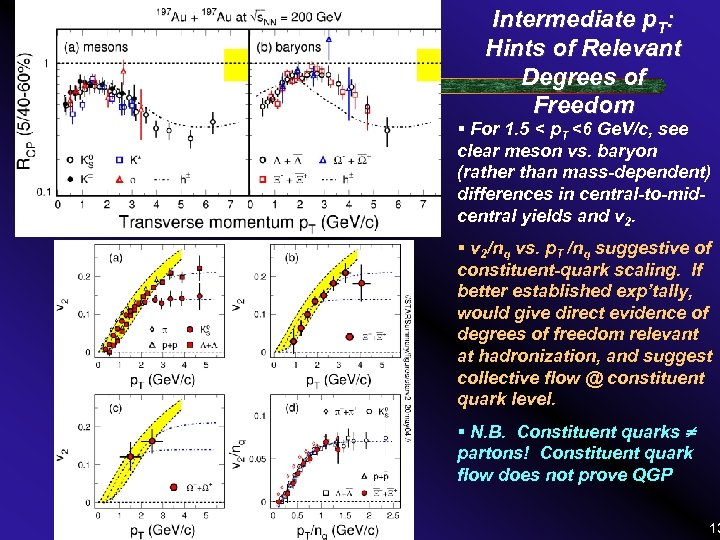 Intermediate p. T: Hints of Relevant Degrees of Freedom § For 1. 5 < p. T <6 Ge. V/c, see clear meson vs. baryon (rather than mass-dependent) differences in central-to-midcentral yields and v 2. § v 2/nq vs. p. T /nq suggestive of constituent-quark scaling. If better established exp’tally, would give direct evidence of degrees of freedom relevant at hadronization, and suggest collective flow @ constituent quark level. § N. B. Constituent quarks partons! Constituent quark flow does not prove QGP 13
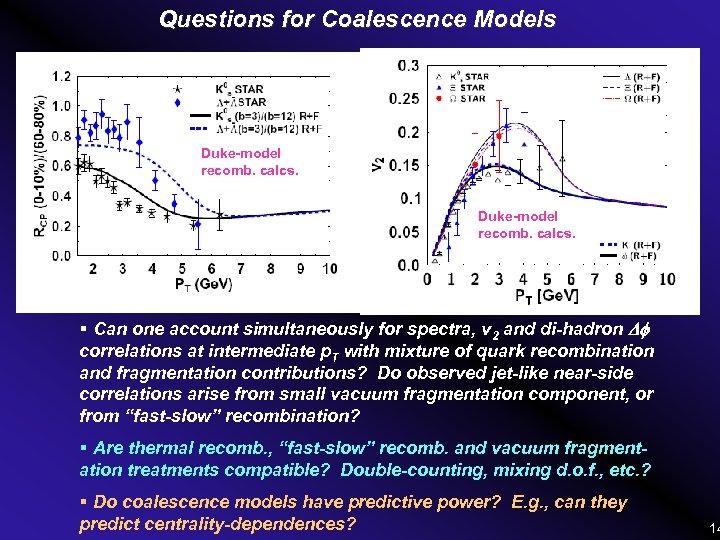 Questions for Coalescence Models Duke-model recomb. calcs. § Can one account simultaneously for spectra, v 2 and di-hadron correlations at intermediate p. T with mixture of quark recombination and fragmentation contributions? Do observed jet-like near-side correlations arise from small vacuum fragmentation component, or from “fast-slow” recombination? § Are thermal recomb. , “fast-slow” recomb. and vacuum fragmentation treatments compatible? Double-counting, mixing d. o. f. , etc. ? § Do coalescence models have predictive power? E. g. , can they predict centrality-dependences? 14
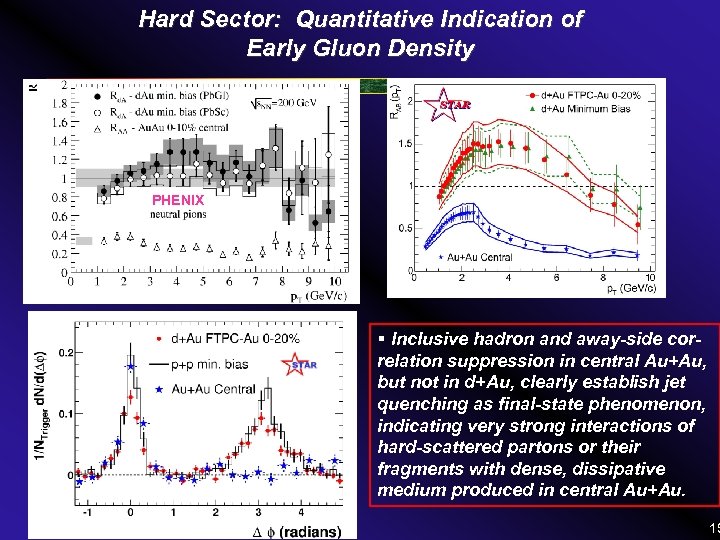 Hard Sector: Quantitative Indication of Early Gluon Density PHENIX § Inclusive hadron and away-side correlation suppression in central Au+Au, but not in d+Au, clearly establish jet quenching as final-state phenomenon, indicating very strong interactions of hard-scattered partons or their fragments with dense, dissipative medium produced in central Au+Au. 15
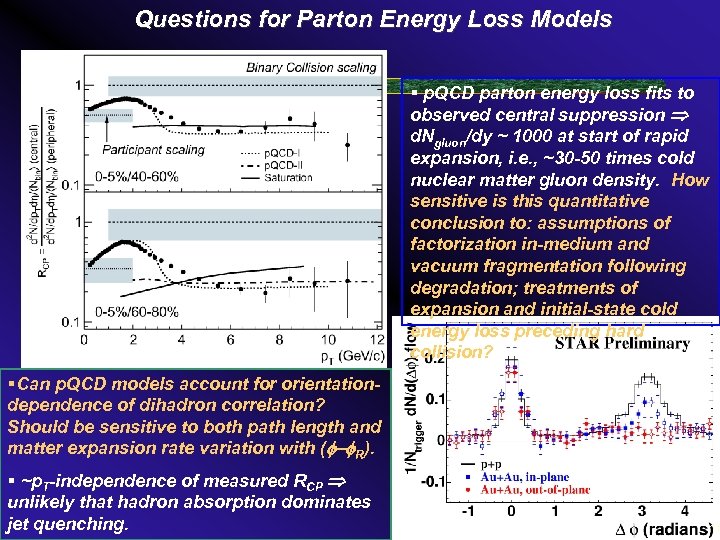 Questions for Parton Energy Loss Models § p. QCD parton energy loss fits to observed central suppression d. Ngluon/dy ~ 1000 at start of rapid expansion, i. e. , ~30 -50 times cold nuclear matter gluon density. How sensitive is this quantitative conclusion to: assumptions of factorization in-medium and vacuum fragmentation following degradation; treatments of expansion and initial-state cold energy loss preceding hard collision? §Can p. QCD models account for orientationdependence of dihadron correlation? Should be sensitive to both path length and matter expansion rate variation with ( R). § ~p. T-independence of measured RCP unlikely that hadron absorption dominates jet quenching. 16
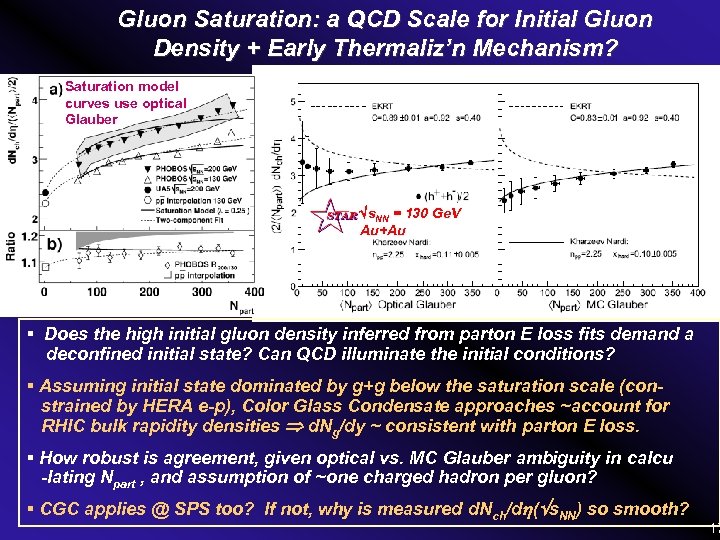 Gluon Saturation: a QCD Scale for Initial Gluon Density + Early Thermaliz’n Mechanism? Saturation model curves use optical Glauber s. NN = 130 Ge. V Au+Au § Does the high initial gluon density inferred from parton E loss fits demand a deconfined initial state? Can QCD illuminate the initial conditions? § Assuming initial state dominated by g+g below the saturation scale (constrained by HERA e-p), Color Glass Condensate approaches ~account for RHIC bulk rapidity densities d. Ng/dy ~ consistent with parton E loss. § How robust is agreement, given optical vs. MC Glauber ambiguity in calcu -lating Npart , and assumption of ~one charged hadron per gluon? § CGC applies @ SPS too? If not, why is measured d. Nch/d ( s. NN) so smooth? 17
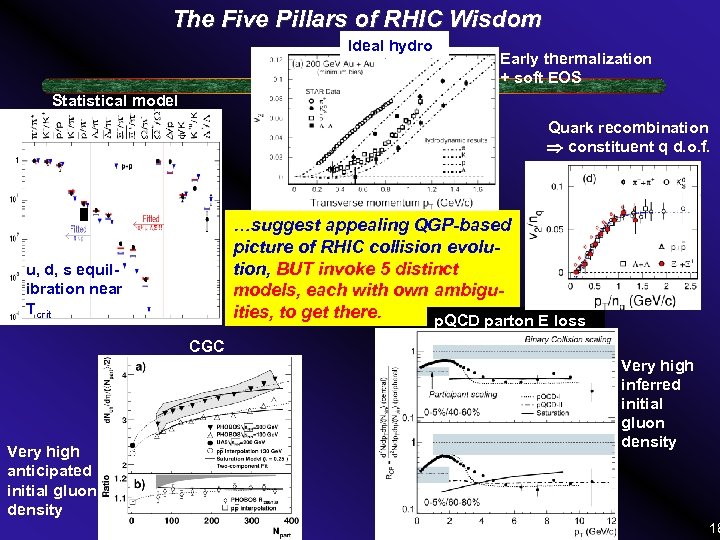 The Five Pillars of RHIC Wisdom Ideal hydro Early thermalization + soft EOS Statistical model Quark recombination constituent q d. o. f. …suggest appealing QGP-based picture of RHIC collision evolution, BUT invoke 5 distinct models, each with own ambiguities, to get there. p. QCD parton E loss u, d, s equilibration near Tcrit CGC Very high anticipated initial gluon density Very high inferred initial gluon density 18
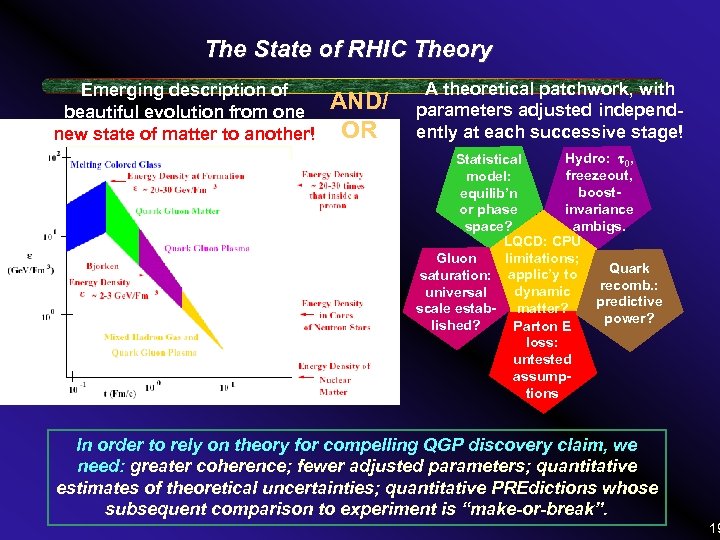 The State of RHIC Theory Emerging description of beautiful evolution from one new state of matter to another! AND/ OR A theoretical patchwork, with parameters adjusted independently at each successive stage! Hydro: 0, Statistical freezeout, model: boostequilib’n invariance or phase ambigs. space? LQCD: CPU limitations; Gluon Quark saturation: applic’y to recomb. : dynamic universal predictive scale estab- matter? power? lished? Parton E loss: untested assumptions In order to rely on theory for compelling QGP discovery claim, we need: greater coherence; fewer adjusted parameters; quantitative estimates of theoretical uncertainties; quantitative PREdictions whose subsequent comparison to experiment is “make-or-break”. 19
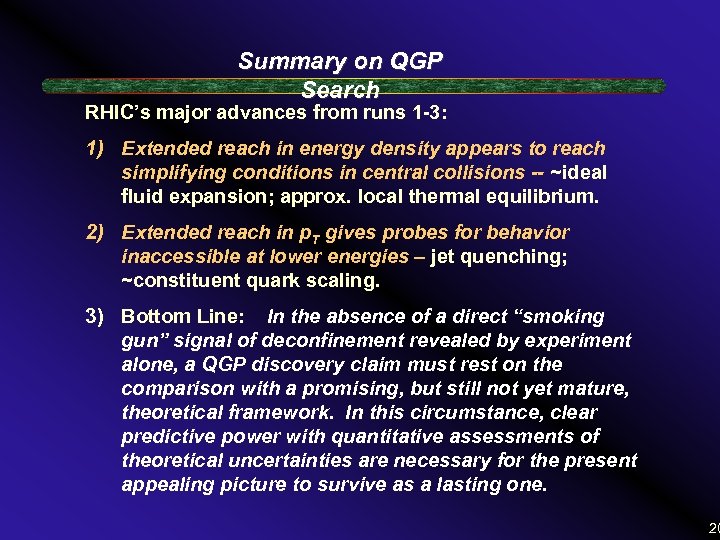 Summary on QGP Search RHIC’s major advances from runs 1 -3: 1) Extended reach in energy density appears to reach simplifying conditions in central collisions -- ~ideal fluid expansion; approx. local thermal equilibrium. 2) Extended reach in p. T gives probes for behavior inaccessible at lower energies – jet quenching; ~constituent quark scaling. 3) Bottom Line: In the absence of a direct “smoking gun” signal of deconfinement revealed by experiment alone, a QGP discovery claim must rest on the comparison with a promising, but still not yet mature, theoretical framework. In this circumstance, clear predictive power with quantitative assessments of theoretical uncertainties are necessary for the present appealing picture to survive as a lasting one. 20
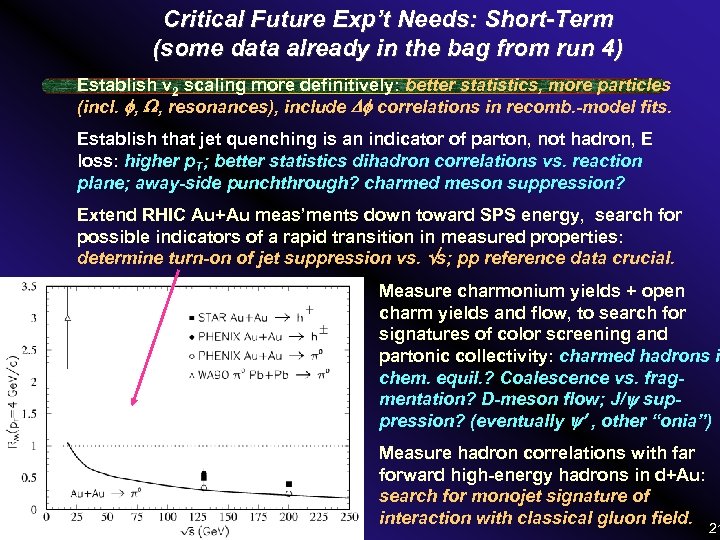 Critical Future Exp’t Needs: Short-Term (some data already in the bag from run 4) Establish v 2 scaling more definitively: better statistics, more particles (incl. , , resonances), include correlations in recomb. -model fits. Establish that jet quenching is an indicator of parton, not hadron, E loss: higher p. T; better statistics dihadron correlations vs. reaction plane; away-side punchthrough? charmed meson suppression? Extend RHIC Au+Au meas’ments down toward SPS energy, search for possible indicators of a rapid transition in measured properties: determine turn-on of jet suppression vs. s; pp reference data crucial. Measure charmonium yields + open charm yields and flow, to search for signatures of color screening and partonic collectivity: charmed hadrons i chem. equil. ? Coalescence vs. fragmentation? D-meson flow; J/ suppression? (eventually , other “onia”) Measure hadron correlations with far forward high-energy hadrons in d+Au: search for monojet signature of interaction with classical gluon field. 21
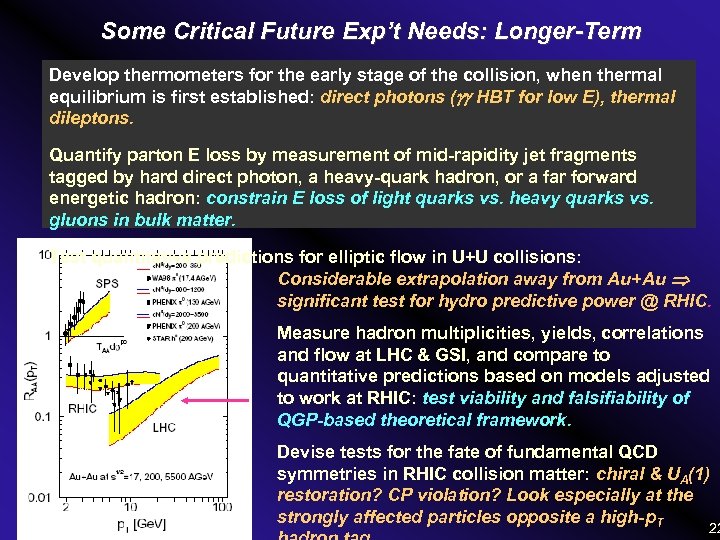 Some Critical Future Exp’t Needs: Longer-Term Develop thermometers for the early stage of the collision, when thermal equilibrium is first established: direct photons ( HBT for low E), thermal dileptons. Quantify parton E loss by measurement of mid-rapidity jet fragments tagged by hard direct photon, a heavy-quark hadron, or a far forward energetic hadron: constrain E loss of light quarks vs. heavy quarks vs. gluons in bulk matter. Test quantitative predictions for elliptic flow in U+U collisions: Considerable extrapolation away from Au+Au significant test for hydro predictive power @ RHIC. Measure hadron multiplicities, yields, correlations and flow at LHC & GSI, and compare to quantitative predictions based on models adjusted to work at RHIC: test viability and falsifiability of QGP-based theoretical framework. Devise tests for the fate of fundamental QCD symmetries in RHIC collision matter: chiral & UA(1) restoration? CP violation? Look especially at the strongly affected particles opposite a high-p. T 22
 RHIC II Physics in STAR • Detailed studies of the fundamental properties of the new high temperature, high density (QGP) matter at RHIC – – – • Is it equilibrated? Does it behave collectively? What are its early temperature and pressure? What is its gluon density? What is the quark mass dependence of partonic energy loss? Does it exhibit the properties of a classical plasma? Studying the deconfinement and chiral transitions, and the hot, superdense states preceding the formation of a plasma of quarks and gluons to: – Test lattice predictions of the properties and behavior of bulk QCD matter – Study the nature of chiral symmetry breaking and how it is related to the masses of the hadrons – Study the nature of a possible saturated gluon state in cold nuclei at low momentum fraction (Bjorken x) – Search for broken/restored symmetries the QGP may provide access to (e. g. strong CP, parity) • Understanding the contributions to the nucleon spin – – The helicity preference of gluons inside a proton The origin of the proton sea 23
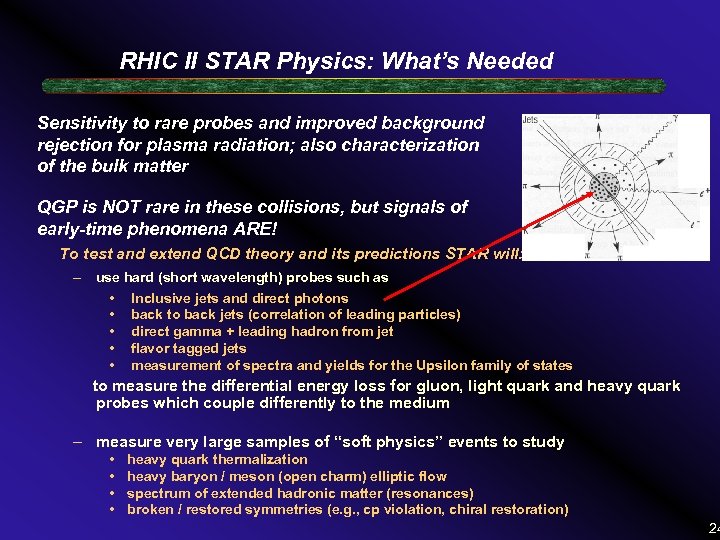 RHIC II STAR Physics: What’s Needed Sensitivity to rare probes and improved background rejection for plasma radiation; also characterization of the bulk matter QGP is NOT rare in these collisions, but signals of early-time phenomena ARE! To test and extend QCD theory and its predictions STAR will: – use hard (short wavelength) probes such as • Inclusive jets and direct photons • back to back jets (correlation of leading particles) • direct gamma + leading hadron from jet • flavor tagged jets • measurement of spectra and yields for the Upsilon family of states to measure the differential energy loss for gluon, light quark and heavy quark probes which couple differently to the medium – measure very large samples of “soft physics” events to study • • heavy quark thermalization heavy baryon / meson (open charm) elliptic flow spectrum of extended hadronic matter (resonances) broken / restored symmetries (e. g. , cp violation, chiral restoration) 24
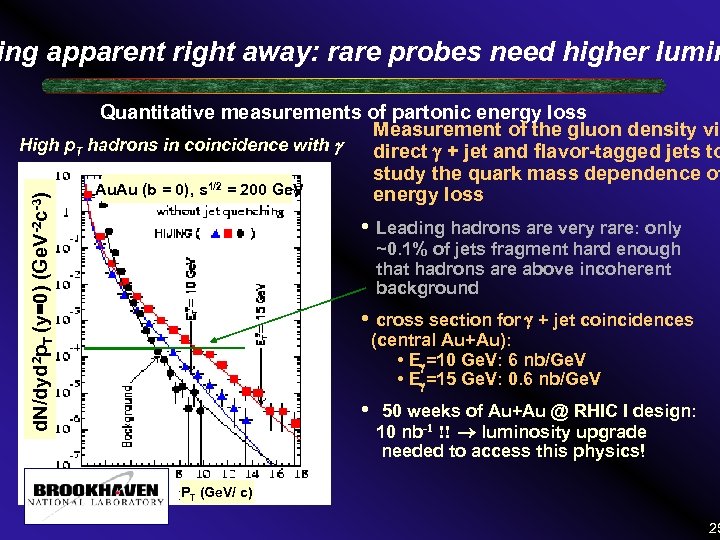 ing apparent right away: rare probes need higher lumin d. N/dyd 2 p. T (y=0) (Ge. V-2 c-3) Quantitative measurements of partonic energy loss Measurement of the gluon density via High p. T hadrons in coincidence with direct + jet and flavor-tagged jets to study the quark mass dependence of 1/2 = 200 Ge. V Au. Au (b = 0), s energy loss • Leading hadrons are very rare: only ~0. 1% of jets fragment hard enough that hadrons are above incoherent background • cross section for + jet coincidences (central Au+Au): • E =10 Ge. V: 6 nb/Ge. V • E =15 Ge. V: 0. 6 nb/Ge. V • 50 weeks of Au+Au @ RHIC I design: 10 nb-1 !! luminosity upgrade needed to access this physics! PT (Ge. V/ c) 25
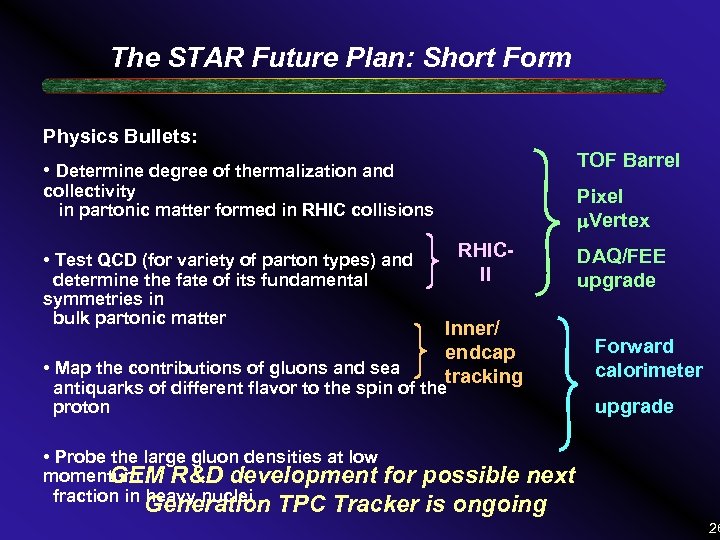 The STAR Future Plan: Short Form Physics Bullets: TOF Barrel • Determine degree of thermalization and collectivity in partonic matter formed in RHIC collisions • Test QCD (for variety of parton types) and determine the fate of its fundamental symmetries in bulk partonic matter Pixel Vertex RHICII Inner/ endcap tracking • Map the contributions of gluons and sea antiquarks of different flavor to the spin of the proton DAQ/FEE upgrade Forward calorimeter upgrade • Probe the large gluon densities at low momentum GEM R&D development for fraction in heavy nuclei possible next Generation TPC Tracker is ongoing 26
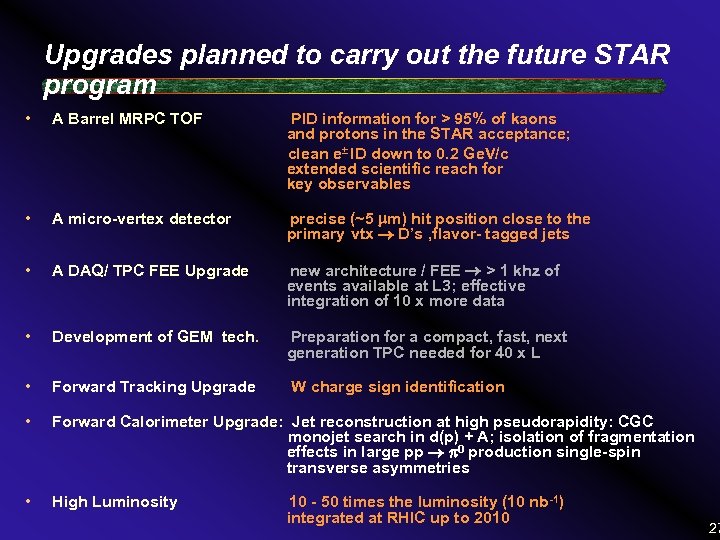 Upgrades planned to carry out the future STAR program • A Barrel MRPC TOF PID information for > 95% of kaons and protons in the STAR acceptance; clean e± ID down to 0. 2 Ge. V/c extended scientific reach for key observables • A micro-vertex detector precise (~5 m) hit position close to the primary vtx D’s , flavor- tagged jets • A DAQ/ TPC FEE Upgrade new architecture / FEE > 1 khz of events available at L 3; effective integration of 10 x more data • Development of GEM tech. Preparation for a compact, fast, next generation TPC needed for 40 x L • Forward Tracking Upgrade W charge sign identification • Forward Calorimeter Upgrade: Jet reconstruction at high pseudorapidity: CGC monojet search in d(p) + A; isolation of fragmentation effects in large pp 0 production single-spin transverse asymmetries • High Luminosity 10 - 50 times the luminosity (10 nb-1) integrated at RHIC up to 2010 27
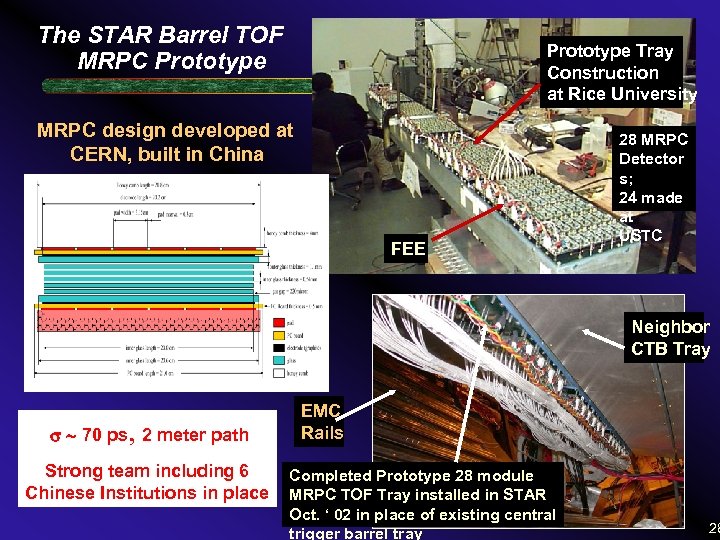 The STAR Barrel TOF MRPC Prototype Tray Construction at Rice University MRPC design developed at CERN, built in China FEE 28 MRPC Detector s; 24 made at USTC Neighbor CTB Tray 70 ps, 2 meter path Strong team including 6 Chinese Institutions in place EMC Rails Completed Prototype 28 module MRPC TOF Tray installed in STAR Oct. ‘ 02 in place of existing central trigger barrel tray 28
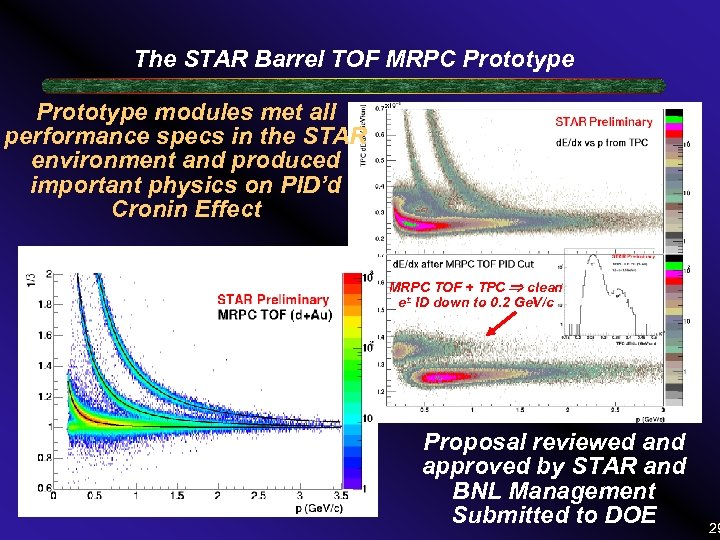 The STAR Barrel TOF MRPC Prototype modules met all performance specs in the STAR environment and produced important physics on PID’d Cronin Effect MRPC TOF + TPC clean e± ID down to 0. 2 Ge. V/c Proposal reviewed and approved by STAR and BNL Management Submitted to DOE 29
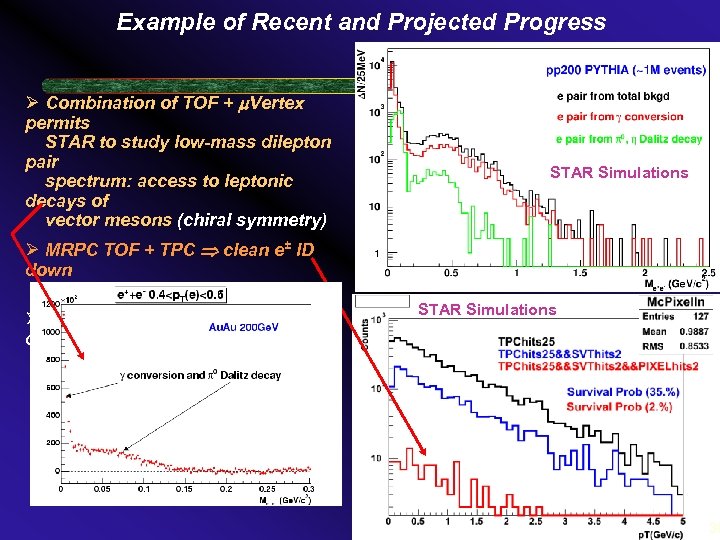 Example of Recent and Projected Progress Ø Combination of TOF + Vertex permits STAR to study low-mass dilepton pair spectrum: access to leptonic decays of vector mesons (chiral symmetry) STAR Simulations Ø MRPC TOF + TPC clean e± ID down to 0. 2 Ge. V/c (from run 4 data!) Ø Addition of Vertex suppress dominant conversion bkgd. by large factor! STAR Simulations 30
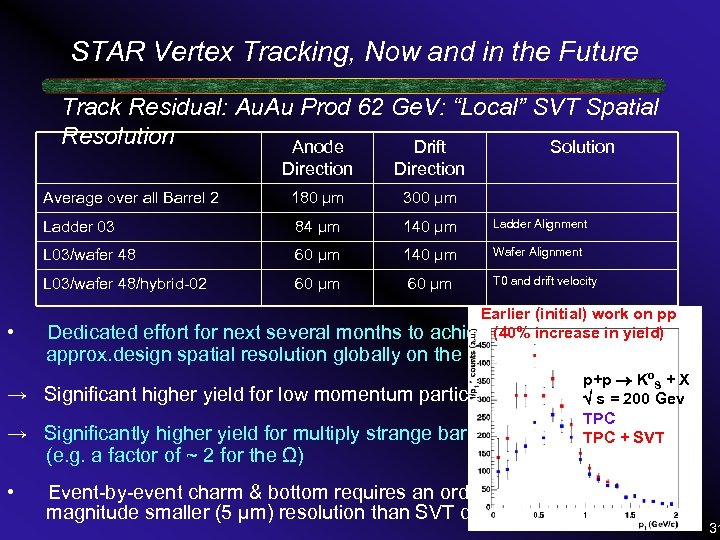 STAR Vertex Tracking, Now and in the Future Track Residual: Au. Au Prod 62 Ge. V: “Local” SVT Spatial Resolution Anode Drift Solution Direction Average over all Barrel 2 180 μm 300 μm Ladder 03 84 μm 140 μm Ladder Alignment L 03/wafer 48 60 μm 140 μm Wafer Alignment L 03/wafer 48/hybrid-02 • Direction 60 μm T 0 and drift velocity Earlier (initial) work on pp (40% increase in yield) achieve Dedicated effort for next several months to approx. design spatial resolution globally on the detector → Significant higher yield for low momentum particles → Significantly higher yield for multiply strange baryons (e. g. a factor of ~ 2 for the Ω) • Event-by-event charm & bottom requires an order of magnitude smaller (5 μm) resolution than SVT design p+p KºS + X s = 200 Gev TPC + SVT 31
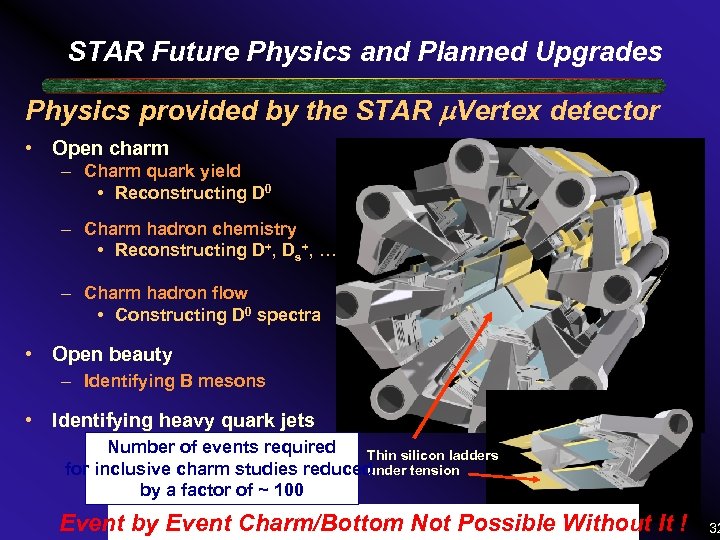 STAR Future Physics and Planned Upgrades Physics provided by the STAR Vertex detector • Open charm – Charm quark yield • Reconstructing D 0 – Charm hadron chemistry • Reconstructing D+, Ds+, … – Charm hadron flow • Constructing D 0 spectra • Open beauty – Identifying B mesons • Identifying heavy quark jets Number of events required Thin silicon ladders for inclusive charm studies reduced under tension by a factor of ~ 100 Event by Event Charm/Bottom Not Possible Without It ! 32
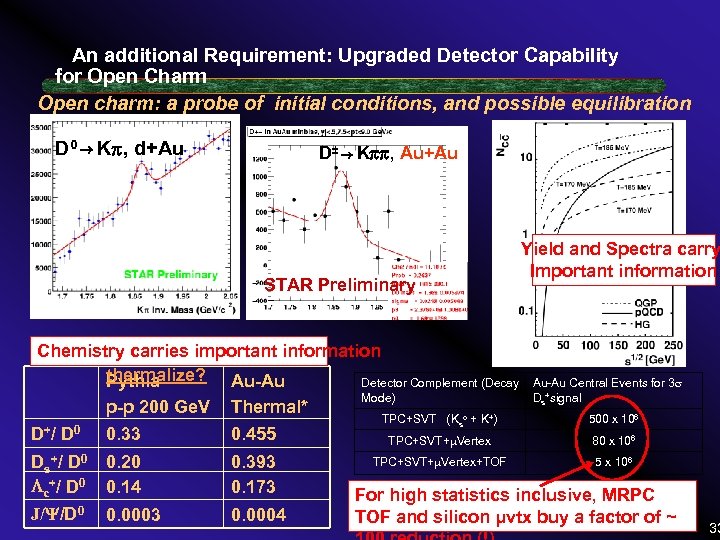 An additional Requirement: Upgraded Detector Capability for Open Charm Open charm: a probe of initial conditions, and possible equilibration at early times D 0 K , d+Au D± K , Au+Au STAR Preliminary Chemistry carries important information Do c quarks thermalize? Au-Au Pythia Detector Complement (Decay D+ / D 0 p-p 200 Ge. V 0. 33 Thermal* 0. 455 Ds + / D 0 c+/ D 0 0. 20 0. 14 0. 393 0. 173 J/Y/D 0 0. 0003 0. 0004 Mode) Yield and Spectra carry Important information Au-Au Central Events for 3 s Ds+signal TPC+SVT (Kso + K+) 500 x 106 TPC+SVT+m. Vertex 80 x 106 TPC+SVT+m. Vertex+TOF 5 x 10⁶ For high statistics inclusive, MRPC TOF and silicon μvtx buy a factor of ~ 33
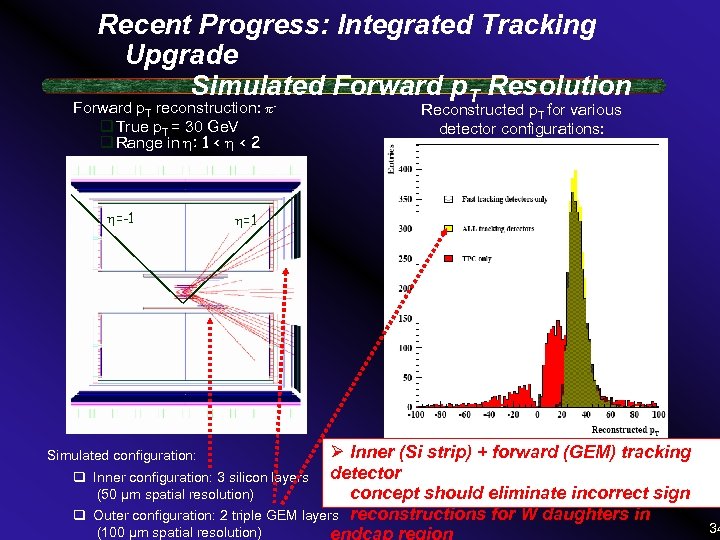 Recent Progress: Integrated Tracking Upgrade Simulated Forward p. T Resolution Forward p. T reconstruction: q True p. T = 30 Ge. V q Range in : 1 < < 2 =-1 Reconstructed p. T for various detector configurations: =1 Ø Inner (Si strip) + forward (GEM) tracking detector Inner configuration: 3 silicon layers (50 μm spatial resolution) concept should eliminate incorrect sign Outer configuration: 2 triple GEM layers reconstructions for W daughters in Simulated configuration: q q (100 μm spatial resolution) 34
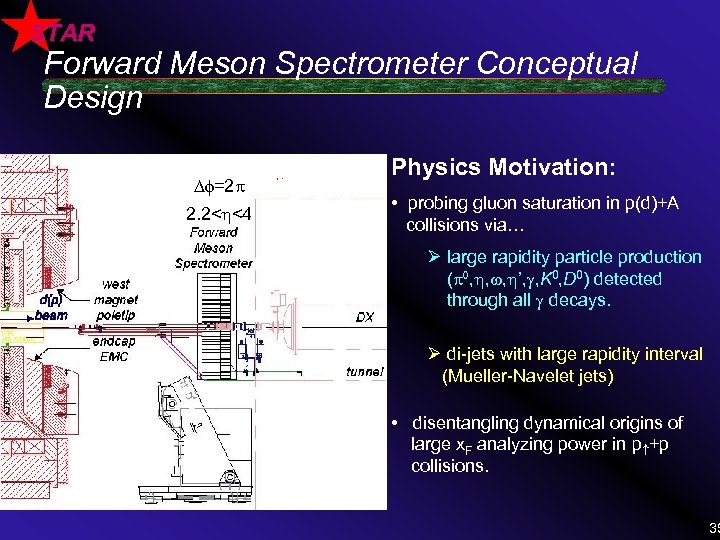 STAR Forward Meson Spectrometer Conceptual Design Df=2 2. 2< <4 Physics Motivation: • probing gluon saturation in p(d)+A collisions via… Ø large rapidity particle production ( 0, , w, ’, g, K 0, D 0) detected through all g decays. Ø di-jets with large rapidity interval (Mueller-Navelet jets) • disentangling dynamical origins of large x. F analyzing power in p +p collisions. 35
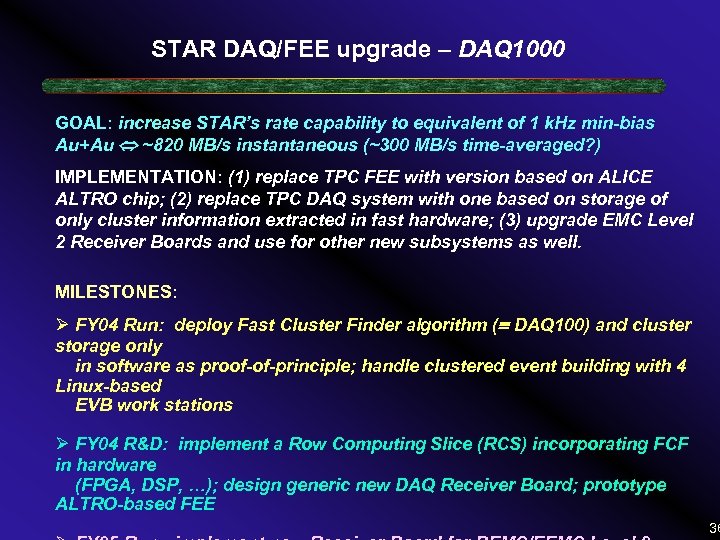 STAR DAQ/FEE upgrade – DAQ 1000 GOAL: increase STAR’s rate capability to equivalent of 1 k. Hz min-bias Au+Au ~820 MB/s instantaneous (~300 MB/s time-averaged? ) IMPLEMENTATION: (1) replace TPC FEE with version based on ALICE ALTRO chip; (2) replace TPC DAQ system with one based on storage of only cluster information extracted in fast hardware; (3) upgrade EMC Level 2 Receiver Boards and use for other new subsystems as well. MILESTONES: Ø FY 04 Run: deploy Fast Cluster Finder algorithm ( DAQ 100) and cluster storage only in software as proof-of-principle; handle clustered event building with 4 Linux-based EVB work stations Ø FY 04 R&D: implement a Row Computing Slice (RCS) incorporating FCF in hardware (FPGA, DSP, …); design generic new DAQ Receiver Board; prototype ALTRO-based FEE 36
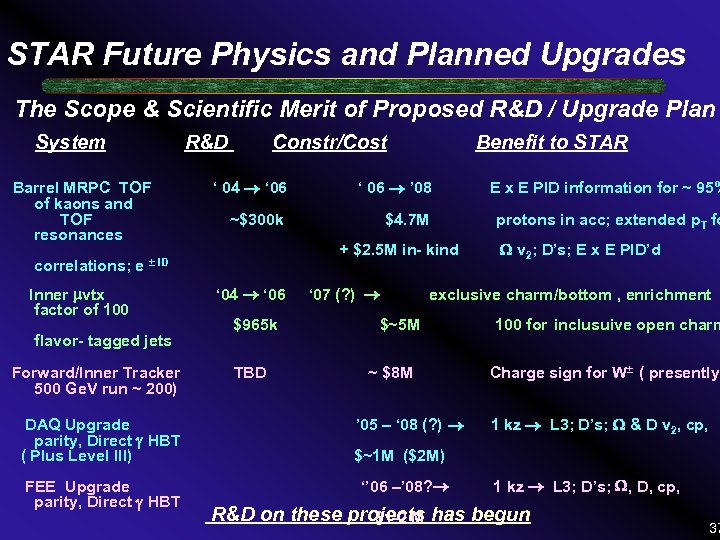 STAR Future Physics and Planned Upgrades The Scope & Scientific Merit of Proposed R&D / Upgrade Plan System R&D Barrel MRPC TOF of kaons and TOF resonances correlations; e Constr/Cost ‘ 04 ‘ 06 ’ 08 E x E PID information for ~ 95% ~$300 k $4. 7 M protons in acc; extended p. T fo + $2. 5 M in- kind ± ID Inner vtx factor of 100 flavor- tagged jets Forward/Inner Tracker 500 Ge. V run ~ 200) DAQ Upgrade parity, Direct HBT ( Plus Level III) FEE Upgrade parity, Direct HBT Benefit to STAR ‘ 04 ‘ 06 $965 k TBD ‘ 07 (? ) v 2; D’s; E x E PID’d exclusive charm/bottom , enrichment $~5 M ~ $8 M ’ 05 – ‘ 08 (? ) 100 for inclusuive open charm Charge sign for W± ( presently 1 kz L 3; D’s; & D v 2, cp, $~1 M ($2 M) ‘’ 06 –’ 08? 1 kz L 3; D’s; , D, cp, R&D on these projects has begun $1 -2 M 37
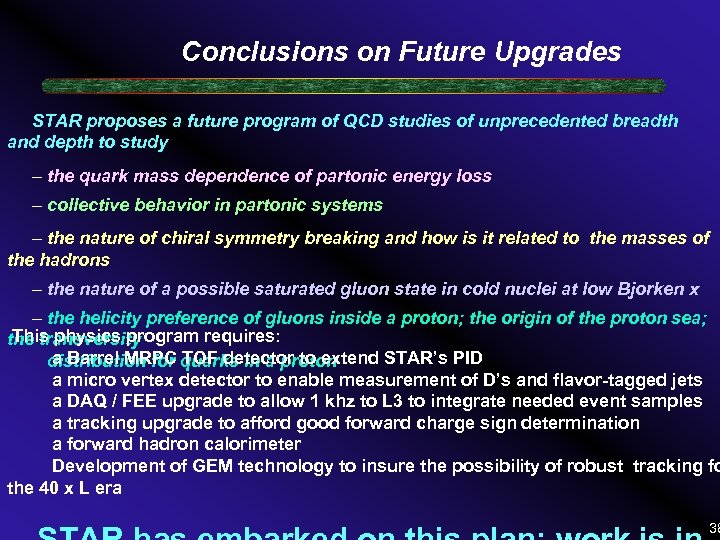 Conclusions on Future Upgrades STAR proposes a future program of QCD studies of unprecedented breadth and depth to study – the quark mass dependence of partonic energy loss – collective behavior in partonic systems – the nature of chiral symmetry breaking and how is it related to the masses of the hadrons – the nature of a possible saturated gluon state in cold nuclei at low Bjorken x – the helicity preference of gluons inside a proton; the origin of the proton sea; This physics program requires: the transversity a Barrel MRPC TOF detector to extend STAR’s PID distribution for quarks in a proton a micro vertex detector to enable measurement of D’s and flavor-tagged jets a DAQ / FEE upgrade to allow 1 khz to L 3 to integrate needed event samples a tracking upgrade to afford good forward charge sign determination a forward hadron calorimeter Development of GEM technology to insure the possibility of robust tracking fo the 40 x L era 38
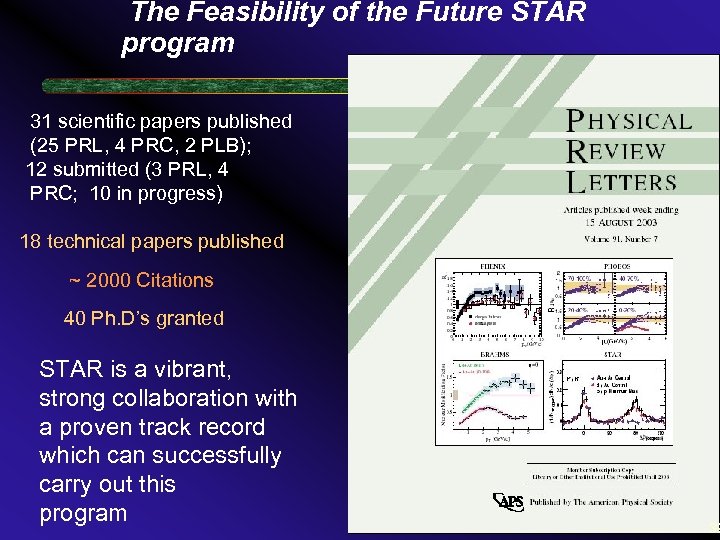 The Feasibility of the Future STAR program 31 scientific papers published (25 PRL, 4 PRC, 2 PLB); 12 submitted (3 PRL, 4 PRC; 10 in progress) 18 technical papers published ~ 2000 Citations 40 Ph. D’s granted STAR is a vibrant, strong collaboration with a proven track record which can successfully carry out this program 39
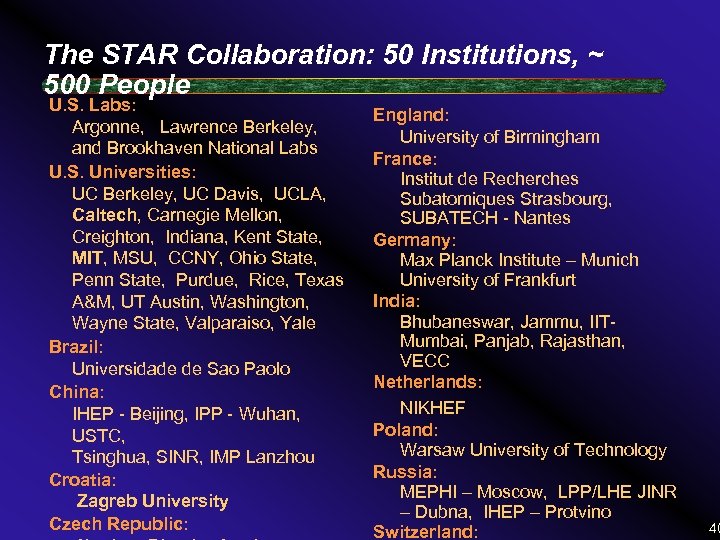 The STAR Collaboration: 50 Institutions, ~ 500 People U. S. Labs: Argonne, Lawrence Berkeley, and Brookhaven National Labs U. S. Universities: UC Berkeley, UC Davis, UCLA, Caltech, Carnegie Mellon, Creighton, Indiana, Kent State, MIT, MSU, CCNY, Ohio State, Penn State, Purdue, Rice, Texas A&M, UT Austin, Washington, Wayne State, Valparaiso, Yale Brazil: Universidade de Sao Paolo China: IHEP - Beijing, IPP - Wuhan, USTC, Tsinghua, SINR, IMP Lanzhou Croatia: Zagreb University Czech Republic: England: University of Birmingham France: Institut de Recherches Subatomiques Strasbourg, SUBATECH - Nantes Germany: Max Planck Institute – Munich University of Frankfurt India: Bhubaneswar, Jammu, IITMumbai, Panjab, Rajasthan, VECC Netherlands: NIKHEF Poland: Warsaw University of Technology Russia: MEPHI – Moscow, LPP/LHE JINR – Dubna, IHEP – Protvino Switzerland: 40
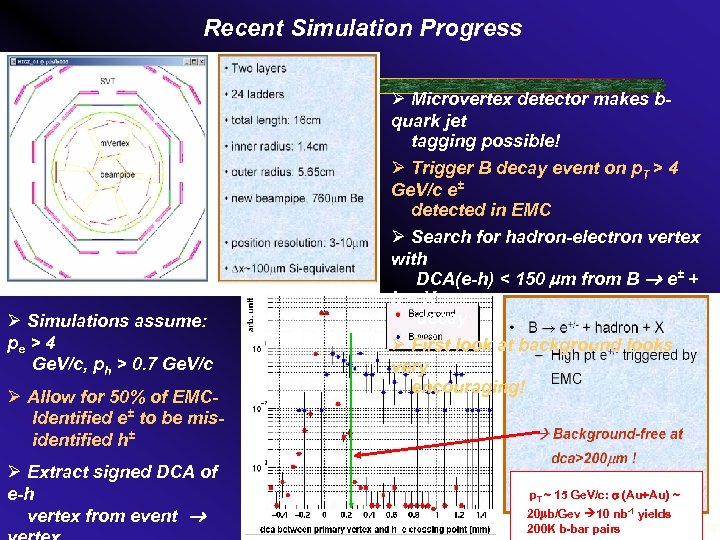 Recent Simulation Progress Ø Simulations assume: pe > 4 Ge. V/c, ph > 0. 7 Ge. V/c Ø Allow for 50% of EMCIdentified e± to be misidentified h± Ø Extract signed DCA of e-h vertex from event Ø Microvertex detector makes bquark jet tagging possible! Ø Trigger B decay event on p. T > 4 Ge. V/c e± detected in EMC Ø Search for hadron-electron vertex with DCA(e-h) < 150 m from B e± + h+X decay Ø First look at background looks very encouraging! p. T ~ 15 Ge. V/c: (Au+Au) ~ 20 b/Gev 10 nb-1 yields 200 K b-bar pairs 41
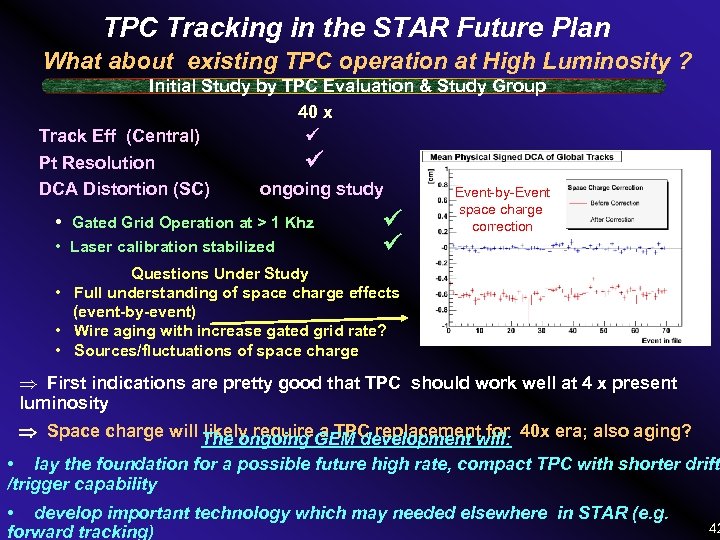 TPC Tracking in the STAR Future Plan What about existing TPC operation at High Luminosity ? Initial Study by TPC Evaluation & Study Group 40 x Track Eff (Central) Pt Resolution DCA Distortion (SC) ongoing study • Gated Grid Operation at > 1 Khz • Laser calibration stabilized Event-by-Event space charge correction Questions Under Study • Full understanding of space charge effects (event-by-event) • Wire aging with increase gated grid rate? • Sources/fluctuations of space charge Þ First indications are pretty good that TPC should work well at 4 x present luminosity Space charge will The ongoing GEM development will: 40 x era; also aging? likely require a TPC replacement for • lay the foundation for a possible future high rate, compact TPC with shorter drift /trigger capability • develop important technology which may needed elsewhere in STAR (e. g. forward tracking) 42
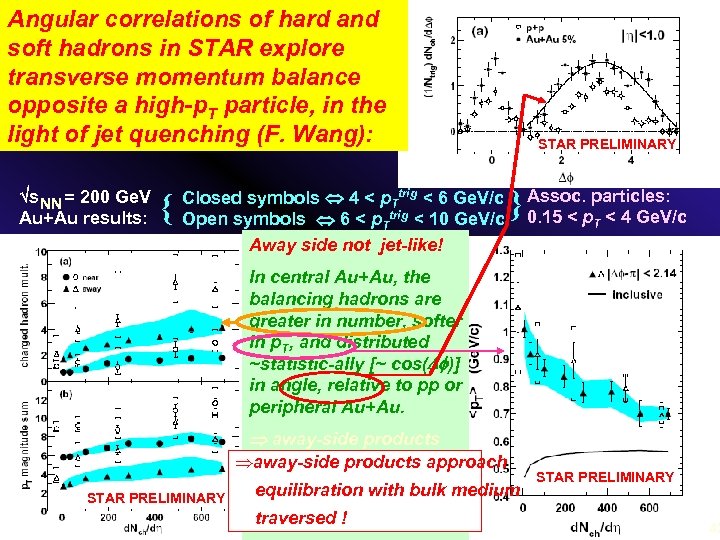 Angular correlations of hard and soft hadrons in STAR explore transverse momentum balance opposite a high-p. T particle, in the light of jet quenching (F. Wang): { Closed symbols 4 < p. Ttrig < 6 Ge. V/c Open symbols 6 < p. Ttrig < 10 Ge. V/c Away side not jet-like! { s. NN = 200 Ge. V Au+Au results: STAR PRELIMINARY Assoc. particles: 0. 15 < p. T < 4 Ge. V/c In central Au+Au, the balancing hadrons are greater in number, softer in p. T, and distributed ~statistic-ally [~ cos( )] in angle, relative to pp or peripheral Au+Au. away-side products approach equilibration Þaway-side products approach STAR PRELIMINARY with bulk medium equilibration with traversed ! STAR PRELIMINARY 43
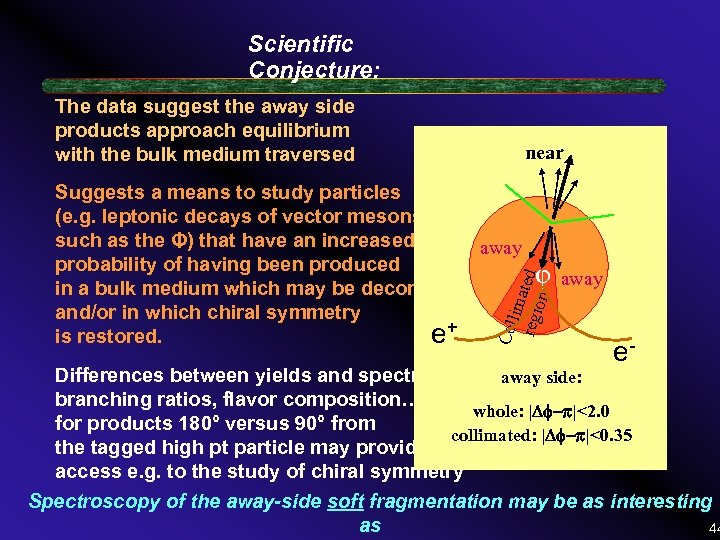 Scientific Conjecture: The data suggest the away side products approach equilibrium with the bulk medium traversed near φ Coll ima regi ted on Suggests a means to study particles (e. g. leptonic decays of vector mesons such as the Φ) that have an increased away probability of having been produced in a bulk medium which may be deconfined, and/or in which chiral symmetry e+ is restored. away e- Differences between yields and spectra, away side: branching ratios, flavor composition… whole: |Df- |<2. 0 for products 180° versus 90° from collimated: |Df- |<0. 35 the tagged high pt particle may provide access e. g. to the study of chiral symmetry Spectroscopy of the away-side soft fragmentation may be as interesting as 44
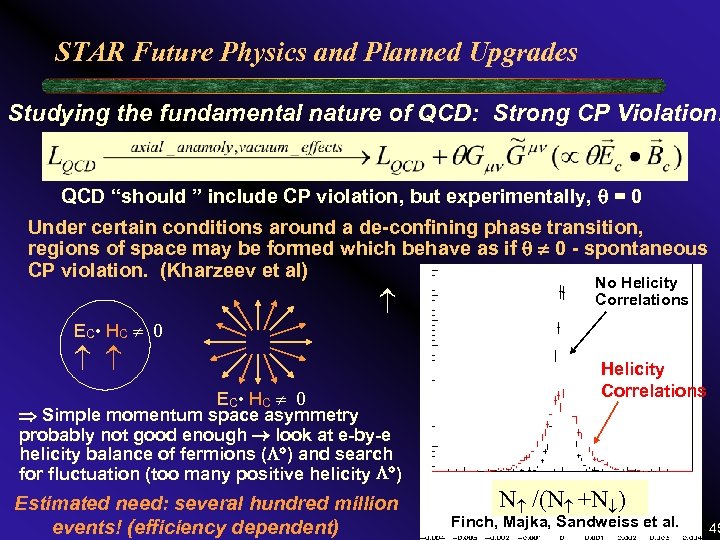 STAR Future Physics and Planned Upgrades Studying the fundamental nature of QCD: Strong CP Violation: QCD “should ” include CP violation, but experimentally, = 0 Under certain conditions around a de-confining phase transition, regions of space may be formed which behave as if 0 - spontaneous CP violation. (Kharzeev et al) E C • HC 0 Simple momentum space asymmetry probably not good enough look at e-by-e helicity balance of fermions ( ) and search for fluctuation (too many positive helicity ) Estimated need: several hundred million events! (efficiency dependent) No Helicity Correlations N /(N +N ) Finch, Majka, Sandweiss et al. 45
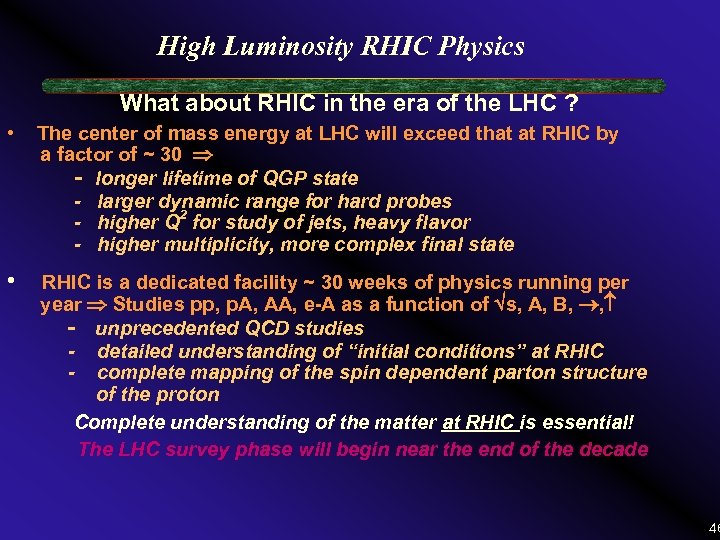 High Luminosity RHIC Physics What about RHIC in the era of the LHC ? • The center of mass energy at LHC will exceed that at RHIC by a factor of ~ 30 - longer lifetime of QGP state - larger dynamic range for hard probes - higher Q 2 for study of jets, heavy flavor - higher multiplicity, more complex final state • RHIC is a dedicated facility ~ 30 weeks of physics running per year Studies pp, p. A, AA, e-A as a function of s, A, B, , - unprecedented QCD studies - detailed understanding of “initial conditions” at RHIC - complete mapping of the spin dependent parton structure of the proton Complete understanding of the matter at RHIC is essential! The LHC survey phase will begin near the end of the decade 46
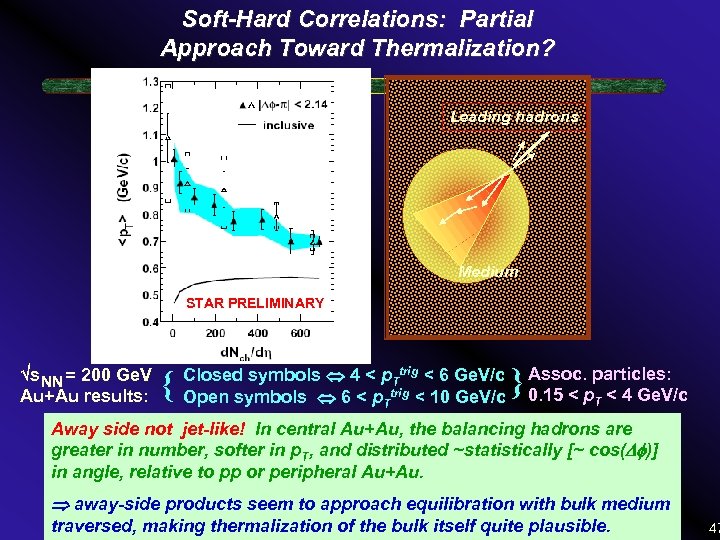 Soft-Hard Correlations: Partial Approach Toward Thermalization? Leading hadrons Medium STAR PRELIMINARY { Closed symbols 4 < p. Ttrig < 6 Ge. V/c Open symbols 6 < p. Ttrig < 10 Ge. V/c { s. NN = 200 Ge. V Au+Au results: Assoc. particles: 0. 15 < p. T < 4 Ge. V/c Away side not jet-like! In central Au+Au, the balancing hadrons are greater in number, softer in p. T, and distributed ~statistically [~ cos( )] in angle, relative to pp or peripheral Au+Au. away-side products seem to approach equilibration with bulk medium traversed, making thermalization of the bulk itself quite plausible. 47
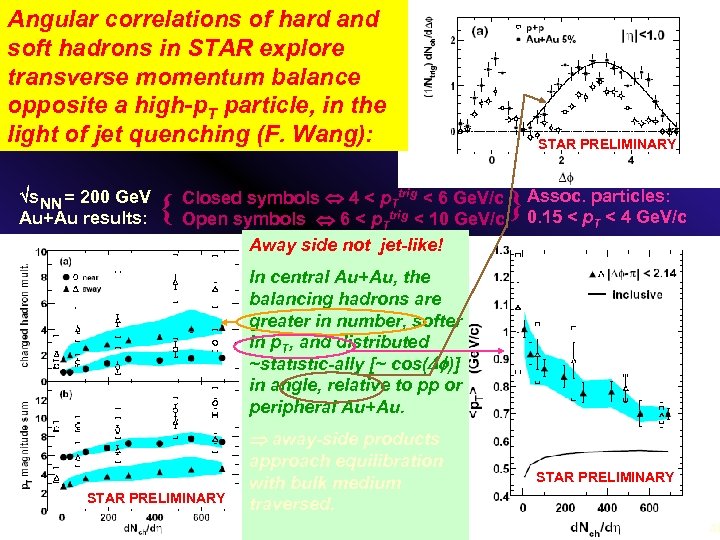 Angular correlations of hard and soft hadrons in STAR explore transverse momentum balance opposite a high-p. T particle, in the light of jet quenching (F. Wang): { Closed symbols 4 < p. Ttrig < 6 Ge. V/c Open symbols 6 < p. Ttrig < 10 Ge. V/c Away side not jet-like! { s. NN = 200 Ge. V Au+Au results: STAR PRELIMINARY Assoc. particles: 0. 15 < p. T < 4 Ge. V/c In central Au+Au, the balancing hadrons are greater in number, softer in p. T, and distributed ~statistic-ally [~ cos( )] in angle, relative to pp or peripheral Au+Au. away-side products STAR PRELIMINARY approach equilibration with bulk medium traversed. STAR PRELIMINARY 48