 Скачать презентацию Star formation histories and environment Bianca M Poggianti
24a7674f1b124773ce3b0a92f34d22a5.ppt
- Количество слайдов: 38



Star formation histories and environment Bianca M. Poggianti INAF – Osservatorio Astronomico di Padova WE ARE ALL AFTER THE BIG PICTURE: 1) To what extent, environment 2) To what extent intrinsic/galaxy mass or else 3) 2) When environment, what physical mechanism (hence, where & when)
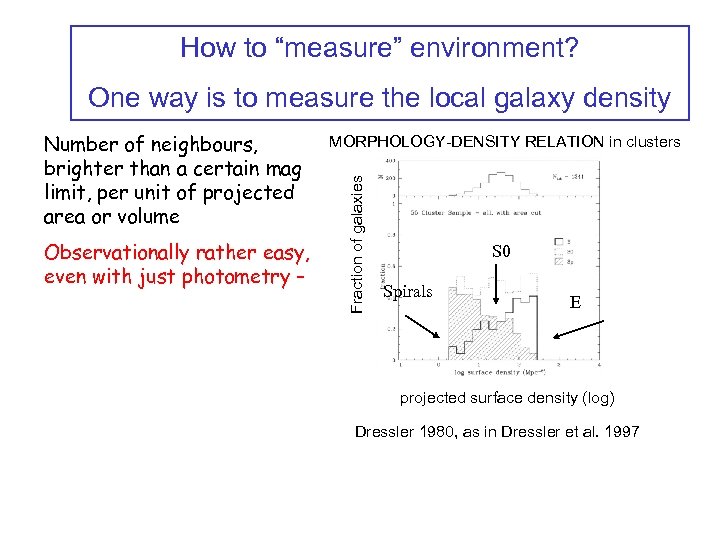
How to “measure” environment? One way is to measure the local galaxy density MORPHOLOGY-DENSITY RELATION in clusters Observationally rather easy, even with just photometry – S 0 Fraction of galaxies Number of neighbours, brighter than a certain mag limit, per unit of projected area or volume Spirals E projected surface density (log) Dressler 1980, as in Dressler et al. 1997
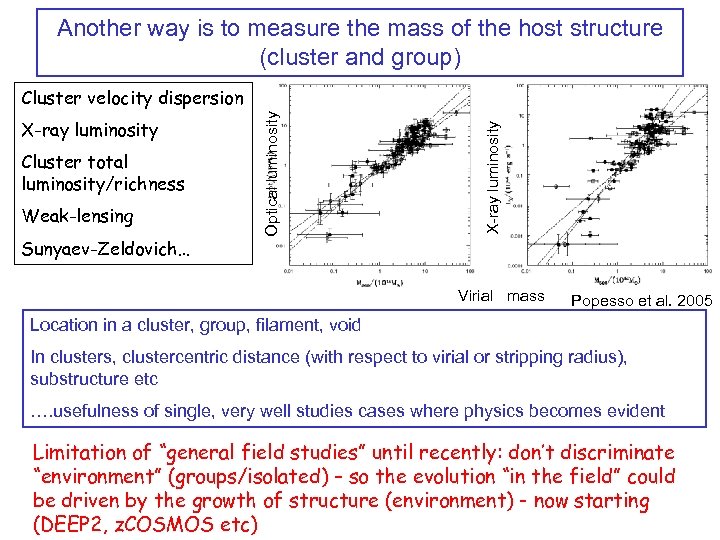
Another way is to measure the mass of the host structure (cluster and group) Cluster total luminosity/richness Weak-lensing Sunyaev-Zeldovich… X-ray luminosity Optical luminosity Cluster velocity dispersion Virial mass Popesso et al. 2005 Location in a cluster, group, filament, void In clusters, clustercentric distance (with respect to virial or stripping radius), substructure etc …. usefulness of single, very well studies cases where physics becomes evident Limitation of “general field studies” until recently: don’t discriminate “environment” (groups/isolated) – so the evolution “in the field” could be driven by the growth of structure (environment) - now starting (DEEP 2, z. COSMOS etc)
OUTLINE Ø Star. Formation and Local Density Ø Star. Formation and Cluster/Group Mass Ø Evolution of the Star. Formation in Clusters (red sequence, blue/emission line galaxies, poststarburst galaxies) Ø Star Formation and Galaxy Morphology Ø the big picture (? )
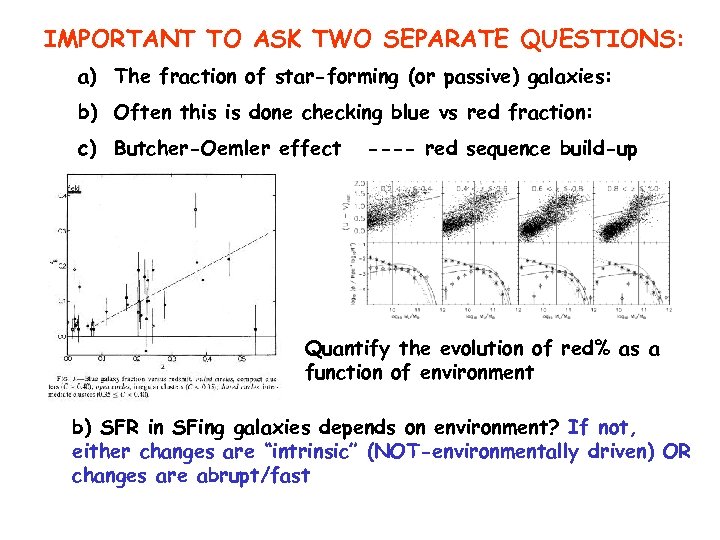
IMPORTANT TO ASK TWO SEPARATE QUESTIONS: a) The fraction of star-forming (or passive) galaxies: b) Often this is done checking blue vs red fraction: c) Butcher-Oemler effect ---- red sequence build-up Quantify the evolution of red% as a function of environment b) SFR in SFing galaxies depends on environment? If not, either changes are “intrinsic” (NOT-environmentally driven) OR changes are abrupt/fast
The evolution of the star formation-density relation
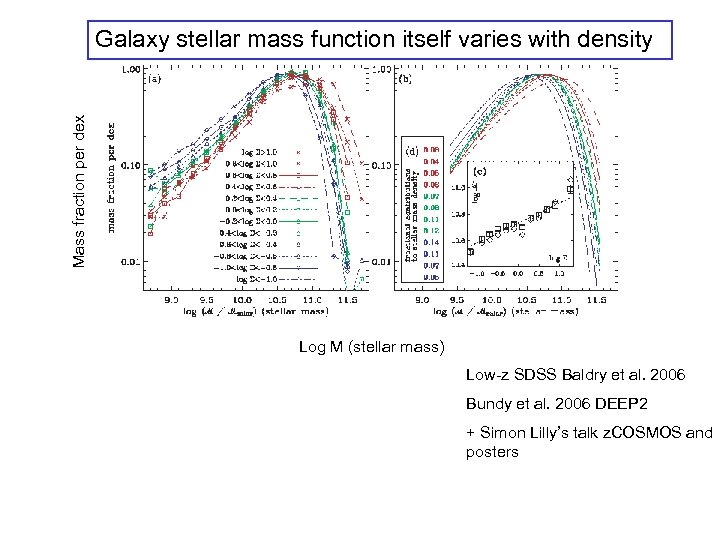
Mass fraction per dex Galaxy stellar mass function itself varies with density Log M (stellar mass) Low-z SDSS Baldry et al. 2006 Bundy et al. 2006 DEEP 2 + Simon Lilly’s talk z. COSMOS and posters
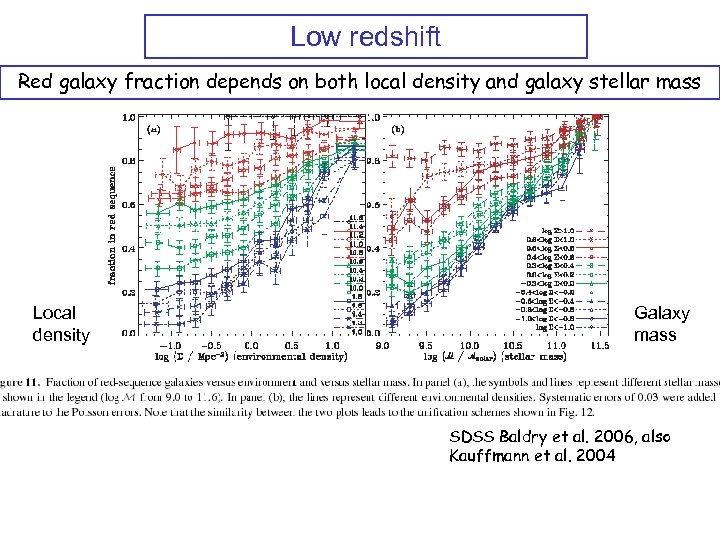
Low redshift Red galaxy fraction depends on both local density and galaxy stellar mass Local density Galaxy mass SDSS Baldry et al. 2006, also Kauffmann et al. 2004
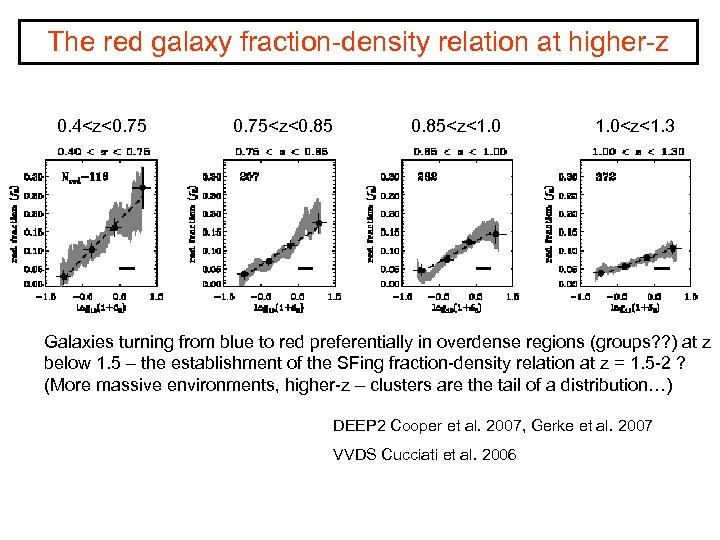
The red galaxy fraction-density relation at higher-z 0. 4<z<0. 75<z<0. 85<z<1. 0<z<1. 3 Galaxies turning from blue to red preferentially in overdense regions (groups? ? ) at z below 1. 5 – the establishment of the SFing fraction-density relation at z = 1. 5 -2 ? (More massive environments, higher-z – clusters are the tail of a distribution…) DEEP 2 Cooper et al. 2007, Gerke et al. 2007 VVDS Cucciati et al. 2006
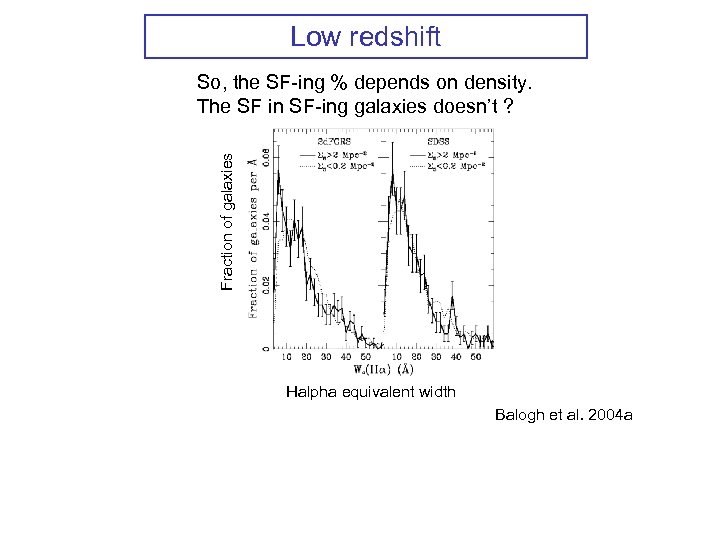
Low redshift Fraction of galaxies So, the SF-ing % depends on density. The SF in SF-ing galaxies doesn’t ? Halpha equivalent width Balogh et al. 2004 a
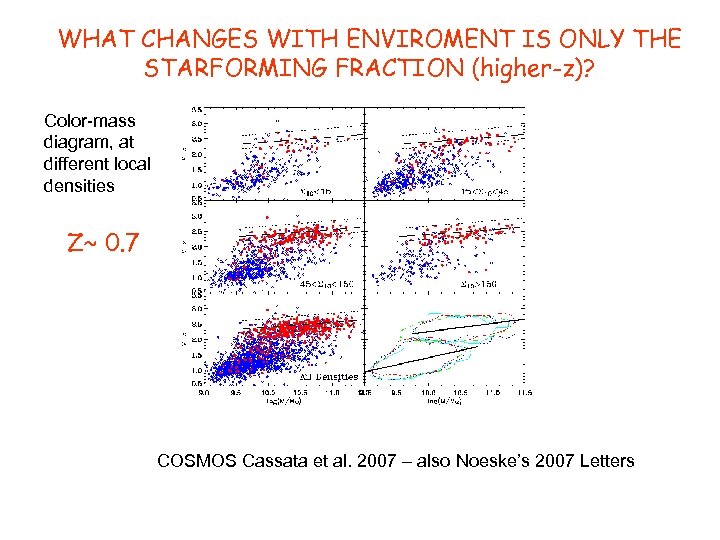
WHAT CHANGES WITH ENVIROMENT IS ONLY THE STARFORMING FRACTION (higher-z)? Color-mass diagram, at different local densities Z~ 0. 7 COSMOS Cassata et al. 2007 – also Noeske’s 2007 Letters
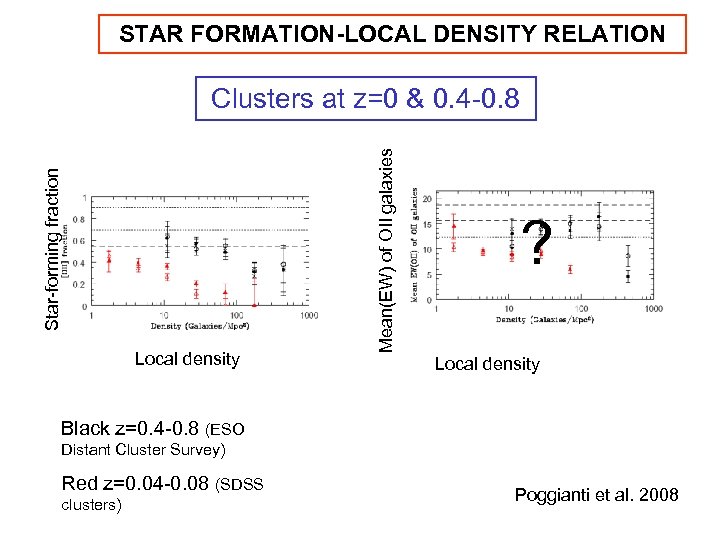
STAR FORMATION-LOCAL DENSITY RELATION Local density Mean(EW) of OII galaxies Star-forming fraction Clusters at z=0 & 0. 4 -0. 8 ? Local density Black z=0. 4 -0. 8 (ESO Distant Cluster Survey) Red z=0. 04 -0. 08 (SDSS clusters) Poggianti et al. 2008
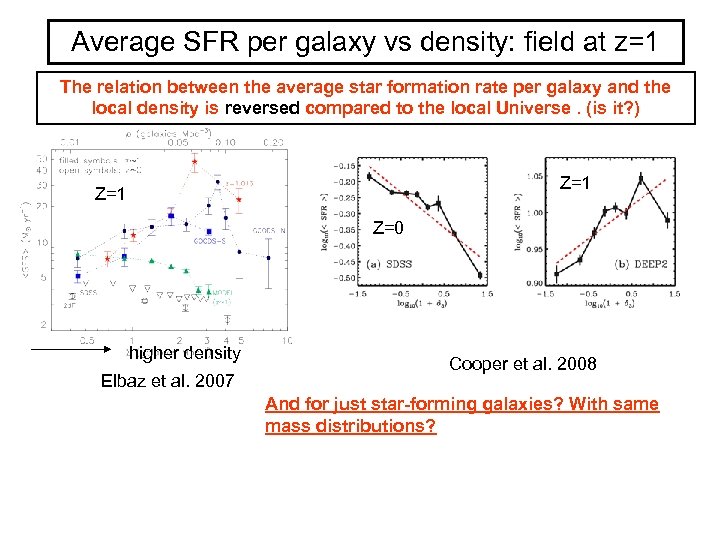
Average SFR per galaxy vs density: field at z=1 The relation between the average star formation rate per galaxy and the local density is reversed compared to the local Universe. (is it? ) Z=1 Z=0 higher density Elbaz et al. 2007 Cooper et al. 2008 And for just star-forming galaxies? With same mass distributions?
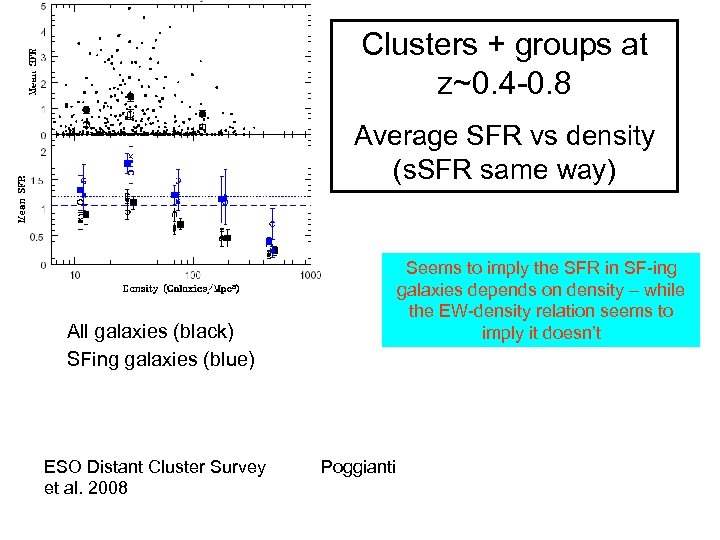
Clusters + groups at z~0. 4 -0. 8 Average SFR vs density (s. SFR same way) Seems to imply the SFR in SF-ing galaxies depends on density – while the EW-density relation seems to imply it doesn’t All galaxies (black) SFing galaxies (blue) ESO Distant Cluster Survey et al. 2008 Poggianti
The evolution of the star formation activity as a function of cluster/group mass
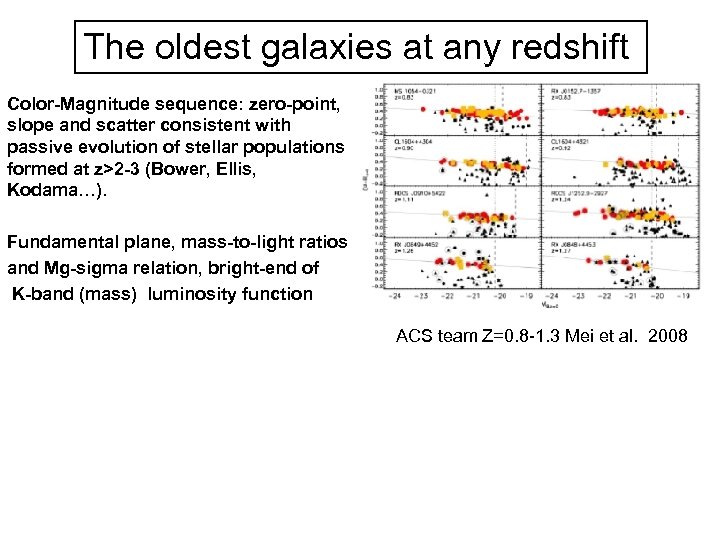
The oldest galaxies at any redshift Color-Magnitude sequence: zero-point, slope and scatter consistent with passive evolution of stellar populations formed at z>2 -3 (Bower, Ellis, Kodama…). Fundamental plane, mass-to-light ratios and Mg-sigma relation, bright-end of K-band (mass) luminosity function ACS team Z=0. 8 -1. 3 Mei et al. 2008
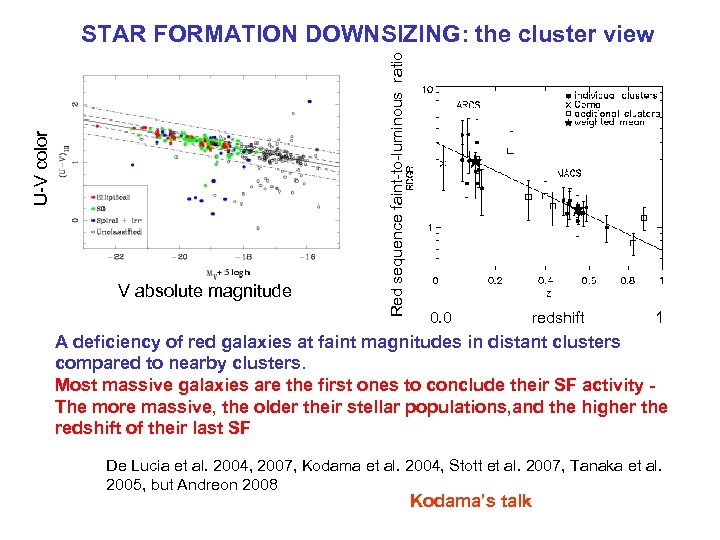
V absolute magnitude Red sequence faint-to-luminous ratio U-V color STAR FORMATION DOWNSIZING: the cluster view 0. 0 redshift 1 A deficiency of red galaxies at faint magnitudes in distant clusters compared to nearby clusters. Most massive galaxies are the first ones to conclude their SF activity The more massive, the older their stellar populations, and the higher the redshift of their last SF De Lucia et al. 2004, 2007, Kodama et al. 2004, Stott et al. 2007, Tanaka et al. 2005, but Andreon 2008 Kodama’s talk
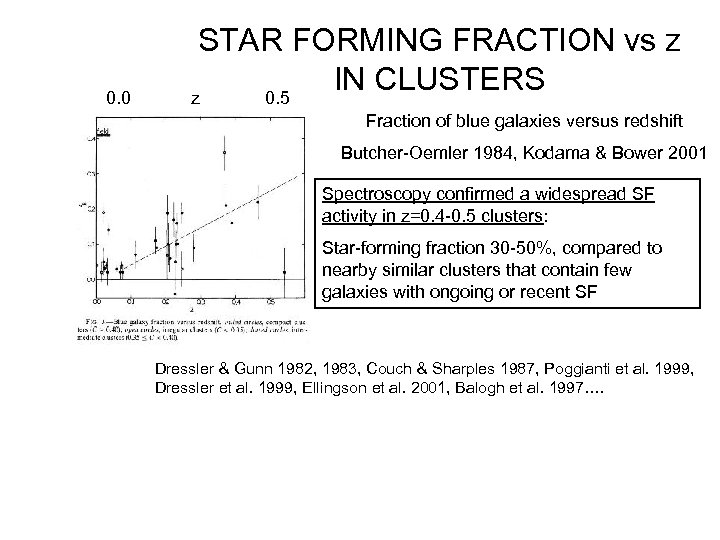
0. 0 STAR FORMING FRACTION vs z IN CLUSTERS z 0. 5 Fraction of blue galaxies versus redshift Butcher-Oemler 1984, Kodama & Bower 2001 Spectroscopy confirmed a widespread SF activity in z=0. 4 -0. 5 clusters: Star-forming fraction 30 -50%, compared to nearby similar clusters that contain few galaxies with ongoing or recent SF Dressler & Gunn 1982, 1983, Couch & Sharples 1987, Poggianti et al. 1999, Dressler et al. 1999, Ellingson et al. 2001, Balogh et al. 1997….
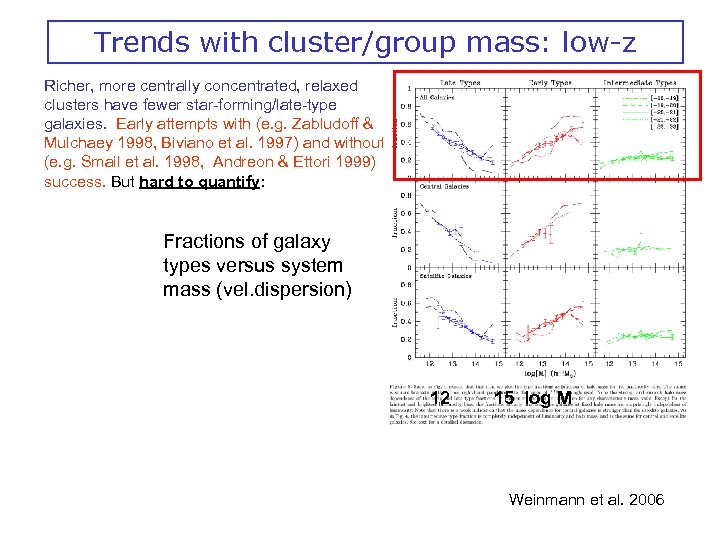
Trends with cluster/group mass: low-z Richer, more centrally concentrated, relaxed clusters have fewer star-forming/late-type galaxies. Early attempts with (e. g. Zabludoff & Mulchaey 1998, Biviano et al. 1997) and without (e. g. Smail et al. 1998, Andreon & Ettori 1999) success. But hard to quantify: Fractions of galaxy types versus system mass (vel. dispersion) 12 15 log M Weinmann et al. 2006
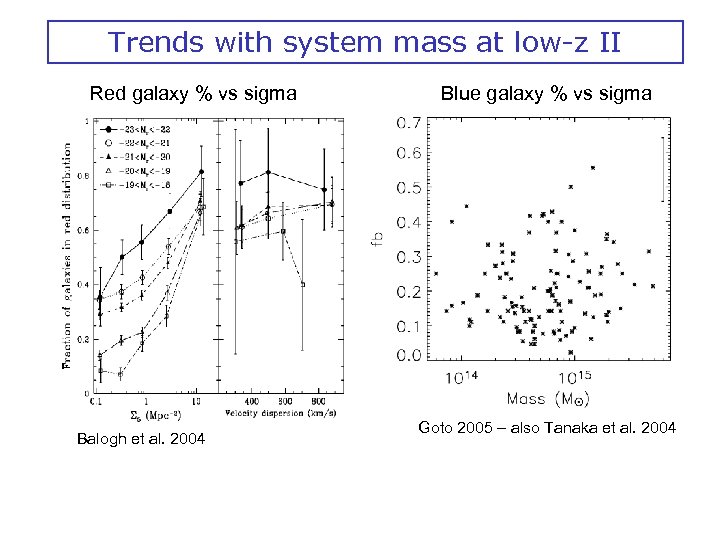
Trends with system mass at low-z II Red galaxy % vs sigma Balogh et al. 2004 Blue galaxy % vs sigma Goto 2005 – also Tanaka et al. 2004
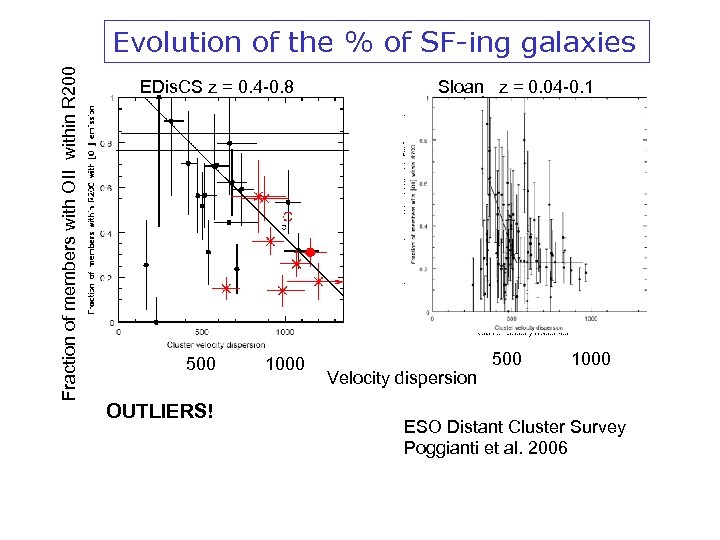
Fraction of members with OII within R 200 Evolution of the % of SF-ing galaxies EDis. CS z = 0. 4 -0. 8 500 OUTLIERS! 1000 Sloan z = 0. 04 -0. 1 Velocity dispersion 500 1000 ESO Distant Cluster Survey Poggianti et al. 2006
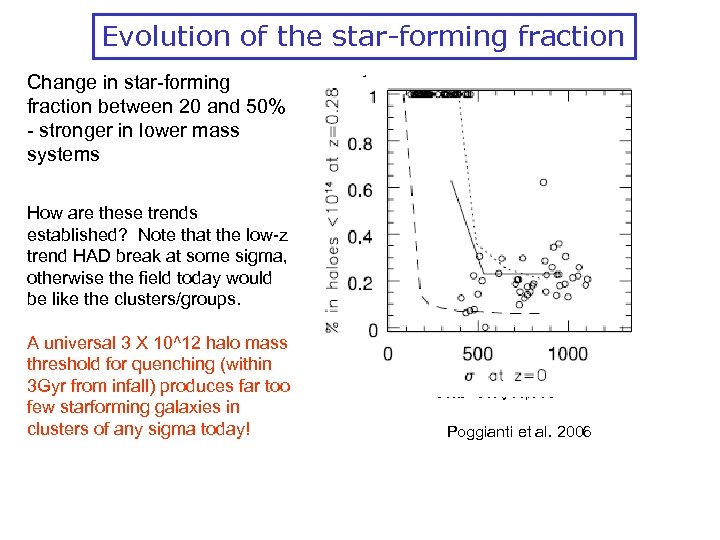
Evolution of the star-forming fraction Change in star-forming fraction between 20 and 50% - stronger in lower mass systems How are these trends established? Note that the low-z trend HAD break at some sigma, otherwise the field today would be like the clusters/groups. A universal 3 X 10^12 halo mass threshold for quenching (within 3 Gyr from infall) produces far too few starforming galaxies in clusters of any sigma today! Poggianti et al. 2006
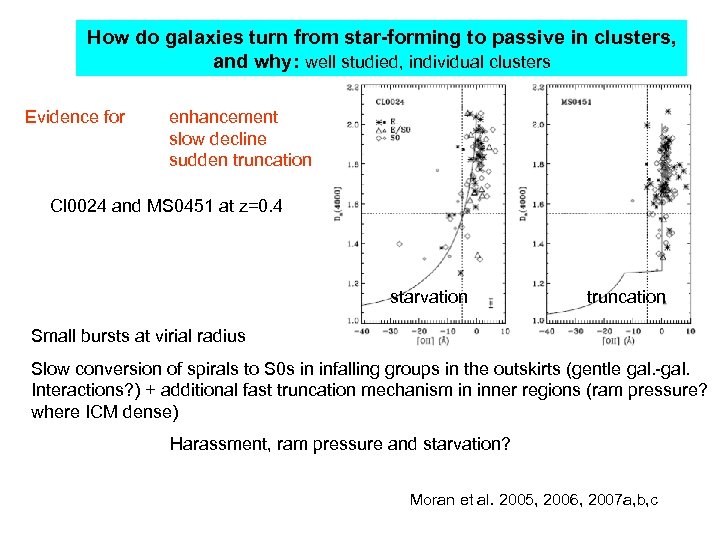
How do galaxies turn from star-forming to passive in clusters, and why: well studied, individual clusters Evidence for enhancement slow decline sudden truncation Cl 0024 and MS 0451 at z=0. 4 starvation truncation Small bursts at virial radius Slow conversion of spirals to S 0 s in infalling groups in the outskirts (gentle gal. -gal. Interactions? ) + additional fast truncation mechanism in inner regions (ram pressure? where ICM dense) Harassment, ram pressure and starvation? Moran et al. 2005, 2006, 2007 a, b, c
![Dusty red galaxies: log. M=[10 -11], low mean specific star formation rate (dust reddened),](https://present5.com/presentation/24a7674f1b124773ce3b0a92f34d22a5/image-24.jpg "Dusty red galaxies: log. M=[10 -11], low mean specific star formation rate (dust reddened),")
Dusty red galaxies: log. M=[10 -11], low mean specific star formation rate (dust reddened), indicating quenching is slow – (see also Goto et al. 2003) – but could it be just that are more massive are earlier-type galaxies? In lower mass galaxies, fast quenching accompanied by morphological change (no cluster-specific red spirals phenomenon at log. M<10) Log SFR/M A quenching timescale dependent on galaxy mass… STAGES Wolf et al. 2009 Also Haines et al. 2006, 2007 log. Mass
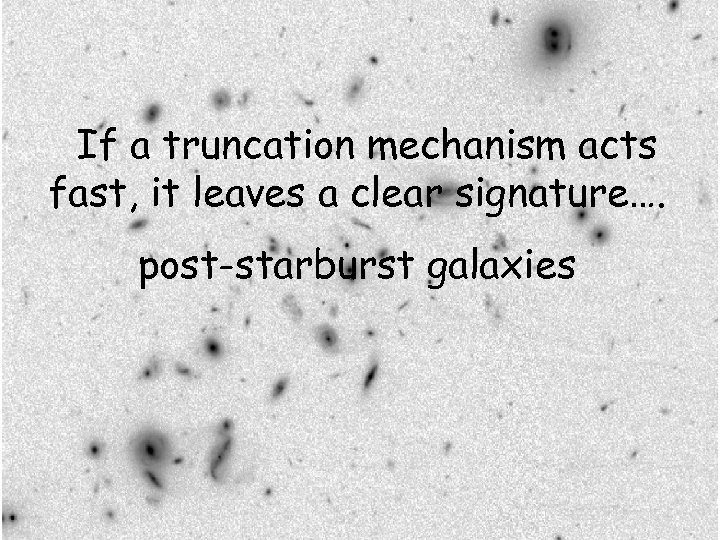
If a truncation mechanism acts fast, it leaves a clear signature…. post-starburst galaxies
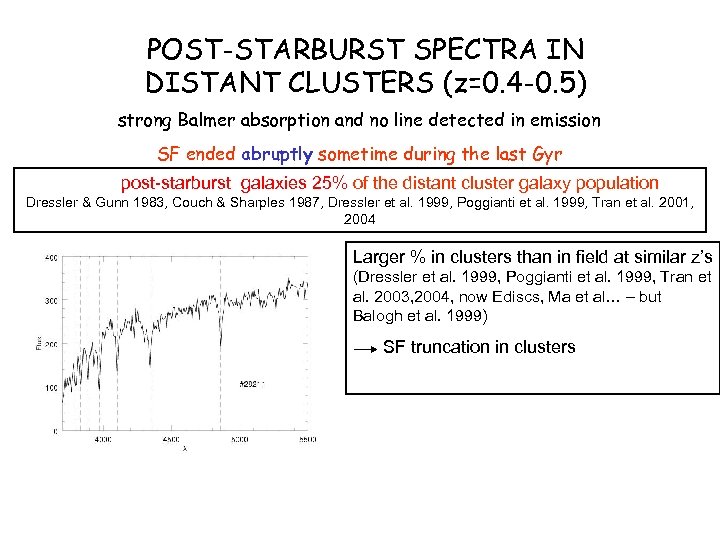
POST-STARBURST SPECTRA IN DISTANT CLUSTERS (z=0. 4 -0. 5) strong Balmer absorption and no line detected in emission SF ended abruptly sometime during the last Gyr post-starburst galaxies 25% of the distant cluster galaxy population Dressler & Gunn 1983, Couch & Sharples 1987, Dressler et al. 1999, Poggianti et al. 1999, Tran et al. 2001, 2004 Larger % in clusters than in field at similar z’s (Dressler et al. 1999, Poggianti et al. 1999, Tran et al. 2003, 2004, now Ediscs, Ma et al… – but Balogh et al. 1999) SF truncation in clusters
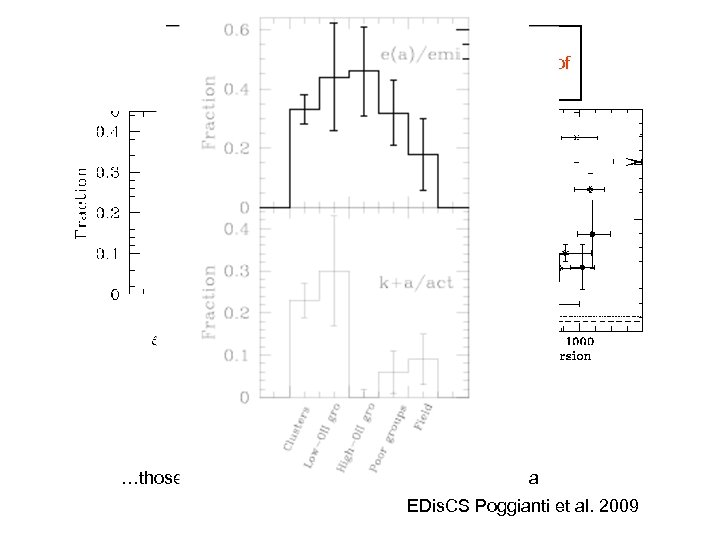
K+a fraction At z=0. 4 -0. 8, post-starburst galaxies more frequent in more massive clusters and in some of the groups… …those groups with a low OII fraction for their sigma EDis. CS Poggianti et al. 2009
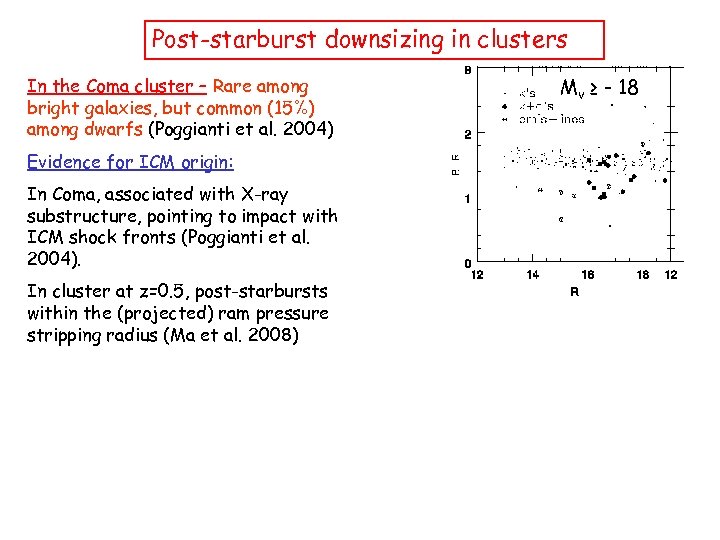
Post-starburst downsizing in clusters In the Coma cluster – Rare among bright galaxies, but common (15%) among dwarfs (Poggianti et al. 2004) Evidence for ICM origin: In Coma, associated with X-ray substructure, pointing to impact with ICM shock fronts (Poggianti et al. 2004). In cluster at z=0. 5, post-starbursts within the (projected) ram pressure stripping radius (Ma et al. 2008) Mv ≥ - 18
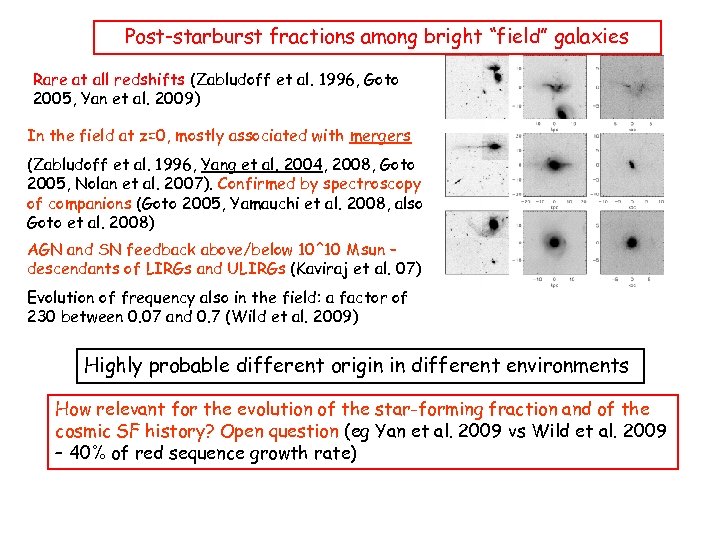
Post-starburst fractions among bright “field” galaxies Rare at all redshifts (Zabludoff et al. 1996, Goto 2005, Yan et al. 2009) In the field at z=0, mostly associated with mergers (Zabludoff et al. 1996, Yang et al. 2004, 2008, Goto 2005, Nolan et al. 2007). Confirmed by spectroscopy of companions (Goto 2005, Yamauchi et al. 2008, also Goto et al. 2008) AGN and SN feedback above/below 10^10 Msun – descendants of LIRGs and ULIRGs (Kaviraj et al. 07) Evolution of frequency also in the field: a factor of 230 between 0. 07 and 0. 7 (Wild et al. 2009) Highly probable different origin in different environments How relevant for the evolution of the star-forming fraction and of the cosmic SF history? Open question (eg Yan et al. 2009 vs Wild et al. 2009 – 40% of red sequence growth rate)
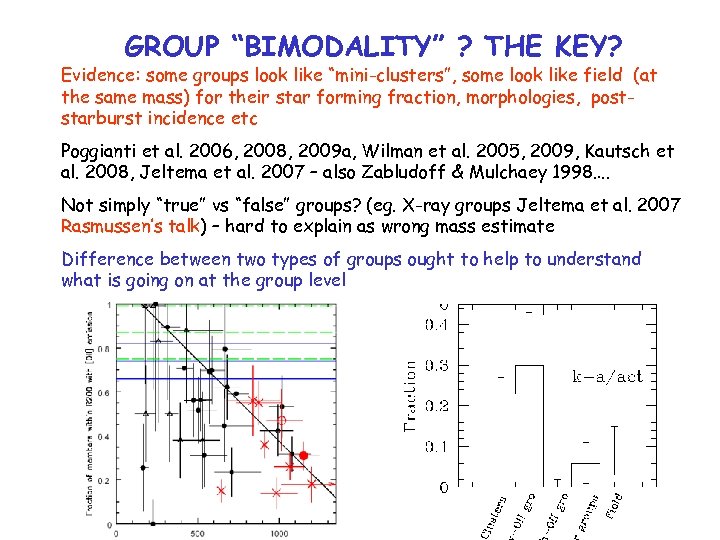
GROUP “BIMODALITY” ? THE KEY? Evidence: some groups look like “mini-clusters”, some look like field (at the same mass) for their star forming fraction, morphologies, poststarburst incidence etc Poggianti et al. 2006, 2008, 2009 a, Wilman et al. 2005, 2009, Kautsch et al. 2008, Jeltema et al. 2007 – also Zabludoff & Mulchaey 1998…. Not simply “true” vs “false” groups? (eg. X-ray groups Jeltema et al. 2007 Rasmussen’s talk) – hard to explain as wrong mass estimate Difference between two types of groups ought to help to understand what is going on at the group level
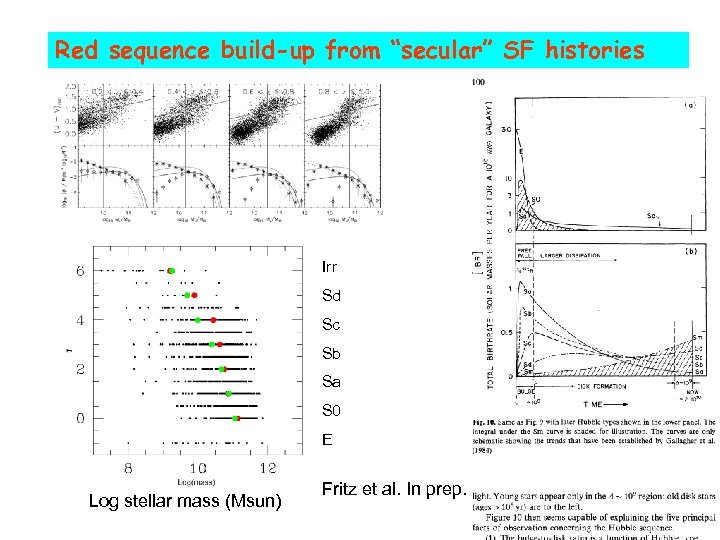
Red sequence build-up from “secular” SF histories Irr Sd Sc Sb Sa S 0 E Log stellar mass (Msun) Fritz et al. In prep.
Star formation and galaxy morphology (Hubble type)
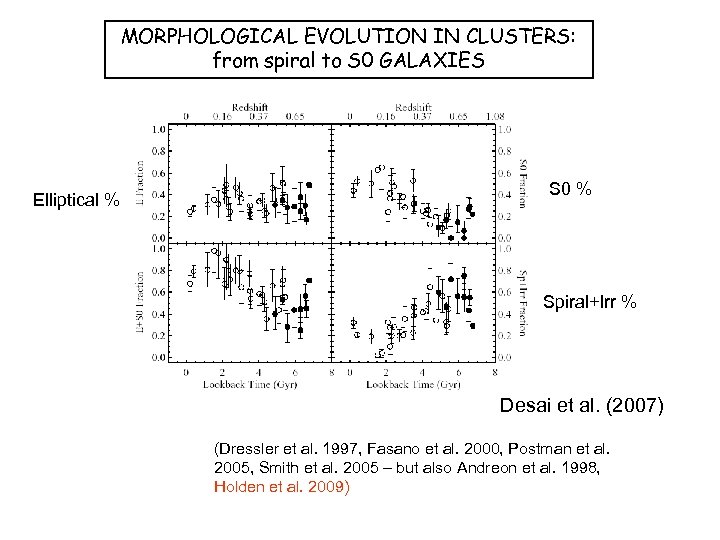
MORPHOLOGICAL EVOLUTION IN CLUSTERS: from spiral to S 0 GALAXIES Elliptical % S 0 % Spiral+Irr % Desai et al. (2007) (Dressler et al. 1997, Fasano et al. 2000, Postman et al. 2005, Smith et al. 2005 – but also Andreon et al. 1998, Holden et al. 2009)
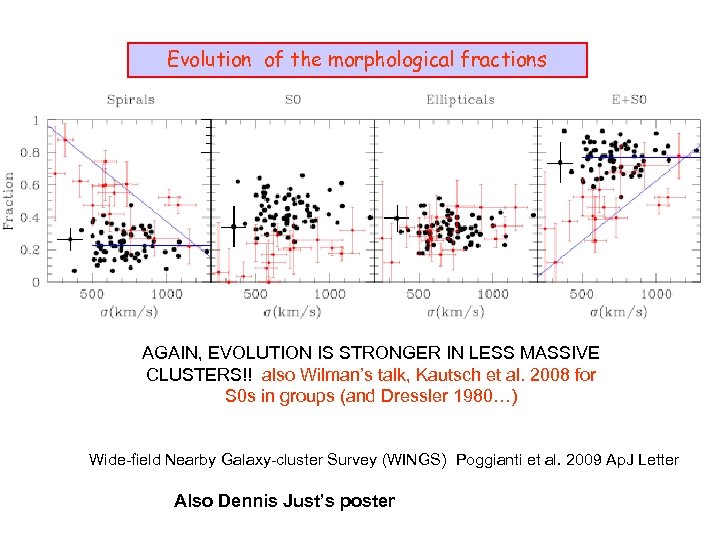
Evolution of the morphological fractions AGAIN, EVOLUTION IS STRONGER IN LESS MASSIVE CLUSTERS!! also Wilman’s talk, Kautsch et al. 2008 for S 0 s in groups (and Dressler 1980…) Wide-field Nearby Galaxy-cluster Survey (WINGS) Poggianti et al. 2009 Ap. J Letter Also Dennis Just’s poster
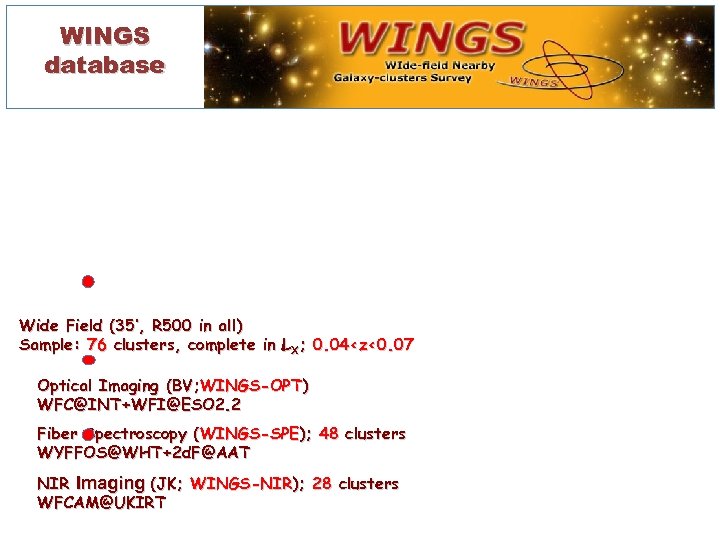
WINGS database Wide Field (35’, R 500 in all) Sample: 76 clusters, complete in LX; 0. 04<z<0. 07 Optical Imaging (BV; WINGS-OPT) WFC@INT+WFI@ESO 2. 2 Fiber Spectroscopy (WINGS-SPE); 48 clusters WYFFOS@WHT+2 d. F@AAT NIR Imaging (JK; WINGS-NIR); 28 clusters WFCAM@UKIRT
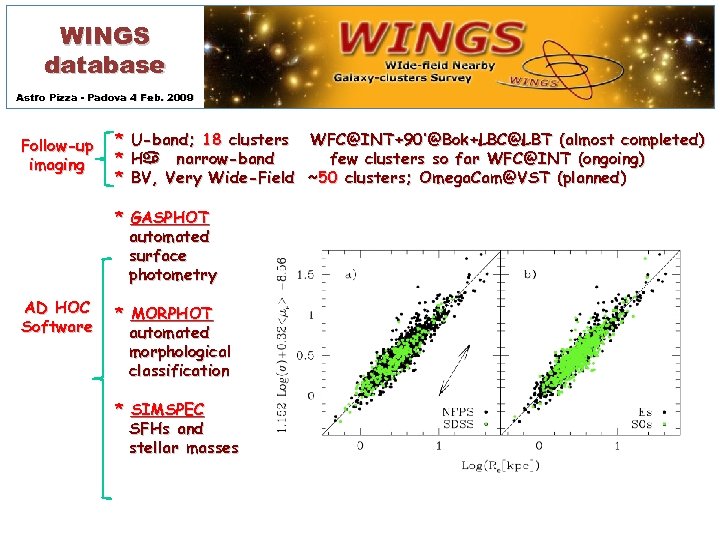
WINGS database Astro Pizza - Padova 4 Feb. 2009 Follow-up imaging * * * U-band; 18 clusters WFC@INT+90’@Bok+LBC@LBT (almost completed) Ha narrow-band few clusters so far WFC@INT (ongoing) BV, Very Wide-Field ~50 clusters; Omega. Cam@VST (planned) * GASPHOT automated surface photometry AD HOC Software * MORPHOT automated morphological classification * SIMSPEC SFHs and stellar masses

Wings Catalogs Optical photometry (Fasano et al. 2006, Varela et al. 2009 in press) Near-IR catalogs release (Valentinuzzi et al. 2009 in press) Spectroscopic catalog release (Cava et al. 2009 in press) Line measurements and star formation histories (Fritz et al. 2009 a in prep. , 2009 b in prep. ) Morphology and sur. phot. catalogs (Fasano et al. 2009, in prep. , D’Onofrio et al. in prep. ) Lick Indices Release (Hansson et al. 2009 in prep. ) UV catalogs release (Omizzolo et al. 2009, in prep. )
FORMULATING A WORKING HYPOTHESIS FROM BLUE TO RED ON A COSMIC SCALE: either it happens in groups, or it is “intrinsic” – but it cannot happen in all groups, as testified by the large scatter in galaxy properties in groups – so, hard to be explained by strangulation What if what really matters is the primordial matter density (“primordial environment”, if you like) AND the primordial “available mass” That correlates with the distributions of local projected future density global environment galaxy mass + additional mechanisms on some galaxies required (eg. poststarbursts) – is there ANY evidence that a group-specific mechanism (=strangulation) is needed? ? How different from “common” picture?
Скачать презентацию Star formation histories and environment Bianca M Poggianti
24a7674f1b124773ce3b0a92f34d22a5.ppt