


 Скачать презентацию Star Formation 28 April 2003 Astronomy G 9001
4a146045324e2de7893df1d821be808d.ppt
- Количество слайдов: 30
 Star Formation 28 April 2003 Astronomy G 9001 - Spring 2003 Prof. Mordecai-Mark Mac Low
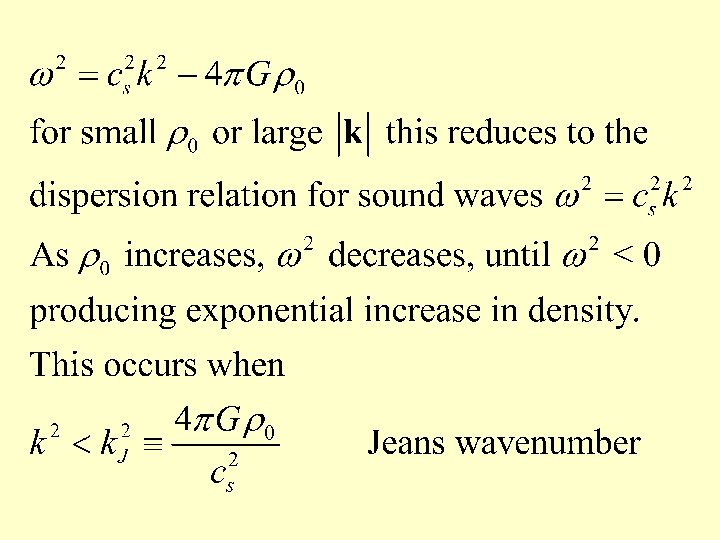
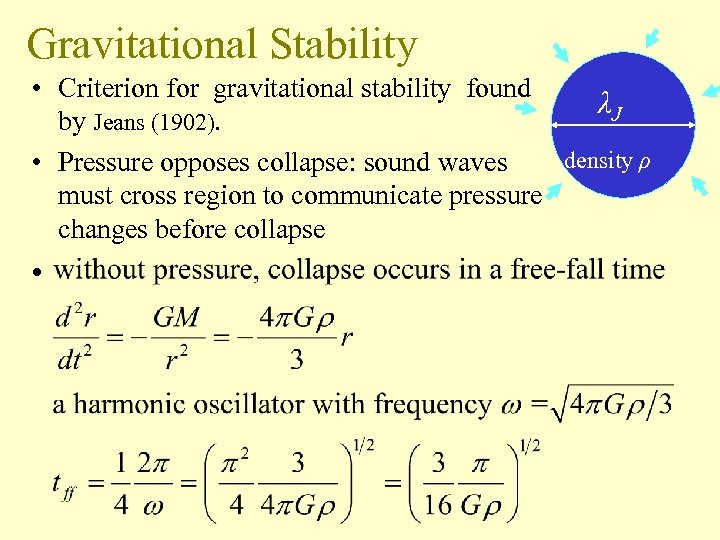 Gravitational Stability • Criterion for gravitational stability found λJ by Jeans (1902). density ρ • Pressure opposes collapse: sound waves must cross region to communicate pressure changes before collapse •
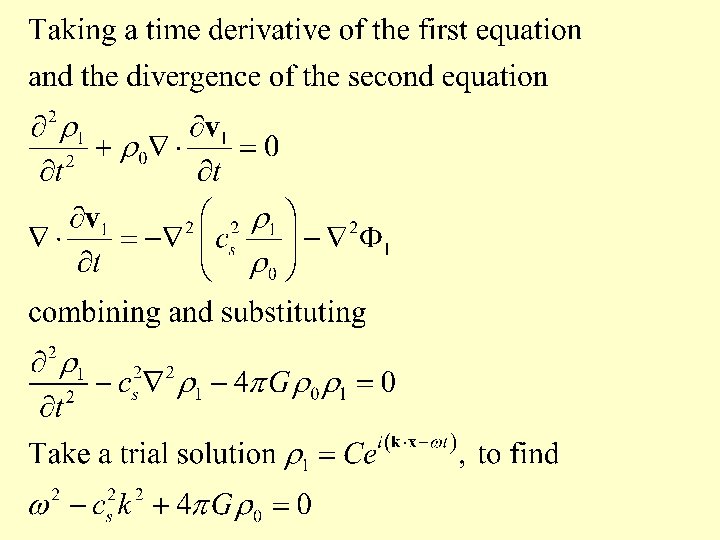
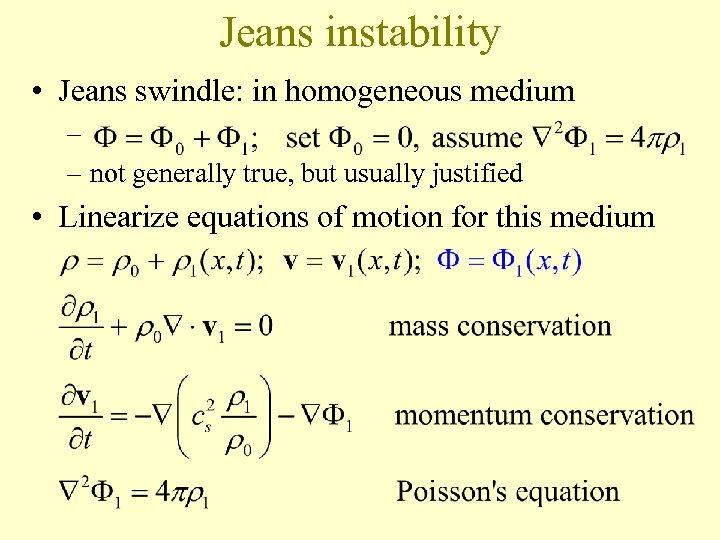 Jeans instability • Jeans swindle: in homogeneous medium – – not generally true, but usually justified • Linearize equations of motion for this medium
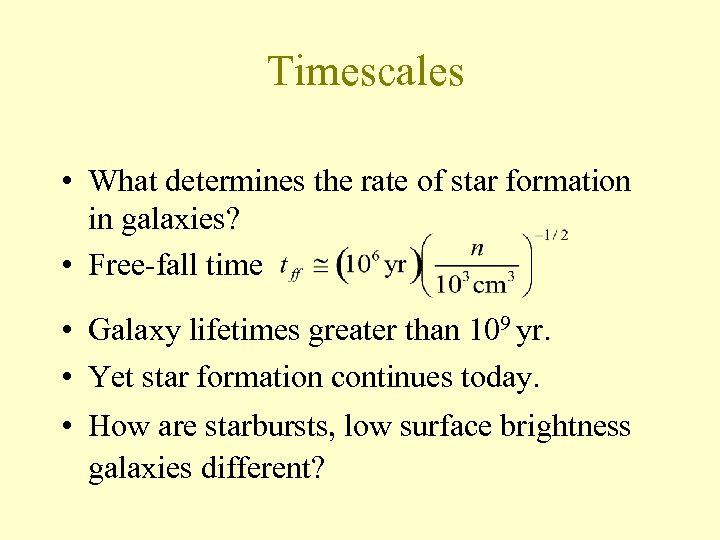 Timescales • What determines the rate of star formation in galaxies? • Free-fall time • Galaxy lifetimes greater than 109 yr. • Yet star formation continues today. • How are starbursts, low surface brightness galaxies different?
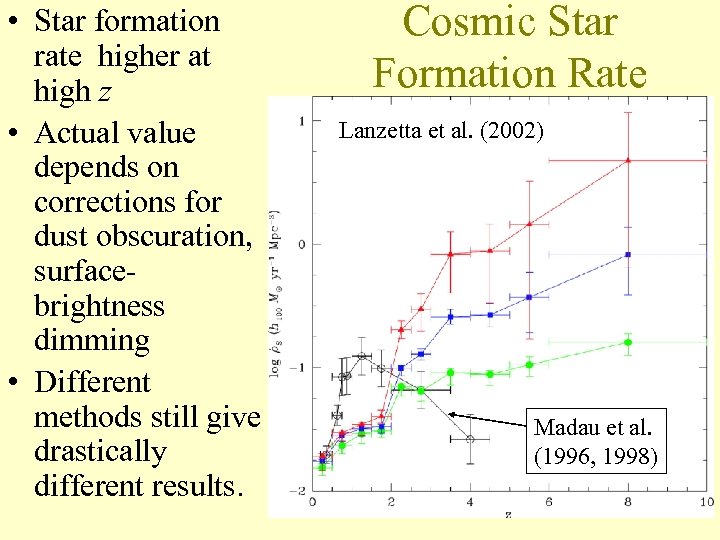 • Star formation rate higher at high z • Actual value depends on corrections for dust obscuration, surfacebrightness dimming • Different methods still give drastically different results. Cosmic Star Formation Rate Lanzetta et al. (2002) Madau et al. (1996, 1998)
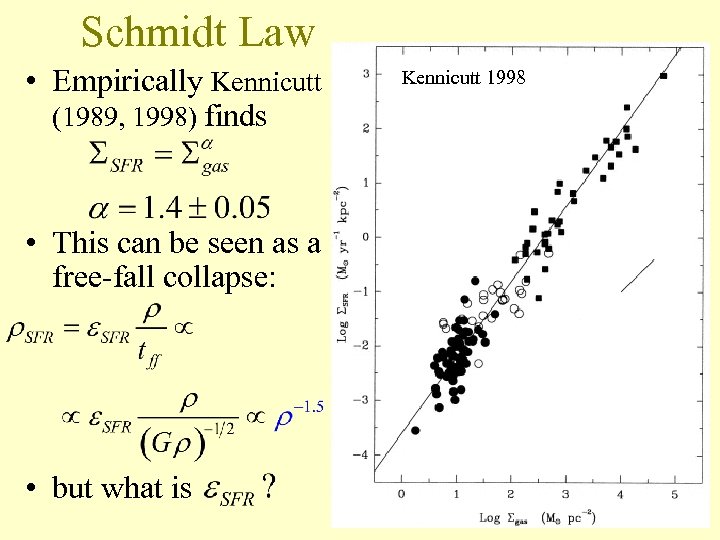 Schmidt Law • Empirically Kennicutt (1989, 1998) finds • This can be seen as a free-fall collapse: • but what is Kennicutt 1998
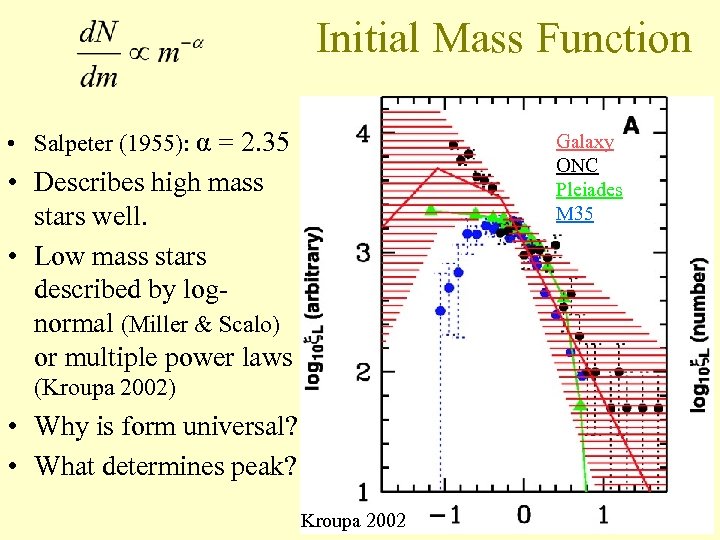 Initial Mass Function • Salpeter (1955): α = 2. 35 Galaxy ONC Pleiades M 35 • Describes high mass stars well. • Low mass stars described by lognormal (Miller & Scalo) or multiple power laws (Kroupa 2002) • Why is form universal? • What determines peak? Kroupa 2002
 How can stars form? • Gravity is counteracted by – thermal pressure – angular momentum – magnetic pressure and tension • Each must be overcome for collapse to occur
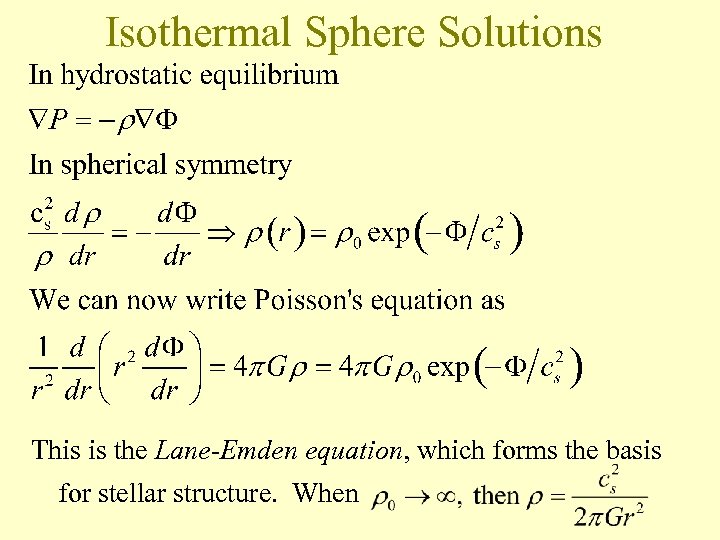 Isothermal Sphere Solutions This is the Lane-Emden equation, which forms the basis for stellar structure. When
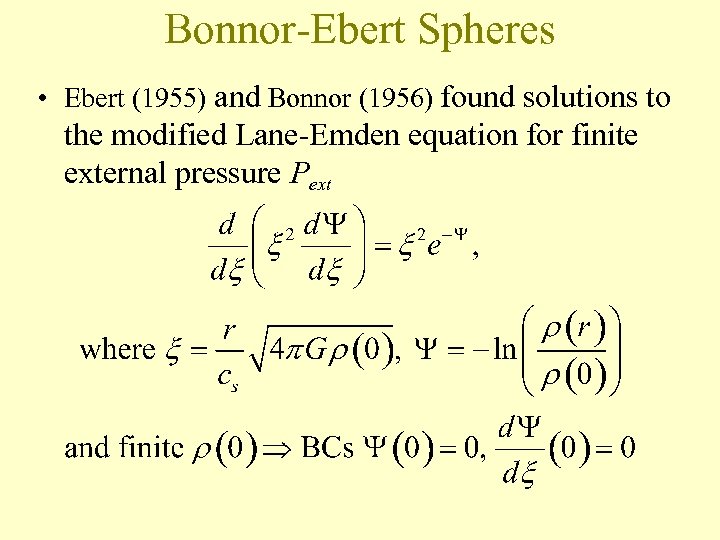 Bonnor-Ebert Spheres • Ebert (1955) and Bonnor (1956) found solutions to the modified Lane-Emden equation for finite external pressure Pext
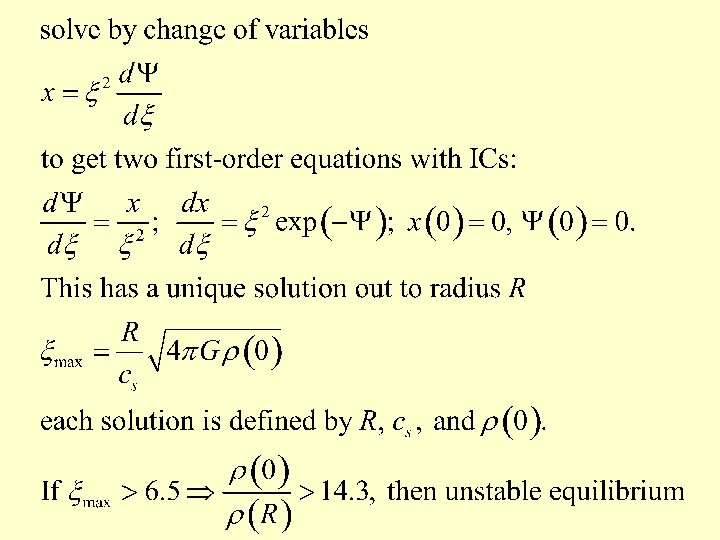
 Isothermal Collapse • Larson (1969) and Penston (1969) found similarity solutions for the collapse of a uniform density, isothermal sphere • Shu (1977) gave the collapse solution for an initially hydrostatic isothermal sphere (but this has a density singularity at the center). • Whitworth & Summers (1985) showed that many isothermal collapse solutions exist; all can be described with two parameters measuring the initial and final density concentration • Isothermal sphere with central singularity is only the most extreme case
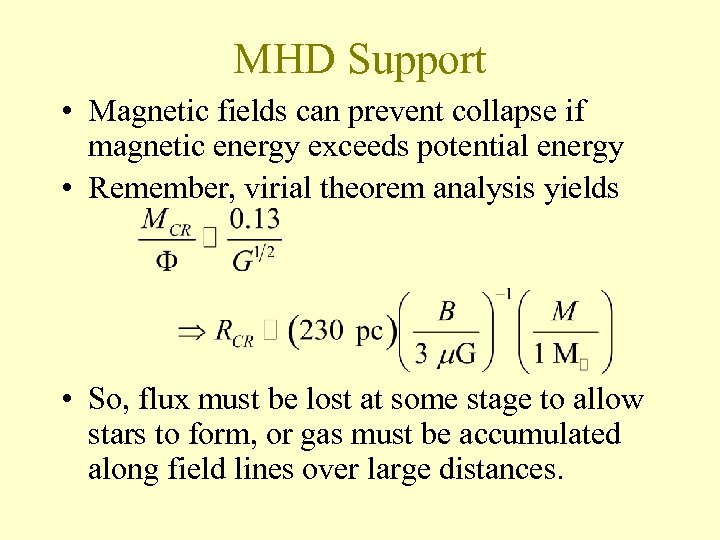 MHD Support • Magnetic fields can prevent collapse if magnetic energy exceeds potential energy • Remember, virial theorem analysis yields • So, flux must be lost at some stage to allow stars to form, or gas must be accumulated along field lines over large distances.
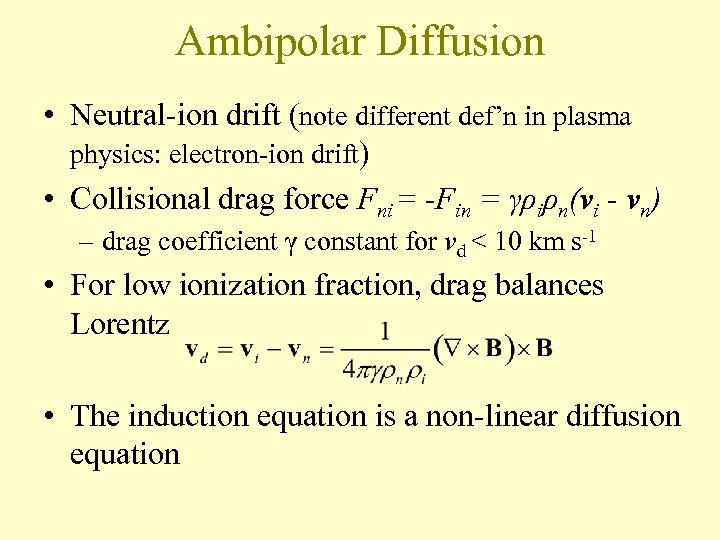 Ambipolar Diffusion • Neutral-ion drift (note different def’n in plasma physics: electron-ion drift) • Collisional drag force Fni = -Fin = γρiρn(vi - vn) – drag coefficient γ constant for vd < 10 km s-1 • For low ionization fraction, drag balances Lorentz • The induction equation is a non-linear diffusion equation
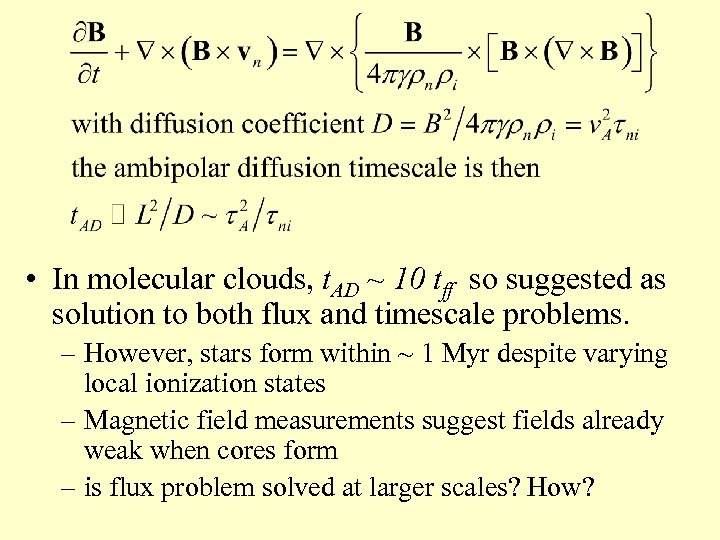 • In molecular clouds, t. AD ~ 10 tff so suggested as solution to both flux and timescale problems. – However, stars form within ~ 1 Myr despite varying local ionization states – Magnetic field measurements suggest fields already weak when cores form – is flux problem solved at larger scales? How?
 Importance of Ambipolar Diffusion • May be most important dissipation mechanism in turbulence • Mediates shock waves, reducing heating, but causing instability • Determines binary formation by modulating magnetic braking in protostellar cores • Controls viscosity in accretion disks by suppressing magnetorotational instability • Forms current sheets in turbulent flows, perhaps melting meteoritic chondrules in protoplanetary disks?
 Turbulent Fragmentation • Gravitational fragmentation in a turbulent flow may explain some features of star formation – collapse time depends on strength of turbulence – slow, isolated collapse occurs in regions globally supported against collapse by turbulence – fast, clustered collapse occurs in unsupported regions – IMF appears log normal near Jeans mass • Turbulent state of molecular clouds suggests this mechanism indeed operates – most observed cores magnetically unsupported
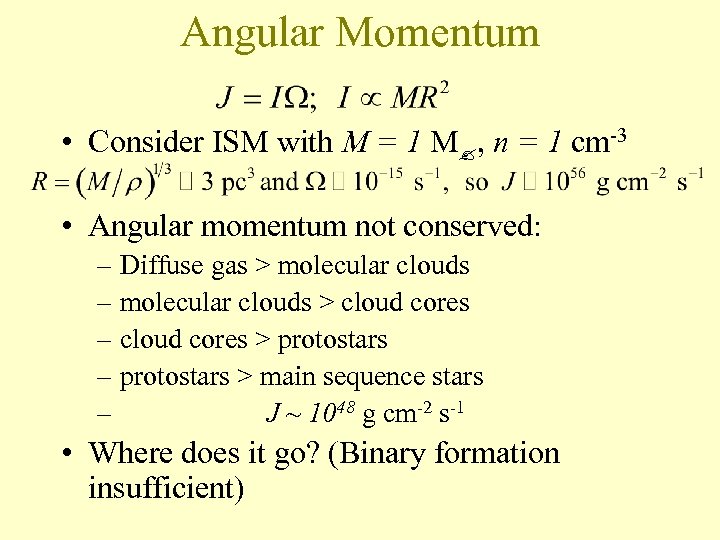 Angular Momentum • Consider ISM with M = 1 M , n = 1 cm-3 • Angular momentum not conserved: – Diffuse gas > molecular clouds – molecular clouds > cloud cores – cloud cores > protostars – protostars > main sequence stars – J ~ 1048 g cm-2 s-1 • Where does it go? (Binary formation insufficient)
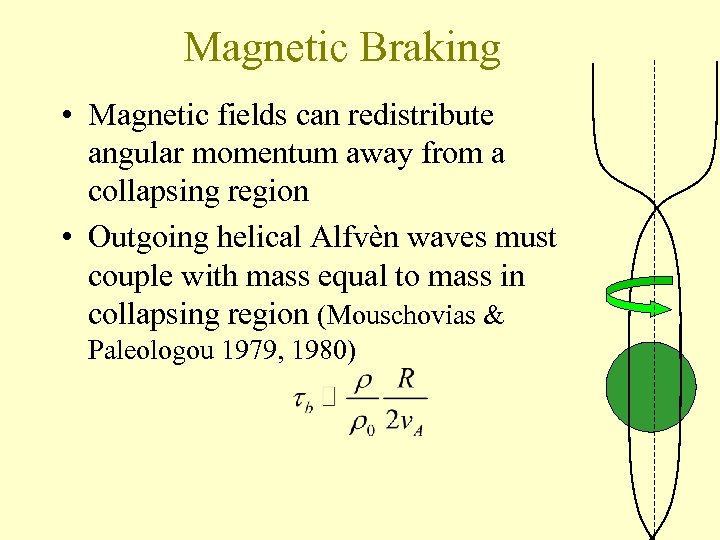 Magnetic Braking • Magnetic fields can redistribute angular momentum away from a collapsing region • Outgoing helical Alfvèn waves must couple with mass equal to mass in collapsing region (Mouschovias & Paleologou 1979, 1980)
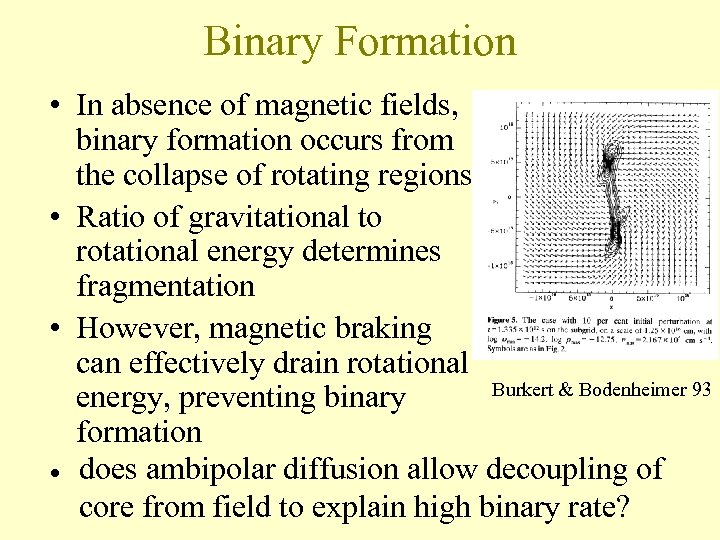 Binary Formation • In absence of magnetic fields, binary formation occurs from the collapse of rotating regions • Ratio of gravitational to rotational energy determines fragmentation • However, magnetic braking can effectively drain rotational Burkert & Bodenheimer 93 energy, preventing binary formation • does ambipolar diffusion allow decoupling of core from field to explain high binary rate?
 Piecewise Parabolic Method • • • Third-order advection Godunov method for flux estimation Contact discontinuity steepeners Small amount of linear artificial viscosity Described by Colella & Woodward 1984, JCP, compared to other methods by Woodward & Colella 1984, JCP.
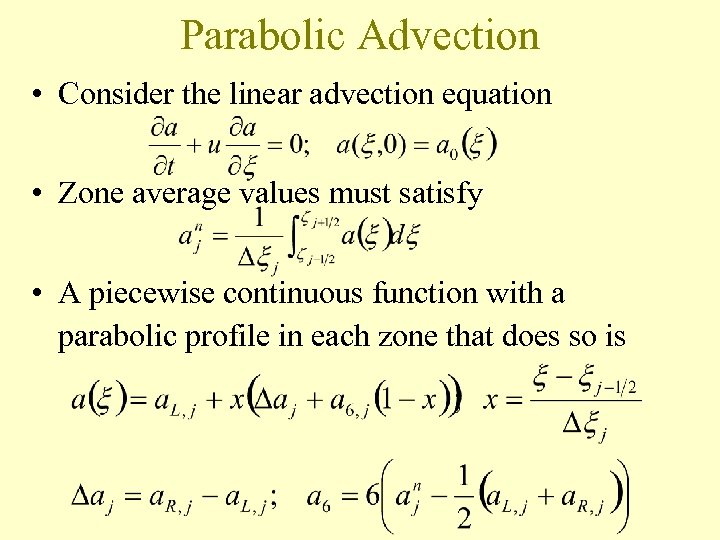 Parabolic Advection • Consider the linear advection equation • Zone average values must satisfy • A piecewise continuous function with a parabolic profile in each zone that does so is
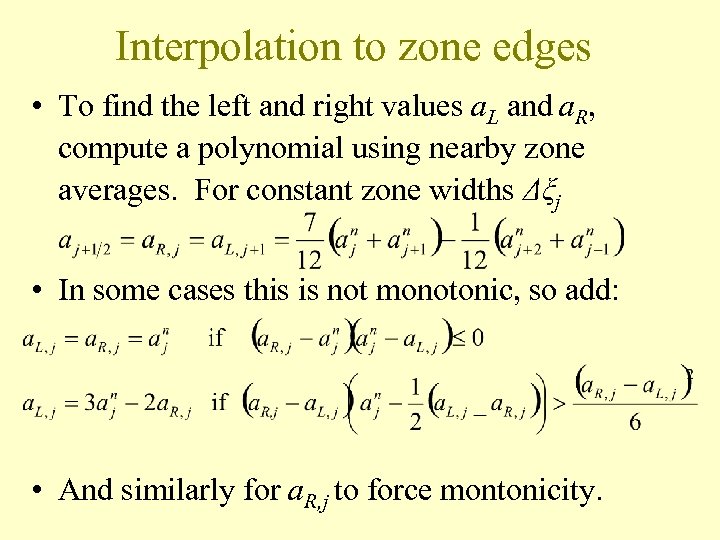 Interpolation to zone edges • To find the left and right values a. L and a. R, compute a polynomial using nearby zone averages. For constant zone widths Δξj • In some cases this is not monotonic, so add: • And similarly for a. R, j to force montonicity.
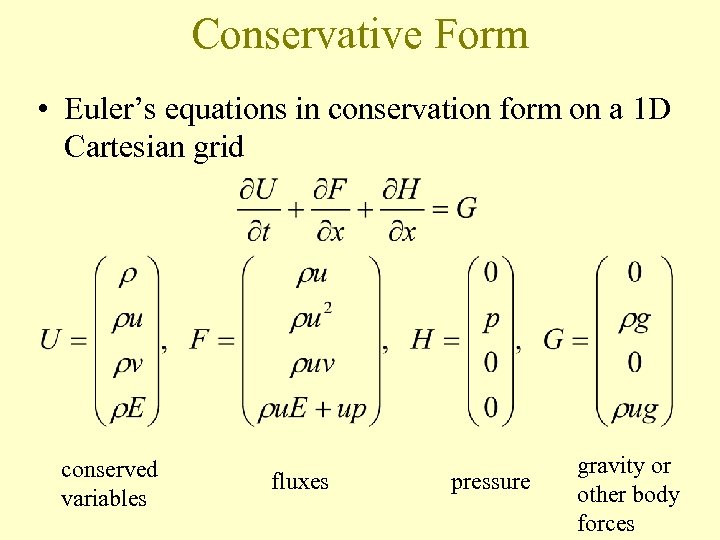 Conservative Form • Euler’s equations in conservation form on a 1 D Cartesian grid conserved variables fluxes pressure gravity or other body forces
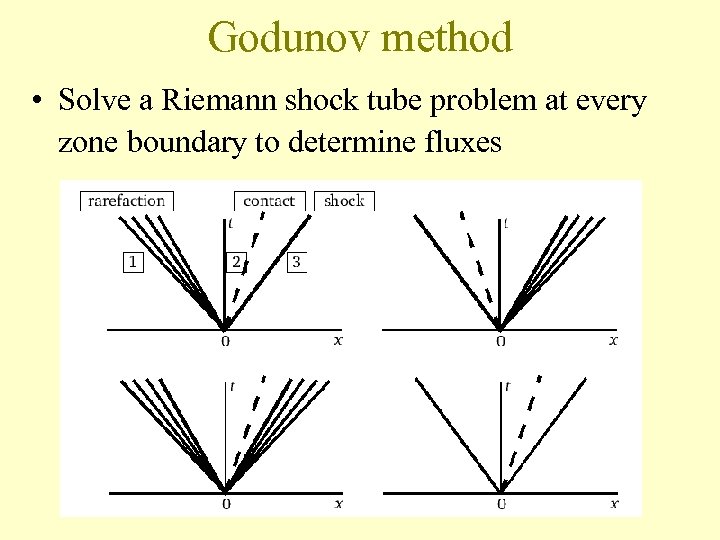 Godunov method • Solve a Riemann shock tube problem at every zone boundary to determine fluxes
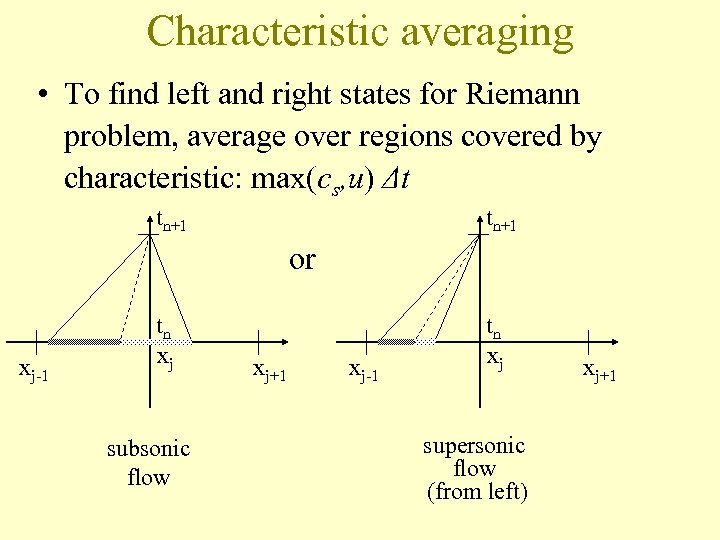 Characteristic averaging • To find left and right states for Riemann problem, average over regions covered by characteristic: max(cs, u) Δt tn+1 or xj-1 tn xj subsonic flow xj+1 xj-1 tn xj supersonic flow (from left) xj+1
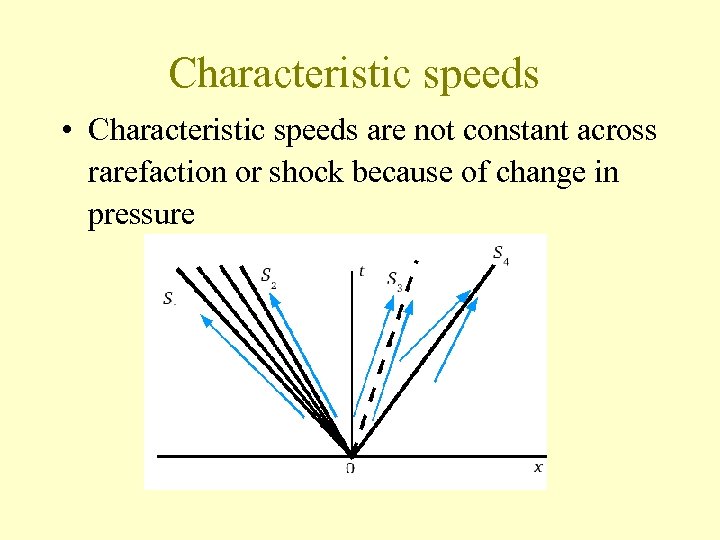 Characteristic speeds • Characteristic speeds are not constant across rarefaction or shock because of change in pressure
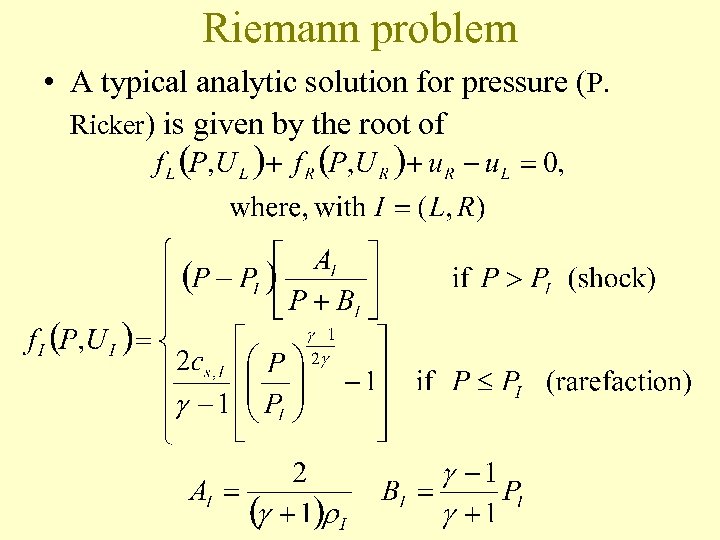 Riemann problem • A typical analytic solution for pressure (P. Ricker) is given by the root of