


 Скачать презентацию stanford hci group cs 376 Intelligent Display
be616d216849a0521f8f8c58c0bec611.ppt
- Количество слайдов: 9
 stanford hci group / cs 376 Intelligent Display Techniques Scott Klemmer 06 December 2005 research topics in human-computer interaction
 Adaptive User Interfaces § Earliest study by Greenberg & Witten, 1985 2
 Consistency in the User Interface § Grudin, 1989 – The Case Against UI Consistency § Internal Consistency § External Consistency § Correspondence 3
 Model-Based User Interfaces the late § Pioneered in 80 s & early 90 s by Foley & co, Myers & co, and others § Challenge: homogoneity of desktop eroded most of the benefits § New opportunity! Heterogenaity of ubicomp… also implies new challenges 4
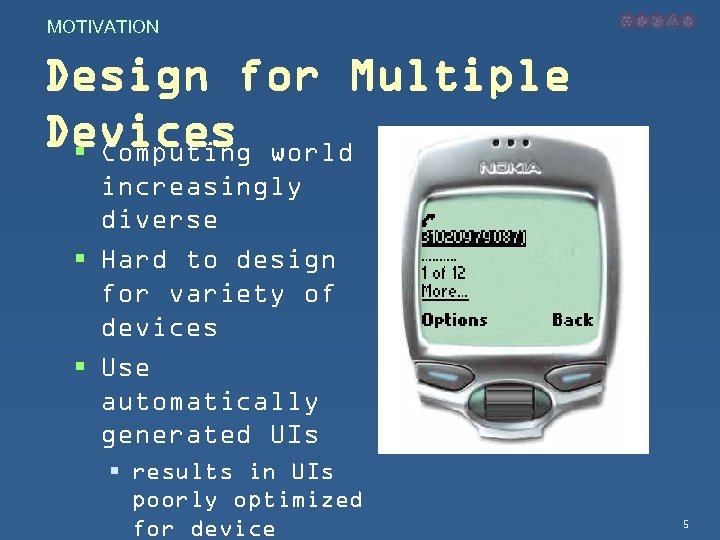 MOTIVATION Design for Multiple Devices world § Computing increasingly diverse § Hard to design for variety of devices § Use automatically generated UIs § results in UIs poorly optimized for device 5
 MOTIVATION Study of Cross-Device Designers § Interviewed 9 UI designers § UIs targeted at desktop and PDAs and/or mobile phones § usually, mobile UI was a subset of desktop UI § Tools and process § similar to web design in many respects § less sketching, more Visio § can quickly type out whole screens 6
 MOTIVATION Study of Cross-Device Designers § Consistency across devices is major burden § led to teams being organized by project, not device § Recurring patterns often observed § 3 groups incorporated these into mobile phone UI style guides § Hard to deal with so many devices § must test UI with each device 7
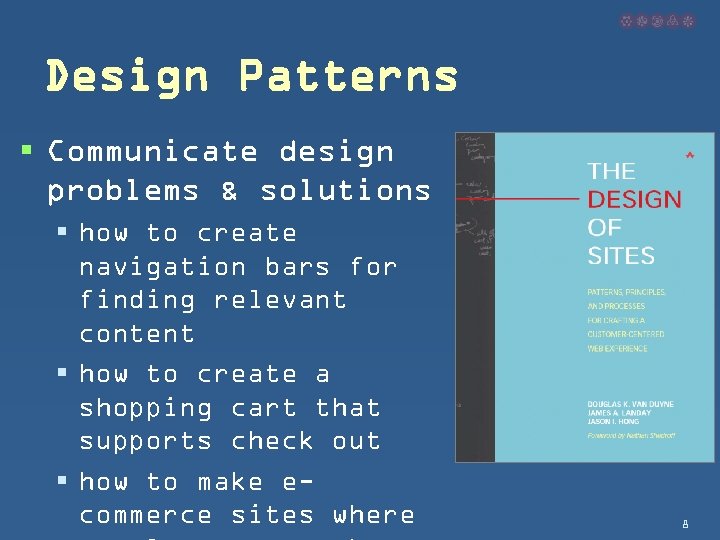 Design Patterns § Communicate design problems & solutions § how to create navigation bars for finding relevant content § how to create a shopping cart that supports check out § how to make ecommerce sites where 8
 PATTERNS Navigation Bar § Problem: Customers need a structured, organized way of finding the most important parts of your Web site § Example First-level navigation § Solution Second-level navigation 9