 Скачать презентацию STANFORD FINANCIAL GROUP Allen Stanford Robert Allen
Stanford Financial Group.pptx
- Количество слайдов: 5



STANFORD FINANCIAL GROUP
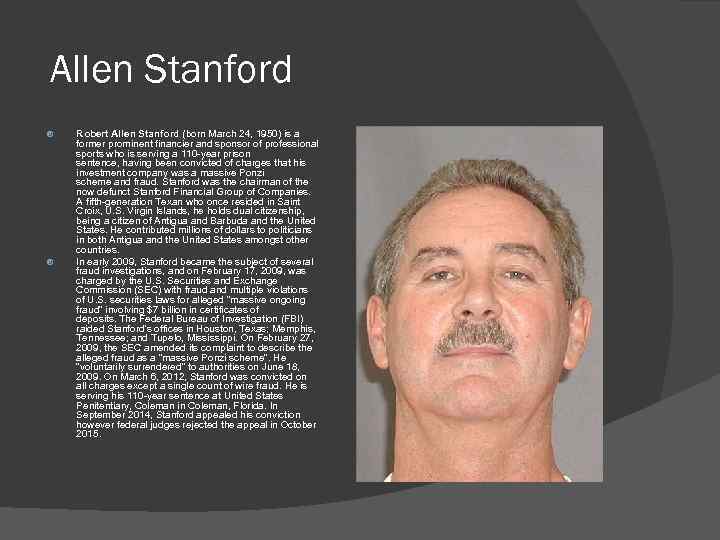
Allen Stanford Robert Allen Stanford (born March 24, 1950) is a former prominent financier and sponsor of professional sports who is serving a 110 -year prison sentence, having been convicted of charges that his investment company was a massive Ponzi scheme and fraud. Stanford was the chairman of the now defunct Stanford Financial Group of Companies. A fifth-generation Texan who once resided in Saint Croix, U. S. Virgin Islands, he holds dual citizenship, being a citizen of Antigua and Barbuda and the United States. He contributed millions of dollars to politicians in both Antigua and the United States amongst other countries. In early 2009, Stanford became the subject of several fraud investigations, and on February 17, 2009, was charged by the U. S. Securities and Exchange Commission (SEC) with fraud and multiple violations of U. S. securities laws for alleged "massive ongoing fraud" involving $7 billion in certificates of deposits. The Federal Bureau of Investigation (FBI) raided Stanford's offices in Houston, Texas; Memphis, Tennessee; and Tupelo, Mississippi. On February 27, 2009, the SEC amended its complaint to describe the alleged fraud as a "massive Ponzi scheme". He "voluntarily surrendered" to authorities on June 18, 2009. On March 6, 2012, Stanford was convicted on all charges except a single count of wire fraud. He is serving his 110 -year sentence at United States Penitentiary, Coleman in Coleman, Florida. In September 2014, Stanford appealed his conviction however federal judges rejected the appeal in October 2015.
History Allen Stanford traced his company to the insurance company founded in 1932 in Mexia, Texas, by his grandfather, Lodis B. Stanford. However, there was no direct connection between the insurance company and Allen Stanford's banking business, which he started on the British Overseas Territory of Montserrat in the West Indies in the 1980 s. Allen Stanford's move into banking utilised funds he had made in real estate in Houston in the early 1980 s. In 2008, Stanford Financial Group announced it would open a new global management complex in St. Croix, U. S. Virgin Islands, to include the base for the corporate support functions such as business technology, compliance, finance, human resources, investment strategy and legal, as well as the chairman's office. Completion was planned for July 2009, but this will now not occur due to the company's dissolution. The company was bound by a web of personal and family ties. Stanford's chief financial officer and second-in-command, James M. Davis, was his roommate at Baylor University. The chief investment officer, Laura Pendergest-Holt, grew up attending a church in Baldwyn, Mississippi where Davis was a Sunday school teacher. Many top officials were related to each other. This led former employees to claim the company was fraught with nepotism; former executive Charles Satterfield told Bloomberg News that whenever someone asked questions, a common response was "I'm not going to question my brother-in-law. "
Affiliated companies Stanford Financial Group comprises several affiliated companies: Stanford Financial Group Company (SFGC) was an entity based in Houston, Texas, USA, that provided financial services to several of the affiliated companies, and in particular to Stanford International Bank Limited (SIBL). The services were provided via a "Services Agreement" that paved the way for investor deposits to be funneled via a circuitous route to multiple destinations, including affiliated companies that leased multiple corporate jets, owned yachts, funded a cricket pitch and even a Swiss bank account used to bribe officials. Stanford Capital Management, investment adviser, based on Houston Stanford Group Company, broker-dealer, based in Houston Stanford International Bank, was started in 1986 in Montserrat where it was called Guardian International Bank. Allen Stanford relocated its operations to Antigua. On 19 February 2009 Nigel Hamilton-Smith and Peter Wastell of the British accounting firm Vantis were appointed joint receivers of the bank, and were made liquidators on 15 April 2009. In June 2010, the High Court of Antigua resolved that Vantis should be removed from its responsibilities. The firm, which had recently received government approval to sell the property assets, appealed the decision. Stanford Trust Company, helped manage and protect wealth. Vantis was also appointed receivers of Stanford Trust Company. Bank of Antigua Stanford Coins and Bullion
Regulatory investigation During the week of February 13, 2009, Stanford issued a letter to clients saying: "Regulatory officers have visited our offices and have stated that these are routine examinations". On February 17, 2009, U. S. Federal agents entered the company's Houston and Memphis offices. Law enforcement officials placed signs on the office doors stating that the company was temporarily closed: "The company is still in operation but under the management of a eceiver" r The Securities Exchange Commission's (SEC) charged Allen Stanford, Pendergest-Holt and Davis of fraud in connection with Stanford Financial Group's US$8 billion certificate of deposit (CD) investment scheme that offered "improbable and unsubstantiated high interest rates". This led the Federal government to freeze the assets of Allen Stanford, Stanford International Bank, Stanford Group Co. , and Stanford Capital Management. In addition, Stanford International Bank placed a 60 -day moratorium on early redemptions of its CDs. On February 18 and 19, 2009, Ecuador and Peru suspended the operations of local Stanford units, and, in Venezuela and Panama, the governments seized local units of Stanford Bank. Mexico's financial regulator announced on February 19 that it was investigating the local affiliate of Stanford bank for possible violation of banking laws. On February 27, 2009, Stanford official Laura Pendergest-Holt was arrested by Federal agents in connection with the alleged fraud. On that day the SEC said that Stanford and his accomplices operated a "massive Ponzi scheme", misappropriated billions of dollars of investors' money and falsified the Stanford International Bank's records to hide their fraud. "Stanford International Bank's financial statements, including its investment income, are fictional, " the SEC said. United States District Judge David Godbey froze all of the Stanford personal and corporate assets. Godbey gave them to Ralph Janvey, a Dallas receiver; Janvey will retain control until the SEC suit is resolved. A British receiver took the Antigua -based Stanford International Bank. On July 1, 2009, James M. Davis, the CFO of the company, agreed to change course from his not guilty plea and plead guilty to three charges related to the Ponzi scheme fraud, once details can be worked out. On November 13, 2009 The US District Court Ordered Brokerage Accounts to be transferred to Dominick & Dominick LLC. The transfer became effective on January 20, 2010. In 2011, an auction of Stanford's goods was held in Houston. On March 19, 2012 the 5 th U. S. Circuit Court of Appeals overturned a federal judge’s ruling from last year that threw out three class action lawsuits that are trying to use state laws to recover investor losses resulting from Stanford’s scheme. The ruling allows lawsuits by investors who lost millions in Stanford Ponzi scheme to go forward against several 3 rd parties.
Скачать презентацию STANFORD FINANCIAL GROUP Allen Stanford Robert Allen
Stanford Financial Group.pptx