


 Скачать презентацию Standards of Practice Course COST MANAGEMENT Welcome
3bfe1298eb345799a93eee56955720f2.ppt
- Количество слайдов: 87
 Standards of Practice Course COST MANAGEMENT
 Welcome § Agenda - Introduction & Overview - Project & Construction Budget - Cost Management System - Cost Estimating - Cost Compliance Monitoring - Design Phase Monitoring - Bid & Award Phase Cost Management - Construction Phase Cost Management - Bid & Award Phase Cost Management - Additional Information - Q&A, Conclusion © Construction Management Association of America. Do Not Duplicate or Reproduce.
 Introduction & Overview § Cost Management Objectives - Control Cost - Deliver within Budget § Cost Management Basics - Realistic project budget within Owner’s limitations - Most economical way § CM’s Role in Cost Management - Cost Management Plan (CMP), aka Project Money Plan - Deliver within Budget • Financial forecast • Control project costs and cash flow § Failure will lead to cost overruns © Construction Management Association of America. Do Not Duplicate or Reproduce.
 Introduction & Overview § The Purpose of Cost Control - Control the project budget - Help deliver the project within the accepted project budget § Almost all projects have limited budgets, so: - The CM must create a system and implement all necessary processes and procedures to control cost - The CM must control cost growth § Two Types of Estimates: - Conceptual - Detailed © Construction Management Association of America. Do Not Duplicate or Reproduce.
 Introduction & Overview § Project Team: Interaction / Relationships - The Owner is “first among equals, ” but often lacks expertise in cost control - The Designer is typically more concerned with technical aspects and aesthetics - The Contractor is typically concerned with completing work within its budget (unrelated to the owner’s budget), and maximizing profit - The CM, by default, is in sole possession of the cost control role © Construction Management Association of America. Do Not Duplicate or Reproduce.
 Introduction & Overview § Cost Control Responsibilities - All communications must include the CM - The CM must attend all meetings - The CM must report accurately and regularly to the Owner - The CM must ensure that the project is delivered in the most economical way, and conforming to the project requirements © Construction Management Association of America. Do Not Duplicate or Reproduce.
 Introduction & Overview Cost Control Stages § Pre-construction Phase - Gather cost information - Provide cost estimates - Employ “value analysis” - Guard against cost growth § Construction Phase - Play a role in the payment process - Manage the Change Order and Claims process © Construction Management Association of America. Do Not Duplicate or Reproduce.
 Project & Construction Budget § Project Inception - Unlimited funds (ideal world!) - Owners are looking for positive ROI § Preliminary Cost Investigation - ALL project participants review and approve § Success Requires Buy-In - All participants must be working toward delivery within the approved CMP and budget © Construction Management Association of America. Do Not Duplicate or Reproduce.
 Project & Construction Budget § Conceptual Budgeting - Project definition and project scope - Project location / timeframe - Conceptual estimates • Analagous Estimating (top down) - Actual results of previously performed projects • Parametric Modeling - Project characteristics in mathematic equations (ie, cost per sq ft, megawatt cost, etc) • Bottom-Up Estimating - Individual project components • Computerized Estimating - National cost databases © Construction Management Association of America. Do Not Duplicate or Reproduce.
 Project & Construction Budget § Interpreting Conceptual Budgets - Conceptual budgets are based on conceptual estimates! - What is the degree of accuracy / reliability? - No single accepted variance • Ritz suggests +/- 25% to 30% • AACEI refers to conceptual estimates as an “order of magnitude” and defines accuracy at +50% to -30% • Other authors or organizations use different percentages © Construction Management Association of America. Do Not Duplicate or Reproduce.
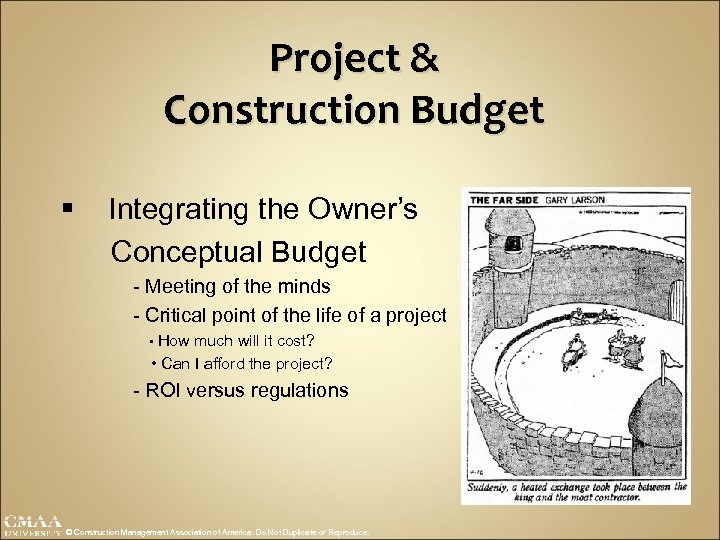 Project & Construction Budget § Integrating the Owner’s Conceptual Budget - Meeting of the minds - Critical point of the life of a project • How much will it cost? • Can I afford the project? - ROI versus regulations © Construction Management Association of America. Do Not Duplicate or Reproduce.
 Project & Construction Budget § Cost Analysis - Owner may require “conceptual design alternatives” - Each will require conceptual estimates - Different project locations • Utilities, site access, soils, topography, market conditions, etc. - Other studies • Life Cycle costs • Energy studies • Preliminary cash flow © Construction Management Association of America. Do Not Duplicate or Reproduce.
 Project & Construction Budget § Development of the Project and its Construction Budget - Develop estimate of “cost of construction” as well as “total project cost” - Total Project Cost = Initial Project Budget • Land acquisition • A/E, CM & other consultants (plus contingency) • Financing • Owner management - +/- 10 -20% at this stage, plus 15 -20% for design contingency - Budget change at this point is inevitable © Construction Management Association of America. Do Not Duplicate or Reproduce.
 Project & Construction Budget § Owner Project Objectives - CM must clearly identify the Owner’s project objectives - CM must draw out as much detail as possible, ie: • Interior finish quality • Energy utilization and efficiency • Life cycle costs • Architectural aesthetics • Return on investment (ROI) • Expansion capabilities - CM must determine what the Owner REALLY expects © Construction Management Association of America. Do Not Duplicate or Reproduce.
 Project & Construction Budget § Project and Owner Constraints - Constraint = Restriction on the project & activities - Caused by external factors - Examples: • Financial constraints (cash flow, contract date, etc) • Time-to-market (ie, must begin production by…. ) • Schedule (ie, must take occupancy by…) • Seasonal / weather constraints (ie, rainy season, frost, etc) • Work tine (ie, work during evenings, not able to start before X o’clock, etc) © Construction Management Association of America. Do Not Duplicate or Reproduce.
 Project & Construction Budget § Procurement Strategies - Procurement Strategies = Budget Implications - Types of procurement strategies: • Design-Bid-Build • CM at Risk • Agency CM • Design / Build • Owner-Furnished, Contractor Installed • Firm Fixed Price / Lump Sum -Damage clauses / Incentive Fees / Cost-sharing • Cost Reimbursement Contracts - Cost Plus (plus a fixed fee / plus an incentive fee / plus an award fee) • Unit Price - Blanket purchase / Time & materials / Job order contracts - Legal and/or financial requirements © Construction Management Association of America. Do Not Duplicate or Reproduce.
 Project & Construction Budget § Resource Availability, Productivity, and other Factors - Local conditions / constraints • Labor - Availability / Cost • Climate-related productivity factors • Location - Infrastructure - Foreign payments - Tariffs © Construction Management Association of America. Do Not Duplicate or Reproduce.
 Project & Construction Budget § Project Conditions Impacting the Budget - Other factors for conceptual budgets: • Allowances (for known but undefined requirements) • Contingencies (for unknowns) • Cost escalation factors • Field and general conditions costs • Foreign currency fluctuations • Market conditions for materials and equipment © Construction Management Association of America. Do Not Duplicate or Reproduce.
 Project & Construction Budget § Organizing the Budget - Standardized format - Work Breakdown Structure (WBS) • Define work components, packages • Arrange in a hierarchical structure • Identify every activity through a coding system • Uniform communication - All budgets should be reviewed for: • Completeness • Compatibility with cost limitations • Attainability (managing the owner’s expectations) - Be sure to list exclusions / assumptions • (ie, no significant OT costs, no concrete pours during winter, single tower crane, etc) © Construction Management Association of America. Do Not Duplicate or Reproduce.
 Project & Construction Budget § Contingency in the Preliminary Phase - Soft costs are difficult to quantify - National standards versus concrete values - Risk analysis • Expected monetary value of risk = probability of risk event X value of risk event - DO NOT overstate the likely cost of probability of risk events - Overstating = artificial inflation = meaningless © Construction Management Association of America. Do Not Duplicate or Reproduce.
 Project & Construction Budget § Summary - Failures often result from inadequate initial project budgeting - A realistic budget contains: • Considering the Owner’s goals and objectives • Reasonable procurement strategy • Identified project constraints - It is a challenging task! © Construction Management Association of America. Do Not Duplicate or Reproduce.
 The Cost Management System § Purpose and Objectives - Ensure project completion within budget - Two areas: • Cost of project resources • Effects of project decisions on project cost and life cycle cost - There is a cost to construct / cost to maintain © Construction Management Association of America. Do Not Duplicate or Reproduce.
 The Cost Management System § Development and Implementation - Several processes • Resource planning - What resources are needed - What quantity of resources are needed • Cost Estimating - Approximate cost of the resources needed • Cost Budgeting - Allocation of the estimated costs to project elements or activities • Cost Control - Controlling the changes that impact an accepted budget © Construction Management Association of America. Do Not Duplicate or Reproduce.
 The Cost Management System § Understanding cost planning concepts - Scope definition - Good resource planning / cost estimating inputs: • Land acquisition and access costs • Design costs • Labor costs • Equipment costs • Material costs • Furniture, fixtures, and equipment (FF&E) costs • Management cost • Other costs © Construction Management Association of America. Do Not Duplicate or Reproduce.
 The Cost Management System § Basic inputs to resource planning • Work breakdown structure (WBS) • Scope of work • Historical information • Resource pool description (market survey) • Organizational policies - Identify, then estimate the cost of each resource - Outcome = project cost plan - Owner’s acceptance of the project cost plan = project budget © Construction Management Association of America. Do Not Duplicate or Reproduce.
 The Cost Management System § Project feasibility studies - Determination of capital costs to test the project’s business practicality • ie, target rental rates, target production unit prices - Screening estimates = conceptual estimates - Commercial versus public feasibility: • Commercial – business model • Public (regulatory) – cost effective project delivery • Public (non-regulatory) – amount of funding necessary for project delivery (ie, municipal bond council) © Construction Management Association of America. Do Not Duplicate or Reproduce.
 The Cost Management System § Conceptual Estimate - Owner’s approval § Cost Plan - Owner’s approval § Project Approval - Cash flow • Projected rate of expenditure, when incurred, not awarded - Owner’s approval © Construction Management Association of America. Do Not Duplicate or Reproduce.
 The Cost Management System § Project Cash Flow - Projected rate of which the Owner’s cash is expended (ie, taking the fast lane to the poor house) - Allows the Owner to reinvest funds until needed - Develop a borrowing schedule © Construction Management Association of America. Do Not Duplicate or Reproduce.
 The Cost Management System § Developing a Cash Flow Schedule - Items needed: • Cash flow analysis • Conceptual project schedule • Conceptual estimate - Time versus $$ • Typical “S” curve - Straight Line analysis versus Bell Shape - Font-end loaded / back-end loaded • Equipment buy out / installation © Construction Management Association of America. Do Not Duplicate or Reproduce.
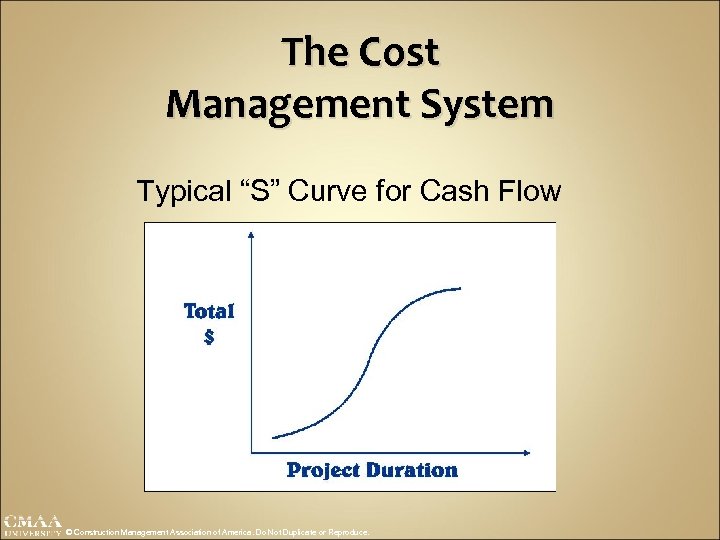 The Cost Management System Typical “S” Curve for Cash Flow © Construction Management Association of America. Do Not Duplicate or Reproduce.
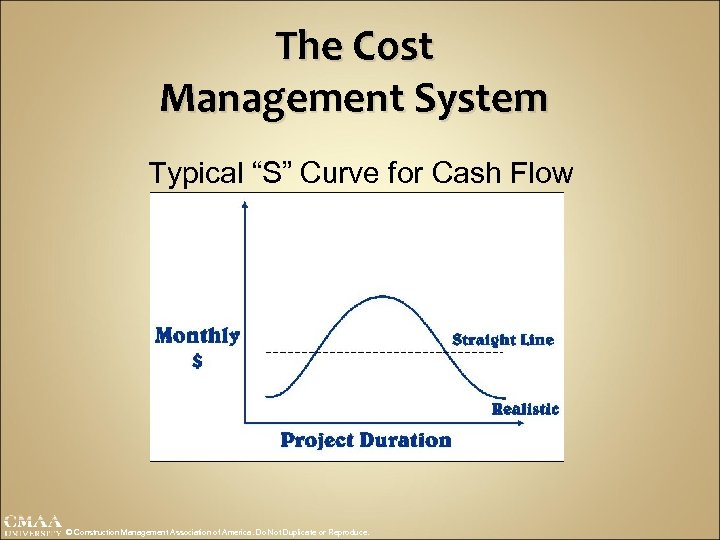 The Cost Management System Typical “S” Curve for Cash Flow © Construction Management Association of America. Do Not Duplicate or Reproduce.
 The Cost Management System § Cost Model for Monitoring Costs - Monitoring / reporting on costs and variances • Planned versus actual: (simple and straightforward) - Cash flow • Planned versus actual: dependence on creation / approval of cash flow curve - Cost-trending (estimate at completion) • EAC = Actual costs of work to date + remaining costs • EAC = Actual costs of work to date + remaining budget © Construction Management Association of America. Do Not Duplicate or Reproduce.
 The Cost Management System § Cost Model for Monitoring Costs, continued - Earned value calculations • Measure planned versus actual cost and schedule performance in order to “trend” how the project is doing - Schedule Variance (SV) = Earned Hours or $$ - Budgeted Hours or $$ - Schedule Performance Index (SPI) = Earned Hours or $$ to date / Budgeted Hours or $$ to date - Cost Variance (CV) = Earned Hours or $$ / Budgeted Hours or $$ - Cost Performance Index (SPI) = Earned Hours or $$ to date / Actual Hours or $$ to date © Construction Management Association of America. Do Not Duplicate or Reproduce.
 The Cost Management System § Impact of External Economic Factors - Time to Market • Productivity available / lead time - Taxation laws • Pollution control equipment, energy savings equipment - Funding restrictions • Fiscal year end / start - Advance Commitments by Owner - ROI - Calendar restrictions • School construction © Construction Management Association of America. Do Not Duplicate or Reproduce.
 The Cost Management System § Method of Project Funding - Typically the Owner’s responsibility - The CM can impact • Cost management plan • Feasibility study / ROI calculation (may determine whether the Owner can fund project) - The CM must understand early on how the project will be funded © Construction Management Association of America. Do Not Duplicate or Reproduce.
 The Cost Management System § Impact of Project Funding Method on Cost and Schedule - Method may impact Cost Management Plan and Cash Flow Plan • Government grant funding - Under construction within _____ months • Construction Financing versus Permanent Financing - Need to convert to permanent financing no later than _____ for the ROI to work out • Expiration of Land Options - Sale must close no later than _____ © Construction Management Association of America. Do Not Duplicate or Reproduce.
 The Cost Management System § Summary - Helps establish and manage the Project Budget - Provides the tools necessary to manage and monitor budget, ie: • Feasibility studies • Cash flow schedules • Cost Models - Helps ensure the project is delivered within budget - Helps to manage the budget from inception to completion © Construction Management Association of America. Do Not Duplicate or Reproduce.
 The Cost Management System § § § The Cost Management Plan is based on a reliable cost estimate Selection of estimating techniques Identifying factors for conceptual estimating Parameters for cost estimating Concepts of range estimating Quantity survey based cost estimates and procurement strategies © Construction Management Association of America. Do Not Duplicate or Reproduce.
 Cost Estimating § Selection of Estimating Techniques - Application of quantity surveys to cost estimating - Accurate prediction of the project cost - The estimate should be neither optimistic nor pessimistic - CM should set forth all relevant cost assumptions • Contracting plan, labor productivity, etc. © Construction Management Association of America. Do Not Duplicate or Reproduce.
 Cost Estimating § What is a Cost Estimate? - A predicted cost of constructing the project - Level of accuracy is dependent upon the quantity and the quality of information available to the estimator - Is it an art, a science, or both? © Construction Management Association of America. Do Not Duplicate or Reproduce.
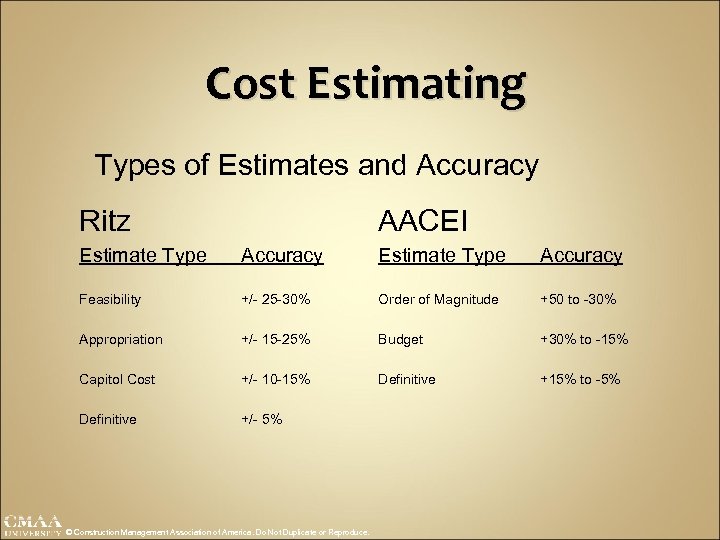 Cost Estimating Types of Estimates and Accuracy Ritz AACEI Estimate Type Accuracy Feasibility +/- 25 -30% Order of Magnitude +50 to -30% Appropriation +/- 15 -25% Budget +30% to -15% Capitol Cost +/- 10 -15% Definitive +15% to -5% Definitive +/- 5% © Construction Management Association of America. Do Not Duplicate or Reproduce.
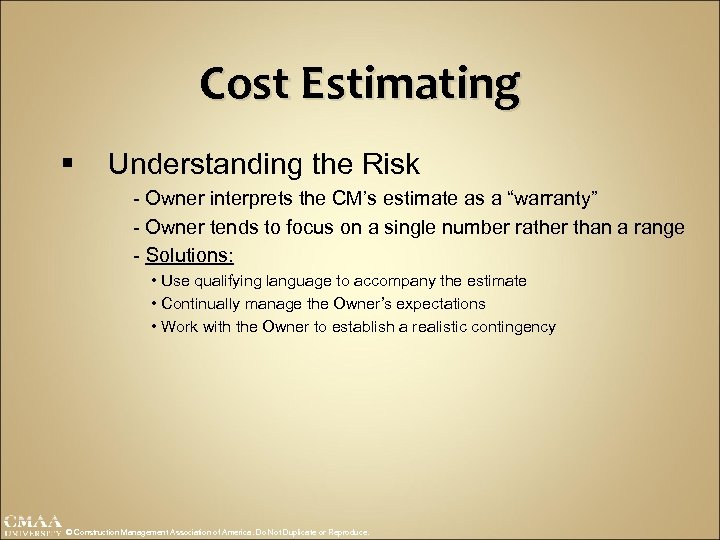 Cost Estimating § Understanding the Risk - Owner interprets the CM’s estimate as a “warranty” - Owner tends to focus on a single number rather than a range - Solutions: • Use qualifying language to accompany the estimate • Continually manage the Owner’s expectations • Work with the Owner to establish a realistic contingency © Construction Management Association of America. Do Not Duplicate or Reproduce.
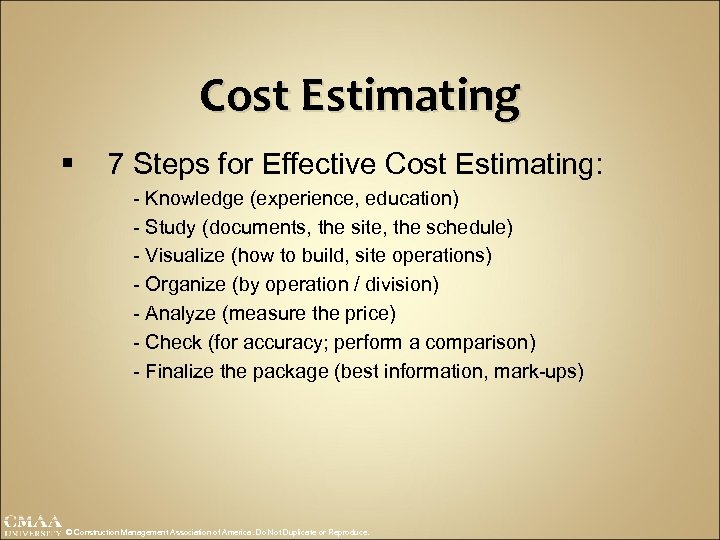 Cost Estimating § 7 Steps for Effective Cost Estimating: - Knowledge (experience, education) - Study (documents, the site, the schedule) - Visualize (how to build, site operations) - Organize (by operation / division) - Analyze (measure the price) - Check (for accuracy; perform a comparison) - Finalize the package (best information, mark-ups) © Construction Management Association of America. Do Not Duplicate or Reproduce.
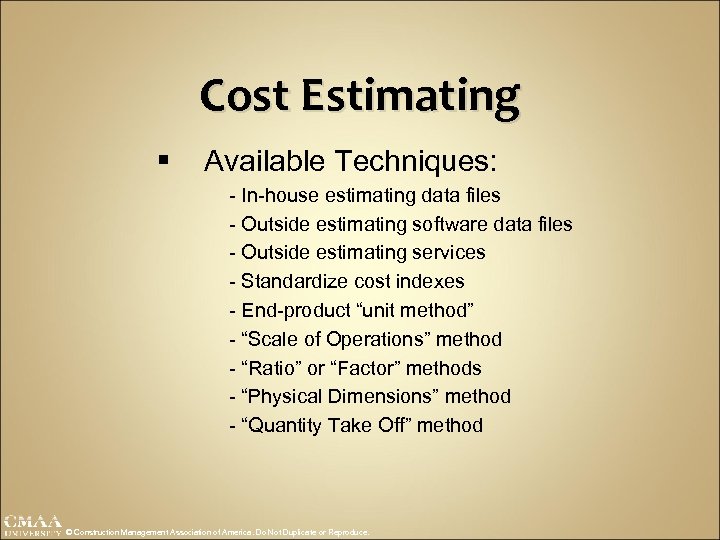 Cost Estimating § Available Techniques: - In-house estimating data files - Outside estimating software data files - Outside estimating services - Standardize cost indexes - End-product “unit method” - “Scale of Operations” method - “Ratio” or “Factor” methods - “Physical Dimensions” method - “Quantity Take Off” method © Construction Management Association of America. Do Not Duplicate or Reproduce.
 Cost Estimating: Conceptual § Factors for Conceptual Estimating: - Minimum information required to perform a conceptual estimate: • Project Type (heath care, commercial, etc) • Project size or capacity (square footage, # of hospital beds, etc) • Project location • Project schedule - Reliability of the estimate increases with more information § Parameters for Conceptual Estimating: - Parameters are defined as a set of physical properties whose value determines the characteristics or behavior of something © Construction Management Association of America. Do Not Duplicate or Reproduce.
 Cost Estimating: Conceptual § Parameters for performing a conceptual estimate include: - Design phase costs - Construction phase costs - Plans and specifications - Construction and procurement strategies - Site Information - Engineering - Quantity take-offs - Labor © Construction Management Association of America. Do Not Duplicate or Reproduce.
 Cost Estimating: Conceptual § Parameters, cont: - Materials - Equipment - General Conditions - Home Office Overhead - Miscellaneous Costs - Schedule - Inspection and Permits - Bid alternates & allowances - Mark-ups © Construction Management Association of America. Do Not Duplicate or Reproduce. September, 2006
 Cost Estimating § Market Survey - A market survey is conducted by the CM to determine the current costs and availability of labor, materials, plant and equipment costs, current and future bidding climates, and other related factors. © Construction Management Association of America. Do Not Duplicate or Reproduce.
 Cost Estimating: Range Estimating § § Used for negotiating change orders or settling claims or disputes Not subject to competitive bid conditions Often “independent” or “check” estimates Incorporates a combination of analysis, simulation, and speculation to determine the probability of cost overruns, and maximum possible deviation from the target estimate © Construction Management Association of America. Do Not Duplicate or Reproduce.
 Cost Estimating: Quantity-Based Survey Estimating § § § More European than American A/E or CM does complete take-off of all elements or units of the project Establishes the list of bid items Classic “unit price” contract As units increase or decrease, so does the contract cost Requires a “final adjustment change order” © Construction Management Association of America. Do Not Duplicate or Reproduce.
 Cost Estimating: Quantity-Based Survey Estimating § Applications to Cost-Estimating: - Based on history, this allows a very accurate database to be developed and maintained - Can be modified based upon indexes or location factors - An excellent estimating tool © Construction Management Association of America. Do Not Duplicate or Reproduce.
 Cost Compliance Monitoring § Objectives of the Cost Management Plan - Capture and monitor cost from the onset - Variances happen! - Need a pro-active response to these variances • Is it a major variance or a minor one? - Setting the decision-making process - Delivery of the project within the approved budget © Construction Management Association of America. Do Not Duplicate or Reproduce.
 Cost Compliance Monitoring § Developing a Project Contingency - Funding “set aside” to cover the unknown / unexpected - Contingency lien items should be in every estimate - Suggested contingencies: • Preliminary estimates: +50% • Budget estimate: +30% • Design and bid: +15% • Construction (new): +10% • Construction (renovations): © Construction Management Association of America. Do Not Duplicate or Reproduce. +15%
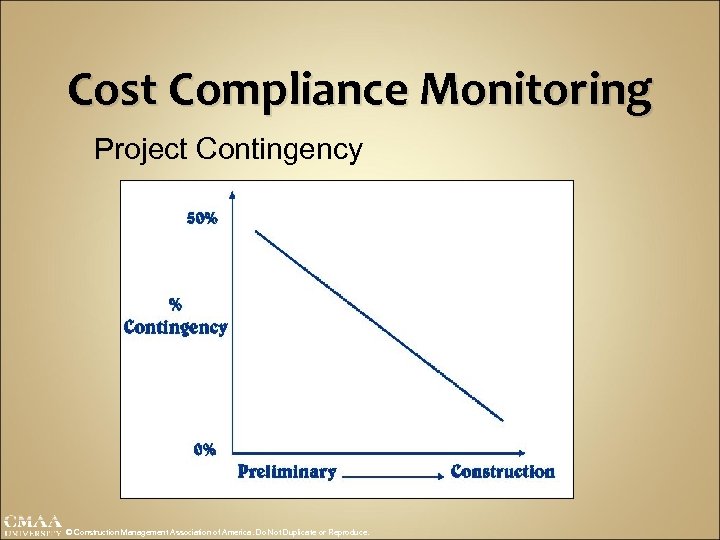 Cost Compliance Monitoring Project Contingency © Construction Management Association of America. Do Not Duplicate or Reproduce.
 Cost Compliance Monitoring § The Internet and Cost Monitoring - Becoming more predominant - Current project cost data can be posted - Costs can be continually monitored, decreasing the likelihood of surprises - Multiple users: reports utilized as needed - Free flow of information © Construction Management Association of America. Do Not Duplicate or Reproduce.
 Cost Compliance Monitoring § Summary - Recommended Cost Monitoring Techniques - Developed early in the project - Covers: • What is to be monitored • How to monitor • Plan of action - Developed prior to incurring cost variances © Construction Management Association of America. Do Not Duplicate or Reproduce.
 Cost Management: Design Phase § Estimating Cost and Budget Impacts During Design - Proactive and not reactive - Uniform framework throughout the design phases - Design phases include: • Schematic design • Design development • Construction documents • Bid set and addenda © Construction Management Association of America. Do Not Duplicate or Reproduce.
 Cost Management: Design Phase § Estimating Cost and Budget Impacts, cont. - Ideally, the CM should participate in the design process and provide timely cost advice - The cost estimate should be on a unit price basis - Dig into the “boiler plate” - Determine cost impacts - Escalation © Construction Management Association of America. Do Not Duplicate or Reproduce.
 Cost Management: Design Phase § Recommended Estimates - Program estimates (performed @ planning completion) • Can the plan be delivered within the approved budget? - Completion of schematic design • Parametric (may obtain approximate quantities) - Completion of design development - In-progress final design / construction documents • Quantitative • Varies between 30 -90% - Completion of bidding documents • An estimate may be required in order to bid © Construction Management Association of America. Do Not Duplicate or Reproduce.
 Cost Management: Design Phase § Evaluating the level of design detail - Guard against cost growth - Report the level of under-runs and over-runs - Dependent on the situation • Bring the project back under budget • Modify the project budget (if so, by how much? ) - Cost growth without owner or project team knowledge / approval = NOT an option © Construction Management Association of America. Do Not Duplicate or Reproduce.
 Cost Management: Design Phase § Value / Analysis Program - Value engineering / value analysis • Multi-disciplined, systematic, and proactive function to optimize value • Least life-cycle cost, or provide the greatest value, while still meeting all functional, safety, quality, operability, maintainability, and durability established for the project • Good for “designing to cost” • About to go to construction • During construction - CM should take an active role © Construction Management Association of America. Do Not Duplicate or Reproduce.
 Cost Management: Design Phase § Trade-off Factors in Value Analysis - Fully documented with recommendations - Factors to consider • Construction cost versus life-cycle cost • Capital cost savings versus operations and maintenance (O&M) cost • Current space savings versus future space needs - Avoid the trap: • Up-front cost savings versus life-cycle cost © Construction Management Association of America. Do Not Duplicate or Reproduce.
 Cost Management: Design Phase § Summary - Cost management must be started early in the project planning and design - Costs must be managed throughout the entire life of the project - Largest changes are likely to be made during pre-construction - Change must be monitored and reported © Construction Management Association of America. Do Not Duplicate or Reproduce.
 Cost Management: Bid and Award Phase § Bid evaluation, review, and contract award - Follow established Owner procedures - Evaluate and analyze the bid: • Completeness • Responsiveness • Technical / references • Math errors • Alternates - Compare to budget - Recommend action © Construction Management Association of America. Do Not Duplicate or Reproduce.
 Cost Management: Bid and Award Phase § If over budget, possible options include: - Reject all bids; redesign and re-bid - Negotiate with the apparent low-bidder - Use bid alternates - Increase the project budget to allow award © Construction Management Association of America. Do Not Duplicate or Reproduce.
 Cost Management: Bid and Award Phase § Problems with unbalanced bids: - Mathematically unbalanced buds are possible on unit price contracts where: • The contractor needs monies early in the project in order to help finance the job, or • The contractor has reason to believe that the estimated quantities in the bidding documents are in error, and a potential significant profits possible due to quantity overruns / under-runs © Construction Management Association of America. Do Not Duplicate or Reproduce.
 Cost Management: Bid and Award Phase § Problems with unbalanced bids, cont: - The Owner may be faced with over-paying for work if the bid is front-end loaded, resulting in problems if the contractor defaults - The Owner may over-pay for change-order work - Suggested remedy: include language in the instructions to bidders allowing the Owner to declare the bid non-responsive if the bid appears unbalanced © Construction Management Association of America. Do Not Duplicate or Reproduce.
 Cost Management: Bid and Award Phase § Summary - The CM traditionally assumes the primary responsibility for cost control - Bid review and analysis is a key function of the CM - Define and report ALL irregularities, both minor and major, to the Owner for decision © Construction Management Association of America. Do Not Duplicate or Reproduce.
 Cost Management: Construction Phase § § Surprise: it starts during the design phase Contract documents must specify: - Schedule of values - Earned value information - Payment application procedures: form and frequency - Use of resource-loaded CPM schedule and updates - Requirements for certified payrolls - Submittal of unit costs for equipment, general conditions, or daily delay © Construction Management Association of America. Do Not Duplicate or Reproduce.
 Cost Management: Construction Phase § Contingency Management - Theoretical during planning and design - Accounts for inevitable change - What is the average contingency? From the mid 70 s-80 s: • Building Research Board 5. 7 -11. 5% • Veterans Administration 3. 9 -8. 8% • US Census Bureau 2. 2 -10. 0% • Average: 5. 0 -10. 0% - Current recommendation: 10 -15% © Construction Management Association of America. Do Not Duplicate or Reproduce.
 Cost Management: Construction Phase § Schedule of Values - Required when the contract is bid and awarded on a lump sum basis - Defined as: “A statement furnished by the contractor to the owner reflecting the portions of the contract sum allotted for the various parts of the work…. used as a basis for reviewing the contractor’s application for progress payments. ” © Construction Management Association of America. Do Not Duplicate or Reproduce.
 Cost Management: Construction Phase § Schedule of Values, cont. - Must be reviewed and agreed upon by the contractor, CM, and Owner - Required X days after issuance the notice to proceed (NTP) - Must be detailed enough to evaluate contractor’s pay requests - Must not be front-end loaded! - Must be balanced - Promotes prompt payments to the contractor to avoid interest or penalties © Construction Management Association of America. Do Not Duplicate or Reproduce.
 Cost Management: Construction Phase § Cost Loaded CPM Schedule: Key Provisions - Avoid front-end loading - Assign maximum value to any one activity - Discrete “schedule of values” is useful in change order and claims negotiations - More cumbersome to manage than a traditional schedule of values - Benefit: ties progress payments to schedule updates © Construction Management Association of America. Do Not Duplicate or Reproduce.
 Cost Management: Construction Phase § Controlling the Change Order System - Change in inevitable – it will happen - Controlling change orders during construction is not as easy as during design - During construction, change orders often arise from situations beyond the control of the CM (3 rd party delays, differing site conditions (DSC), etc. © Construction Management Association of America. Do Not Duplicate or Reproduce.
 Cost Management: Construction Phase § Controlling the Change Order System, cont. - The role of the CM is to mitigate damages by administering the change order process promptly, and in accordance with the terms and conditions of the contract documents - Opportunity for real leadership from the CM! - Management techniques: • Written notice requirements • Written change order requirements • Project warranties • Delegation of authority • Change control board • Change order policy • Budget contingency © Construction Management Association of America. Do Not Duplicate or Reproduce.
 Cost Management: Construction Phase § Factors covering cost changes: - Once agreed that a change order is required, the following are necessary: • Have a thorough understanding of the scope of the changed work • Important: obtain supporting documentation as proof of additional costs • Determine fair and reasonable adjustment to both cost and time - The CM should prepare an independent estimate listing the anticipated labor, materials, equipment, subcontracted work, contractor’s overhead and profit, and any justified impact costs - The independent estimate allows for a better review of the contractor’s proposal © Construction Management Association of America. Do Not Duplicate or Reproduce.
 Cost Management: Construction Phase § Factors covering cost changes, cont: There are two ways to price change orders: - Forward pricing • Done prior to performance of changed work, and with the agreement of all parties - Actual Cost pricing • Also called “time and materials” or “force account” © Construction Management Association of America. Do Not Duplicate or Reproduce.
 Cost Management: Construction Phase § Factors covering cost changes, cont: - In Forward pricing change orders, the CM should recognize some special factors, such as: • Statutes and condition of the work • Size and complexity of the change • Climatic conditions • Learning curves • Additional supervision © Construction Management Association of America. Do Not Duplicate or Reproduce.
 Cost Management: Construction Phase § Factors covering cost changes, cont: - Other items to consider: • Value of salvaged material • Odd lot sizes • Special delivery costs • Higher cost for proprietary items • Cost escalation from the bid opening • Storage costs • Bond and insurance premiums • Changes in the sequence of the work • Premium time • Congestion in work areas • Mobilization and demobilization • Loss of efficiency or productivity • Extended general conditions, field overhead, home office overhead © Construction Management Association of America. Do Not Duplicate or Reproduce.
 Cost Management: Construction Phase § Productivity and efficiency, using man-hour analysis: - Useful for productivity studies, impact analyses, and efficiency losses - Assumes use of resource-loaded CPM schedule by the contractor - Use the accepted “as-planned” schedule to determine what productivity level has to be achieved in order to meet the plan - Monitor field activities to calculate actual productivity © Construction Management Association of America. Do Not Duplicate or Reproduce.
 Cost Management: Construction Phase § Productivity and efficiency, using man-hour analysis, continued: - If the contractor is at or above the planned productivity = OK - If not, the contractor is likely behind schedule, and corrective action may be required - This is also useful for change order and claim analysis concerning lost productivity and lost efficiency © Construction Management Association of America. Do Not Duplicate or Reproduce.
 Cost Management: Construction Phase § Productivity and efficiency, using man-hour analysis, continued: - Provides actual data from the project in lieu of generic “national studies” often provided by contractors - “Measured mile” technique: compares a non-impacted portion of the project with the impacted portion; also allows an “earned value analysis” to determine the productivity impacts of change orders © Construction Management Association of America. Do Not Duplicate or Reproduce.
 Cost Management: Construction Phase § Cost Evaluation System for Potential Claims - CM typically charged with leading the settlement actions on behalf of the owner - Same techniques as for change orders - Advantage: typically work is already complete - Burden of proof is on contractors to substantiate entitlement and damages - Include audit provisions in the contract © Construction Management Association of America. Do Not Duplicate or Reproduce.
 Cost Management: Construction Phase § Summary - Must establish and manage a realistic contingency - Must determine a fair schedule of values - Process payment applications, change orders, and claims promptly - The CMs primary role during this phase is an aggressive and timely resolution of change orders issues - Independent estimate of change order costs - Two methods: forward pricing and actual cost pricing - Be aware of factors impacting change order costs © Construction Management Association of America. Do Not Duplicate or Reproduce.
 Cost Management: Project Closeout § § § Project Close Out Release of Liens Release of Retainage Final Cost Accounting Final Closeout Report © Construction Management Association of America. Do Not Duplicate or Reproduce.
 Cost Management § Conclusion - The CM plays a key role in Cost Management during all phases of a construction project: planning, design, bid/award, construction, and closeout - The CM is the cost professional on the project - Cost management must be established and implemented at the outset and continued throughout the project - CMAA procedures intended to help the CM with this role © Construction Management Association of America. Do Not Duplicate or Reproduce.
 QUESTIONS?