


 Скачать презентацию Standards landscape and ARC development plans Péter Stefán
9a570e8345bdc5043efd18222f15ab52.ppt
- Количество слайдов: 14
 Standards landscape and ARC development plans Péter Stefán Know. ARC WP 3 + NIIF
 Agenda Importance Interoperability Process T 3. 3 and T 3. 4 Standards survey Important for ARC and Know. ARC
 Why to deal with standards? Numerous grid infrastructure and middleware initiatives: thematic and regional grids that do not even talk to each other at service level. Lessons learned from network development: protocol war in 80 s, then consolidation, then huge boots in development. What had led to this? The recognition of the original purpose: connecting computers. In grid: connect resources. Tool: commonly accepted data models and interfaces.
 Interoperability Definition: “the ability of systems, units, or forces to provide services to and accept services from other systems, units or forces and to use the services exchanged to enable them to operate effectively together”. The emphasis is on the service not on the infrastructures that provide them. Know. ARC: dedicated WP 3, 5 tasks.
 Interoperability, interoperation
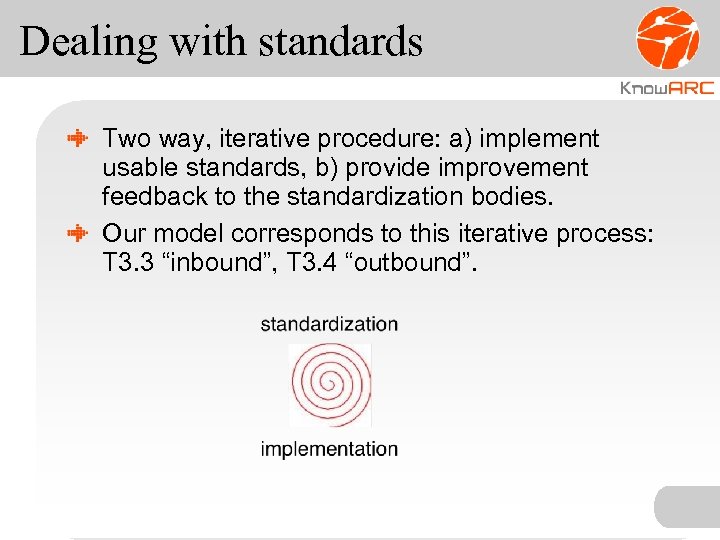 Dealing with standards Two way, iterative procedure: a) implement usable standards, b) provide improvement feedback to the standardization bodies. Our model corresponds to this iterative process: T 3. 3 “inbound”, T 3. 4 “outbound”.
 Survey of standards D 3. 3 -1 originally referred to as OGSA survey: a document summarizing current standards, quasistandards. Gratitude: Alex Konstantinov, Balázs Kónya, Ferenc Szalai, Mattias Ellert. Different grid (or grid-related) standardization organizations: OGF, OASIS, IETF, W 3 C. Title, Organization, Reference, Summary, Relevance, Action, Issues. Relevant, potentially relevant, good to know about, irrelevant.
 Relevant standards - core GDF. 80 - OGSA architecture process (capabilities): ARC will be re-engineered in a WSframework, rely on XML/WSDL/SOAP, accept WS-Addressing, provide state manipulation and notification functionality and satisfy one or more OGSA profiles. GFD. 72 + WS-I BP, BSP - WS-RF Basic Profile: The development of ARC components based on the WS-RF specifications included in this profile must follow the instructions of the profile.
 Relevant standards - exec cap. GFD. 56 - JSDL: Should be used for communication among services dealing with job instances. x. RSL, JSDL Arclib. Extensions. OGSA-BES (interface, activities): The basic job management service can use BES-Factory as a primary interface but it is clear that some extensions will be required, and such extensions can be collected in a BES-specific Profile. Extensions in sync.
 Relevant standards - data GFD. 47 - Grid. FTP: Support the protocol; as soon as the new features are implemented in GT 4. x C libraries, they should be included into ARC. Transfer neutrality - modular layout. SRM: Storage management capability is an important feature of ARC that will be implemented through the SRM version 2. 2 in addition to other more suitable solutions. Interoperation, interoperability purposes.
 Relevant standards - infosys GLUE (sites, services, computing and storage resources): We should try to use Glue 2. 0 as a basic information model during the ARC implementation. Mapping between GLUE and ARC schema is available.
 Relevant standards - security RFC 3820 - X. 509 Proxy certificate profile: Core implementation should focus on supporting such standardized PCs. BSP SC - extends WS-I BSP: No anonymous connections. Follow the development of the draft while implementing middleware.
 Possibly relevant standards GFD. 73 - Application Content Service for RTEs, GFD. 54 - My. Proxy, GFD. 53 - OGSA standards roadmap, GFD. 38 - Authorization framework, GFD. 24 - GSS-API, RUS, GGF-UR, WS-Addressing, XACML, SAML, WSN
 Thanks + Questions