


 Скачать презентацию Standards Influences in the Middle East and North
8b97ace727e531779f265e6998c460fc.ppt
- Количество слайдов: 14
 Standards Influences in the Middle East and North Africa Renee Hancher Office of Multilateral Affairs Market Access and Compliance/ITA
 Overview • United States and the European Union (EU) – World’s largest markets – World’s biggest standards developers – U. S. standardization system is market-driven and private sector-led. – European standardization system is government-driven and top down. Both the United States and European Union are undertaking standards activities in many countries and regions. 2
 Europe’s Standards Activities in the Middle East • • • Neighborhood Policy Delivery of Technical Assistance CEN/CENELEC Agreements 3
 European Neighborhood Policy • • A framework for relations with the European Union’s eastern and southern neighbor states. – Algeria, Egypt, Israel, Jordan, Lebanon, Libya, Morocco, Palestinian Authority, Syria and Tunisia. Bilateral Action Plans identify areas for cooperation and influence technical assistance provided by the EU; Association Agreements address standards and conformity assessment. – Active agreements: Israel, Jordan, Morocco, Palestinian Authority and Tunisia. – In process: Algeria, Lebanon and Syria 4
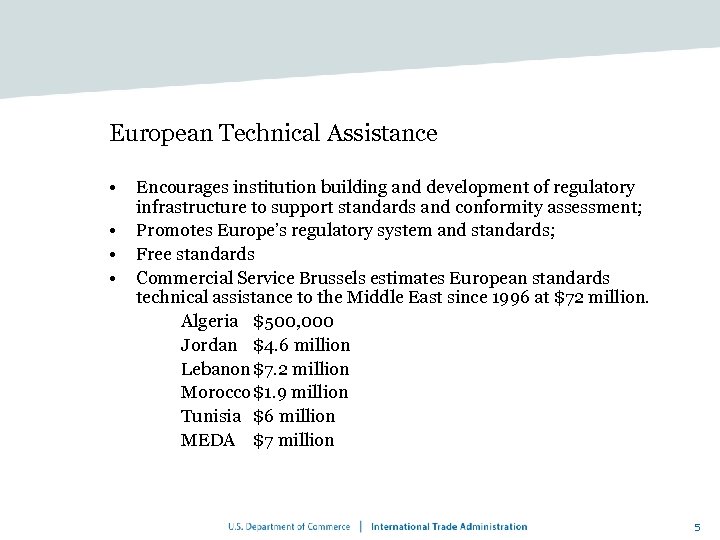 European Technical Assistance • • Encourages institution building and development of regulatory infrastructure to support standards and conformity assessment; Promotes Europe’s regulatory system and standards; Free standards Commercial Service Brussels estimates European standards technical assistance to the Middle East since 1996 at $72 million. Algeria $500, 000 Jordan $4. 6 million Lebanon $7. 2 million Morocco $1. 9 million Tunisia $6 million MEDA $7 million 5
 CEN and CENELEC Partner Agreements • • • Solidify standards ties in specific sectors; For countries that are ISO members, but cannot join CEN or CENELEC; CEN (Partner Standardization Bodies) – Obligated to implement European standards as national standards for technical committees where active. – PSB must withdraw conflicting national standards when adopting European standards. 6
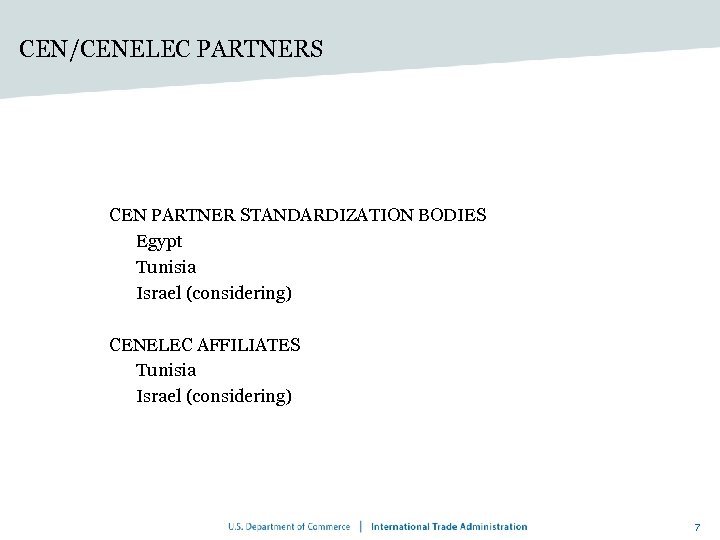 CEN/CENELEC PARTNERS CEN PARTNER STANDARDIZATION BODIES Egypt Tunisia Israel (considering) CENELEC AFFILIATES Tunisia Israel (considering) 7
 USG Standards Related Activities in the Middle East and North Africa • • Technical Assistance Free Trade Agreement TBT chapters NIST Standards in Trade Workshops Other Initiatives 8
 U. S. Standards Technical Assistance • • • USAID Trade Capacity Database reports TBT-related technical assistance at $3. 4 million for 2000 -2004; Private sector efforts by ANSI and SDOs are significant; Delivered to Algeria, Egypt, Iraq, Jordan, Lebanon, and Morocco. 9
 Free Trade Agreements (FTAs) • • • United States has FTAs with Bahrain, Israel, Jordan and Morocco; OMA FTA implementing legislation signed; UAE FTA in process; Recent FTAs have TBT chapters that build on WTO TBT Agreement provisions, encourage use of international standards; Israel and Jordan FTAs have no TBT chapters. 10
 NIST Standards in Trade Workshops • • Raise awareness by foreign government and private sectors representatives about the U. S. standardization system. Nine workshops for the region in the last decade: Iraq Housing and construction sectors MENA/ Life safety/building construction Pakistan Israel Roadway infrastructure and ITS GCC Electrical appliance safety & metrology 11
 Other Initiatives • Commercial Law Development Program (CLDP) – Provides standards-related technical assistance to WTO members and FTA partners; – Example: 2006 Moroccan delegation studied U. S. regulatory system. • Afghanistan and Iraq – USG working to set up standards infrastructures; – NIST standards advisor deployed to Iraq in 2006. 12
 ITA Follow-Up • • • ITA continues to monitor - -private sector input welcome; Report market access issues to DOC (tcc. export. gov); Notify U. S. provides information on proposed foreign technical regulations that can affect exporters. http: //tsapps. nist. gov/notifyus/data/index. cfm 13
 Have Increased Use of European Standards in the Middle East and North Africa or the CEN/CENELEC partner agreements affected: • • Information flows (transparency); U. S. exports to the region; Participation in standards development; Please provide specific examples. 14