


 Скачать презентацию Standards for Language Resources Nancy IDE Department of
516cbb60694a142ab20927d1d9727c57.ppt
- Количество слайдов: 44
 Standards for Language Resources Nancy IDE Department of Computer Science Vassar College Laurent ROMARY Equipe Langue et Dialogue LORIA/INRIA IRCS Workshop on Linguistic Databases • 11 -13 December 2001 • Philadelphia
 Goals • present an abstract data model for linguistic annotations and its implementation using XML, RDF and related standards • outline work of newly formed ISO committee: TC 37/SC 4 Language Resource Management – Using the work described as its starting point – Solicit the participation of members of the research community IRCS Workshop on Linguistic Databases • 11 -13 December 2001 • Philadelphia
 Goals of ISO TC 37/SC 4 • prepare international standards/guidelines for effective language resource (LR) management in mono- and multi-lingual applications • develop principles and methods for creating, coding, processing and managing LR – written corpora, lexical corpora, speech corpora, dictionary compiling and classification schemes • Focus : – data modeling – data exchange, evaluation IRCS Workshop on Linguistic Databases • 11 -13 December 2001 • Philadelphia
 Standardization Process • Two-phases: 1. Develop basic architecture to support widerange of applications 2. Use as basis for building more precise standards for LR management • Liaison with ISLE – – Incorporate existing standards where possible Broaden by including additional languages (e. g. Asian) IRCS Workshop on Linguistic Databases • 11 -13 December 2001 • Philadelphia
 Standardization is Tricky • • Skepticism within the community Arguments against LR standardization: 1. diversity of theoretical approaches makes standardization impractical or impossible 2. vast amounts of existing data and processing software will be rendered obsolete by the acceptance of new standards IRCS Workshop on Linguistic Databases • 11 -13 December 2001 • Philadelphia
 SC 4 Approach • Efforts geared toward defining abstract models and general frameworks for creation and representation of language resources – In principle, abstract enough to accommodate diverse theoretical approaches • Situate development squarely in the framework of XML and related standards – Ensure compatibility with established and widely accepted web-based technologies – Ensure feasibility of transduction from legacy formats into newly defined formats IRCS Workshop on Linguistic Databases • 11 -13 December 2001 • Philadelphia
 Call for Participation • Success of the committee depends on community’s awareness of its activity, in order to ensure widespread adoption • Involve from the outset broad range of potential users of the standards IRCS Workshop on Linguistic Databases • 11 -13 December 2001 • Philadelphia
 The General Framework • Model for linguistic annotation that can – be instantiated in a standard representational format – serve as a pivot format into and out of which proprietary formats may be transduced to enable • comparison • merging • manipulation via common tools IRCS Workshop on Linguistic Databases • 11 -13 December 2001 • Philadelphia
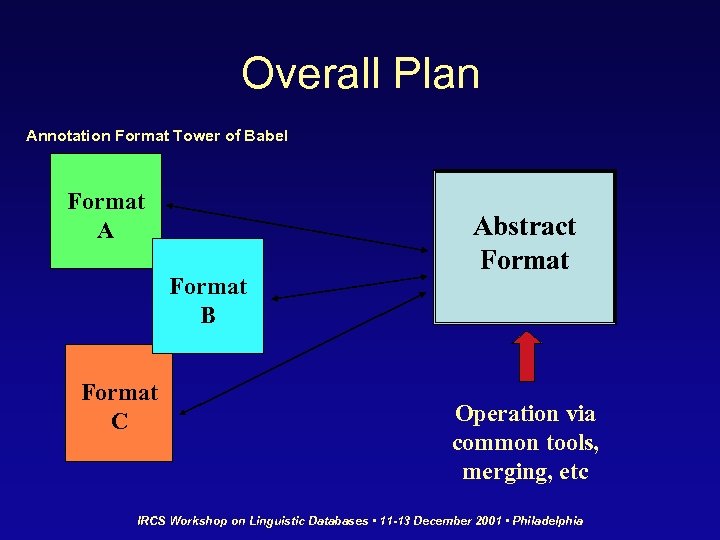 Overall Plan Annotation Format Tower of Babel Format A Format B Format C Abstract Format Operation via common tools, merging, etc IRCS Workshop on Linguistic Databases • 11 -13 December 2001 • Philadelphia
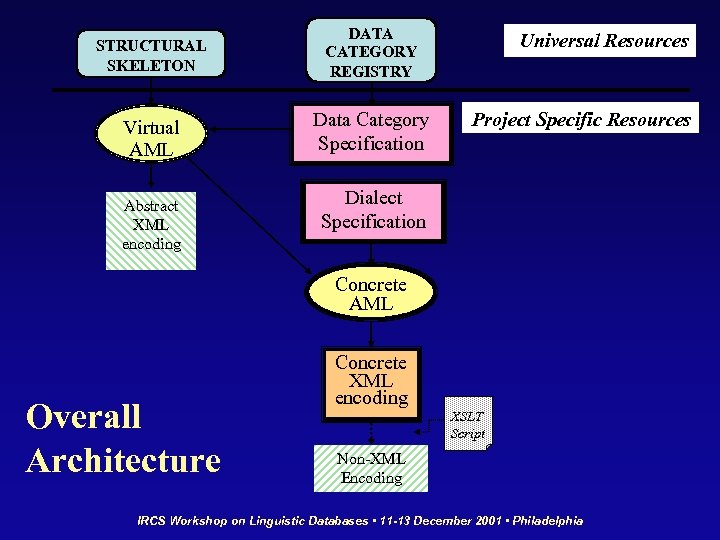 STRUCTURAL SKELETON DATA CATEGORY REGISTRY Virtual AML Data Category Specification Abstract XML encoding Universal Resources Project Specific Resources Dialect Specification Concrete AML Overall Architecture Concrete XML encoding XSLT Script Non-XML Encoding IRCS Workshop on Linguistic Databases • 11 -13 December 2001 • Philadelphia
 N. B. • We do not expect XML to necessarily serve as the internal format used by tools etc. • We do not care about creating yet another “standard” format • We do not care (for this work) about designing specific annotation formats IRCS Workshop on Linguistic Databases • 11 -13 December 2001 • Philadelphia
 Data Model • Identify a consistent underlying data model for data and its annotations – Formalized description of data objects • • Composition Attributes Class membership Applicable procedures, etc – Formalized description of relations among data objects – Independent of instantiation in any particular form IRCS Workshop on Linguistic Databases • 11 -13 December 2001 • Philadelphia
 (Most) Abstract Model • An annotation is a set of data or information associated with some other data • More precise: an annotation is a one- or two-way link between – an annotation object, and – a point or span (or a list/set of points or spans) within a “base” data set • Links may or may not have a semantics • Points and spans may be objects, or sets/lists of objects IRCS Workshop on Linguistic Databases • 11 -13 December 2001 • Philadelphia
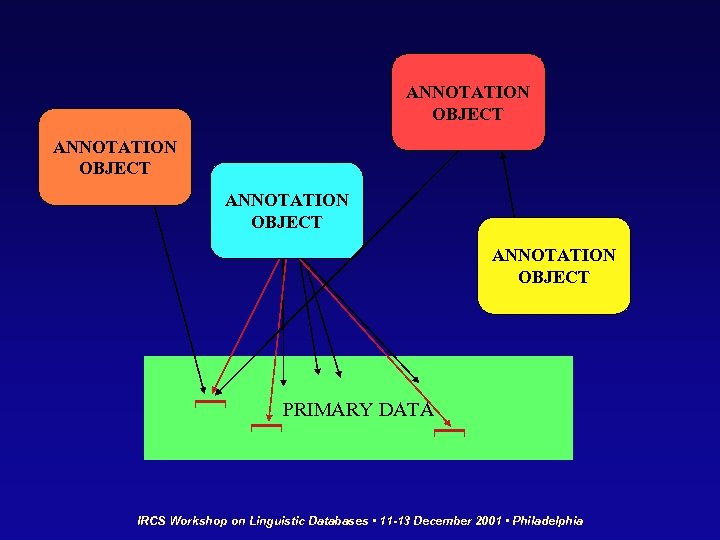 ANNOTATION OBJECT [ PRIMARY DATA [ [ IRCS Workshop on Linguistic Databases • 11 -13 December 2001 • Philadelphia
 Observations · Granularity of the data representation and encoding is critical · Must be possible to represent objects and relations in some form that prevents information loss IRCS Workshop on Linguistic Databases • 11 -13 December 2001 • Philadelphia
 Representing Annotation Objects • Annotation objects may be relatively complex • Abstract representation – graph of elementary structural nodes to which one or more information units are attached – distinction between structure and information units is critical to the design of a truly general model • Annotations may be structured in several ways – Most common: hierarchical • phrase structure analyses of syntax • lexical and terminological information • etc. IRCS Workshop on Linguistic Databases • 11 -13 December 2001 • Philadelphia
 Relations Among Annotations 1. Parallelism – two or more annotations refer to the same data object 2. Alternatives – two or more annotations comprise a set of mutually exclusive alternatives 3. Aggregation – two or more annotations comprise a list or set that should be taken as a unit IRCS Workshop on Linguistic Databases • 11 -13 December 2001 • Philadelphia
 Information Units • Also called data categories – provide the semantics of the annotation – most theory and application-specific part of an annotation scheme • No attempt to define data categories – – – Proposal : development of a Data Category Registry Define data categories with RDF schemas Formalize properties and relations Templates that describe how objects are instantiated Inheritance of appropriate properties IRCS Workshop on Linguistic Databases • 11 -13 December 2001 • Philadelphia
 Data Category Registry • Several functions 1. provide a precise semantics for annotation categories • can be used “off the shelf” or modified 2. provide a set of reference categories onto which scheme-specific names can be mapped 3. provide a point of departure for definition of variant or more precise categories • Overall goal – Ensure that semantics of data categories are well -defined and understood IRCS Workshop on Linguistic Databases • 11 -13 December 2001 • Philadelphia
 Generic Mapping Tool (GMT) • Instantiation of abstract format in XML • Why XML? – Supported standard – Built-in representation for hierarchies (nested tags) – Sophisticated linking mechanisms • Can link to points, spans, use explicit locations or tags – XSLT for transduction, XML Schemas for validation, etc. IRCS Workshop on Linguistic Databases • 11 -13 December 2001 • Philadelphia
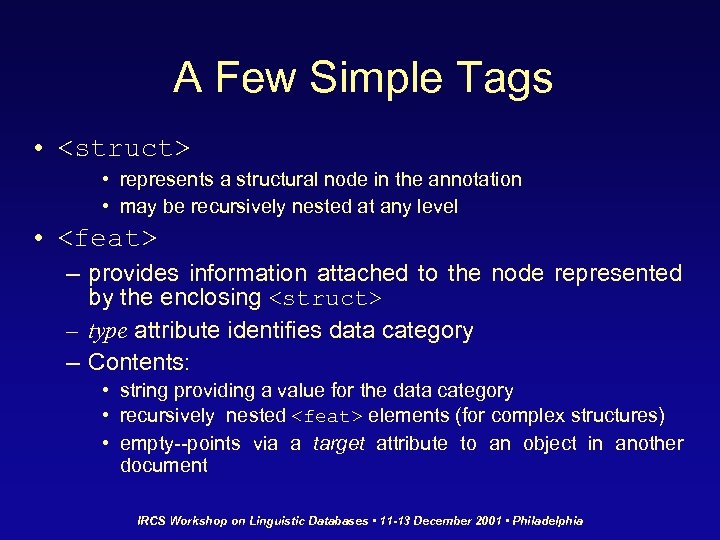 A Few Simple Tags •
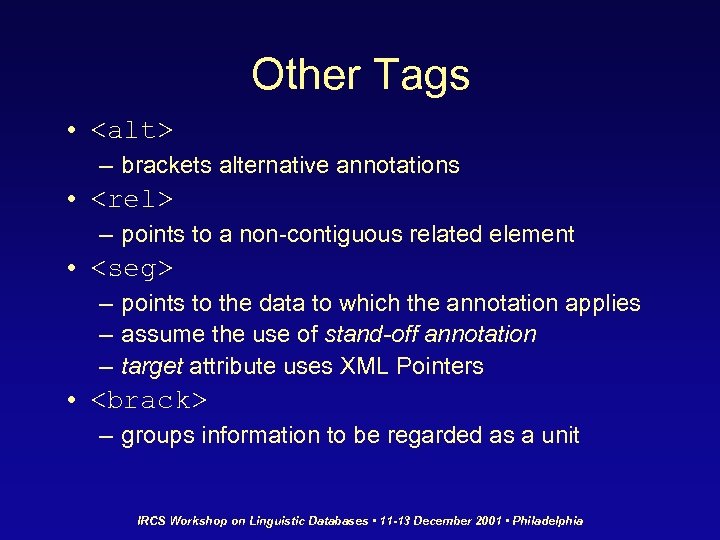 Other Tags •
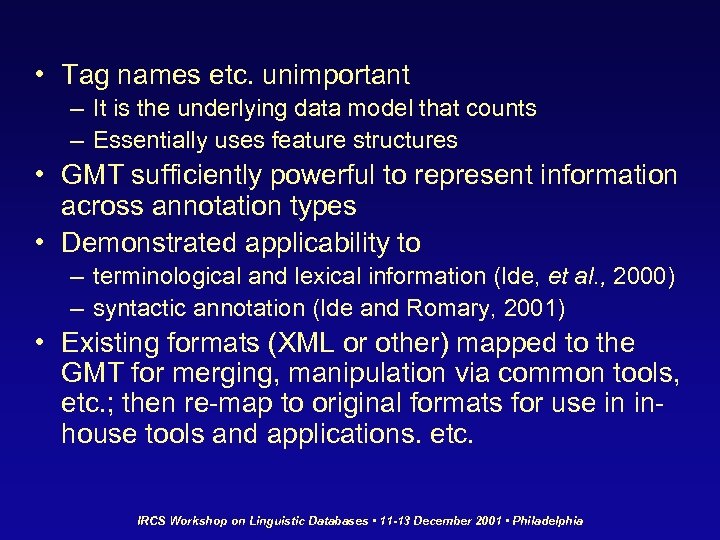 • Tag names etc. unimportant – It is the underlying data model that counts – Essentially uses feature structures • GMT sufficiently powerful to represent information across annotation types • Demonstrated applicability to – terminological and lexical information (Ide, et al. , 2000) – syntactic annotation (Ide and Romary, 2001) • Existing formats (XML or other) mapped to the GMT for merging, manipulation via common tools, etc. ; then re-map to original formats for use in inhouse tools and applications. etc. IRCS Workshop on Linguistic Databases • 11 -13 December 2001 • Philadelphia
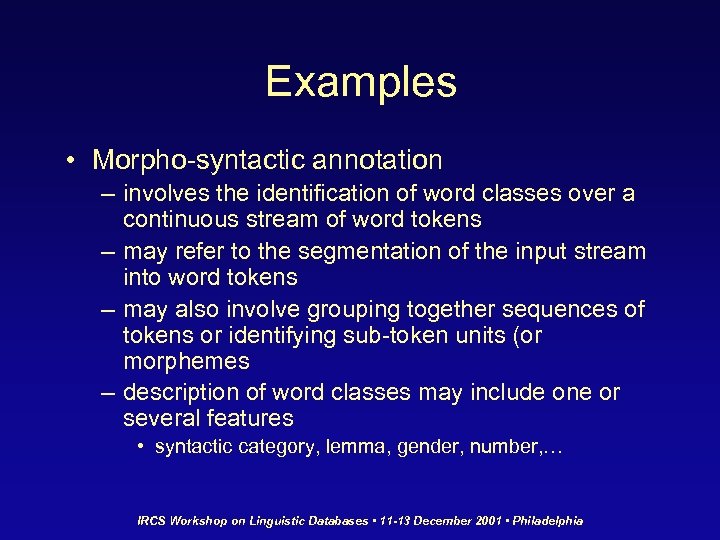 Examples • Morpho-syntactic annotation – involves the identification of word classes over a continuous stream of word tokens – may refer to the segmentation of the input stream into word tokens – may also involve grouping together sequences of tokens or identifying sub-token units (or morphemes – description of word classes may include one or several features • syntactic category, lemma, gender, number, … IRCS Workshop on Linguistic Databases • 11 -13 December 2001 • Philadelphia
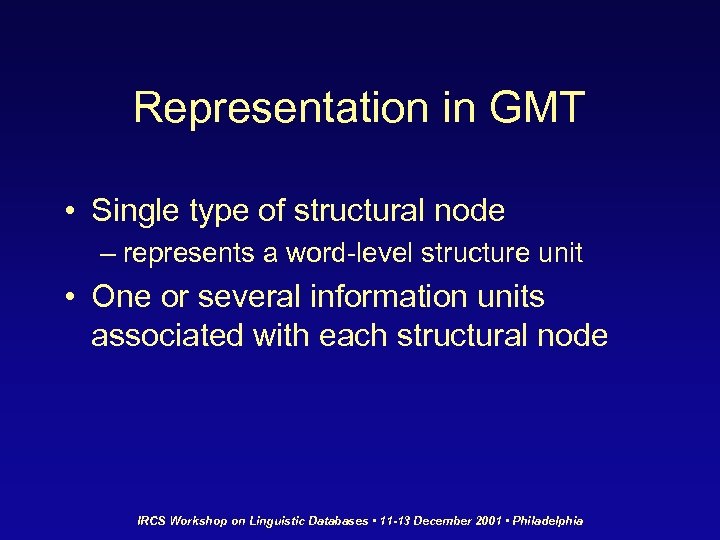 Representation in GMT • Single type of structural node – represents a word-level structure unit • One or several information units associated with each structural node IRCS Workshop on Linguistic Databases • 11 -13 December 2001 • Philadelphia
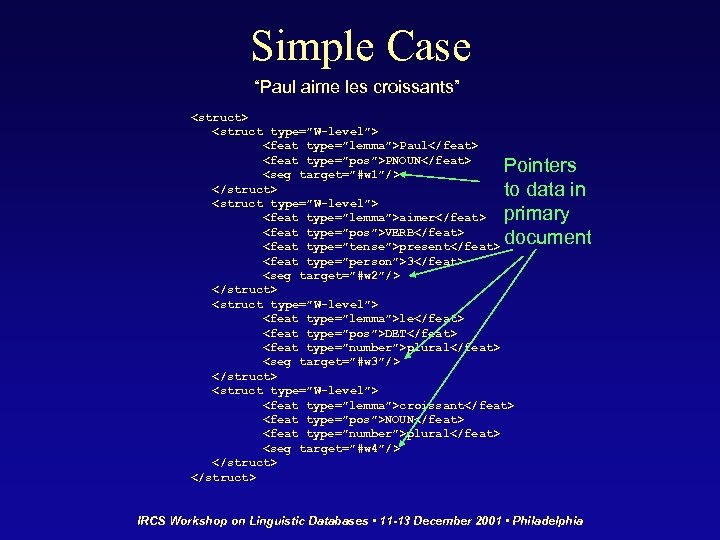 Simple Case “Paul aime les croissants”
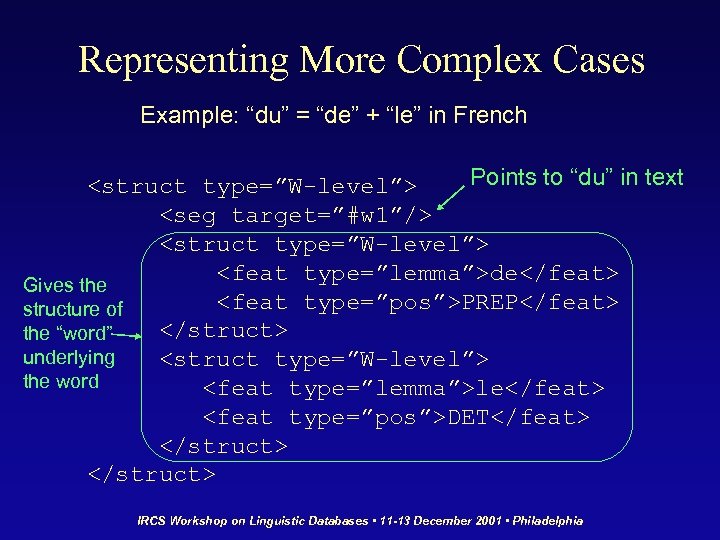 Representing More Complex Cases Example: “du” = “de” + “le” in French Points to “du” in text
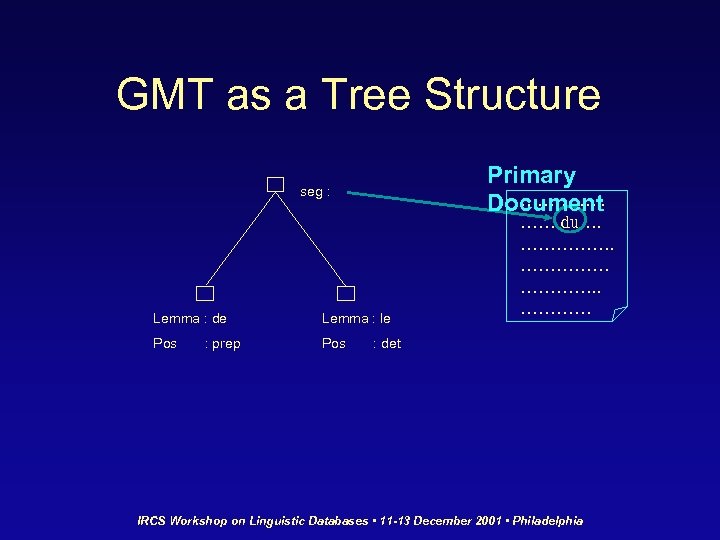 GMT as a Tree Structure Primary …. ………. . Document seg : Lemma : de Lemma : le Pos : prep ……. du…. ……………. . ………… : det IRCS Workshop on Linguistic Databases • 11 -13 December 2001 • Philadelphia
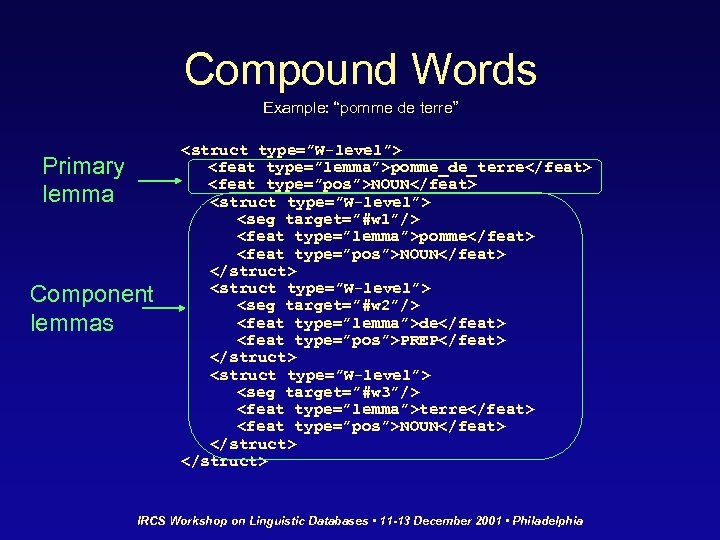 Compound Words Example: “pomme de terre” Primary lemma Component lemmas
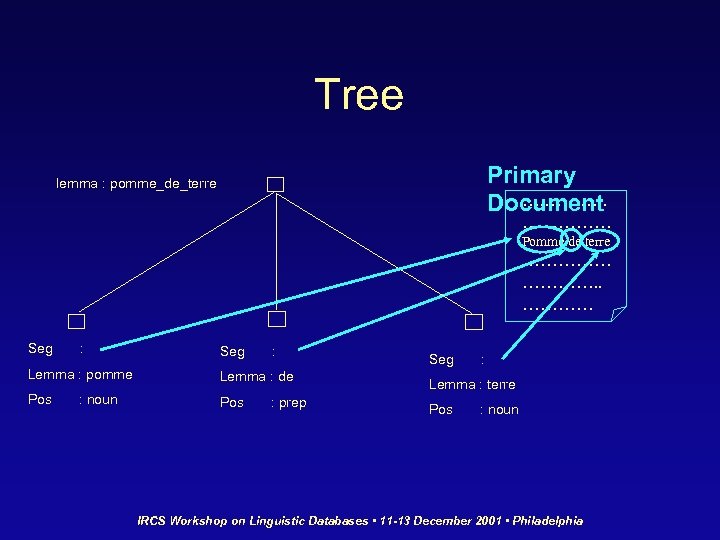 Tree Primary …. ………. . Document lemma : pomme_de_terre …………… Pomme de terre ……………. . ………… Seg : Lemma : pomme Lemma : de Pos : noun : prep Seg : Lemma : terre Pos : noun IRCS Workshop on Linguistic Databases • 11 -13 December 2001 • Philadelphia
 Advantages • Enables specification of the required level of granularity – granularity of the segmentation in (or associated with) primary data may not correspond to that required for the annotation • Can define relations over the tree independently – Compositional for morpho-syntax, etc. – Partitions in lexical data –… IRCS Workshop on Linguistic Databases • 11 -13 December 2001 • Philadelphia
![<struct> <feat type=“orth”>overdress</feat> <struct> <feat type=“pos”>verb</feat> <feat type=“pron”>[jdciw]</pron> <feat type=“def”> To dress (oneself or](https://present5.com/presentation/516cbb60694a142ab20927d1d9727c57/image-32.jpg "<struct> <feat type=“orth”>overdress</feat> <struct> <feat type=“pos”>verb</feat> <feat type=“pron”>[jdciw]</pron> <feat type=“def”> To dress (oneself or")
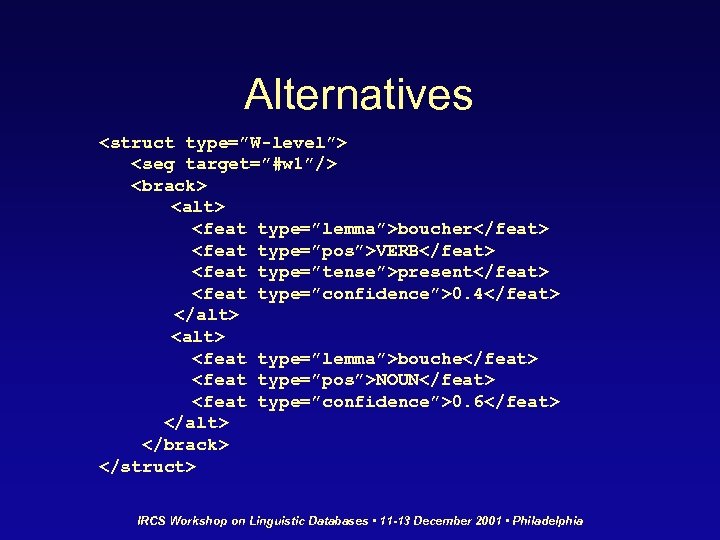 Alternatives
 Relating Annotation Levels • Three ways: 1. Temporal anchoring • associates positional information with each structural level 2. Event-based anchoring • introduces a structural node to represent a location in the text to which all annotations can refer 3. Object-based anchoring • enables pointing from a given level to one or several structural nodes at another level IRCS Workshop on Linguistic Databases • 11 -13 December 2001 • Philadelphia
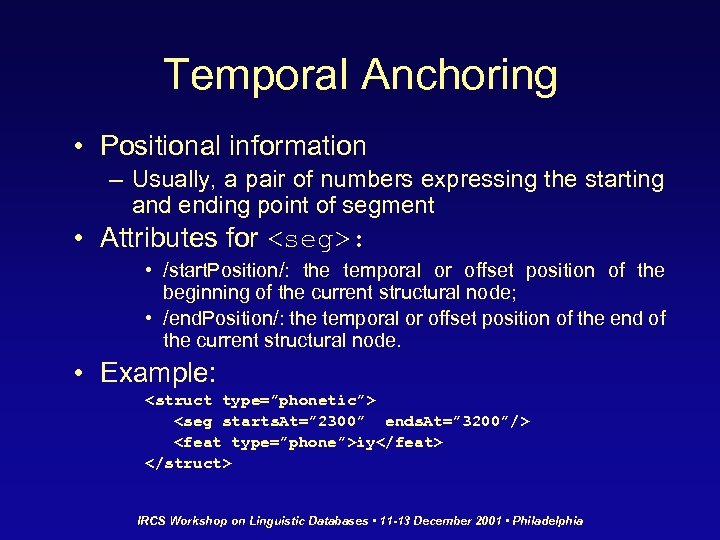 Temporal Anchoring • Positional information – Usually, a pair of numbers expressing the starting and ending point of segment • Attributes for
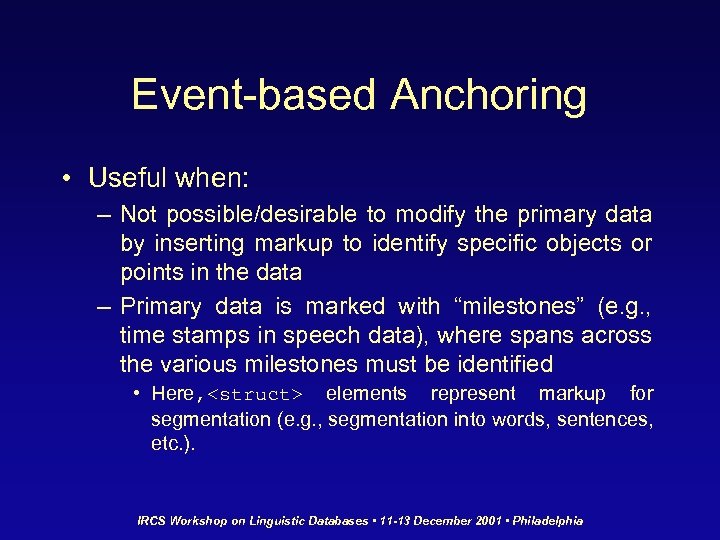 Event-based Anchoring • Useful when: – Not possible/desirable to modify the primary data by inserting markup to identify specific objects or points in the data – Primary data is marked with “milestones” (e. g. , time stamps in speech data), where spans across the various milestones must be identified • Here,
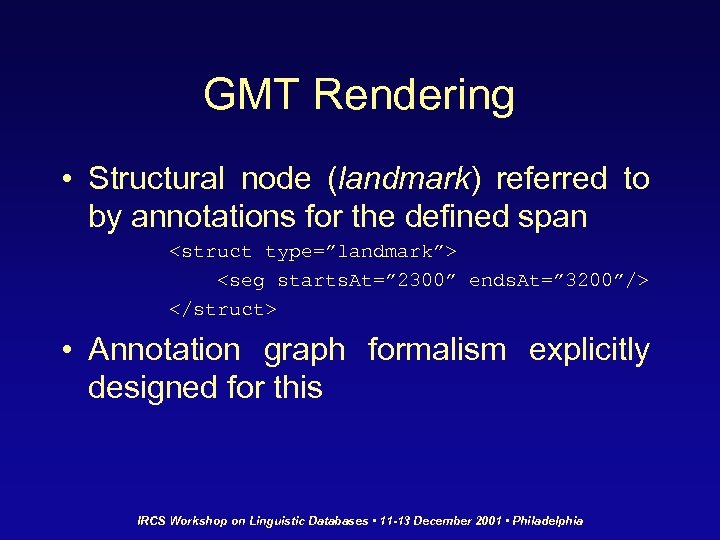 GMT Rendering • Structural node (landmark) referred to by annotations for the defined span
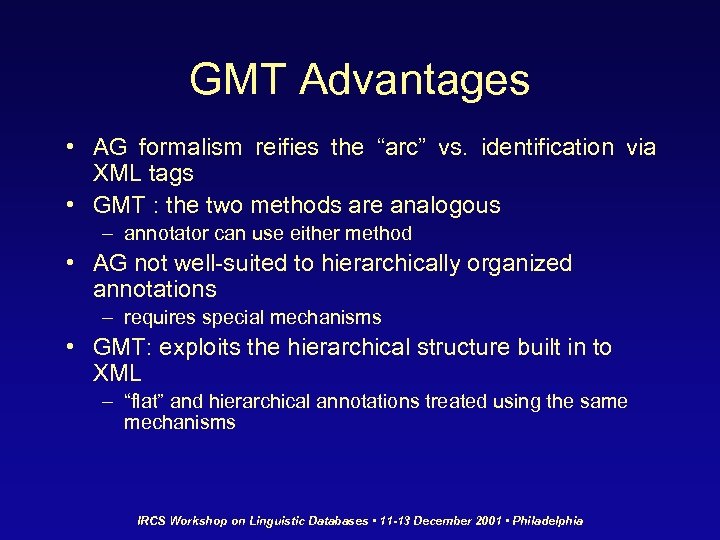 GMT Advantages • AG formalism reifies the “arc” vs. identification via XML tags • GMT : the two methods are analogous – annotator can use either method • AG not well-suited to hierarchically organized annotations – requires special mechanisms • GMT: exploits the hierarchical structure built in to XML – “flat” and hierarchical annotations treated using the same mechanisms IRCS Workshop on Linguistic Databases • 11 -13 December 2001 • Philadelphia
 Object-based Anchoring • Useful to make dependencies between two or more annotation levels explicit – Example: syntactic annotation can refer directly to the relevant nodes in a morphosyntactically annotated corpus IRCS Workshop on Linguistic Databases • 11 -13 December 2001 • Philadelphia
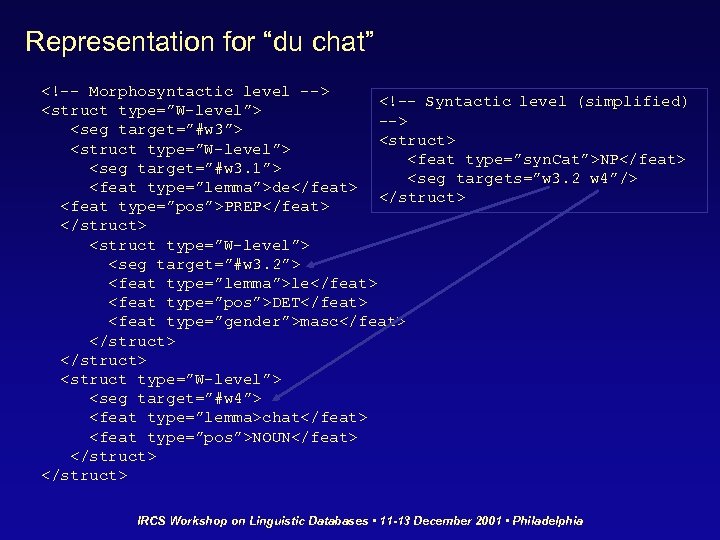 Representation for “du chat”
 GMT as a Modeling Tool • Rendering various formats into GMT representation has revealed some problems, inconsistencies in existing formats – Penn Treebank : inconsistent indication of relations (see Ide and Romary, ACL 2001 or Abeillé Treebank book, forthcoming) – NOMLEX lexicon : no (automatically perceivable) distinction between lists and alternatives • The abstract format serves the unexpected purpose of providing a “template” for fundamental annotation properties IRCS Workshop on Linguistic Databases • 11 -13 December 2001 • Philadelphia
 Jumping Ahead… • Is XML distracting us from our real work? – YES, because • Focus on details of using XML and related standards can obscure the real work of data modeling – BUT • Datas models are no use only in the abstract - need means to implement • XML, schemas, RDF, etc. are powerful data modeling tools based on years of research in this area • Need to know how to best exploit them for our purposes • Need a synergy between modeling efforts and implementation in XML, RDF, etc. • Need to remember that using XML is just a vehicle to ensure flexibility, convertability, and compatibility with evolving technologies IRCS Workshop on Linguistic Databases • 11 -13 December 2001 • Philadelphia
 Conclusion • ISO committee – Work is continually evolving • Try to stay at the leading edge of data representation – We are only at the “assembly language” level – We need to do this right to enable a “web of databases” • Call for participation!!! IRCS Workshop on Linguistic Databases • 11 -13 December 2001 • Philadelphia
 Thank You Contacts US Expert, ISO TC 37 SC 4 Nancy Ide ide@cs. vassar. edu Chairman, ISO TC 37 SC 4 Laurent Romary romary@loria. fr IRCS Workshop on Linguistic Databases • 11 -13 December 2001 • Philadelphia