


 Скачать презентацию Standardization for Marine Sanitation Devices One Manufacturers Perspective
9e9a7fa4afceaa72688dc4644edb3a0f.ppt
- Количество слайдов: 7
 Standardization for Marine Sanitation Devices: One Manufacturers Perspective Stephen P. Markle, PE Engineering Director, Navalis Environmental Systems 09 December 2009 Made in the USA
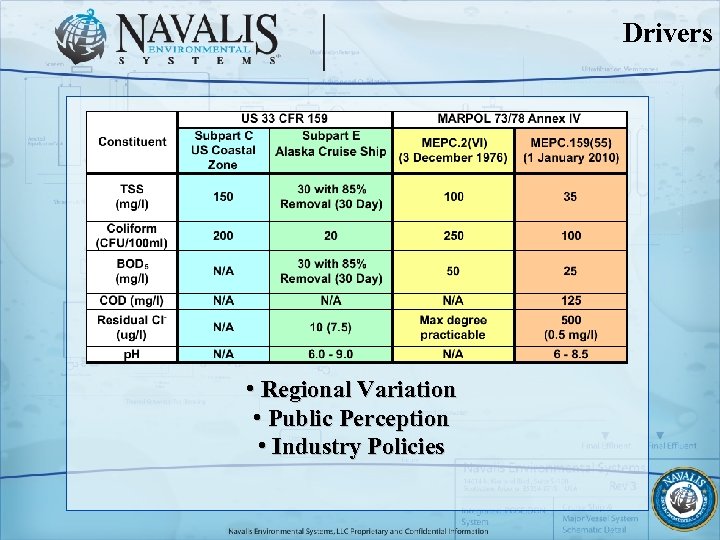 Drivers • Regional Variation • Public Perception • Industry Policies
 Sewage, Why the Difference? • US 33 CFR 159: Sewage means human body wastes and the wastes from toilets and other receptacles intended to receive or retain body waste. • MARPOL Annex IV: (MEPC. 115(51) April 2004) –. 1 drainage and other wastes from any form of toilets and urinals; –. 2 drainage from medical premises (dispensary, sick bay, etc. ) via wash basins, wash tubs and scuppers located in such premises; –. 3 drainage from spaces containing living animals; or –. 4 other waste waters when mixed with the drainages defined above. • Should be harmonized.
 Existing Test Requirements • US 33 CFR 159 Type II MSD and MEPC. 159(55) STP – 10 Days, 40 Samples – Influent Quality – Fresh Sewage – Minimum 500 mg/l TSS – Account for Loading – Allow both Land Based and Shipboard Testing • Correlate the differences • Only “Murkowski” for Cruise Ships in Alaska (33 CFR 159 Subpart E) requires continual performance verification after installation. • Reality is that Certificate does not mean it works in Marine Environment. – Test Protocol – Influent Specification looks like generic land based POTWF influent. • What is desired, a Certificate or High Quality Effluent?
 What is Required? • International Standard – EPA and IMO come to Terms – Goal is a single world wide maritime standard – Emphasize Best Available Technology • Revise Test Protocol – Specify Shipboard Like Influent – Examine 10 -day test for adequacy • Examine USCG Material Requirements – i. e. Shock and Vibe Requirement • Vibe requirement exposed Navalis PLC to equivalent of 9. 5 g’s acceleration. • Requirements based on 1970’s smaller vessels exposed to heavy seas – Reasonable and Reflective of Today’s Ship Designs? – Surrogate Testing: Modeling and Simulation, Component Testing • Who? – ASTM Task Group with US EPA, US Coast Guard, US Navy, CLIA, INTERTANKO, Manufacturers, Academics, NGO Environmental Groups…
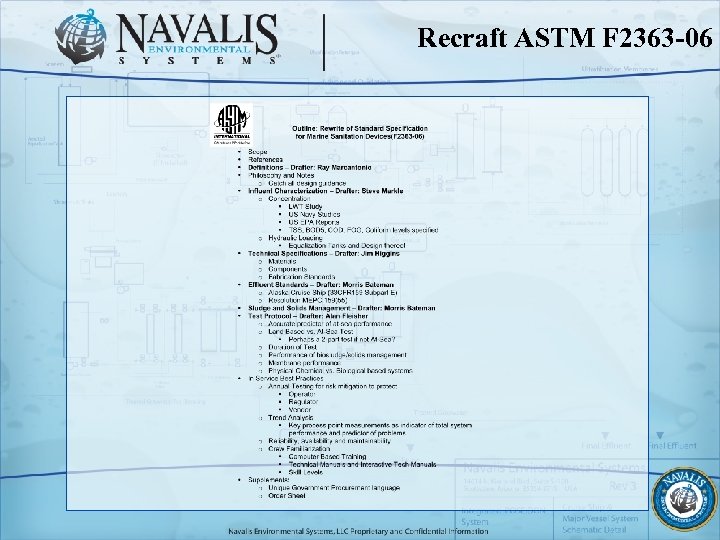 Recraft ASTM F 2363 -06
 Conclusion: Desired Actions • US Ratify MARPOL 73/78 Annex IV – Even the Playing Field – Allow Industry to Build One Product Line • Increase Efficiency, Reduce Costs – Take Guess Work out of “What is Legal” • ASTM Take Lead and Develop World Class Specification for Type II MSD/STPs – Require Representative Influent – Require Reasonable Tests • Process Duration • Physical – Consensus Standard: Owner/Operator, Manufacturer, Regulator… – Best Available Technology? • Long Term: Shift from Equipment Standard to Ship Standard as in 33 CFR 159 Subpart E if truly working to protect the environment.