


 Скачать презентацию Standard Method for Product Description Sheryn Kirkpatrick-Papineau OEWG
39057f39ce3b3c15c6bceeedd391372c.ppt
- Количество слайдов: 13
 Standard Method for Product Description Sheryn Kirkpatrick-Papineau OEWG IPPC Workshop, Seoul, Korea, June 8, 2011
 Objectives • Compare product descriptions in a paper versus an electronic system • Highlight opportunities for standardization within the UNCEFACT Schema (Schema) • Present potential benefits of a common approach to describing products • Introduce a concept for systematic product description 2
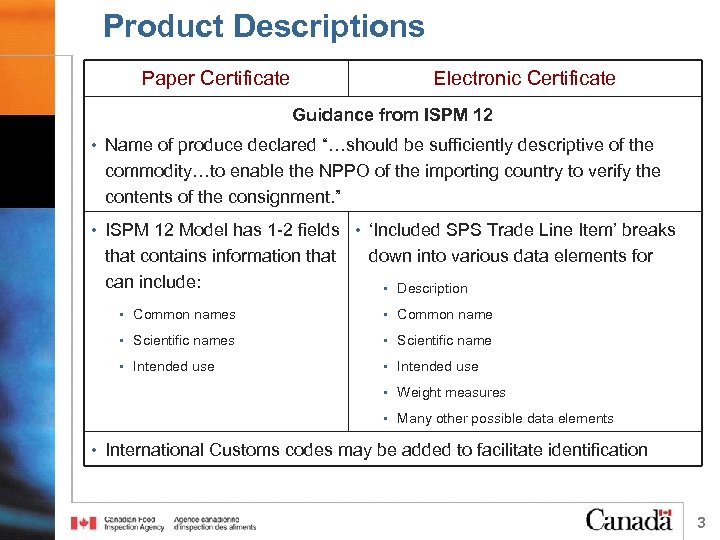 Product Descriptions Paper Certificate Electronic Certificate Guidance from ISPM 12 • Name of produce declared “…should be sufficiently descriptive of the commodity…to enable the NPPO of the importing country to verify the contents of the consignment. ” • ISPM 12 Model has 1 -2 fields • ‘Included SPS Trade Line Item’ breaks that contains information that can include: down into various data elements for • Description • Common names • Common name • Scientific names • Scientific name • Intended use • Weight measures • Many other possible data elements • International Customs codes may be added to facilitate identification 3
 Considerations • The inherent flexibility of the Schema has the potential for inconsistency in the data within an element or between elements • Inconsistency can reduce the potential benefits delivered by moving to electronic certification • The Schema provides an opportunity for standardization 4
 Potential Benefits of Standardization • Standardization reduces errors • Standardization facilitates automated validation of documentation • Automation of document validation can generate efficiencies to focus efforts elsewhere (e. g. inspection/verification of shipment compliance) • Automation of document validation can allow for rapid communication of non-compliant documentation and correction/amendment of documentation Benefits exist for both exporting and importing countries 5
 How Do We Standardize? • Define Schema data elements to capture product description data that permit standardization • ‘Applicable SPS Classification’ • Provides an opportunity to use a list of codes with descriptions for classification • Standardize methodology to generate descriptions • Potential for categorization, coding • ISPM 5 is a good starting point for common terminology 6
 One Possible Approach Codification based on three standardized categories • Commodity Class • “A category of similar commodities that can be considered together in phytosanitary regulations” (as defined in ISPM 5) • Some possible examples to include in a standard list: Plants, Fruit & Vegetables, Seed & Grain, Sawn Timber/Lumber, etc. • Sub-Class • Generally describes the state of the product • Some possible examples to include in a standard list: Fresh, Processed, Dried, etc. ) • Intended Use • Some possible examples to include in a standard list: For Planting, For Direct Human Consumption 7
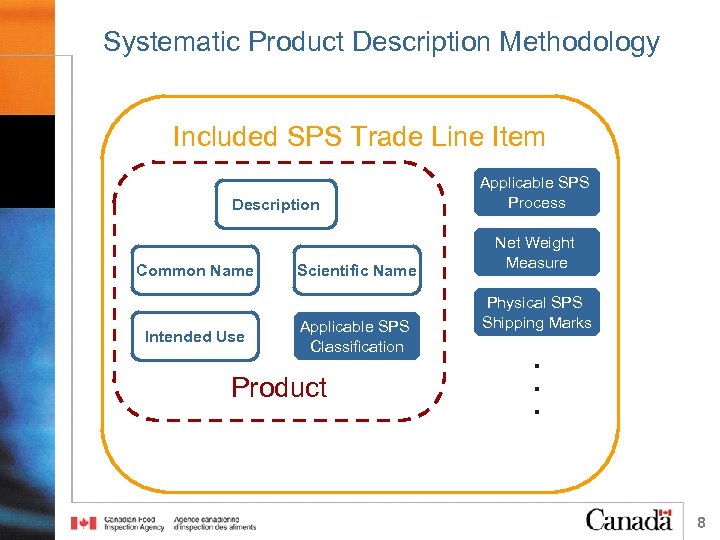 Systematic Product Description Methodology Included SPS Trade Line Item Description Common Name Intended Use Scientific Name Applicable SPS Classification Product Applicable SPS Process Net Weight Measure Physical SPS Shipping Marks . . . 8
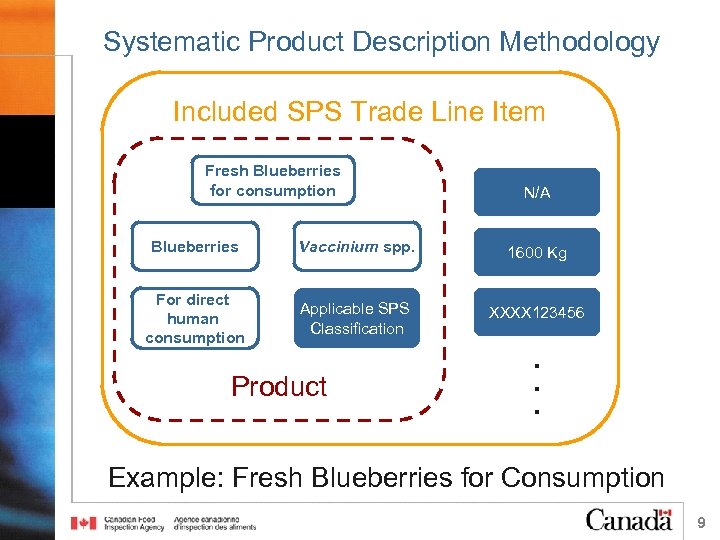 Systematic Product Description Methodology Included SPS Trade Line Item Fresh Blueberries for consumption N/A Blueberries Vaccinium spp. 1600 Kg For direct human consumption Applicable SPS Classification XXXX 123456 Product . . . Example: Fresh Blueberries for Consumption 9
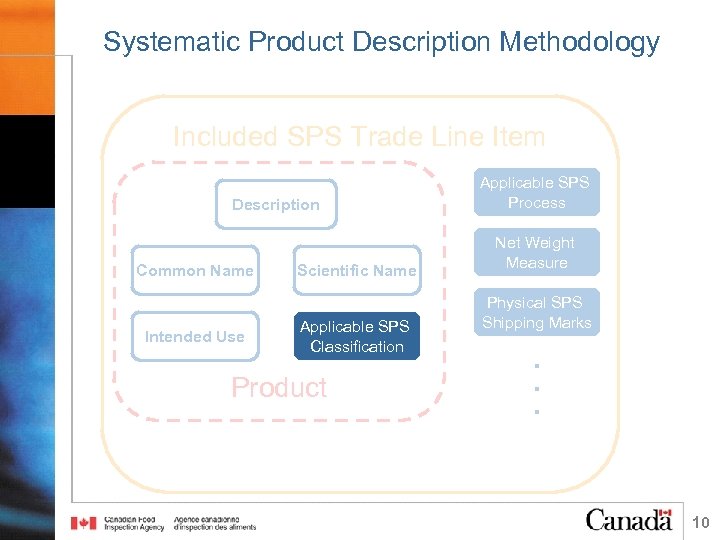 Systematic Product Description Methodology Included SPS Trade Line Item Description Common Name Intended Use Scientific Name Applicable SPS Classification Product Applicable SPS Process Net Weight Measure Physical SPS Shipping Marks . . . 10
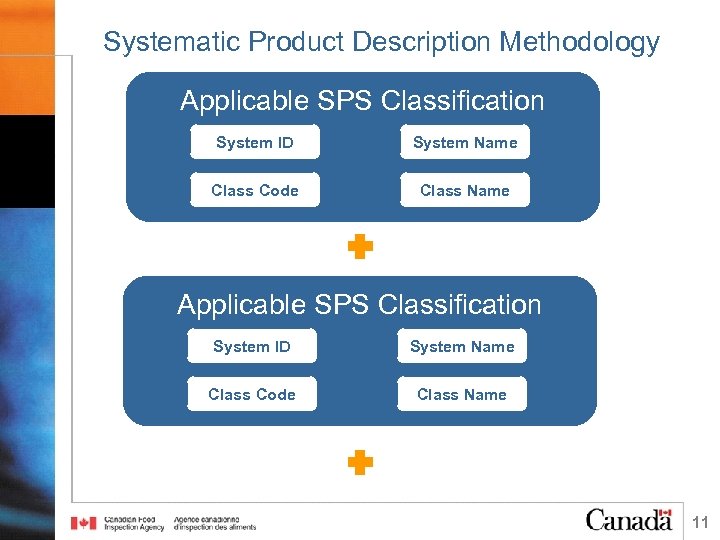 Systematic Product Description Methodology Applicable SPS Classification System ID System Name Class Code Class Name 11
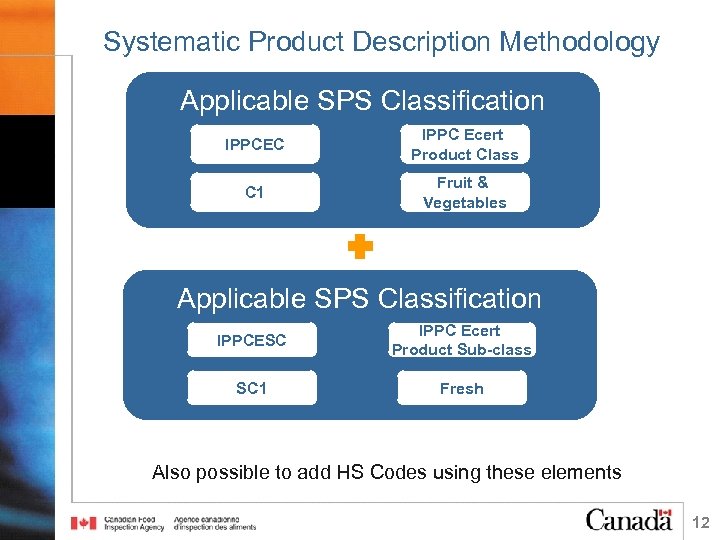 Systematic Product Description Methodology Applicable SPS Classification IPPCEC IPPC Ecert Product Class C 1 Fruit & Vegetables Applicable SPS Classification IPPCESC IPPC Ecert Product Sub-class SC 1 Fresh Also possible to add HS Codes using these elements 12
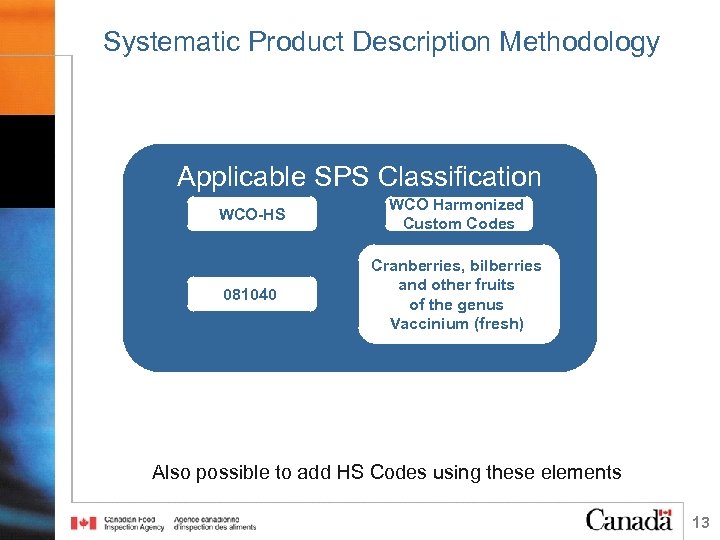 Systematic Product Description Methodology Applicable SPS Classification WCO-HS WCO Harmonized Custom Codes 081040 Cranberries, bilberries and other fruits of the genus Vaccinium (fresh) Also possible to add HS Codes using these elements 13