


 Скачать презентацию Standard 7 5 Analyze the impact of the
0d19006ab00f3a809067c8d46e9a2687.ppt
- Количество слайдов: 26
 Standard 7. 5 Analyze the impact of the Cold War on national security and individual freedom, including the containment policy and the role of military alliances, the effects of the “Red Scare” and Mc. Carthyism, the conflicts in Korea and the Middle East, the Iron Curtain and the Berlin Wall, the Cuban missile crisis, and the nuclear arms race.
 Cold War Competition between U. S. and Soviet Union that spread all over the world.
 U. S. /Soviet Differences after WWII U. S. Soviets • (1) Wanted • (1) Encouraged democratic elections • (2) Access to raw materials and markets • (3) Reunite Germany communism • (2) Wanted to set up satellite nations (838) • (3) Control Eastern Europe • (4) Keep Germany divided
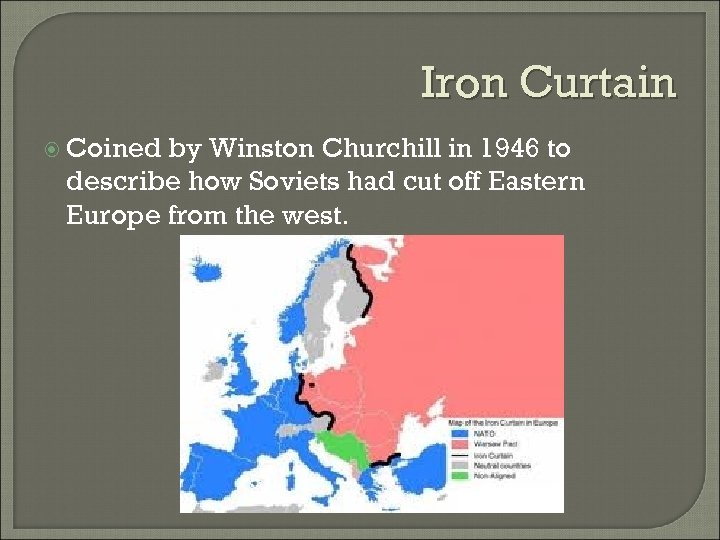 Iron Curtain Coined by Winston Churchill in 1946 to describe how Soviets had cut off Eastern Europe from the west.
 United Nations (UN) International organization designed to help keep world peace. Came into existence in 1945. 5 permanent members – U. S. , France, Brit, Soviet Union, and China. They were to address political and military problems, and veto any action proposed by the General Assembly.
 Containment Becomes the cornerstone, restricting the expansion of Soviet communism.
 Truman Doctrine Assist any country that would resist the spread of Communism; essential to keeping Soviet influence from spreading in Europe especially Turkey and Greece.
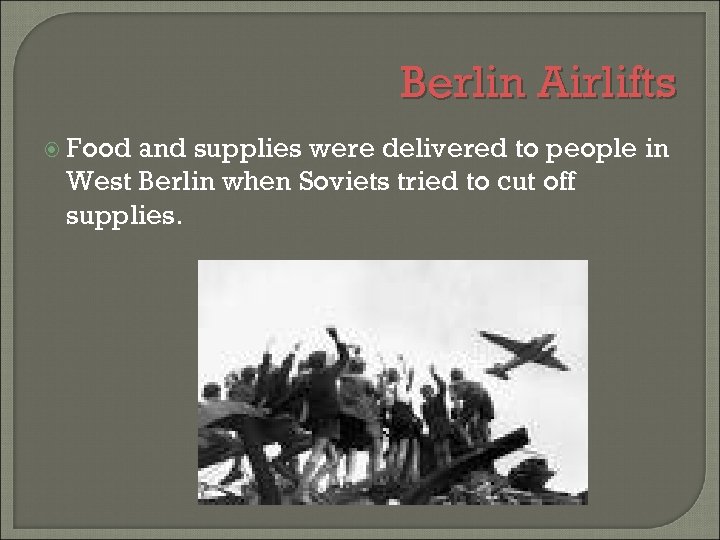 Berlin Airlifts Food and supplies were delivered to people in West Berlin when Soviets tried to cut off supplies.
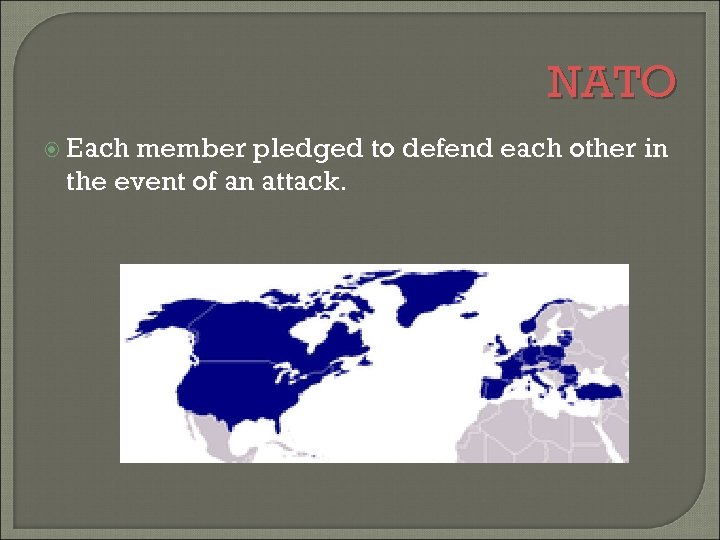 NATO Each member pledged to defend each other in the event of an attack.
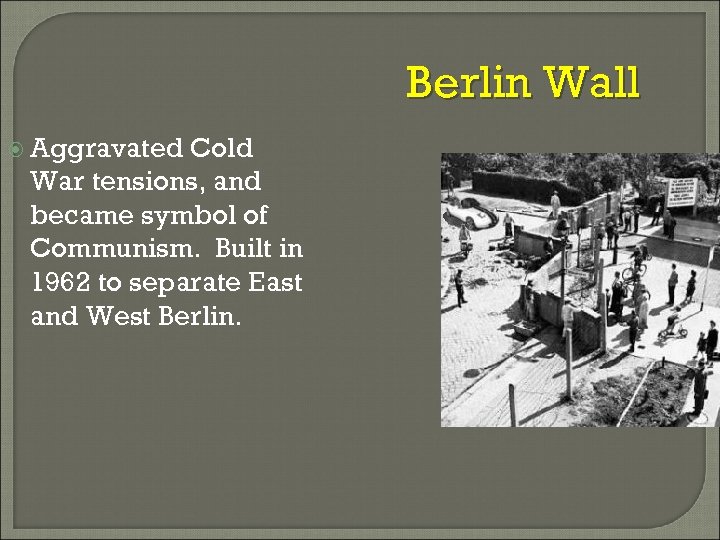 Berlin Wall Aggravated Cold War tensions, and became symbol of Communism. Built in 1962 to separate East and West Berlin.
 Arm’s Race Struggle • • • to gain weapons superiority. H-Bomb Brinkmanship ICBM’s Sputnik U-2 Incident
 Korean War Stared June 25, 1950: Starts when N. Korean troops streamed across the 38 th Parallel. North Korea – communist; South Korea – democratic. UN called its members to defend South Korea. UN troops were placed under the command of Mac. Arthur the N. Koreans back when attacked them from behind. China gets involved because we threatened the border with them at the Yalu River.
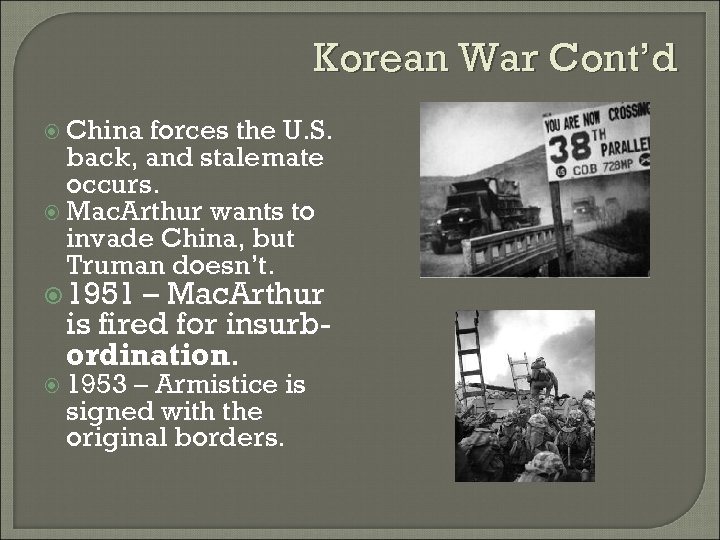 Korean War Cont’d China forces the U. S. back, and stalemate occurs. Mac. Arthur wants to invade China, but Truman doesn’t. 1951 – Mac. Arthur is fired for insurbordination. 1953 – Armistice is signed with the original borders.
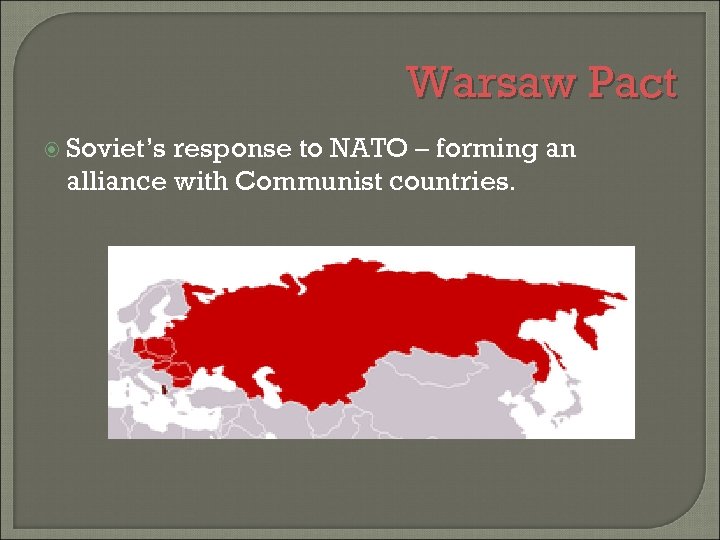 Warsaw Pact Soviet’s response to NATO – forming an alliance with Communist countries.
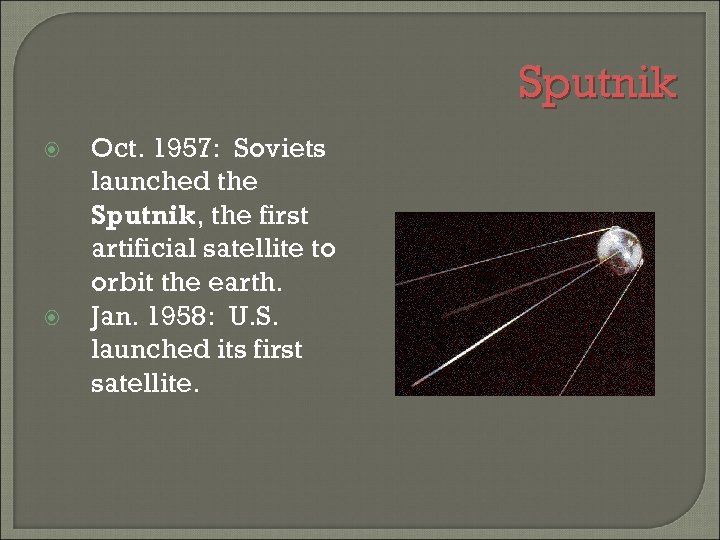 Sputnik Oct. 1957: Soviets launched the Sputnik, the first artificial satellite to orbit the earth. Jan. 1958: U. S. launched its first satellite.
 Eisenhower Response To keep up Eisenhower urged the establishment of NASA to promote space technology. Also got the National Defense Education Act passed – passed to put more money in the study of math, science, and foreign languages in schools.
 Red Scare of 40’s and 50’s Started with the arms race and race to space. Citizens built bomb shelters.
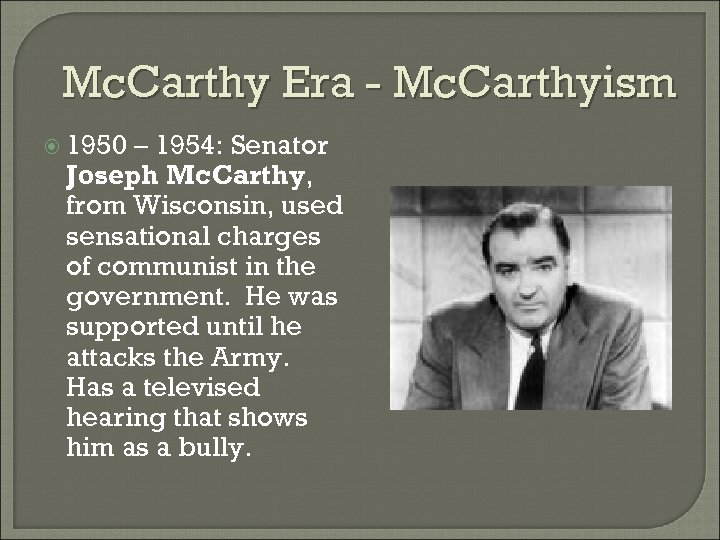 Mc. Carthy Era - Mc. Carthyism 1950 – 1954: Senator Joseph Mc. Carthy, from Wisconsin, used sensational charges of communist in the government. He was supported until he attacks the Army. Has a televised hearing that shows him as a bully.
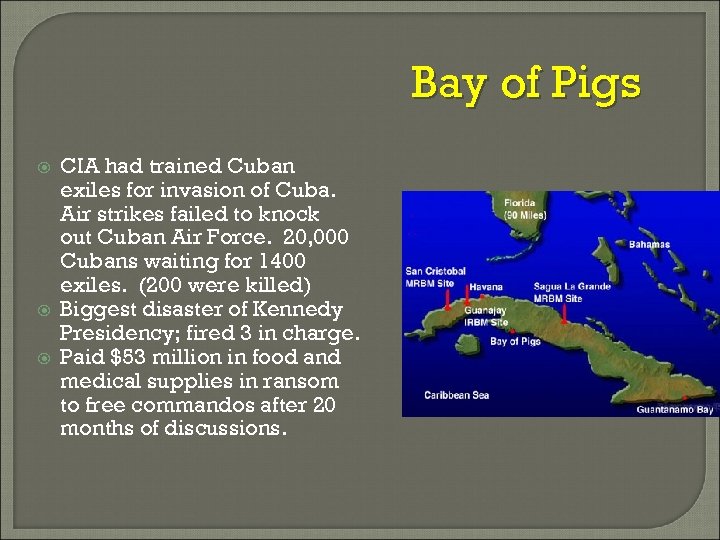 Bay of Pigs CIA had trained Cuban exiles for invasion of Cuba. Air strikes failed to knock out Cuban Air Force. 20, 000 Cubans waiting for 1400 exiles. (200 were killed) Biggest disaster of Kennedy Presidency; fired 3 in charge. Paid $53 million in food and medical supplies in ransom to free commandos after 20 months of discussions.
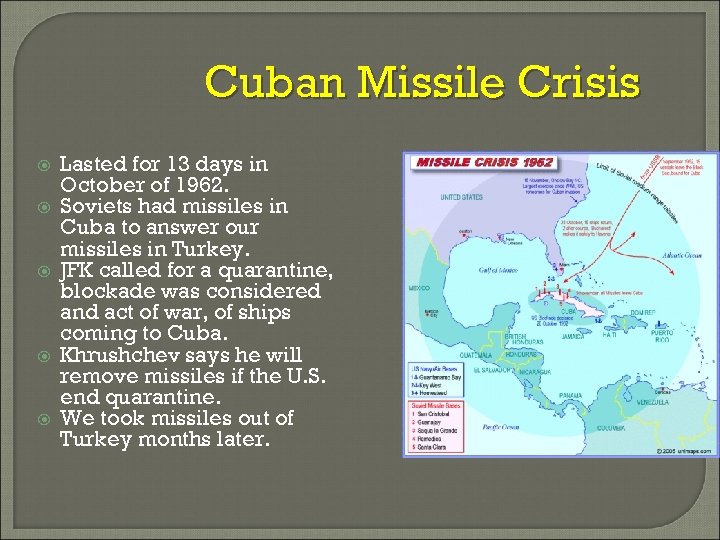 Cuban Missile Crisis Lasted for 13 days in October of 1962. Soviets had missiles in Cuba to answer our missiles in Turkey. JFK called for a quarantine, blockade was considered and act of war, of ships coming to Cuba. Khrushchev says he will remove missiles if the U. S. end quarantine. We took missiles out of Turkey months later.
 State of Israel - 1948 Recognized in 1948 by U. S. Increased our involvement in Middle East. We supported Israel and had interest in oil controlled by Arabs.
 U. S. Cold War Politics 1953 – Eisenhower pulls out of Korea and discusses the domino theory, that when one country in a region falls under Communist rule the others are close to follow. 1956 – Suez Crisis 1957 – Eisenhower Doctrine – U. S. would use force “to safeguard the independence of any country or group of countries in the Middle East requesting aid against an aggressor. ” Basically the U. S. would use force to protect the Middle East from aggressors.
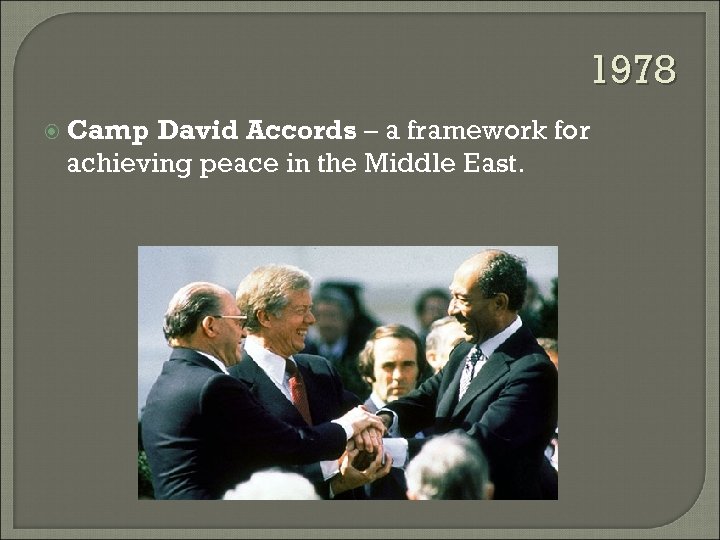 1978 Camp David Accords – a framework for achieving peace in the Middle East.
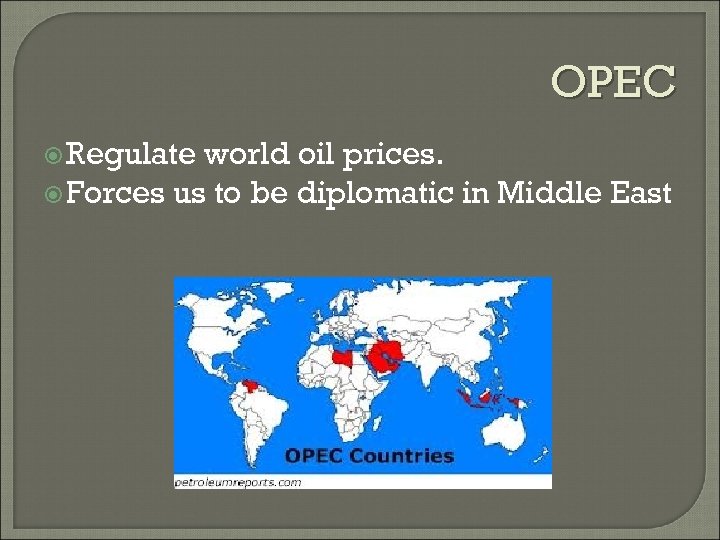 OPEC Regulate world oil prices. Forces us to be diplomatic in Middle East
 1979 Iran Hostage Crisis U. S. had supported the Shah’s government in Iran. Oct. – Start of Iran Hostage Crisis. We had allowed the Shah to enter the U. S. for cancer treatment. Iranians wanted him for trial. Iranian students that supported the Ayatollah Khomeini seized the American embassy. Crisis lasted until Jan. 1981.
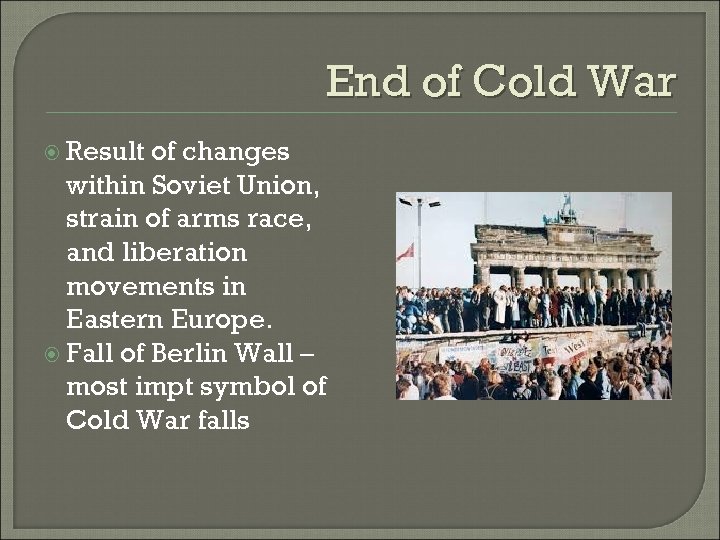 End of Cold War Result of changes within Soviet Union, strain of arms race, and liberation movements in Eastern Europe. Fall of Berlin Wall – most impt symbol of Cold War falls