 Скачать презентацию Stand und zukünftige attraktive Arbeitsgebiete für den Lehrstuhl
20e7179f329602b58bbd20ccf9eb6a73.ppt
- Количество слайдов: 57



Stand und zukünftige attraktive Arbeitsgebiete für den Lehrstuhl für Kommunikationsnetze Prof. Dr. -Ing. Bernhard Walke Kommunikationsnetze, RWTH Aachen walke@comnets. rwth-aachen. de Sitzung des vorbereitenden Berufungsausschusses Kommunikationsnetze Mo. 19. Dezember 2005 Communication Networks
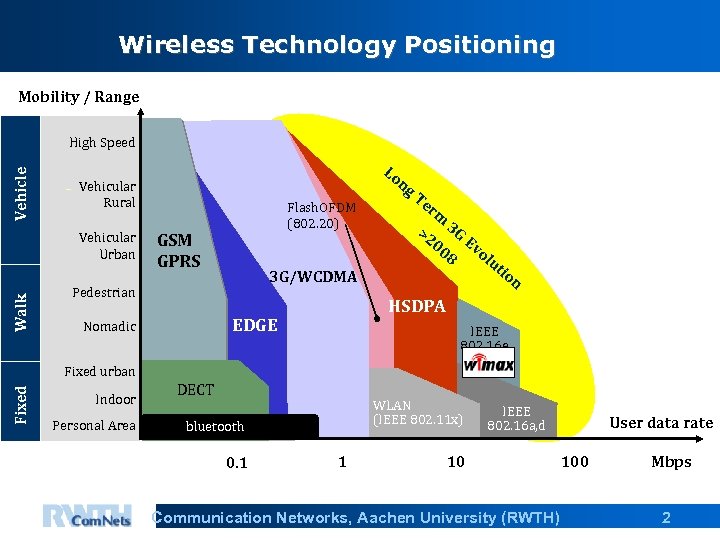
Wireless Technology Positioning Mobility / Range Vehicle High Speed Vehicular Rural Vehicular Urban Walk Lo ng Flash. OFDM (802. 20) GSM GPRS rm >2 3 G 00 Ev o 8 lu tio 3 G/WCDMA Pedestrian n HSDPA EDGE Nomadic Te IEEE 802. 16 e Fixed urban Indoor Personal Area DECT WLAN (IEEE 802. 11 x) bluetooth 0. 1 1 IEEE 802. 16 a, d 10 Communication Networks, Aachen University (RWTH) User data rate 100 Mbps 2
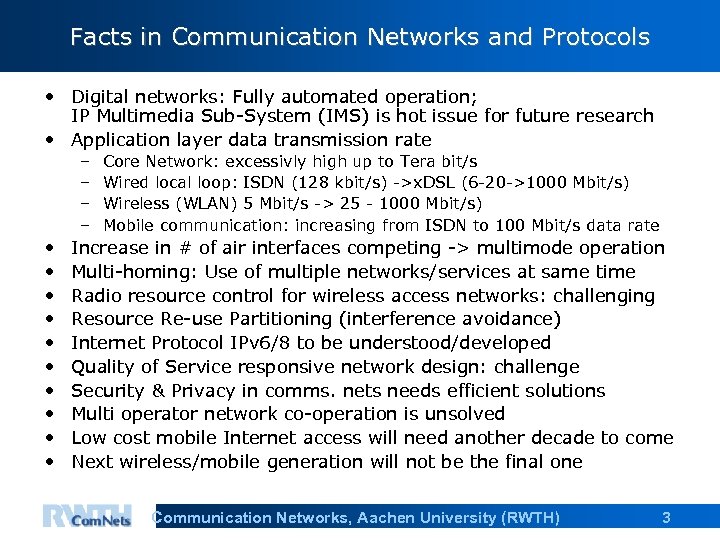
Facts in Communication Networks and Protocols • Digital networks: Fully automated operation; IP Multimedia Sub-System (IMS) is hot issue for future research • Application layer data transmission rate – – • • • Core Network: excessivly high up to Tera bit/s Wired local loop: ISDN (128 kbit/s) ->x. DSL (6 -20 ->1000 Mbit/s) Wireless (WLAN) 5 Mbit/s -> 25 - 1000 Mbit/s) Mobile communication: increasing from ISDN to 100 Mbit/s data rate Increase in # of air interfaces competing -> multimode operation Multi-homing: Use of multiple networks/services at same time Radio resource control for wireless access networks: challenging Resource Re-use Partitioning (interference avoidance) Internet Protocol IPv 6/8 to be understood/developed Quality of Service responsive network design: challenge Security & Privacy in comms. nets needs efficient solutions Multi operator network co-operation is unsolved Low cost mobile Internet access will need another decade to come Next wireless/mobile generation will not be the final one Communication Networks, Aachen University (RWTH) 3
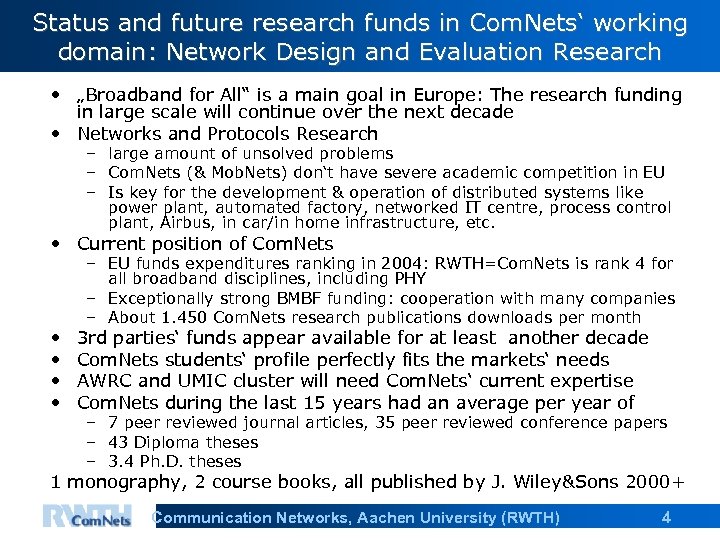
Status and future research funds in Com. Nets‘ working domain: Network Design and Evaluation Research • „Broadband for All“ is a main goal in Europe: The research funding in large scale will continue over the next decade • Networks and Protocols Research – large amount of unsolved problems – Com. Nets (& Mob. Nets) don‘t have severe academic competition in EU – Is key for the development & operation of distributed systems like power plant, automated factory, networked IT centre, process control plant, Airbus, in car/in home infrastructure, etc. • Current position of Com. Nets • • – EU funds expenditures ranking in 2004: RWTH=Com. Nets is rank 4 for all broadband disciplines, including PHY – Exceptionally strong BMBF funding: cooperation with many companies – About 1. 450 Com. Nets research publications downloads per month 3 rd parties‘ funds appear available for at least another decade Com. Nets students‘ profile perfectly fits the markets‘ needs AWRC and UMIC cluster will need Com. Nets‘ current expertise Com. Nets during the last 15 years had an average per year of – 7 peer reviewed journal articles, 35 peer reviewed conference papers – 43 Diploma theses – 3. 4 Ph. D. theses 1 monography, 2 course books, all published by J. Wiley&Sons 2000+ Communication Networks, Aachen University (RWTH) 4
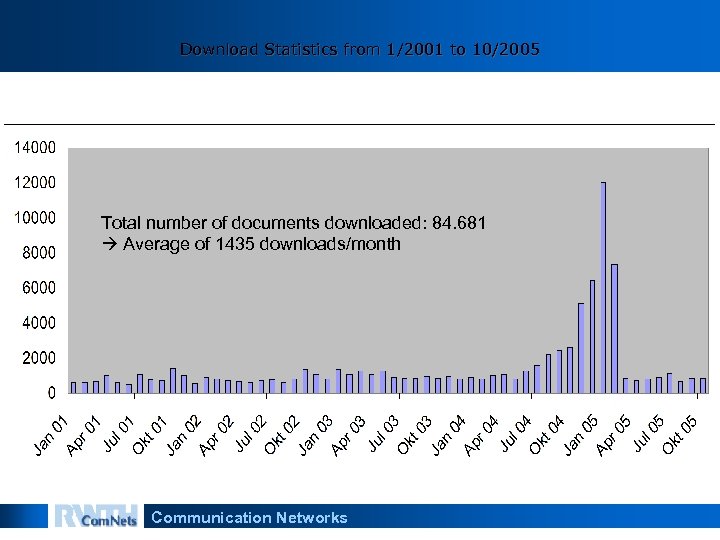
Download Statistics from 1/2001 to 10/2005 Total number of documents downloaded: 84. 681 Average of 1435 downloads/month Communication Networks
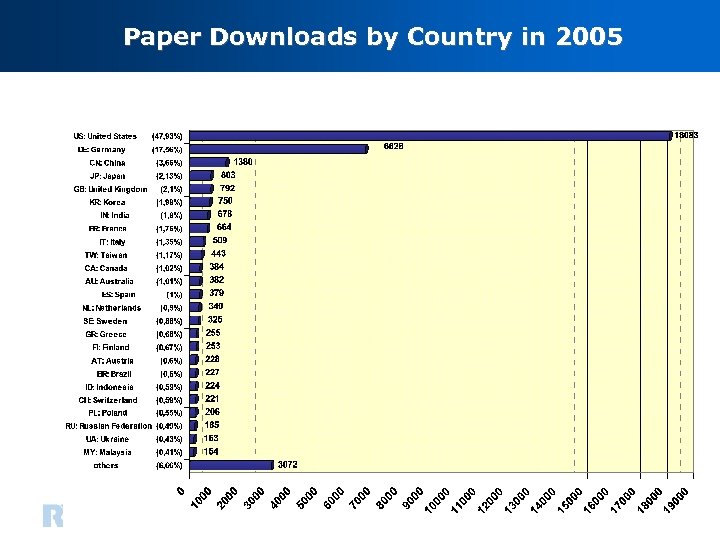
Paper Downloads by Country in 2005 Communication Networks, Aachen University (RWTH) 6
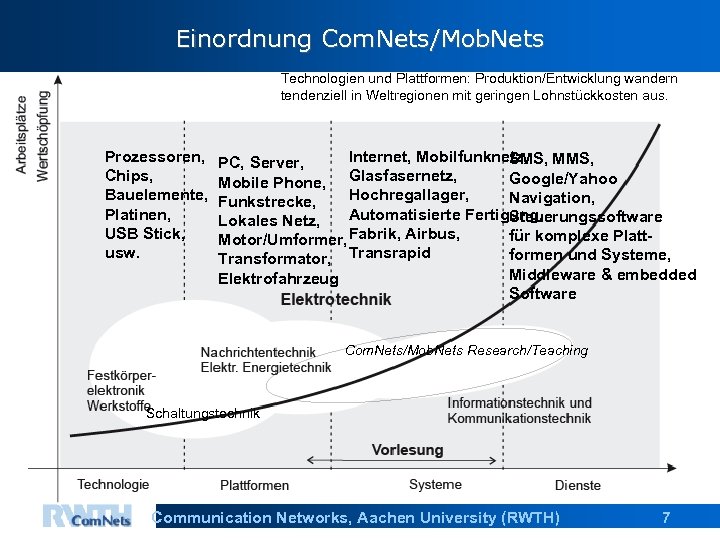
Einordnung Com. Nets/Mob. Nets Technologien und Plattformen: Produktion/Entwicklung wandern tendenziell in Weltregionen mit geringen Lohnstückkosten aus. Prozessoren, Chips, Bauelemente, Platinen, USB Stick, usw. Internet, Mobilfunknetz, SMS, MMS, PC, Server, Google/Yahoo Mobile Phone, Glasfasernetz, Hochregallager, Navigation, Funkstrecke, Automatisierte Fertigung, Steuerungssoftware Lokales Netz, für komplexe Platt. Motor/Umformer, Fabrik, Airbus, formen und Systeme, Transformator, Transrapid Middleware & embedded Elektrofahrzeug Software Com. Nets/Mob. Nets Research/Teaching Schaltungstechnik Communication Networks, Aachen University (RWTH) 7
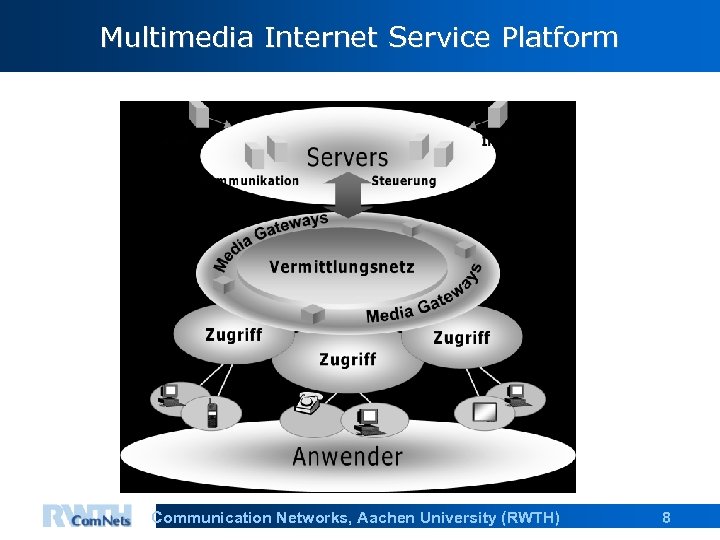
Multimedia Internet Service Platform Communication Networks, Aachen University (RWTH) 8
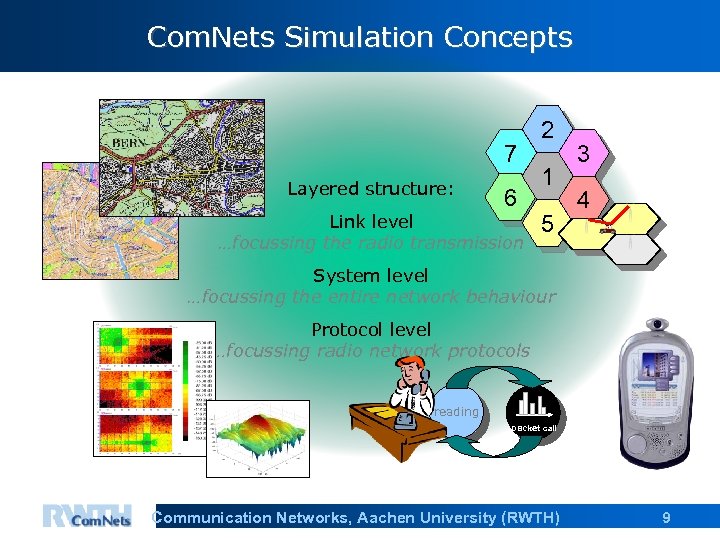
Com. Nets Simulation Concepts 7 Layered structure: 6 Link level …focussing the radio transmission 2 1 5 3 4 System level …focussing the entire network behaviour Protocol level …focussing radio network protocols reading packet call Communication Networks, Aachen University (RWTH) 9
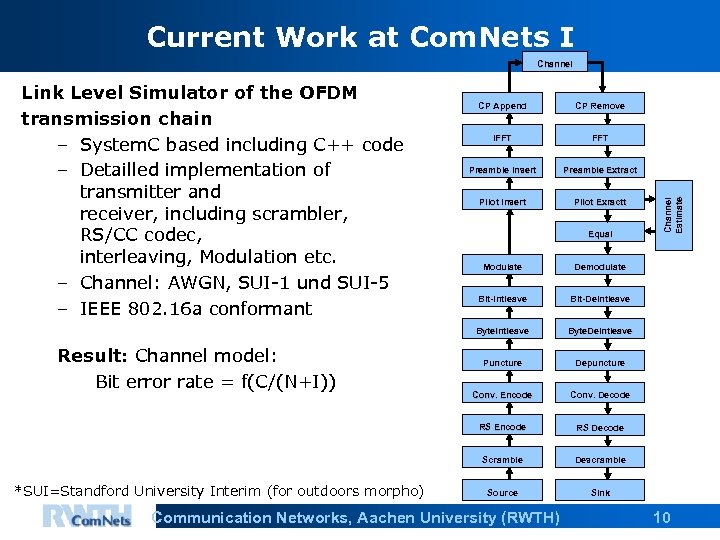
Current Work at Com. Nets I Channel CP Append CP Remove IF F T FFT Preamble Insert Preamble Extract Pilot Insert Pilot Exractt Equal Bit-Intleave Bit-Deintleave Byte. Deintleave Puncture Depuncture Conv. Encode Conv. Decode RS Encode RS Decode Scramble *SUI=Standford University Interim (for outdoors morpho) Demodulate Byte. Intleave Result: Channel model: Bit error rate = f(C/(N+I)) Modulate Descramble Source Channel Estimate Link Level Simulator of the OFDM transmission chain – System. C based including C++ code – Detailled implementation of transmitter and receiver, including scrambler, RS/CC codec, interleaving, Modulation etc. – Channel: AWGN, SUI-1 und SUI-5 – IEEE 802. 16 a conformant Sin k Communication Networks, Aachen University (RWTH) 10
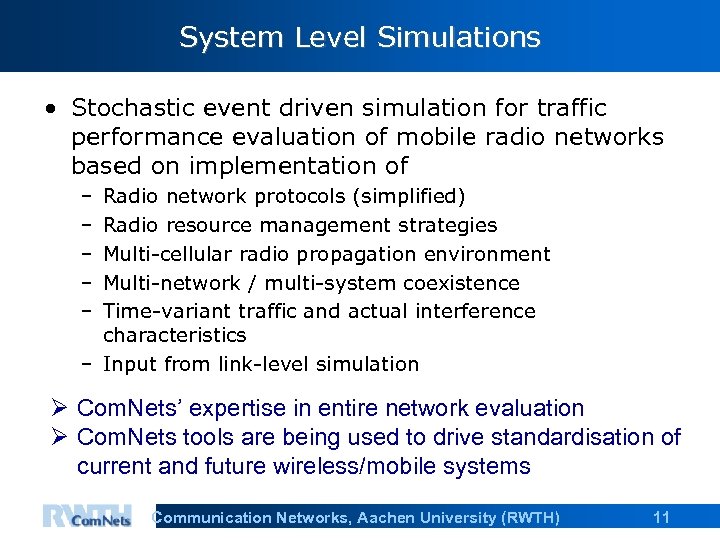
System Level Simulations • Stochastic event driven simulation for traffic performance evaluation of mobile radio networks based on implementation of – – – Radio network protocols (simplified) Radio resource management strategies Multi-cellular radio propagation environment Multi-network / multi-system coexistence Time-variant traffic and actual interference characteristics – Input from link-level simulation Ø Com. Nets’ expertise in entire network evaluation Ø Com. Nets tools are being used to drive standardisation of current and future wireless/mobile systems Communication Networks, Aachen University (RWTH) 11
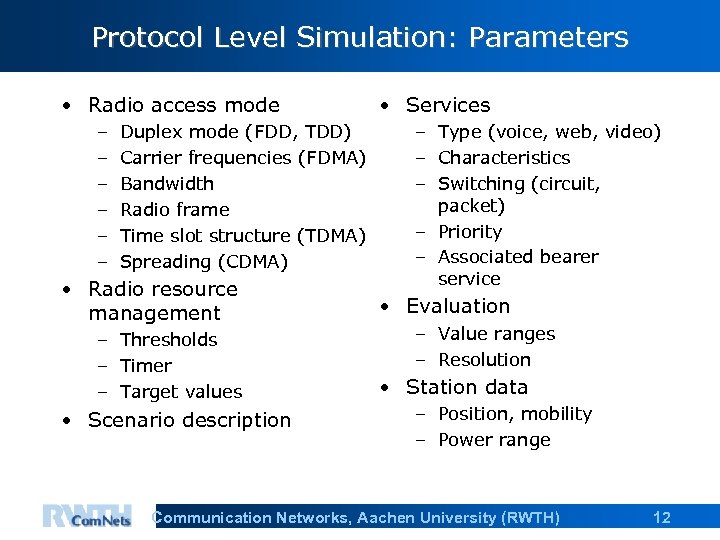
Protocol Level Simulation: Parameters • Radio access mode – – – Duplex mode (FDD, TDD) Carrier frequencies (FDMA) Bandwidth Radio frame Time slot structure (TDMA) Spreading (CDMA) • Radio resource management – Thresholds – Timer – Target values • Scenario description • Services – Type (voice, web, video) – Characteristics – Switching (circuit, packet) – Priority – Associated bearer service • Evaluation – Value ranges – Resolution • Station data – Position, mobility – Power range Communication Networks, Aachen University (RWTH) 12
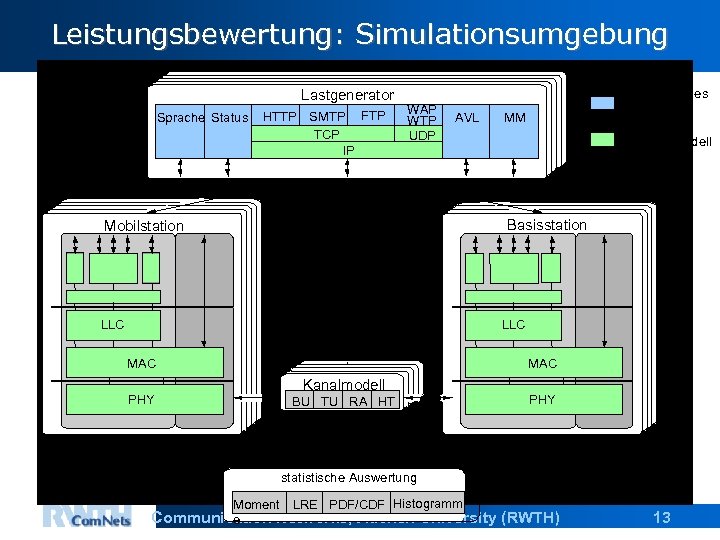
Leistungsbewertung: Simulationsumgebung Lastgenerator Sprache Status HTTP SMTP FTP TCP IP WAP WTP UDP AVL stochastisches Modell MM Protokollmodell Instanz Basisstation Mobilstation Um LLC MAC PHY MAC Kanalmodell BU TU RA HT PHY statistische Auswertung Moment LRE PDF/CDF Histogramm Communication Networks, Aachen University e (RWTH) 13
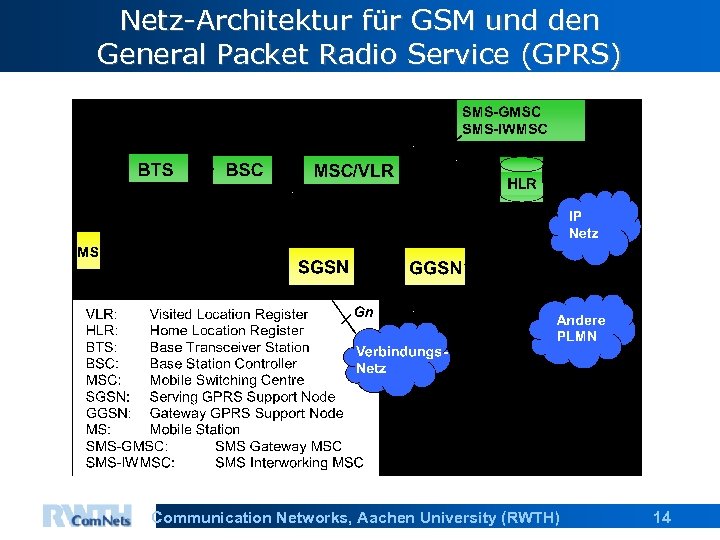
Netz-Architektur für GSM und den General Packet Radio Service (GPRS) Communication Networks, Aachen University (RWTH) 14
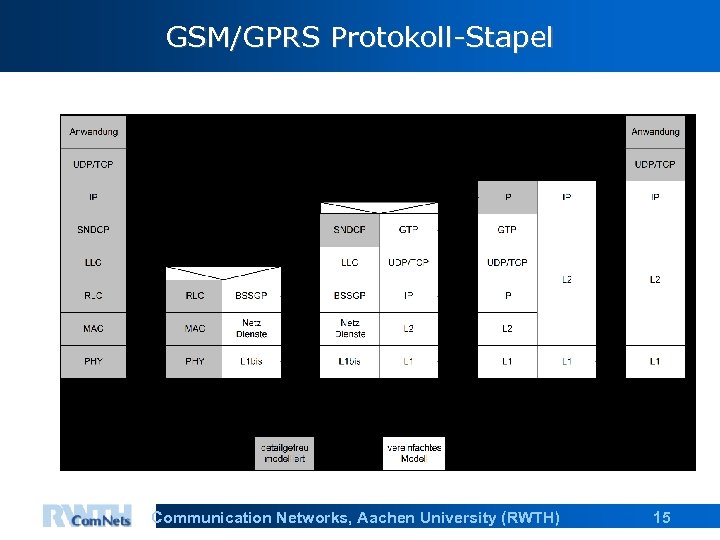
GSM/GPRS Protokoll-Stapel Communication Networks, Aachen University (RWTH) 15
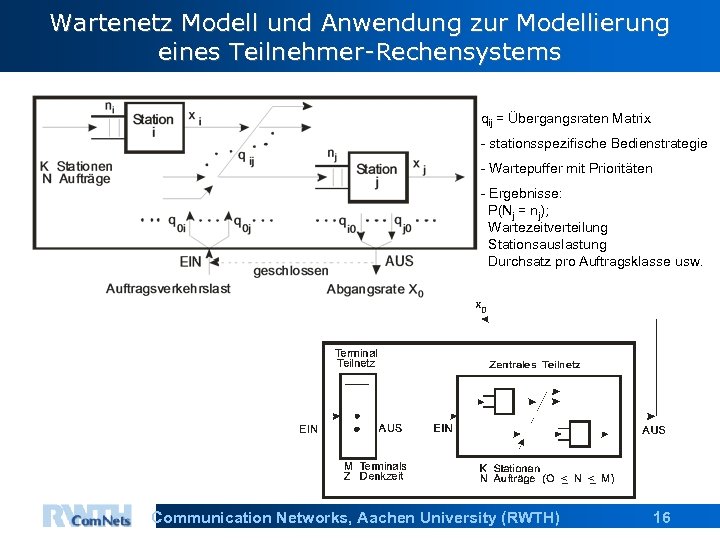
Wartenetz Modell und Anwendung zur Modellierung eines Teilnehmer-Rechensystems qij = Übergangsraten Matrix - stationsspezifische Bedienstrategie - Wartepuffer mit Prioritäten - Ergebnisse: P(Nj = nj); Wartezeitverteilung Stationsauslastung Durchsatz pro Auftragsklasse usw. Communication Networks, Aachen University (RWTH) 16
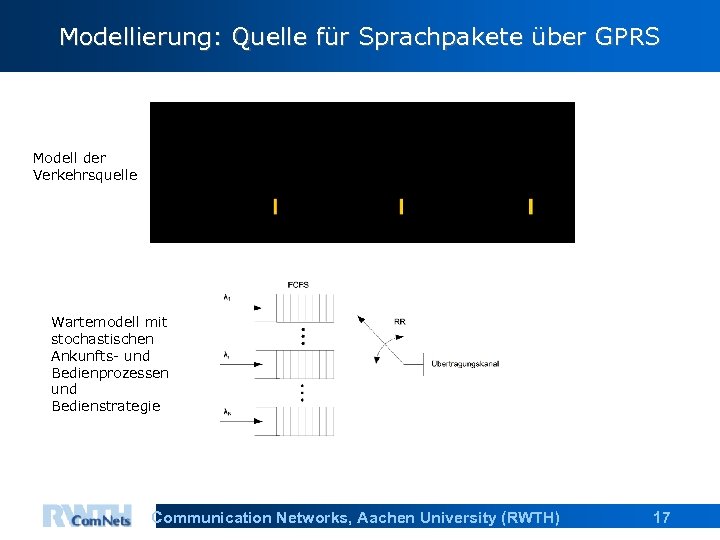
Modellierung: Quelle für Sprachpakete über GPRS Modell der Verkehrsquelle Wartemodell mit stochastischen Ankunfts- und Bedienprozessen und Bedienstrategie Communication Networks, Aachen University (RWTH) 17
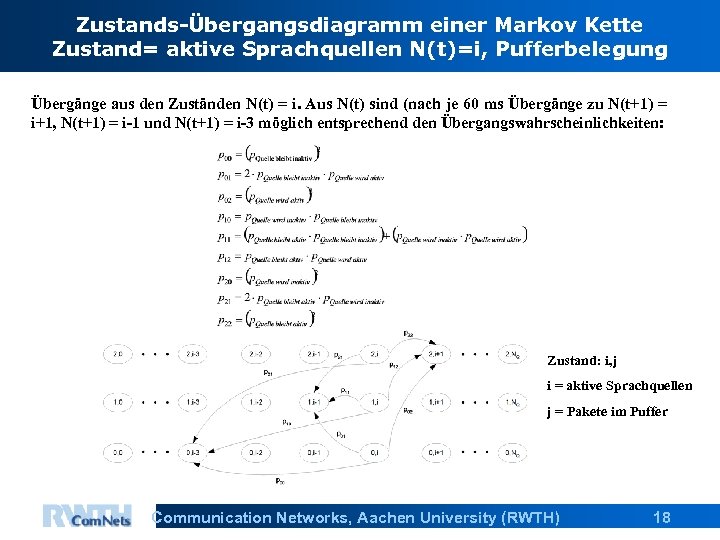
Zustands-Übergangsdiagramm einer Markov Kette Zustand= aktive Sprachquellen N(t)=i, Pufferbelegung Übergänge aus den Zuständen N(t) = i. Aus N(t) sind (nach je 60 ms Übergänge zu N(t+1) = i+1, N(t+1) = i-1 und N(t+1) = i-3 möglich entsprechend den Übergangswahrscheinlichkeiten: Zustand: i, j i = aktive Sprachquellen j = Pakete im Puffer Communication Networks, Aachen University (RWTH) 18
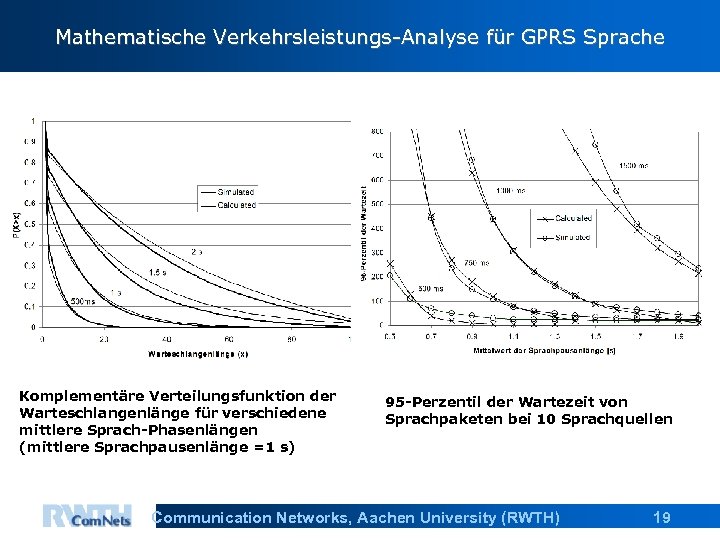
Mathematische Verkehrsleistungs-Analyse für GPRS Sprache Komplementäre Verteilungsfunktion der Warteschlangenlänge für verschiedene mittlere Sprach-Phasenlängen (mittlere Sprachpausenlänge =1 s) 95 -Perzentil der Wartezeit von Sprachpaketen bei 10 Sprachquellen Communication Networks, Aachen University (RWTH) 19
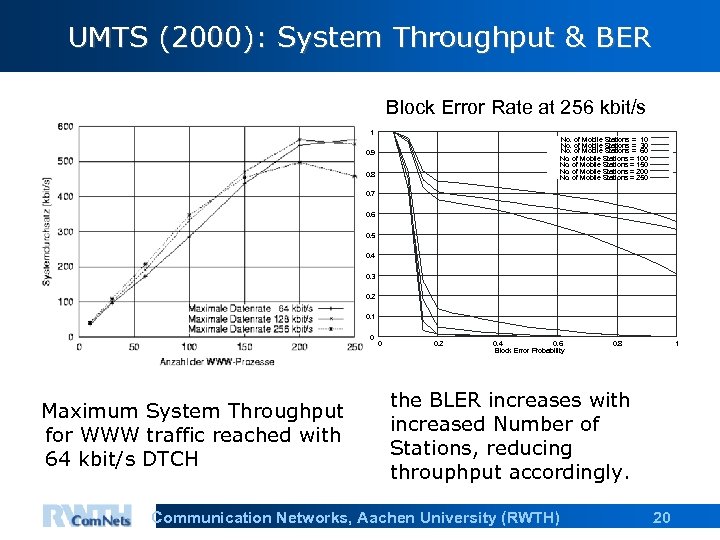
UMTS (2000): System Throughput & BER Block Error Rate at 256 kbit/s 1 No. of Mobile Stations = 10 No. of Mobile Stations = 30 No. of Mobile Stations = 60 No. of Mobile Stations = 100 No. of Mobile Stations = 150 No. of Mobile Stations = 200 No. of Mobile Stations = 250 0. 9 0. 8 0. 7 0. 6 0. 5 0. 4 0. 3 0. 2 0. 1 0 Maximum System Throughput for WWW traffic reached with 64 kbit/s DTCH 0 0. 2 0. 4 0. 6 Block Error Probability 0. 8 1 the BLER increases with increased Number of Stations, reducing throuphput accordingly. Communication Networks, Aachen University (RWTH) 20
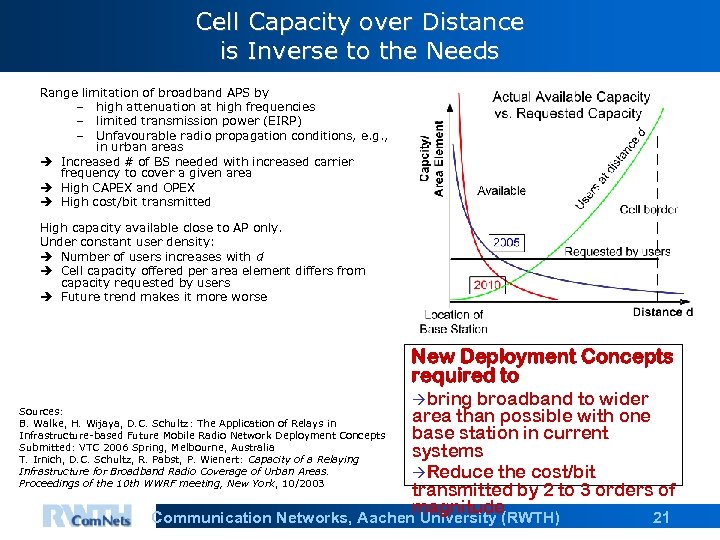
Cell Capacity over Distance is Inverse to the Needs Range limitation of broadband APS by – high attenuation at high frequencies – limited transmission power (EIRP) – Unfavourable radio propagation conditions, e. g. , in urban areas Increased # of BS needed with increased carrier frequency to cover a given area High CAPEX and OPEX High cost/bit transmitted High capacity available close to AP only. Under constant user density: Number of users increases with d Cell capacity offered per area element differs from capacity requested by users Future trend makes it more worse New Deployment Concepts required to Sources: B. Walke, H. Wijaya, D. C. Schultz: The Application of Relays in Infrastructure-based Future Mobile Radio Network Deployment Concepts Submitted: VTC 2006 Spring, Melbourne, Australia T. Irnich, D. C. Schultz, R. Pabst, P. Wienert: Capacity of a Relaying Infrastructure for Broadband Radio Coverage of Urban Areas. Proceedings of the 10 th WWRF meeting, New York, 10/2003 bring broadband to wider area than possible with one base station in current systems Reduce the cost/bit transmitted by 2 to 3 orders of magnitude Communication Networks, Aachen University (RWTH) 21
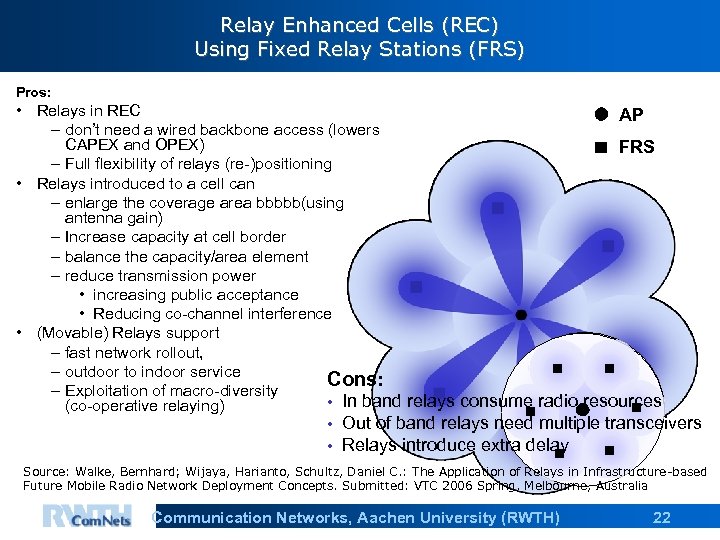
Relay Enhanced Cells (REC) Using Fixed Relay Stations (FRS) Pros: • Relays in REC AP – don’t need a wired backbone access (lowers CAPEX and OPEX) FRS – Full flexibility of relays (re-)positioning • Relays introduced to a cell can – enlarge the coverage area bbbbb(using antenna gain) – Increase capacity at cell border – balance the capacity/area element – reduce transmission power • increasing public acceptance • Reducing co-channel interference • (Movable) Relays support – fast network rollout, – outdoor to indoor service Cons: – Exploitation of macro-diversity • In band relays consume radio resources (co-operative relaying) • • Out of band relays need multiple transceivers Relays introduce extra delay Source: Walke, Bernhard; Wijaya, Harianto, Schultz, Daniel C. : The Application of Relays in Infrastructure-based Future Mobile Radio Network Deployment Concepts. Submitted: VTC 2006 Spring, Melbourne, Australia Communication Networks, Aachen University (RWTH) 22
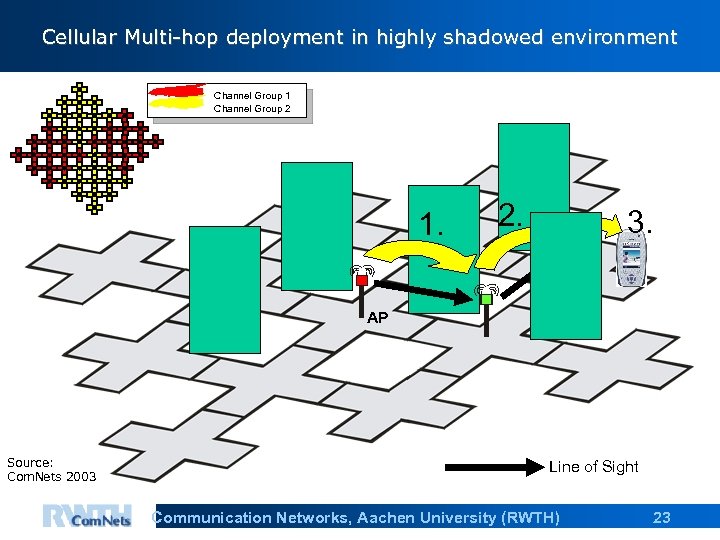
Cellular Multi-hop deployment in highly shadowed environment Channel Group 1 Channel Group 2 1. 2. 3. AP Source: Com. Nets 2003 Line of Sight Communication Networks, Aachen University (RWTH) 23
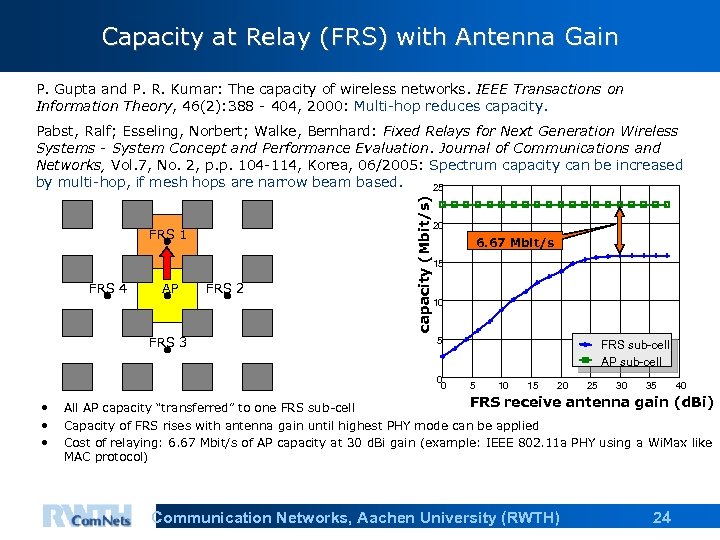
Capacity at Relay (FRS) with Antenna Gain P. Gupta and P. R. Kumar: The capacity of wireless networks. IEEE Transactions on Information Theory, 46(2): 388 - 404, 2000: Multi-hop reduces capacity. FRS 1 FRS 4 AP FRS 3 FRS 2 capacity (Mbit/s) Pabst, Ralf; Esseling, Norbert; Walke, Bernhard: Fixed Relays for Next Generation Wireless Systems - System Concept and Performance Evaluation. Journal of Communications and Networks, Vol. 7, No. 2, p. p. 104 -114, Korea, 06/2005: Spectrum capacity can be increased by multi-hop, if mesh hops are narrow beam based. 25 20 6. 67 Mbit/s 15 10 5 0 0 • • • FRS sub-cell AP sub-cell 5 10 15 20 25 30 35 40 FRS receive antenna gain (d. Bi) All AP capacity “transferred” to one FRS sub-cell Capacity of FRS rises with antenna gain until highest PHY mode can be applied Cost of relaying: 6. 67 Mbit/s of AP capacity at 30 d. Bi gain (example: IEEE 802. 11 a PHY using a Wi. Max like MAC protocol) Communication Networks, Aachen University (RWTH) 24
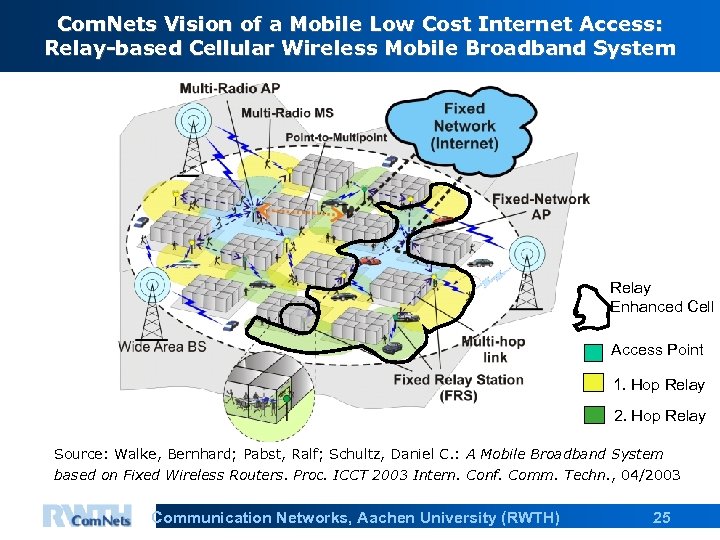
Com. Nets Vision of a Mobile Low Cost Internet Access: Relay-based Cellular Wireless Mobile Broadband System Relay Enhanced Cell Access Point 1. Hop Relay 2. Hop Relay Source: Walke, Bernhard; Pabst, Ralf; Schultz, Daniel C. : A Mobile Broadband System based on Fixed Wireless Routers. Proc. ICCT 2003 Intern. Conf. Comm. Techn. , 04/2003 Communication Networks, Aachen University (RWTH) 25
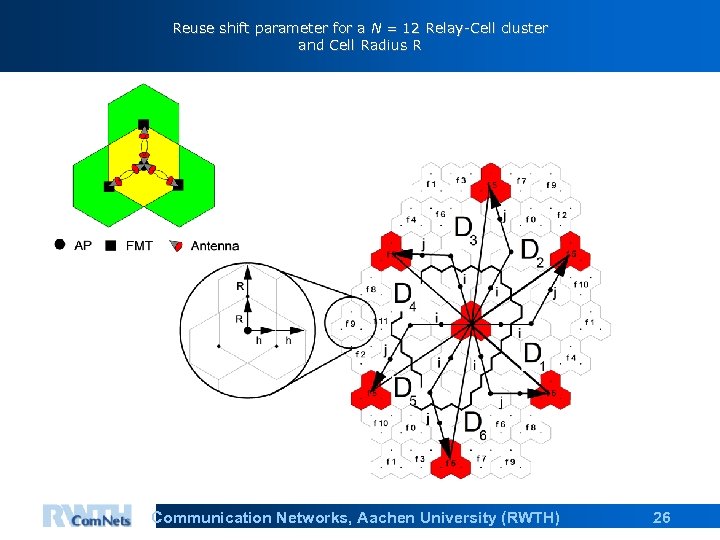
Reuse shift parameter for a N = 12 Relay-Cell cluster and Cell Radius R Communication Networks, Aachen University (RWTH) 26
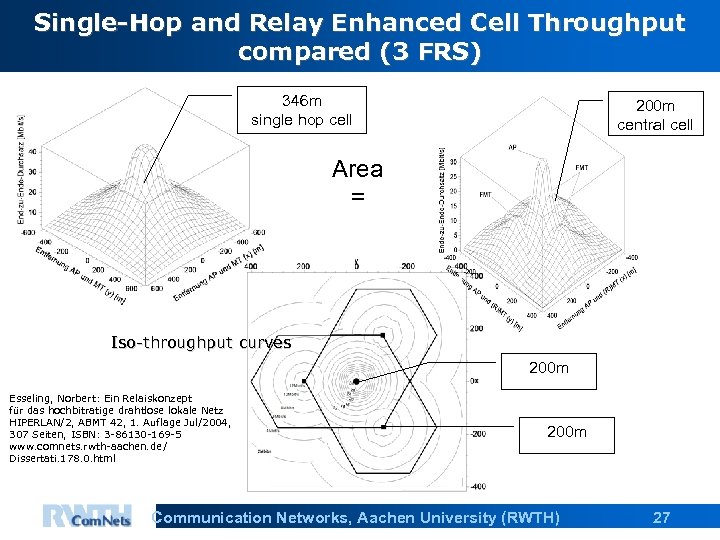
Single-Hop and Relay Enhanced Cell Throughput compared (3 FRS) 346 m single hop cell 200 m central cell Area = Iso-throughput curves 200 m Esseling, Norbert: Ein Relaiskonzept für das hochbitratige drahtlose lokale Netz HIPERLAN/2, ABMT 42, 1. Auflage Jul/2004, 307 Seiten, ISBN: 3 -86130 -169 -5 www. comnets. rwth-aachen. de/ Dissertati. 178. 0. html 200 m Communication Networks, Aachen University (RWTH) 27
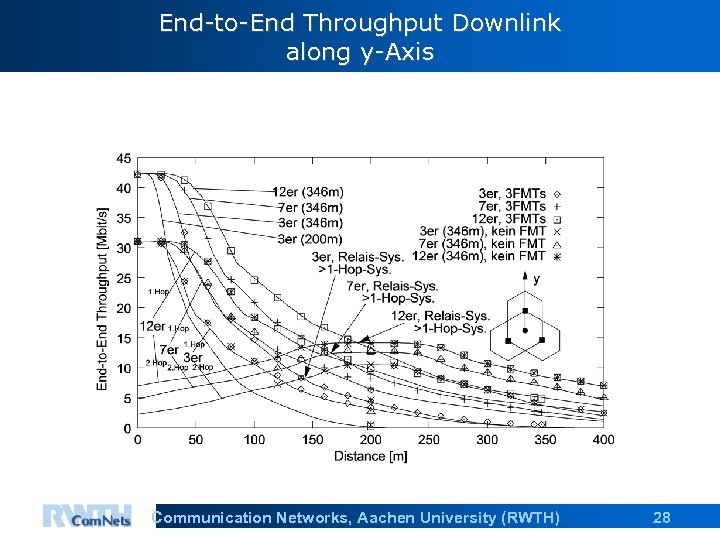
End-to-End Throughput Downlink along y-Axis Communication Networks, Aachen University (RWTH) 28
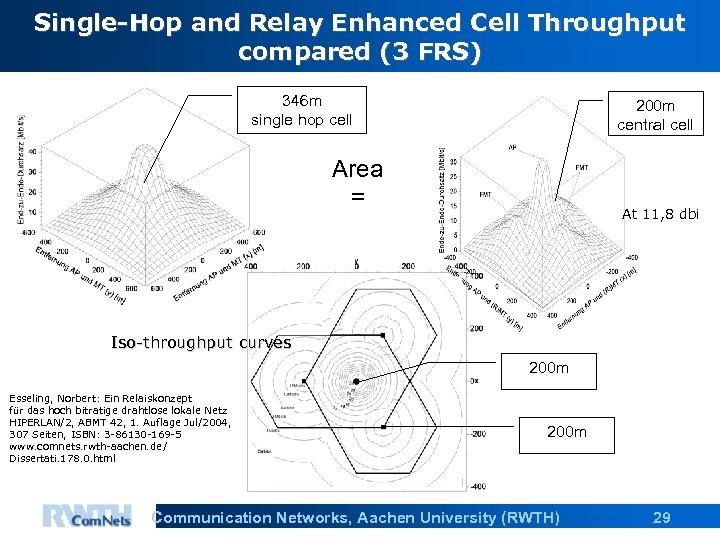
Single-Hop and Relay Enhanced Cell Throughput compared (3 FRS) 346 m single hop cell 200 m central cell Area = At 11, 8 dbi Iso-throughput curves 200 m Esseling, Norbert: Ein Relaiskonzept für das hoch bitratige drahtlose lokale Netz HIPERLAN/2, ABMT 42, 1. Auflage Jul/2004, 307 Seiten, ISBN: 3 -86130 -169 -5 www. comnets. rwth-aachen. de/ Dissertati. 178. 0. html 200 m Communication Networks, Aachen University (RWTH) 29
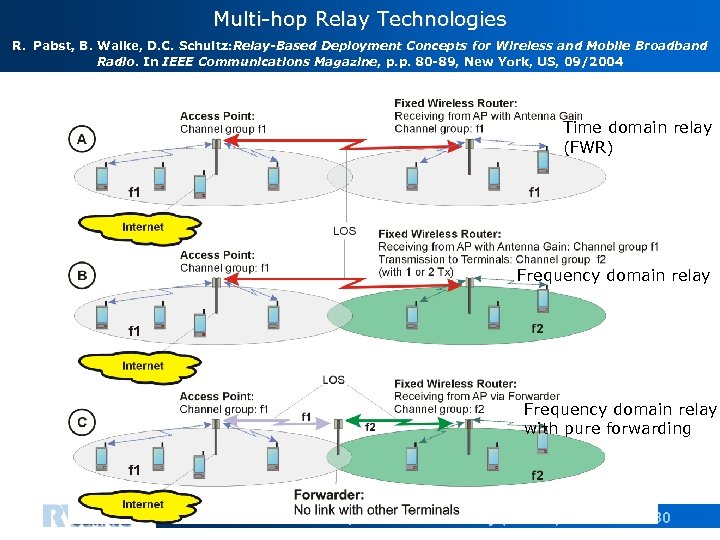
Multi-hop Relay Technologies R. Pabst, B. Walke, D. C. Schultz: Relay-Based Deployment Concepts for Wireless and Mobile Broadband Radio. In IEEE Communications Magazine, p. p. 80 -89, New York, US, 09/2004 Time domain relay (FWR) Frequency domain relay with pure forwarding Communication Networks, Aachen University (RWTH) 30
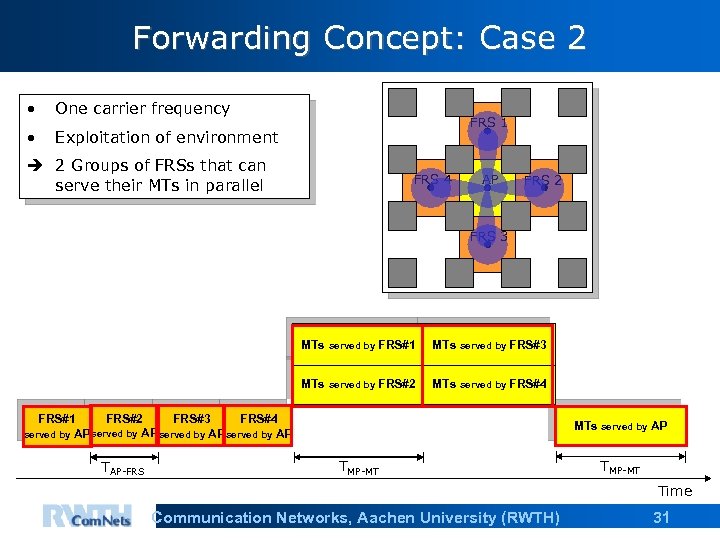
Forwarding Concept: Case 2 • One carrier frequency • Exploitation of environment FRS 1 2 Groups of FRSs that can serve their MTs in parallel FRS 4 AP FRS 2 FRS 3 MTs served by FRS#1 MTs served by FRS#3 MTs served by FRS#2 MTs served by FRS#4 FRS#2 FRS#1 FRS#3 FRS#4 served by AP TAP-FRS MTs served by AP TMP-MT Time Communication Networks, Aachen University (RWTH) 31
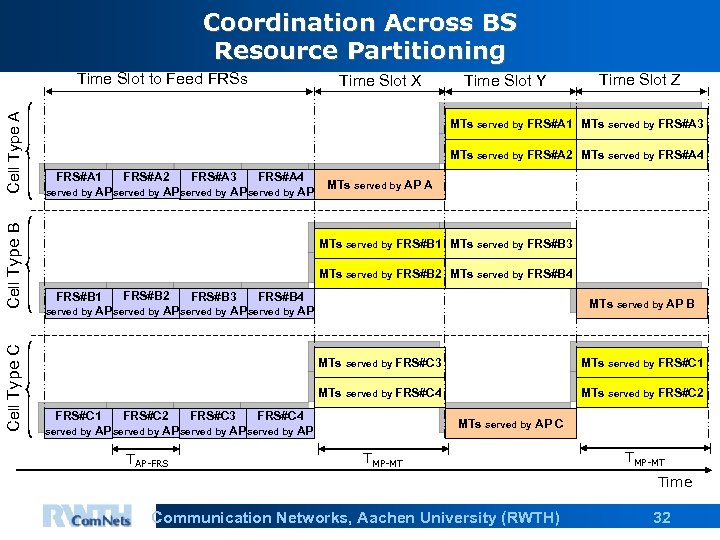
Coordination Across BS Resource Partitioning Cell Type C Cell Type B Cell Type A Time Slot to Feed FRSs Time Slot X Time Slot Y Time Slot Z MTs served by FRS#A 1 MTs served by FRS#A 3 MTs served by FRS#A 2 MTs served by FRS#A 4 FRS#A 2 FRS#A 1 FRS#A 3 FRS#A 4 AP served by MTs served by AP A MTs served by FRS#B 1 MTs served by FRS#B 3 MTs served by FRS#B 2 MTs served by FRS#B 4 FRS#B 2 FRS#B 1 FRS#B 3 FRS#B 4 AP served by AP MTs served by AP B served by MTs served by FRS#C 3 MTs served by FRS#C 1 MTs served by FRS#C 4 MTs served by FRS#C 2 FRS#C 1 FRS#C 3 FRS#C 4 AP served by AP MTs served by AP C served by TAP-FRS TMP-MT Time Communication Networks, Aachen University (RWTH) 32
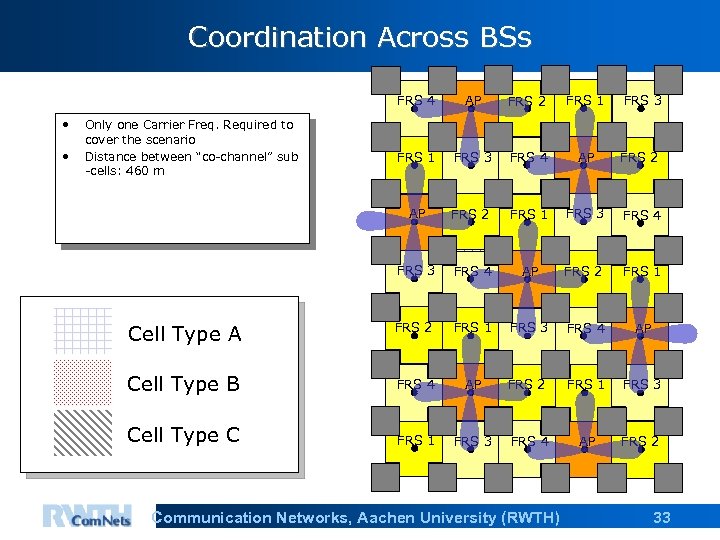
Coordination Across BSs FRS 4 • • AP FRS 2 FRS 1 FRS 3 FRS 4 AP FRS 2 FRS 1 Cell Type A FRS 2 FRS 1 FRS 3 FRS 4 AP Cell Type B FRS 4 AP FRS 2 FRS 1 FRS 3 Cell Type C FRS 1 FRS 3 FRS 4 AP FRS 2 Only one Carrier Freq. Required to cover the scenario Distance between “co-channel” sub -cells: 460 m Communication Networks, Aachen University (RWTH) 33
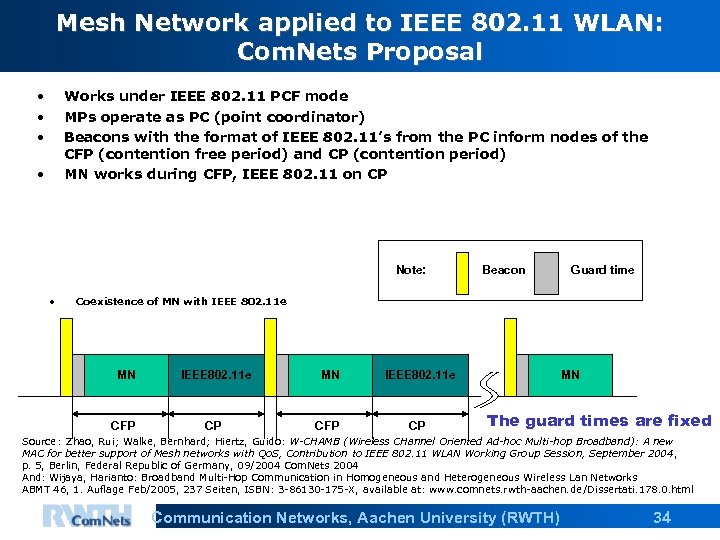
Mesh Network applied to IEEE 802. 11 WLAN: Com. Nets Proposal • • • Works under IEEE 802. 11 PCF mode MPs operate as PC (point coordinator) Beacons with the format of IEEE 802. 11’s from the PC inform nodes of the CFP (contention free period) and CP (contention period) MN works during CFP, IEEE 802. 11 on CP • Note: • Beacon Guard time Coexistence of MN with IEEE 802. 11 e MN IEEE 802. 11 e CFP CP MN The guard times are fixed Source: Zhao, Rui; Walke, Bernhard; Hiertz, Guido: W-CHAMB (Wireless CHannel Oriented Ad-hoc Multi-hop Broadband): A new MAC for better support of Mesh networks with Qo. S, Contribution to IEEE 802. 11 WLAN Working Group Session, September 2004, p. 5, Berlin, Federal Republic of Germany, 09/2004 Com. Nets 2004 And: Wijaya, Harianto: Broadband Multi-Hop Communication in Homogeneous and Heterogeneous Wireless Lan Networks ABMT 46, 1. Auflage Feb/2005, 237 Seiten, ISBN: 3 -86130 -175 -X, available at: www. comnets. rwth-aachen. de/Dissertati. 178. 0. html Communication Networks, Aachen University (RWTH) 34
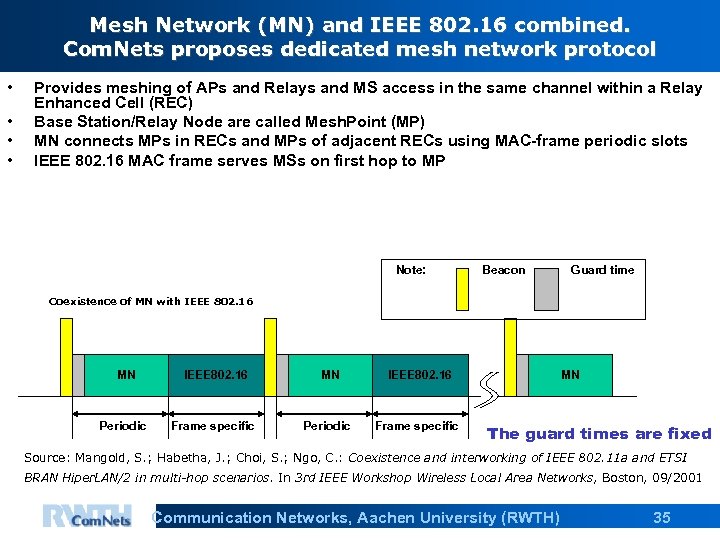
Mesh Network (MN) and IEEE 802. 16 combined. Com. Nets proposes dedicated mesh network protocol • • Provides meshing of APs and Relays and MS access in the same channel within a Relay Enhanced Cell (REC) Base Station/Relay Node are called Mesh. Point (MP) MN connects MPs in RECs and MPs of adjacent RECs using MAC-frame periodic slots IEEE 802. 16 MAC frame serves MSs on first hop to MP Note: Beacon Guard time Coexistence of MN with IEEE 802. 16 MN IEEE 802. 16 Periodic Frame specific MN The guard times are fixed Source: Mangold, S. ; Habetha, J. ; Choi, S. ; Ngo, C. : Coexistence and interworking of IEEE 802. 11 a and ETSI BRAN Hiper. LAN/2 in multi-hop scenarios. In 3 rd IEEE Workshop Wireless Local Area Networks, Boston, 09/2001 Communication Networks, Aachen University (RWTH) 35
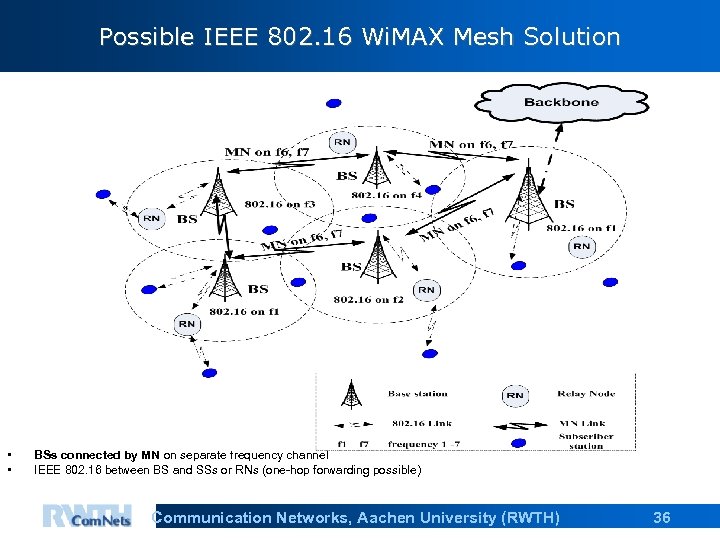
Possible IEEE 802. 16 Wi. MAX Mesh Solution • • BSs connected by MN on separate frequency channel IEEE 802. 16 between BS and SSs or RNs (one-hop forwarding possible) Communication Networks, Aachen University (RWTH) 36
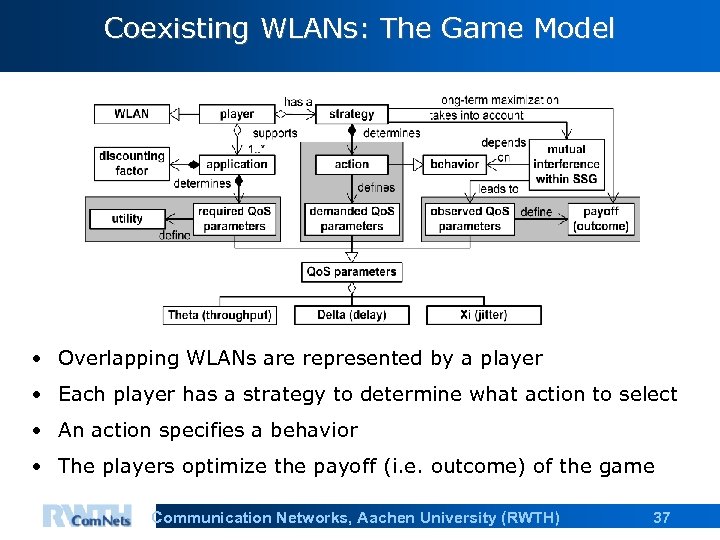
Coexisting WLANs: The Game Model • Overlapping WLANs are represented by a player • Each player has a strategy to determine what action to select • An action specifies a behavior • The players optimize the payoff (i. e. outcome) of the game Communication Networks, Aachen University (RWTH) 37
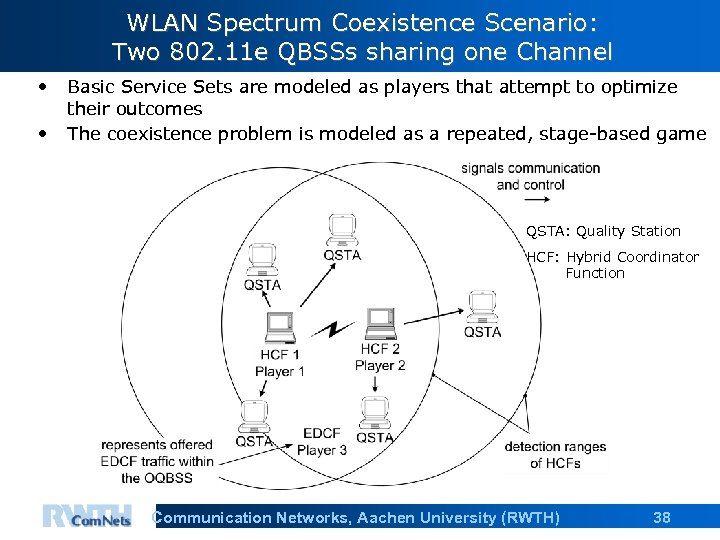
WLAN Spectrum Coexistence Scenario: Two 802. 11 e QBSSs sharing one Channel • • Basic Service Sets are modeled as players that attempt to optimize their outcomes The coexistence problem is modeled as a repeated, stage-based game QSTA: Quality Station HCF: Hybrid Coordinator Function Communication Networks, Aachen University (RWTH) 38
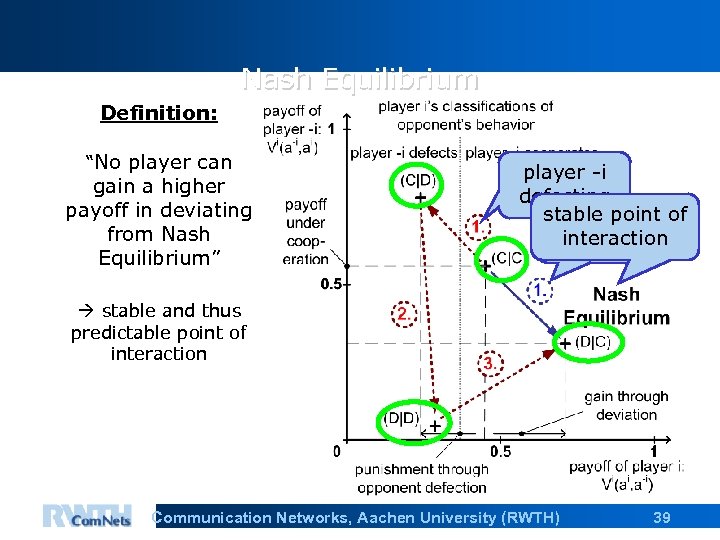
Nash Equilibrium Definition: “No player can gain a higher payoff in deviating from Nash Equilibrium” player -i defecting stable point of player i interaction defecting stable and thus predictable point of interaction Communication Networks, Aachen University (RWTH) 39
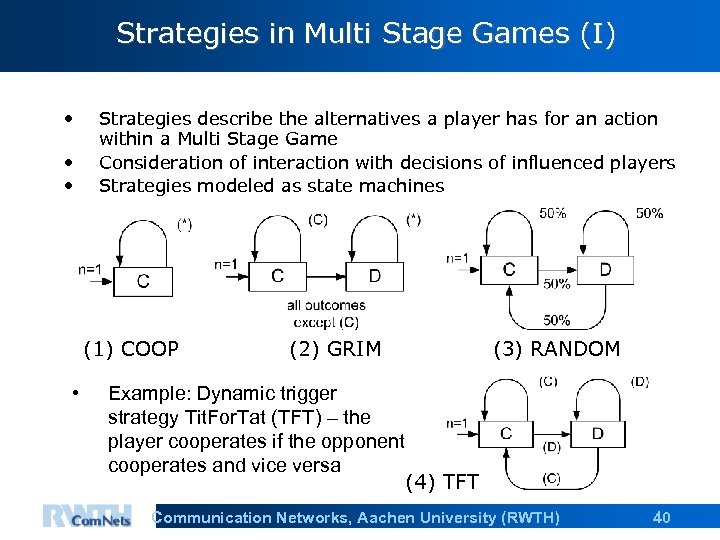
Strategies in Multi Stage Games (I) • • • Strategies describe the alternatives a player has for an action within a Multi Stage Game Consideration of interaction with decisions of influenced players Strategies modeled as state machines (1) COOP • (2) GRIM Example: Dynamic trigger strategy Tit. For. Tat (TFT) – the player cooperates if the opponent cooperates and vice versa (3) RANDOM (4) TFT Communication Networks, Aachen University (RWTH) 40
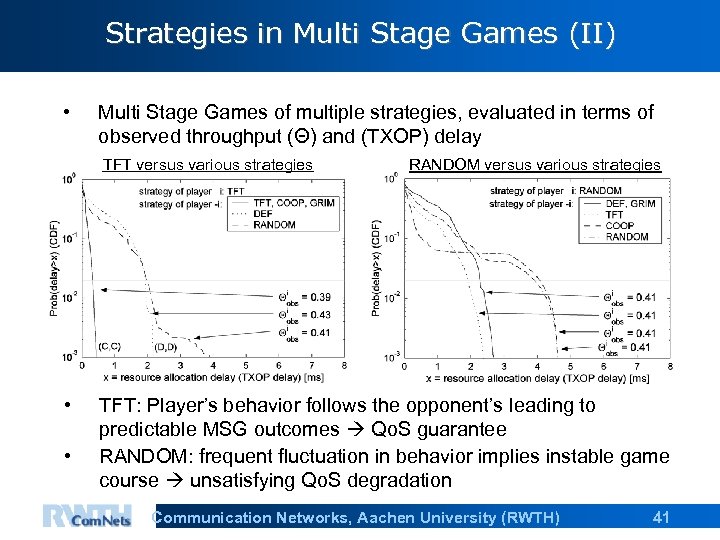
Strategies in Multi Stage Games (II) • Multi Stage Games of multiple strategies, evaluated in terms of observed throughput (Θ) and (TXOP) delay TFT versus various strategies • • RANDOM versus various strategies TFT: Player’s behavior follows the opponent’s leading to predictable MSG outcomes Qo. S guarantee RANDOM: frequent fluctuation in behavior implies instable game course unsatisfying Qo. S degradation Communication Networks, Aachen University (RWTH) 41
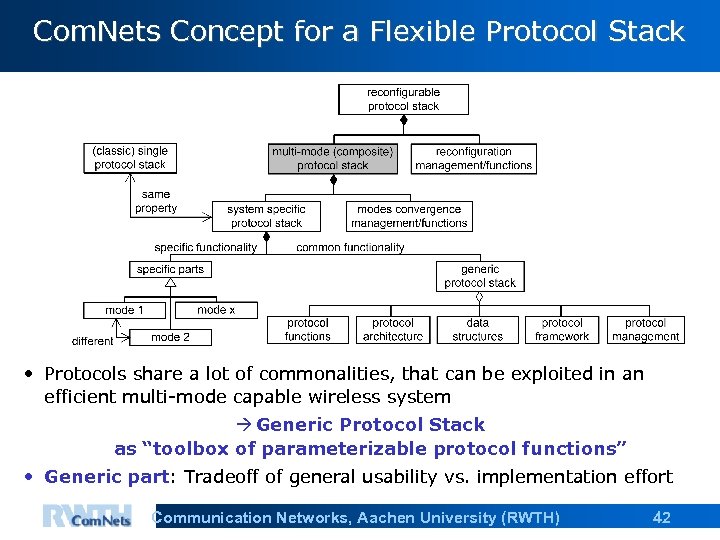
Com. Nets Concept for a Flexible Protocol Stack • Protocols share a lot of commonalities, that can be exploited in an efficient multi-mode capable wireless system Generic Protocol Stack as “toolbox of parameterizable protocol functions” • Generic part: Tradeoff of general usability vs. implementation effort Communication Networks, Aachen University (RWTH) 42
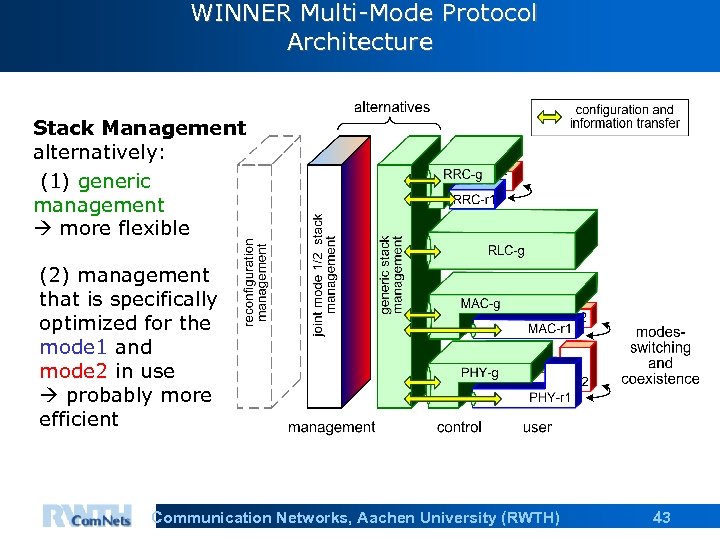
WINNER Multi-Mode Protocol Architecture Stack Management alternatively: (1) generic management more flexible (2) management that is specifically optimized for the mode 1 and mode 2 in use probably more efficient Communication Networks, Aachen University (RWTH) 43
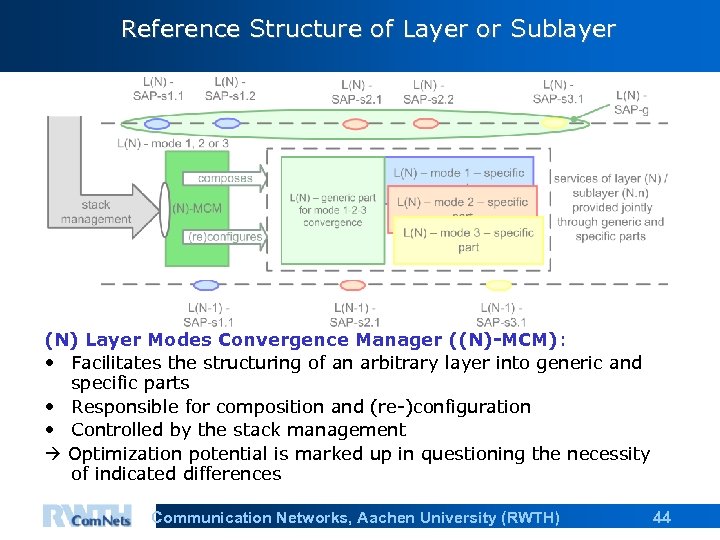
Reference Structure of Layer or Sublayer (N) Layer Modes Convergence Manager ((N)-MCM): • Facilitates the structuring of an arbitrary layer into generic and specific parts • Responsible for composition and (re-)configuration • Controlled by the stack management Optimization potential is marked up in questioning the necessity of indicated differences Communication Networks, Aachen University (RWTH) 44
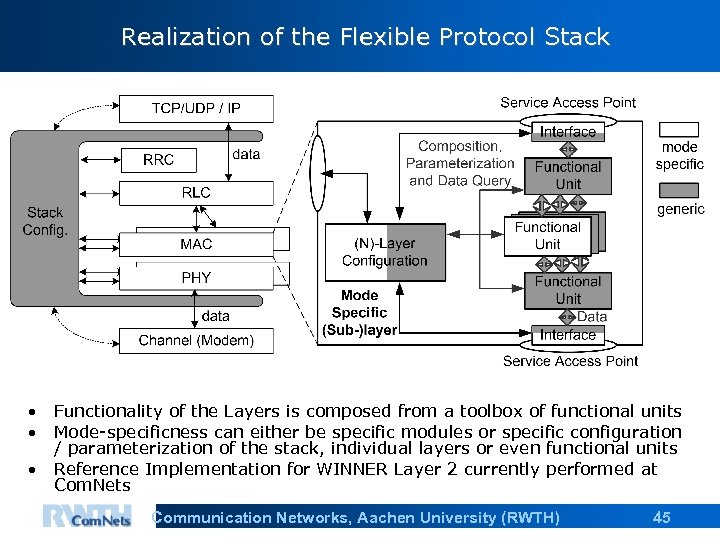
Realization of the Flexible Protocol Stack • Functionality of the Layers is composed from a toolbox of functional units • Mode-specificness can either be specific modules or specific configuration / parameterization of the stack, individual layers or even functional units • Reference Implementation for WINNER Layer 2 currently performed at Com. Nets Communication Networks, Aachen University (RWTH) 45
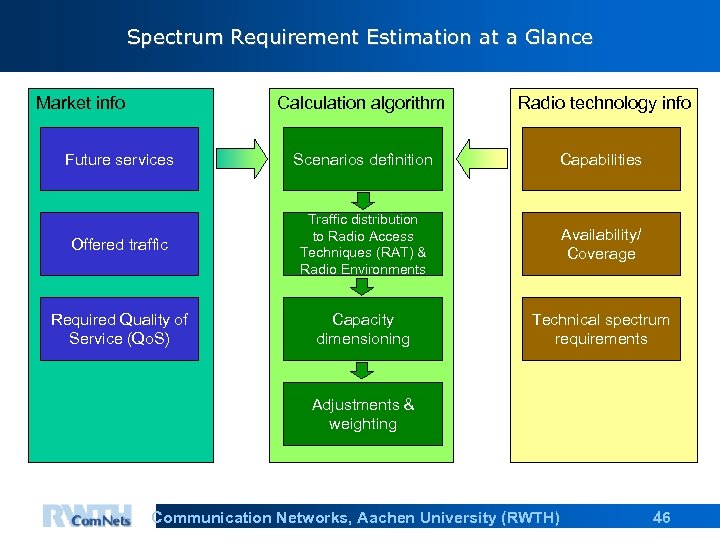
Spectrum Requirement Estimation at a Glance Market info Calculation algorithm Radio technology info Future services Scenarios definition Capabilities Offered traffic Traffic distribution to Radio Access Techniques (RAT) & Radio Environments Availability/ Coverage Required Quality of Service (Qo. S) Capacity dimensioning Technical spectrum requirements Adjustments & weighting Communication Networks, Aachen University (RWTH) 46
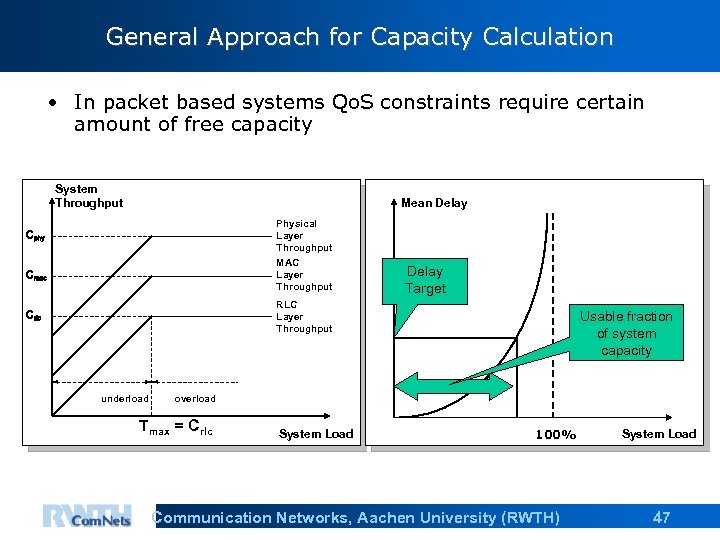
General Approach for Capacity Calculation • In packet based systems Qo. S constraints require certain amount of free capacity System Throughput Mean Delay Physical Layer Throughput MAC Layer Throughput Delay Target RLC Layer Throughput underload Usable fraction of system capacity overload Tmax = Crlc System Load 100% Communication Networks, Aachen University (RWTH) System Load 47
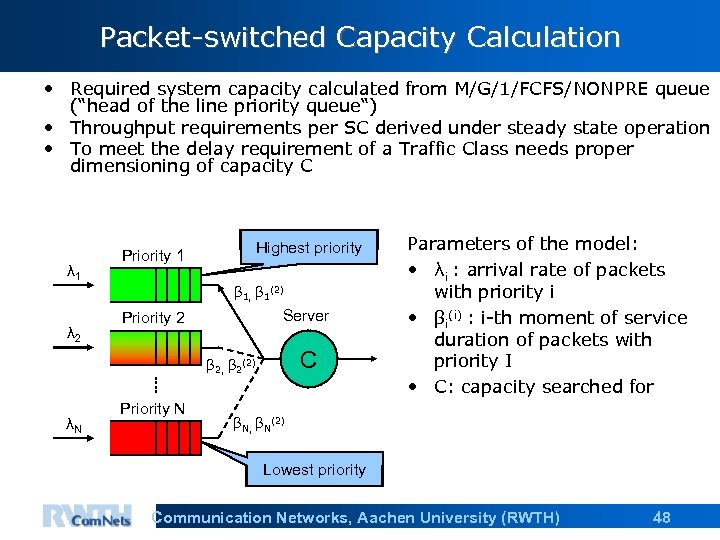
Packet-switched Capacity Calculation • Required system capacity calculated from M/G/1/FCFS/NONPRE queue (“head of the line priority queue“) • Throughput requirements per SC derived under steady state operation • To meet the delay requirement of a Traffic Class needs proper dimensioning of capacity C λ 1 Priority 1 Highest priority β 1, β 1(2) λ 2 Server Priority 2 C β 2, β 2(2) λN Priority N Parameters of the model: • λi : arrival rate of packets with priority i • βi(i) : i-th moment of service duration of packets with priority I • C: capacity searched for βN, βN(2) Lowest priority Communication Networks, Aachen University (RWTH) 48
![Aggregate Spectrum Requirement Required spectrum [MHz] Service environment UL Relative change [%] DL UL+DL](https://present5.com/presentation/20e7179f329602b58bbd20ccf9eb6a73/image-49.jpg "Aggregate Spectrum Requirement Required spectrum [MHz] Service environment UL Relative change [%] DL UL+DL")
Aggregate Spectrum Requirement Required spectrum [MHz] Service environment UL Relative change [%] DL UL+DL UL+DL SE 1 18. 332 21. 742 40. 074 40. 91 -21. 37 -1. 44 SE 2 130. 754 257. 224 387. 978 12. 85 -0. 37 3. 72 SE 3 9. 332 9. 772 19. 304 73. 79 -23. 55 4. 81 Sum 154. 418 288. 738 447. 356 18. 00 -3. 33 3. 28 • • • Results shown above do not include last step of new methodology (i. e. , accounting for multiple operators, guard bands, FSU, etc. ) Some parameters for PS capacity calculation have been reasonably chosen, other choice would have led to different results Small difference resulting is more or less coincidence, since a number of effects partly compensate each other The scenario considered is not a likely scenario to be looked at in spectrum requirement calculation in preparation for WRC-07 Comparison shows that results are in line with earlier results New methodology’s concepts and algorithms represent state of the art Communication Networks, Aachen University (RWTH) 49
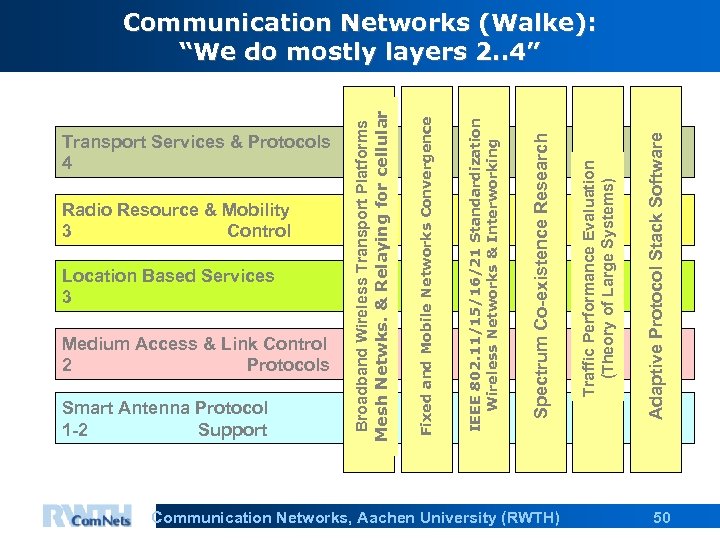
Transport Services & Protocols 4 Radio Resource & Mobility 3 Control Location Based Services 3 Medium Access & Link Control 2 Protocols Smart Antenna Protocol 1 -2 Support Communication Networks, Aachen University (RWTH) Adaptive Protocol Stack Software Traffic Performance Evaluation (Theory of Large Systems) Spectrum Co-existence Research IEEE 802. 11/15/16/21 Standardization Wireless Networks & Interworking Fixed and Mobile Networks Convergence Broadband Wireless Transport Platforms Mesh Netwks. & Relaying for cellular Communication Networks (Walke): “We do mostly layers 2. . 4” 50
Com. Nets Profile http: //www. comnets. rwth-aachen. de/ (Oct. 2005) Com. Nets research focuses on OSI-layers 2, 3 and 4. We work also in radio spectrum co-existence & design of adaptive protocol stack solutions for multi-radios. Some of our people are in domains of the -spectrum & regulation, - cognitive radios, - SW-defined re-configurable radios. Research is both strongly theoretical and experimental. Experimentation capabilities at Com. Nets cover the „down to bit level“ prototype like implementation of radio access networks based on software based tools and include the possibility to implement protocol stacks and new algorithms for test. Design and Optimisation of Disruptive Deployment Concepts for Future Cellular Radio is our strongest key research area, this extends to wireless mesh networks. We have contributed to standards like GSM/GPRS, ETSI Hiper. LAN 2, IEEE 802. 11 e, k, s, IEEE 802. 15. 3, IEEE 802. 16 CEN TC 278 DSRC, ITU-R WP 8 F spectrum estimation methodology. Our theoretical basic research, especially in game theory applied to radio systems‘ co-existience in frequency spectrum will hopefully permit better exploitation of spectrum. We are leading in mesh networking protocols for wireless systems. Our wireless broadband multi-hop ad-hoc communication network design does not have any severe competition. We are able to evaluate really large communication systems based on the unique tools that we have developed. Communication Networks
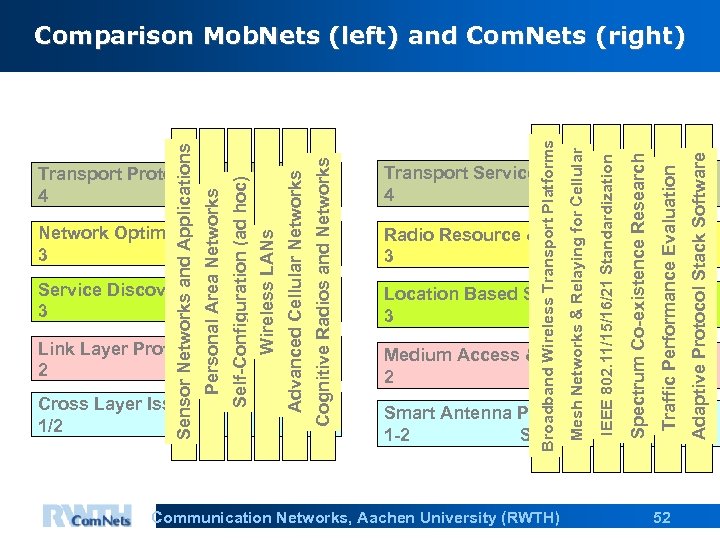
Radio Resource & Mobility 3 Control Location Based Services 3 Medium Access & Link Control 2 Protocols Smart Antenna Protocol 1 -2 Support Communication Networks, Aachen University (RWTH) 52 Adaptive Protocol Stack Software Transport Services & Protocols 4 Traffic Performance Evaluation Spectrum Co-existence Research IEEE 802. 11/15/16/21 Standardization Cross Layer Issues &Low-Power 1/2 Mesh Networks & Relaying for Cellular Link Layer Protocols 2 Broadband Wireless Transport Platforms Service Discovery 3 Wireless LANs Network Optimization & Theory 3 Cognitive Radios and Networks Advanced Cellular Networks Personal Area Networks Transport Protocobls 4 Self-Configuration (ad hoc) Sensor Networks and Applications Comparison Mob. Nets (left) and Com. Nets (right)
Courses, Labs and Seminars • Networking & Protocols Expertise is a must for Information Technology Engineers • Both Curricula – Information & Communications (ET & IT) – Technical Computer Science (TI) Contain mandatory courses and courses to be selected from catalogues on Networking & Protocols • The load from Course Lecturing, Labs and Seminars is by far to big to be shouldered by one chair • It is agreed that Mob. Nets is not lecturing courses in basic studies Communication Networks, Aachen University (RWTH) 53
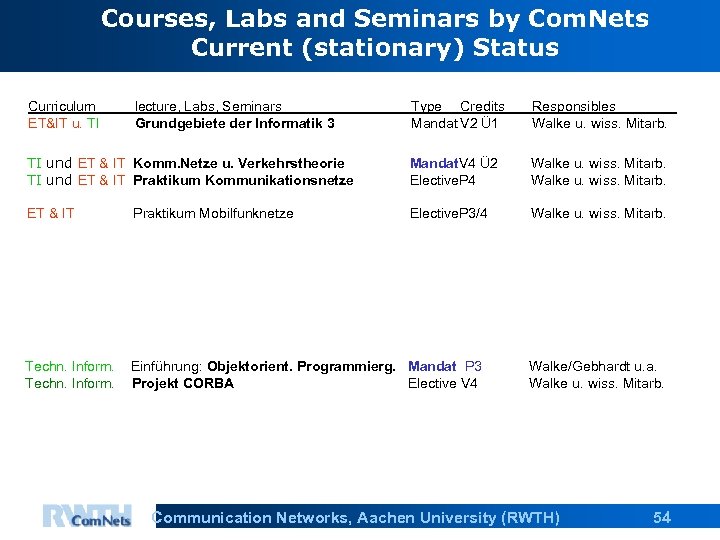
Courses, Labs and Seminars by Com. Nets Current (stationary) Status Curriculum ET&IT u. TI lecture, Labs, Seminars Grundgebiete der Informatik 3 Type Credits Mandat V 2 Ü 1 Responsibles Walke u. wiss. Mitarb. TI und ET & IT Komm. Netze u. Verkehrstheorie TI und ET & IT Praktikum Kommunikationsnetze Mandat. V 4 Ü 2 Elective. P 4 Walke u. wiss. Mitarb. ET & IT Praktikum Mobilfunknetze Elective. P 3/4 Walke u. wiss. Mitarb. Techn. Inform. Einführung: Objektorient. Programmierg. Mandat P 3 Projekt CORBA Elective V 4 Walke/Gebhardt u. a. Walke u. wiss. Mitarb. Communication Networks, Aachen University (RWTH) 54
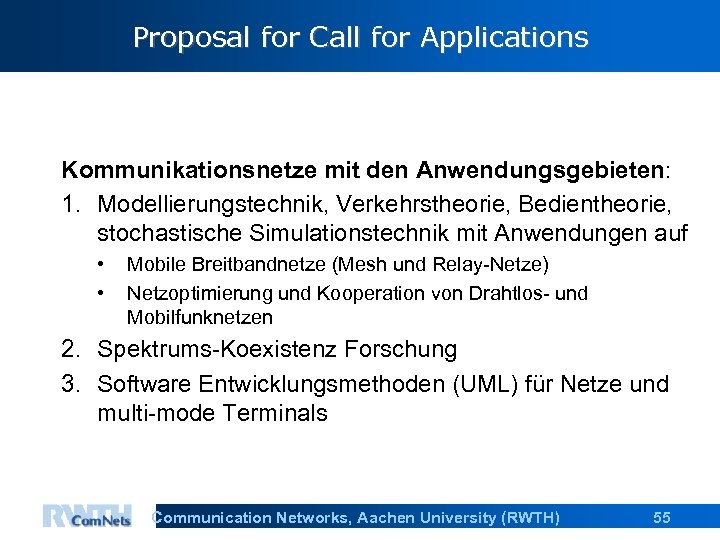
Proposal for Call for Applications Kommunikationsnetze mit den Anwendungsgebieten: 1. Modellierungstechnik, Verkehrstheorie, Bedientheorie, stochastische Simulationstechnik mit Anwendungen auf • • Mobile Breitbandnetze (Mesh und Relay-Netze) Netzoptimierung und Kooperation von Drahtlos- und Mobilfunknetzen 2. Spektrums-Koexistenz Forschung 3. Software Entwicklungsmethoden (UML) für Netze und multi-mode Terminals Communication Networks, Aachen University (RWTH) 55
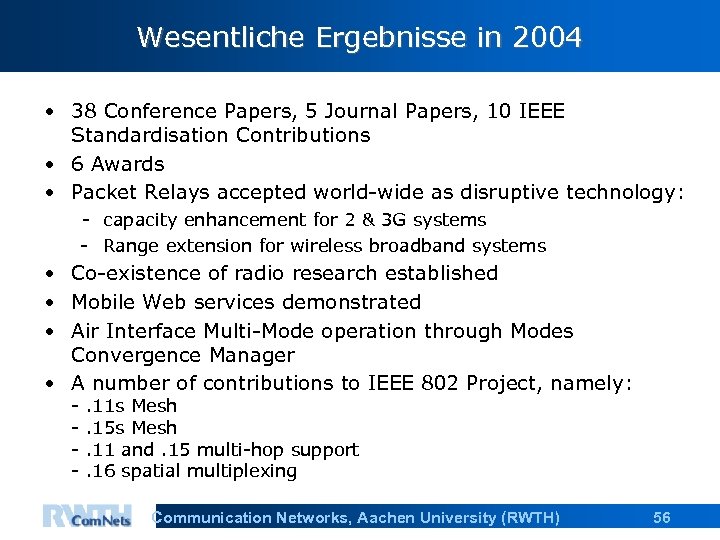
Wesentliche Ergebnisse in 2004 • 38 Conference Papers, 5 Journal Papers, 10 IEEE Standardisation Contributions • 6 Awards • Packet Relays accepted world-wide as disruptive technology: - capacity enhancement for 2 & 3 G systems - Range extension for wireless broadband systems • Co-existence of radio research established • Mobile Web services demonstrated • Air Interface Multi-Mode operation through Modes Convergence Manager • A number of contributions to IEEE 802 Project, namely: - . 11 s Mesh. 15 s Mesh. 11 and. 15 multi-hop support. 16 spatial multiplexing Communication Networks, Aachen University (RWTH) 56
Ende Communication Networks, Aachen University (RWTH) 57
Скачать презентацию Stand und zukünftige attraktive Arbeitsgebiete für den Lehrstuhl
20e7179f329602b58bbd20ccf9eb6a73.ppt