


 Скачать презентацию Staging Screening and Testing Session I Strengths and
76d849b41c71c46344fb27ea781571b5.ppt
- Количество слайдов: 10
 Staging Screening and Testing Session I Strengths and Weaknesses of the EDSP Assays The Endocrine Disruptor Screening Program: What Can Screening Results Tell Us About Potential Adverse Endocrine Effects ISRTP Workshop, Lister Hill Auditorium Bethesda, MD. September 9 -10, 2009 Christopher J. Borgert, Ph. D 1 www. apt-pharmatox. com
 Collaborators Rick Becker - ACC Steve Levine - Monsanto Sue Marty - Dow Ellen Mihaich - ER 2 2 www. apt-pharmatox. com
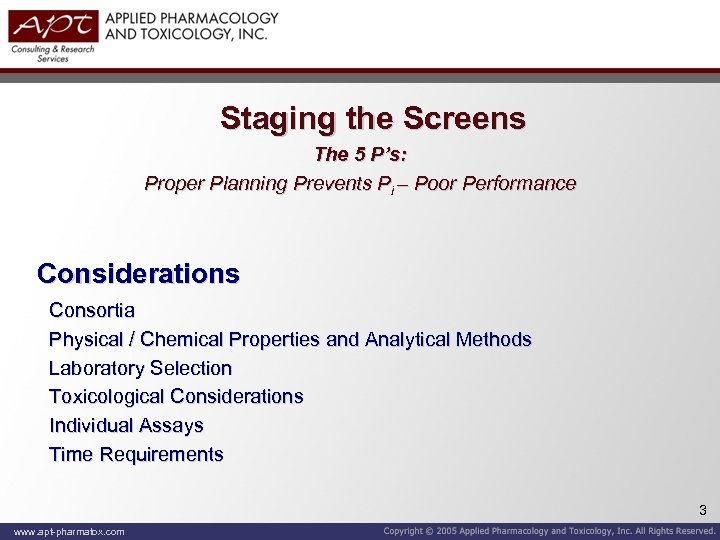 Staging the Screens The 5 P’s: Proper Planning Prevents Pi – Poor Performance Considerations Consortia Physical / Chemical Properties and Analytical Methods Laboratory Selection Toxicological Considerations Individual Assays Time Requirements 3 www. apt-pharmatox. com
 Consortia • Other manufacturers • Other programs – Reach – HPV – etc. 4 www. apt-pharmatox. com
 Physical / Chemical Properties and Analytical Methods • Special handling required? • Solubility and solvent / vehicle selection – Volatile compounds or those with high octanol/water partition coefficients may not be amenable to aquatic testing. • Stability – if hydrolytically or photolytically unstable, aquatic studies will be difficult if not impossible. • Analytical method in place? » for dose solutions at limit of solubility and low concentrations where effects may be observed? » for certificate of analysis? » Time necessary for development of methods, if lacking 5 www. apt-pharmatox. com
 Laboratory Selection • Capability – experience with the assay(s) – historical control information? • experience with interpretation of assay results • knowledge of assay idiosyncrasies • Capacity – some assays are complex; need to insure that lab is not over-extended. • Cost – may vary considerably and need to compare identical protocols, as these are new assays and few labs will have run all the assays, or many of any single assay. 6 www. apt-pharmatox. com
 Toxicological Considerations • Protein denaturant or surfactant? – interference with receptor-based in vitro assays • Cytotoxicity? - interference with cell-based in vitro assays • Metabolism? - important for selecting correct route of administration; avoiding false positives/negatives in in vitro assays. • Consider prior toxicological information - will results of in vitro assays help determine doses for in vivo assays? • Dose selection - will range finders be needed? -see also individual assays. • eg. fish 21 -day screen – apical endpoints required; differentiating between a primary effect on the endocrine system and a secondary effect mediated through some other toxic action will need to be carefully considered. 7 www. apt-pharmatox. com
 Individual Assays / Sequence • • • Recall comments from Drs. Marty & Guiney Run concurrently or consecutively ? Uterotrophic & Hershberger Binding assays Intact male The others (good luck) 8 www. apt-pharmatox. com
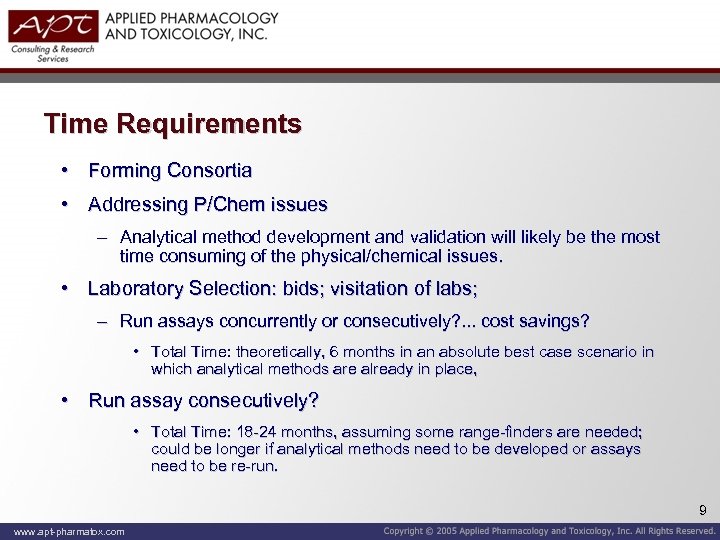 Time Requirements • Forming Consortia • Addressing P/Chem issues – Analytical method development and validation will likely be the most time consuming of the physical/chemical issues. • Laboratory Selection: bids; visitation of labs; – Run assays concurrently or consecutively? . . . cost savings? • Total Time: theoretically, 6 months in an absolute best case scenario in which analytical methods are already in place, • Run assay consecutively? • Total Time: 18 -24 months, assuming some range-finders are needed; could be longer if analytical methods need to be developed or assays need to be re-run. 9 www. apt-pharmatox. com
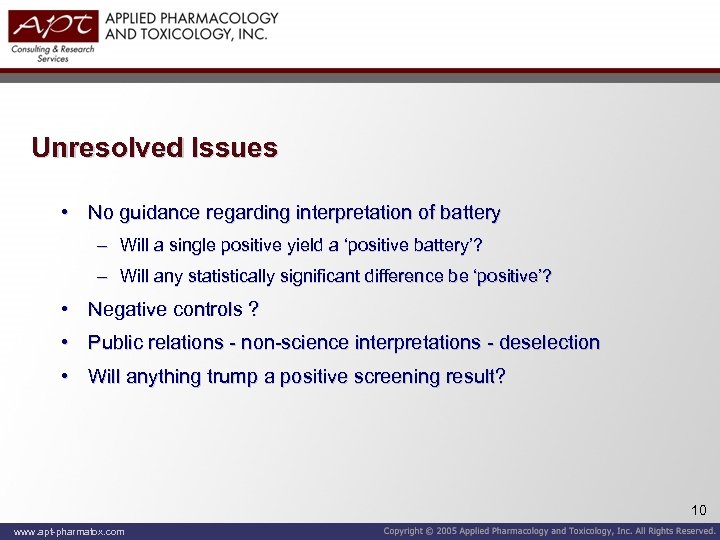 Unresolved Issues • No guidance regarding interpretation of battery – Will a single positive yield a ‘positive battery’? – Will any statistically significant difference be ‘positive’? • Negative controls ? • Public relations - non-science interpretations - deselection • Will anything trump a positive screening result? 10 www. apt-pharmatox. com