 Скачать презентацию Stages of Spelling Development Objectives 1 Analyze
4fdb7399e51ecb57f9bdd91198723db2.ppt
- Количество слайдов: 30



Stages of Spelling Development
Objectives 1. Analyze spelling patterns and align to stages of spelling development > set goals for what to teach next 2. Review key practices for assessing spelling development 3. Score and analyze individual results with a partner to determine developmental stages of two students 4. Using classroom profiles to group for instruction
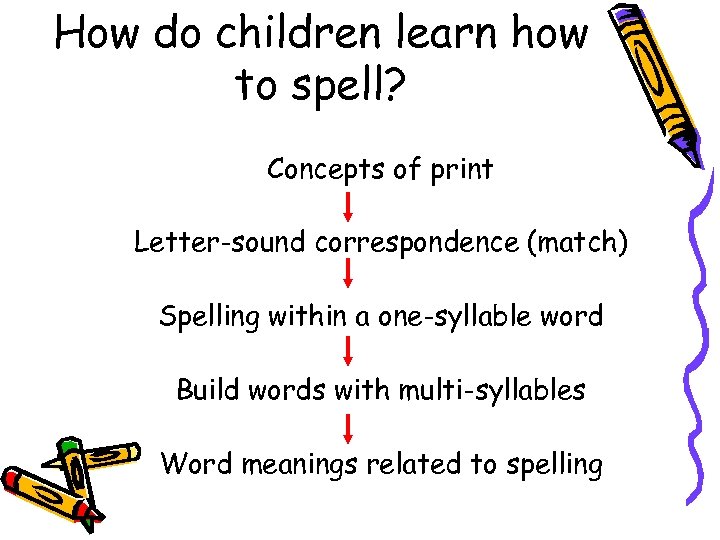
How do children learn how to spell? Concepts of print Letter-sound correspondence (match) Spelling within a one-syllable word Build words with multi-syllables Word meanings related to spelling
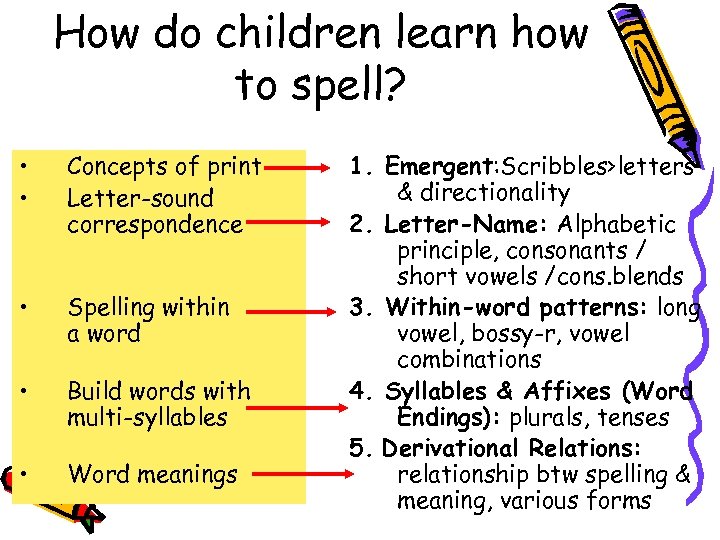
How do children learn how to spell? • • Concepts of print Letter-sound correspondence • Spelling within a word • Build words with multi-syllables • Word meanings 1. Emergent: Scribbles>letters & directionality 2. Letter-Name: Alphabetic principle, consonants / short vowels /cons. blends 3. Within-word patterns: long vowel, bossy-r, vowel combinations 4. Syllables & Affixes (Word Endings): plurals, tenses 5. Derivational Relations: relationship btw spelling & meaning, various forms
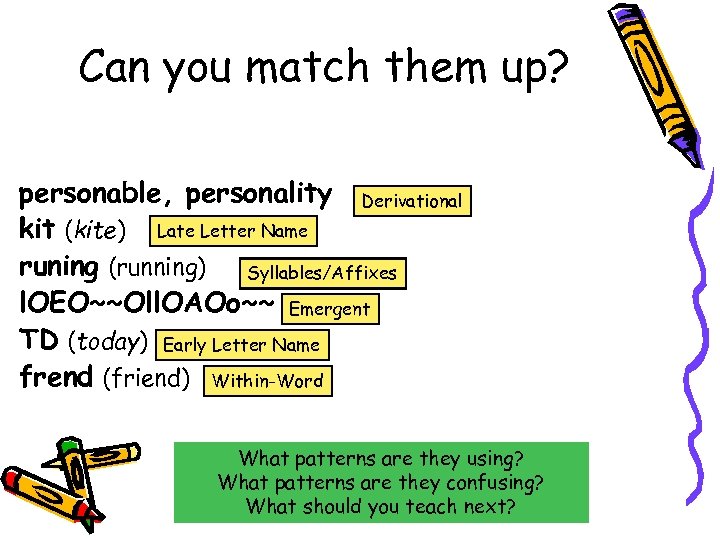
Can you match them up? personable, personality Derivational kit (kite) Late Letter Name runing (running) Syllables/Affixes l. OEO~~Oll. OAOo~~ Emergent TD (today) Early Letter Name frend (friend) Within-Word What patterns are they using? What patterns are they confusing? What should you teach next?
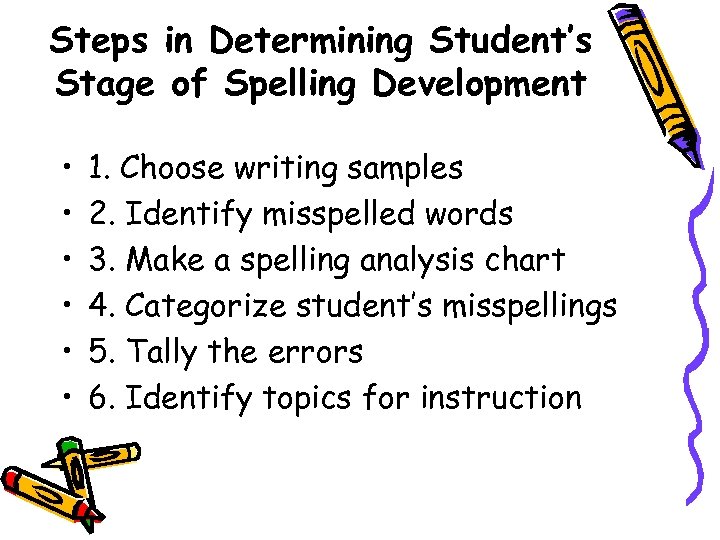
Steps in Determining Student’s Stage of Spelling Development • • • 1. Choose writing samples 2. Identify misspelled words 3. Make a spelling analysis chart 4. Categorize student’s misspellings 5. Tally the errors 6. Identify topics for instruction
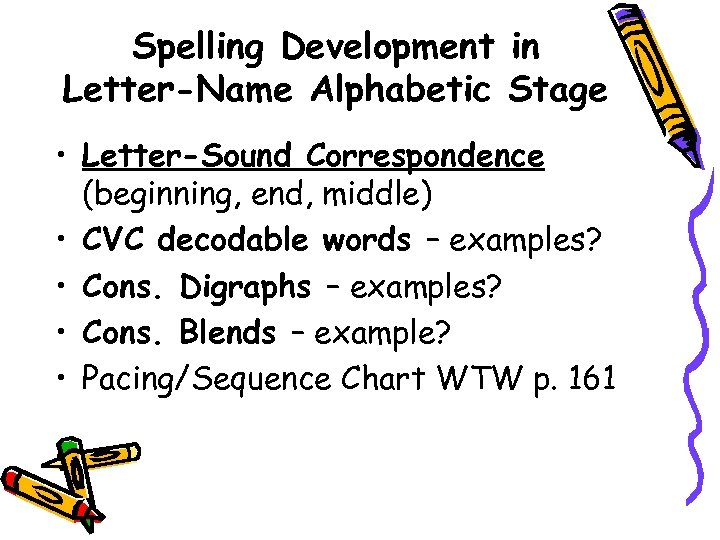
Spelling Development in Letter-Name Alphabetic Stage • Letter-Sound Correspondence (beginning, end, middle) • CVC decodable words – examples? • Cons. Digraphs – examples? • Cons. Blends – example? • Pacing/Sequence Chart WTW p. 161
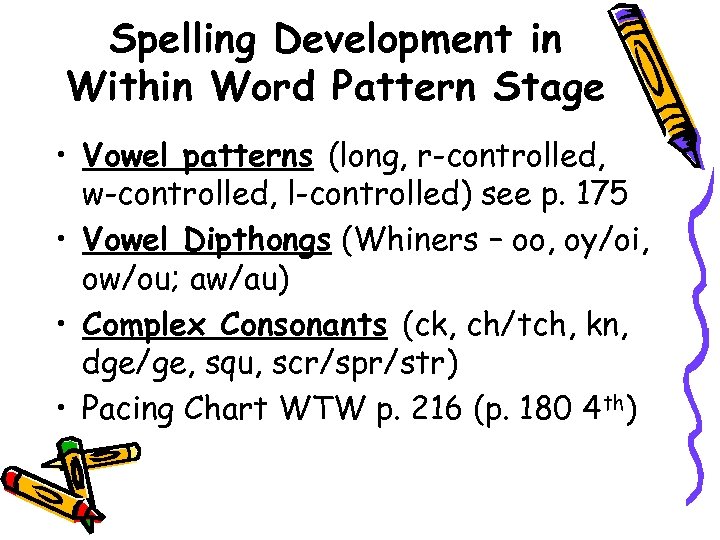
Spelling Development in Within Word Pattern Stage • Vowel patterns (long, r-controlled, w-controlled, l-controlled) see p. 175 • Vowel Dipthongs (Whiners – oo, oy/oi, ow/ou; aw/au) • Complex Consonants (ck, ch/tch, kn, dge/ge, squ, scr/spr/str) • Pacing Chart WTW p. 216 (p. 180 4 th)
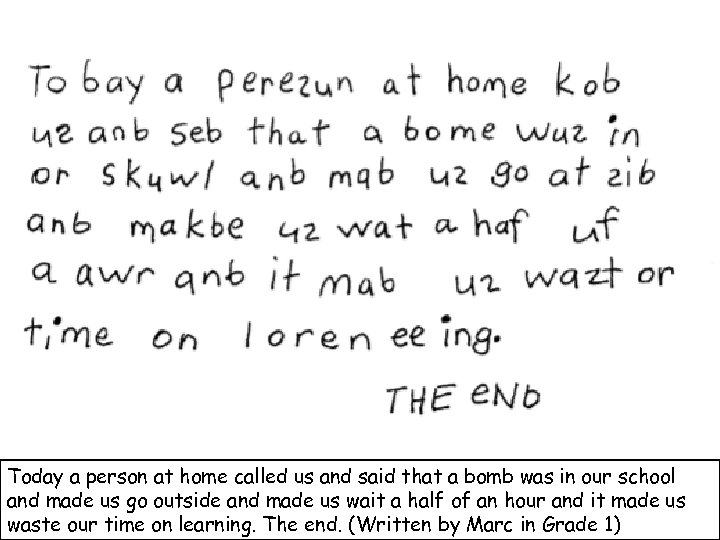
Today a person at home called us and said that a bomb was in our school and made us go outside and made us wait a half of an hour and it made us waste our time on learning. The end. (Written by Marc in Grade 1)
Letter-Name Alphabetic Other Issues Within-Word Conclusion: Syllables & Affixes Goals for Word Study Instruction: 1. 2. 3. 4.
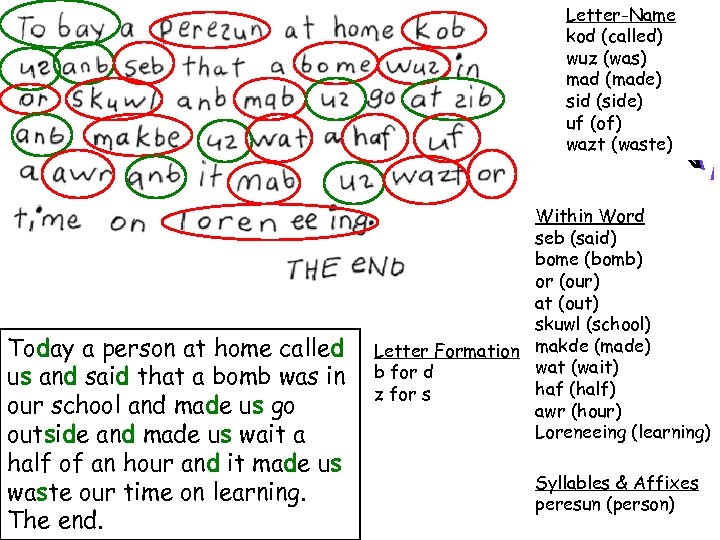
Letter-Name kod (called) wuz (was) mad (made) sid (side) uf (of) wazt (waste) Today a person at home called us and said that a bomb was in our school and made us go outside and made us wait a half of an hour and it made us waste our time on learning. The end. Within Word seb (said) bome (bomb) or (our) at (out) skuwl (school) Letter Formation makde (made) wat (wait) b for d haf (half) z for s awr (hour) Loreneeing (learning) Syllables & Affixes peresun (person)
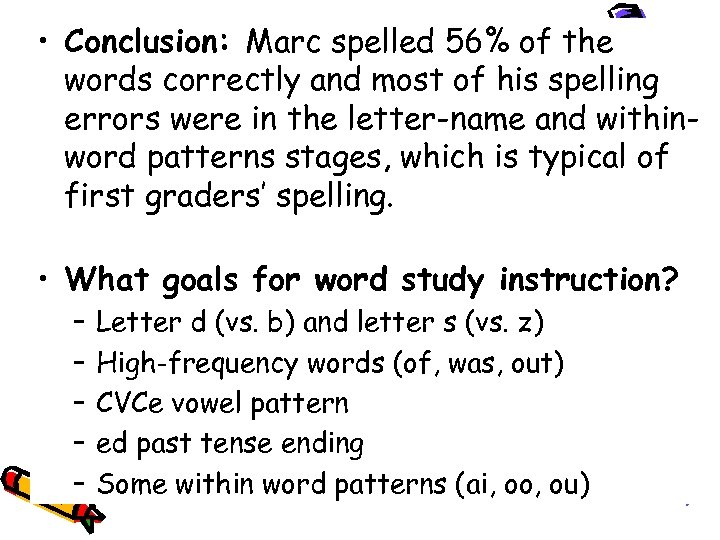
• Conclusion: Marc spelled 56% of the words correctly and most of his spelling errors were in the letter-name and withinword patterns stages, which is typical of first graders’ spelling. • What goals for word study instruction? – – – Letter d (vs. b) and letter s (vs. z) High-frequency words (of, was, out) CVCe vowel pattern ed past tense ending Some within word patterns (ai, oo, ou)
Teaching Spelling • Sound it out > Think it out (think about spelling patterns, root words, affixes, the shape of the word, etc) • Stretch & spell each sound; • Break the word into syllables and use patterns from open and closed syllables; • Word Walls; Word Sorts; and Making Words • Interactive Writing: model and write WITH students helping

Try it out… Mapping Early Literacy Writing Samples to Developmental Spelling Stages
Sample & Stage 1. 2. How do you know? Where do you go next?
Sample & Stage 3. 4. How do you know? Where do you go next?
Sample & Stage 5. 6. How do you know? Where do you go next?
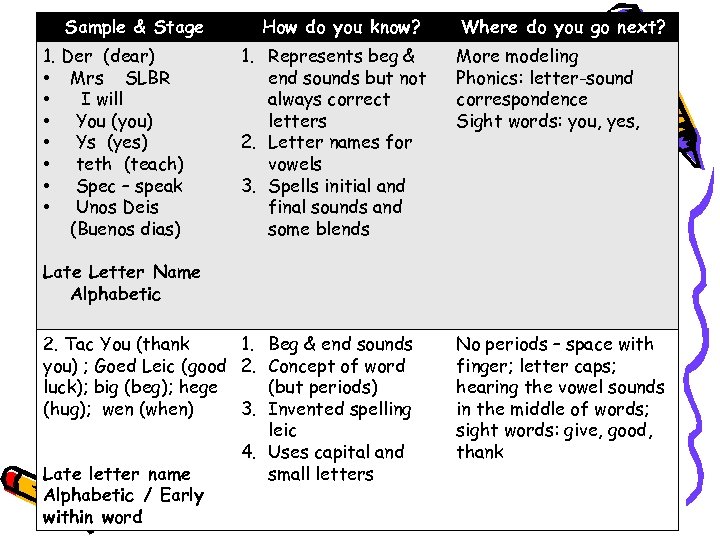
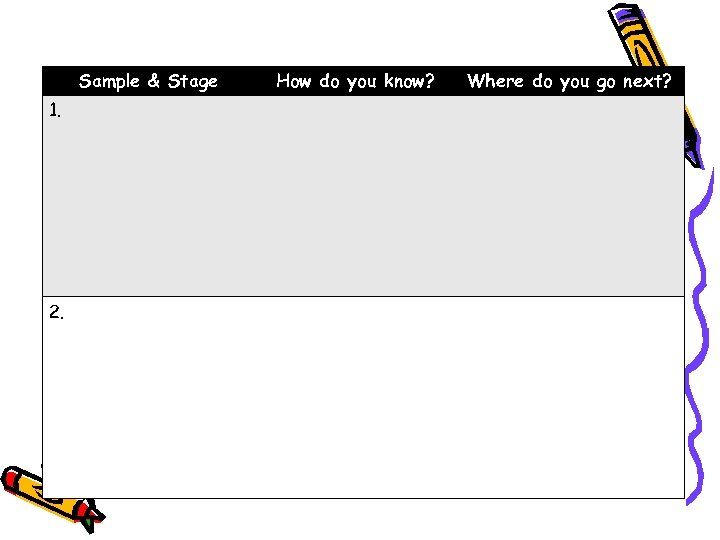
Sample & Stage 1. Der (dear) • Mrs SLBR • I will • You (you) • Ys (yes) • teth (teach) • Spec – speak • Unos Deis (Buenos dias) How do you know? 1. Represents beg & end sounds but not always correct letters 2. Letter names for vowels 3. Spells initial and final sounds and some blends Where do you go next? More modeling Phonics: letter-sound correspondence Sight words: you, yes, Late Letter Name Alphabetic 2. Tac You (thank 1. Beg & end sounds you) ; Goed Leic (good 2. Concept of word luck); big (beg); hege (but periods) (hug); wen (when) 3. Invented spelling leic 4. Uses capital and Late letter name small letters Alphabetic / Early within word No periods – space with finger; letter caps; hearing the vowel sounds in the middle of words; sight words: give, good, thank
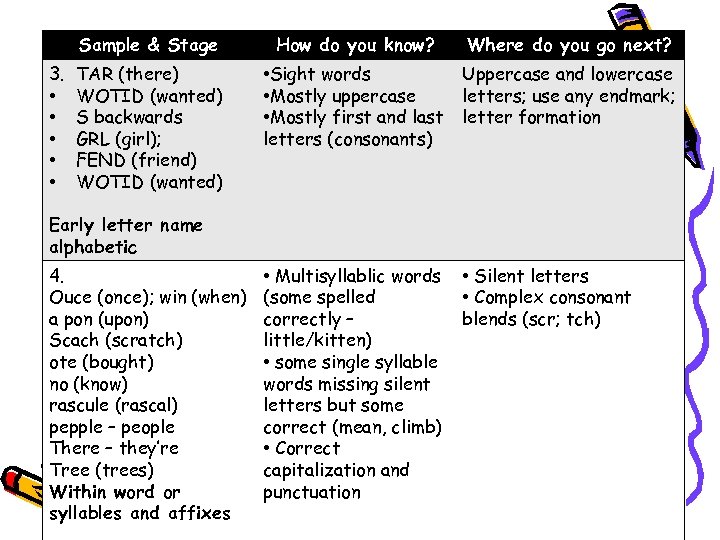
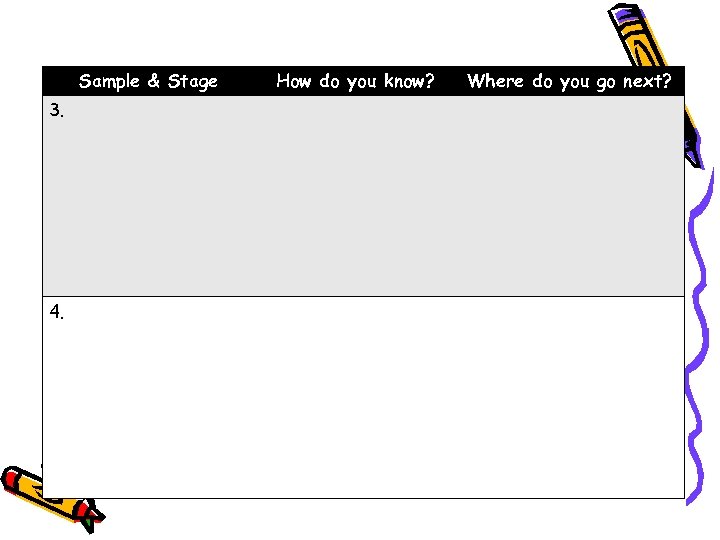
Sample & Stage 3. • • • How do you know? Where do you go next? TAR (there) WOTID (wanted) S backwards GRL (girl); FEND (friend) WOTID (wanted) • Sight words • Mostly uppercase • Mostly first and last letters (consonants) Uppercase and lowercase letters; use any endmark; letter formation • Multisyllablic words (some spelled correctly – little/kitten) • some single syllable words missing silent letters but some correct (mean, climb) • Correct capitalization and punctuation • Silent letters • Complex consonant blends (scr; tch) Early letter name alphabetic 4. Ouce (once); win (when) a pon (upon) Scach (scratch) ote (bought) no (know) rascule (rascal) pepple – people There – they’re Tree (trees) Within word or syllables and affixes
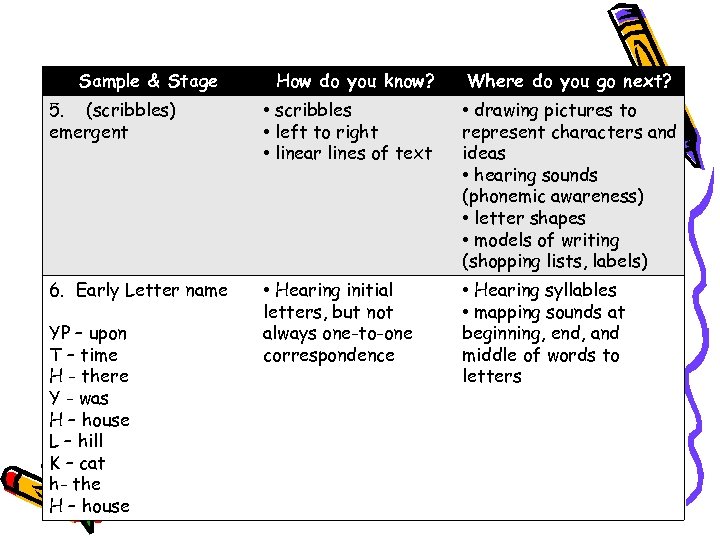
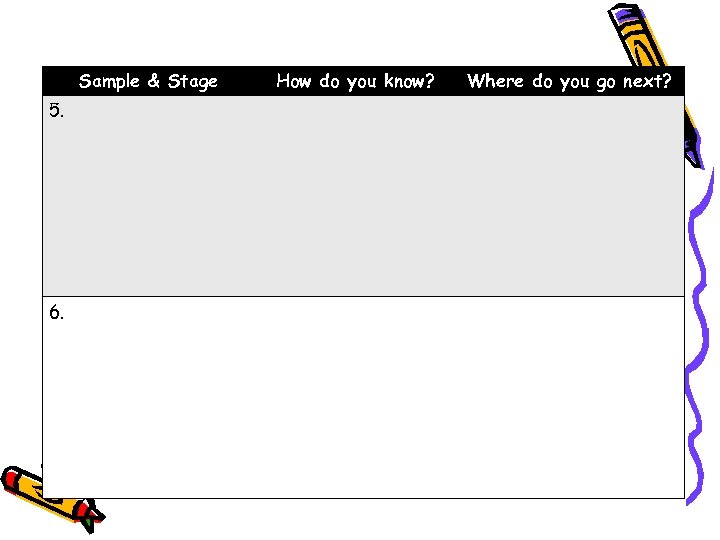
Sample & Stage How do you know? Where do you go next? 5. (scribbles) emergent • scribbles • left to right • linear lines of text • drawing pictures to represent characters and ideas • hearing sounds (phonemic awareness) • letter shapes • models of writing (shopping lists, labels) 6. Early Letter name • Hearing initial letters, but not always one-to-one correspondence • Hearing syllables • mapping sounds at beginning, end, and middle of words to letters YP – upon T – time H - there Y - was H – house L – hill K – cat h- the H – house
Spelling Assessment and Grouping Decisions EDC 424
Qualitative Spelling Inventories • Words Their Way Spelling Assessments – Primary Spelling Inventory (Gr. K-3 Emergent to Late Within-Word Patterns) – Elementary Spelling Inventory (Gr. 1 -6 Letter. Name to early derivational relations) – Upper Level Spelling Inventory (Gr. 5 -12 Within word pattern to derivational relations)
Using Spelling Inventories • Select inventory based on grade level and students’ achievement levels • Administer with brief introduction and know when to stop • Analyze students’ spelling using a feature guide • Organize groups using the Spelling by Stage form and/or a Classroom Composite form
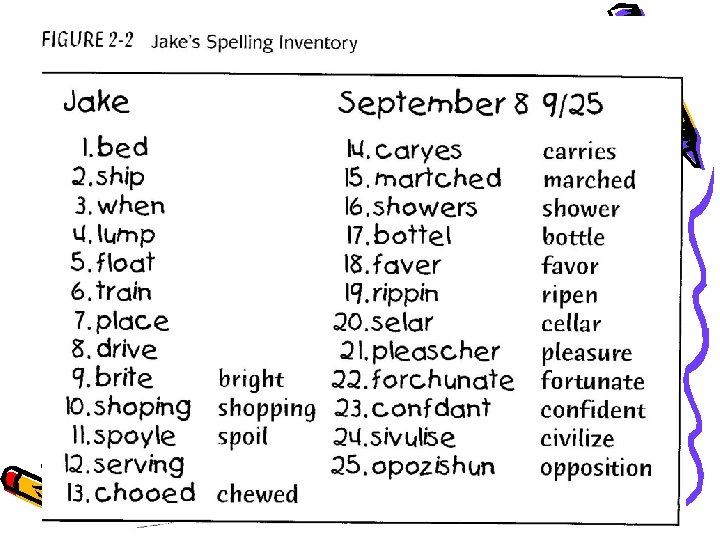
How to Score & Analyze Spelling Inventories A. Use total accuracy to group with minimal information: 1. Mark words right or wrong on list (write correct spelling next to it) 2. Use the chart to tally the words spelled correctly in the right column and calculate a power score. Use power score to estimate a stage (see WTW, p. 34). B. Use feature patterns to determine individual strengths, weaknesses, and instructional goals: 1. For each word, check off features got correct and write in errors and circle. 2. For each word, add up the feature checks along each row and add up each column for individual
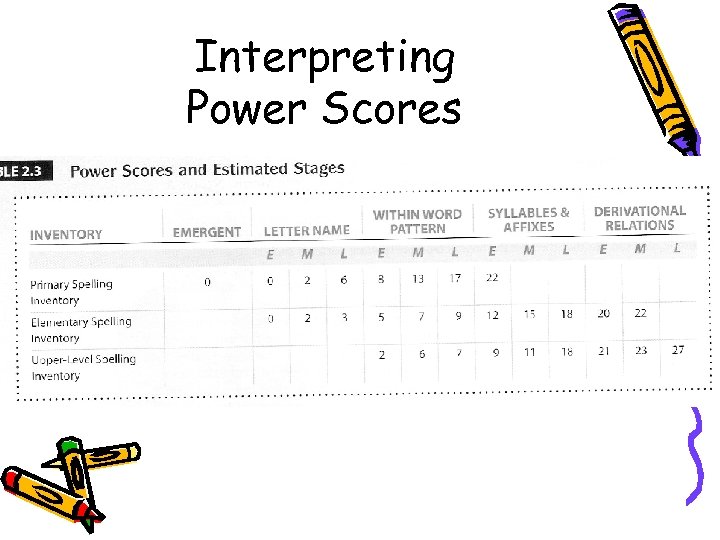
Interpreting Power Scores
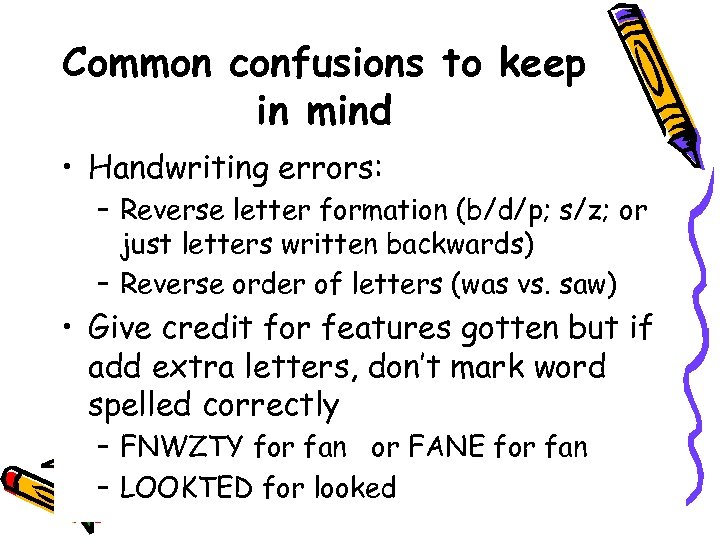
Common confusions to keep in mind • Handwriting errors: – Reverse letter formation (b/d/p; s/z; or just letters written backwards) – Reverse order of letters (was vs. saw) • Give credit for features gotten but if add extra letters, don’t mark word spelled correctly – FNWZTY for fan or FANE for fan – LOOKTED for looked
TRY IT OUT • Work with one partner to record the spelling patterns of your two students. • Use one Features Guide Form in your handout for each student. • When finished, look for patterns (similarities/differences) across your two readers. Make a list of what you might teach next for each student (based on what each knows and what is confusing) • Then, we’ll look at whole class patterns that can inform grouping decisions.
Make whole class grouping decisions • 1. Plot the students in “our class” on the Spelling-by-Stage classroom organization chart • 2. Make decisions about group size and composition • 3. Use the classroom composite chart to make more informed decisions about grouping and instruction (For the sake of time, we’ll explore the model on WTW, p. 41)
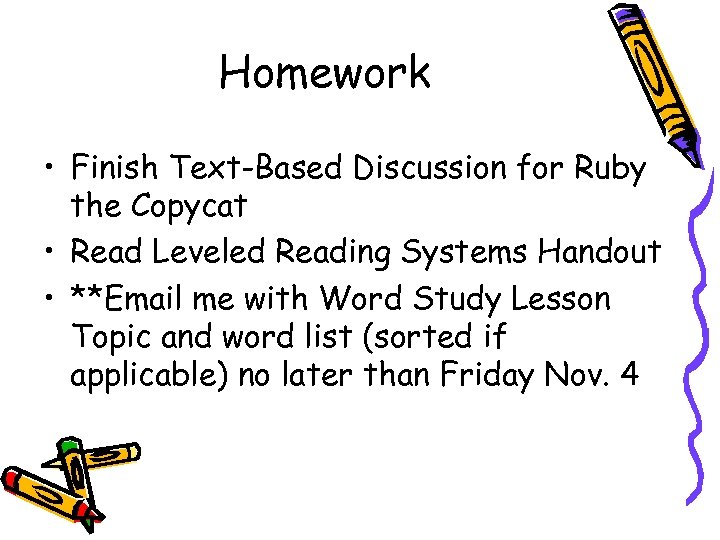
Homework • Finish Text-Based Discussion for Ruby the Copycat • Read Leveled Reading Systems Handout • **Email me with Word Study Lesson Topic and word list (sorted if applicable) no later than Friday Nov. 4
Скачать презентацию Stages of Spelling Development Objectives 1 Analyze
4fdb7399e51ecb57f9bdd91198723db2.ppt