


 Скачать презентацию Stage Six Creative Application of Technology to New
8f50bb8c9101575b02ddac0b5281ee5e.ppt
- Количество слайдов: 40
 Stage Six: Creative Application of Technology to New Contexts Which is it: Creative Technologies or Creative New Contexts?
 The presentation of a paper by Theresa Overall CECS 5800 n Dr. Rhonda Christensen’s class n August 11, 2000 n University of North Texas n
 Stages of Adoption n Text from the Stages of Adoption Survey Instrument by Dr. Rhonda Christensen, 1995 n Cartoons from “TILT--Technology in Learning and Teaching” by New South Wales (Sydney, Australia) Department of Education and Training © 1996
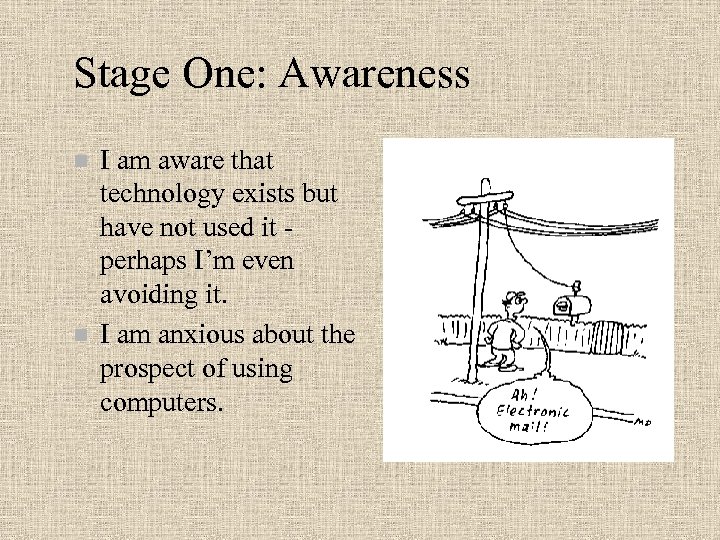 Stage One: Awareness n n I am aware that technology exists but have not used it perhaps I’m even avoiding it. I am anxious about the prospect of using computers.
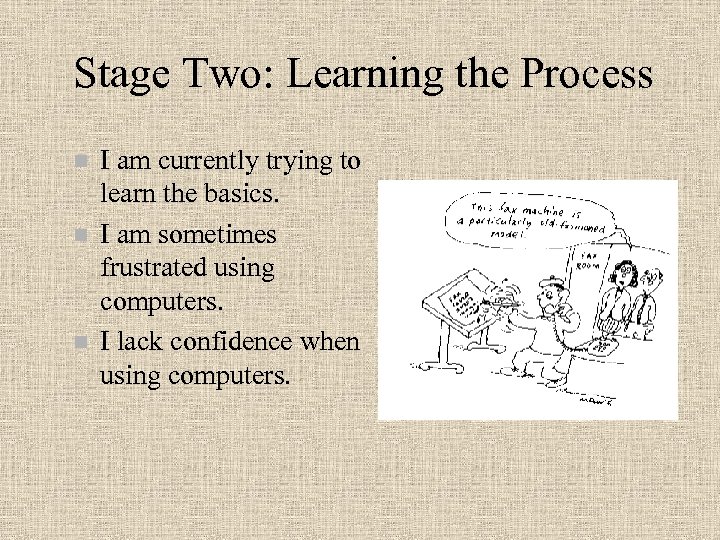 Stage Two: Learning the Process n n n I am currently trying to learn the basics. I am sometimes frustrated using computers. I lack confidence when using computers.
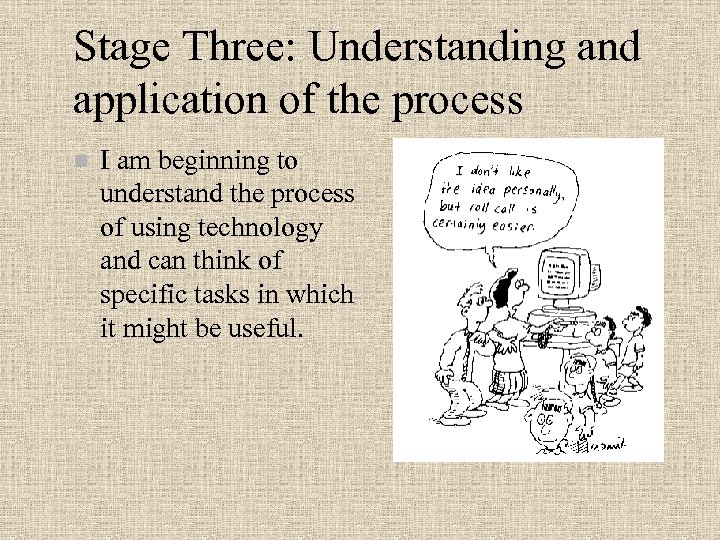 Stage Three: Understanding and application of the process n I am beginning to understand the process of using technology and can think of specific tasks in which it might be useful.
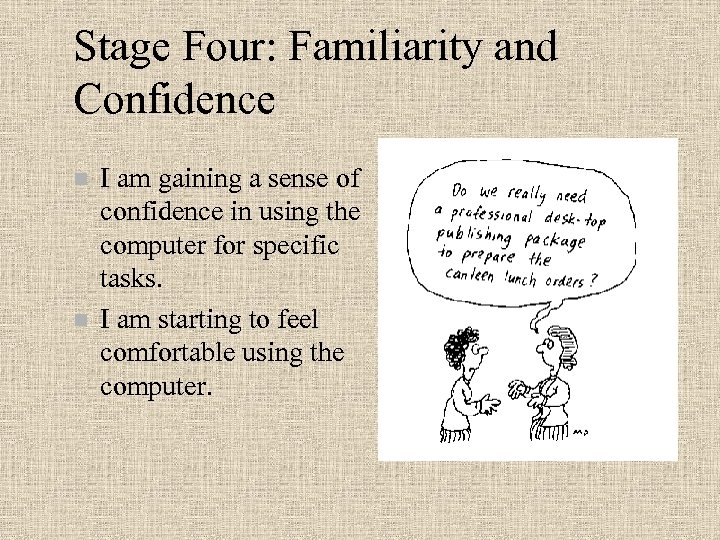 Stage Four: Familiarity and Confidence n n I am gaining a sense of confidence in using the computer for specific tasks. I am starting to feel comfortable using the computer.
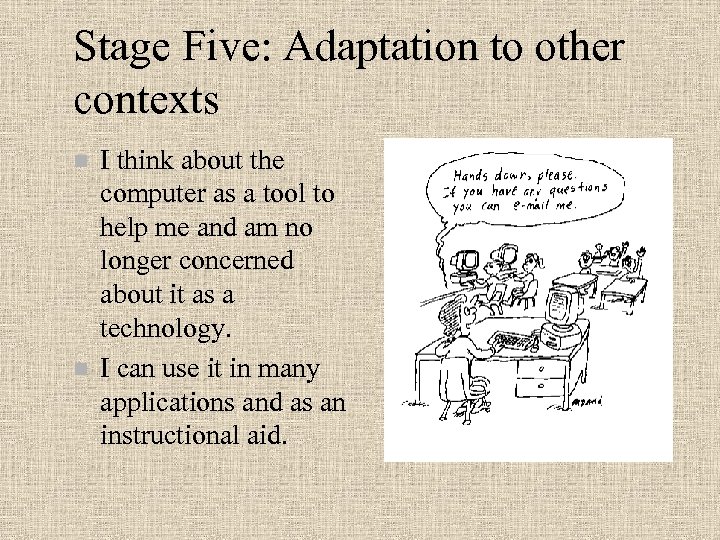 Stage Five: Adaptation to other contexts n n I think about the computer as a tool to help me and am no longer concerned about it as a technology. I can use it in many applications and as an instructional aid.
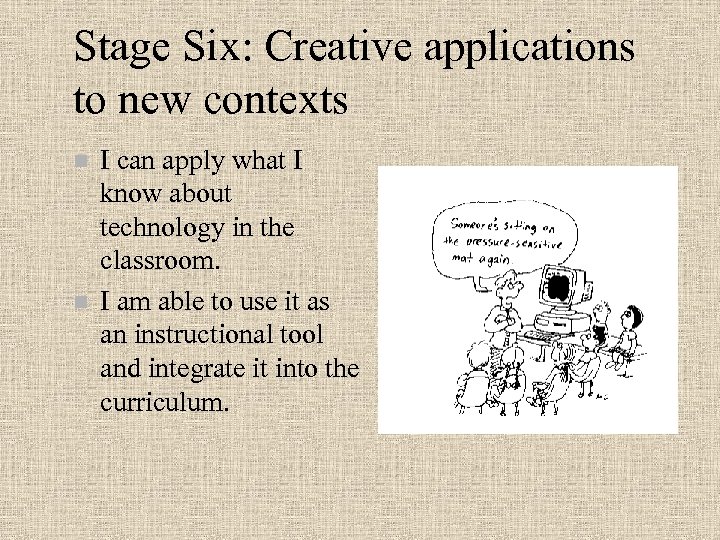 Stage Six: Creative applications to new contexts n n I can apply what I know about technology in the classroom. I am able to use it as an instructional tool and integrate it into the curriculum.
 How does a Stage 6 teacher challenge his/her comfort and creativity? n USE A NEW TECHNOLOGY: Learn new, higher-level technologies that can complement/ supplement your existing curriculum and further student understanding of key concepts n DESIGN A NEW CONTEXT: Design new activities in your curriculum that take further advantage of existing technologies (in the classroom and in the community) while integrating the technology
 Examples of New Technologies The Topocam--a digital robotic camera that makes motion and time visible in ways we haven’t seen before n Whoola. com-WHOlesome On-line Learning Activities MYST-like games that explore chemistry, marine biology, and social studies in a community of learners across the Internet n
 Examples of New Contexts n n Teachers establish individual/group technological projects, negotiating agreements with individuals or teams of students to pursue a specific set of tasks related to their interests and the resources available. Teachers establish some whole-class or year-group studies which explore a context or major area, with a number of projects for individuals or groups contributing to a major, integrated experience
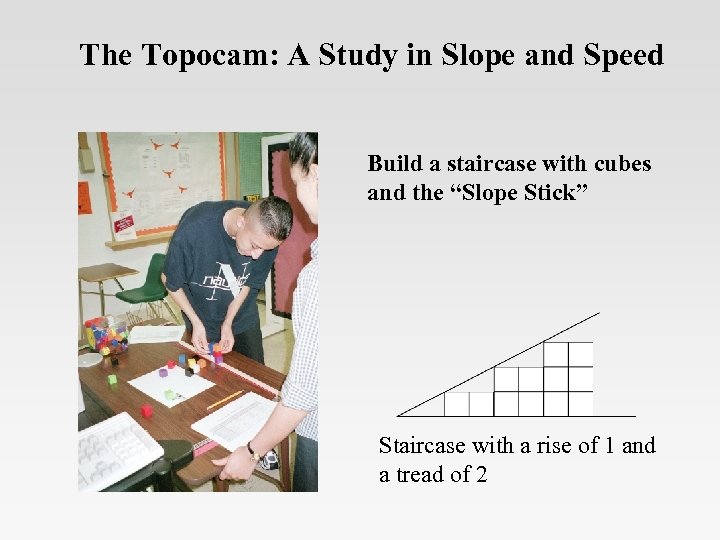 The Topocam: A Study in Slope and Speed Build a staircase with cubes and the “Slope Stick” Staircase with a rise of 1 and a tread of 2
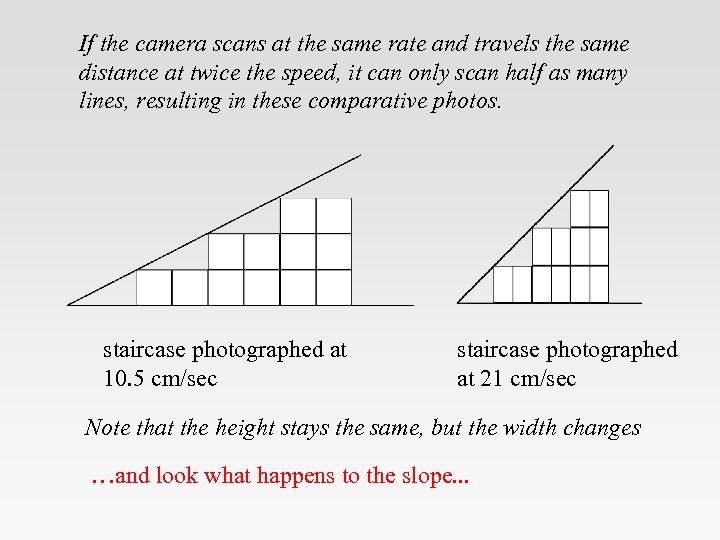 If the camera scans at the same rate and travels the same distance at twice the speed, it can only scan half as many lines, resulting in these comparative photos. staircase photographed at 10. 5 cm/sec staircase photographed at 21 cm/sec Note that the height stays the same, but the width changes …and look what happens to the slope. . .
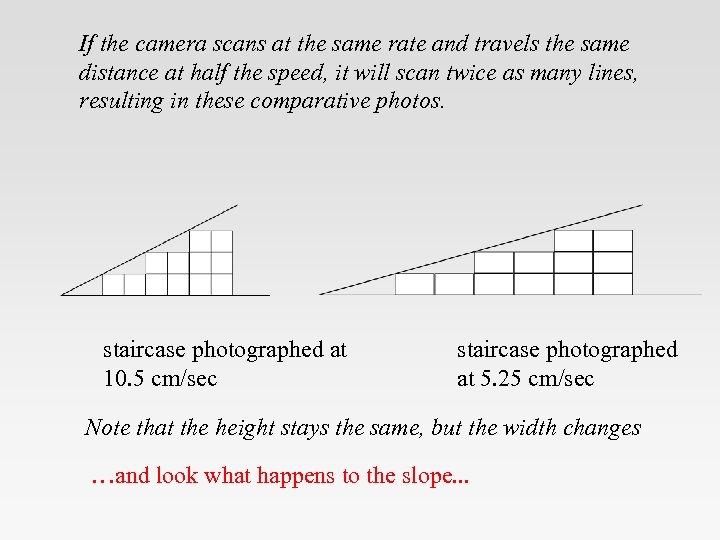 If the camera scans at the same rate and travels the same distance at half the speed, it will scan twice as many lines, resulting in these comparative photos. staircase photographed at 10. 5 cm/sec staircase photographed at 5. 25 cm/sec Note that the height stays the same, but the width changes …and look what happens to the slope. . .
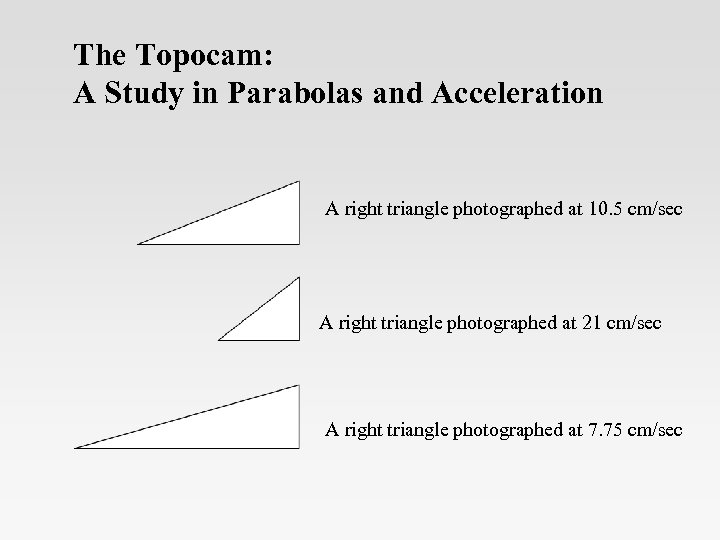 The Topocam: A Study in Parabolas and Acceleration A right triangle photographed at 10. 5 cm/sec A right triangle photographed at 21 cm/sec A right triangle photographed at 7. 75 cm/sec
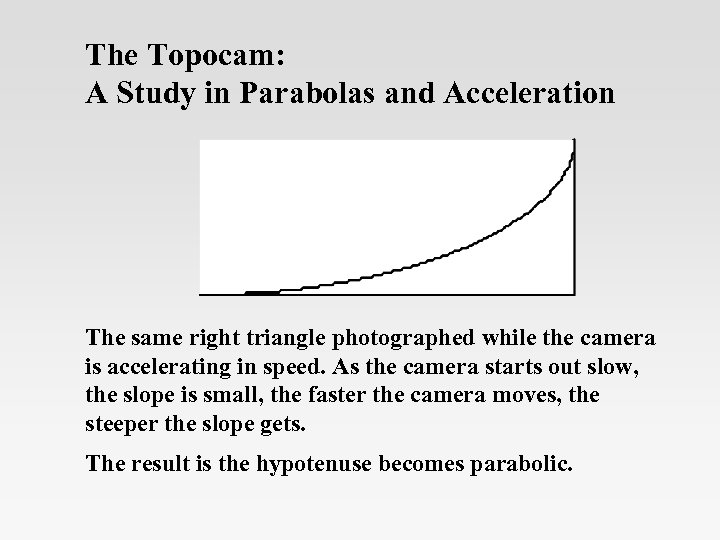 The Topocam: A Study in Parabolas and Acceleration The same right triangle photographed while the camera is accelerating in speed. As the camera starts out slow, the slope is small, the faster the camera moves, the steeper the slope gets. The result is the hypotenuse becomes parabolic.
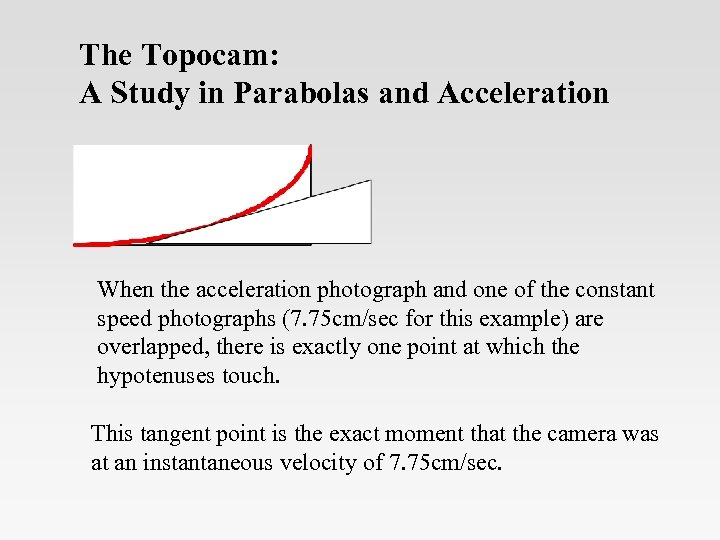 The Topocam: A Study in Parabolas and Acceleration When the acceleration photograph and one of the constant speed photographs (7. 75 cm/sec for this example) are overlapped, there is exactly one point at which the hypotenuses touch. This tangent point is the exact moment that the camera was at an instantaneous velocity of 7. 75 cm/sec.
 The Topocam: So much more! Physical Science Friction…see the effects in new ways n Pendulums n Simple machines n Mechanical energy n Relative motion n Newton’s laws n
 The Topocam: So much more! Physics, Robotics n Relative motion: – – n The camera can stay still and objects move in front of it The camera can move while photographing a moving object Measure wave motions and oscillations – Can you imagine what the motion of a slinky looks like?
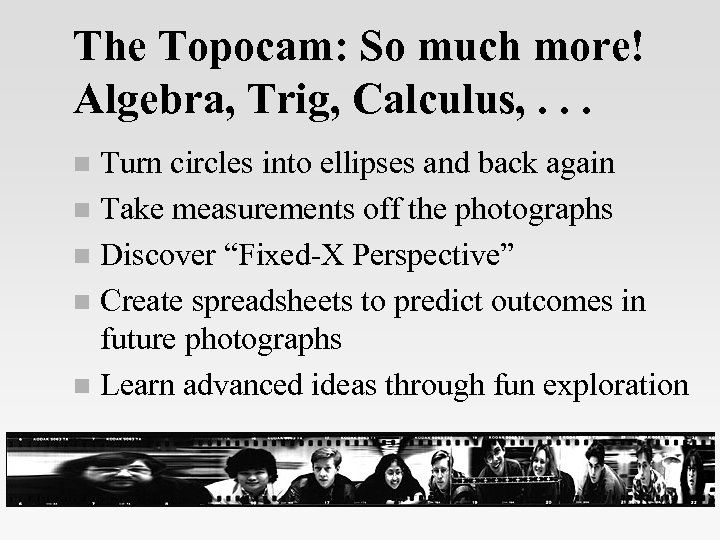 The Topocam: So much more! Algebra, Trig, Calculus, . . . Turn circles into ellipses and back again n Take measurements off the photographs n Discover “Fixed-X Perspective” n Create spreadsheets to predict outcomes in future photographs n Learn advanced ideas through fun exploration n
 New Technology: Whoola. com “mesmerizing multi-user collaborative learning environments”
 Whoola's mission: n Push e-learning from its current "learning in isolation" to engaging and lively multi-user interactions and collaboration oriented learning.
 n Learning happens best in a social environment and Whoola's environments closely mimic the way learning happens in a traditional classroom environment. n Whoola utilizes technology to provide individual attention in such a community/social-play environment.
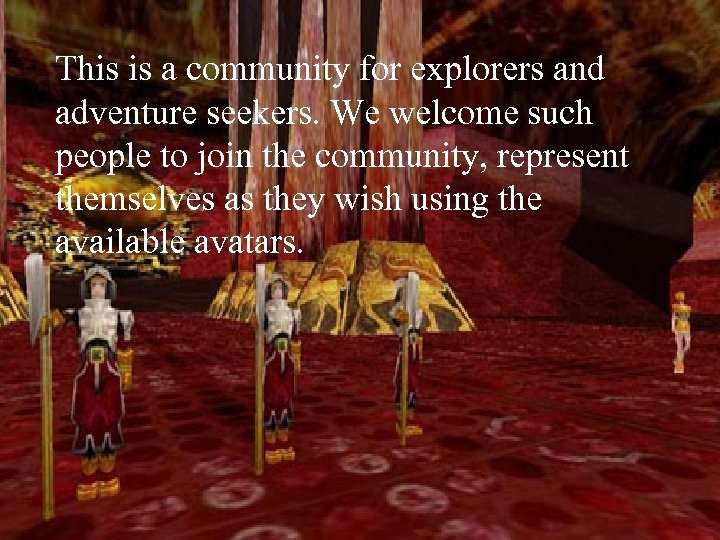 This is a community for explorers and adventure seekers. We welcome such people to join the community, represent themselves as they wish using the available avatars.
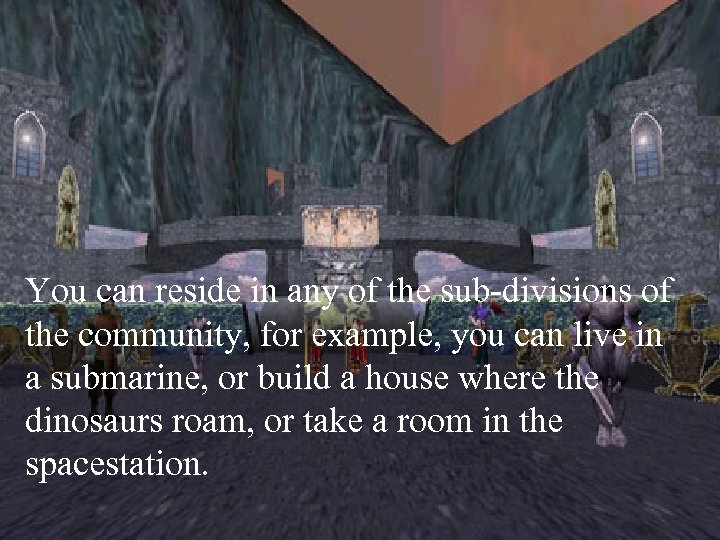 You can reside in any of the sub-divisions of the community, for example, you can live in a submarine, or build a house where the dinosaurs roam, or take a room in the spacestation.
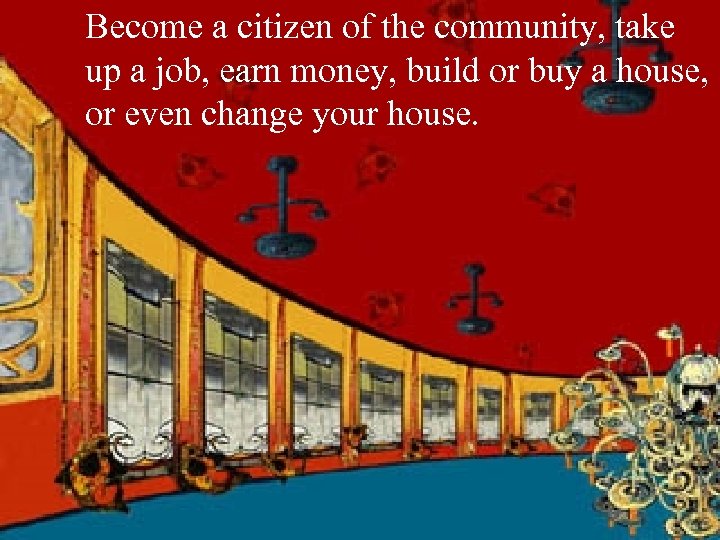 Become a citizen of the community, take up a job, earn money, build or buy a house, or even change your house.
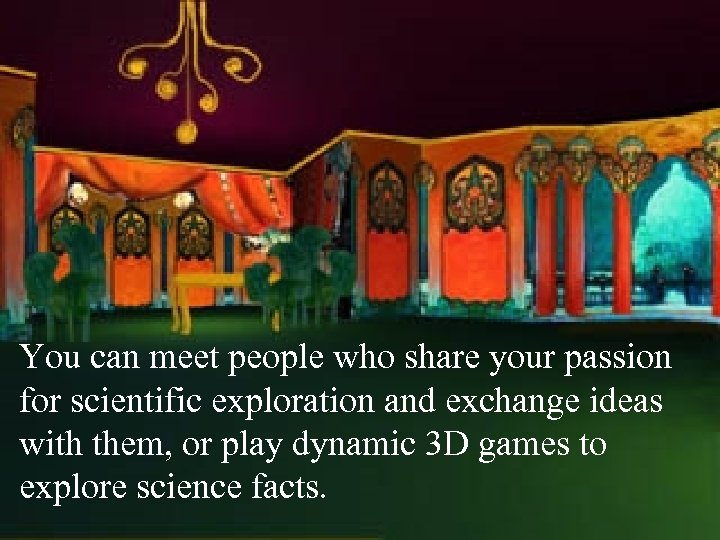 You can meet people who share your passion for scientific exploration and exchange ideas with them, or play dynamic 3 D games to explore science facts.
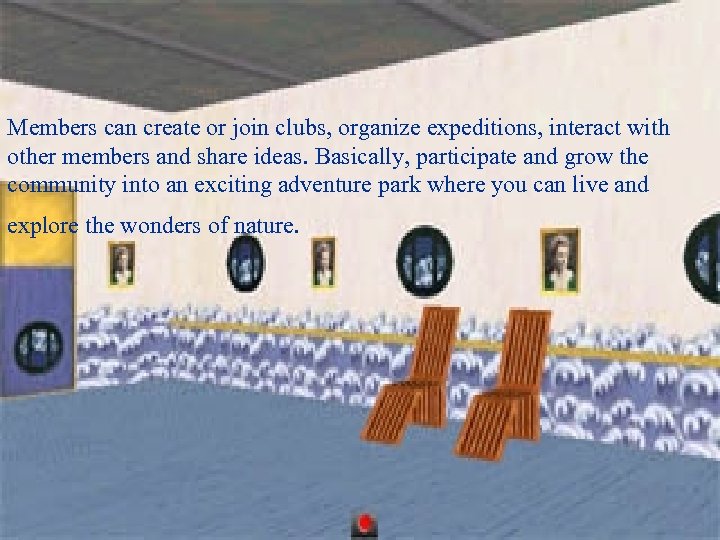 Members can create or join clubs, organize expeditions, interact with other members and share ideas. Basically, participate and grow the community into an exciting adventure park where you can live and explore the wonders of nature.
 As members of The Corps of Discovery, we want you to experience thrill of adventure and the spirit of collaboration.
 The goals of the multi-user learning adventures are to: Create positive inter-dependence among learners, n Provide ample opportunities for experimentation (and failures), n Provide users an opportunity to learn through collaborative discovery, musing and hypothesizing, n Provide effective feedback. n
 An example of different roles played by learners in Acidia: --Each "role" or Avatar represents a column of the periodic table of elements and derives its game personality from the elements they represent. --In order to explore the multitude of miniquests in the different game worlds, each learner has to collaborate with other learners.
 Design a New Context Examples from “Technology in the New Zealand Curriculum” By Ministry of Education
 Achievement Objectives n Technological Capability: levels 7 & 8 – Within a range of technological areas and contexts, students should produce technological solutions
 New Context: Individual Project in Chemistry Protective Coverings and Coatings n Students could be: n – – Investigating the range, properties, and promotion of protective coverings and finishings Identifying unmet needs, for example, in specific climatic conditions
 New Context: Individual Project in Chemistry Protective Coverings and Coatings n Students could be: n – – Designing, developing, testing, producing, and promoting a new product Exploring materials used in other times and situations, such as flax for insulation
 New Context: Group Project in Robotics n Groups could be: – – – Investigating successful applications of a robotic arm interfaced with a control system Analysing new applications for specific users, such as people with disabilities Discussing with local kaumatua the concept of using robotics to produce carving patterns or assist in food preparation
 New Context: Group Project in Robotics n Groups could be: – – Planning, producing, and testing prototypes for different purposes to investigate the sequencing and ease of control Producing an illustrated report to show the articulation and performance of the prototype Planning final production Analysing the impact on an individual or workplace of introducing a robot to undertake certain tasks
 Stage Six: Creative Application of Technology to New Contexts Which is it: Creative Technologies or Creative New Contexts?
 Thank You! Millie Hubbard n Dr. Rhonda Christensen n Dr. Gerald Knezek n Dana Arrowood n