 Скачать презентацию Stabilization Wedges and the Management of Global Carbon
21c9ef1ef3e0c17cdbdcd85bf1805548.ppt
- Количество слайдов: 47



Stabilization Wedges and the Management of Global Carbon for the Next 50 Years: A Primer for the Physicist as Researcher and Teacher Robert Socolow Princeton University socolow@princeton. edu Fermi National Accelerator Laboratory April 18, 2007

Good Advice Long Ago Received Never underestimate a person’s intelligence, nor overestimate what they know.
Outline of Talk 1. The Earth system 2. The energy system 3. The wedge model 4. The rush to coal 5. Efficiency 6. Solution science and prospicience
1. THE EARTH SYSTEM All of this belongs in physics courses
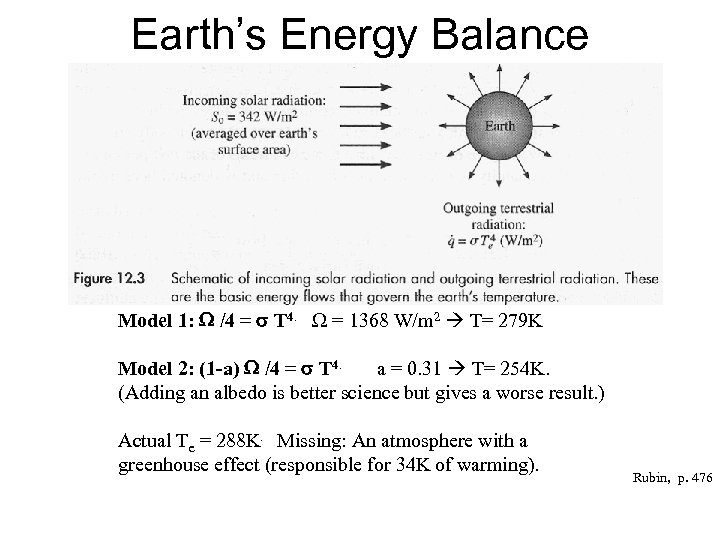
Earth’s Energy Balance Model 1: /4 = T 4. = 1368 W/m 2 T= 279 K Model 2: (1 -a) /4 = T 4. a = 0. 31 T= 254 K. (Adding an albedo is better science but gives a worse result. ) Actual Te = 288 K. Missing: An atmosphere with a greenhouse effect (responsible for 34 K of warming). Rubin, p. 476
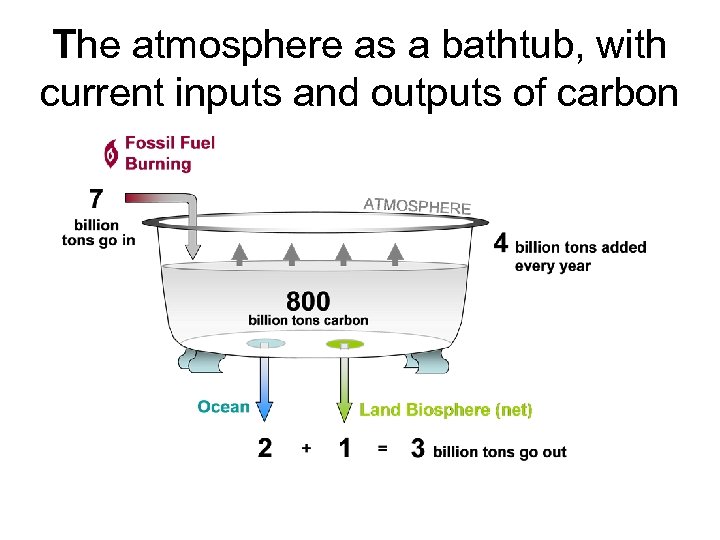
The atmosphere as a bathtub, with current inputs and outputs of carbon
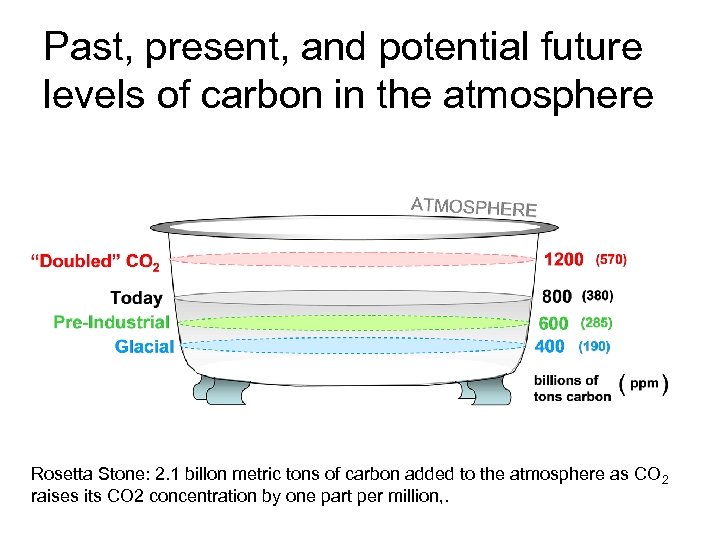
Past, present, and potential future levels of carbon in the atmosphere Rosetta Stone: 2. 1 billon metric tons of carbon added to the atmosphere as CO 2 raises its CO 2 concentration by one part per million, .
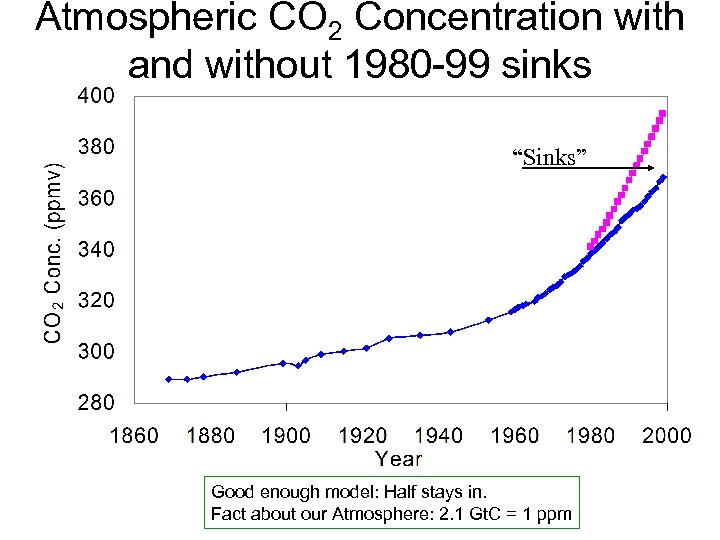
Atmospheric CO 2 Concentration with and without 1980 -99 sinks “Sinks” Good enough model: Half stays in. Fact about our Atmosphere: 2. 1 Gt. C = 1 ppm
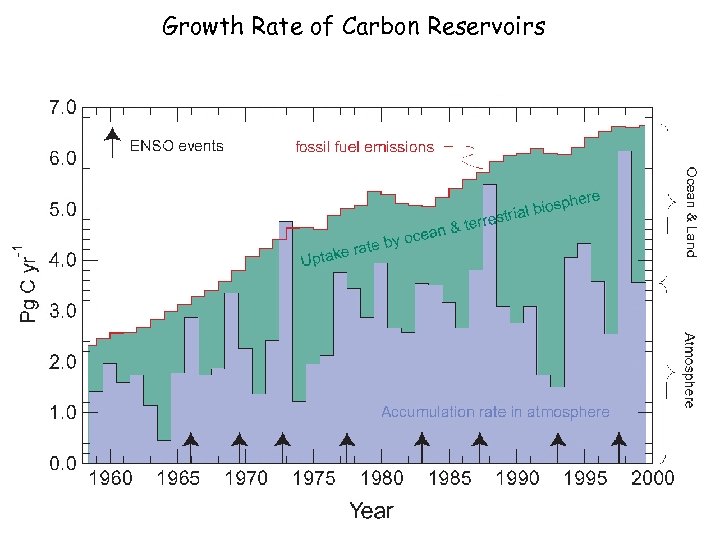
Growth Rate of Carbon Reservoirs
2. ENERGY
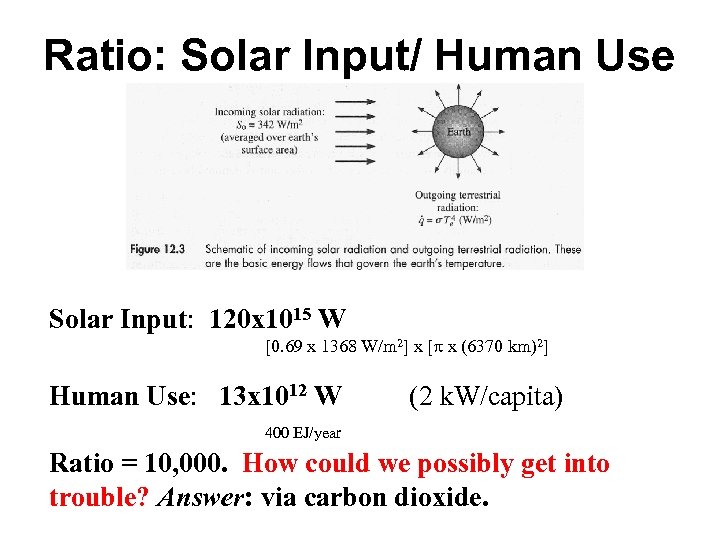
Ratio: Solar Input/ Human Use Solar Input: 120 x 1015 W [0. 69 x 1368 W/m 2] x [ x (6370 km)2] Human Use: 13 x 1012 W (2 k. W/capita) 400 EJ/year Ratio = 10, 000. How could we possibly get into trouble? Answer: via carbon dioxide.
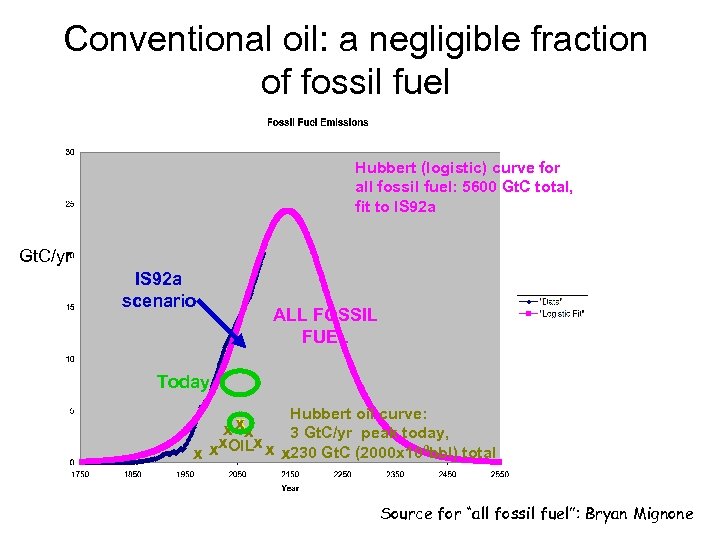
Conventional oil: a negligible fraction of fossil fuel Hubbert (logistic) curve for all fossil fuel: 5600 Gt. C total, fit to IS 92 a Gt. C/yr IS 92 a scenario ALL FOSSIL FUEL Today Hubbert oil curve: x x x 3 Gt. C/yr peak today, x. OILx x xx x 230 Gt. C (2000 x 109 bbl) total Source for “all fossil fuel”: Bryan Mignone
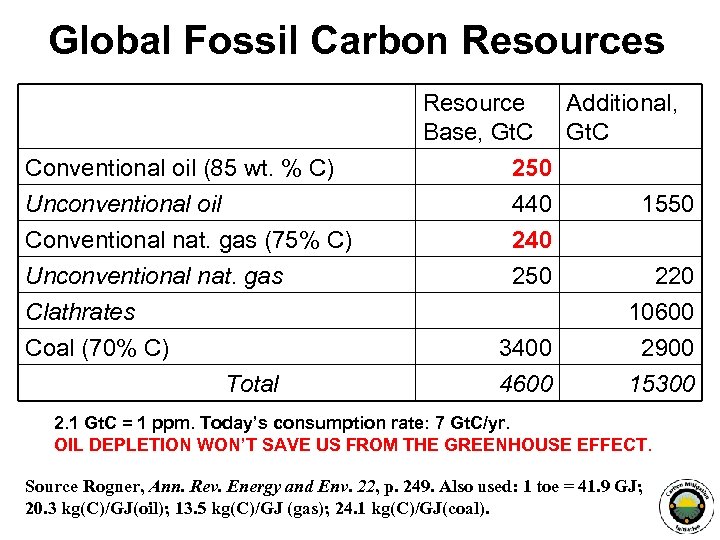
Global Fossil Carbon Resources Conventional oil (85 wt. % C) Unconventional oil Conventional nat. gas (75% C) Unconventional nat. gas Clathrates Coal (70% C) Total Resource Additional, Base, Gt. C 250 440 1550 240 250 3400 4600 220 10600 2900 15300 2. 1 Gt. C = 1 ppm. Today’s consumption rate: 7 Gt. C/yr. OIL DEPLETION WON’T SAVE US FROM THE GREENHOUSE EFFECT. Source Rogner, Ann. Rev. Energy and Env. 22, p. 249. Also used: 1 toe = 41. 9 GJ; 20. 3 kg(C)/GJ(oil); 13. 5 kg(C)/GJ (gas); 24. 1 kg(C)/GJ(coal).
3. THE WEDGE MODEL
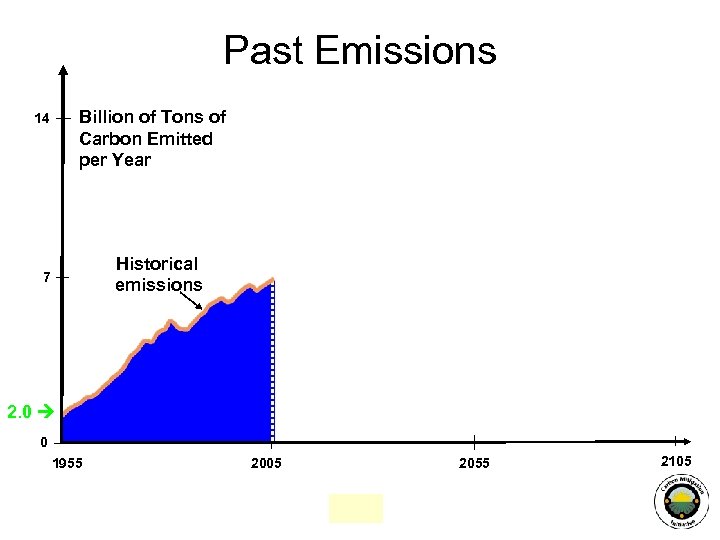
Past Emissions Billion of Tons of Carbon Emitted per Year 14 Historical emissions 7 2. 0 0 1955 2005 2055 2105
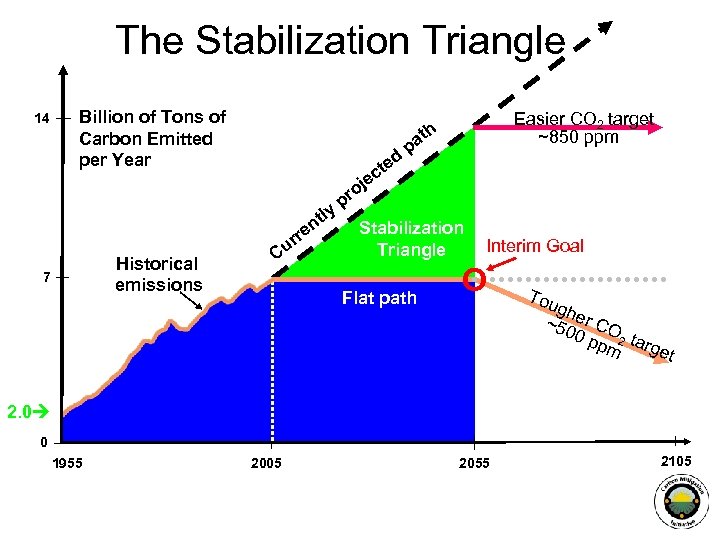
The Stabilization Triangle 14 Billion of Tons of Carbon Emitted per Year ly nt rre Historical emissions 7 Cu j ro p d te ec Easier CO 2 target ~850 ppm h at p Stabilization Triangle Flat path Interim Goal O Tou ghe ~50 r CO 0 p 2 ta pm rge t 2. 0 0 1955 2005 2055 2105
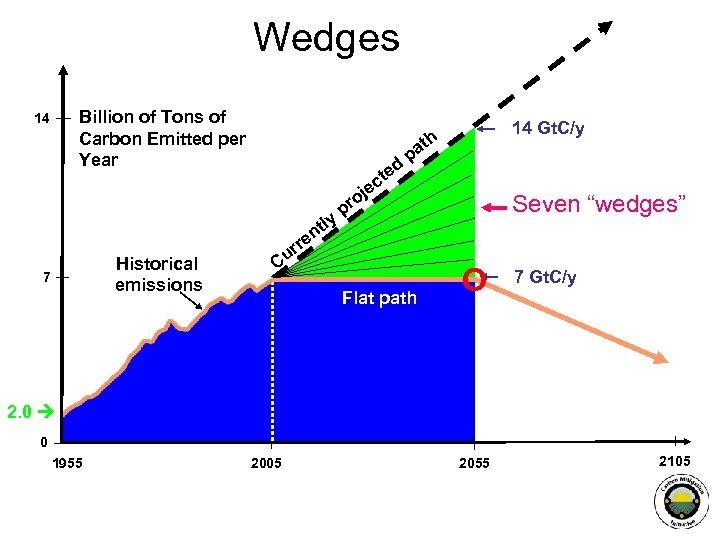
Wedges Billion of Tons of Carbon Emitted per Year 14 ly Historical emissions 7 t en rr j ro p d te ec 14 Gt. C/y h at p Cu Flat path Seven “wedges” O 7 Gt. C/y 2. 0 0 1955 2005 2055 2105
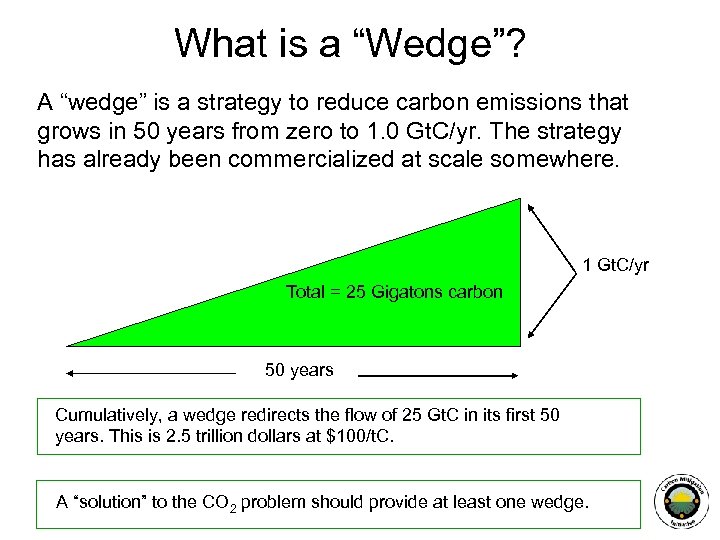
What is a “Wedge”? A “wedge” is a strategy to reduce carbon emissions that grows in 50 years from zero to 1. 0 Gt. C/yr. The strategy has already been commercialized at scale somewhere. 1 Gt. C/yr Total = 25 Gigatons carbon 50 years Cumulatively, a wedge redirects the flow of 25 Gt. C in its first 50 years. This is 2. 5 trillion dollars at $100/t. C. A “solution” to the CO 2 problem should provide at least one wedge.
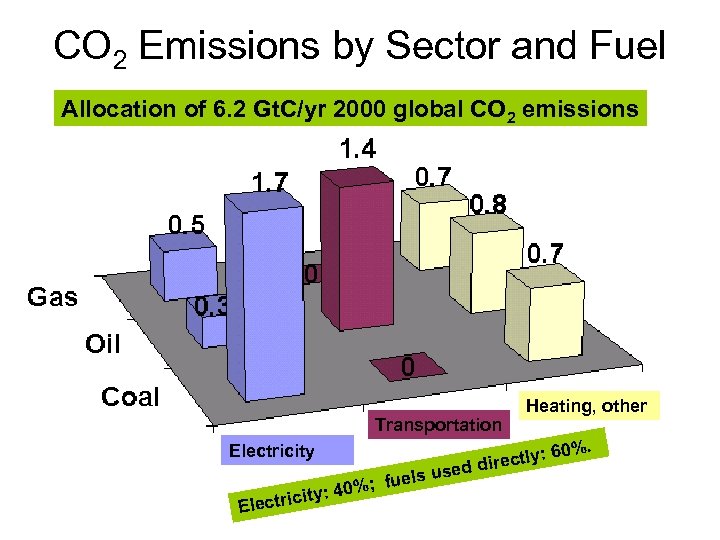
CO 2 Emissions by Sector and Fuel Allocation of 6. 2 Gt. C/yr 2000 global CO 2 emissions Transportation Heating, other %. y: 60 directl sed Electricity Electri u ; fuels : 40%
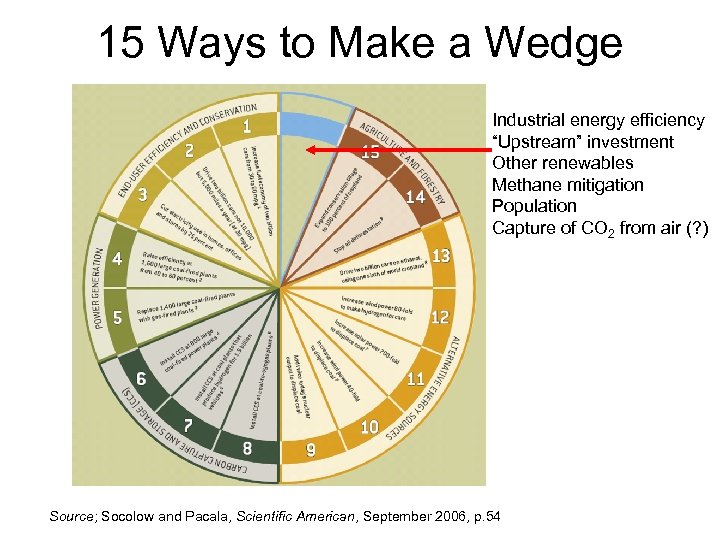
15 Ways to Make a Wedge Industrial energy efficiency “Upstream” investment Other renewables Methane mitigation Population Capture of CO 2 from air (? ) Source; Socolow and Pacala, Scientific American, September 2006, p. 54
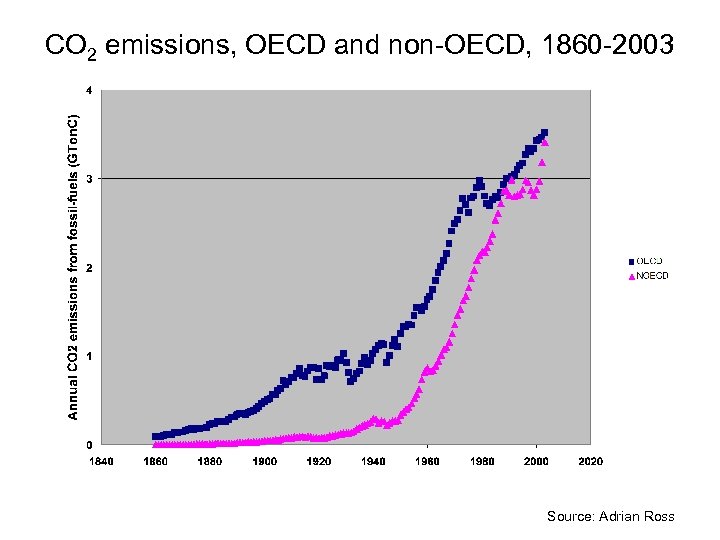
CO 2 emissions, OECD and non-OECD, 1860 -2003 Source: Adrian Ross
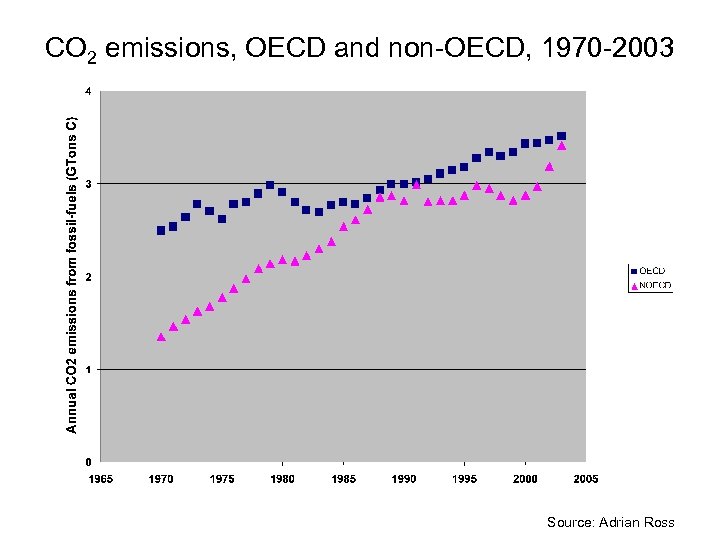
CO 2 emissions, OECD and non-OECD, 1970 -2003 Source: Adrian Ross
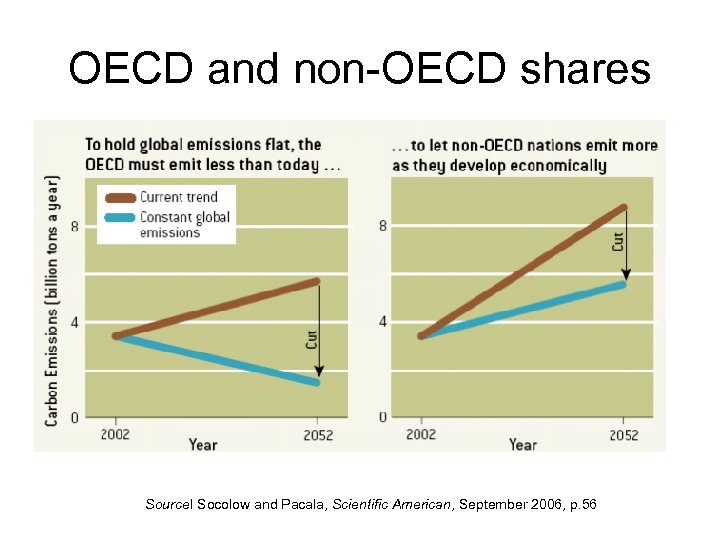
OECD and non-OECD shares Source. I Socolow and Pacala, Scientific American, September 2006, p. 56
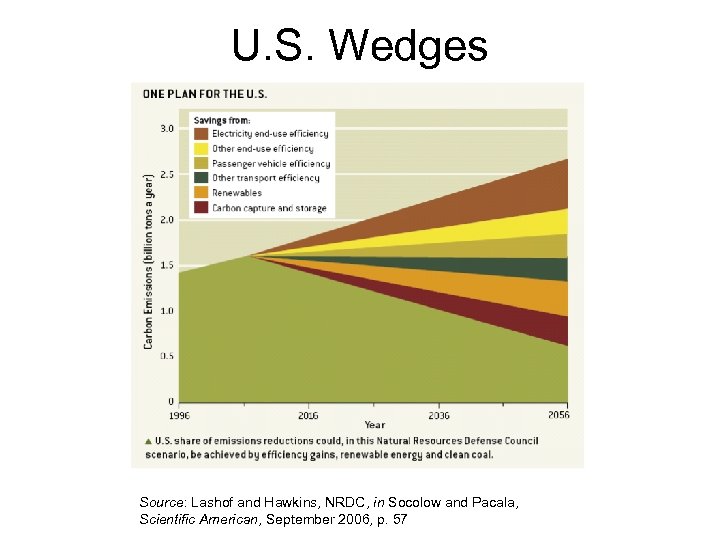
U. S. Wedges Source: Lashof and Hawkins, NRDC, in Socolow and Pacala, Scientific American, September 2006, p. 57
4. THE RUSH TO COAL
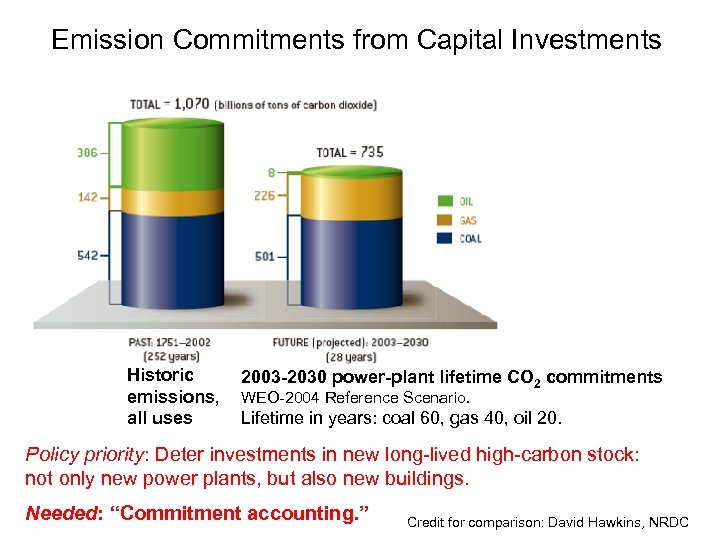
Emission Commitments from Capital Investments Historic emissions, all uses 2003 -2030 power-plant lifetime CO 2 commitments WEO-2004 Reference Scenario. Lifetime in years: coal 60, gas 40, oil 20. Policy priority: Deter investments in new long-lived high-carbon stock: not only new power plants, but also new buildings. Needed: “Commitment accounting. ” Credit for comparison: David Hawkins, NRDC
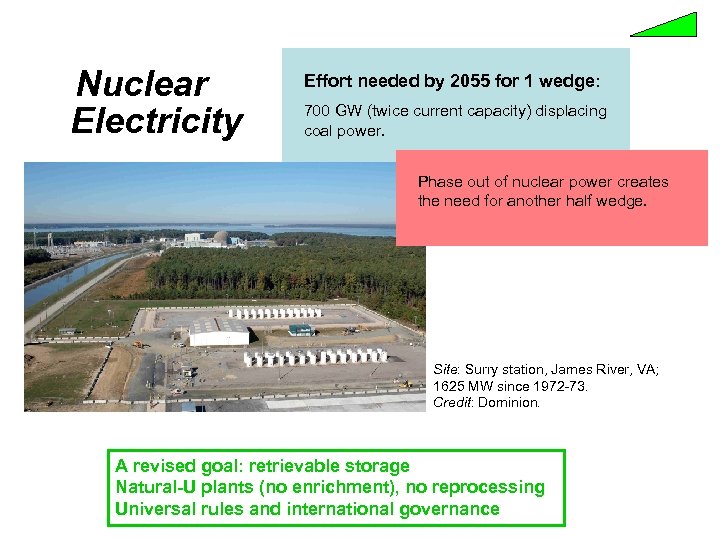
Nuclear Electricity Effort needed by 2055 for 1 wedge: 700 GW (twice current capacity) displacing coal power. Phase out of nuclear power creates the need for another half wedge. Site: Surry station, James River, VA; 1625 MW since 1972 -73. Credit: Dominion. A revised goal: retrievable storage Natural-U plants (no enrichment), no reprocessing Universal rules and international governance
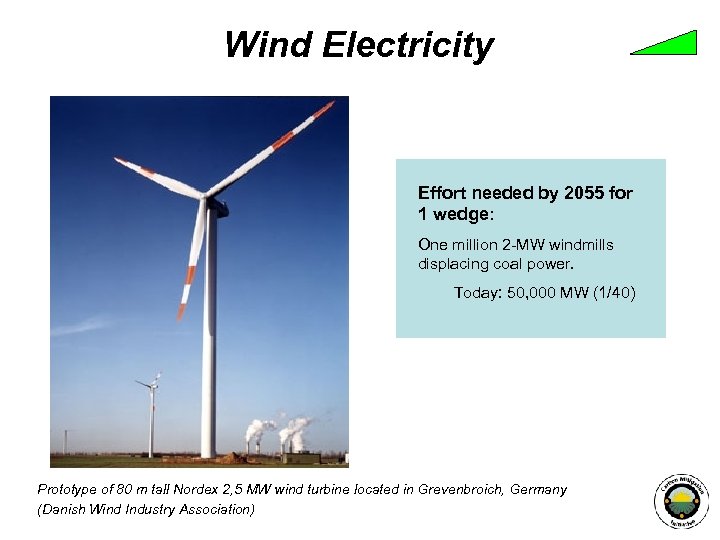
Wind Electricity Effort needed by 2055 for 1 wedge: One million 2 -MW windmills displacing coal power. Today: 50, 000 MW (1/40) Prototype of 80 m tall Nordex 2, 5 MW wind turbine located in Grevenbroich, Germany (Danish Wind Industry Association)
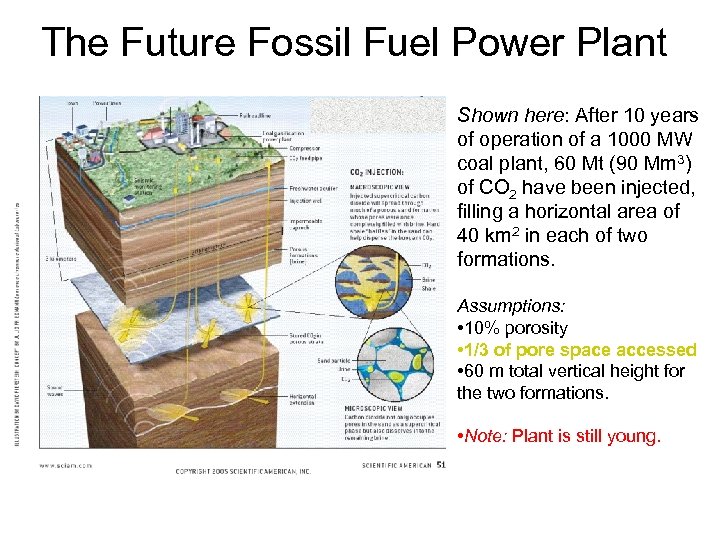
The Future Fossil Fuel Power Plant Shown here: After 10 years of operation of a 1000 MW coal plant, 60 Mt (90 Mm 3) of CO 2 have been injected, filling a horizontal area of 40 km 2 in each of two formations. Assumptions: • 10% porosity • 1/3 of pore space accessed • 60 m total vertical height for the two formations. • Note: Plant is still young.
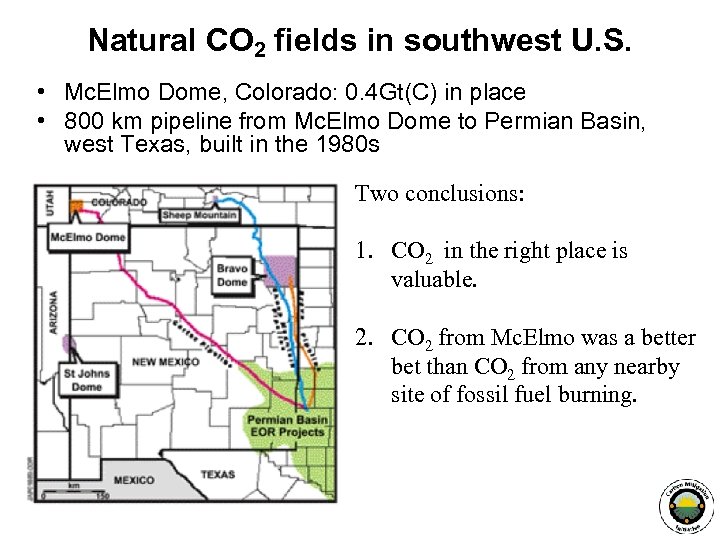
Natural CO 2 fields in southwest U. S. • Mc. Elmo Dome, Colorado: 0. 4 Gt(C) in place • 800 km pipeline from Mc. Elmo Dome to Permian Basin, west Texas, built in the 1980 s Two conclusions: 1. CO 2 in the right place is valuable. 2. CO 2 from Mc. Elmo was a better bet than CO 2 from any nearby site of fossil fuel burning.
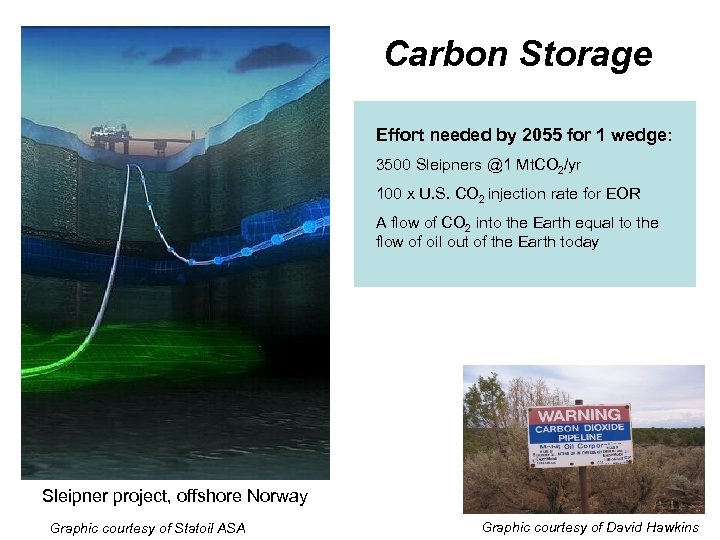
Carbon Storage Effort needed by 2055 for 1 wedge: 3500 Sleipners @1 Mt. CO 2/yr 100 x U. S. CO 2 injection rate for EOR A flow of CO 2 into the Earth equal to the flow of oil out of the Earth today Sleipner project, offshore Norway Graphic courtesy of Statoil ASA Graphic courtesy of David Hawkins
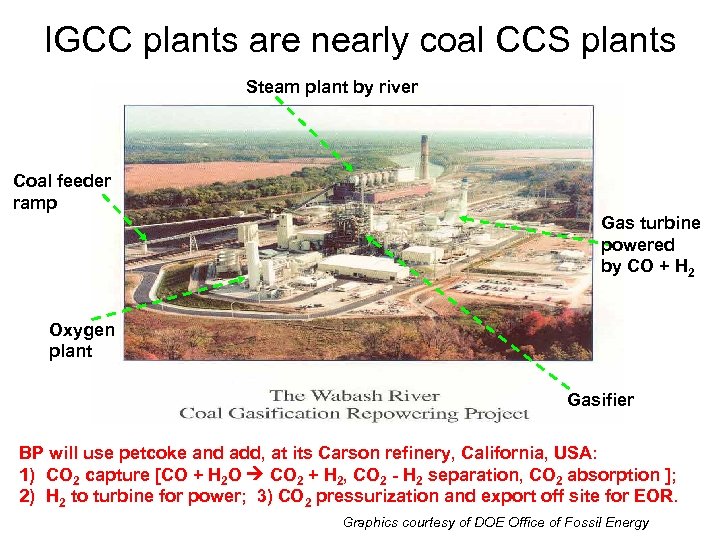
IGCC plants are nearly coal CCS plants Steam plant by river Coal feeder ramp Gas turbine powered by CO + H 2 Oxygen plant Gasifier BP will use petcoke and add, at its Carson refinery, California, USA: 1) CO 2 capture [CO + H 2 O CO 2 + H 2, CO 2 - H 2 separation, CO 2 absorption ]; 2) H 2 to turbine for power; 3) CO 2 pressurization and export off site for EOR. Graphics courtesy of DOE Office of Fossil Energy
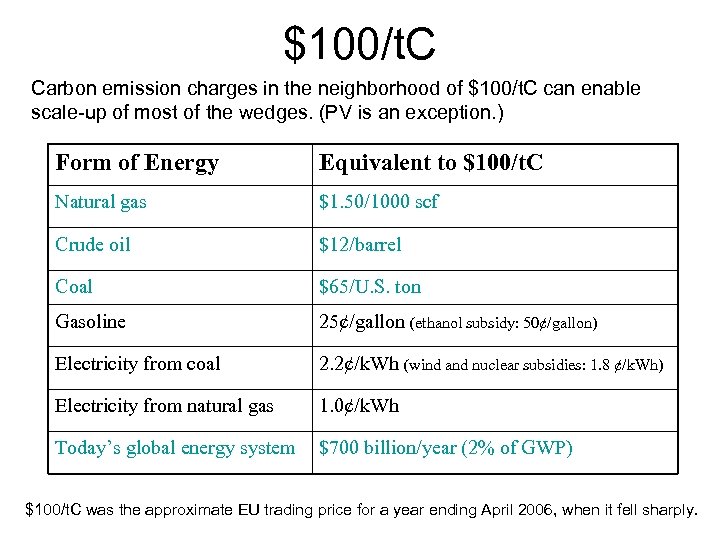
$100/t. C Carbon emission charges in the neighborhood of $100/t. C can enable scale-up of most of the wedges. (PV is an exception. ) Form of Energy Equivalent to $100/t. C Natural gas $1. 50/1000 scf Crude oil $12/barrel Coal $65/U. S. ton Gasoline 25¢/gallon (ethanol subsidy: 50¢/gallon) Electricity from coal 2. 2¢/k. Wh (wind and nuclear subsidies: 1. 8 ¢/k. Wh) Electricity from natural gas 1. 0¢/k. Wh Today’s global energy system $700 billion/year (2% of GWP) $100/t. C was the approximate EU trading price for a year ending April 2006, when it fell sharply.
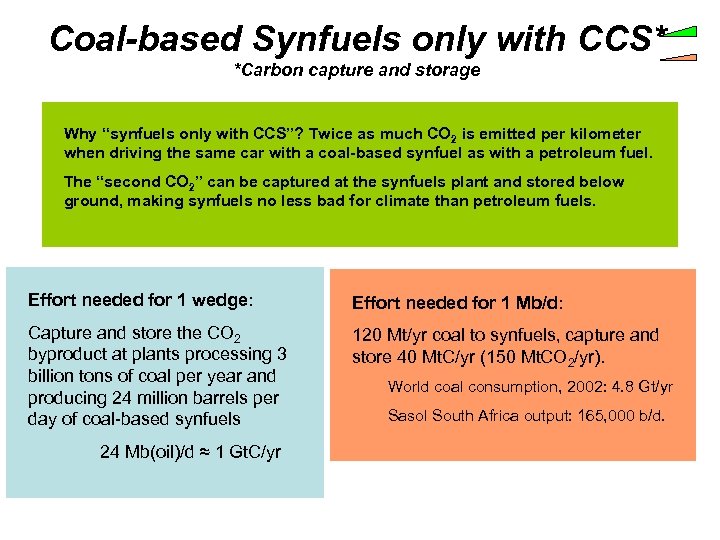
Coal-based Synfuels only with CCS* *Carbon capture and storage Why “synfuels only with CCS”? Twice as much CO 2 is emitted per kilometer when driving the same car with a coal-based synfuel as with a petroleum fuel. The “second CO 2” can be captured at the synfuels plant and stored below ground, making synfuels no less bad for climate than petroleum fuels. Effort needed for 1 wedge: Effort needed for 1 Mb/d: Capture and store the CO 2 byproduct at plants processing 3 billion tons of coal per year and producing 24 million barrels per day of coal-based synfuels 120 Mt/yr coal to synfuels, capture and store 40 Mt. C/yr (150 Mt. CO 2/yr). 24 Mb(oil)/d ≈ 1 Gt. C/yr World coal consumption, 2002: 4. 8 Gt/yr Sasol South Africa output: 165, 000 b/d.
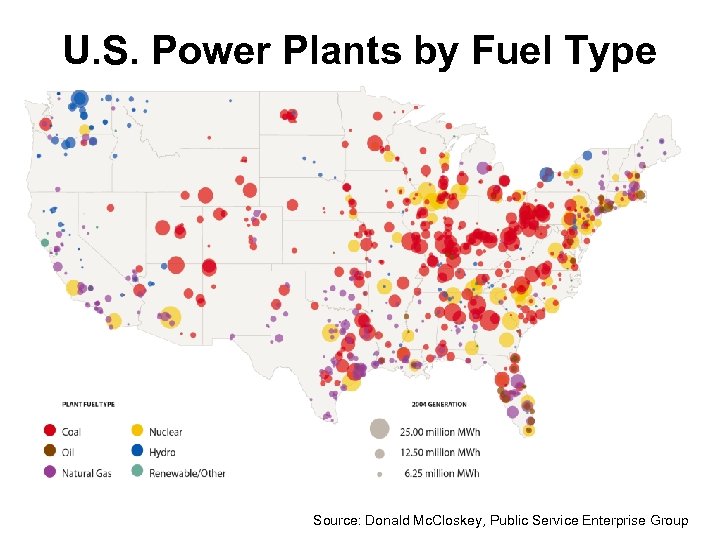
U. S. Power Plants by Fuel Type Source: Donald Mc. Closkey, Public Service Enterprise Group
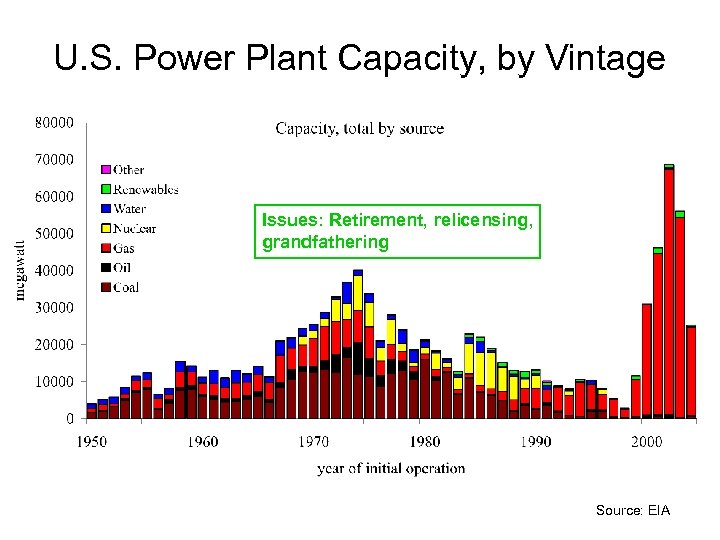
U. S. Power Plant Capacity, by Vintage Issues: Retirement, relicensing, grandfathering Source: EIA
5. EFFICIENCY
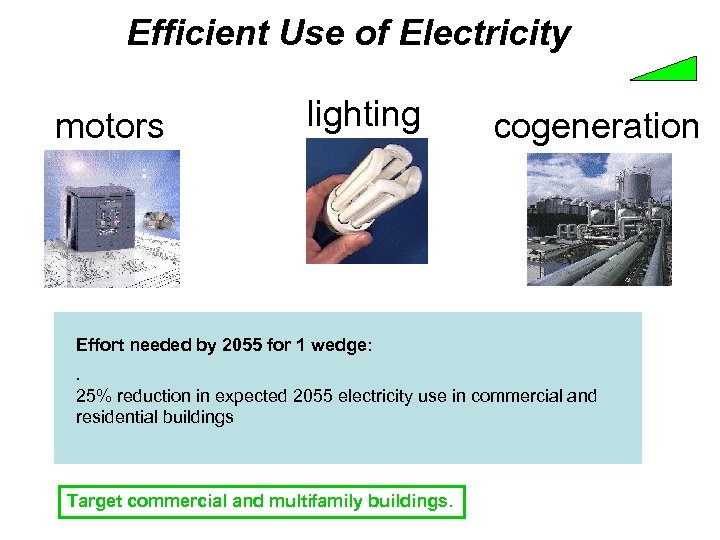
Efficient Use of Electricity motors lighting cogeneration Effort needed by 2055 for 1 wedge: . 25% reduction in expected 2055 electricity use in commercial and residential buildings Target commercial and multifamily buildings.
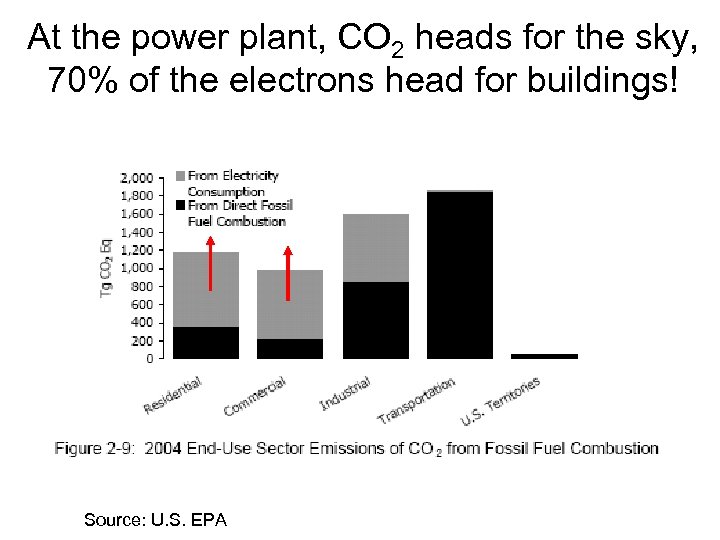
At the power plant, CO 2 heads for the sky, 70% of the electrons head for buildings! Source: U. S. EPA
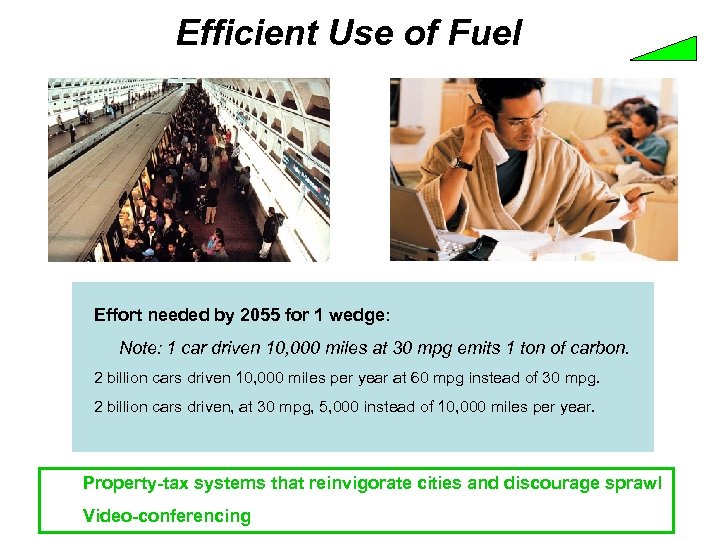
Efficient Use of Fuel Effort needed by 2055 for 1 wedge: Note: 1 car driven 10, 000 miles at 30 mpg emits 1 ton of carbon. 2 billion cars driven 10, 000 miles per year at 60 mpg instead of 30 mpg. 2 billion cars driven, at 30 mpg, 5, 000 instead of 10, 000 miles per year. Property-tax systems that reinvigorate cities and discourage sprawl Video-conferencing
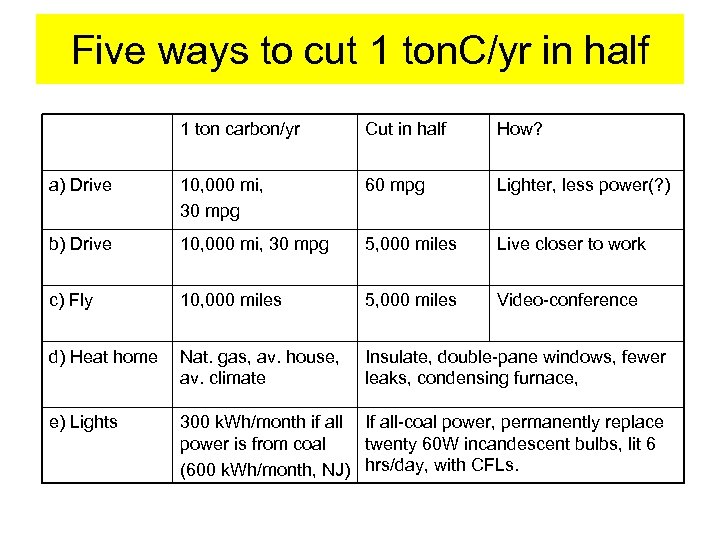
Five ways to cut 1 ton. C/yr in half 1 ton carbon/yr Cut in half How? a) Drive 10, 000 mi, 30 mpg 60 mpg Lighter, less power(? ) b) Drive 10, 000 mi, 30 mpg 5, 000 miles Live closer to work c) Fly 10, 000 miles 5, 000 miles Video-conference d) Heat home Nat. gas, av. house, av. climate Insulate, double-pane windows, fewer leaks, condensing furnace, e) Lights 300 k. Wh/month if all If all-coal power, permanently replace power is from coal twenty 60 W incandescent bulbs, lit 6 (600 k. Wh/month, NJ) hrs/day, with CFLs.
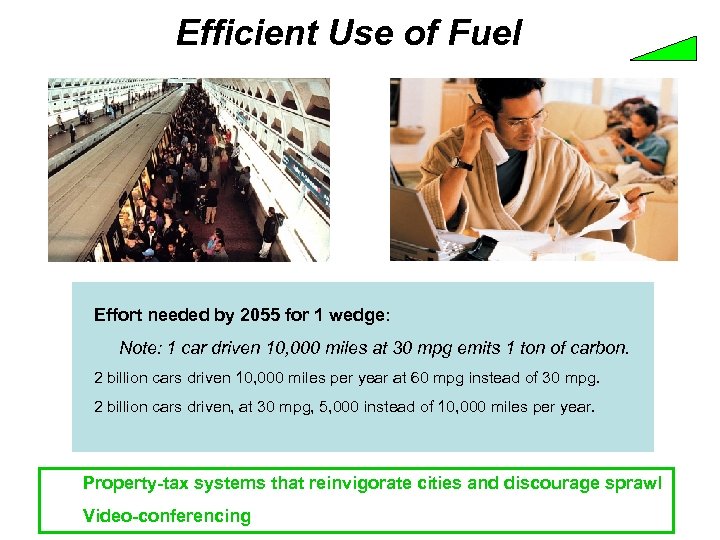
Efficient Use of Fuel Effort needed by 2055 for 1 wedge: Note: 1 car driven 10, 000 miles at 30 mpg emits 1 ton of carbon. 2 billion cars driven 10, 000 miles per year at 60 mpg instead of 30 mpg. 2 billion cars driven, at 30 mpg, 5, 000 instead of 10, 000 miles per year. Property-tax systems that reinvigorate cities and discourage sprawl Video-conferencing
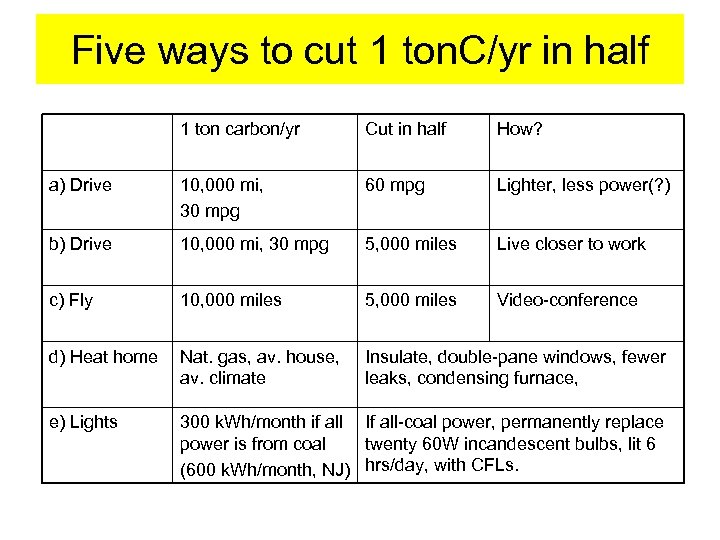
Five ways to cut 1 ton. C/yr in half 1 ton carbon/yr Cut in half How? a) Drive 10, 000 mi, 30 mpg 60 mpg Lighter, less power(? ) b) Drive 10, 000 mi, 30 mpg 5, 000 miles Live closer to work c) Fly 10, 000 miles 5, 000 miles Video-conference d) Heat home Nat. gas, av. house, av. climate Insulate, double-pane windows, fewer leaks, condensing furnace, e) Lights 300 k. Wh/month if all If all-coal power, permanently replace power is from coal twenty 60 W incandescent bulbs, lit 6 (600 k. Wh/month, NJ) hrs/day, with CFLs.
6. SOLUTION SCIENCE AND PROSPICIENCE
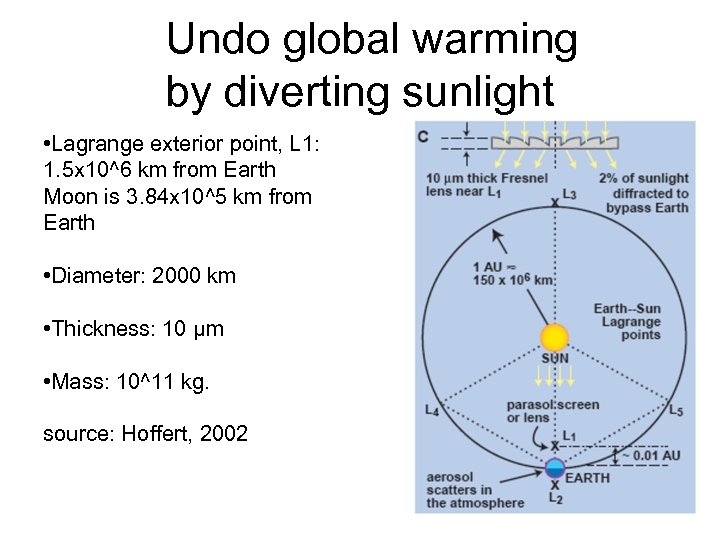
Undo global warming by diverting sunlight • Lagrange exterior point, L 1: 1. 5 x 10^6 km from Earth Moon is 3. 84 x 10^5 km from Earth • Diameter: 2000 km • Thickness: 10 μm • Mass: 10^11 kg. source: Hoffert, 2002
Anticipate adverse environmental and social impacts of “solutions. ” Every wedge strategy can be implemented well or poorly. Although every wedge has co-benefits that generate alliances and improve the prospects of implementation, every wedge also has a dark side, generating opposition that thwarts implementation. “Solution science” is emerging: the study of the environmental and social costs and benefits of stabilization strategies.
![Prospicience: “The art [and science] of looking ahead. ” We need a new word](https://present5.com/presentation/21c9ef1ef3e0c17cdbdcd85bf1805548/image-47.jpg "Prospicience: “The art [and science] of looking ahead. ” We need a new word")
Prospicience: “The art [and science] of looking ahead. ” We need a new word to describe a new intellectual domain. In the past 50 years we have become aware of our deep history: the history of our Universe, our Earth, and life. Can we achieve a comparable quantitative understanding of human civilization at various future times: 50 years ahead vs. 5000 vs. longer? We have scarcely begun to ask: What are we on this planet to do? What are our goals? What are our responsibilities? Imagine spending as much effort on our collective destiny on Earth as we spend on our personal destiny in the afterlife!
Скачать презентацию Stabilization Wedges and the Management of Global Carbon
21c9ef1ef3e0c17cdbdcd85bf1805548.ppt