 Скачать презентацию Stability or Stabilizability Seidman s FCFS example revisited José
af34380bd70a8cf506f5d3f87724cb83.ppt
- Количество слайдов: 21



Stability or Stabilizability? Seidman’s FCFS example revisited José A. A. Moreira Carlos F. G. Bispo Agilent Technologies Germany Instituto de Sistemas e Robótica Portugal MED 2002 - Lisbon, Portugal
Outline • Motivation • Proposed Solution – Active Idleness – Time Window Controller • Simulation Results • Conclusions MED 2002 - Lisbon, Portugal 1
Motivation – The system • Multi-class, Non-Acyclic Queuing network – Random service times – Random external inter-arrival times – Diferent types of customers • • Each type has a deterministic routing Same type may visit a server more than once Each service a different class Each class a different service distribution – Not a Jackson network MED 2002 - Lisbon, Portugal 2
Motivation – The control policies • Open networks – No adimission policy – Scheduling policy • Scheduling policy – Distributed: buffer priority; ESPT; FCFS; etc. – Non-idling or work conserving – No preemption MED 2002 - Lisbon, Portugal 3
Motivation – The stability condition • Assume all classes are uniquely numbered – k = 1, 2, . . . , K – Let mk be the first moment of the service for class k • Each server operates over a subset of all classes • Each class has an associated type of customer for wich an external arrival rate is defined – Let lk be the first moment for the arrival rate of class k • Then the traffic intensity condition is – Sk c(i) lk mk < 1, for all i = 1, 2, . . . , S MED 2002 - Lisbon, Portugal 4
Motivation – The problem • Is the traffic intensity condition sufficient or simply a necessary condition for stability? – It is sufficient for Jackson networks • Service distribution associated with the server, not the customer • FCFS as the scheduling policy – It seems sufficient for acyclic networks – But, some examples of unstable non-acyclic networks • Lu-Kumar example (’ 91); Seidman’s example (’ 94); Dai’s example (’ 95) MED 2002 - Lisbon, Portugal 5
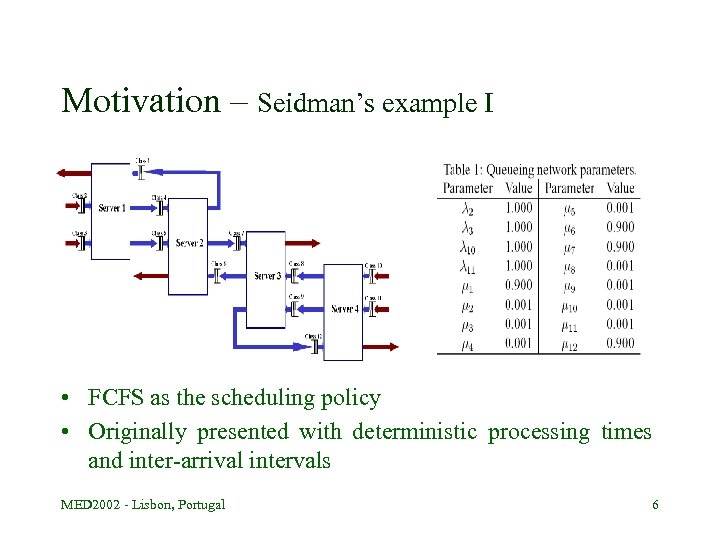
Motivation – Seidman’s example I • FCFS as the scheduling policy • Originally presented with deterministic processing times and inter-arrival intervals MED 2002 - Lisbon, Portugal 6
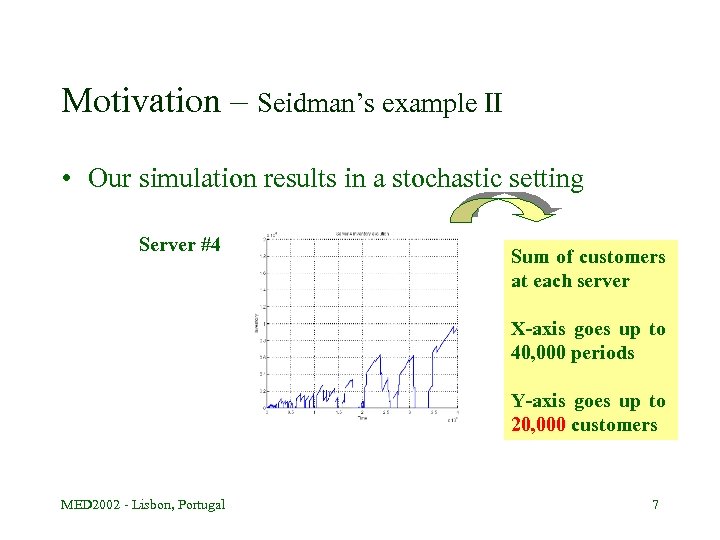
Motivation – Seidman’s example II • Our simulation results in a stochastic setting Server #1 #4 #3 #2 Sum of customers at each server X-axis goes up to 40, 000 periods Y-axis goes up to 20, 000 customers MED 2002 - Lisbon, Portugal 7
Motivation – Consequences • After these examples, the answer seems to be – The traffic intensity condition is NOT a sufficient stability condition for general queuing networks. • However, – Most authors focused on non-idling policies – From the static and deterministic scheduling theory we know that their equivalent to non-idling policies may not contain the optimal solution – Clear-a-Fraction policies with Backoff resorts to idling policies to establish stability (Kumar & Seidman, ‘ 90) MED 2002 - Lisbon, Portugal 8
Proposed solution – Active Idleness I • Why determine if a network is stable under all non -idling policies? • Or, why determine regions for which some topologies are stable for all non-idling policies? • Why not asking if a network is stabilizable? – That is, can a given policy be changed to make the network stable? – Is this property intrinsic to the pair network/policy or just a property of the network? MED 2002 - Lisbon, Portugal 9
Proposed solution – Active Idleness II • By using non-idling policies we are forcing idleness due to lack of customers – Burstiness in the arrival and services times is allowed to freely spread trough the network • Actively resort to idleness – That is, allow a server to stay idle in the presence of customers – Take the server’s past history to provide a measure of global state of the network MED 2002 - Lisbon, Portugal 10
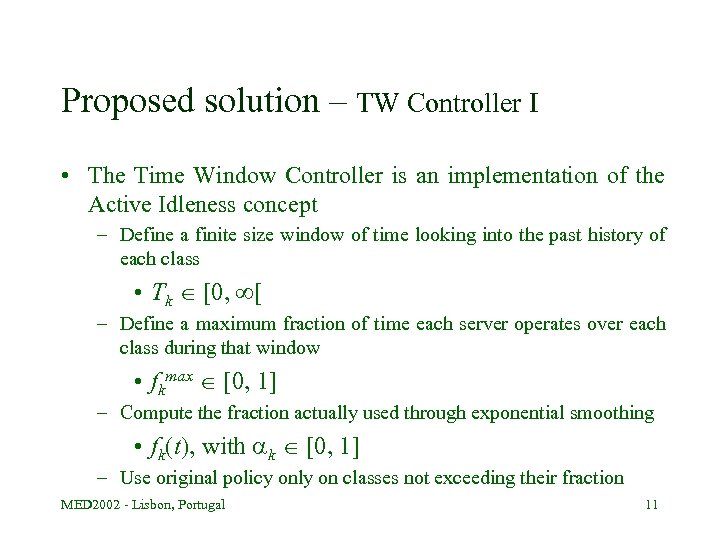
Proposed solution – TW Controller I • The Time Window Controller is an implementation of the Active Idleness concept – Define a finite size window of time looking into the past history of each class • Tk [0, [ – Define a maximum fraction of time each server operates over each class during that window • fkmax [0, 1] – Compute the fraction actually used through exponential smoothing • fk(t), with ak [0, 1] – Use original policy only on classes not exceeding their fraction MED 2002 - Lisbon, Portugal 11
Proposed solution – TW Controller II • Classes exceeding their maximum fraction are blocked – If all costumers waiting belong to blocked classes, the server will remain idle – Idleness is kept until a new customer from a non blocked class arrives or until one of the blocked classes present drops below its maximum time fraction • Controller filters burstiness on individual classes • The filtering procedure is local MED 2002 - Lisbon, Portugal 12
Proposed solution – TW Controller III • What is good for an individual server is not necessarily good for the network – Idleness is bad for a single server when customers are present – Local scheduling policies are based on what is good for a single server • Getting rid of waiting customers – Active Idleness hurts single servers to preserve the network • Past history of a single server is a measure of load to remaining servers MED 2002 - Lisbon, Portugal 13
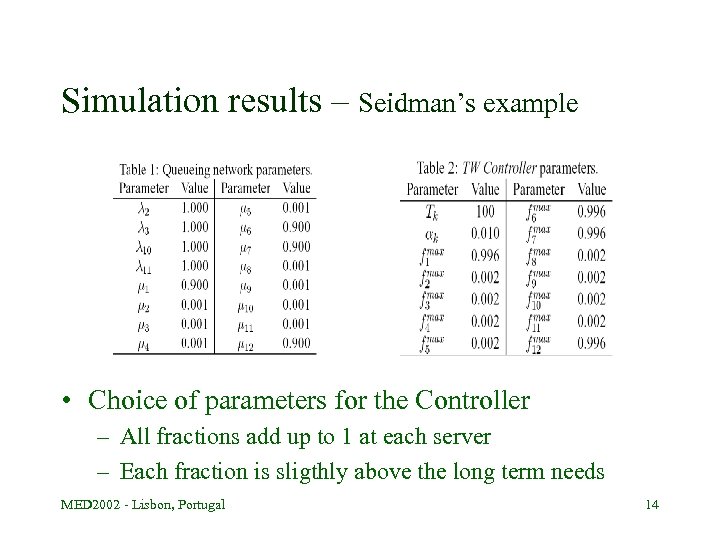
Simulation results – Seidman’s example • Choice of parameters for the Controller – All fractions add up to 1 at each server – Each fraction is sligthly above the long term needs MED 2002 - Lisbon, Portugal 14
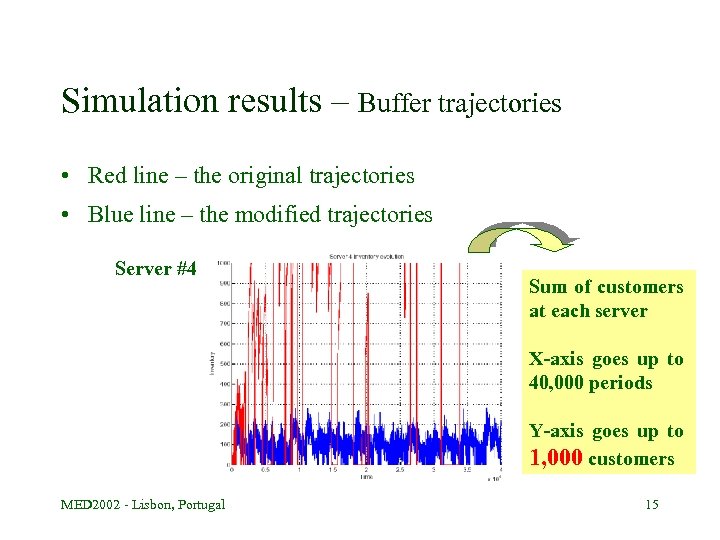
Simulation results – Buffer trajectories • Red line – the original trajectories • Blue line – the modified trajectories Server #1 #4 #3 #2 Sum of customers at each server X-axis goes up to 40, 000 periods Y-axis goes up to 1, 000 customers MED 2002 - Lisbon, Portugal 15
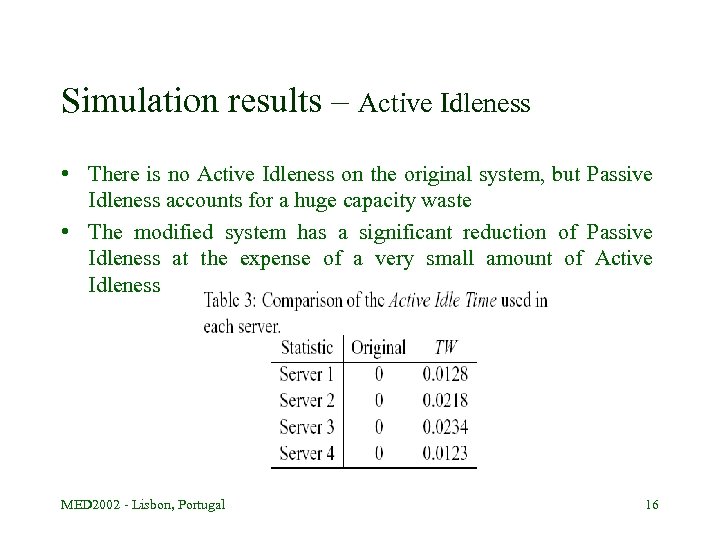
Simulation results – Active Idleness • There is no Active Idleness on the original system, but Passive Idleness accounts for a huge capacity waste • The modified system has a significant reduction of Passive Idleness at the expense of a very small amount of Active Idleness MED 2002 - Lisbon, Portugal 16
Conclusions I • Consequences – The traffic intensity condition is sufficient to ensure stabilizability, if processing times have upper bounds and original policy is nonidling – Stabilizability is intrinsic to the network’s topology – Optimal controller is stable • Limitations – We can construct a provably stabilizing controller if all services have an upper bound • Leaves out Markovian systems, but not critical for real life systems MED 2002 - Lisbon, Portugal 17
Conclusions II • Features – The maximum time fractions can add up to more than one – Performance gains even when the original is already stable • Future – Characterize the performance measures as functions of the parameters – convex? ; unimodal? ; etc. – Design an optimization package to tune the TW Controller MED 2002 - Lisbon, Portugal 18
Stability or Stabilizability? Seidman’s FCFS example revisited José A. A. Moreira Carlos F. G. Bispo jose_moreira@agilent. com cfb@isr. ist. utl. pt http: //www. isr. ist. utl. pt MED 2002 - Lisbon, Portugal
Dai’s example Dai’s network Performance Parameters Idleness MED 2002 - Lisbon, Portugal 20
Скачать презентацию Stability or Stabilizability Seidman s FCFS example revisited José
af34380bd70a8cf506f5d3f87724cb83.ppt