 Скачать презентацию Stability and Alignment in Linear Collider Andrei Seryi
a209e443a0a1c2be090fdda9ccd7fada.ppt
- Количество слайдов: 73



Stability and Alignment in Linear Collider Andrei Seryi SLAC USPAS Santa Barbara, CA, June, 2003

The Luminosity Challenge • Must jump by a Factor of 10000 in Luminosity !!! (from what is achieved in the only so far linear collider SLC) • Many improvements, to ensure this : generation of smaller emittances, their better preservation, … • Including better focusing, dealing with beam-beam, and better stability – Ensure maximal possible focusing of the beams at IP – Optimize IP parameters w. r. to beam-beam effects – Ensure that ground motion and vibrations do not produce intolerable misalignments 2 Lecture 6 Lecture 7 Lecture 8
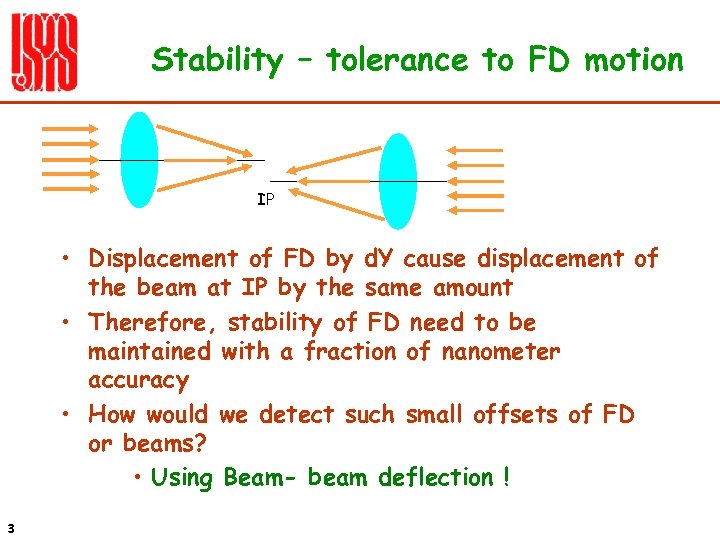
Stability – tolerance to FD motion IP • Displacement of FD by d. Y cause displacement of the beam at IP by the same amount • Therefore, stability of FD need to be maintained with a fraction of nanometer accuracy • How would we detect such small offsets of FD or beams? • Using Beam- beam deflection ! 3
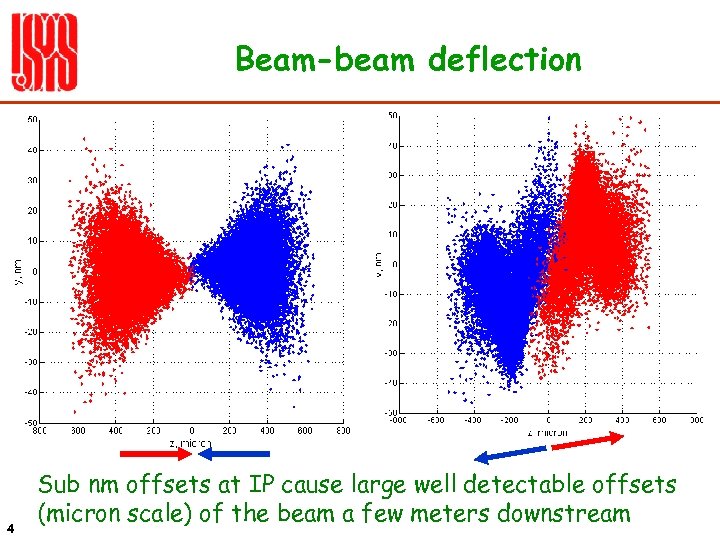
Beam-beam deflection 4 Sub nm offsets at IP cause large well detectable offsets (micron scale) of the beam a few meters downstream
What can cause misalignments of FD and other quads? • Initial installation errors – But if static, can eventually correct them out • Non-static effects, such as ground motion (natural or human produced) – In this lecture, we will try to learn how to evaluate effect of ground motion and misalignment on linear collider 5

What ground motion we are talking about ? • In some languages “Earth” and “ground” called by the same word… • No, we are not talking about Earth orbital motion… 6

And not about continental drift… 7

of tectonic plates… 8

And not so much about earthquakes… World Seismicity: 1975 -1995 9
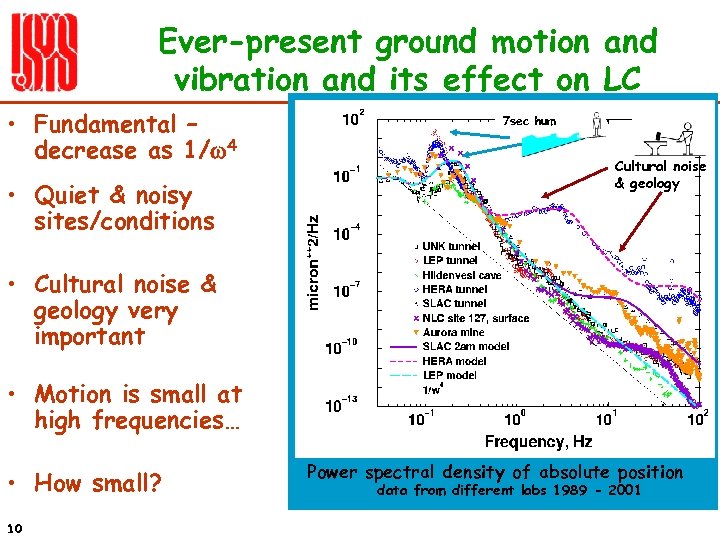
Ever-present ground motion and vibration and its effect on LC • Fundamental – decrease as 1/w 4 • Quiet & noisy sites/conditions 7 sec hum Cultural noise & geology • Cultural noise & geology very important • Motion is small at high frequencies… • How small? 10 Power spectral density of absolute position data from different labs 1989 - 2001
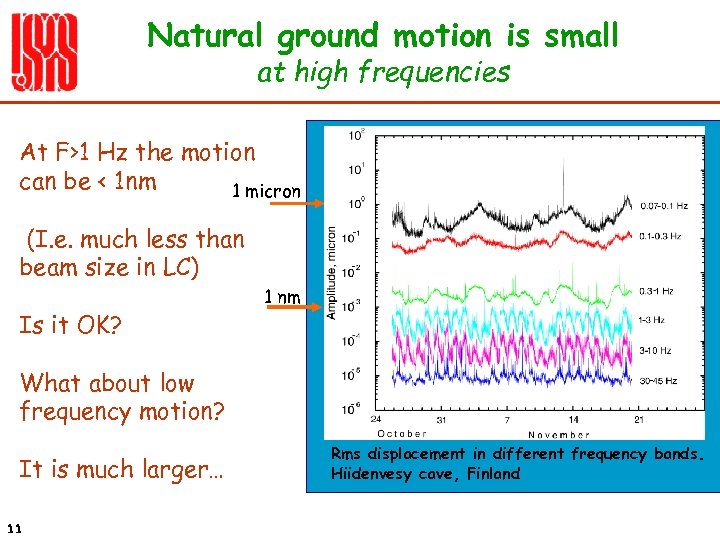
Natural ground motion is small at high frequencies At F>1 Hz the motion can be < 1 nm 1 micron (I. e. much less than beam size in LC) Is it OK? 1 nm What about low frequency motion? It is much larger… 11 Rms displacement in different frequency bands. Hiidenvesy cave, Finland
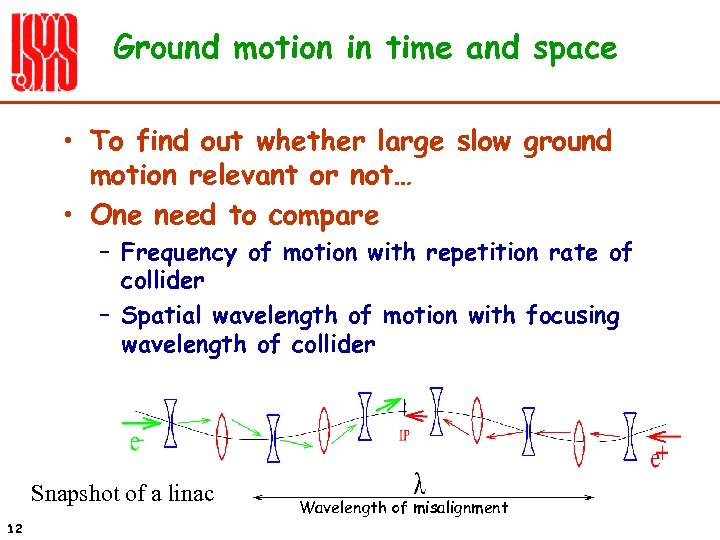
Ground motion in time and space • To find out whether large slow ground motion relevant or not… • One need to compare – Frequency of motion with repetition rate of collider – Spatial wavelength of motion with focusing wavelength of collider Snapshot of a linac 12 Wavelength of misalignment
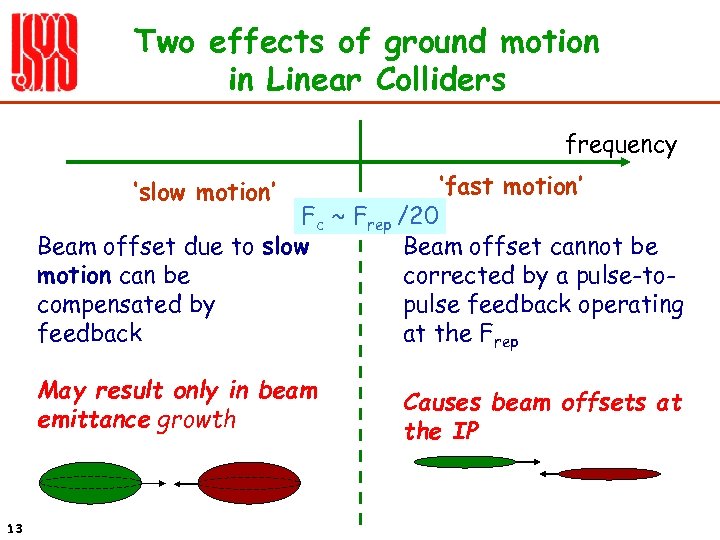
Two effects of ground motion in Linear Colliders frequency ‘slow motion’ ‘fast motion’ Fc ~ Frep /20 Beam offset due to slow Beam offset cannot be motion can be corrected by a pulse-tocompensated by pulse feedback operating feedback at the Frep May result only in beam emittance growth 13 Causes beam offsets at the IP
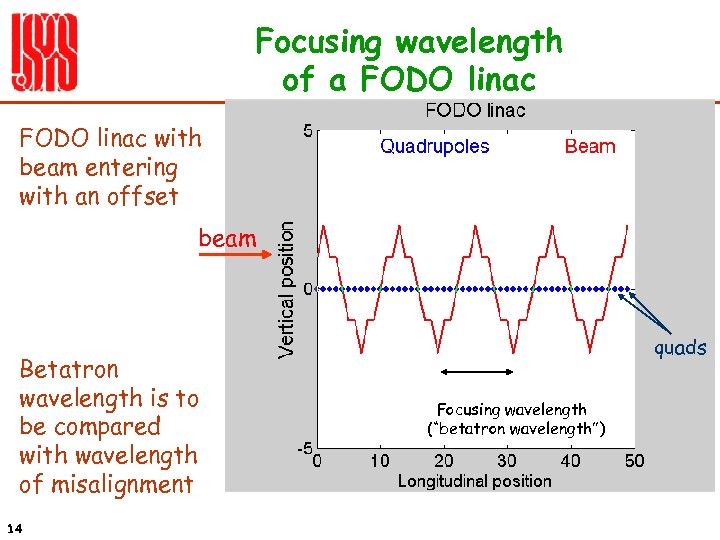
Focusing wavelength of a FODO linac with beam entering with an offset beam Betatron wavelength is to be compared with wavelength of misalignment 14 quads Focusing wavelength (“betatron wavelength”)
Movie of a Misaligned FODO linac next page Note the following: Beam follows the linac if misalignment is more smooth than betatron wavelength Resonance if wavelength of misalignment ~ focusing wavelength Spectral response function – how much beam motion due to misalignment with certain wavelength Below, we will try to understand this behavior step by step… 15
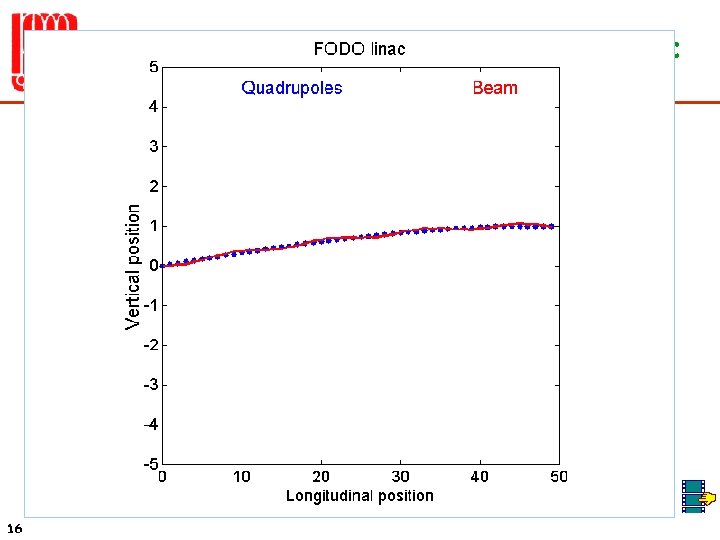
Movie of a Misaligned FODO linac 16
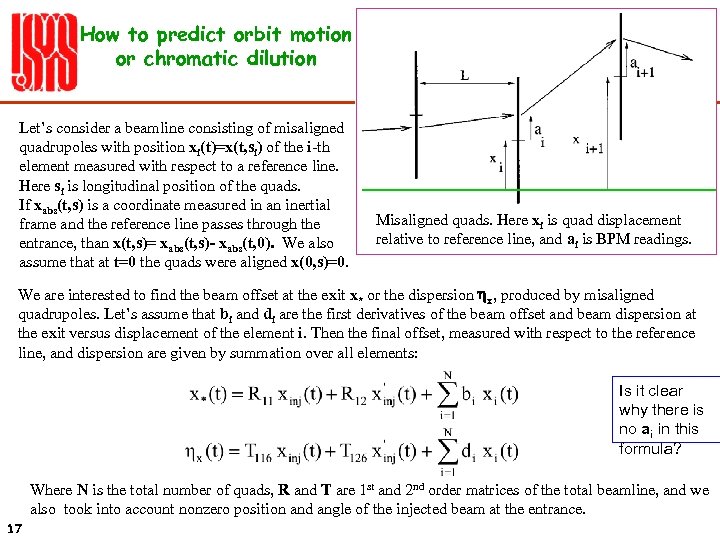
How to predict orbit motion or chromatic dilution Let’s consider a beamline consisting of misaligned quadrupoles with position xi(t)=x(t, si) of the i-th element measured with respect to a reference line. Here si is longitudinal position of the quads. If xabs(t, s) is a coordinate measured in an inertial frame and the reference line passes through the entrance, than x(t, s)= xabs(t, s)- xabs(t, 0). We also assume that at t=0 the quads were aligned x(0, s)=0. Misaligned quads. Here xi is quad displacement relative to reference line, and ai is BPM readings. We are interested to find the beam offset at the exit x* or the dispersion hx, produced by misaligned quadrupoles. Let’s assume that bi and di are the first derivatives of the beam offset and beam dispersion at the exit versus displacement of the element i. Then the final offset, measured with respect to the reference line, and dispersion are given by summation over all elements: Is it clear why there is no ai in this formula? Where N is the total number of quads, R and T are 1 st and 2 nd order matrices of the total beamline, and we also took into account nonzero position and angle of the injected beam at the entrance. 17
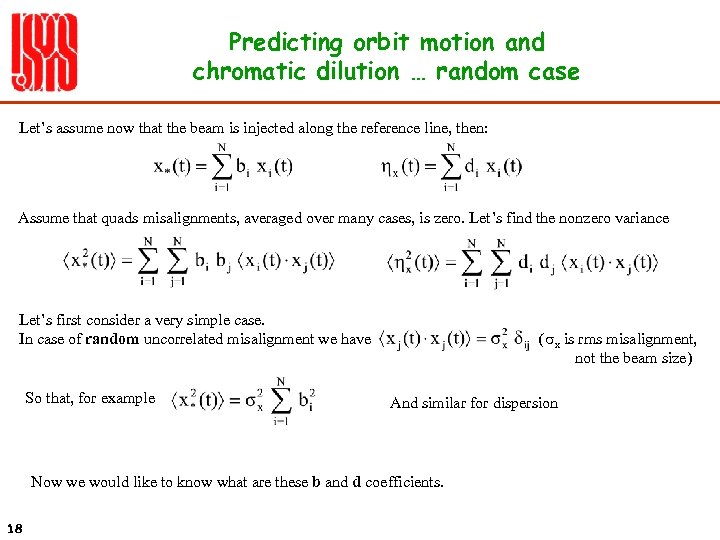
Predicting orbit motion and chromatic dilution … random case Let’s assume now that the beam is injected along the reference line, then: Assume that quads misalignments, averaged over many cases, is zero. Let’s find the nonzero variance Let’s first consider a very simple case. In case of random uncorrelated misalignment we have So that, for example (sx is rms misalignment, not the beam size) And similar for dispersion Now we would like to know what are these b and d coefficients. 18
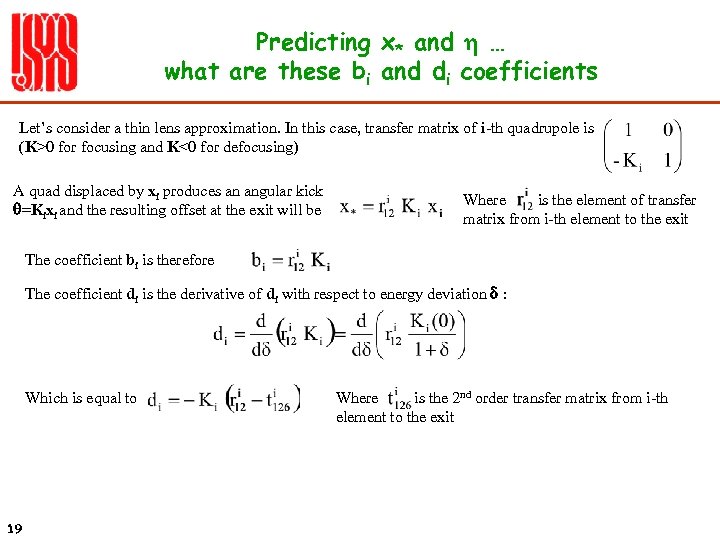
Predicting x* and h … what are these bi and di coefficients Let’s consider a thin lens approximation. In this case, transfer matrix of i-th quadrupole is (K>0 for focusing and K<0 for defocusing) A quad displaced by xi produces an angular kick q=Kixi and the resulting offset at the exit will be Where is the element of transfer matrix from i-th element to the exit The coefficient bi is therefore The coefficient di is the derivative of di with respect to energy deviation d : Which is equal to 19 Where is the 2 nd order transfer matrix from i-th element to the exit
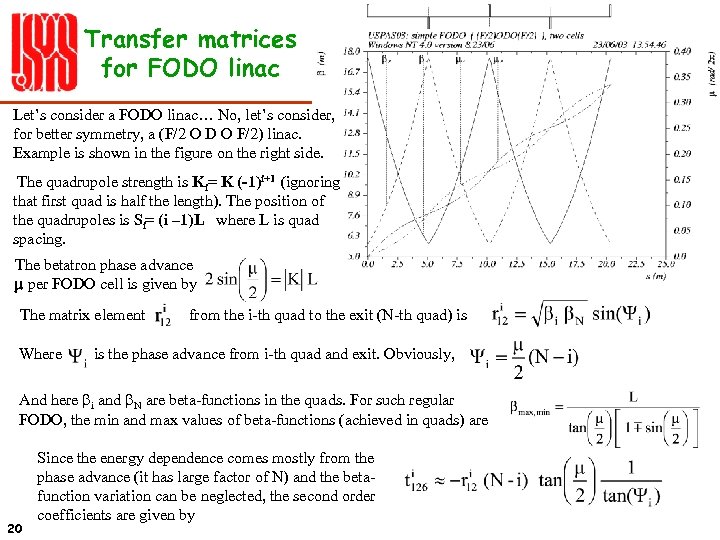
Transfer matrices for FODO linac Let’s consider a FODO linac… No, let’s consider, for better symmetry, a (F/2 O D O F/2) linac. Example is shown in the figure on the right side. The quadrupole strength is Ki= K (-1)i+1 (ignoring that first quad is half the length). The position of the quadrupoles is Si= (i – 1)L where L is quad spacing. The betatron phase advance m per FODO cell is given by The matrix element Where from the i-th quad to the exit (N-th quad) is is the phase advance from i-th quad and exit. Obviously, And here bi and b. N are beta-functions in the quads. For such regular FODO, the min and max values of beta-functions (achieved in quads) are 20 Since the energy dependence comes mostly from the phase advance (it has large factor of N) and the betafunction variation can be neglected, the second order coefficients are given by
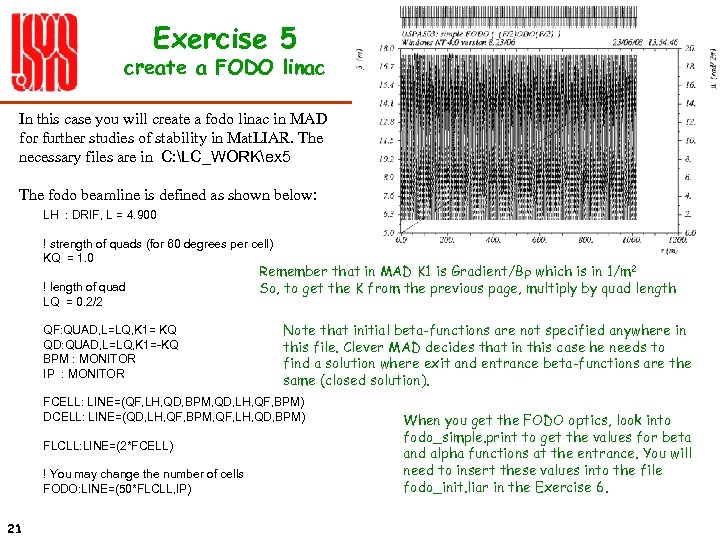
Exercise 5 create a FODO linac In this case you will create a fodo linac in MAD for further studies of stability in Mat. LIAR. The necessary files are in C: LC_WORKex 5 The fodo beamline is defined as shown below: LH : DRIF, L = 4. 900 ! strength of quads (for 60 degrees per cell) KQ = 1. 0 ! length of quad LQ = 0. 2/2 QF: QUAD, L=LQ, K 1= KQ QD: QUAD, L=LQ, K 1=-KQ BPM : MONITOR IP : MONITOR Remember that in MAD K 1 is Gradient/Br which is in 1/m 2 So, to get the K from the previous page, multiply by quad length Note that initial beta-functions are not specified anywhere in this file. Clever MAD decides that in this case he needs to find a solution where exit and entrance beta-functions are the same (closed solution). FCELL: LINE=(QF, LH, QD, BPM, QD, LH, QF, BPM) DCELL: LINE=(QD, LH, QF, BPM, QF, LH, QD, BPM) FLCLL: LINE=(2*FCELL) ! You may change the number of cells FODO: LINE=(50*FLCLL, IP) 21 When you get the FODO optics, look into fodo_simple. print to get the values for beta and alpha functions at the entrance. You will need to insert these values into the file fodo_init. liar in the Exercise 6.
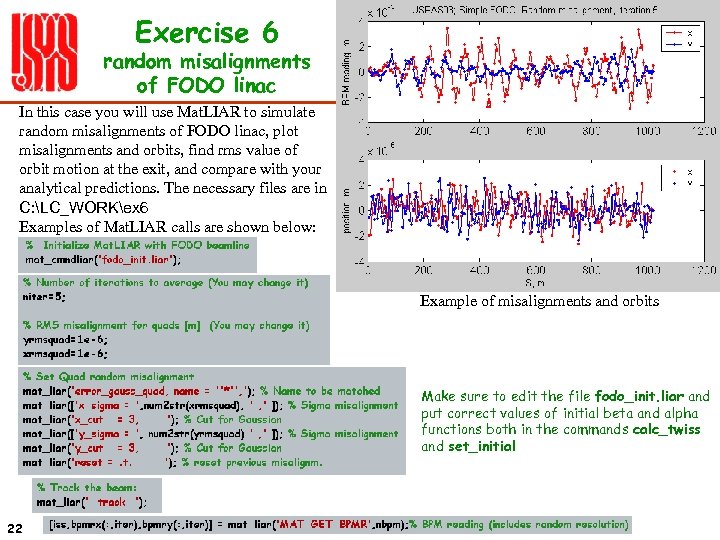
Exercise 6 random misalignments of FODO linac In this case you will use Mat. LIAR to simulate random misalignments of FODO linac, plot misalignments and orbits, find rms value of orbit motion at the exit, and compare with your analytical predictions. The necessary files are in C: LC_WORKex 6 Examples of Mat. LIAR calls are shown below: Example of misalignments and orbits Make sure to edit the file fodo_init. liar and put correct values of initial beta and alpha functions both in the commands calc_twiss and set_initial 22
Predicting orbit motion … escaping the complete randomness Now you have everything to calculate b and d coefficients and find, for example, the rms of the orbit motion at the exit for the simplest case – completely random uncorrelated misalignments. Completely random and uncorrelated means that misalignments of two neighboring points, even infinitesimally close to each other, would be completely independent. If we would assume that such random and uncorrelated behavior occur in time also, I. e. for any infinitesimally small Dt the misalignments will be random (no “memory” in the system) then it would be obvious that such situation is physically impossible. Simply because its spectrum correspond to white noise, I. e. goes to infinite frequencies, thus having infinite energy. We have to assume that things do not get changed infinitely fast, nor in space, neither in time. I. e. , there is some correlation with previous moments of time, or with neighboring points in space. Let’s consider the random walk (drunk sailor). In this case, together with randomness, there is certain memory in this process: the sailor makes the next step relative to the position he is at the present point. Extension of random walk model to multiple points in space and time is described by the famous ATL [B. Baklakov, et al, 1991]. 23 N. B. Nonzero correlation (often called auto-correlation, when talking about correlation in time) would necessarily mean that spectrum decrease with frequency, saving the energy conservation law. More on this later in the lecture.
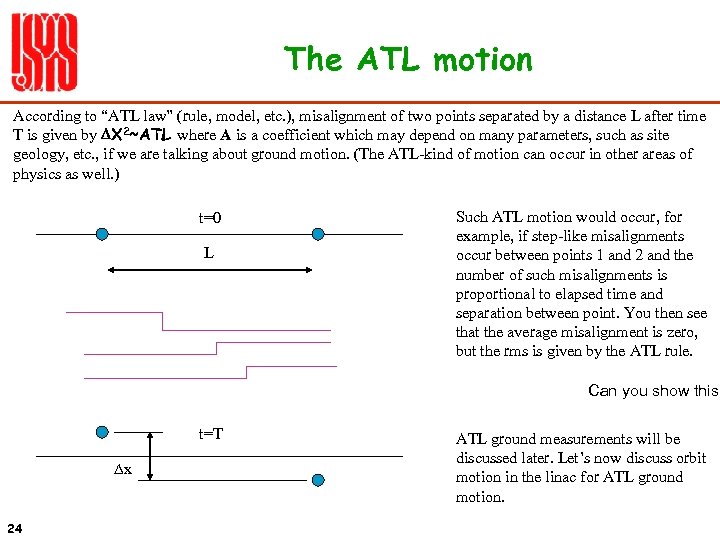
The ATL motion According to “ATL law” (rule, model, etc. ), misalignment of two points separated by a distance L after time T is given by DX 2~ATL where A is a coefficient which may depend on many parameters, such as site geology, etc. , if we are talking about ground motion. (The ATL-kind of motion can occur in other areas of physics as well. ) t=0 L Such ATL motion would occur, for example, if step-like misalignments occur between points 1 and 2 and the number of such misalignments is proportional to elapsed time and separation between point. You then see that the average misalignment is zero, but the rms is given by the ATL rule. Can you show this? t=T Dx 24 ATL ground measurements will be discussed later. Let’s now discuss orbit motion in the linac for ATL ground motion.
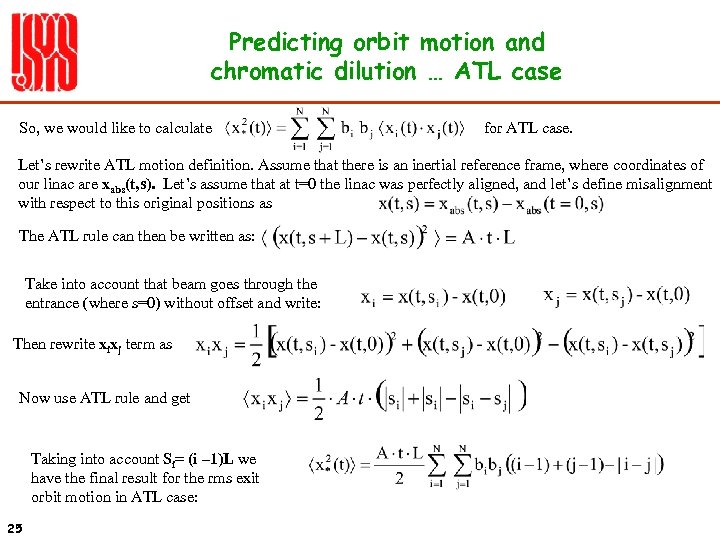
Predicting orbit motion and chromatic dilution … ATL case So, we would like to calculate for ATL case. Let’s rewrite ATL motion definition. Assume that there is an inertial reference frame, where coordinates of our linac are xabs(t, s). Let’s assume that at t=0 the linac was perfectly aligned, and let’s define misalignment with respect to this original positions as The ATL rule can then be written as: Take into account that beam goes through the entrance (where s=0) without offset and write: Then rewrite xixj term as Now use ATL rule and get Taking into account Si= (i – 1)L we have the final result for the rms exit orbit motion in ATL case: 25
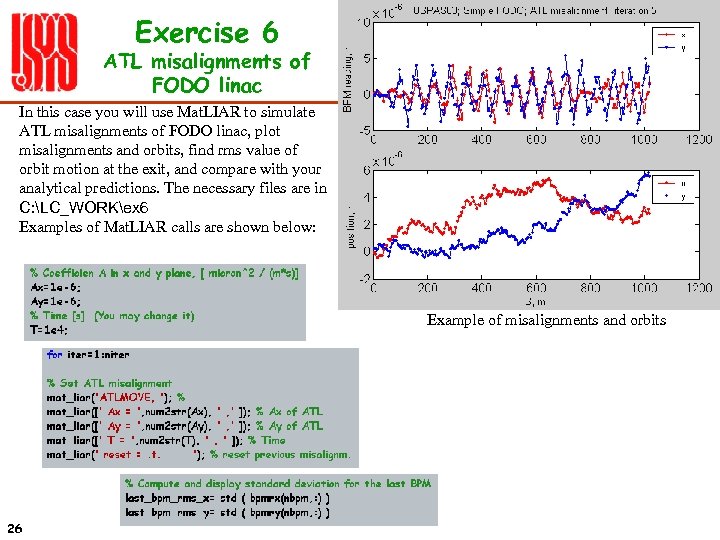
Exercise 6 ATL misalignments of FODO linac In this case you will use Mat. LIAR to simulate ATL misalignments of FODO linac, plot misalignments and orbits, find rms value of orbit motion at the exit, and compare with your analytical predictions. The necessary files are in C: LC_WORKex 6 Examples of Mat. LIAR calls are shown below: Example of misalignments and orbits 26
Slow and fast motion, again • We know how to evaluate effect of ATL motion • This motion is slow • What about fast motion? • Its correlation? • Measured data? 27
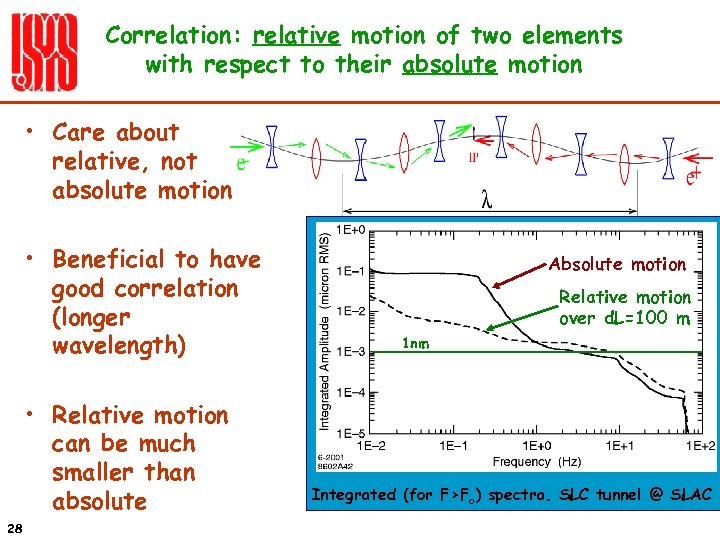
Correlation: relative motion of two elements with respect to their absolute motion • Care about relative, not absolute motion • Beneficial to have good correlation (longer wavelength) • Relative motion can be much smaller than absolute 28 Absolute motion Relative motion over d. L=100 m 1 nm Integrated (for F>Fo) spectra. SLC tunnel @ SLAC
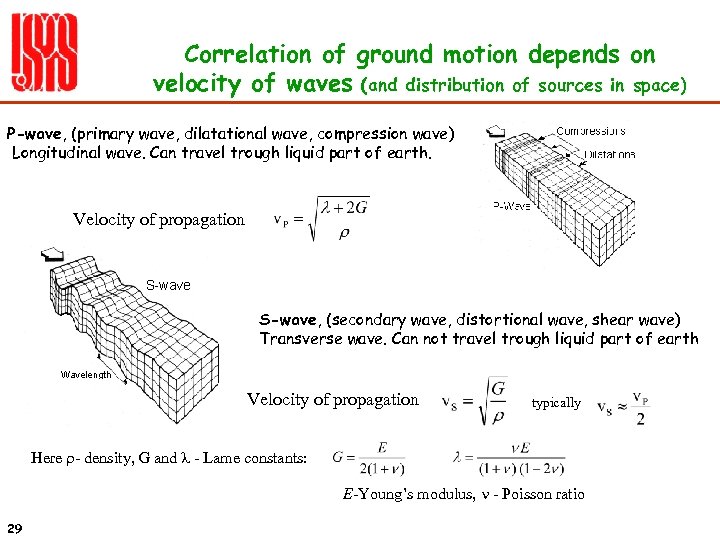
Correlation of ground motion depends on velocity of waves (and distribution of sources in space) P-wave, (primary wave, dilatational wave, compression wave) Longitudinal wave. Can travel trough liquid part of earth. Velocity of propagation S-wave, (secondary wave, distortional wave, shear wave) Transverse wave. Can not travel trough liquid part of earth Velocity of propagation typically Here r- density, G and l - Lame constants: E-Young’s modulus, n - Poisson ratio 29
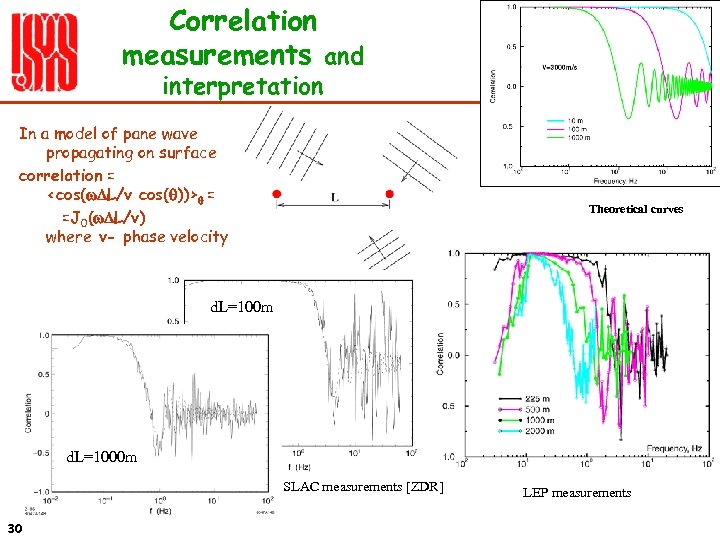
Correlation measurements and interpretation In a model of pane wave propagating on surface correlation = <cos(w. DL/v cos(q))>q = =J 0(w. DL/v) where v- phase velocity Theoretical curves d. L=100 m d. L=1000 m SLAC measurements [ZDR] 30 LEP measurements
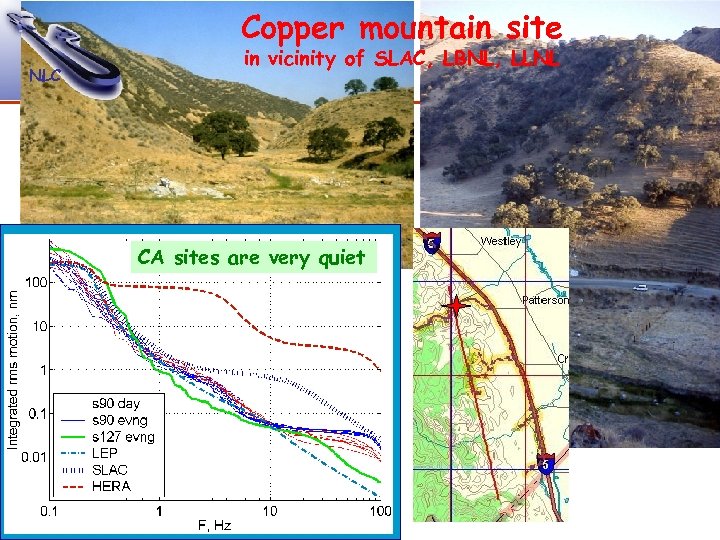
Copper mountain site NLC in vicinity of SLAC, LBNL, LLNL CA sites are very quiet 31
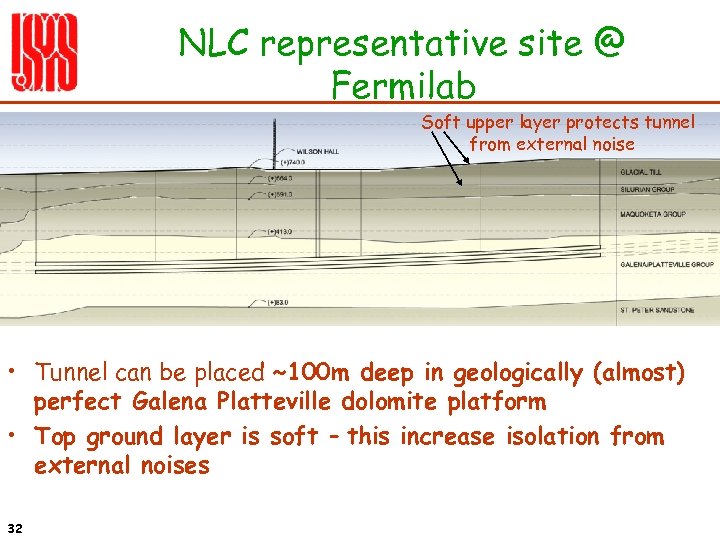
NLC representative site @ Fermilab Soft upper layer protects tunnel from external noise • Tunnel can be placed ~100 m deep in geologically (almost) perfect Galena Platteville dolomite platform • Top ground layer is soft – this increase isolation from external noises 32
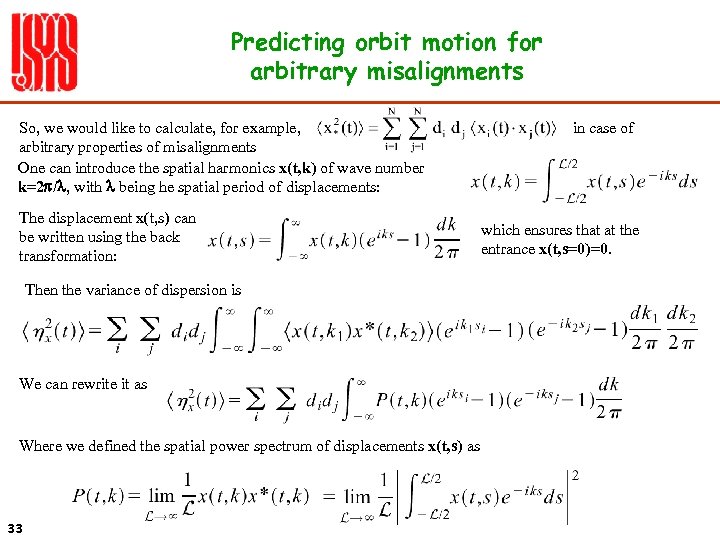
Predicting orbit motion for arbitrary misalignments So, we would like to calculate, for example, arbitrary properties of misalignments One can introduce the spatial harmonics x(t, k) of wave number k=2 p/l, with l being he spatial period of displacements: The displacement x(t, s) can be written using the back transformation: Then the variance of dispersion is We can rewrite it as Where we defined the spatial power spectrum of displacements x(t, s) as 33 in case of which ensures that at the entrance x(t, s=0)=0.
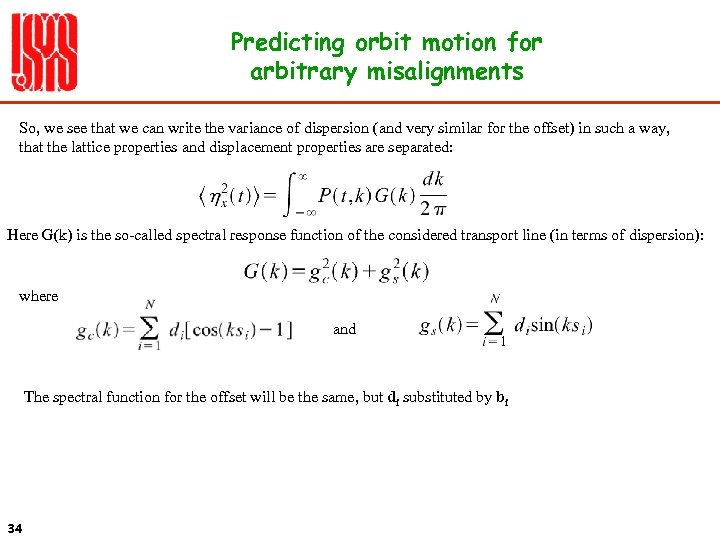
Predicting orbit motion for arbitrary misalignments So, we see that we can write the variance of dispersion (and very similar for the offset) in such a way, that the lattice properties and displacement properties are separated: Here G(k) is the so-called spectral response function of the considered transport line (in terms of dispersion): where and The spectral function for the offset will be the same, but di substituted by bi 34
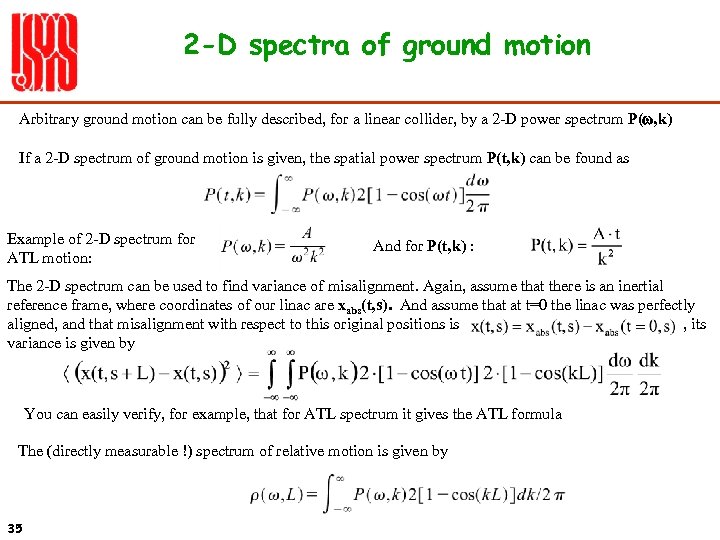
2 -D spectra of ground motion Arbitrary ground motion can be fully described, for a linear collider, by a 2 -D power spectrum P(w, k) If a 2 -D spectrum of ground motion is given, the spatial power spectrum P(t, k) can be found as Example of 2 -D spectrum for ATL motion: And for P(t, k) : The 2 -D spectrum can be used to find variance of misalignment. Again, assume that there is an inertial reference frame, where coordinates of our linac are xabs(t, s). And assume that at t=0 the linac was perfectly aligned, and that misalignment with respect to this original positions is , its variance is given by You can easily verify, for example, that for ATL spectrum it gives the ATL formula The (directly measurable !) spectrum of relative motion is given by 35
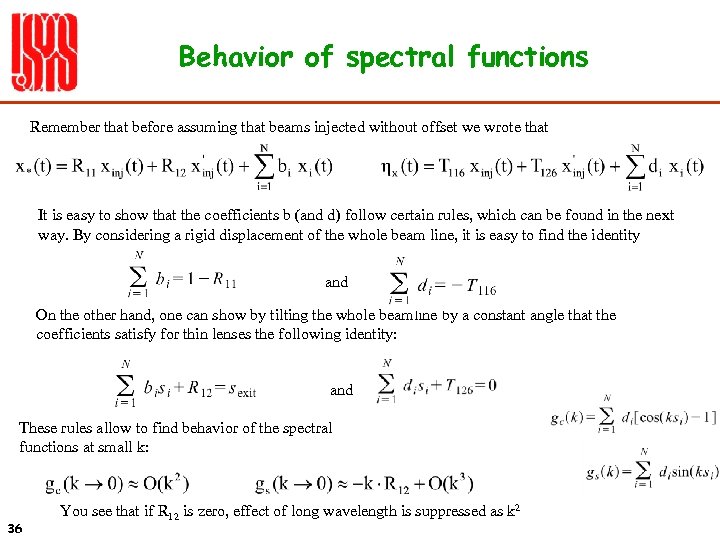
Behavior of spectral functions Remember that before assuming that beams injected without offset we wrote that It is easy to show that the coefficients b (and d) follow certain rules, which can be found in the next way. By considering a rigid displacement of the whole beam line, it is easy to find the identity and On the other hand, one can show by tilting the whole beamline by a constant angle that the coefficients satisfy for thin lenses the following identity: and These rules allow to find behavior of the spectral functions at small k: 36 You see that if R 12 is zero, effect of long wavelength is suppressed as k 2
Additional exercise You created a FODO , simulated misalignments and compared rms orbit motion with analytical predictions using derivation for ATL which does not involve spectra. You may try to calculate spectral response function for your linac and calculate the rms offset using integral of spectral function and power spectrum P(t, k). How would you deal with this fact? : In the integrals k goes from – to + infinity. However, for FODO linac the range of valid k is bounded. For example, the maximum k is equal to p/L. 37
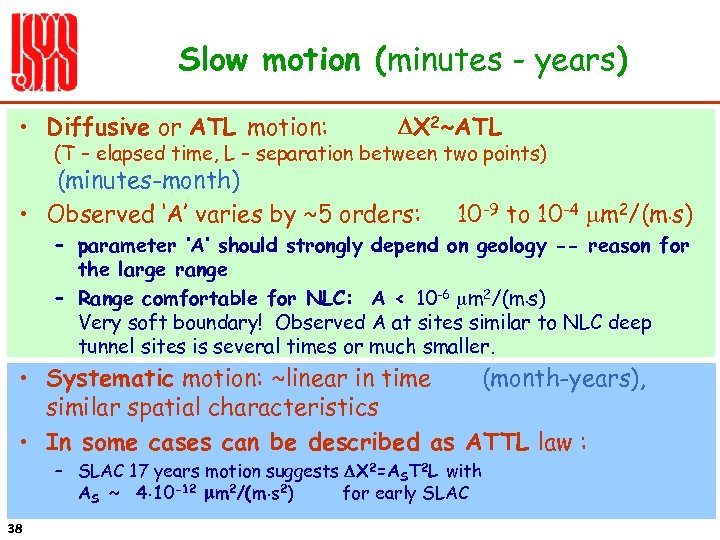
Slow motion (minutes - years) • Diffusive or ATL motion: DX 2~ATL (T – elapsed time, L – separation between two points) (minutes-month) • Observed ‘A’ varies by ~5 orders: 10 -9 to 10 -4 mm 2/(m. s) – parameter ‘A’ should strongly depend on geology -- reason for the large range – Range comfortable for NLC: A < 10 -6 mm 2/(m. s) Very soft boundary! Observed A at sites similar to NLC deep tunnel sites is several times or much smaller. • Systematic motion: ~linear in time (month-years), similar spatial characteristics • In some cases can be described as ATTL law : – SLAC 17 years motion suggests DX 2=AST 2 L with AS ~ 4. 10 -12 mm 2/(m. s 2) for early SLAC 38
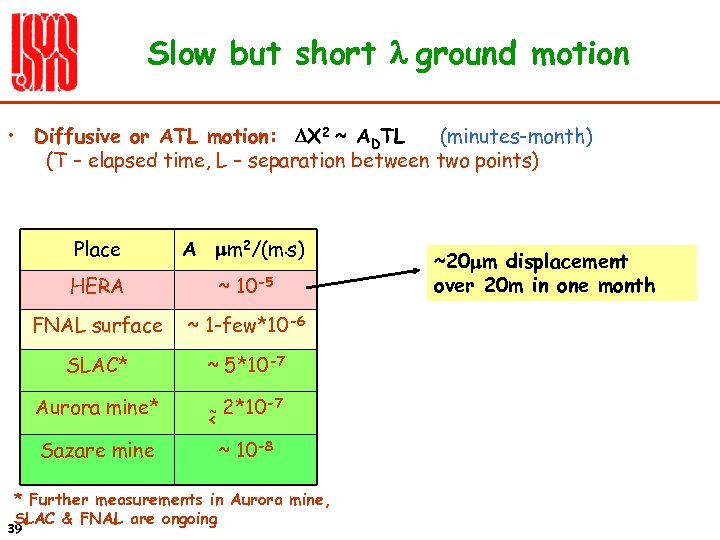
Slow but short l ground motion • Diffusive or ATL motion: DX 2 ~ ADTL (minutes-month) (T – elapsed time, L – separation between two points) Place A mm 2/(m. s) HERA ~ 10 -5 FNAL surface ~ 1 -few*10 -6 SLAC* ~ 5*10 -7 Aurora mine* Sazare mine ~ < 2*10 -7 ~ 10 -8 * Further measurements in Aurora mine, SLAC & FNAL are ongoing 39 ~20 mm displacement over 20 m in one month
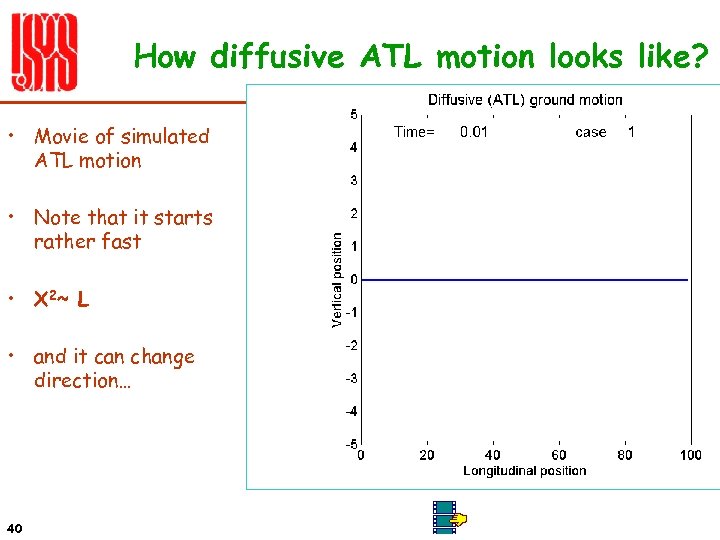
How diffusive ATL motion looks like? • Movie of simulated ATL motion • Note that it starts rather fast • X 2~ L • and it can change direction… 40
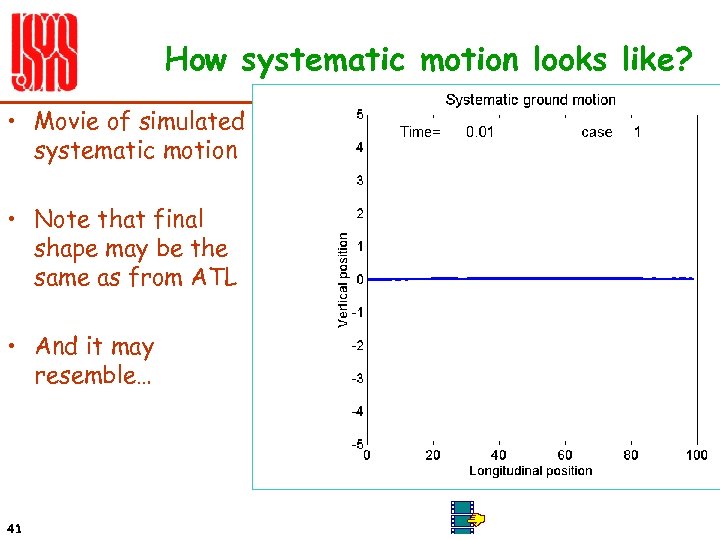
How systematic motion looks like? • Movie of simulated systematic motion • Note that final shape may be the same as from ATL • And it may resemble… 41

And in billion years… 42
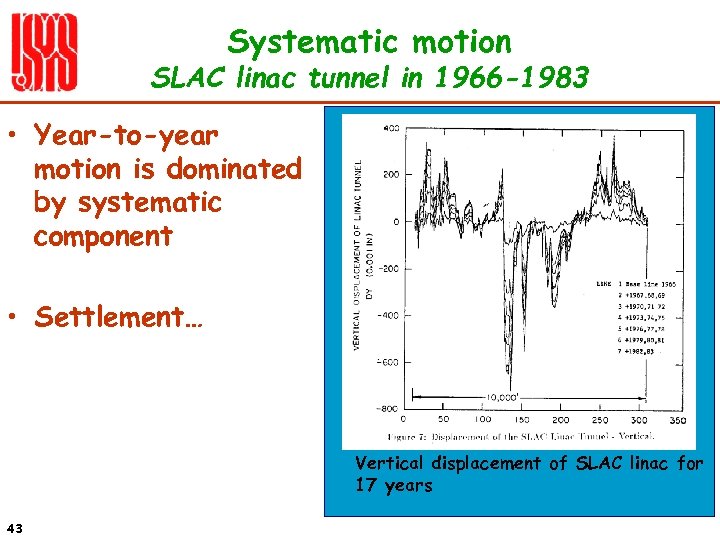
Systematic motion SLAC linac tunnel in 1966 -1983 • Year-to-year motion is dominated by systematic component • Settlement… Vertical displacement of SLAC linac for 17 years 43
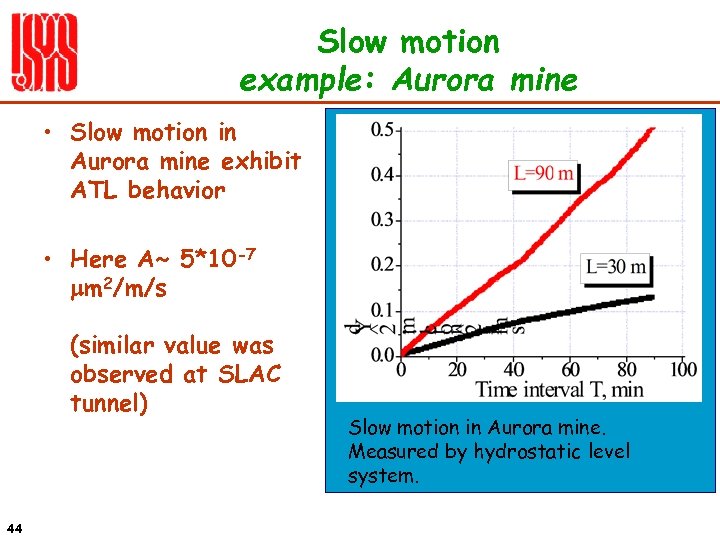
Slow motion example: Aurora mine • Slow motion in Aurora mine exhibit ATL behavior • Here A~ 5*10 -7 mm 2/m/s (similar value was observed at SLAC tunnel) 44 Slow motion in Aurora mine. Measured by hydrostatic level system.
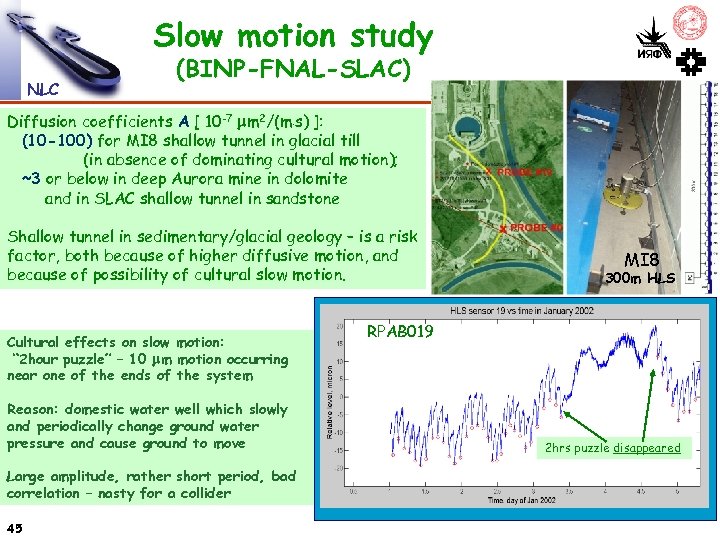
Slow motion study NLC (BINP-FNAL-SLAC) Diffusion coefficients A [ 10 -7 mm 2/(m. s) ]: (10 -100) for MI 8 shallow tunnel in glacial till (in absence of dominating cultural motion); ~3 or below in deep Aurora mine in dolomite and in SLAC shallow tunnel in sandstone Shallow tunnel in sedimentary/glacial geology – is a risk factor, both because of higher diffusive motion, and because of possibility of cultural slow motion. Cultural effects on slow motion: “ 2 hour puzzle” – 10 mm motion occurring near one of the ends of the system Reason: domestic water well which slowly and periodically change ground water pressure and cause ground to move Large amplitude, rather short period, bad correlation – nasty for a collider 45 MI 8 300 m HLS RPAB 019 2 hrs puzzle disappeared
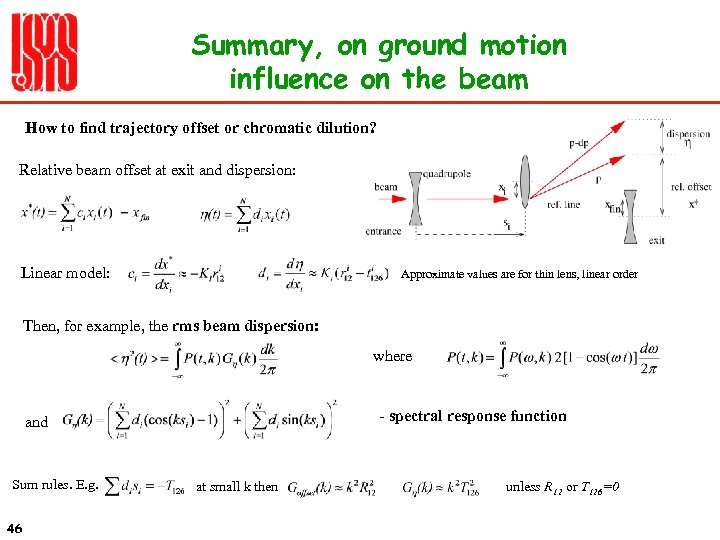
Summary, on ground motion influence on the beam How to find trajectory offset or chromatic dilution? Relative beam offset at exit and dispersion: Linear model: Approximate values are for thin lens, linear order Then, for example, the rms beam dispersion: where - spectral response function and Sum rules. E. g. 46 at small k then unless R 12 or T 126=0
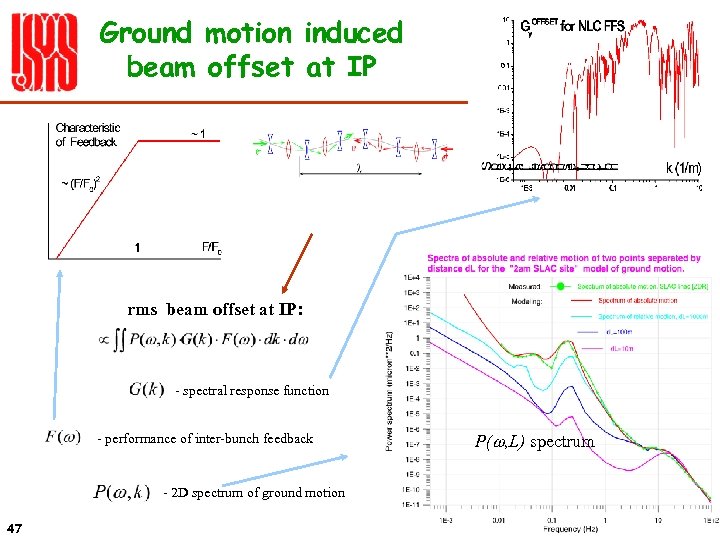
Ground motion induced beam offset at IP rms beam offset at IP: - spectral response function - performance of inter-bunch feedback - 2 D spectrum of ground motion 47 P(w, L) spectrum
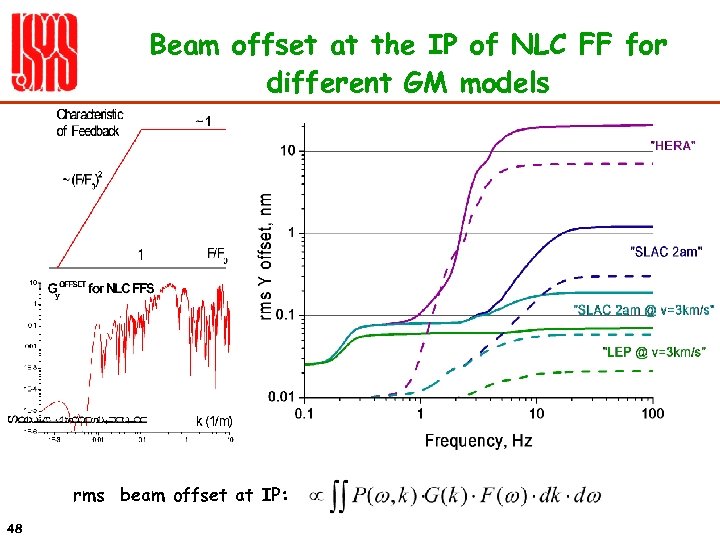
Beam offset at the IP of NLC FF for different GM models rms beam offset at IP: 48
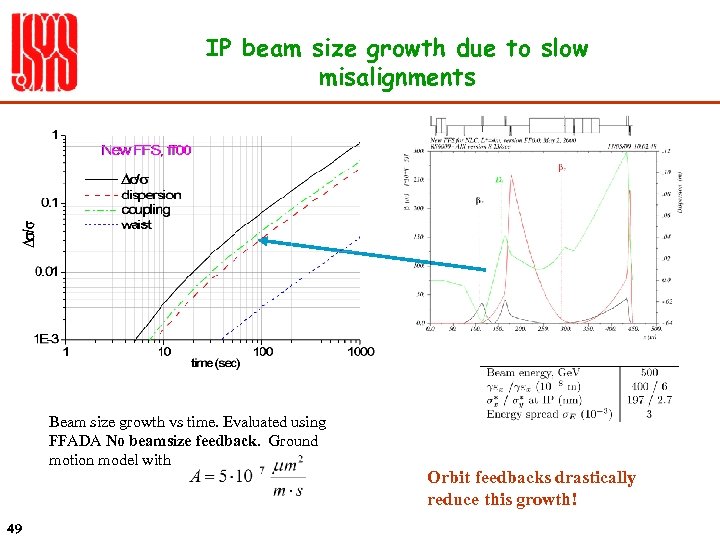
IP beam size growth due to slow misalignments Beam size growth vs time. Evaluated using FFADA No beamsize feedback. Ground motion model with 49 Orbit feedbacks drastically reduce this growth!
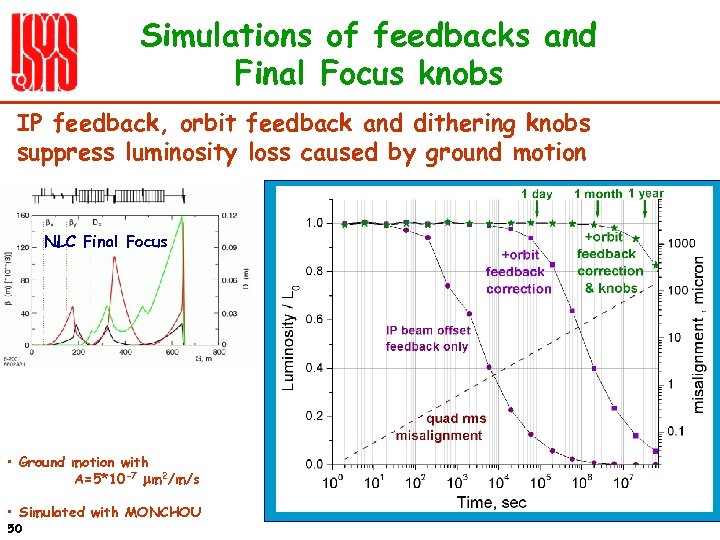
Simulations of feedbacks and Final Focus knobs IP feedback, orbit feedback and dithering knobs suppress luminosity loss caused by ground motion NLC Final Focus • Ground motion with A=5*10 -7 mm 2/m/s • Simulated with MONCHOU 50
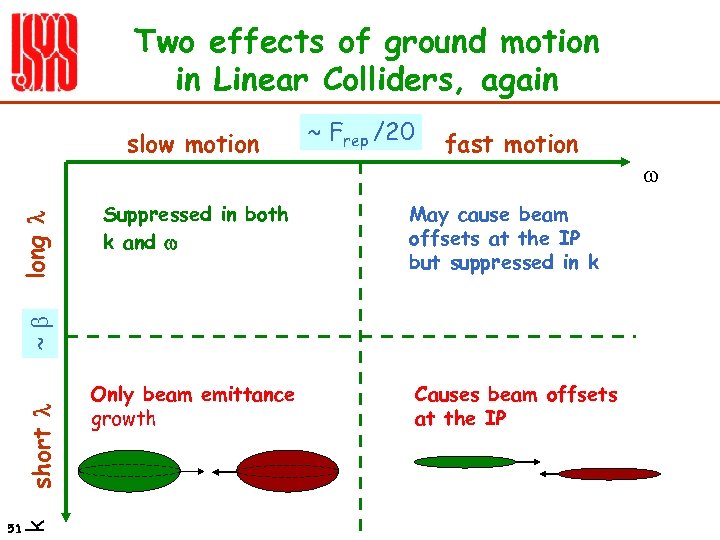
Two effects of ground motion in Linear Colliders, again Suppressed in both k and w ~ Frep /20 fast motion May cause beam offsets at the IP but suppressed in k k short l ~b long l slow motion 51 Only beam emittance growth Causes beam offsets at the IP w
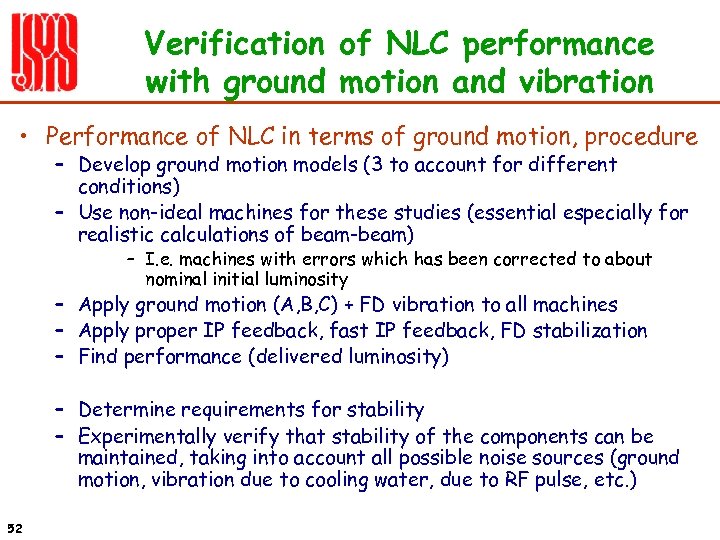
Verification of NLC performance with ground motion and vibration • Performance of NLC in terms of ground motion, procedure – Develop ground motion models (3 to account for different conditions) – Use non-ideal machines for these studies (essential especially for realistic calculations of beam-beam) – I. e. machines with errors which has been corrected to about nominal initial luminosity – Apply ground motion (A, B, C) + FD vibration to all machines – Apply proper IP feedback, fast IP feedback, FD stabilization – Find performance (delivered luminosity) – Determine requirements for stability – Experimentally verify that stability of the components can be maintained, taking into account all possible noise sources (ground motion, vibration due to cooling water, due to RF pulse, etc. ) 52
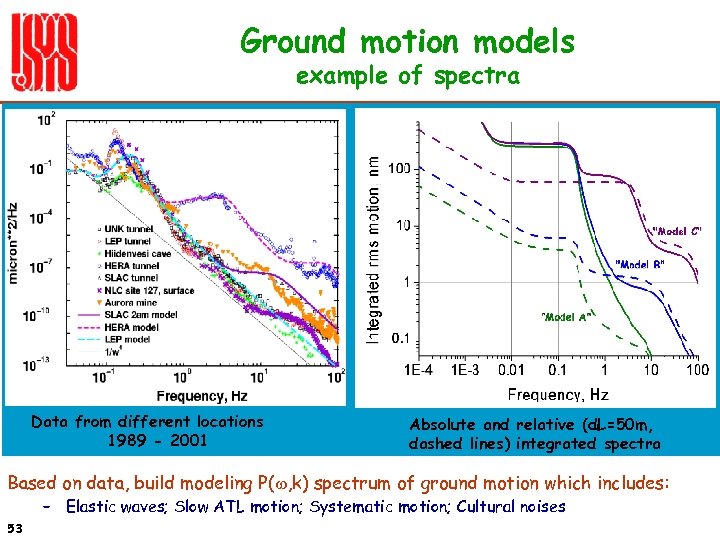
Ground motion models example of spectra Data from different locations 1989 - 2001 Absolute and relative (d. L=50 m, dashed lines) integrated spectra Based on data, build modeling P(w, k) spectrum of ground motion which includes: – Elastic waves; Slow ATL motion; Systematic motion; Cultural noises 53
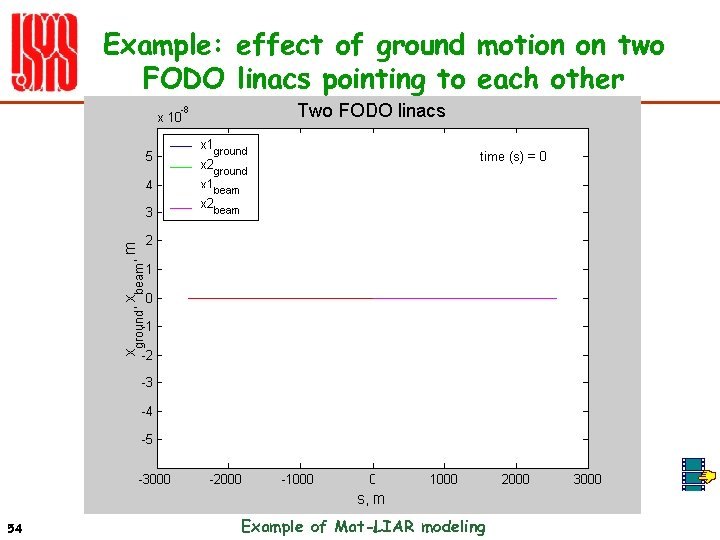
Example: effect of ground motion on two FODO linacs pointing to each other 54 Example of Mat-LIAR modeling
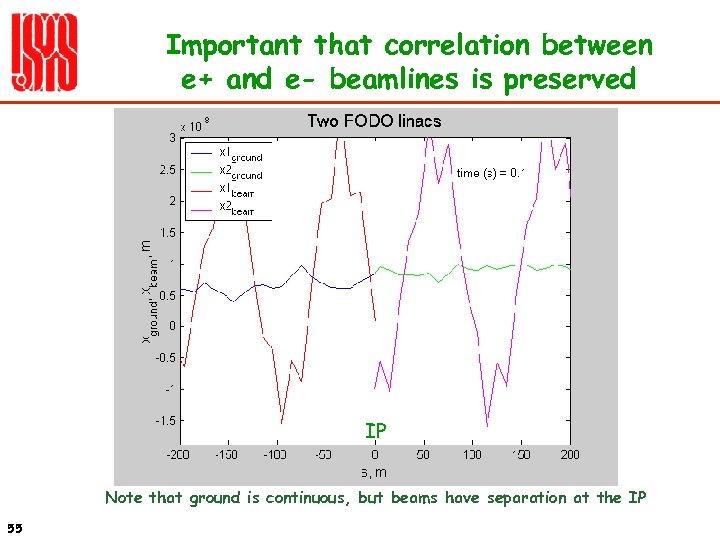
Important that correlation between e+ and e- beamlines is preserved IP Note that ground is continuous, but beams have separation at the IP 55
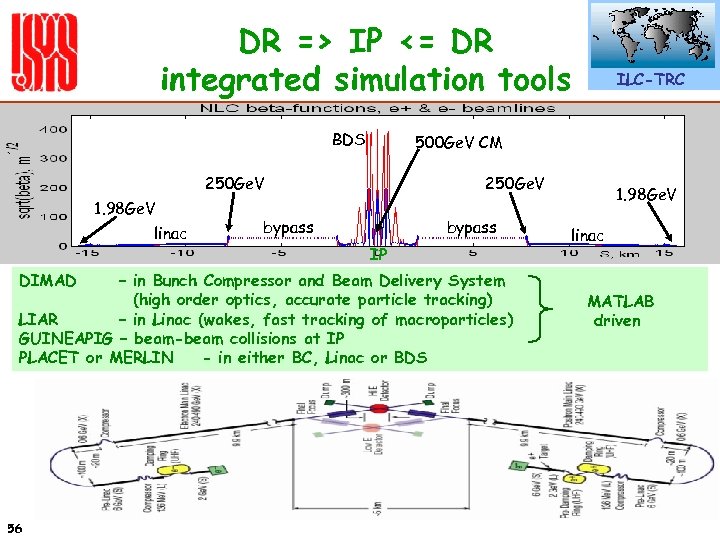
DR => IP <= DR integrated simulation tools BDS 500 Ge. V CM 250 Ge. V 1. 98 Ge. V linac DIMAD 250 Ge. V bypass IP – in Bunch Compressor and Beam Delivery System (high order optics, accurate particle tracking) LIAR – in Linac (wakes, fast tracking of macroparticles) GUINEAPIG – beam-beam collisions at IP PLACET or MERLIN - in either BC, Linac or BDS 56 ILC-TRC 1. 98 Ge. V linac MATLAB driven
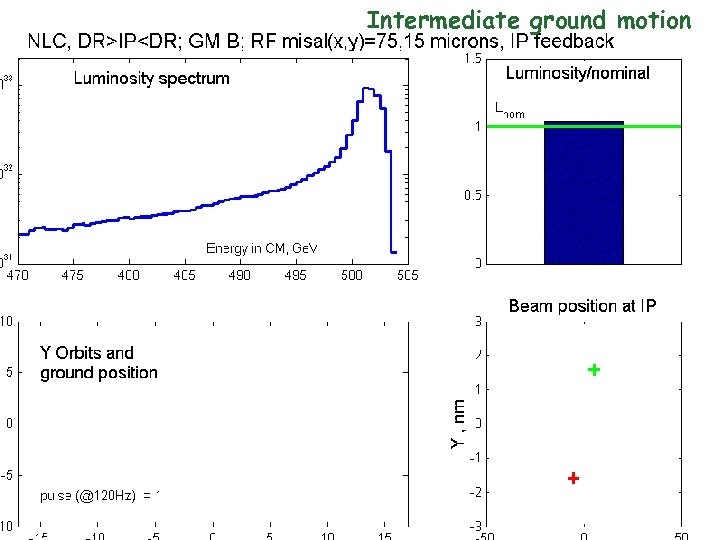
Intermediate ground motion 57
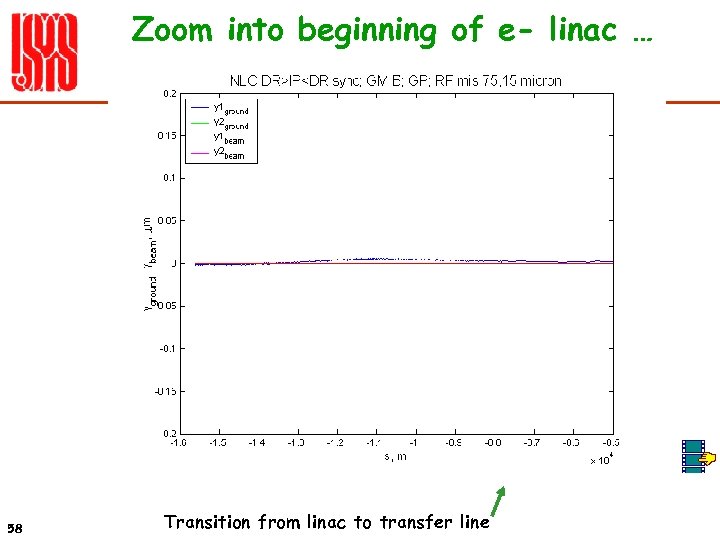
Zoom into beginning of e- linac … 58 Transition from linac to transfer line
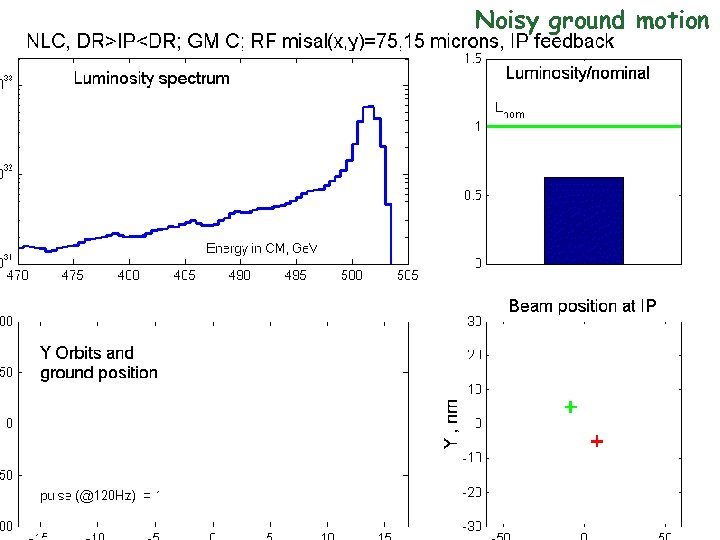
Noisy ground motion 59
![Beam-beam collisions calculated by Guinea-Pig [Daniel Schulte] 60](https://present5.com/presentation/a209e443a0a1c2be090fdda9ccd7fada/image-60.jpg "Beam-beam collisions calculated by Guinea-Pig [Daniel Schulte] 60")
Beam-beam collisions calculated by Guinea-Pig [Daniel Schulte] 60
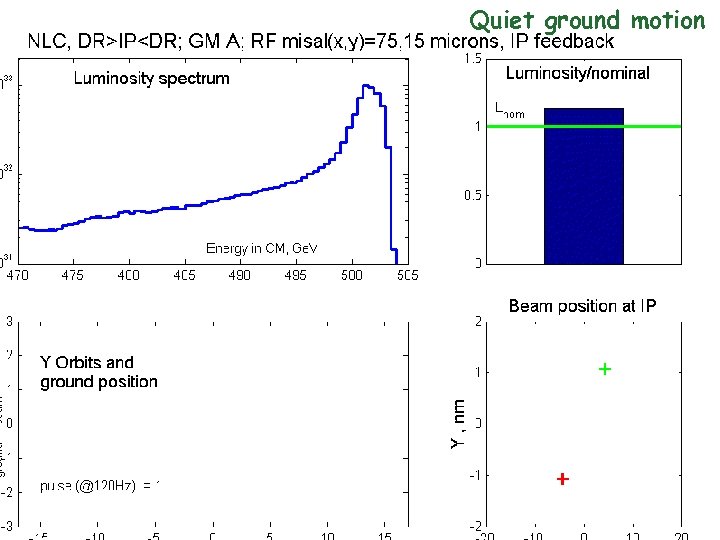
Quiet ground motion 61
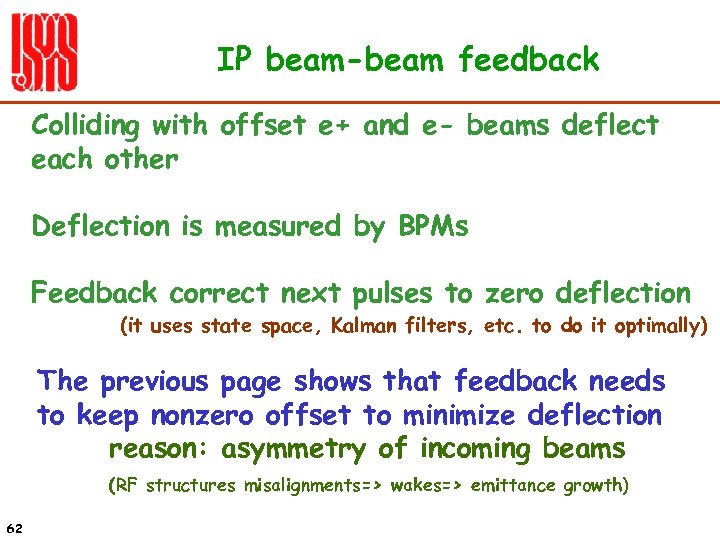
IP beam-beam feedback Colliding with offset e+ and e- beams deflect each other Deflection is measured by BPMs Feedback correct next pulses to zero deflection (it uses state space, Kalman filters, etc. to do it optimally) The previous page shows that feedback needs to keep nonzero offset to minimize deflection reason: asymmetry of incoming beams (RF structures misalignments=> wakes=> emittance growth) 62
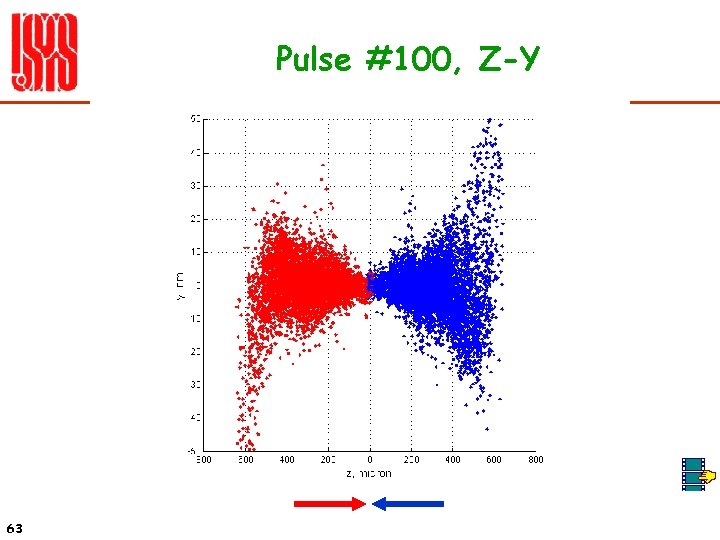
Pulse #100, Z-Y 63
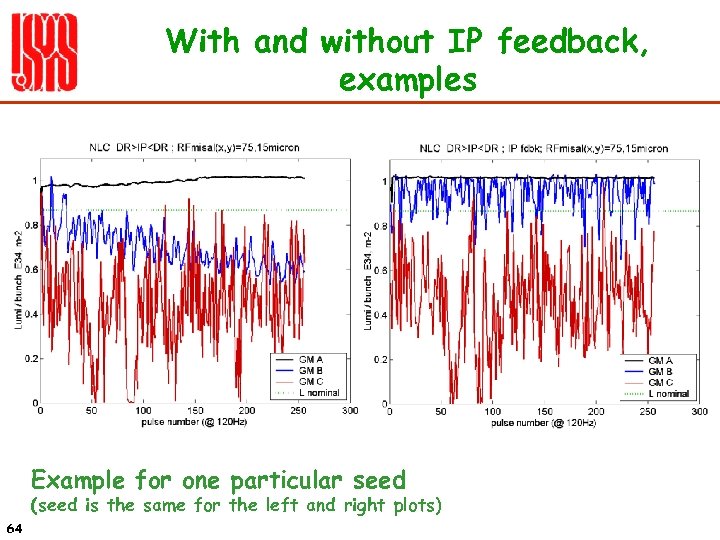
With and without IP feedback, examples Example for one particular seed (seed is the same for the left and right plots) 64
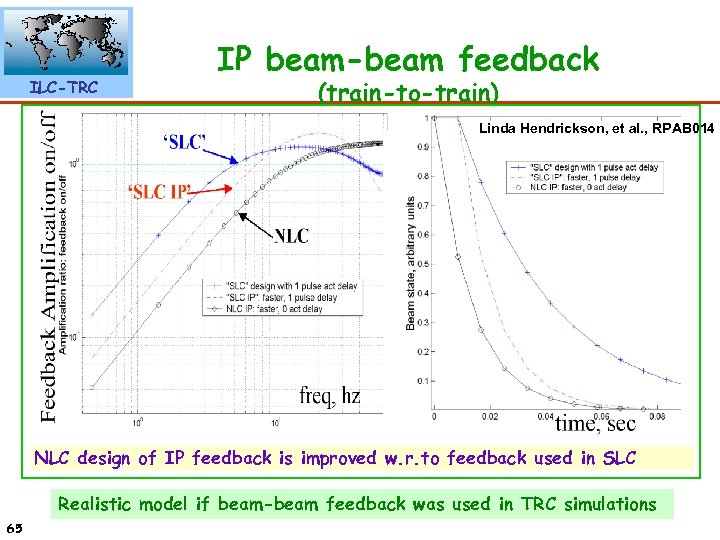
ILC-TRC IP beam-beam feedback (train-to-train) Linda Hendrickson, et al. , RPAB 014 NLC design of IP feedback is improved w. r. to feedback used in SLC Realistic model if beam-beam feedback was used in TRC simulations 65
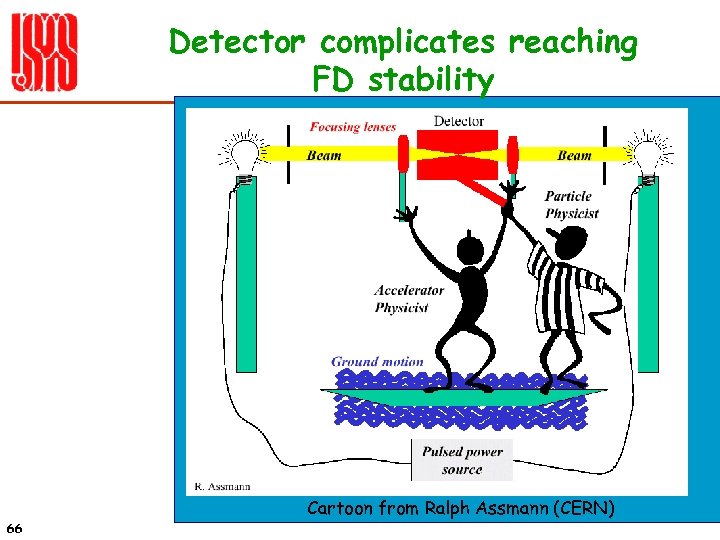
Detector complicates reaching FD stability Cartoon from Ralph Assmann (CERN) 66
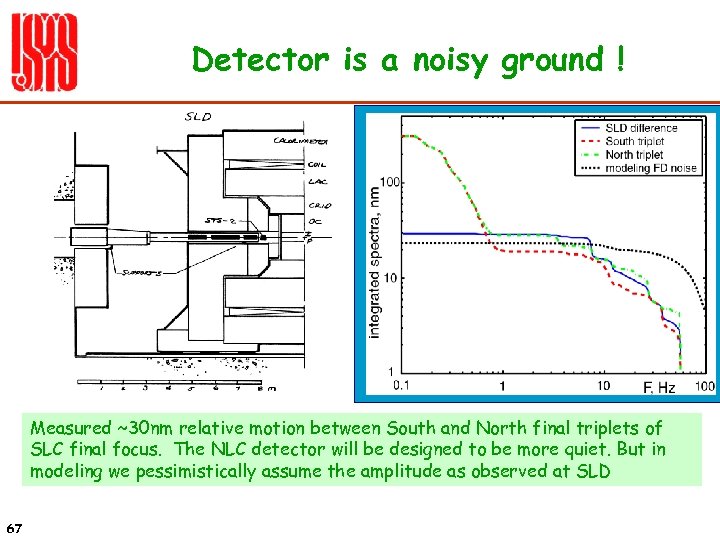
Detector is a noisy ground ! Measured ~30 nm relative motion between South and North final triplets of SLC final focus. The NLC detector will be designed to be more quiet. But in modeling we pessimistically assume the amplitude as observed at SLD 67
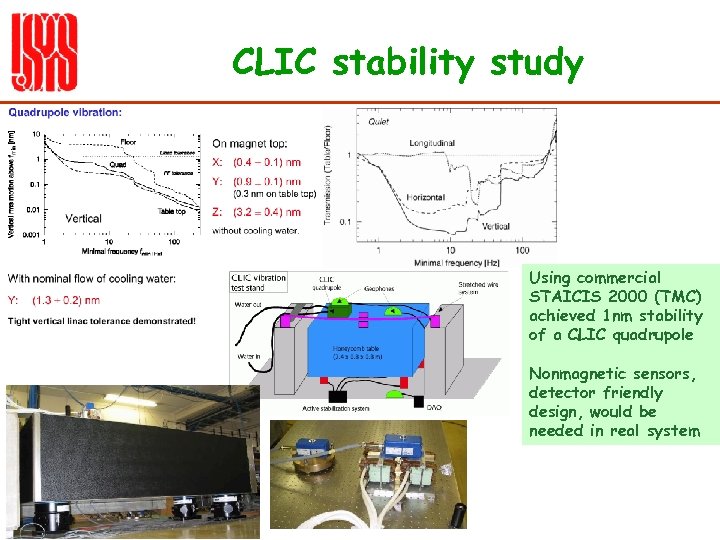
CLIC stability study Using commercial STAICIS 2000 (TMC) achieved 1 nm stability of a CLIC quadrupole Nonmagnetic sensors, detector friendly design, would be needed in real system 68
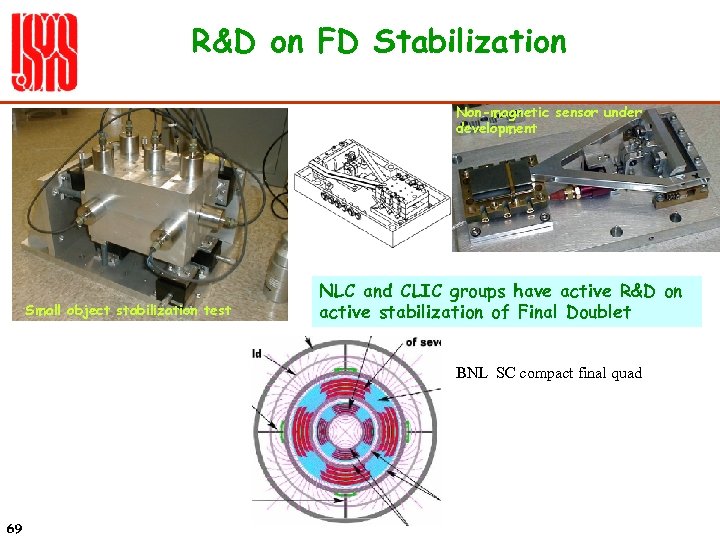
R&D on FD Stabilization Non-magnetic sensor under development Small object stabilization test NLC and CLIC groups have active R&D on active stabilization of Final Doublet BNL SC compact final quad 69
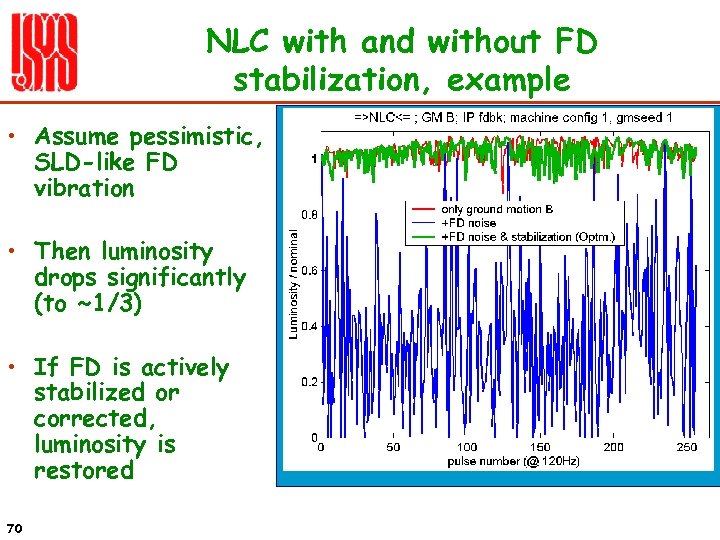
NLC with and without FD stabilization, example • Assume pessimistic, SLD-like FD vibration • Then luminosity drops significantly (to ~1/3) • If FD is actively stabilized or corrected, luminosity is restored 70

Linac stability study at SLAC and FNAL Experiment shows that additional vibrations due to cooling water are acceptable. Vibration coupling to quadrupoles is small Additional vibrations due to RF pulse was found to be negligible 71 We would like the NLC stability to be within the model B and believe it is achievable
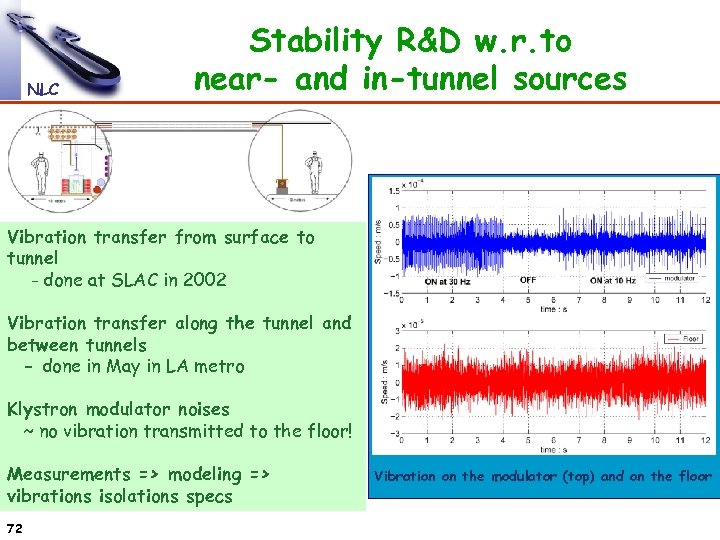
NLC Stability R&D w. r. to near- and in-tunnel sources Vibration transfer from surface to tunnel - done at SLAC in 2002 Vibration transfer along the tunnel and between tunnels - done in May in LA metro Klystron modulator noises ~ no vibration transmitted to the floor! Measurements => modeling => vibrations isolations specs 72 Vibration on the modulator (top) and on the floor

Join ! There will be interesting work for everyone ! 73
Скачать презентацию Stability and Alignment in Linear Collider Andrei Seryi
a209e443a0a1c2be090fdda9ccd7fada.ppt