 Скачать презентацию St Petersburg ICA Western High Speed Diameter Construction
1_ICA WHSD HSE Site _RUS.pptx
- Количество слайдов: 91




St. Petersburg ICA Western High Speed Diameter Construction Project HSE Site Induction
Content Introduction of the Project • • Health, Safety and Environment (HSE) Risk Assessment Hazards of WHSD Project Incident Classification Corrective/Preventive Action Personal Protective Equipment Project Works • • • Working at Height, Electrical Works, Working over Water, Excavation, etc. Confined Spaces, Chemical Substances Warning Signals Fire Housekeeping Alcohol and Drug Use Environment Project HSE Rules/Aims Project HSE Policy Project Main HSE Goal Closure

Russia Capital: Moscow Language: Russian Population: 141, 927, 121 (2010 Estimated) Regime: Federalism President: Vladimir Putin Prime Minister: Dmitri Medvedev Founding year: AC 862, AC 1991 as Russian Federation Area: 17, 075, 400 km² Currency: Russian Rubles (Rub) Time Zones: West/East (UTC+3 /+12) Traffic: Right Internet extension: . ru Telephone code: +7
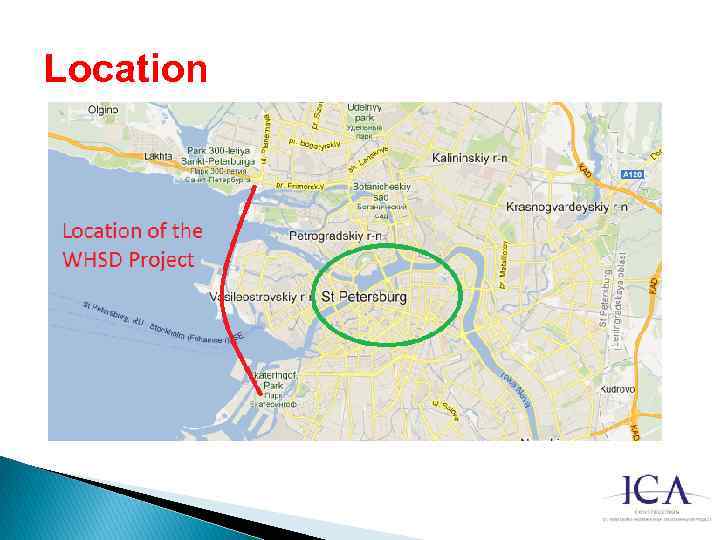
Location
Project Scope WHSD Project is one of the largest and most significant Public Private Partnership Within WHSD Project: contracts developed so far in Russia and is of strategic importance for the transport system of St. Petersburg. WHSD is Russia's first toll road in a city. ◦ ◦ ◦ Viaduct on Land over 7 km, Sea Channel Bridge, Cable-Stayed Bridge, Embankment and Pileworks, Overpass and Temporary Platforms. It is approximately 11, 6 km long. Employer : Northern Capital Highway (NCH) Engineer : COWI Project Commencing Date: March 2013 Completion Date: March 2016
Health, Safety and Environment (HSE) HSE is a technical discipline ◦ To protect employee health, ◦ To provide business and production safety, ◦ To protect people and environment around workspace while performing a duty. HSE begins with Risk Assessment.
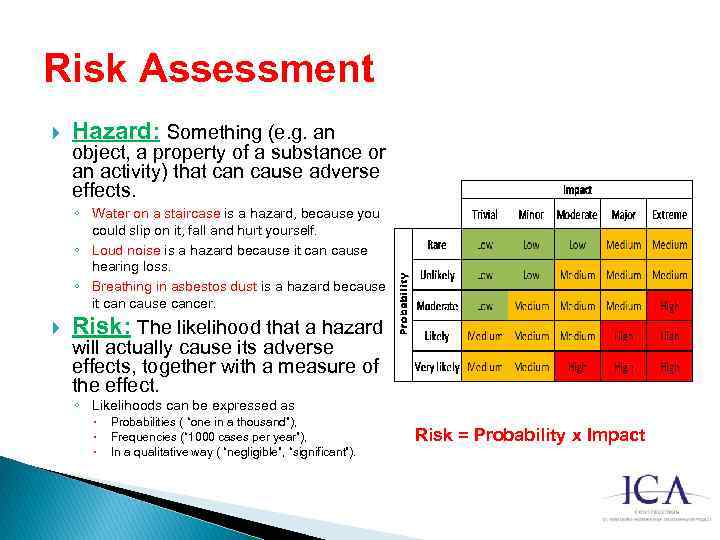
Risk Assessment Hazard: Something (e. g. an object, a property of a substance or an activity) that can cause adverse effects. ◦ Water on a staircase is a hazard, because you could slip on it, fall and hurt yourself. ◦ Loud noise is a hazard because it can cause hearing loss. ◦ Breathing in asbestos dust is a hazard because it can cause cancer. Risk: The likelihood that a hazard will actually cause its adverse effects, together with a measure of the effect. ◦ Likelihoods can be expressed as Probabilities ( “one in a thousand”), Frequencies (“ 1000 cases per year”), In a qualitative way ( “negligible”, “significant”). Risk = Probability x Impact
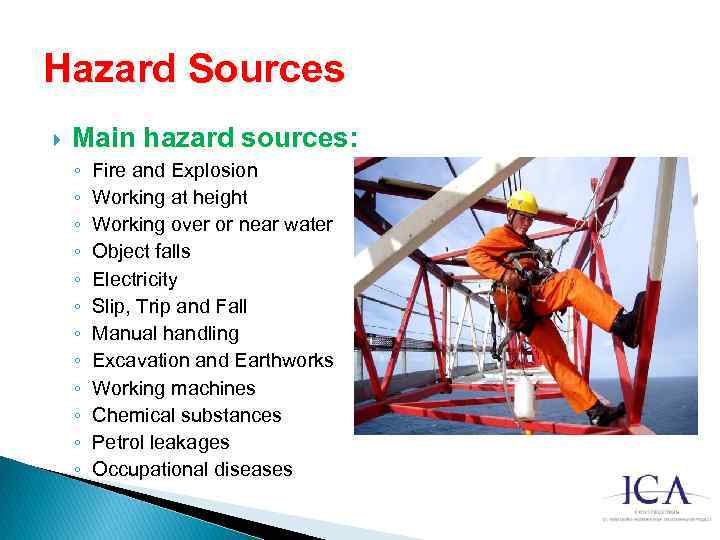
Hazard Sources Main hazard sources: ◦ ◦ ◦ Fire and Explosion Working at height Working over or near water Object falls Electricity Slip, Trip and Fall Manual handling Excavation and Earthworks Working machines Chemical substances Petrol leakages Occupational diseases
Incident Classification WHSD HSE Plan aims to investigate all incidents by root-cause analysis and provides corrective/preventive actions to avoid reoccurence. Incident: Work-related cases in which an injury or ill health or fatality or damage occurred, or could have been occurred. Near-miss, first-aid cases, medical treatment cases, lost time injuries, fatalities. Near-miss: Any case which did not result in an injury, illness, or damage – but had the potential to do so. There is just a moment or a few cm between incident and nearmiss. Ex; To slip while walking, then to stumble but not to fall on the ground. Accident: An incident which result an ill health, injury, damage, production losses or increased liabilities. Ex; Collision of vehicles, Fall from height. Occupational Disease: Any chronic illness that occurs as a result of work or occupational activity. Ex; Ear and nerve diseases caused by noise, Respiratory diseases caused by dust.
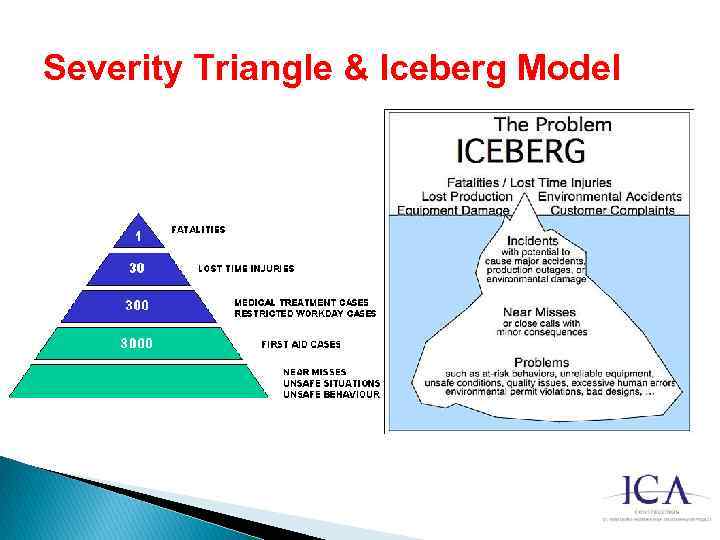
Severity Triangle & Iceberg Model
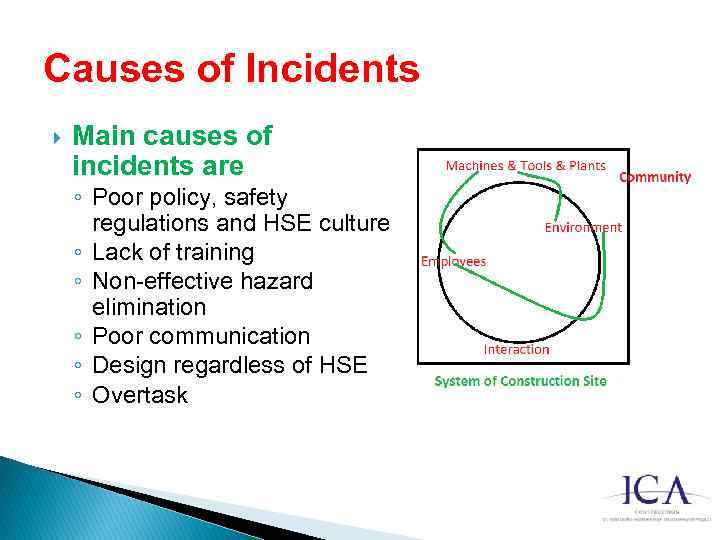
Causes of Incidents Main causes of incidents are ◦ Poor policy, safety regulations and HSE culture ◦ Lack of training ◦ Non-effective hazard elimination ◦ Poor communication ◦ Design regardless of HSE ◦ Overtask
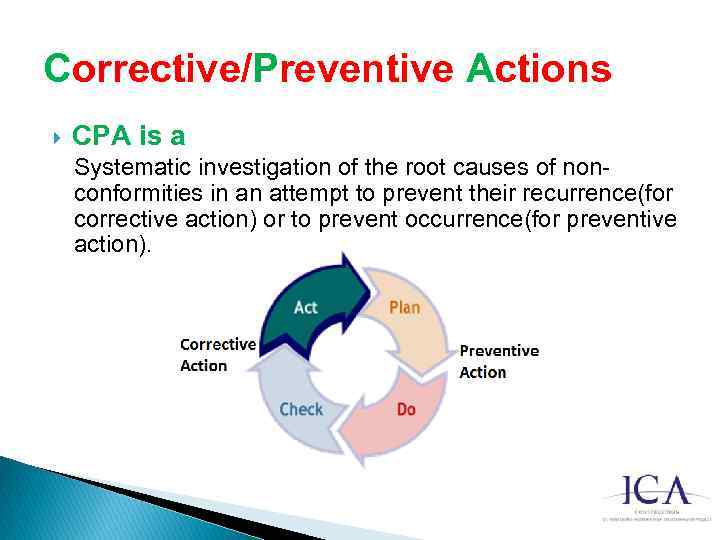
Corrective/Preventive Actions CPA is a Systematic investigation of the root causes of nonconformities in an attempt to prevent their recurrence(for corrective action) or to prevent occurrence(for preventive action).
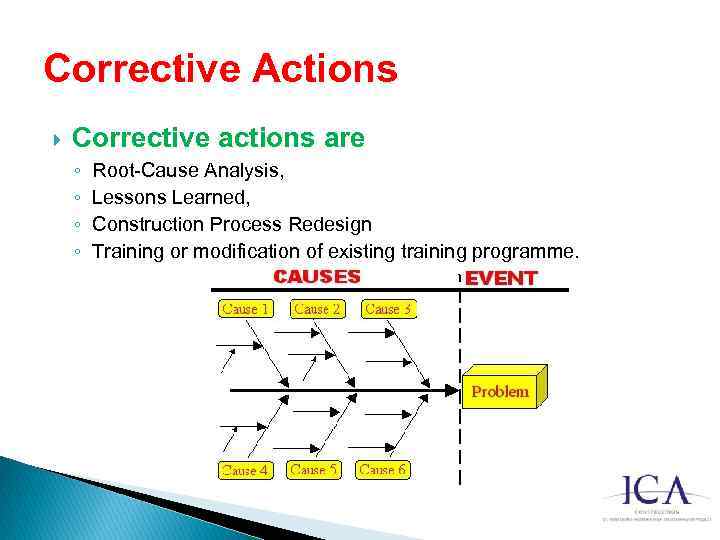
Corrective Actions Corrective actions are ◦ ◦ Root-Cause Analysis, Lessons Learned, Construction Process Redesign Training or modification of existing training programme.
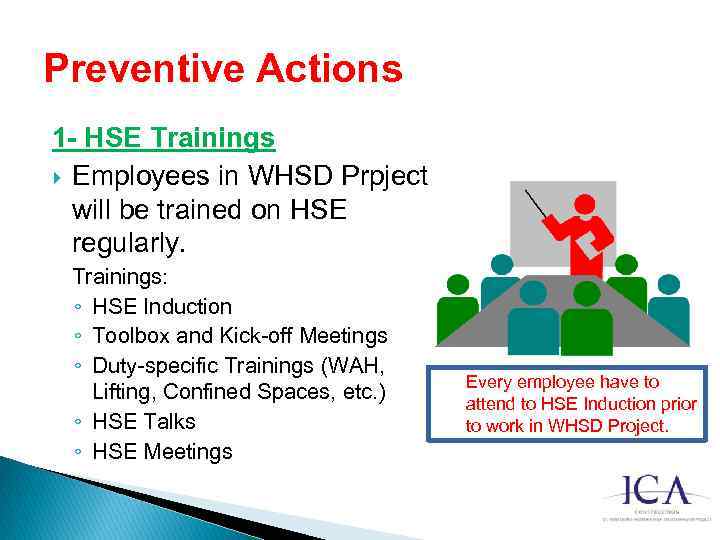
Preventive Actions 1 - HSE Trainings Employees in WHSD Prpject will be trained on HSE regularly. Trainings: ◦ HSE Induction ◦ Toolbox and Kick-off Meetings ◦ Duty-specific Trainings (WAH, Lifting, Confined Spaces, etc. ) ◦ HSE Talks ◦ HSE Meetings Every employee have to attend to HSE Induction prior to work in WHSD Project.
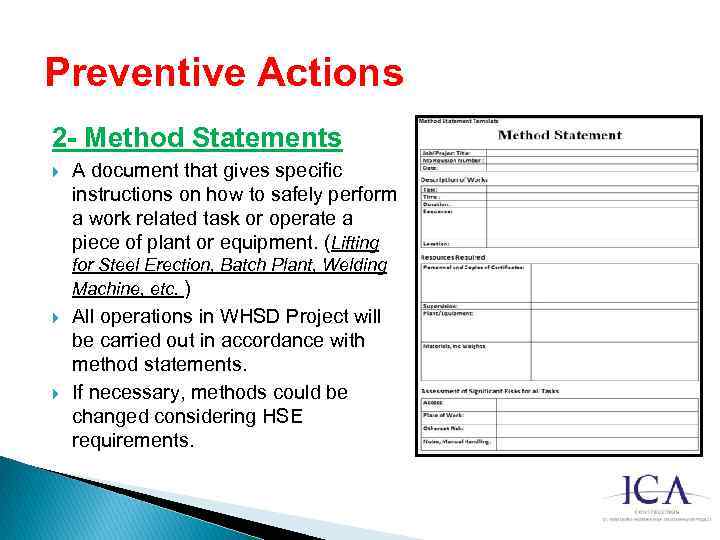
Preventive Actions 2 - Method Statements A document that gives specific instructions on how to safely perform a work related task or operate a piece of plant or equipment. (Lifting for Steel Erection, Batch Plant, Welding Machine, etc. ) All operations in WHSD Project will be carried out in accordance with method statements. If necessary, methods could be changed considering HSE requirements.
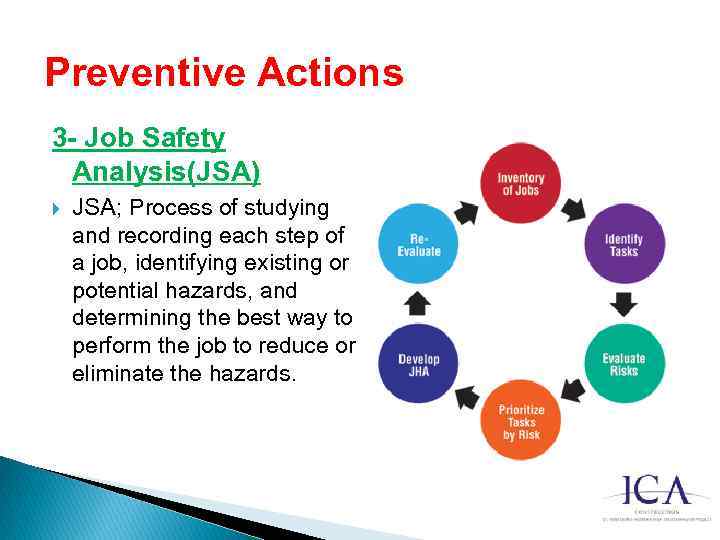
Preventive Actions 3 - Job Safety Analysis(JSA) JSA; Process of studying and recording each step of a job, identifying existing or potential hazards, and determining the best way to perform the job to reduce or eliminate the hazards.
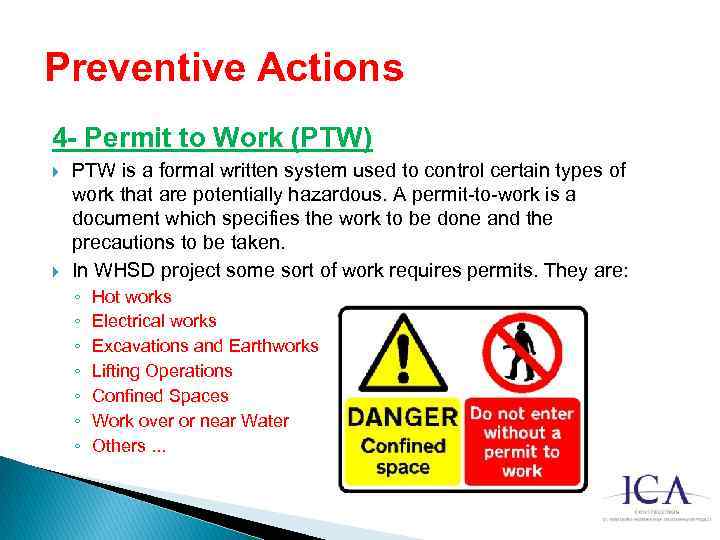
Preventive Actions 4 - Permit to Work (PTW) PTW is a formal written system used to control certain types of work that are potentially hazardous. A permit-to-work is a document which specifies the work to be done and the precautions to be taken. In WHSD project some sort of work requires permits. They are: ◦ ◦ ◦ ◦ Hot works Electrical works Excavations and Earthworks Lifting Operations Confined Spaces Work over or near Water Others. . .
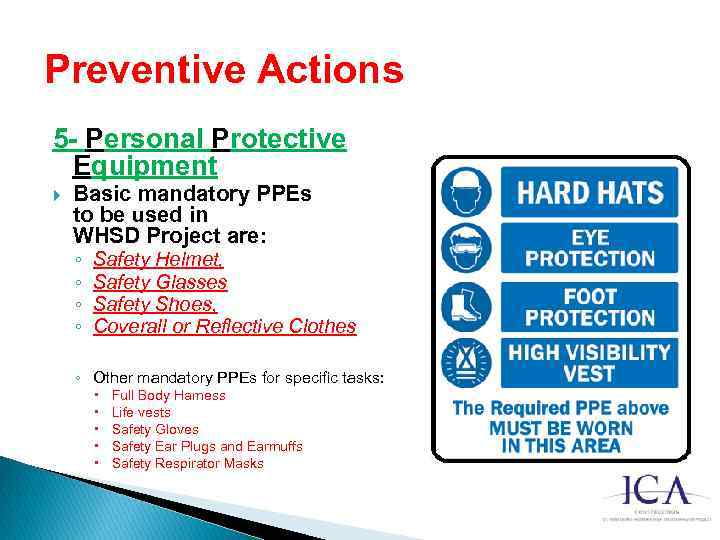
Preventive Actions 5 - Personal Protective Equipment Basic mandatory PPEs to be used in WHSD Project are: ◦ ◦ Safety Helmet, Safety Glasses Safety Shoes, Coverall or Reflective Clothes ◦ Other mandatory PPEs for specific tasks: Full Body Harness Life vests Safety Gloves Safety Ear Plugs and Earmuffs Safety Respirator Masks
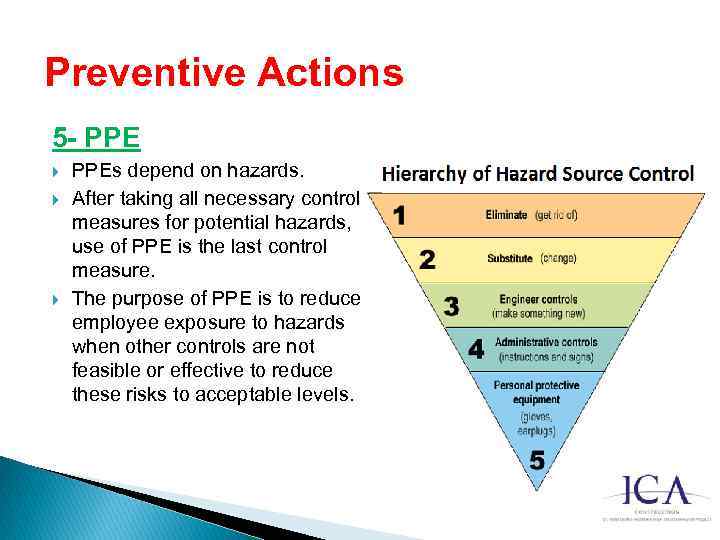
Preventive Actions 5 - PPE PPEs depend on hazards. After taking all necessary control measures for potential hazards, use of PPE is the last control measure. The purpose of PPE is to reduce employee exposure to hazards when other controls are not feasible or effective to reduce these risks to acceptable levels.
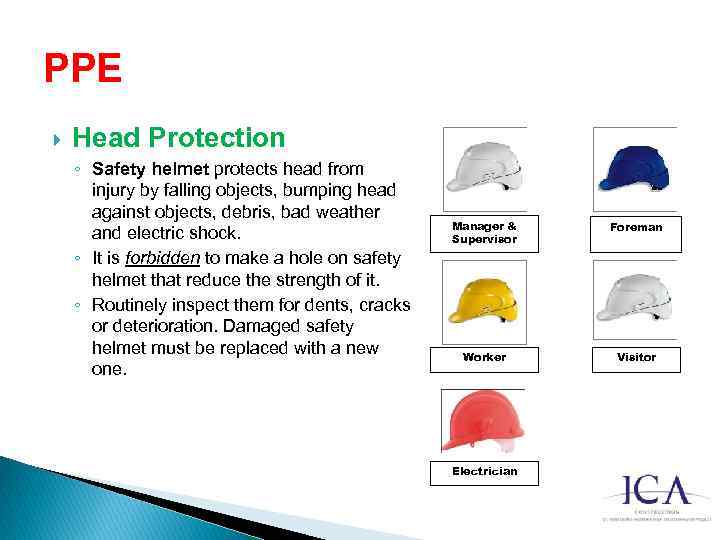
PPE Head Protection ◦ Safety helmet protects head from injury by falling objects, bumping head against objects, debris, bad weather and electric shock. ◦ It is forbidden to make a hole on safety helmet that reduce the strength of it. ◦ Routinely inspect them for dents, cracks or deterioration. Damaged safety helmet must be replaced with a new one. Manager & Supervisor Foreman Worker Visitor Electrician
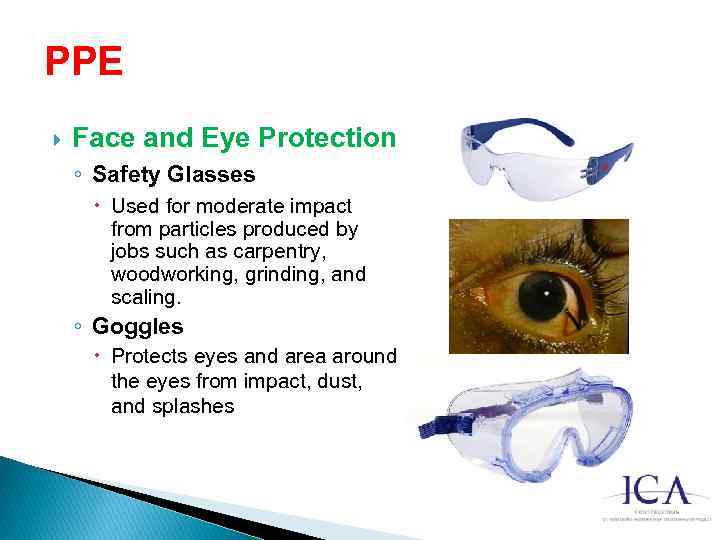
PPE Face and Eye Protection ◦ Safety Glasses Used for moderate impact from particles produced by jobs such as carpentry, woodworking, grinding, and scaling. ◦ Goggles Protects eyes and area around the eyes from impact, dust, and splashes
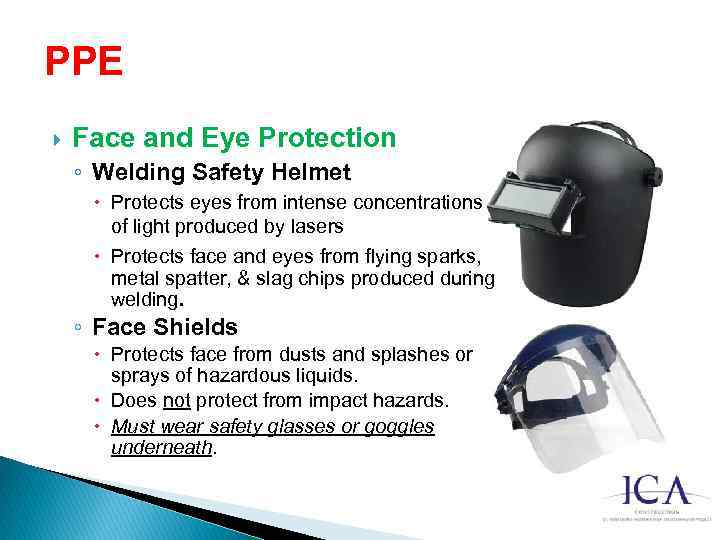
PPE Face and Eye Protection ◦ Welding Safety Helmet Protects eyes from intense concentrations of light produced by lasers Protects face and eyes from flying sparks, metal spatter, & slag chips produced during welding. ◦ Face Shields Protects face from dusts and splashes or sprays of hazardous liquids. Does not protect from impact hazards. Must wear safety glasses or goggles underneath.
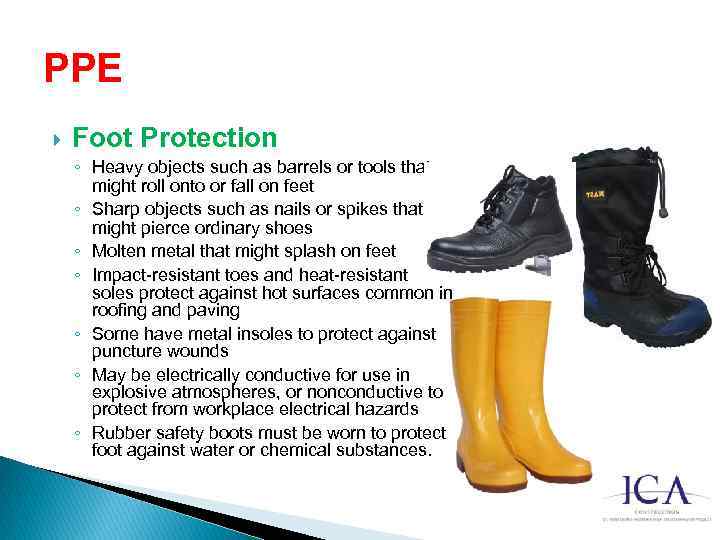
PPE Foot Protection ◦ Heavy objects such as barrels or tools that might roll onto or fall on feet ◦ Sharp objects such as nails or spikes that might pierce ordinary shoes ◦ Molten metal that might splash on feet ◦ Impact-resistant toes and heat-resistant soles protect against hot surfaces common in roofing and paving ◦ Some have metal insoles to protect against puncture wounds ◦ May be electrically conductive for use in explosive atmospheres, or nonconductive to protect from workplace electrical hazards ◦ Rubber safety boots must be worn to protect foot against water or chemical substances.
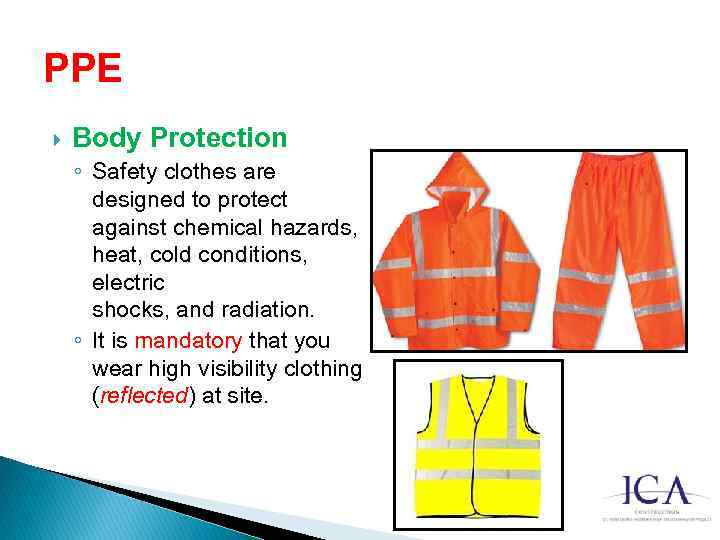
PPE Body Protection ◦ Safety clothes are designed to protect against chemical hazards, heat, cold conditions, electric shocks, and radiation. ◦ It is mandatory that you wear high visibility clothing (reflected) at site.
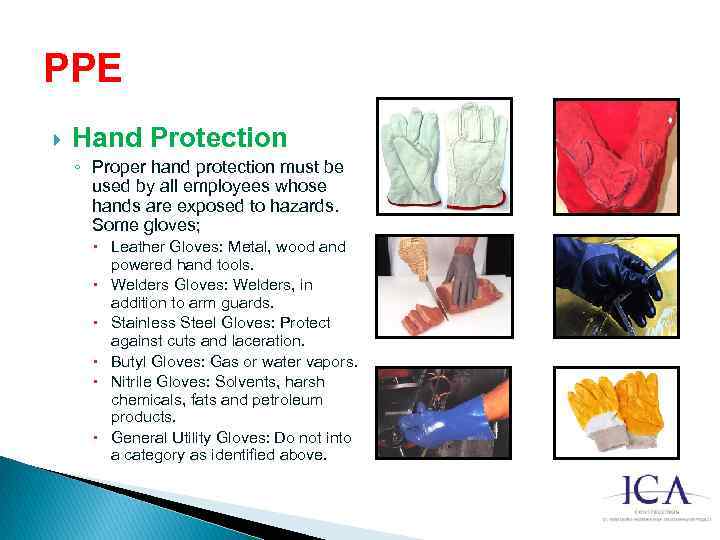
PPE Hand Protection ◦ Proper hand protection must be used by all employees whose hands are exposed to hazards. Some gloves; Leather Gloves: Metal, wood and powered hand tools. Welders Gloves: Welders, in addition to arm guards. Stainless Steel Gloves: Protect against cuts and laceration. Butyl Gloves: Gas or water vapors. Nitrile Gloves: Solvents, harsh chemicals, fats and petroleum products. General Utility Gloves: Do not into a category as identified above.
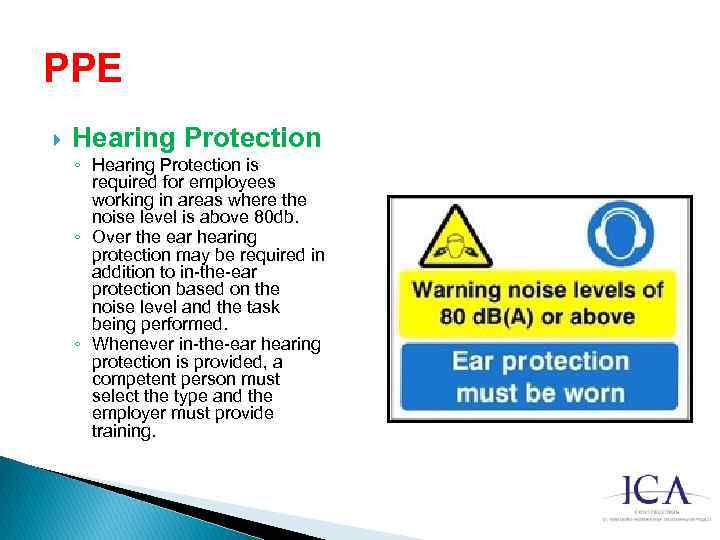
PPE Hearing Protection ◦ Hearing Protection is required for employees working in areas where the noise level is above 80 db. ◦ Over the ear hearing protection may be required in addition to in-the-ear protection based on the noise level and the task being performed. ◦ Whenever in-the-ear hearing protection is provided, a competent person must select the type and the employer must provide training.
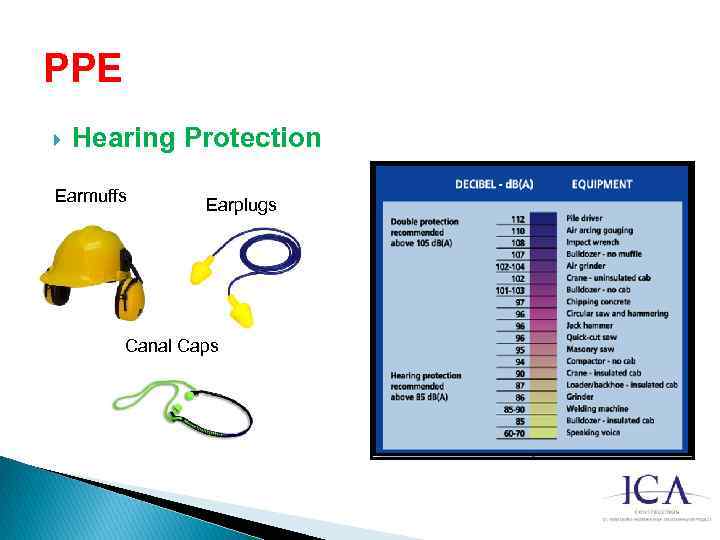
PPE Hearing Protection Earmuffs Earplugs Canal Caps
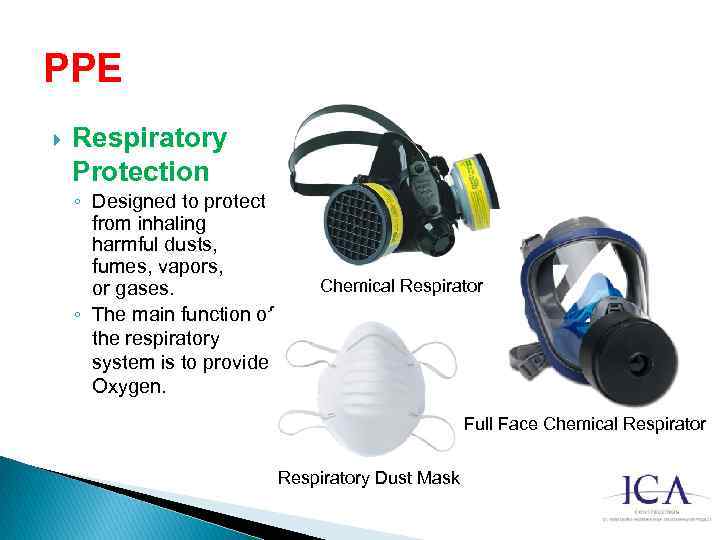
PPE Respiratory Protection ◦ Designed to protect from inhaling harmful dusts, fumes, vapors, or gases. ◦ The main function of the respiratory system is to provide Oxygen. Chemical Respirator Full Face Chemical Respiratory Dust Mask
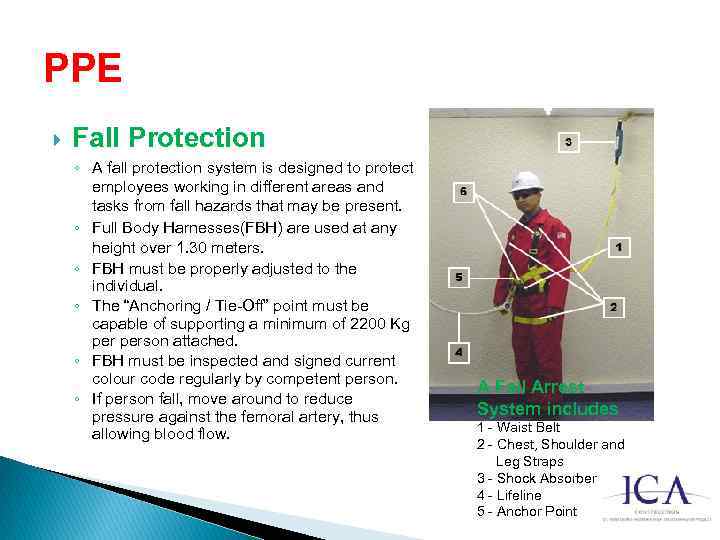
PPE Fall Protection ◦ A fall protection system is designed to protect employees working in different areas and tasks from fall hazards that may be present. ◦ Full Body Harnesses(FBH) are used at any height over 1. 30 meters. ◦ FBH must be properly adjusted to the individual. ◦ The “Anchoring / Tie-Off” point must be capable of supporting a minimum of 2200 Kg person attached. ◦ FBH must be inspected and signed current colour code regularly by competent person. ◦ If person fall, move around to reduce pressure against the femoral artery, thus allowing blood flow. A Fall Arrest System includes 1 - Waist Belt 2 - Chest, Shoulder and Leg Straps 3 - Shock Absorber 4 - Lifeline 5 - Anchor Point
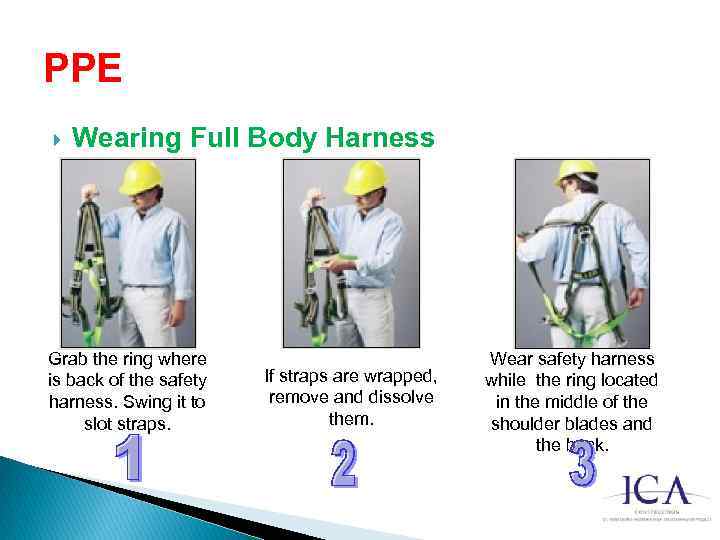
PPE Wearing Full Body Harness Grab the ring where is back of the safety harness. Swing it to slot straps. If straps are wrapped, remove and dissolve them. Wear safety harness while the ring located in the middle of the shoulder blades and the back.
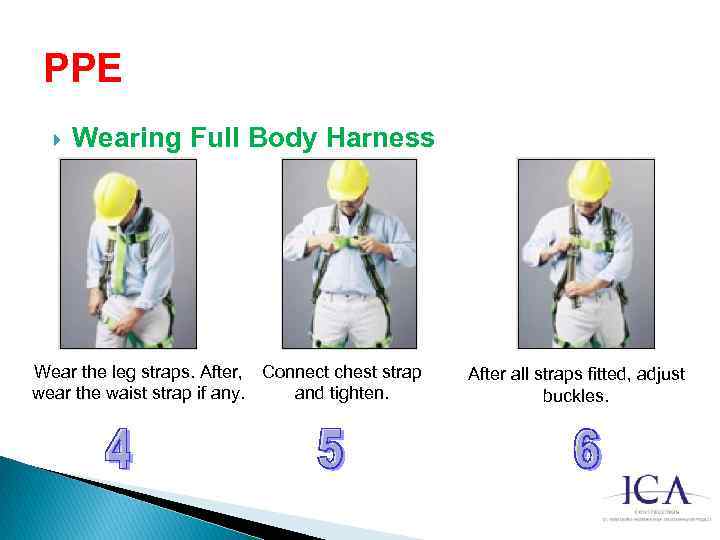
PPE Wearing Full Body Harness Wear the leg straps. After, Connect chest strap wear the waist strap if any. and tighten. After all straps fitted, adjust buckles.
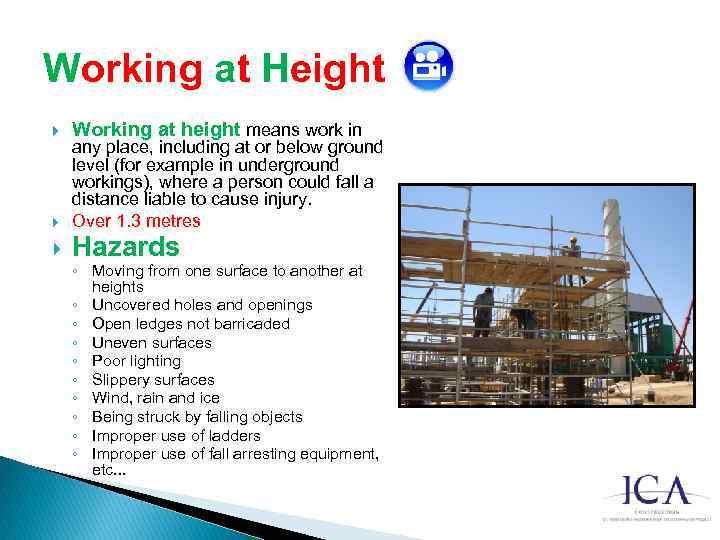
Working at Height Working at height means work in any place, including at or below ground level (for example in underground workings), where a person could fall a distance liable to cause injury. Over 1. 3 metres Hazards ◦ Moving from one surface to another at heights ◦ Uncovered holes and openings ◦ Open ledges not barricaded ◦ Uneven surfaces ◦ Poor lighting ◦ Slippery surfaces ◦ Wind, rain and ice ◦ Being struck by falling objects ◦ Improper use of ladders ◦ Improper use of fall arresting equipment, etc. . .
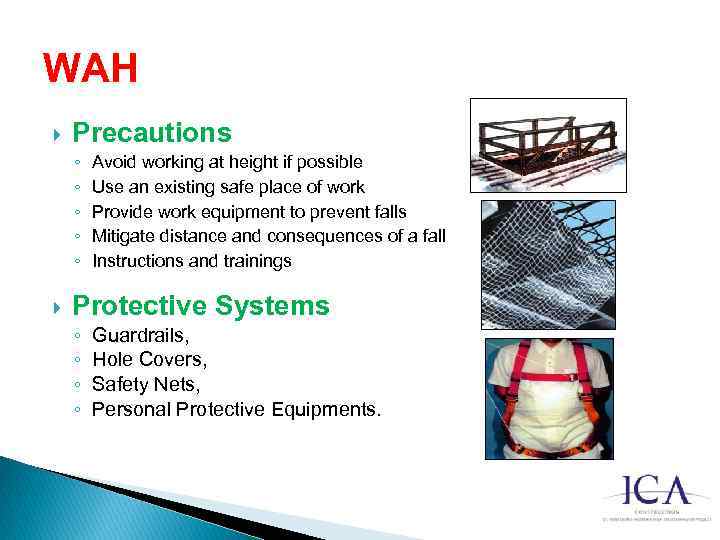
WAH Precautions ◦ ◦ ◦ Avoid working at height if possible Use an existing safe place of work Provide work equipment to prevent falls Mitigate distance and consequences of a fall Instructions and trainings Protective Systems ◦ ◦ Guardrails, Hole Covers, Safety Nets, Personal Protective Equipments.
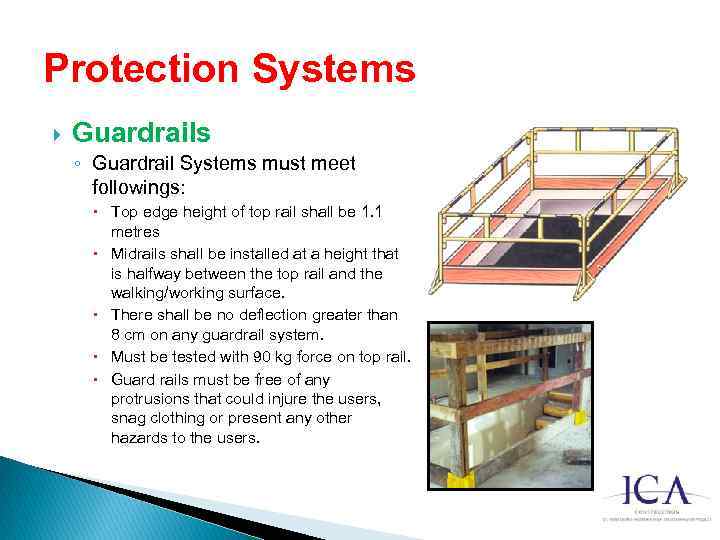
Protection Systems Guardrails ◦ Guardrail Systems must meet followings: Top edge height of top rail shall be 1. 1 metres Midrails shall be installed at a height that is halfway between the top rail and the walking/working surface. There shall be no deflection greater than 8 cm on any guardrail system. Must be tested with 90 kg force on top rail. Guard rails must be free of any protrusions that could injure the users, snag clothing or present any other hazards to the users.
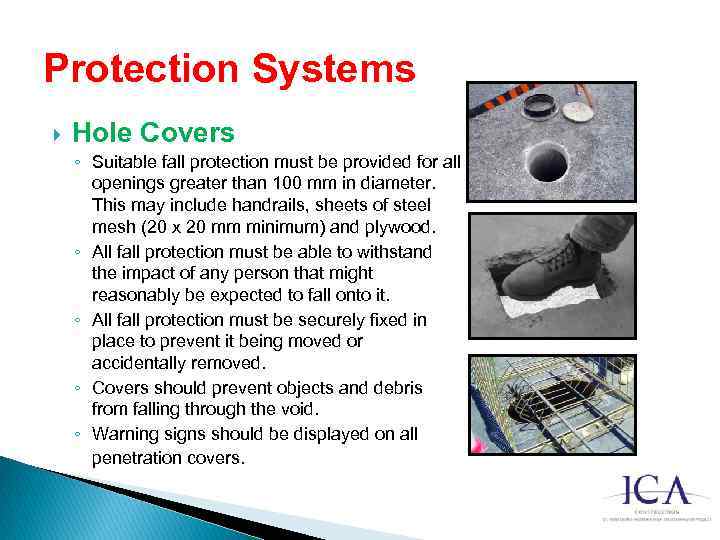
Protection Systems Hole Covers ◦ Suitable fall protection must be provided for all openings greater than 100 mm in diameter. This may include handrails, sheets of steel mesh (20 x 20 mm minimum) and plywood. ◦ All fall protection must be able to withstand the impact of any person that might reasonably be expected to fall onto it. ◦ All fall protection must be securely fixed in place to prevent it being moved or accidentally removed. ◦ Covers should prevent objects and debris from falling through the void. ◦ Warning signs should be displayed on all penetration covers.
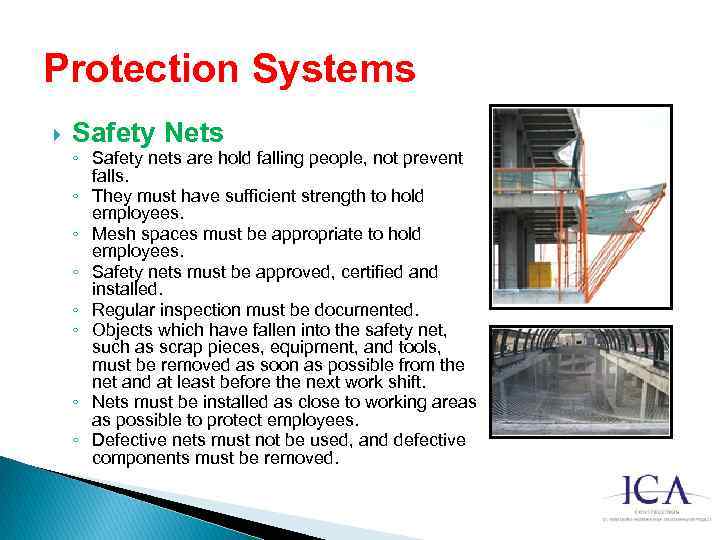
Protection Systems Safety Nets ◦ Safety nets are hold falling people, not prevent falls. ◦ They must have sufficient strength to hold employees. ◦ Mesh spaces must be appropriate to hold employees. ◦ Safety nets must be approved, certified and installed. ◦ Regular inspection must be documented. ◦ Objects which have fallen into the safety net, such as scrap pieces, equipment, and tools, must be removed as soon as possible from the net and at least before the next work shift. ◦ Nets must be installed as close to working areas as possible to protect employees. ◦ Defective nets must not be used, and defective components must be removed.
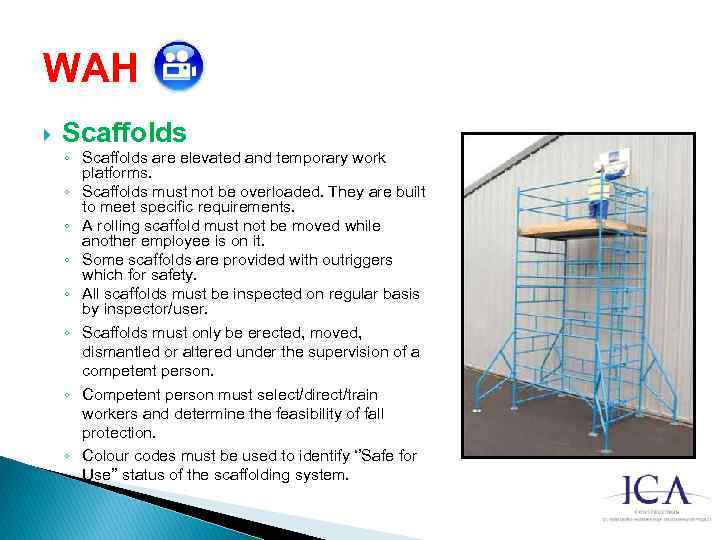
WAH Scaffolds ◦ Scaffolds are elevated and temporary work platforms. ◦ Scaffolds must not be overloaded. They are built to meet specific requirements. ◦ A rolling scaffold must not be moved while another employee is on it. ◦ Some scaffolds are provided with outriggers which for safety. ◦ All scaffolds must be inspected on regular basis by inspector/user. ◦ Scaffolds must only be erected, moved, dismantled or altered under the supervision of a competent person. ◦ Competent person must select/direct/train workers and determine the feasibility of fall protection. ◦ Colour codes must be used to identify ‘’Safe for Use’’ status of the scaffolding system.
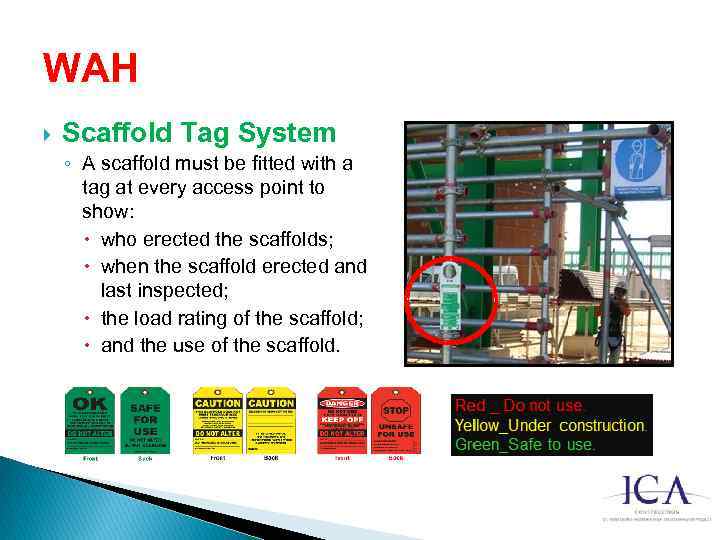
WAH Scaffold Tag System ◦ A scaffold must be fitted with a tag at every access point to show: who erected the scaffolds; when the scaffold erected and last inspected; the load rating of the scaffold; and the use of the scaffold.
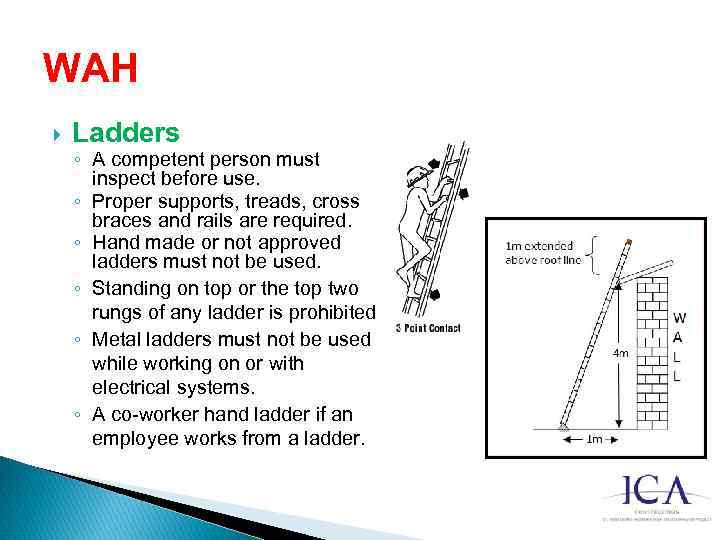
WAH Ladders ◦ A competent person must inspect before use. ◦ Proper supports, treads, cross braces and rails are required. ◦ Hand made or not approved ladders must not be used. ◦ Standing on top or the top two rungs of any ladder is prohibited. ◦ Metal ladders must not be used while working on or with electrical systems. ◦ A co-worker hand ladder if an employee works from a ladder.
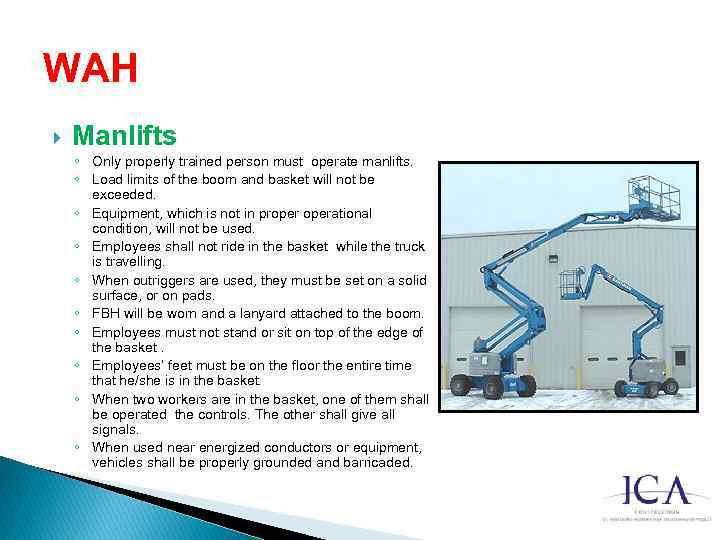
WAH Manlifts ◦ Only properly trained person must operate manlifts. ◦ Load limits of the boom and basket will not be exceeded. ◦ Equipment, which is not in properational condition, will not be used. ◦ Employees shall not ride in the basket while the truck is travelling. ◦ When outriggers are used, they must be set on a solid surface, or on pads. ◦ FBH will be worn and a lanyard attached to the boom. ◦ Employees must not stand or sit on top of the edge of the basket. ◦ Employees’ feet must be on the floor the entire time that he/she is in the basket. ◦ When two workers are in the basket, one of them shall be operated the controls. The other shall give all signals. ◦ When used near energized conductors or equipment, vehicles shall be properly grounded and barricaded.
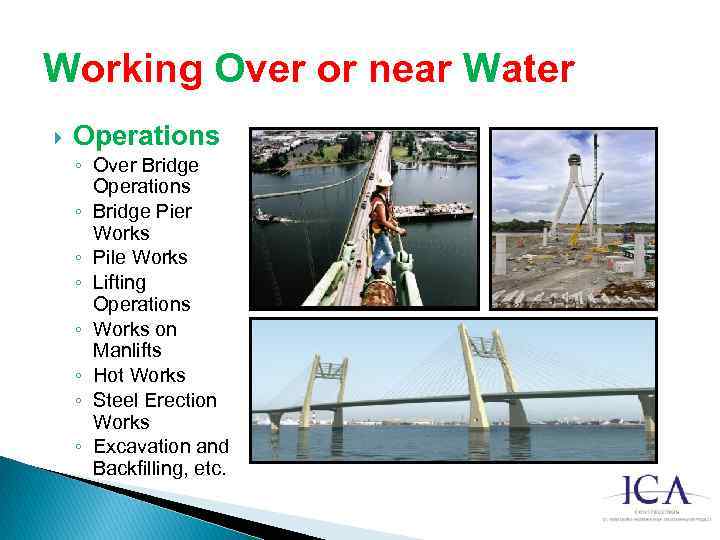
Working Over or near Water Operations ◦ Over Bridge Operations ◦ Bridge Pier Works ◦ Pile Works ◦ Lifting Operations ◦ Works on Manlifts ◦ Hot Works ◦ Steel Erection Works ◦ Excavation and Backfilling, etc.
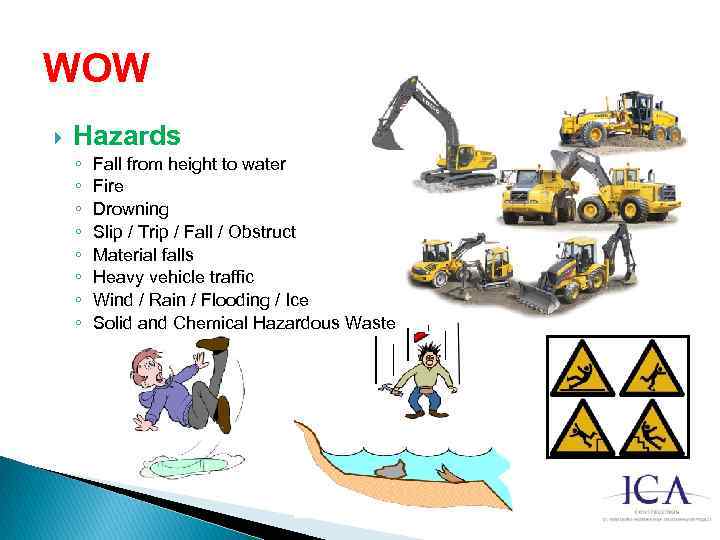
WOW Hazards ◦ ◦ ◦ ◦ Fall from height to water Fire Drowning Slip / Trip / Fall / Obstruct Material falls Heavy vehicle traffic Wind / Rain / Flooding / Ice Solid and Chemical Hazardous Waste
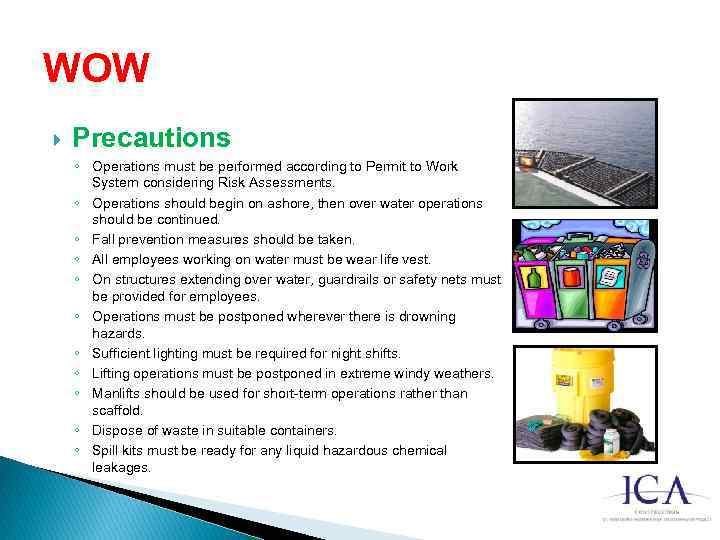
WOW Precautions ◦ Operations must be performed according to Permit to Work System considering Risk Assessments. ◦ Operations should begin on ashore, then over water operations should be continued. ◦ Fall prevention measures should be taken. ◦ All employees working on water must be wear life vest. ◦ On structures extending over water, guardrails or safety nets must be provided for employees. ◦ Operations must be postponed wherever there is drowning hazards. ◦ Sufficient lighting must be required for night shifts. ◦ Lifting operations must be postponed in extreme windy weathers. ◦ Manlifts should be used for short-term operations rather than scaffold. ◦ Dispose of waste in suitable containers. ◦ Spill kits must be ready for any liquid hazardous chemical leakages.
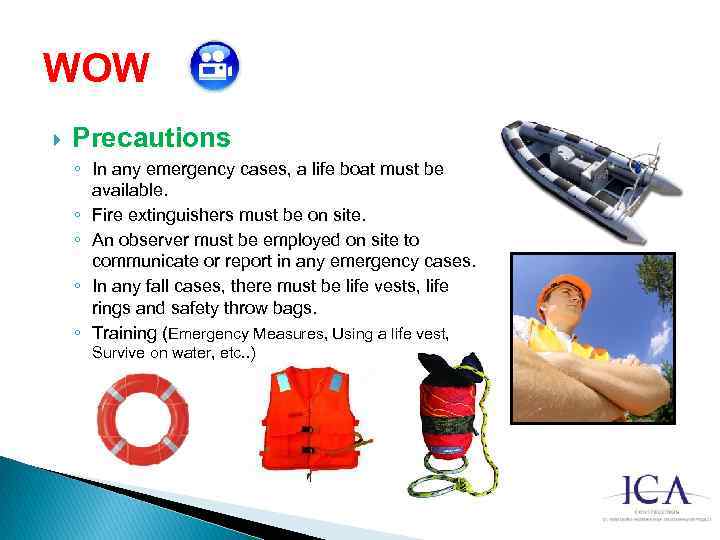
WOW Precautions ◦ In any emergency cases, a life boat must be available. ◦ Fire extinguishers must be on site. ◦ An observer must be employed on site to communicate or report in any emergency cases. ◦ In any fall cases, there must be life vests, life rings and safety throw bags. ◦ Training (Emergency Measures, Using a life vest, Survive on water, etc. . )
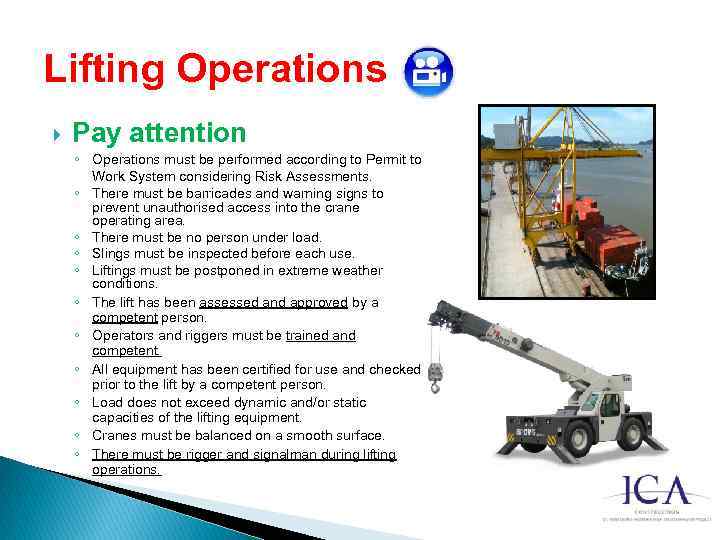
Lifting Operations Pay attention ◦ Operations must be performed according to Permit to Work System considering Risk Assessments. ◦ There must be barricades and warning signs to prevent unauthorised access into the crane operating area. ◦ There must be no person under load. ◦ Slings must be inspected before each use. ◦ Liftings must be postponed in extreme weather conditions. ◦ The lift has been assessed and approved by a competent person. ◦ Operators and riggers must be trained and competent. ◦ All equipment has been certified for use and checked prior to the lift by a competent person. ◦ Load does not exceed dynamic and/or static capacities of the lifting equipment. ◦ Cranes must be balanced on a smooth surface. ◦ There must be rigger and signalman during lifting operations.
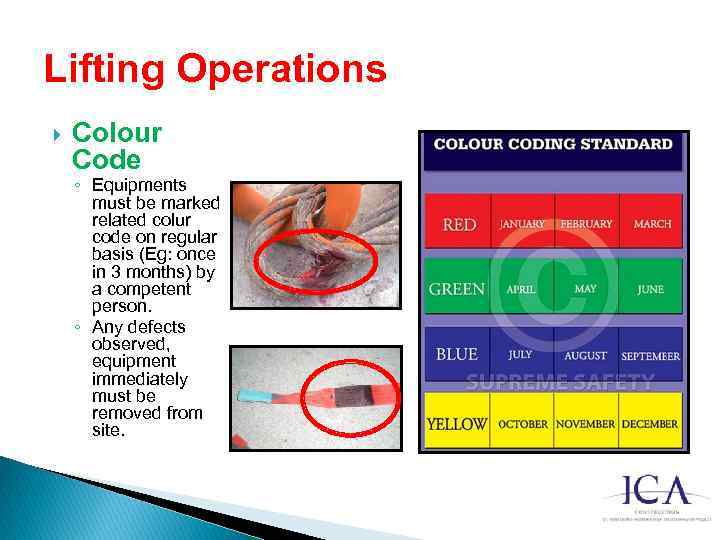
Lifting Operations Colour Code ◦ Equipments must be marked related colur code on regular basis (Eg: once in 3 months) by a competent person. ◦ Any defects observed, equipment immediately must be removed from site.
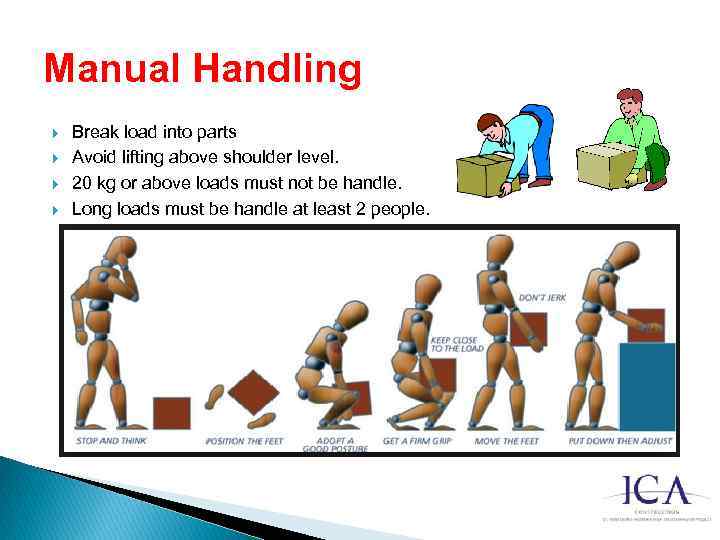
Manual Handling Break load into parts Avoid lifting above shoulder level. 20 kg or above loads must not be handle. Long loads must be handle at least 2 people.
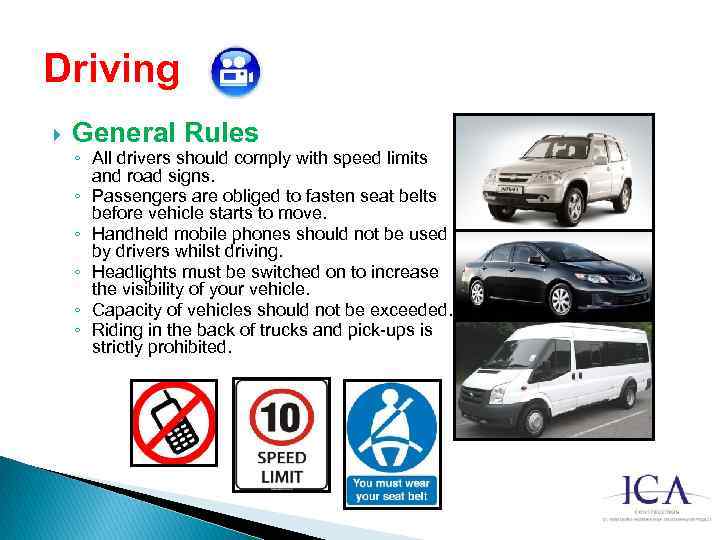
Driving General Rules ◦ All drivers should comply with speed limits and road signs. ◦ Passengers are obliged to fasten seat belts before vehicle starts to move. ◦ Handheld mobile phones should not be used by drivers whilst driving. ◦ Headlights must be switched on to increase the visibility of your vehicle. ◦ Capacity of vehicles should not be exceeded. ◦ Riding in the back of trucks and pick-ups is strictly prohibited.
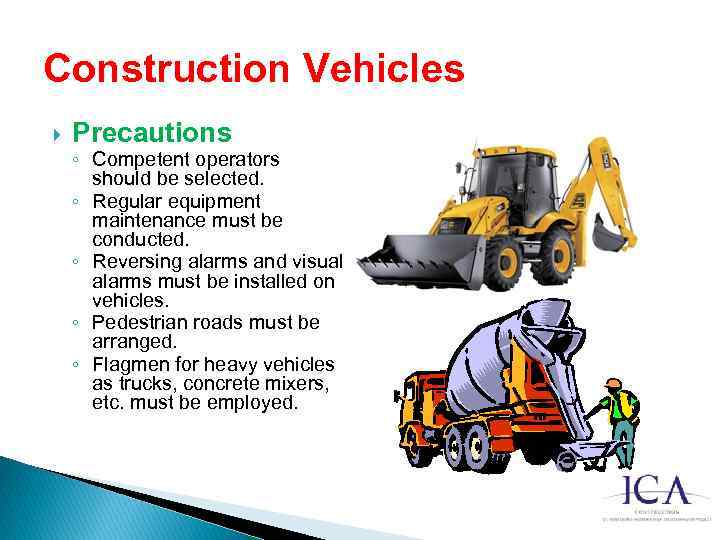
Construction Vehicles Precautions ◦ Competent operators should be selected. ◦ Regular equipment maintenance must be conducted. ◦ Reversing alarms and visual alarms must be installed on vehicles. ◦ Pedestrian roads must be arranged. ◦ Flagmen for heavy vehicles as trucks, concrete mixers, etc. must be employed.
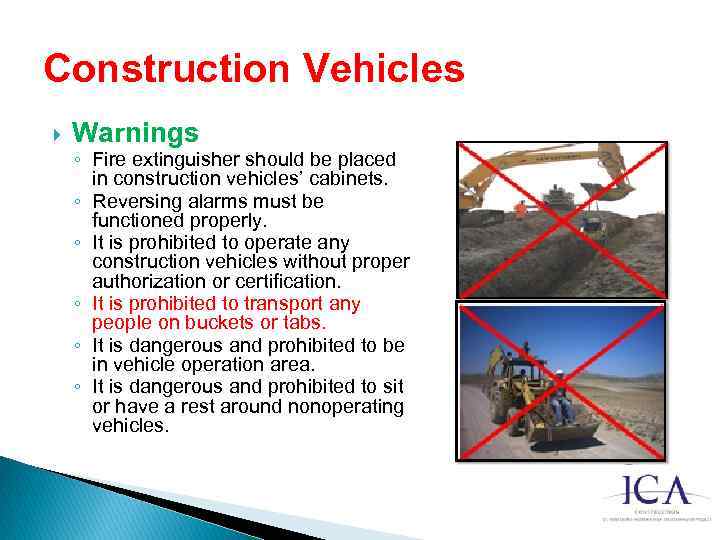
Construction Vehicles Warnings ◦ Fire extinguisher should be placed in construction vehicles’ cabinets. ◦ Reversing alarms must be functioned properly. ◦ It is prohibited to operate any construction vehicles without proper authorization or certification. ◦ It is prohibited to transport any people on buckets or tabs. ◦ It is dangerous and prohibited to be in vehicle operation area. ◦ It is dangerous and prohibited to sit or have a rest around nonoperating vehicles.
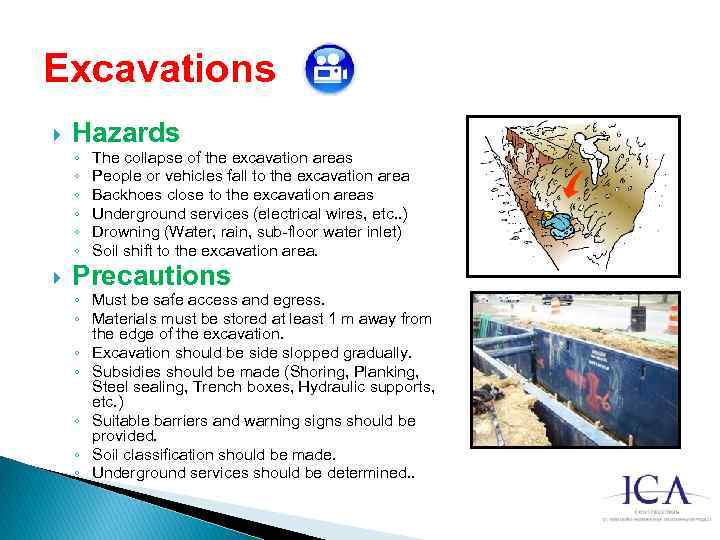
Excavations Hazards ◦ ◦ ◦ The collapse of the excavation areas People or vehicles fall to the excavation area Backhoes close to the excavation areas Underground services (electrical wires, etc. . ) Drowning (Water, rain, sub-floor water inlet) Soil shift to the excavation area. Precautions ◦ Must be safe access and egress. ◦ Materials must be stored at least 1 m away from the edge of the excavation. ◦ Excavation should be side slopped gradually. ◦ Subsidies should be made (Shoring, Planking, Steel sealing, Trench boxes, Hydraulic supports, etc. ) ◦ Suitable barriers and warning signs should be provided. ◦ Soil classification should be made. ◦ Underground services should be determined. .
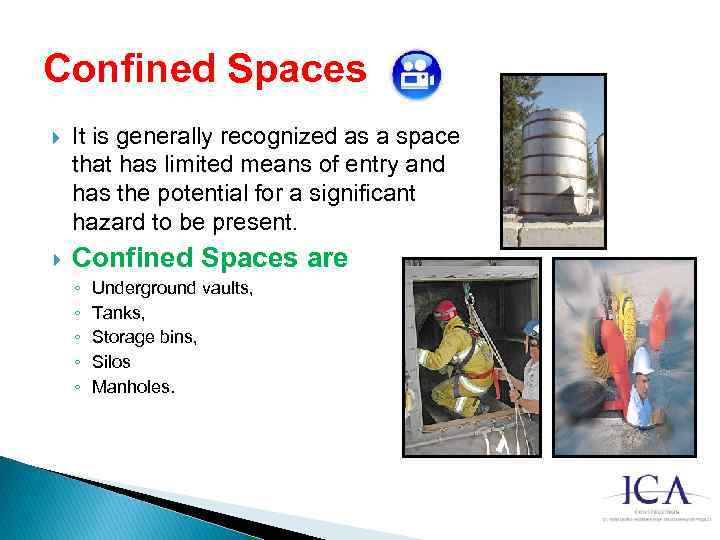
Confined Spaces It is generally recognized as a space that has limited means of entry and has the potential for a significant hazard to be present. Confined Spaces are ◦ ◦ ◦ Underground vaults, Tanks, Storage bins, Silos Manholes.
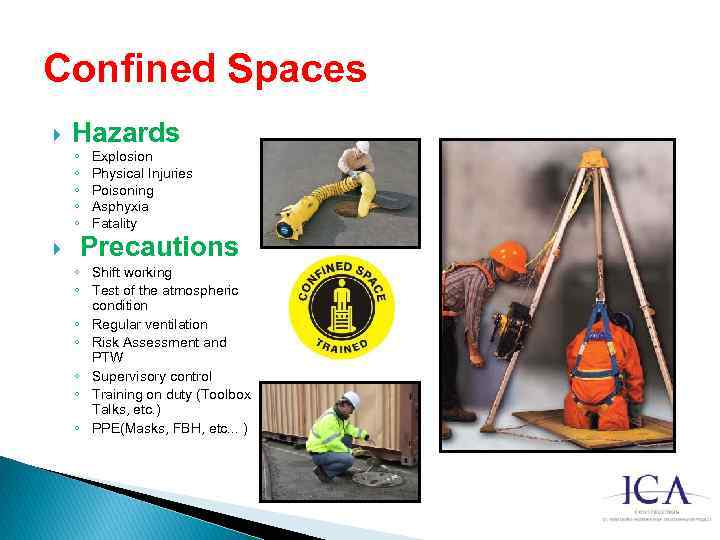
Confined Spaces Hazards ◦ ◦ ◦ Explosion Physical Injuries Poisoning Asphyxia Fatality Precautions ◦ Shift working ◦ Test of the atmospheric condition ◦ Regular ventilation ◦ Risk Assessment and PTW ◦ Supervisory control ◦ Training on duty (Toolbox Talks, etc. ) ◦ PPE(Masks, FBH, etc. . . )
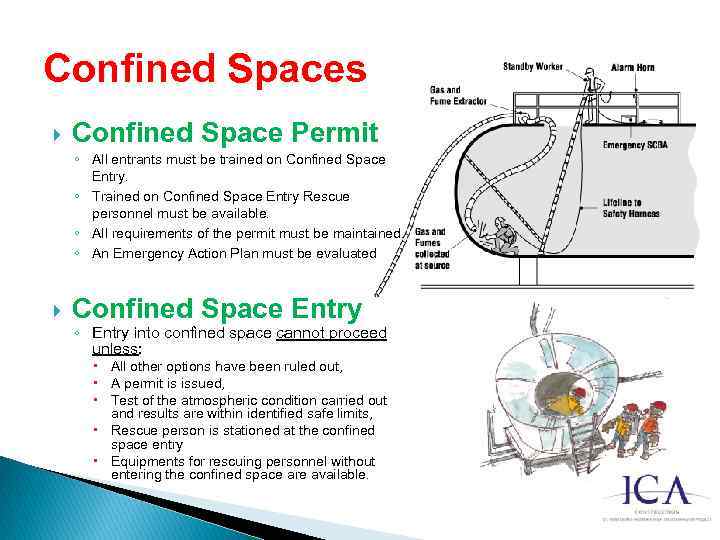
Confined Spaces Confined Space Permit ◦ All entrants must be trained on Confined Space Entry. ◦ Trained on Confined Space Entry Rescue personnel must be available. ◦ All requirements of the permit must be maintained. ◦ An Emergency Action Plan must be evaluated Confined Space Entry ◦ Entry into confined space cannot proceed unless: All other options have been ruled out, A permit is issued, Test of the atmospheric condition carried out and results are within identified safe limits, Rescue person is stationed at the confined space entry Equipments for rescuing personnel without entering the confined space are available.
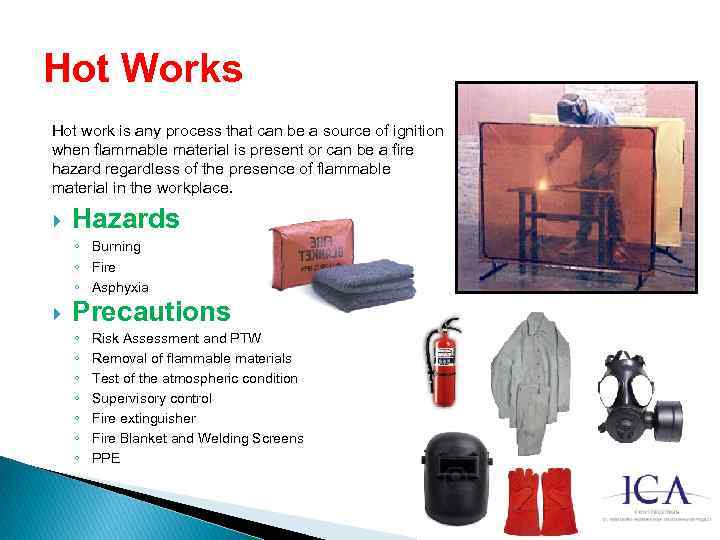
Hot Works Hot work is any process that can be a source of ignition when flammable material is present or can be a fire hazard regardless of the presence of flammable material in the workplace. Hazards ◦ Burning ◦ Fire ◦ Asphyxia Precautions ◦ ◦ ◦ ◦ Risk Assessment and PTW Removal of flammable materials Test of the atmospheric condition Supervisory control Fire extinguisher Fire Blanket and Welding Screens PPE
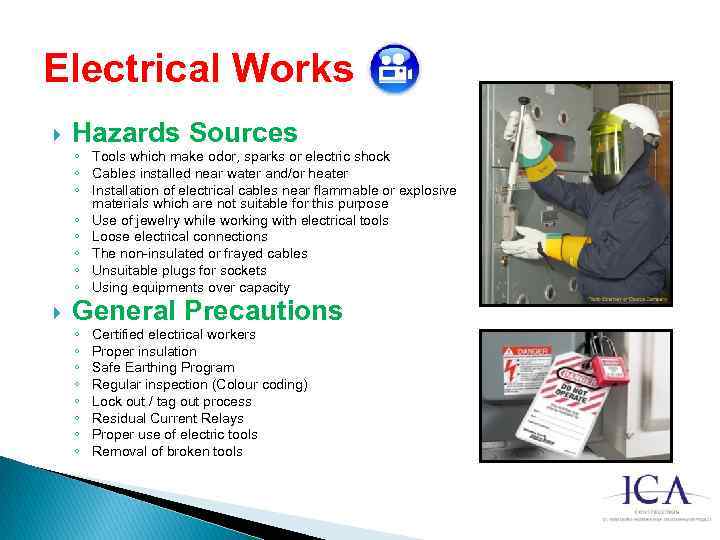
Electrical Works Hazards Sources ◦ Tools which make odor, sparks or electric shock ◦ Cables installed near water and/or heater ◦ Installation of electrical cables near flammable or explosive materials which are not suitable for this purpose ◦ Use of jewelry while working with electrical tools ◦ Loose electrical connections ◦ The non-insulated or frayed cables ◦ Unsuitable plugs for sockets ◦ Using equipments over capacity General Precautions ◦ ◦ ◦ ◦ Certified electrical workers Proper insulation Safe Earthing Program Regular inspection (Colour coding) Lock out / tag out process Residual Current Relays Proper use of electric tools Removal of broken tools
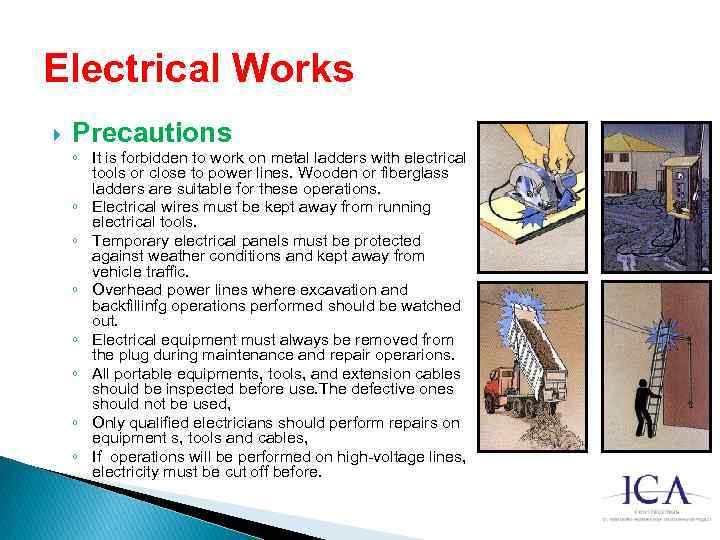
Electrical Works Precautions ◦ It is forbidden to work on metal ladders with electrical tools or close to power lines. Wooden or fiberglass ladders are suitable for these operations. ◦ Electrical wires must be kept away from running electrical tools. ◦ Temporary electrical panels must be protected against weather conditions and kept away from vehicle traffic. ◦ Overhead power lines where excavation and backfillinfg operations performed should be watched out. ◦ Electrical equipment must always be removed from the plug during maintenance and repair operarions. ◦ All portable equipments, tools, and extension cables should be inspected before use. The defective ones should not be used, ◦ Only qualified electricians should perform repairs on equipment s, tools and cables, ◦ If operations will be performed on high-voltage lines, electricity must be cut off before.
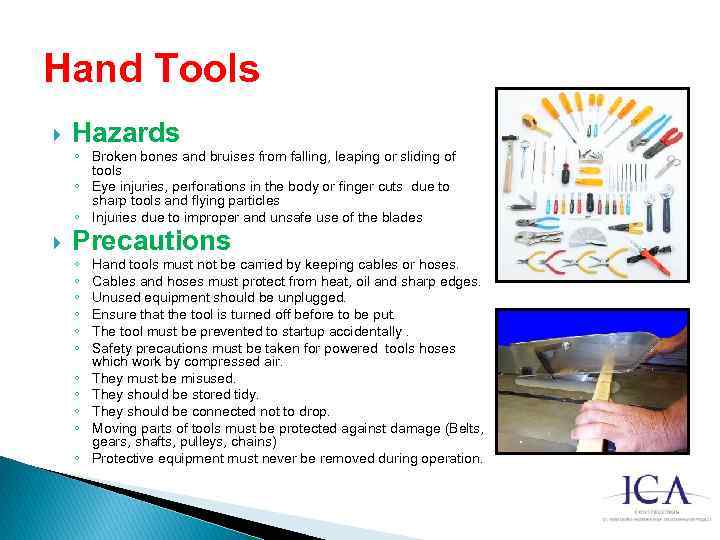
Hand Tools Hazards ◦ Broken bones and bruises from falling, leaping or sliding of tools ◦ Eye injuries, perforations in the body or finger cuts due to sharp tools and flying particles ◦ Injuries due to improper and unsafe use of the blades Precautions ◦ ◦ ◦ Hand tools must not be carried by keeping cables or hoses. Cables and hoses must protect from heat, oil and sharp edges. Unused equipment should be unplugged. Ensure that the tool is turned off before to be put. The tool must be prevented to startup accidentally. Safety precautions must be taken for powered tools hoses which work by compressed air. They must be misused. They should be stored tidy. They should be connected not to drop. Moving parts of tools must be protected against damage (Belts, gears, shafts, pulleys, chains) Protective equipment must never be removed during operation.
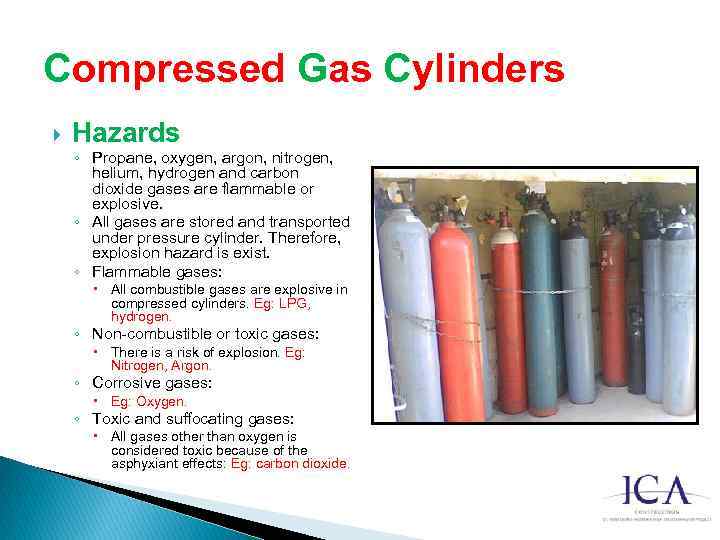
Compressed Gas Cylinders Hazards ◦ Propane, oxygen, argon, nitrogen, helium, hydrogen and carbon dioxide gases are flammable or explosive. ◦ All gases are stored and transported under pressure cylinder. Therefore, explosion hazard is exist. ◦ Flammable gases: All combustible gases are explosive in compressed cylinders. Eg: LPG, hydrogen. ◦ Non-combustible or toxic gases: There is a risk of explosion. Eg: Nitrogen, Argon. ◦ Corrosive gases: Eg: Oxygen. ◦ Toxic and suffocating gases: All gases other than oxygen is considered toxic because of the asphyxiant effects: Eg: carbon dioxide.
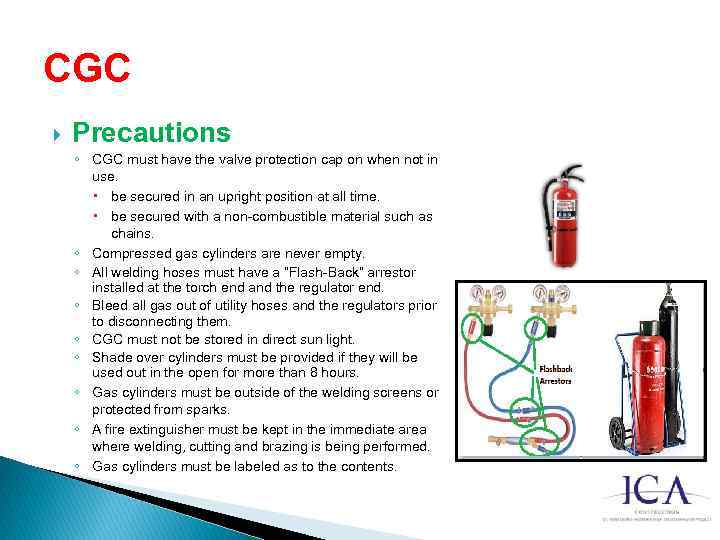
CGC Precautions ◦ CGC must have the valve protection cap on when not in use. be secured in an upright position at all time. be secured with a non-combustible material such as chains. ◦ Compressed gas cylinders are never empty. ◦ All welding hoses must have a “Flash-Back” arrestor installed at the torch end and the regulator end. ◦ Bleed all gas out of utility hoses and the regulators prior to disconnecting them. ◦ CGC must not be stored in direct sun light. ◦ Shade over cylinders must be provided if they will be used out in the open for more than 8 hours. ◦ Gas cylinders must be outside of the welding screens or protected from sparks. ◦ A fire extinguisher must be kept in the immediate area where welding, cutting and brazing is being performed. ◦ Gas cylinders must be labeled as to the contents.
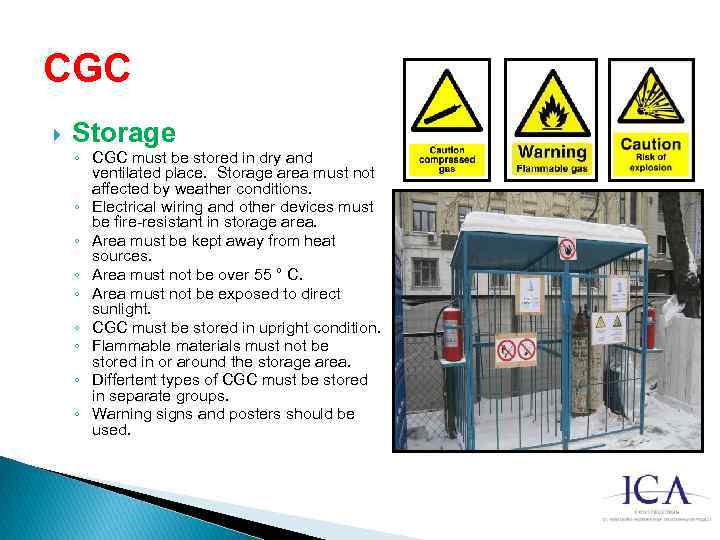
CGC Storage ◦ CGC must be stored in dry and ventilated place. Storage area must not affected by weather conditions. ◦ Electrical wiring and other devices must be fire-resistant in storage area. ◦ Area must be kept away from heat sources. ◦ Area must not be over 55 ° C. ◦ Area must not be exposed to direct sunlight. ◦ CGC must be stored in upright condition. ◦ Flammable materials must not be stored in or around the storage area. ◦ Differtent types of CGC must be stored in separate groups. ◦ Warning signs and posters should be used.
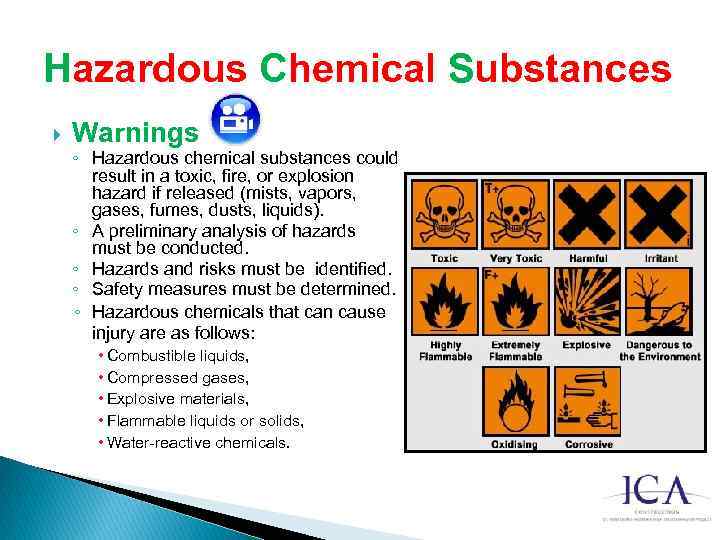
Hazardous Chemical Substances Warnings ◦ Hazardous chemical substances could result in a toxic, fire, or explosion hazard if released (mists, vapors, gases, fumes, dusts, liquids). ◦ A preliminary analysis of hazards must be conducted. ◦ Hazards and risks must be identified. ◦ Safety measures must be determined. ◦ Hazardous chemicals that can cause injury are as follows: • Combustible liquids, • Compressed gases, • Explosive materials, • Flammable liquids or solids, • Water-reactive chemicals.
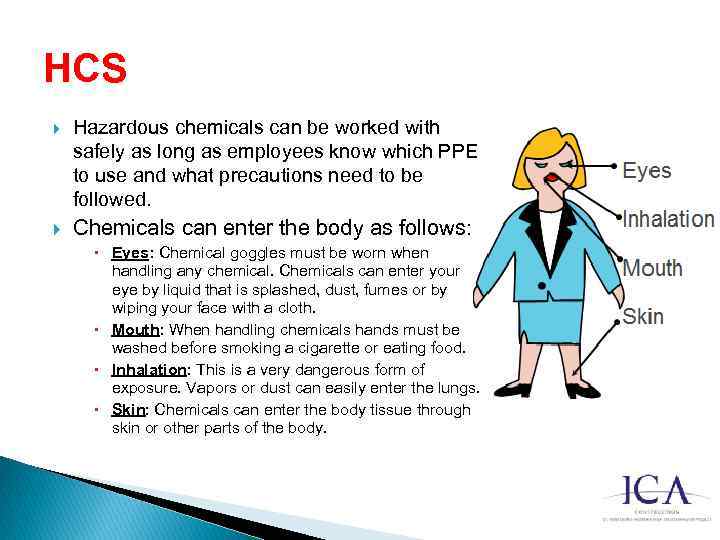
HCS Hazardous chemicals can be worked with safely as long as employees know which PPE to use and what precautions need to be followed. Chemicals can enter the body as follows: Eyes: Chemical goggles must be worn when handling any chemical. Chemicals can enter your eye by liquid that is splashed, dust, fumes or by wiping your face with a cloth. Mouth: When handling chemicals hands must be washed before smoking a cigarette or eating food. Inhalation: This is a very dangerous form of exposure. Vapors or dust can easily enter the lungs. Skin: Chemicals can enter the body tissue through skin or other parts of the body.
HCS Material Safety Data Sheet(MSDS) It is a document that contains information on the potential hazards (health, fire, reactivity and environmental) and how to work safely with the chemical product. It includes: ◦ ◦ ◦ ◦ The introduction of producer, Material composition / information on ingredients, Physical data (melting point, boiling point, etc. ), Toxicity, Health effects, First aid, Reactivity, Fire-fighting measures, Measures to be taken as a result of incident, Storage, Disposal methods, Spill-handling procedures. PPE.
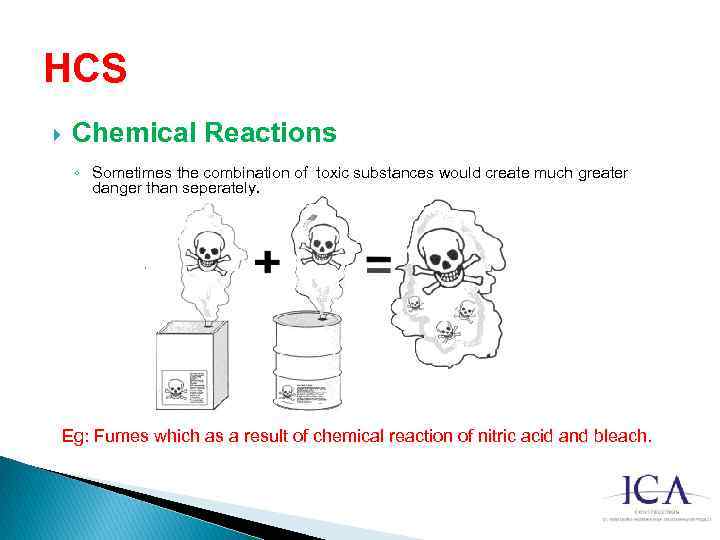
HCS Chemical Reactions ◦ Sometimes the combination of toxic substances would create much greater danger than seperately. Eg: Fumes which as a result of chemical reaction of nitric acid and bleach.
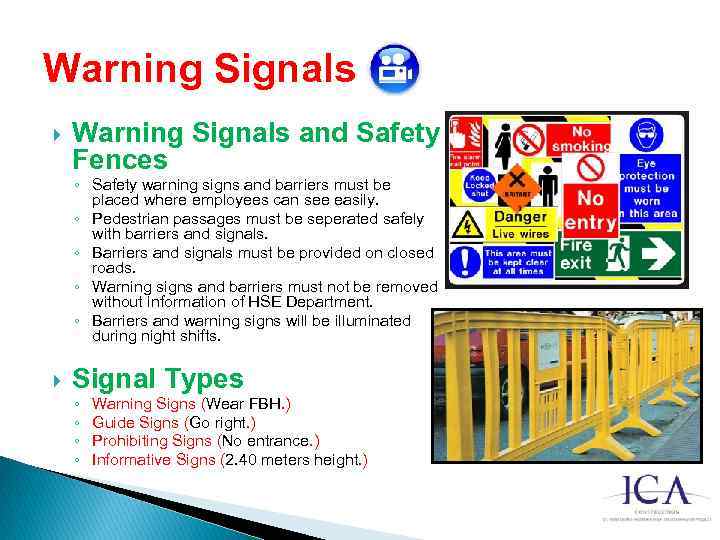
Warning Signals and Safety Fences ◦ Safety warning signs and barriers must be placed where employees can see easily. ◦ Pedestrian passages must be seperated safely with barriers and signals. ◦ Barriers and signals must be provided on closed roads. ◦ Warning signs and barriers must not be removed without information of HSE Department. ◦ Barriers and warning signs will be illuminated during night shifts. Signal Types ◦ ◦ Warning Signs (Wear FBH. ) Guide Signs (Go right. ) Prohibiting Signs (No entrance. ) Informative Signs (2. 40 meters height. )
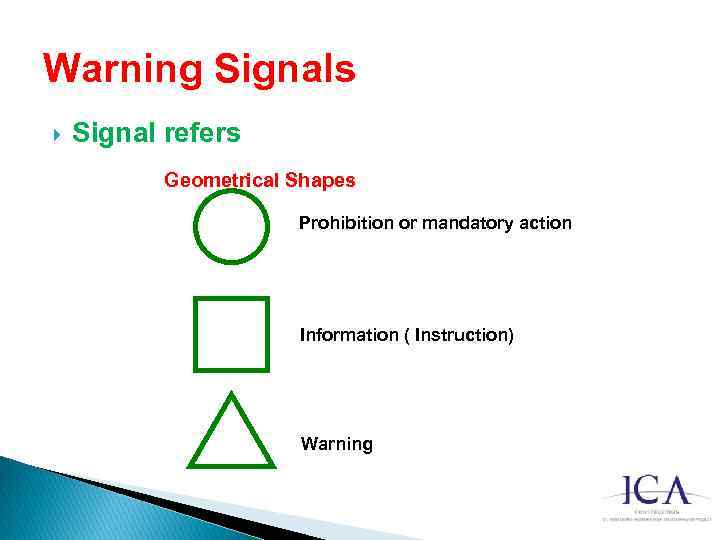
Warning Signals Signal refers Geometrical Shapes Prohibition or mandatory action Information ( Instruction) Warning
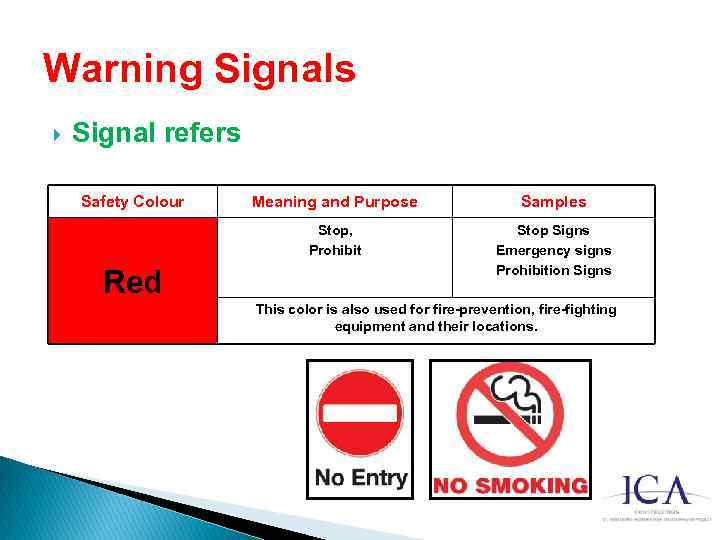
Warning Signals Signal refers Safety Colour Samples Stop, Prohibit Red Meaning and Purpose Stop Signs Emergency signs Prohibition Signs This color is also used for fire-prevention, fire-fighting equipment and their locations.
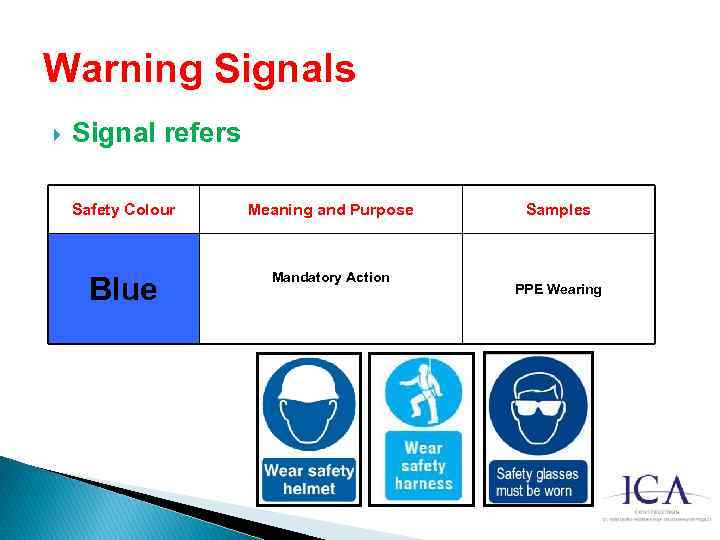
Warning Signals Signal refers Safety Colour Meaning and Purpose Blue Mandatory Action Samples PPE Wearing
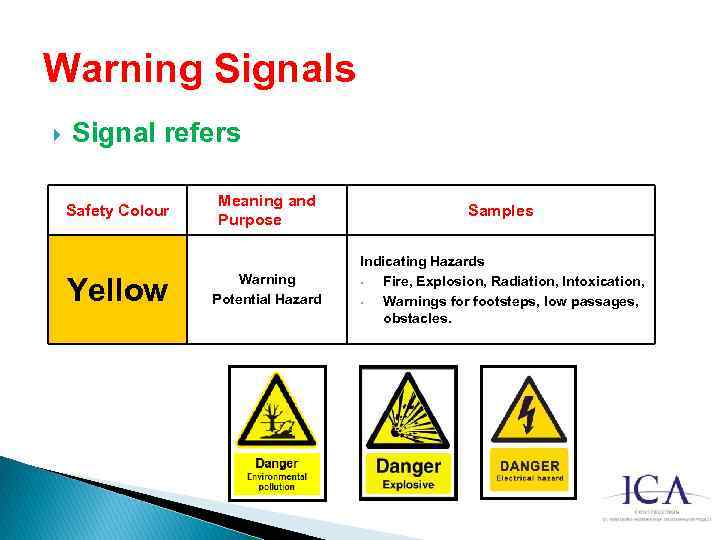
Warning Signals Signal refers Safety Colour Yellow Meaning and Purpose Samples Warning Potential Hazard Indicating Hazards • Fire, Explosion, Radiation, Intoxication, • Warnings for footsteps, low passages, obstacles.
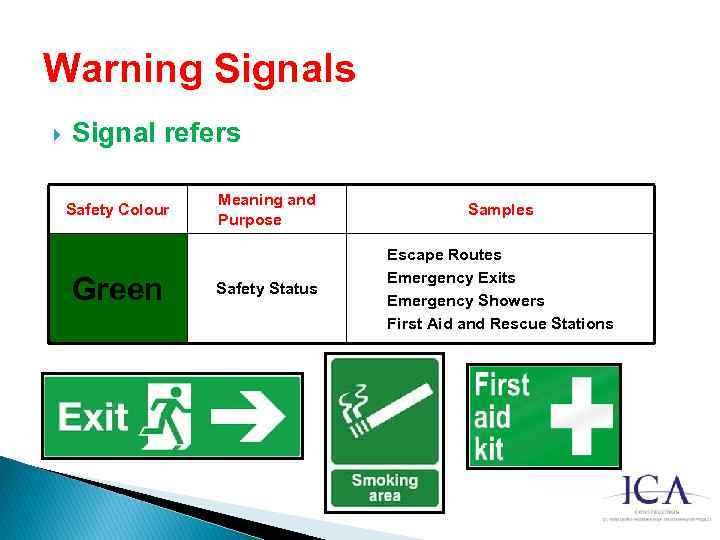
Warning Signals Signal refers Safety Colour Green Meaning and Purpose Samples Safety Status Escape Routes Emergency Exits Emergency Showers First Aid and Rescue Stations
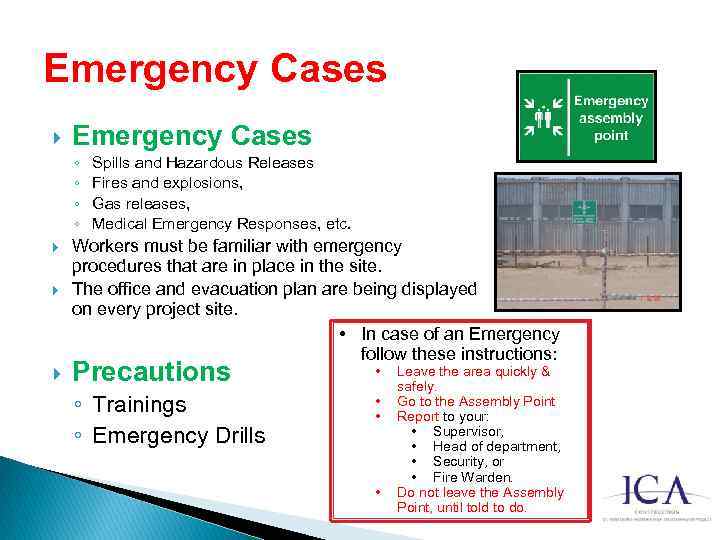
Emergency Cases ◦ ◦ Spills and Hazardous Releases Fires and explosions, Gas releases, Medical Emergency Responses, etc. Workers must be familiar with emergency procedures that are in place in the site. The office and evacuation plan are being displayed on every project site. • In case of an Emergency follow these instructions: Precautions • ◦ Trainings ◦ Emergency Drills • • • Leave the area quickly & safely. Go to the Assembly Point Report to your: • Supervisor, • Head of department, • Security, or • Fire Warden. Do not leave the Assembly Point, until told to do.
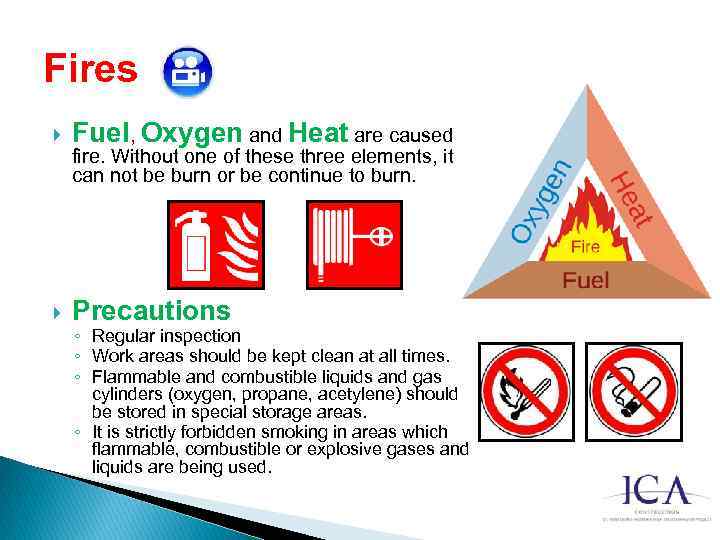
Fires Fuel, Oxygen and Heat are caused Precautions fire. Without one of these three elements, it can not be burn or be continue to burn. ◦ Regular inspection ◦ Work areas should be kept clean at all times. ◦ Flammable and combustible liquids and gas cylinders (oxygen, propane, acetylene) should be stored in special storage areas. ◦ It is strictly forbidden smoking in areas which flammable, combustible or explosive gases and liquids are being used.
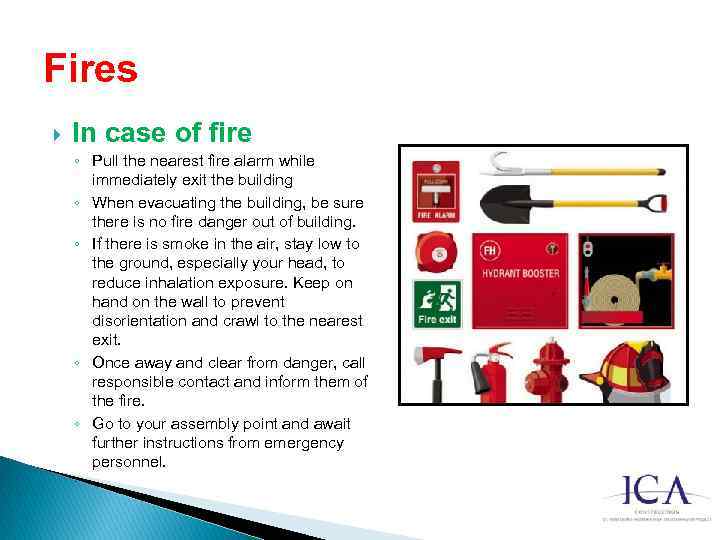
Fires In case of fire ◦ Pull the nearest fire alarm while immediately exit the building ◦ When evacuating the building, be sure there is no fire danger out of building. ◦ If there is smoke in the air, stay low to the ground, especially your head, to reduce inhalation exposure. Keep on hand on the wall to prevent disorientation and crawl to the nearest exit. ◦ Once away and clear from danger, call responsible contact and inform them of the fire. ◦ Go to your assembly point and await further instructions from emergency personnel. .
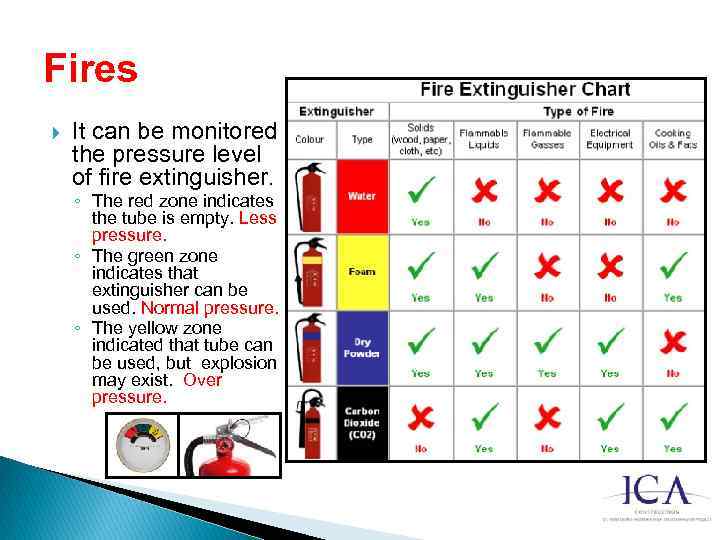
Fires It can be monitored the pressure level of fire extinguisher. ◦ The red zone indicates the tube is empty. Less pressure. ◦ The green zone indicates that extinguisher can be used. Normal pressure. ◦ The yellow zone indicated that tube can be used, but explosion may exist. Over pressure.
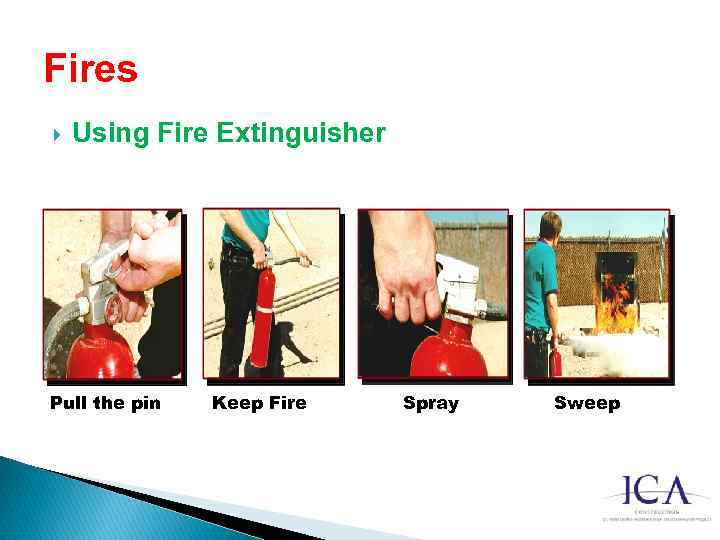
Fires Using Fire Extinguisher Pull the pin Keep Fire Spray Sweep
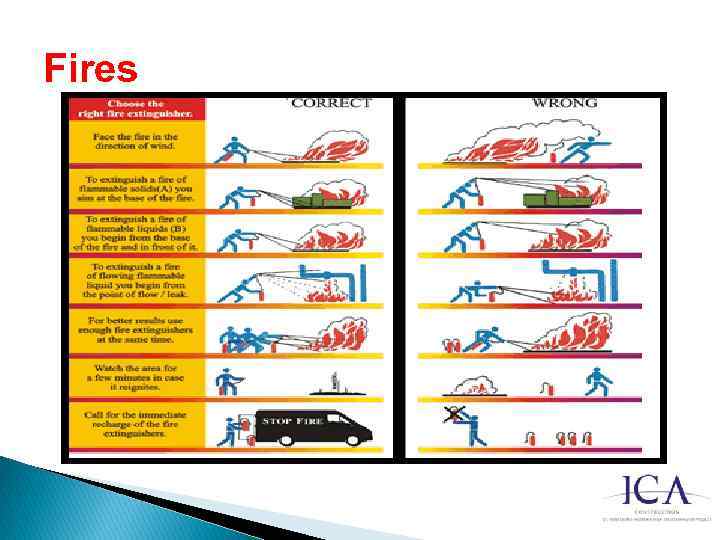
Fires
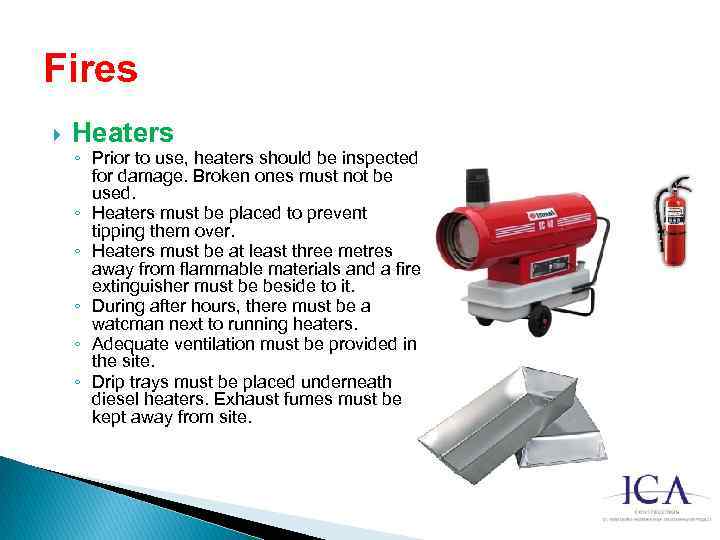
Fires Heaters ◦ Prior to use, heaters should be inspected for damage. Broken ones must not be used. ◦ Heaters must be placed to prevent tipping them over. ◦ Heaters must be at least three metres away from flammable materials and a fire extinguisher must be beside to it. ◦ During after hours, there must be a watcman next to running heaters. ◦ Adequate ventilation must be provided in the site. ◦ Drip trays must be placed underneath diesel heaters. Exhaust fumes must be kept away from site.
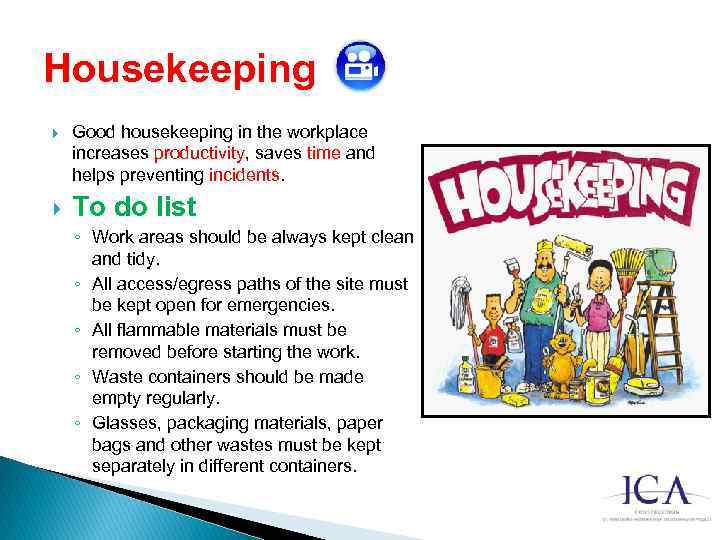
Housekeeping Good housekeeping in the workplace increases productivity, saves time and helps preventing incidents. To do list ◦ Work areas should be always kept clean and tidy. ◦ All access/egress paths of the site must be kept open for emergencies. ◦ All flammable materials must be removed before starting the work. ◦ Waste containers should be made empty regularly. ◦ Glasses, packaging materials, paper bags and other wastes must be kept separately in different containers.
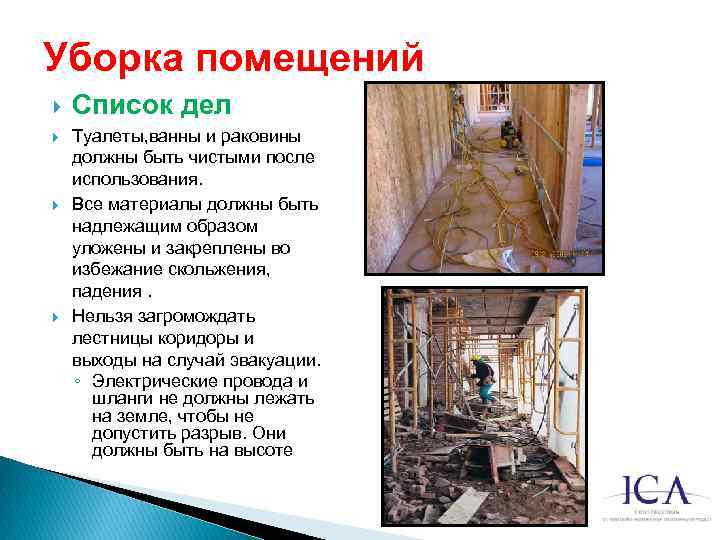
Уборка помещений Список дел Туалеты, ванны и раковины должны быть чистыми после использования. Все материалы должны быть надлежащим образом уложены и закреплены во избежание скольжения, падения. Нельзя загромождать лестницы коридоры и выходы на случай эвакуации. ◦ Электрические провода и шланги не должны лежать на земле, чтобы не допустить разрыв. Они должны быть на высоте
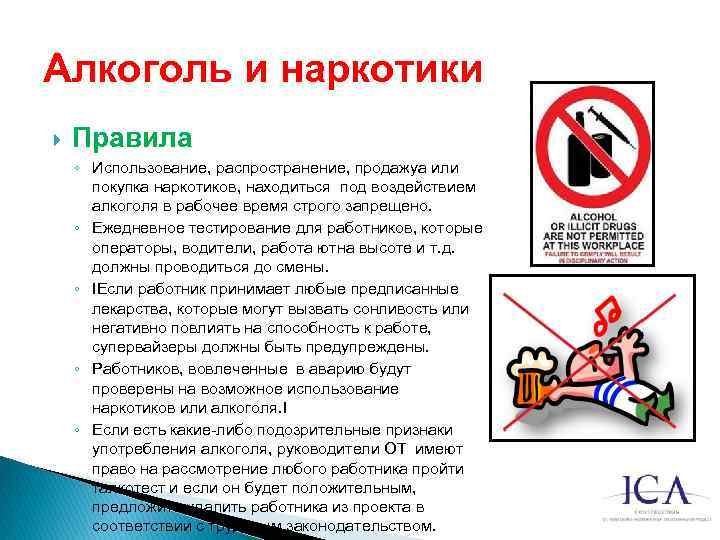
Алкоголь и наркотики Правила ◦ Использование, распространение, продажуа или покупка наркотиков, находиться под воздействием алкоголя в рабочее время строго запрещено. ◦ Ежедневное тестирование для работников, которые операторы, водители, работа ютна высоте и т. д. должны проводиться до смены. ◦ IЕсли работник принимает любые предписанные лекарства, которые могут вызвать сонливость или негативно повлиять на способность к работе, супервайзеры должны быть предупреждены. ◦ Работников, вовлеченные в аварию будут проверены на возможное использование наркотиков или алкоголя. I ◦ Если есть какие-либо подозрительные признаки употребления алкоголя, руководители ОТ имеют право на рассмотрение любого работника пройти талкотест и если он будет положительным, предложите удалить работника из проекта в соответствии с трудовым законодательством.
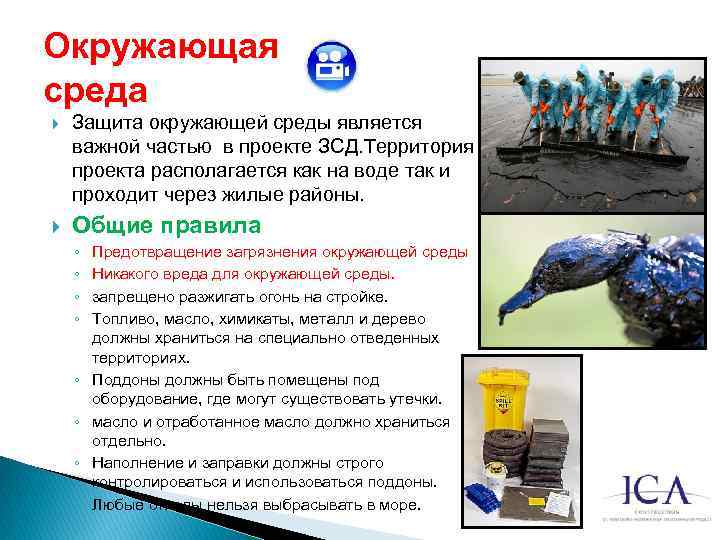
Окружающая среда Защита окружающей среды является важной частью в проекте ЗСД. Территория проекта располагается как на воде так и проходит через жилые районы. Общие правила ◦ ◦ ◦ ◦ Предотвращение загрязнения окружающей среды Никакого вреда для окружающей среды. запрещено разжигать огонь на стройке. Топливо, масло, химикаты, металл и дерево должны храниться на специально отведенных территориях. Поддоны должны быть помещены под оборудование, где могут существовать утечки. масло и отработанное масло должно храниться отдельно. Наполнение и заправки должны строго контролироваться и использоваться поддоны. Любые отходы нельзя выбрасывать в море.
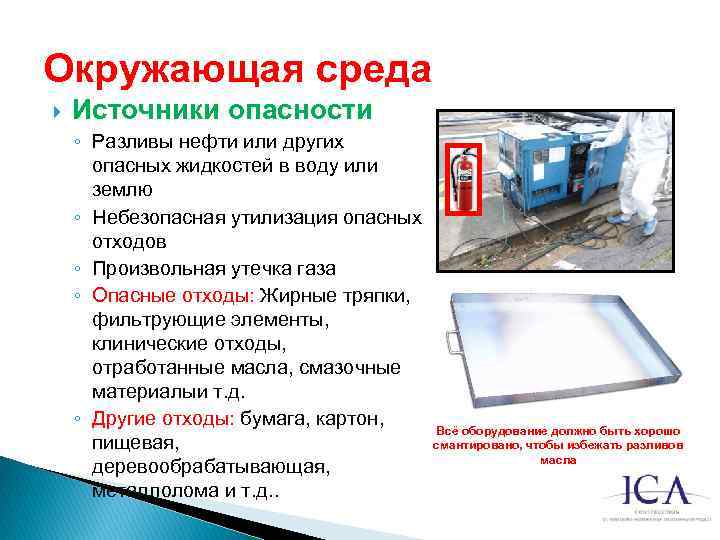
Окружающая среда Источники опасности ◦ Разливы нефти или других опасных жидкостей в воду или землю ◦ Небезопасная утилизация опасных отходов ◦ Произвольная утечка газа ◦ Опасные отходы: Жирные тряпки, фильтрующие элементы, клинические отходы, отработанные масла, смазочные материалыи т. д. ◦ Другие отходы: бумага, картон, Всё оборудование должно быть хорошо смантировано, чтобы избежать разливов пищевая, масла деревообрабатывающая, металлолома и т. д. .
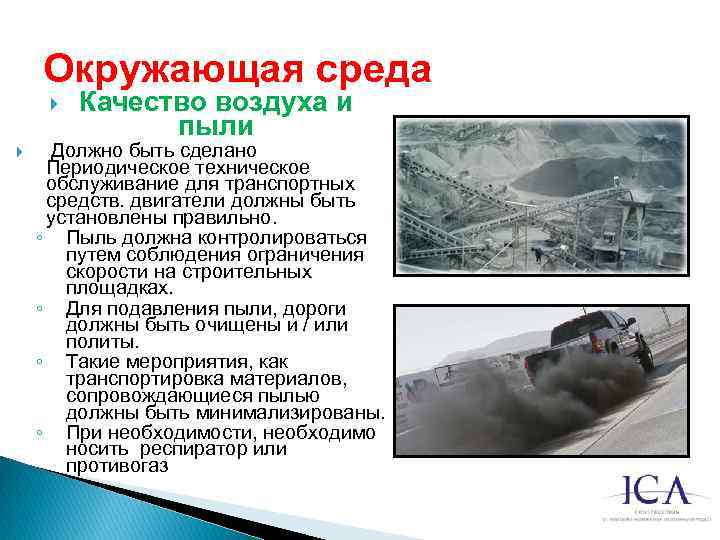
Окружающая среда Качество воздуха и пыли Должно быть сделано Периодическое техническое обслуживание для транспортных средств. двигатели должны быть установлены правильно. ◦ Пыль должна контролироваться путем соблюдения ограничения скорости на строительных площадках. ◦ Для подавления пыли, дороги должны быть очищены и / или политы. ◦ Такие мероприятия, как транспортировка материалов, сопровождающиеся пылью должны быть минимализированы. ◦ При необходимости, необходимо носить респиратор или противогаз
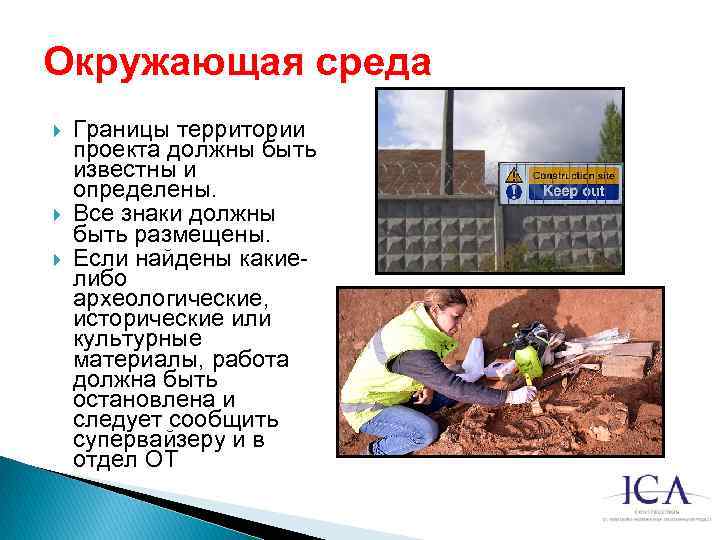
Окружающая среда Границы территории проекта должны быть известны и определены. Все знаки должны быть размещены. Если найдены какиелибо археологические, исторические или культурные материалы, работа должна быть остановлена и следует сообщить супервайзеру и в отдел ОТ
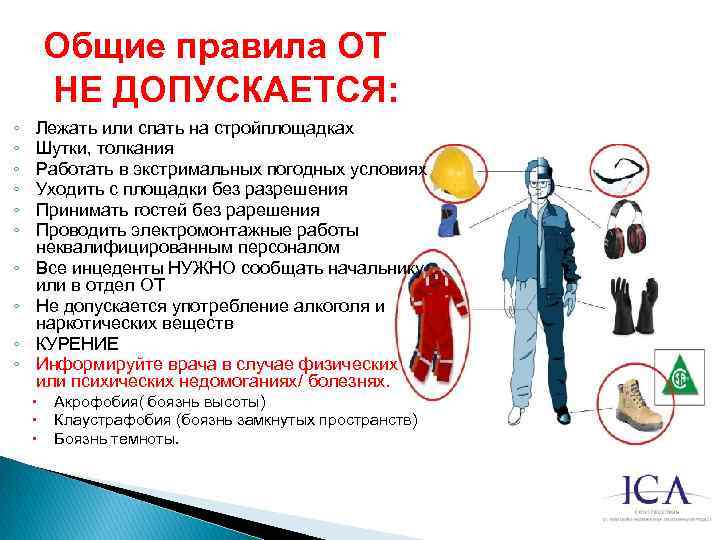
Общие правила ОТ НЕ ДОПУСКАЕТСЯ: ◦ ◦ ◦ ◦ ◦ Лежать или спать на стройплощадках Шутки, толкания Работать в экстримальных погодных условиях Уходить с площадки без разрешения Принимать гостей без рарешения Проводить электромонтажные работы неквалифицированным персоналом Все инцеденты НУЖНО сообщать начальнику или в отдел ОТ Не допускается употребление алкоголя и наркотических веществ КУРЕНИЕ Информируйте врача в случае физических или психических недомоганиях/ болезнях. Акрофобия( боязнь высоты) Клаустрафобия (боязнь замкнутых пространств) Боязнь темноты.
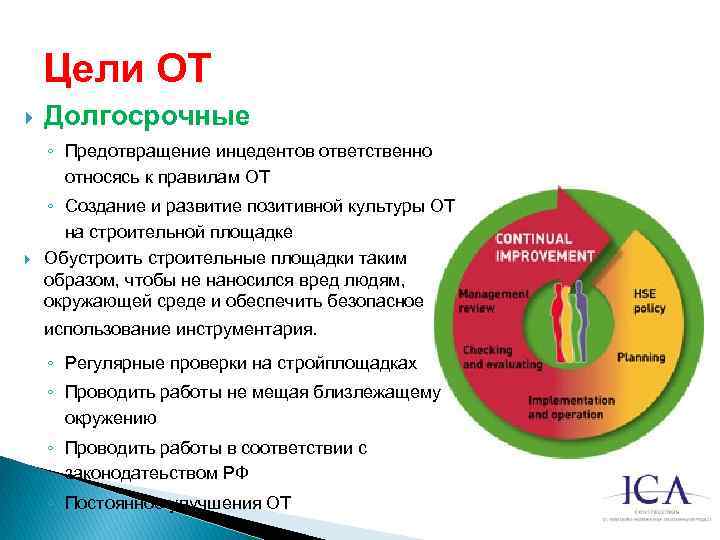
Цели ОТ Долгосрочные ◦ Предотвращение инцедентов ответственно относясь к правилам ОТ ◦ Создание и развитие позитивной культуры ОТ на строительной площадке Обустроить строительные площадки таким образом, чтобы не наносился вред людям, окружающей среде и обеспечить безопасное использование инструментария. ◦ Регулярные проверки на стройплощадках ◦ Проводить работы не мещая близлежащему окружению ◦ Проводить работы в соответствии с законодатеьством РФ ◦ Постоянное улучшения ОТ
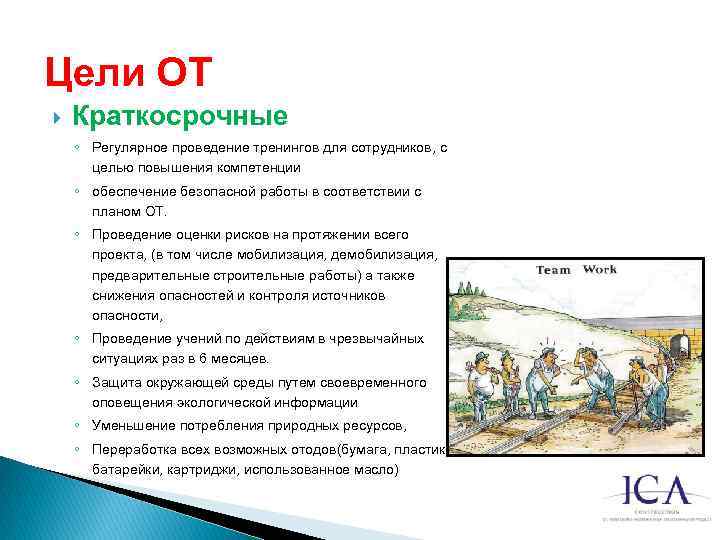
Цели ОТ Краткосрочные ◦ Регулярное проведение тренингов для сотрудников, с целью повышения компетенции ◦ обеспечение безопасной работы в соответствии с планом ОТ. ◦ Проведение оценки рисков на протяжении всего проекта, (в том числе мобилизация, демобилизация, предварительные строительные работы) а также снижения опасностей и контроля источников опасности, ◦ Проведение учений по действиям в чрезвычайных ситуациях раз в 6 месяцев. ◦ Защита окружающей среды путем своевременного оповещения экологической информации ◦ Уменьшение потребления природных ресурсов, ◦ Переработка всех возможных отодов(бумага, пластик, батарейки, картриджи, использованное масло)
Политика Охраны Труда: ICA предоставляет в проекте ЗСД: ◦ Тренинги, презентации, для повышения развития сотрудников и ответственого подхода к работе, ◦ Уменьшение убытков, ◦ Проверку и оценку эффектривности ОТ, ◦ Устанавливает стандарты ОТ, ◦ Создает культуру ОТ на проекте, ◦ Постоянно развивает и улучшает ОТ.
Главные цели ОТ: Основная цель компании ICA на проекте ЗСД это: ‘‘Ни одного несчастного случая’’ ◦ ◦ Каждый, кто работает на проекте ЗСД играет важную роль для достижения цели “Ни одного несчастного случая Все сотрудники, принимающие участие в проекте ЗСД должны соблюдать и реализовывать правила по охране труда в своей работе. Каждый сотрудник проекта имеет право ОСТАНОВИТЬ НЕБЕЗОПАСНУЮ РАБОТУ

Добро пожаловать на проект ЗСД
Скачать презентацию St Petersburg ICA Western High Speed Diameter Construction
1_ICA WHSD HSE Site _RUS.pptx