


 Скачать презентацию St John of Jerusalem Eye Hospital Group 2016
afe3eb29dec760235140c30013e0c228.ppt
- Количество слайдов: 42
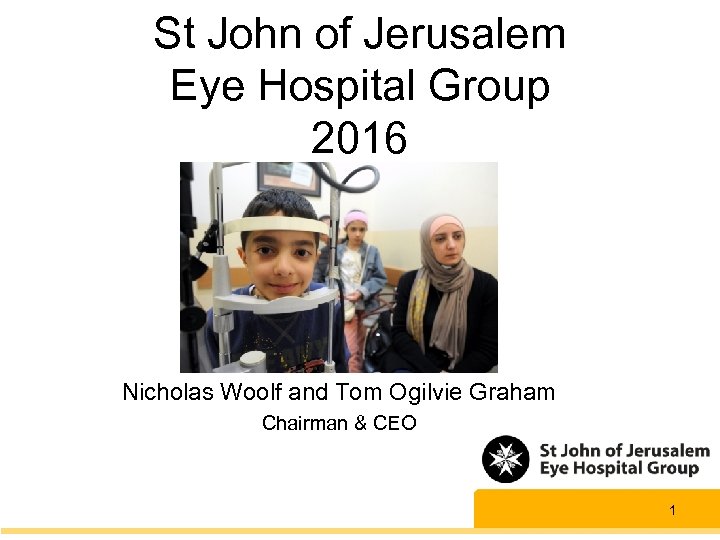 St John of Jerusalem Eye Hospital Group 2016 Nicholas Woolf and Tom Ogilvie Graham Chairman & CEO 1
 Middle East context Middle East engulfed in radicalism, war, sectarianism (e. g. Syria war with impact on Lebanon, Jordan and Turkey; Palestine-Israel conflict in stalemate; ISIS in Iraq and rest of region; instability in Egypt and Gulf) War & conflict + Dire living conditions (poverty; lack of access to health, food and education; unemployment) Direct impact on Europe REFUGEE CRISIS (e. g. ”The Islamic State of Molenbeek? ”) POLARISATION (in politics and society). . . 2
 Palestine: some key facts Dire living conditions • 75% Palestinians in East Jerusalem live below the poverty line • Gaza unemployment rate averages 43%, highest in the world - 60% youth unemployment • Gaza: 1. 8 million people “locked in”, 80% rely on international aid • 20% patients (and their companions) from the West Bank were denied permits to enter Jerusalem • 33% patients (referred on health grounds) from Gaza denied exit in December 2015, the highest in 7 years References: The World Bank, Oxfam, Association for Civil Rights in Israel, the World Health Organization and UNRWA. 3
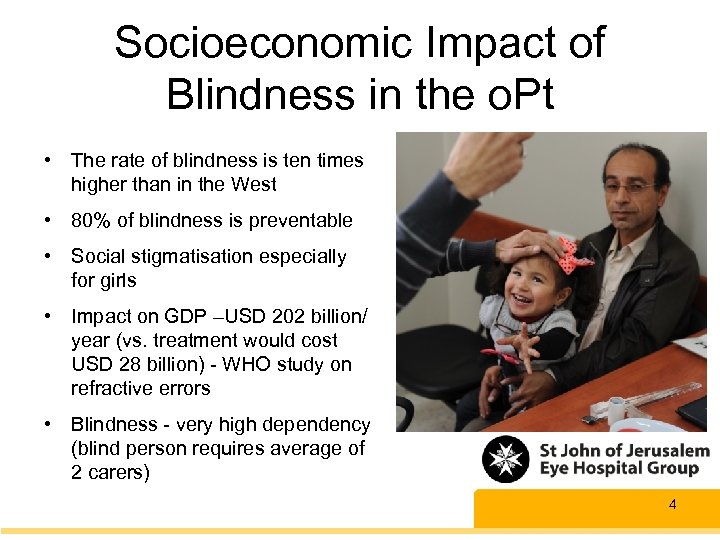 Socioeconomic Impact of Blindness in the o. Pt • The rate of blindness is ten times higher than in the West • 80% of blindness is preventable • Social stigmatisation especially for girls • Impact on GDP –USD 202 billion/ year (vs. treatment would cost USD 28 billion) - WHO study on refractive errors • Blindness - very high dependency (blind person requires average of 2 carers) 4
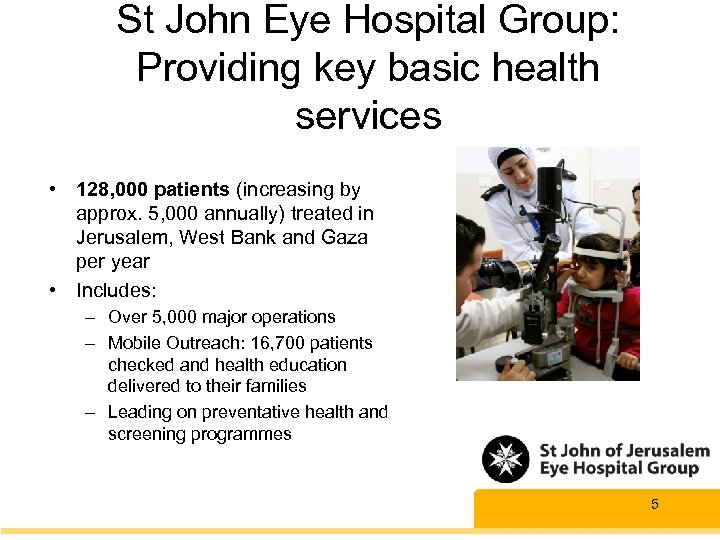 St John Eye Hospital Group: Providing key basic health services • 128, 000 patients (increasing by approx. 5, 000 annually) treated in Jerusalem, West Bank and Gaza per year • Includes: – Over 5, 000 major operations – Mobile Outreach: 16, 700 patients checked and health education delivered to their families – Leading on preventative health and screening programmes 5
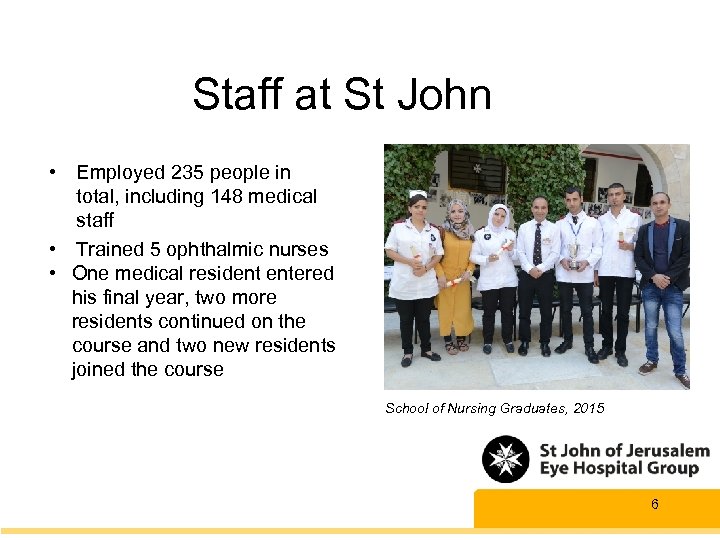 Staff at St John • Employed 235 people in total, including 148 medical staff • Trained 5 ophthalmic nurses • One medical resident entered his final year, two more residents continued on the course and two new residents joined the course School of Nursing Graduates, 2015 6
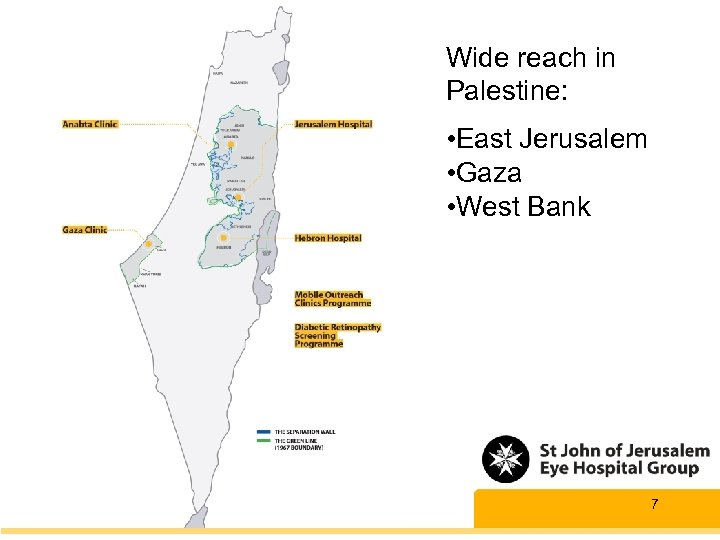 Wide reach in Palestine: • East Jerusalem • Gaza • West Bank 7
 Quality of Care • SJEHG services offer the highest standards of care, notwithstanding the difficult climate in which we operate • JCI accreditation is the gold standard in health care and its consultants are the most experienced in the industry • In 2016 SJEHG had its three yearly review achieving 96% overall 8
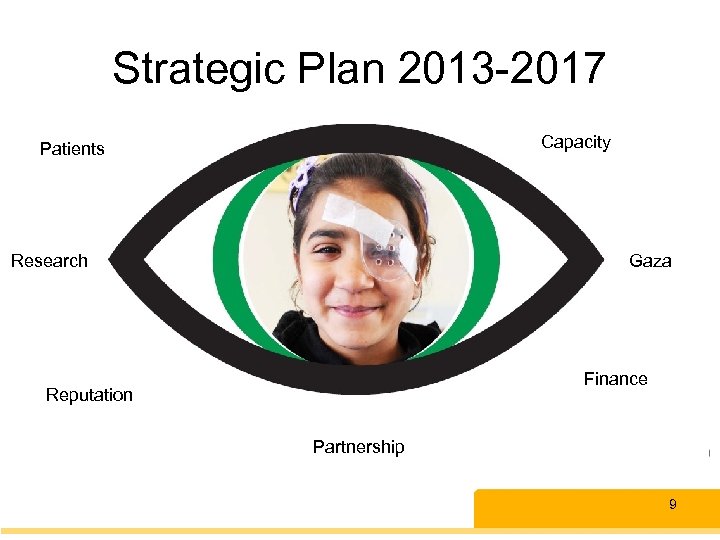 Strategic Plan 2013 -2017 Capacity Patients Research Gaza Finance Reputation Partnership 9
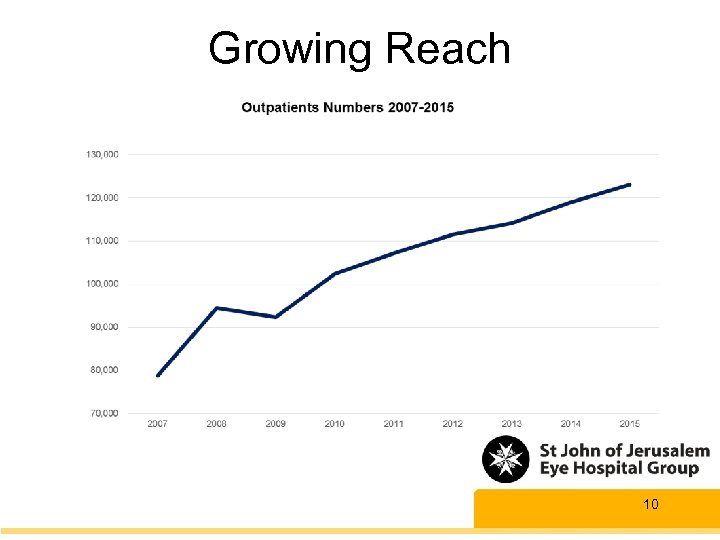 Growing Reach 10
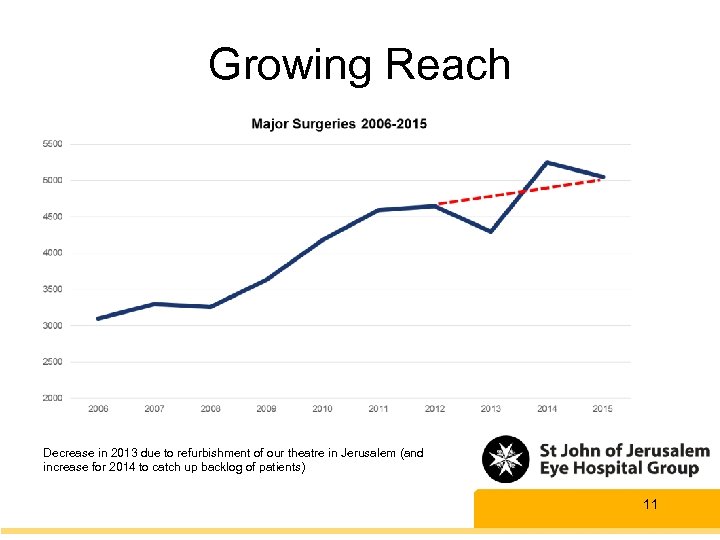 Growing Reach Decrease in 2013 due to refurbishment of our theatre in Jerusalem (and increase for 2014 to catch up backlog of patients) 11
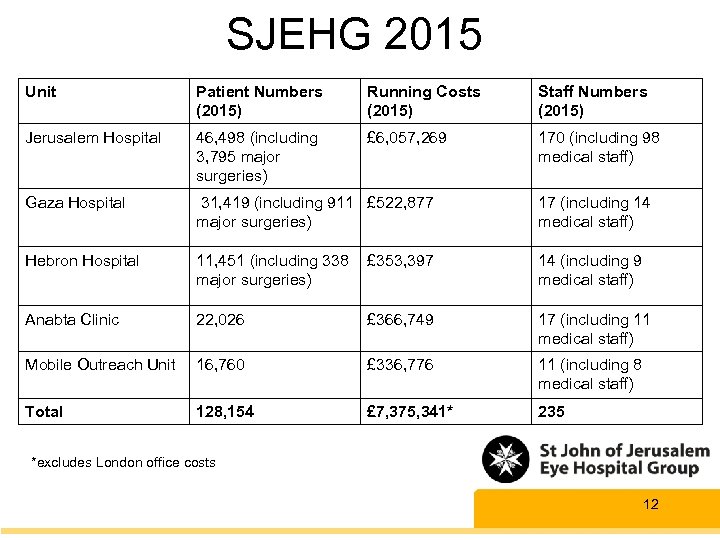 SJEHG 2015 Unit Patient Numbers (2015) Running Costs (2015) Staff Numbers (2015) Jerusalem Hospital 46, 498 (including 3, 795 major surgeries) £ 6, 057, 269 170 (including 98 medical staff) Gaza Hospital 31, 419 (including 911 £ 522, 877 major surgeries) 17 (including 14 medical staff) Hebron Hospital 11, 451 (including 338 £ 353, 397 major surgeries) 14 (including 9 medical staff) Anabta Clinic 22, 026 £ 366, 749 17 (including 11 medical staff) Mobile Outreach Unit 16, 760 £ 336, 776 11 (including 8 medical staff) Total 128, 154 £ 7, 375, 341* 235 *excludes London office costs 12
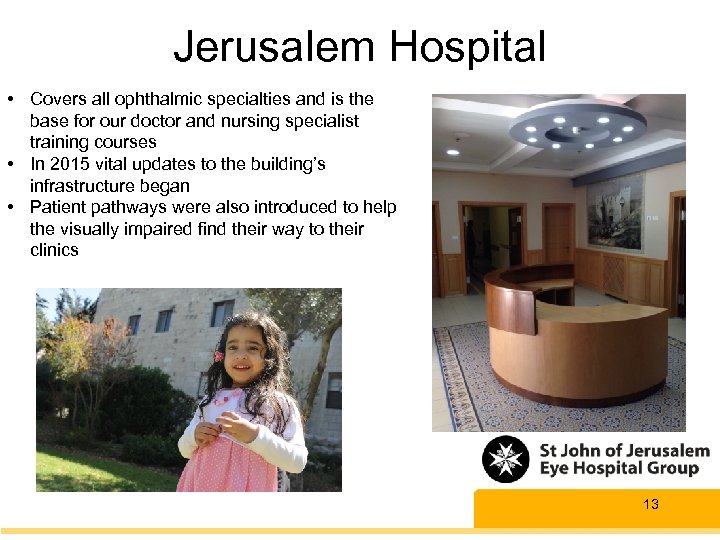 Jerusalem Hospital • Covers all ophthalmic specialties and is the base for our doctor and nursing specialist training courses • In 2015 vital updates to the building’s infrastructure began • Patient pathways were also introduced to help the visually impaired find their way to their clinics 13
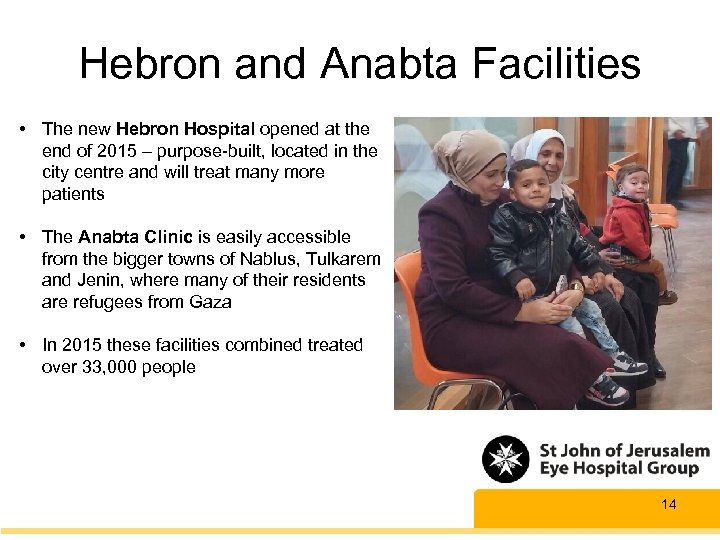 Hebron and Anabta Facilities • The new Hebron Hospital opened at the end of 2015 – purpose-built, located in the city centre and will treat many more patients • The Anabta Clinic is easily accessible from the bigger towns of Nablus, Tulkarem and Jenin, where many of their residents are refugees from Gaza • In 2015 these facilities combined treated over 33, 000 people 14
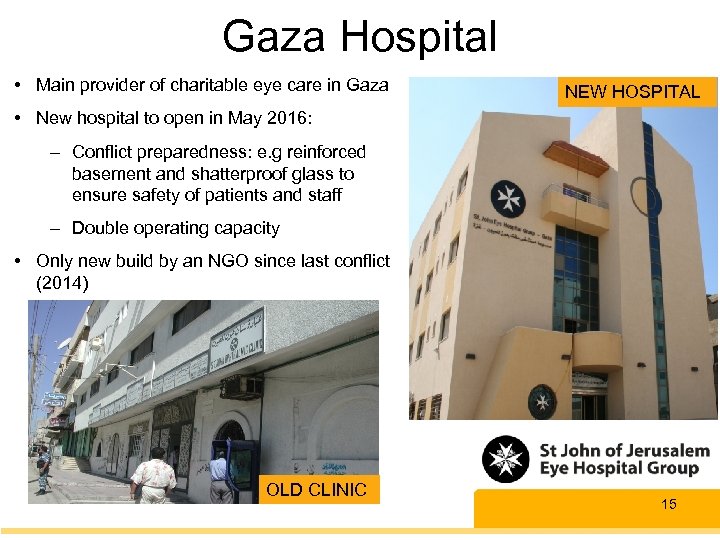 Gaza Hospital • Main provider of charitable eye care in Gaza NEW HOSPITAL • New hospital to open in May 2016: – Conflict preparedness: e. g reinforced basement and shatterproof glass to ensure safety of patients and staff – Double operating capacity • Only new build by an NGO since last conflict (2014) OLD CLINIC 15
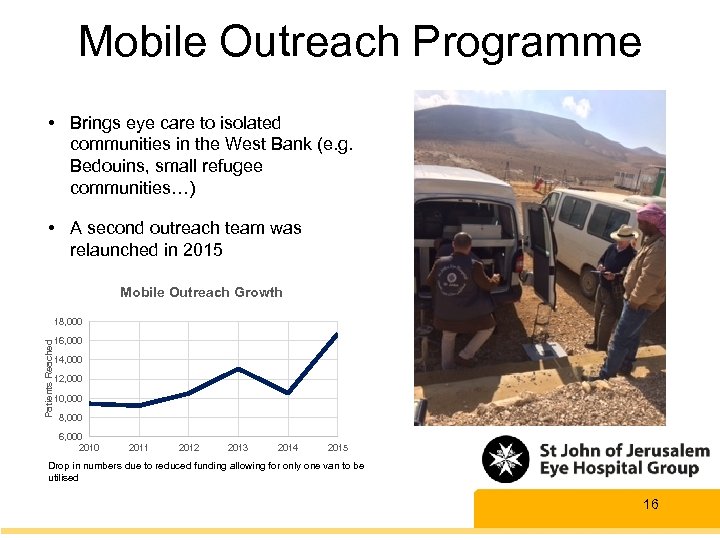 Mobile Outreach Programme • Brings eye care to isolated communities in the West Bank (e. g. Bedouins, small refugee communities…) • A second outreach team was relaunched in 2015 Mobile Outreach Growth Patients Reached 18, 000 16, 000 14, 000 12, 000 10, 000 8, 000 6, 000 2011 2012 2013 2014 2015 Drop in numbers due to reduced funding allowing for only one van to be utilised 16
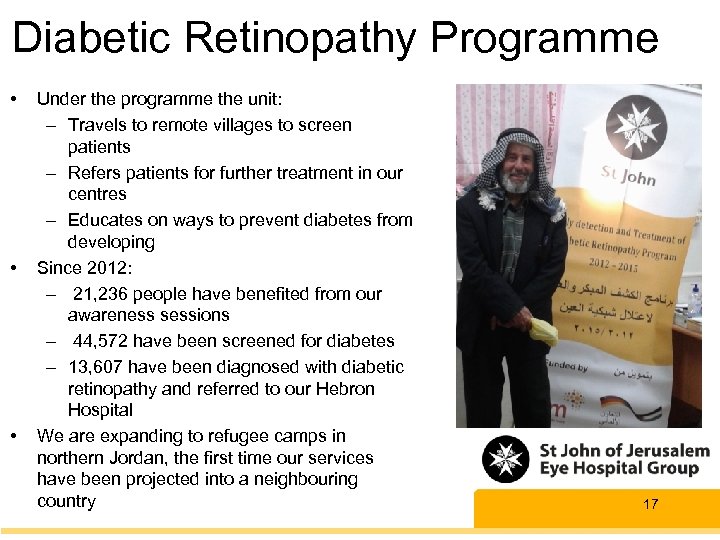 Diabetic Retinopathy Programme • • • Under the programme the unit: – Travels to remote villages to screen patients – Refers patients for further treatment in our centres – Educates on ways to prevent diabetes from developing Since 2012: – 21, 236 people have benefited from our awareness sessions – 44, 572 have been screened for diabetes – 13, 607 have been diagnosed with diabetic retinopathy and referred to our Hebron Hospital We are expanding to refugee camps in northern Jordan, the first time our services have been projected into a neighbouring country 17
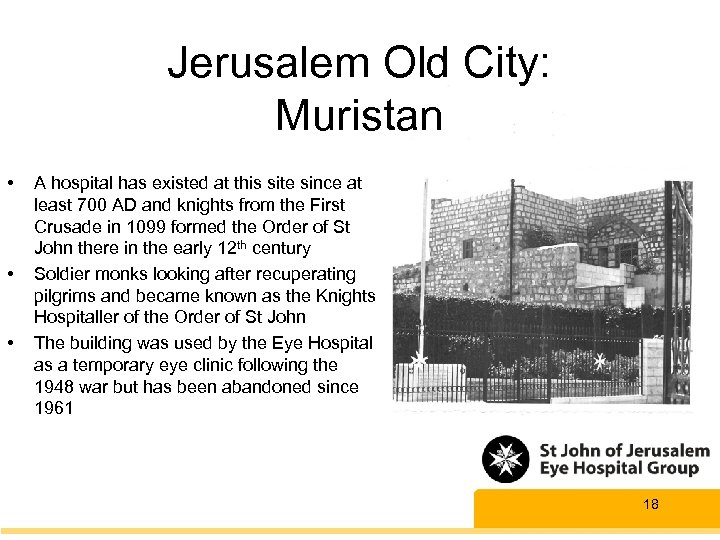 Jerusalem Old City: Muristan • • • A hospital has existed at this site since at least 700 AD and knights from the First Crusade in 1099 formed the Order of St John there in the early 12 th century Soldier monks looking after recuperating pilgrims and became known as the Knights Hospitaller of the Order of St John The building was used by the Eye Hospital as a temporary eye clinic following the 1948 war but has been abandoned since 1961 18
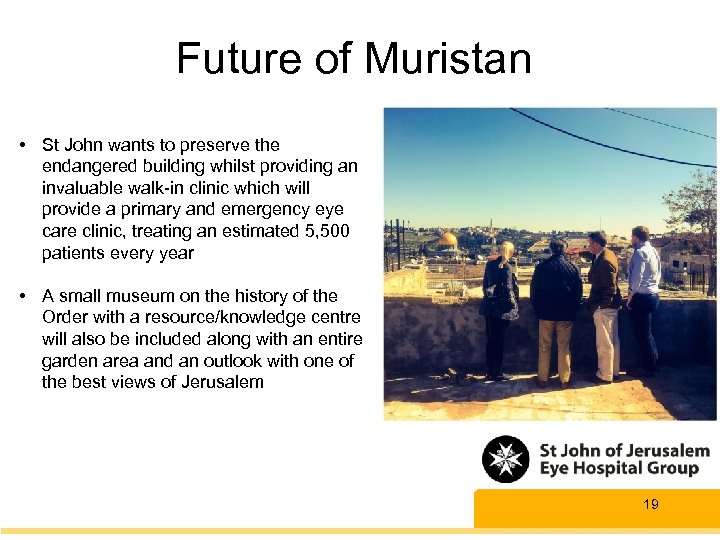 Future of Muristan • St John wants to preserve the endangered building whilst providing an invaluable walk-in clinic which will provide a primary and emergency eye care clinic, treating an estimated 5, 500 patients every year • A small museum on the history of the Order with a resource/knowledge centre will also be included along with an entire garden area and an outlook with one of the best views of Jerusalem 19
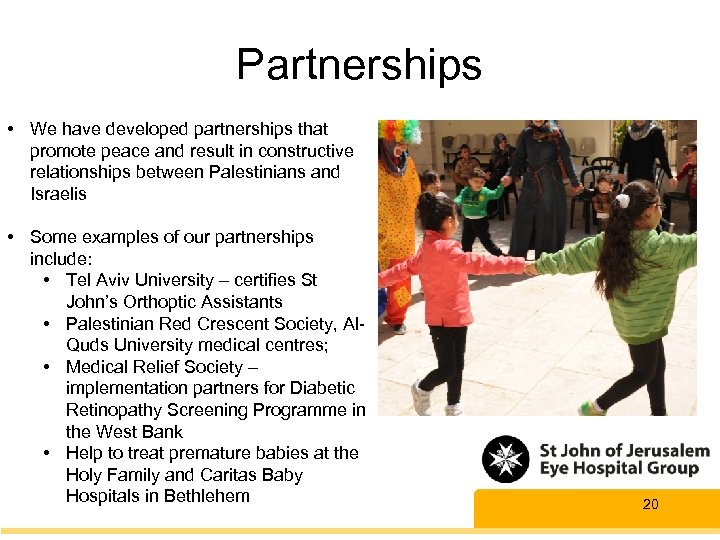 Partnerships • We have developed partnerships that promote peace and result in constructive relationships between Palestinians and Israelis • Some examples of our partnerships include: • Tel Aviv University – certifies St John’s Orthoptic Assistants • Palestinian Red Crescent Society, Al. Quds University medical centres; • Medical Relief Society – implementation partners for Diabetic Retinopathy Screening Programme in the West Bank • Help to treat premature babies at the Holy Family and Caritas Baby Hospitals in Bethlehem 20
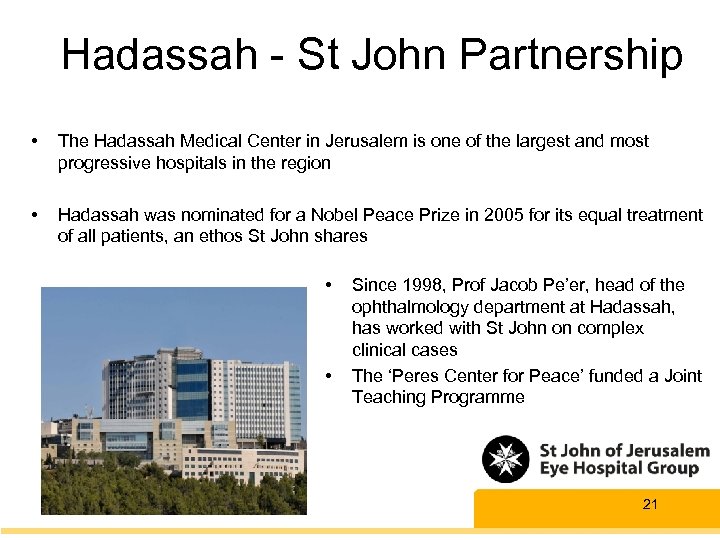 Hadassah - St John Partnership • The Hadassah Medical Center in Jerusalem is one of the largest and most progressive hospitals in the region • Hadassah was nominated for a Nobel Peace Prize in 2005 for its equal treatment of all patients, an ethos St John shares • • Since 1998, Prof Jacob Pe’er, head of the ophthalmology department at Hadassah, has worked with St John on complex clinical cases The ‘Peres Center for Peace’ funded a Joint Teaching Programme 21
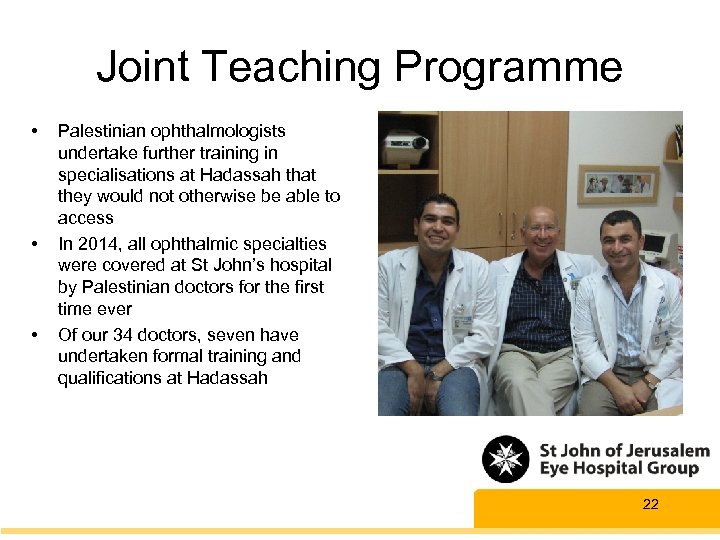 Joint Teaching Programme • • • Palestinian ophthalmologists undertake further training in specialisations at Hadassah that they would not otherwise be able to access In 2014, all ophthalmic specialties were covered at St John’s hospital by Palestinian doctors for the first time ever Of our 34 doctors, seven have undertaken formal training and qualifications at Hadassah 22
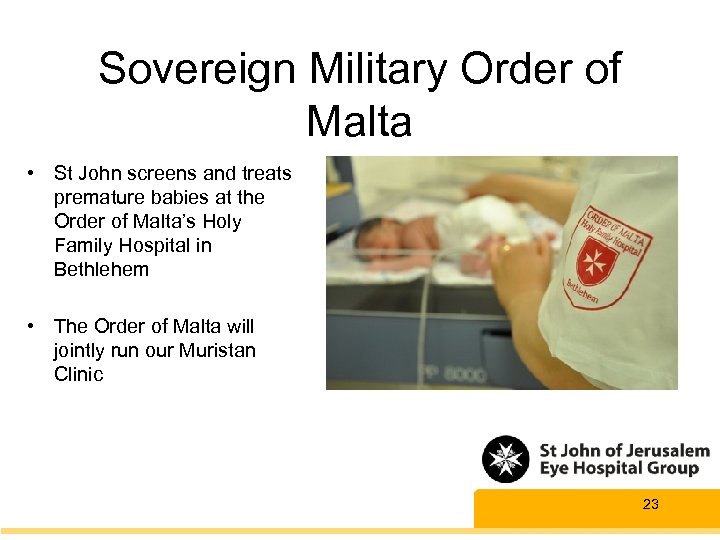 Sovereign Military Order of Malta • St John screens and treats premature babies at the Order of Malta’s Holy Family Hospital in Bethlehem • The Order of Malta will jointly run our Muristan Clinic 23
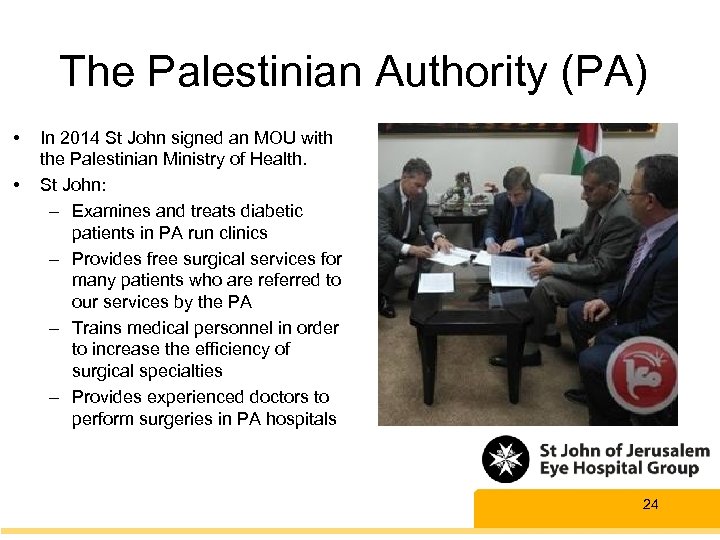 The Palestinian Authority (PA) • • In 2014 St John signed an MOU with the Palestinian Ministry of Health. St John: – Examines and treats diabetic patients in PA run clinics – Provides free surgical services for many patients who are referred to our services by the PA – Trains medical personnel in order to increase the efficiency of surgical specialties – Provides experienced doctors to perform surgeries in PA hospitals 24
 European Union: ‘Partnership for Peace’ Project • In 2015, secured funding for a genetic research project with Hadassah from the EU’s Partnership for Peace Programme • The collaboration will include training: – Geneticist – Epidemiologist – Ocular Ultrasonagraphist • A dedicated genetic research laboratory will be established in our Jerusalem Hospital • First major research project undertaken by St John in over 20 years 25
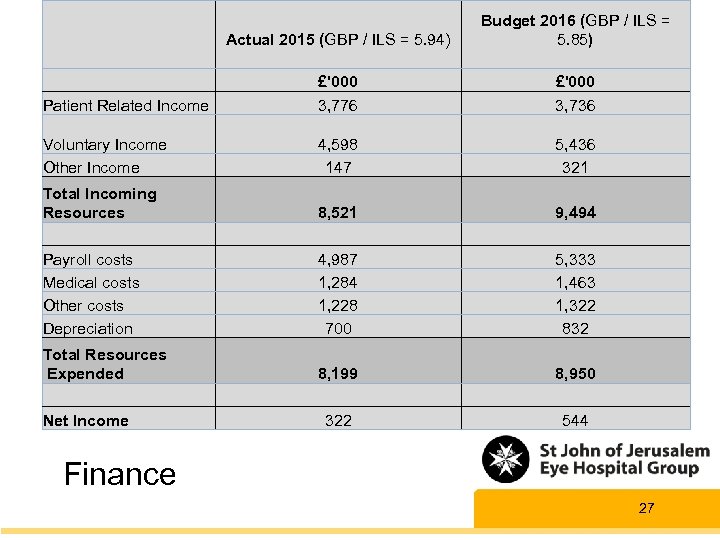 Actual 2015 (GBP / ILS = 5. 94) Budget 2016 (GBP / ILS = 5. 85) Patient Related Income £'000 3, 776 £'000 3, 736 Voluntary Income Other Income 4, 598 147 5, 436 321 Total Incoming Resources 8, 521 9, 494 Payroll costs Medical costs Other costs Depreciation 4, 987 1, 284 1, 228 700 5, 333 1, 463 1, 322 832 Total Resources Expended 8, 199 8, 950 322 544 Net Income Finance 27
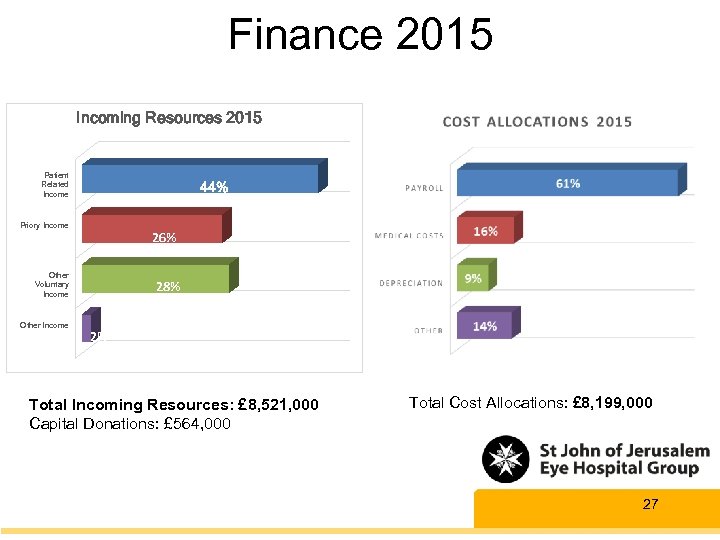 Finance 2015 Incoming Resources 2015 Patient Related Income 44% Priory Income 26% Other Voluntary Income Other Income 28% 2% Total Incoming Resources: £ 8, 521, 000 Capital Donations: £ 564, 000 Total Cost Allocations: £ 8, 199, 000 27
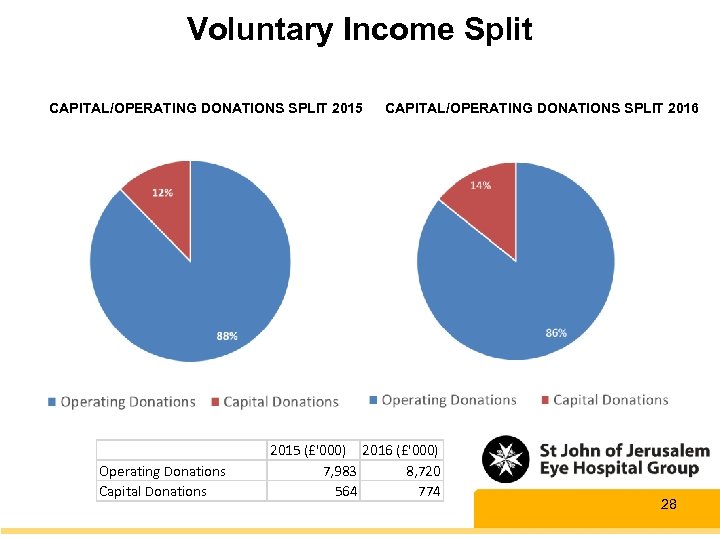 Voluntary Income Split CAPITAL/OPERATING DONATIONS SPLIT 2015 Operating Donations Capital Donations CAPITAL/OPERATING DONATIONS SPLIT 2016 2015 (£'000) 2016 (£'000) 7, 983 8, 720 774 564 28
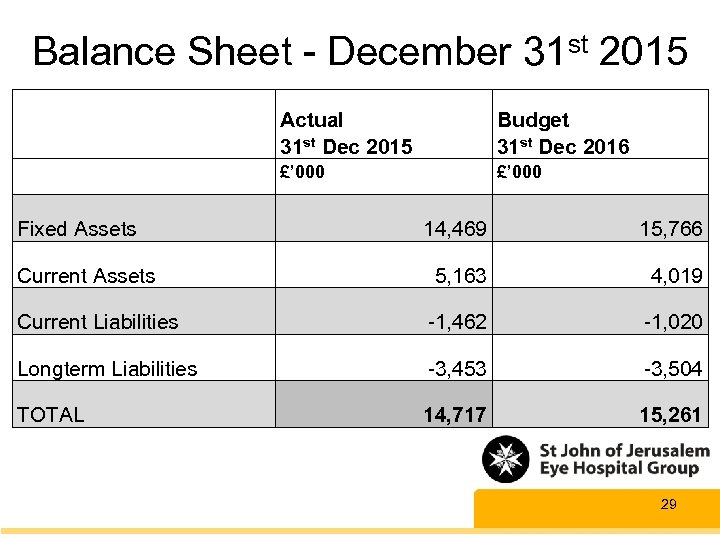 Balance Sheet - December 31 st 2015 Actual 31 st Dec 2015 £’ 000 Fixed Assets Budget 31 st Dec 2016 £’ 000 14, 469 15, 766 5, 163 4, 019 Current Liabilities -1, 462 -1, 020 Longterm Liabilities -3, 453 -3, 504 TOTAL 14, 717 15, 261 Current Assets 29
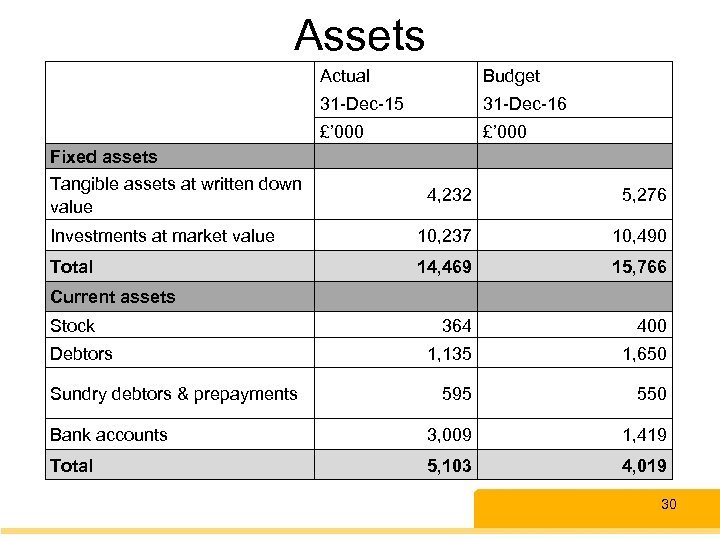 Assets Actual 31 -Dec-15 31 -Dec-16 £’ 000 Fixed assets Tangible assets at written down value Budget £’ 000 4, 232 5, 276 Investments at market value 10, 237 10, 490 Total 14, 469 15, 766 364 400 1, 135 1, 650 595 550 Bank accounts 3, 009 1, 419 Total 5, 103 4, 019 Current assets Stock Debtors Sundry debtors & prepayments 30
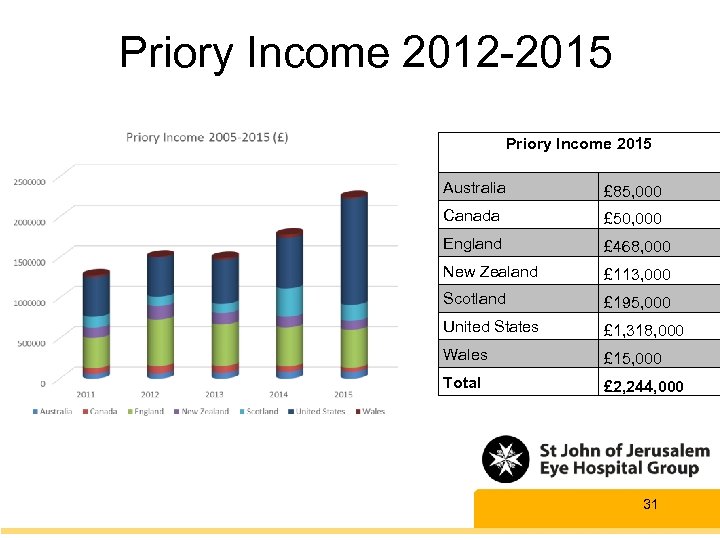 Priory Income 2012 -2015 Priory Income 2015 Australia £ 85, 000 Canada £ 50, 000 England £ 468, 000 New Zealand £ 113, 000 Scotland £ 195, 000 United States £ 1, 318, 000 Wales £ 15, 000 Total £ 2, 244, 000 31
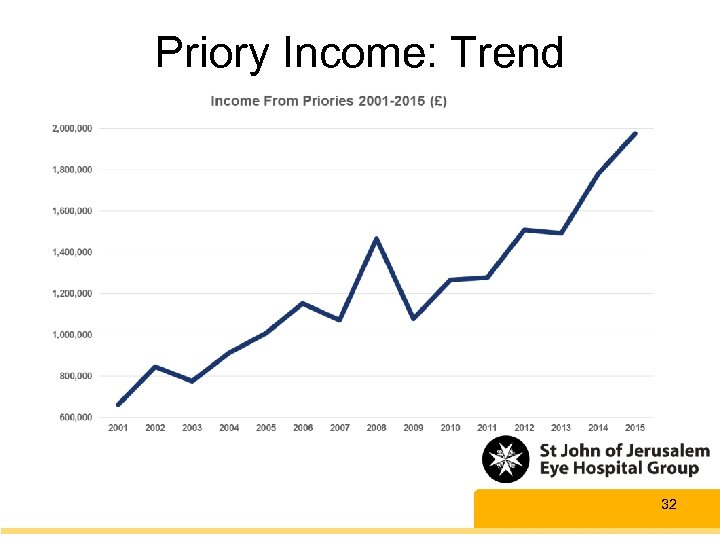 Priory Income: Trend 32
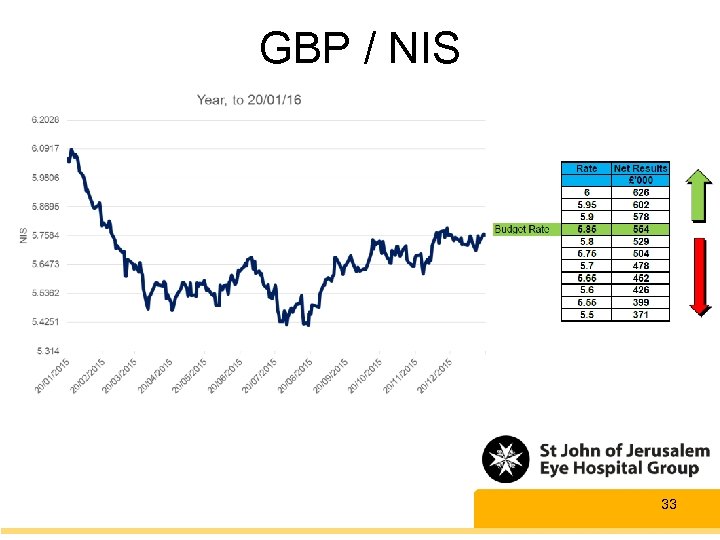 GBP / NIS 33
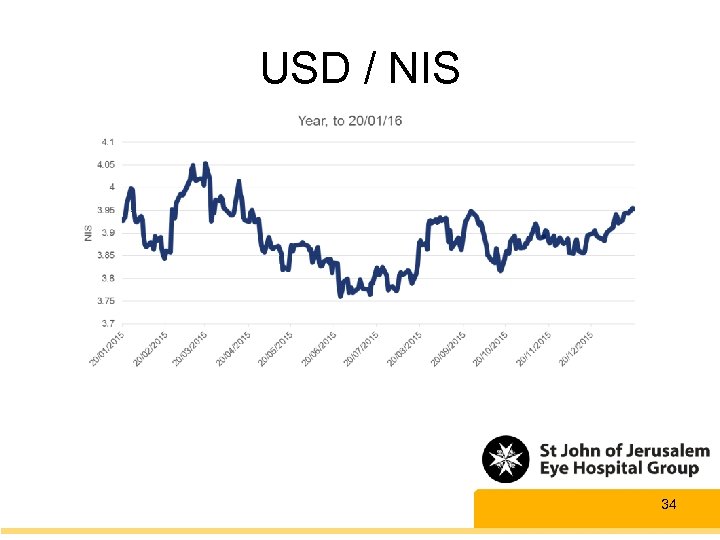 USD / NIS 34
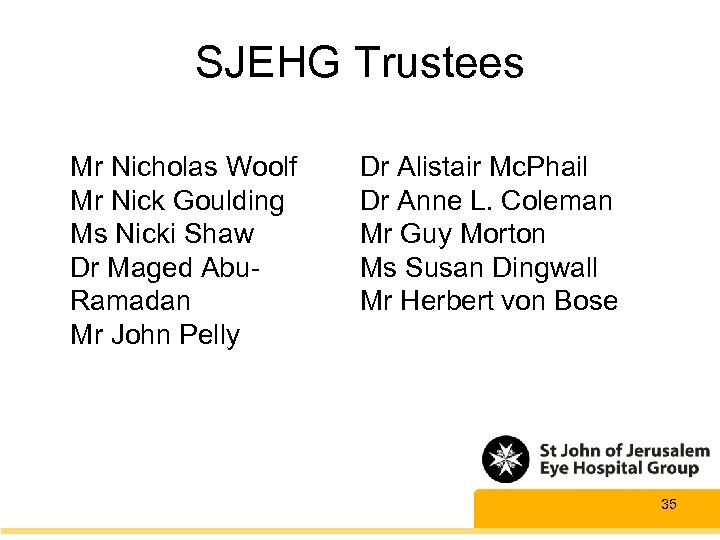 SJEHG Trustees Mr Nicholas Woolf Mr Nick Goulding Ms Nicki Shaw Dr Maged Abu. Ramadan Mr John Pelly Dr Alistair Mc. Phail Dr Anne L. Coleman Mr Guy Morton Ms Susan Dingwall Mr Herbert von Bose 35
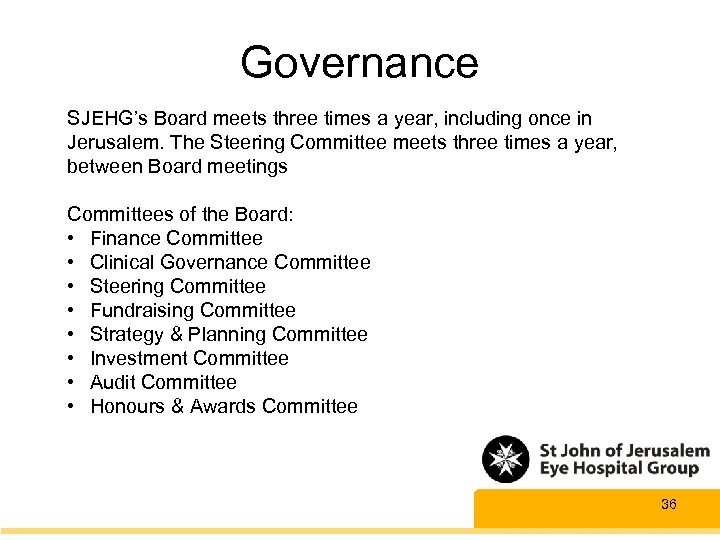 Governance SJEHG’s Board meets three times a year, including once in Jerusalem. The Steering Committee meets three times a year, between Board meetings Committees of the Board: • Finance Committee • Clinical Governance Committee • Steering Committee • Fundraising Committee • Strategy & Planning Committee • Investment Committee • Audit Committee • Honours & Awards Committee 36
 Competition • SJEHG has increasing competition across the o. Pt; • Private practices across the West Bank provide care for patients who live in areas where we do not provide eye care and for those who can afford it. Our doctors themselves also carry out private practice at other clinics • Government hospitals also provide limited ophthalmic services, mostly cataract surgeries • In Gaza, we receive corneal graft and retinal surgery referrals from the Palestinian Authority. Cataract patients are referred from them to government hospitals. UNRWA refer many ophthalmic cases to us but not cataract patients, who are now being sent to the Eye Specialty Hospital (run by the Public Aid Society) 37
 Risks • SJEHG’s risk register analysis is based on UK National Patient Safety approach • Each committee reviews risk in its own area every meeting • Board and Steering committee review major risks each meeting. Board signs off annually for the annual accounts • Only two red risks, after mitigation: political and war, which are beyond our control 38
 Plans for 2016 Research: Installing a laboratory to begin researching hereditary eye diseases and publishing research in recognised journals Training: Alongside regular training programmes, one doctor will begin Fellowship in Glaucoma to enable our Gaza Hospital to provide treatment for the most complicated cases, one doctor’s Fellowship in herediary eye diseases will continue Infrastructure: • Official openings the new Gaza and Hebron Hospitals and restoration of the ancient site of Muristan • Jerusalem Hospital- update of outdated pipe work and hydrants and a separation of our paediatric and retinal clinical areas Information: A roll out of the new Hospital Management Information System Community Healthcare: Expanding our Diabetic Retinopathy Screening Programme to northern Jordan Media: • Releasing ‘Eyes of St John’ on an international stage 39 • Launching a new interactive website & online shop
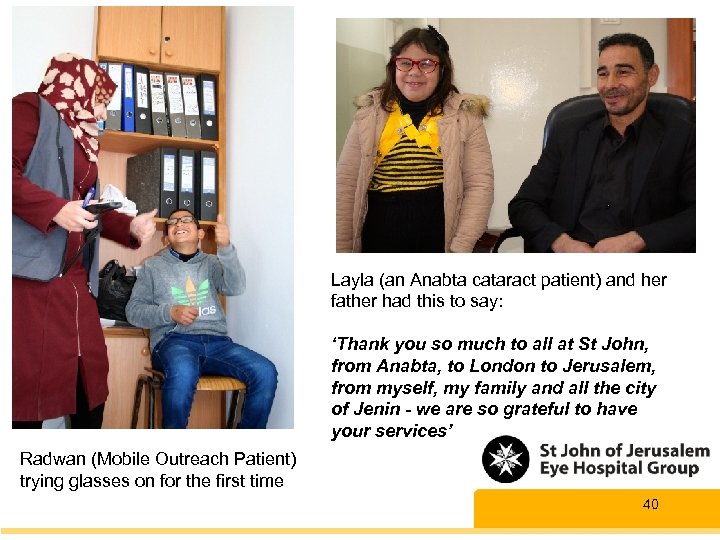 Radwan (Mobile Outreach Patient) trying glasses on for the first time Layla (an Anabta cataract patient) and her father had this to say: ‘Thank you so much to all at St John, from Anabta, to London to Jerusalem, from myself, my family and all the city of Jenin - we are so grateful to have your services’ 40
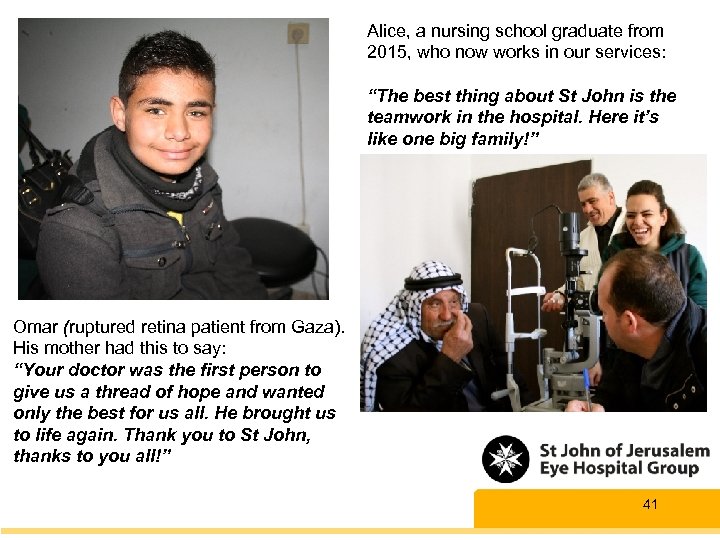 Alice, a nursing school graduate from 2015, who now works in our services: “The best thing about St John is the teamwork in the hospital. Here it’s like one big family!” Omar (ruptured retina patient from Gaza). His mother had this to say: “Your doctor was the first person to give us a thread of hope and wanted only the best for us all. He brought us to life again. Thank you to St John, thanks to you all!” 41
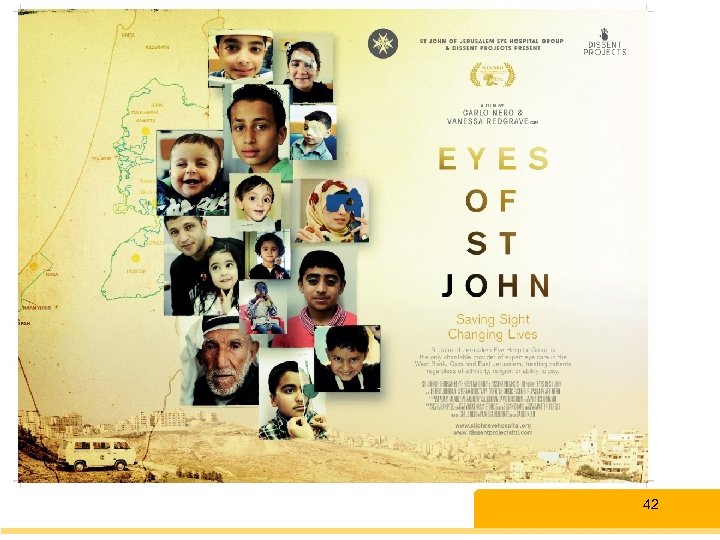 Eyes of St John 42