


 Скачать презентацию st Century Haulier 21 Tuesday 4 th June
3e615a4e5cd85456434014293a00f4a9.ppt
- Количество слайдов: 48
 st Century Haulier 21 Tuesday 4 th June 2013
 The Operator Licensing Regime John Dyne
 Agenda How VOSA targets Operators Public Inquiries v Transport Managers (Seven Deadly Sins) v Ways to lose your ‘Good Repute’ by being ‘non compliant’ v Operator’s relationship with the Traffic Area Office and the Traffic Commissioners v More ways to lose your good repute v Financial Standing v Undertakings and statements of intent (‘Did you keep your promises? ) v Change of ‘Entity’/ Address (How to lose your licence despite being ‘compliant’) v The key essentials for vehicle safety (Getting to the nub of the Operator Licensing Regime) Vehicle Maintenance, PMIs and auditing Driver Defect Reporting and Auditing Forward Planning, PMIs and Annual Test Anti Wheel loss – essential nut torquing / re-torquing procedures Monitoring performance v Dealing with prohibitions v Managing vehicles when not in use v Third Party Trailers v OCRS v Checklist
 How VOSA targets Operators OCRS – a risk based tool or a targeting tool? VOSA’s Intelligence Officers New Operator ‘visit’ Roadside ‘encounters’ MOT History Performance Prohibition History Conviction History
 Public Inquiries A Traffic Commissioner may hold such inquiries as he thinks necessary for the proper exercise of his functions Before a TC exercises his statutory powers of revocation, suspension, curtailment or disqualification there is normally a Public Inquiry – the licence holder, TM or anyone on the receiving end has the right to demand a PI before the TC makes a direction or order. Anyone can attend – it is after all a ‘Public Inquiry’ Reasons – Review of OC, unauthorised use of an OC, prohibitions, contravention of licence condition, relevant convictions (including fixed penalties), false statements of intent in application, unfulfilled undertakings, bankruptcy or liquidation, material change in circumstances of the licence holder. Prepare well for a PI – finances, adverse encounter history, conduct, convictions may all potentially come into play. Maintenance systems and arrangements for management of drivers hours will also come under scrutiny of the TC.
 Countdown to a Public Inquiry Previous warnings/ PIs ‘S’ marked prohibition – wheel security / braking system Non ‘S’ marked prohibitions Adverse maintenance inspection – on site prohibitions / poor records Stretched PMI intervals Poor MOT Performance Recent convictions (failure to notify) Failure to respond to correspondence Call up letter detailing all the evidence the TC will consider Submission of financial information in advance Hearing date seldom adjourned Penalty – a Deadly Sin or Conviction – a Serious Criminal Offence
 Transport Managers Standard Licence Holders are required to meet the requirements of Professional Competence. SLH’s need to designate at least one natural person with the requisite professional competence, who is resident in the community and is of good repute Certificate of qualification can be by examination or entitlement (‘Grandfather Rights’ now replaced by ‘Acquired Rights’)
 Transport Managers TM must be able to fulfil the statutory requirements for having continuous and effective responsibility for the management of the transport operations of the business – the TM retains legal responsibility regardless of whether his or her activities are delegated A TM can be ‘internal’ or ‘external’ (external limited to 4 operators and 50 vehicles)
 Transport Managers If a TM loses ‘good repute’ then disqualified from being a TM in any Member State NB – good repute of TM is a factor taken into account when determining good repute of a Licence Holder
 Ways to Lose your ‘Good Repute’ (non compliance route) Serious Criminal offences and Road Transport Offences TC must conclude an individual is not of good repute if more than one conviction for a serious criminal offence or has been convicted of road transport offences
 Serious Criminal Offences Any conviction where one of the following punishments has been imposed: Imprisonment exceeding 3 months A fine exceeding Level 4 on the standard scale - £ 2, 500 A Community Service Order for more than 60 hours
 Road Transport Offences Examples: • Drivers’ Hours offences. • Overloads • Condition and safety of vehicles and loads • Environmental offences
 Regulation (EC) 1071/2009 The good repute of transport managers is conditional on their not having been convicted of a serious criminal offence or not having incurred a penalty, for a serious infringement, in particular, of Community rules relating to road transport. A conviction or penalty incurred by a transport manager or a road transport undertaking in one or more Member States for the most serious infringements of Community rules should result in the loss of good repute.
 Most serious infringements - 7 Deadly Sins Drivers’ Hours infringements 1. (a) Exceeding the maximum 6 -day or fortnightly driving time limits by margins of 25 % or more. (b) Exceeding, during a daily working period, the maximum daily driving time limit by a margin of 50 % or more without taking a break or without an uninterrupted rest period of at least 4. 5 hours. 2. Not having a tachograph and/or speed limiter, or using a fraudulent device able to modify the records of the recording equipment and/or the speed limiter or falsifying record sheets or data downloaded from the tachograph and/or the driver card.
 Most serious infringements - 7 Deadly Sins Condition of vehicles 3. Driving without a valid roadworthiness certificate if such a document is required under Community law and/or driving with a very serious deficiency of, inter alia, the braking system, the steering linkages, the wheels/tyres, the suspension or chassis that would create such an immediate risk to road safety that it leads to a decision to immobilise the vehicle. 4. Transporting dangerous goods that are prohibited for transporting such goods in a prohibited or nonapproved means of containment or without identifying them on the vehicle as dangerous goods, thus endangering lives or the environment to such extent that it leads to a decision to immobilise the vehicle.
 Most serious infringements - 7 Deadly Sins Lack of entitlements 5. Carrying passengers or goods without holding a valid driving licence or carrying by an undertaking not holding a valid Community licence. False documents 6. Driving with a driver card that has been falsified, or with a card of which the driver is not the holder, or which has been obtained on the basis of false declarations and/or forged documents. Overloads 7. Carrying goods exceeding the maximum permissible laden mass by 20 % or more for vehicles the permissible laden weight of which exceeds 12 tonnes, and by 25 % or more for vehicles the permissible laden weight of which does not exceed 12 tonnes. If an Operator or a TM are convicted of a serious criminal offence or they incur a penalty for a deadly sin the default position is loss of repute unless the TC makes a finding loss of repute would constitute a disproportionate response.
 Other ‘discretionary’ grounds for loss of good repute Individuals The TC can have regards to any matter but in particular: • Relevant convictions of the individual or of his servants or agents; • Any other information in the TC’s possession which appears to him to relate to the individual’s fitness to hold a licence Companies Any relevant convictions of the company or of its officers, servants or agents Any other information in the TC’s possession as to the previous conduct of : • Any officer, servant or agent • Any of the directors, in whatever capacity If that conduct appears to relate to the company’s fitness to hold a licence
 Examples of ‘Relevant Convictions’ Offences involving: • Plating certificate and goods vehicle test certificates • Maintenance of vehicles in a fit and serviceable condition • Limits of speed and weight and loading of goods vehicles • Licensing of drivers • Any offence under GV (Licensing of Operators) Act 1995 • Illegal use of fuel • Drivers’ hours offences • Failure to keep records of inspection of goods vehicles • Environmental offences – illegal deposits of controlled waste • Traffic regulation orders – lorry routes
 Operator’s relationship with the Traffic Area Office and the Traffic Commissioners “A licence is issued to an operator on trust that the operator will comply with the requirements and that the application form has been fully and honestly completed”. You will often hear a TC say – ‘Trust lies at the very heart of the operator licensing regime’. ‘ I need to be sure I can trust you with a licence and trust that you will comply with your statement of intent and the undertakings you have given to me’. ‘ Any adverse findings by a TC are going to be extremely hard to dislodge on appeal.
 More ways to lose your Good Repute Previous adverse history – warnings/ other PI Prohibitions Convictions and Fixed Penalty Notices A persistent failure to comply with undertakings Failure to notify material changes (financial difficulty) An application form that is untruthful False bank statements Failure to disclose convictions Phoenix arrangements to avoid previous liabilities Dishonesty and illegal operation An attempt to deceive the TC in dealings with (i. e. Untruthful application) or at PI Alteration of documents to deceive TC / VOSA Attempts to circumvent the licensing system Bankruptcy/ Liquidation Abusive behaviour towards VOSA and other members of OTC staff Failure to heed advice Unauthorised use of place as OC Loan of discs TMs not exercising continuous and effective responsibility Use of untaxed fuel Use of uninsured, untaxed vehicles or vehicles out of test Use of vehicle without clearing a prohibition
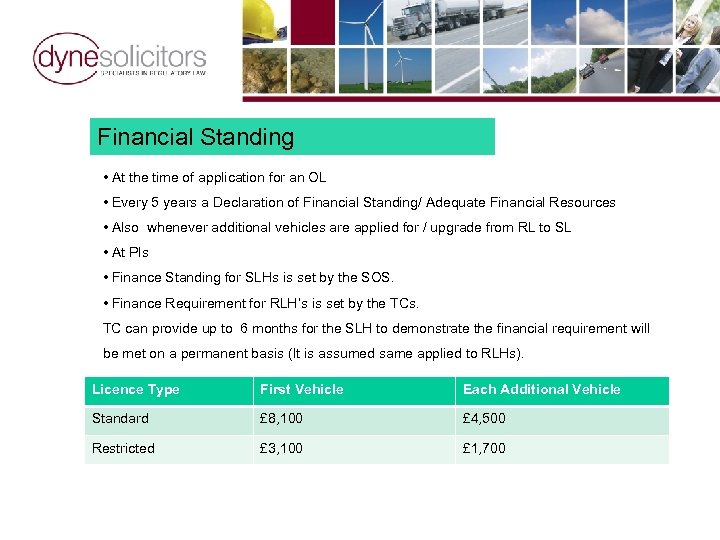 Financial Standing • At the time of application for an OL • Every 5 years a Declaration of Financial Standing/ Adequate Financial Resources • Also whenever additional vehicles are applied for / upgrade from RL to SL • At PIs • Finance Standing for SLHs is set by the SOS. • Finance Requirement for RLH’s is set by the TCs. TC can provide up to 6 months for the SLH to demonstrate the financial requirement will be met on a permanent basis (It is assumed same applied to RLHs). Licence Type First Vehicle Each Additional Vehicle Standard £ 8, 100 £ 4, 500 Restricted £ 3, 100 £ 1, 700
 Undertakings
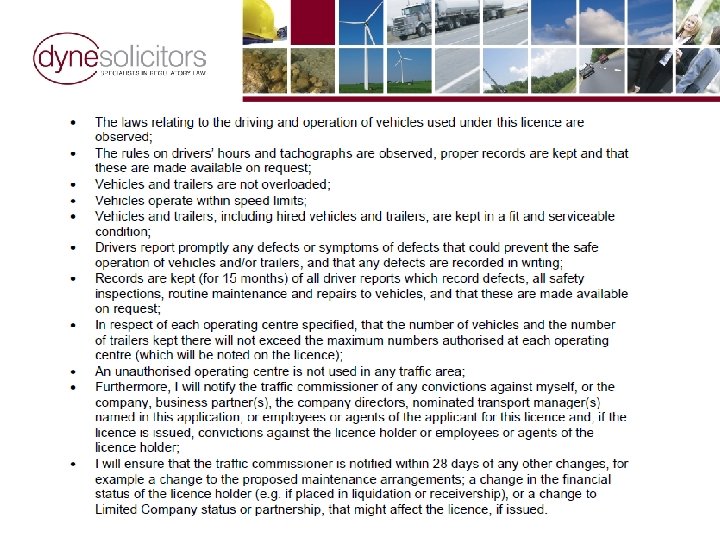
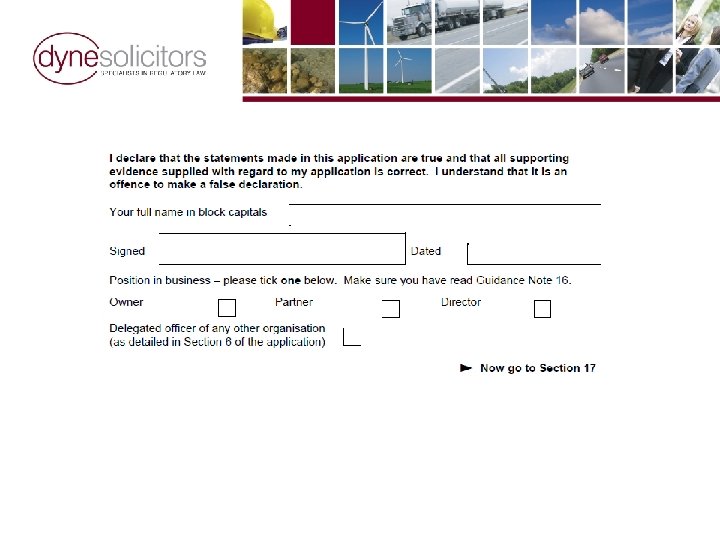
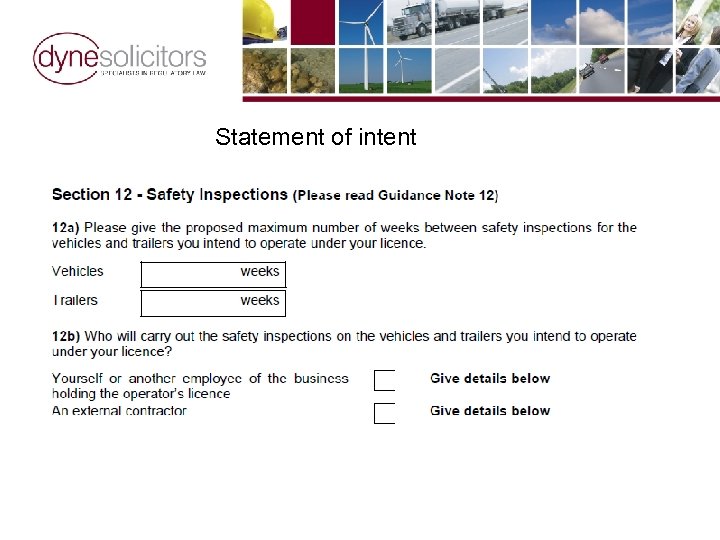 Statement of intent
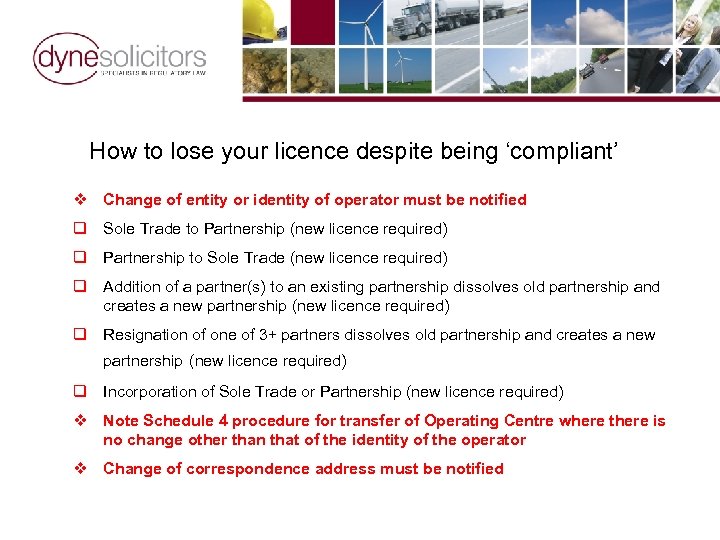 How to lose your licence despite being ‘compliant’ v Change of entity or identity of operator must be notified q Sole Trade to Partnership (new licence required) q Partnership to Sole Trade (new licence required) q Addition of a partner(s) to an existing partnership dissolves old partnership and creates a new partnership (new licence required) q Resignation of one of 3+ partners dissolves old partnership and creates a new partnership (new licence required) q Incorporation of Sole Trade or Partnership (new licence required) v Note Schedule 4 procedure for transfer of Operating Centre where there is no change other than that of the identity of the operator v Change of correspondence address must be notified
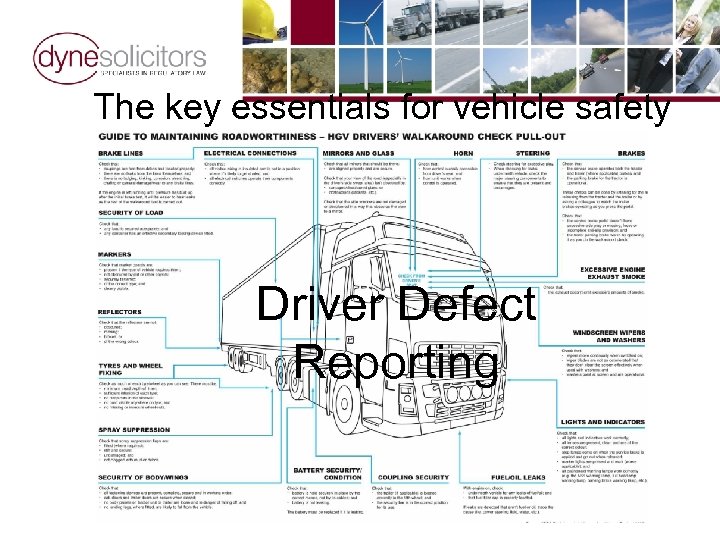 The key essentials for vehicle safety Driver Defect Reporting
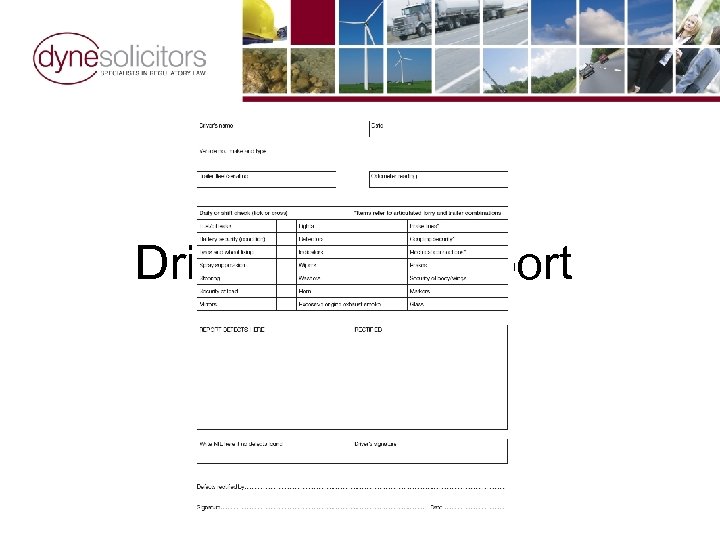 Driver Defect Report
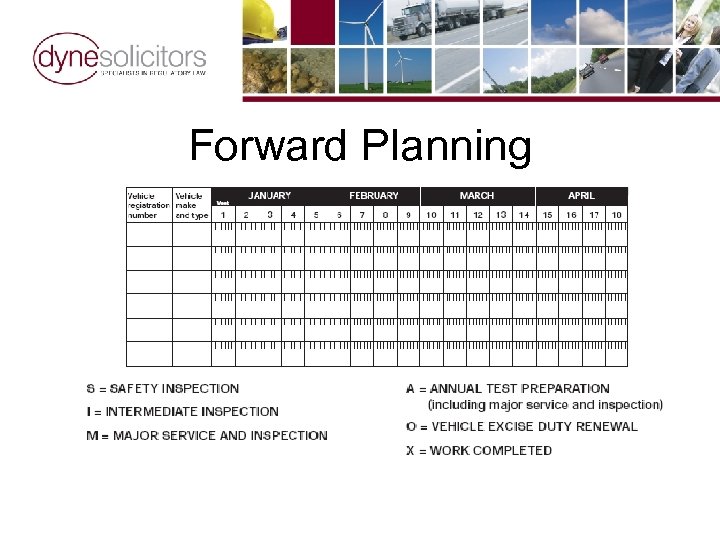 Forward Planning
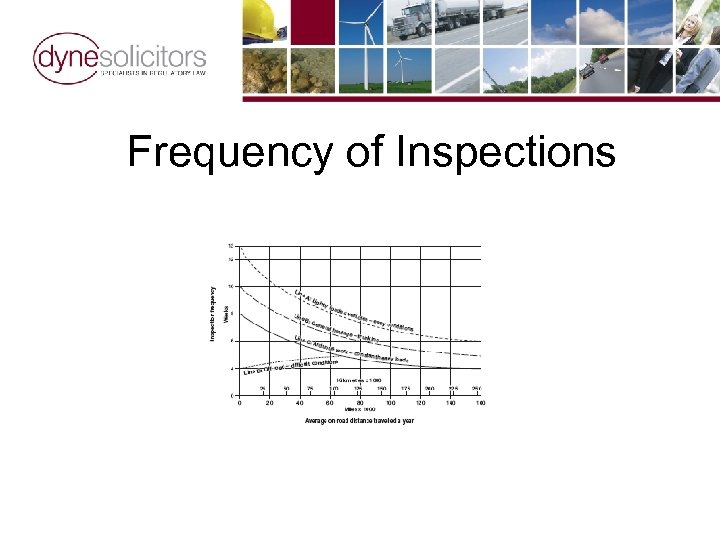 Frequency of Inspections
 Annual Test üImportance of pre-MOT preparation and safety inspections üRefer to VOSA’s annual test inspection manuals üMrs Bell considers a 95% pass rate ‘acceptable’
 Safety Inspections
 Wheel nut torquing procedure Code of practice for the selection and care of tyres and wheels for commercial vehicles states: Retorque wheel nuts after: - 30 minutes or after having travelled for between 40 km and 80 km (25 to 50 miles).
 Monitoring Performance “Even when you get on well with a contractor, you should have a system for regularly Continuous reviewing and monitoring of the quality of the systems in monitoring the quality of work done. Obtaining first time pass rate annual test data place is essential to ensure that they are sufficiently comprehensive to from the contractor is one way of checking that their performance is satisfactory, but this do the job. should be supplemented by other checks. Drivers The external contractor Guide. Crossmaintaining. Safety Inspections Ø to referencing with roadworthiness Ø Quality of daily driver checks Any sign of unreliability, incompetence or other shortcomings causing a reduction in the One method of monitoring is to invite a technically competent third standards achieved should receive prompt attention. Here again a good working party periodically to re-inspect or undertake a safety inspection relationship can help, but if problems persist you might well consider irrespective of whether inspections are done in-house or are a change of contractor. ” contracted out.
 Prohibitions The problem – Part of an operator’s encounter history (OCRS) “S” marked prohibitions Do nothing – Accept prohibition Appeal – Lodge Complaint against a prohibition Refer to Customer Complaints Co-ordinator Refer matter to the Independent Adjudicator
 Managing Vehicles when not in use Under repair Awaiting repair/ scrapping Withdrawn from service Accident damaged Should such vehicles be examined or prohibited?
 Persuasive evidence vehicle not in use üNotice in cab / fixed to trailer – stating vehicle VOR and not to be driven üDe-specify vehicle (don’t forget to re-specify before re-use) üIf vehicle in for inspection do not indicate to VE that safety inspection has been completed!
 Trailers Ø The problem…. Ø Its not my trailer! Ø I was contracted to collect a pre-loaded trailer! Ø I have no access to the safety inspection records
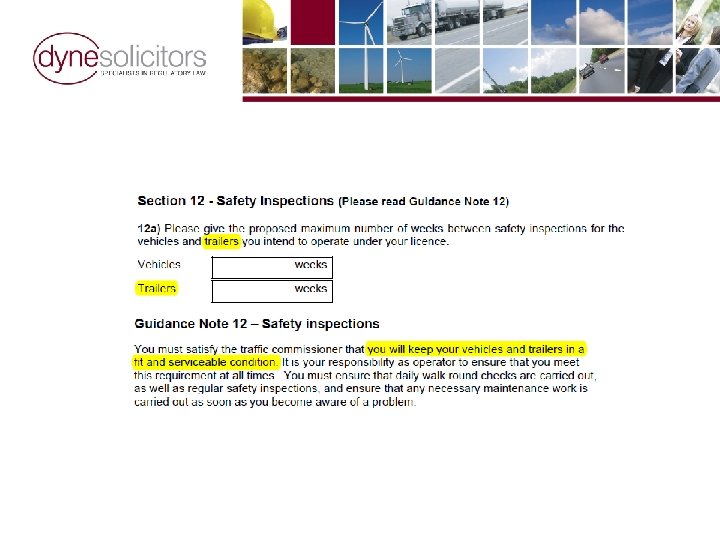
 Practical solutions Ø Agree customer/ owner to be responsible Ø Records (obtain and retain for 15 months) Ø Mobile Mechanic (if all else fails) Ø Driver training (Training/ capability issues? )
 VOSA uses the Operator Compliance Risk Score (OCRS) system to decide which vehicles should be inspected. OCRS is used to calculate the risk of an operator not following the rules on roadworthiness (the condition of its vehicles) and traffic (e. g. drivers’ hours, weighing checks). If your OCRS is high, it’s more likely that your vehicles will be inspected.
 The Operator Compliance Risk Score (OCRS) system is based on data collected by the Vehicle and Operator Services Agency (VOSA) over a 3 -year rolling period. Data is taken from annual tests, roadside inspections and inspections at operators’ premises.
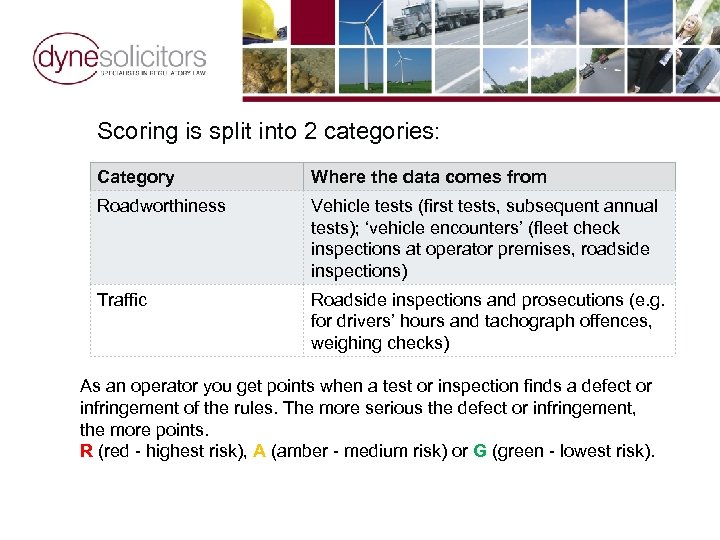 Scoring is split into 2 categories: Category Where the data comes from Roadworthiness Vehicle tests (first tests, subsequent annual tests); ‘vehicle encounters’ (fleet check inspections at operator premises, roadside inspections) Traffic Roadside inspections and prosecutions (e. g. for drivers’ hours and tachograph offences, weighing checks) As an operator you get points when a test or inspection finds a defect or infringement of the rules. The more serious the defect or infringement, the more points. R (red - highest risk), A (amber - medium risk) or G (green - lowest risk).
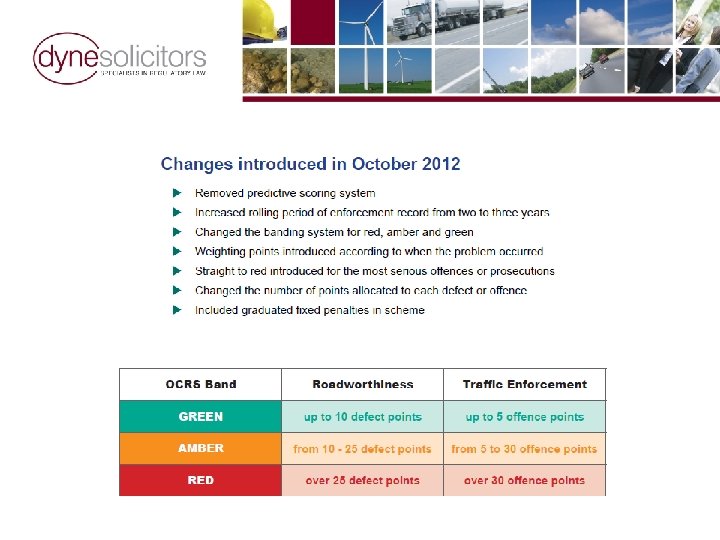
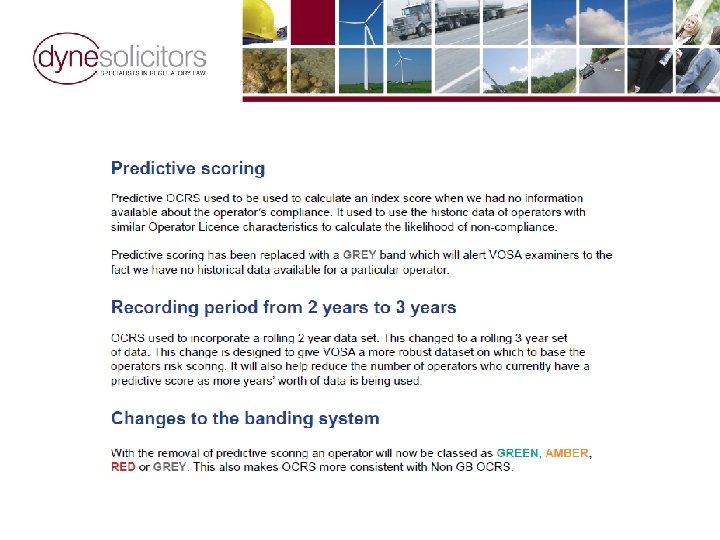
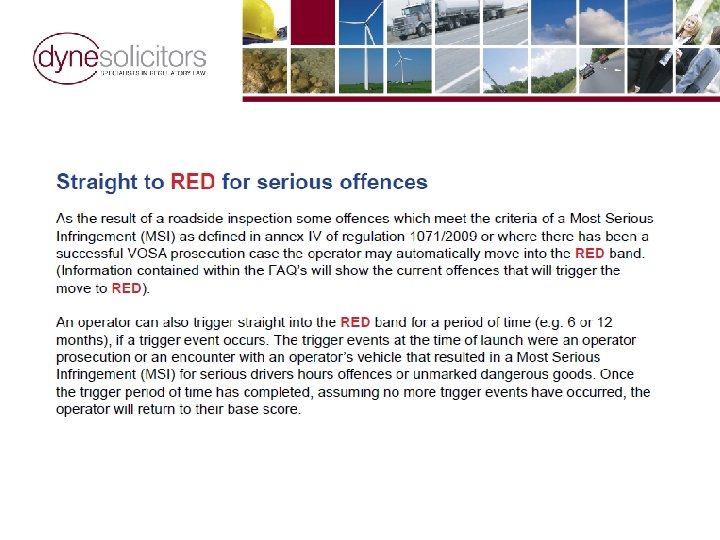
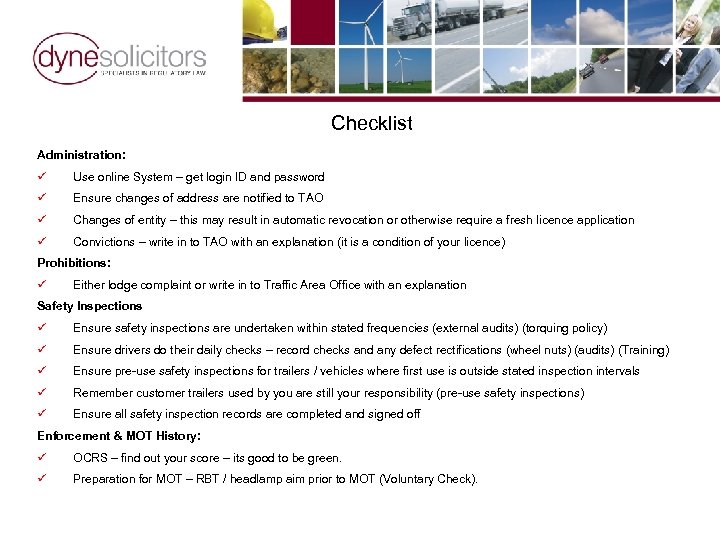 Checklist Administration: ü Use online System – get login ID and password ü Ensure changes of address are notified to TAO ü Changes of entity – this may result in automatic revocation or otherwise require a fresh licence application ü Convictions – write in to TAO with an explanation (it is a condition of your licence) Prohibitions: ü Either lodge complaint or write in to Traffic Area Office with an explanation Safety Inspections ü Ensure safety inspections are undertaken within stated frequencies (external audits) (torquing policy) ü Ensure drivers do their daily checks – record checks and any defect rectifications (wheel nuts) (audits) (Training) ü Ensure pre-use safety inspections for trailers / vehicles where first use is outside stated inspection intervals ü Remember customer trailers used by you are still your responsibility (pre-use safety inspections) ü Ensure all safety inspection records are completed and signed off Enforcement & MOT History: ü OCRS – find out your score – its good to be green. ü Preparation for MOT – RBT / headlamp aim prior to MOT (Voluntary Check).
 Questions?