 Скачать презентацию St Bede s RC Primary School Early Years Brochure
ef477ee98d1fa64deb5a09b5e46f7d89.ppt
- Количество слайдов: 14



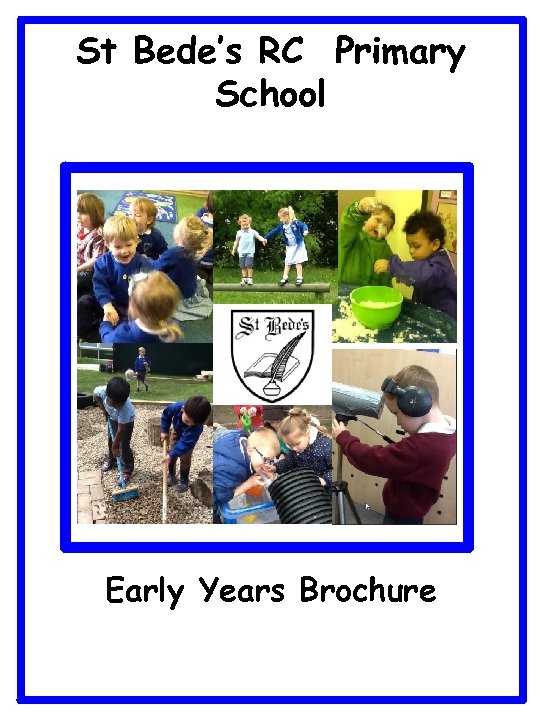
St Bede’s RC Primary School Early Years Brochure
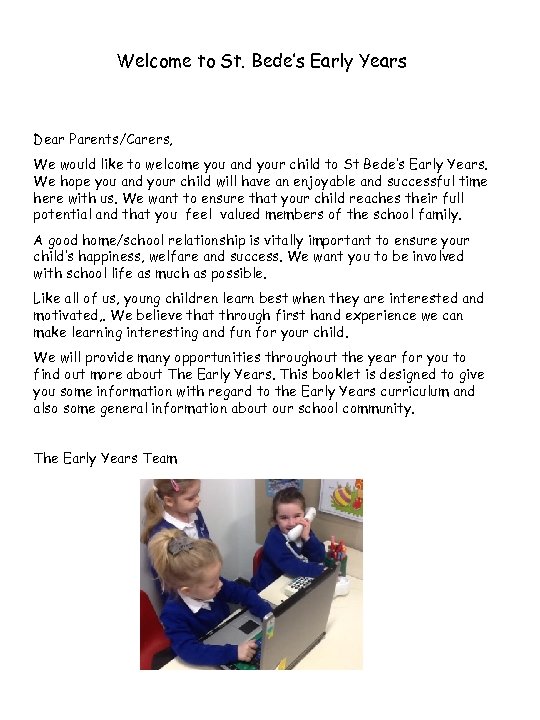
Welcome to St. Bede’s Early Years Dear Parents/Carers, We would like to welcome you and your child to St Bede’s Early Years. We hope you and your child will have an enjoyable and successful time here with us. We want to ensure that your child reaches their full potential and that you feel valued members of the school family. A good home/school relationship is vitally important to ensure your child’s happiness, welfare and success. We want you to be involved with school life as much as possible. Like all of us, young children learn best when they are interested and motivated, . We believe that through first hand experience we can make learning interesting and fun for your child. We will provide many opportunities throughout the year for you to find out more about The Early Years. This booklet is designed to give you some information with regard to the Early Years curriculum and also some general information about our school community. The Early Years Team
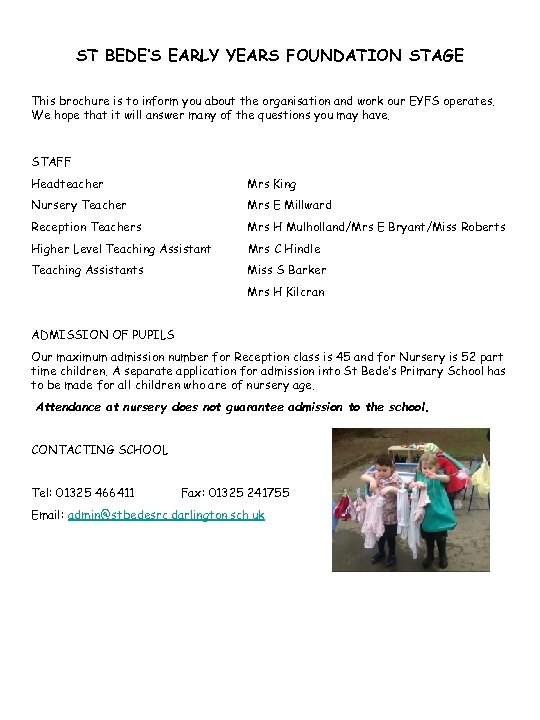
ST BEDE’S EARLY YEARS FOUNDATION STAGE This brochure is to inform you about the organisation and work our EYFS operates. We hope that it will answer many of the questions you may have. STAFF Headteacher Mrs King Nursery Teacher Mrs E Millward Reception Teachers Mrs H Mulholland/Mrs E Bryant/Miss Roberts Higher Level Teaching Assistant Mrs C Hindle Teaching Assistants Miss S Barker Mrs H Kilcran ADMISSION OF PUPILS Our maximum admission number for Reception class is 45 and for Nursery is 52 part time children. A separate application for admission into St Bede’s Primary School has to be made for all children who are of nursery age. Attendance at nursery does not guarantee admission to the school. CONTACTING SCHOOL Tel: 01325 466411 Fax: 01325 241755 Email: admin@stbedesrc. darlington. sch. uk
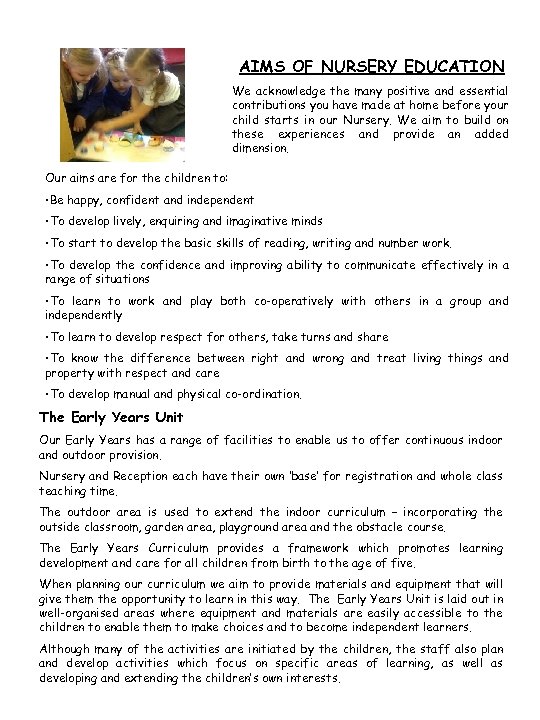
AIMS OF NURSERY EDUCATION We acknowledge the many positive and essential contributions you have made at home before your child starts in our Nursery. We aim to build on these experiences and provide an added dimension. Our aims are for the children to: • Be happy, confident and independent • To develop lively, enquiring and imaginative minds • To start to develop the basic skills of reading, writing and number work. • To develop the confidence and improving ability to communicate effectively in a range of situations • To learn to work and play both co-operatively with others in a group and independently • To learn to develop respect for others, take turns and share • To know the difference between right and wrong and treat living things and property with respect and care • To develop manual and physical co-ordination. The Early Years Unit Our Early Years has a range of facilities to enable us to offer continuous indoor and outdoor provision. Nursery and Reception each have their own ‘base’ for registration and whole class teaching time. The outdoor area is used to extend the indoor curriculum – incorporating the outside classroom, garden area, playground area and the obstacle course. The Early Years Curriculum provides a framework which promotes learning development and care for all children from birth to the age of five. When planning our curriculum we aim to provide materials and equipment that will give them the opportunity to learn in this way. The Early Years Unit is laid out in well-organised areas where equipment and materials are easily accessible to the children to enable them to make choices and to become independent learners. Although many of the activities are initiated by the children, the staff also plan and develop activities which focus on specific areas of learning, as well as developing and extending the children’s own interests.
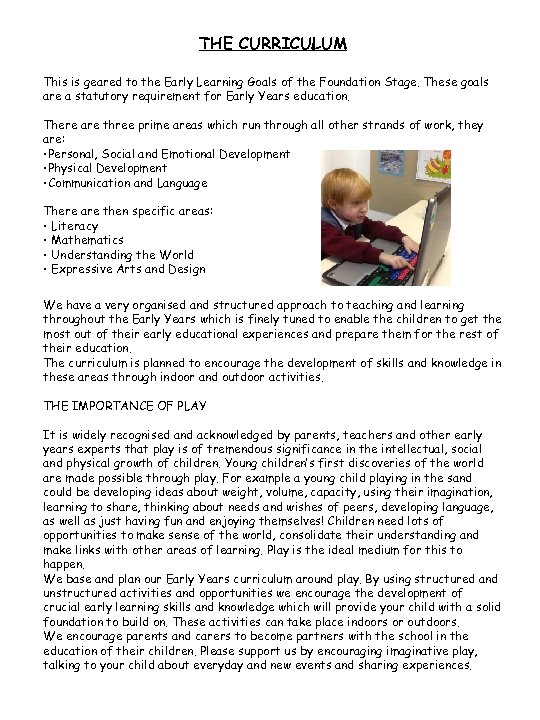
THE CURRICULUM This is geared to the Early Learning Goals of the Foundation Stage. These goals are a statutory requirement for Early Years education. There are three prime areas which run through all other strands of work, they are: • Personal, Social and Emotional Development • Physical Development • Communication and Language There are then specific areas: • Literacy • Mathematics • Understanding the World • Expressive Arts and Design We have a very organised and structured approach to teaching and learning throughout the Early Years which is finely tuned to enable the children to get the most out of their early educational experiences and prepare them for the rest of their education. The curriculum is planned to encourage the development of skills and knowledge in these areas through indoor and outdoor activities. THE IMPORTANCE OF PLAY It is widely recognised and acknowledged by parents, teachers and other early years experts that play is of tremendous significance in the intellectual, social and physical growth of children. Young children’s first discoveries of the world are made possible through play. For example a young child playing in the sand could be developing ideas about weight, volume, capacity, using their imagination, learning to share, thinking about needs and wishes of peers, developing language, as well as just having fun and enjoying themselves! Children need lots of opportunities to make sense of the world, consolidate their understanding and make links with other areas of learning. Play is the ideal medium for this to happen. We base and plan our Early Years curriculum around play. By using structured and unstructured activities and opportunities we encourage the development of crucial early learning skills and knowledge which will provide your child with a solid foundation to build on. These activities can take place indoors or outdoors. We encourage parents and carers to become partners with the school in the education of their children. Please support us by encouraging imaginative play, talking to your child about everyday and new events and sharing experiences.
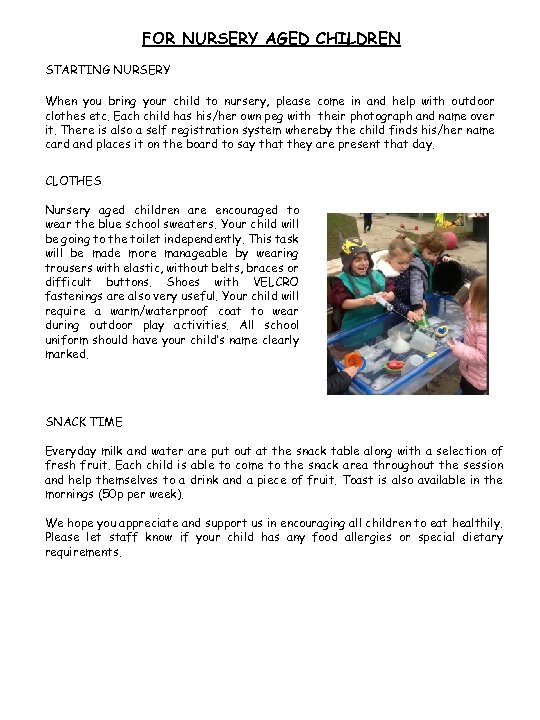
FOR NURSERY AGED CHILDREN STARTING NURSERY When you bring your child to nursery, please come in and help with outdoor clothes etc. Each child has his/her own peg with their photograph and name over it. There is also a self registration system whereby the child finds his/her name card and places it on the board to say that they are present that day. CLOTHES Nursery aged children are encouraged to wear the blue school sweaters. Your child will be going to the toilet independently. This task will be made more manageable by wearing trousers with elastic, without belts, braces or difficult buttons. Shoes with VELCRO fastenings are also very useful. Your child will require a warm/waterproof coat to wear during outdoor play activities. All school uniform should have your child’s name clearly marked. SNACK TIME Everyday milk and water are put out at the snack table along with a selection of fresh fruit. Each child is able to come to the snack area throughout the session and help themselves to a drink and a piece of fruit. Toast is also available in the mornings (50 p per week). We hope you appreciate and support us in encouraging all children to eat healthily. Please let staff know if your child has any food allergies or special dietary requirements.
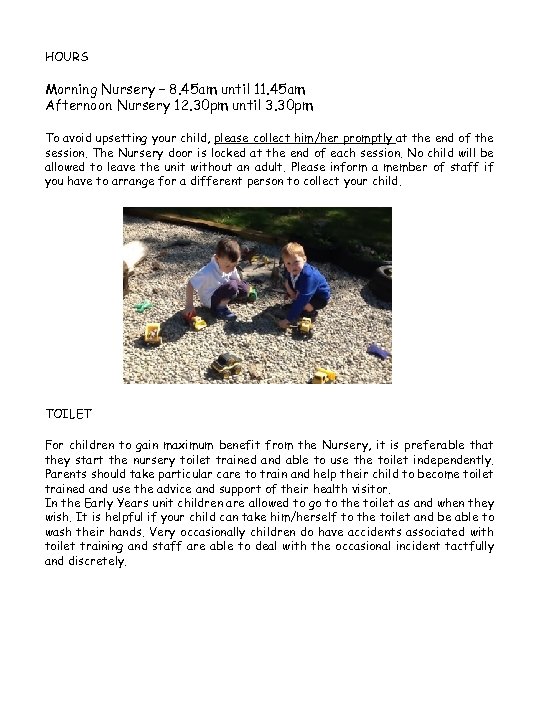
HOURS Morning Nursery – 8. 45 am until 11. 45 am Afternoon Nursery 12. 30 pm until 3. 30 pm To avoid upsetting your child, please collect him/her promptly at the end of the session. The Nursery door is locked at the end of each session. No child will be allowed to leave the unit without an adult. Please inform a member of staff if you have to arrange for a different person to collect your child. TOILET For children to gain maximum benefit from the Nursery, it is preferable that they start the nursery toilet trained and able to use the toilet independently. Parents should take particular care to train and help their child to become toilet trained and use the advice and support of their health visitor. In the Early Years unit children are allowed to go to the toilet as and when they wish. It is helpful if your child can take him/herself to the toilet and be able to wash their hands. Very occasionally children do have accidents associated with toilet training and staff are able to deal with the occasional incident tactfully and discretely.
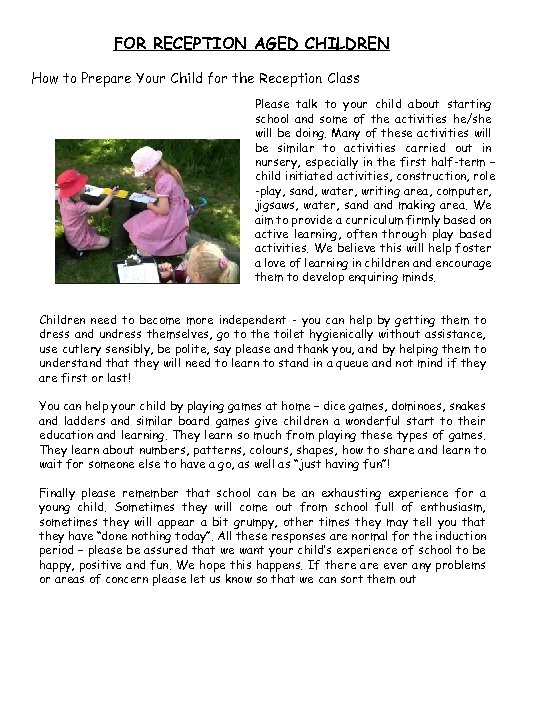
FOR RECEPTION AGED CHILDREN How to Prepare Your Child for the Reception Class Please talk to your child about starting school and some of the activities he/she will be doing. Many of these activities will be similar to activities carried out in nursery, especially in the first half-term – child initiated activities, construction, role -play, sand, water, writing area, computer, jigsaws, water, sand making area. We aim to provide a curriculum firmly based on active learning, often through play based activities. We believe this will help foster a love of learning in children and encourage them to develop enquiring minds. Children need to become more independent - you can help by getting them to dress and undress themselves, go to the toilet hygienically without assistance, use cutlery sensibly, be polite, say please and thank you, and by helping them to understand that they will need to learn to stand in a queue and not mind if they are first or last! You can help your child by playing games at home – dice games, dominoes, snakes and ladders and similar board games give children a wonderful start to their education and learning. They learn so much from playing these types of games. They learn about numbers, patterns, colours, shapes, how to share and learn to wait for someone else to have a go, as well as “just having fun”! Finally please remember that school can be an exhausting experience for a young child. Sometimes they will come out from school full of enthusiasm, sometimes they will appear a bit grumpy, other times they may tell you that they have “done nothing today”. All these responses are normal for the induction period – please be assured that we want your child’s experience of school to be happy, positive and fun. We hope this happens. If there are ever any problems or areas of concern please let us know so that we can sort them out
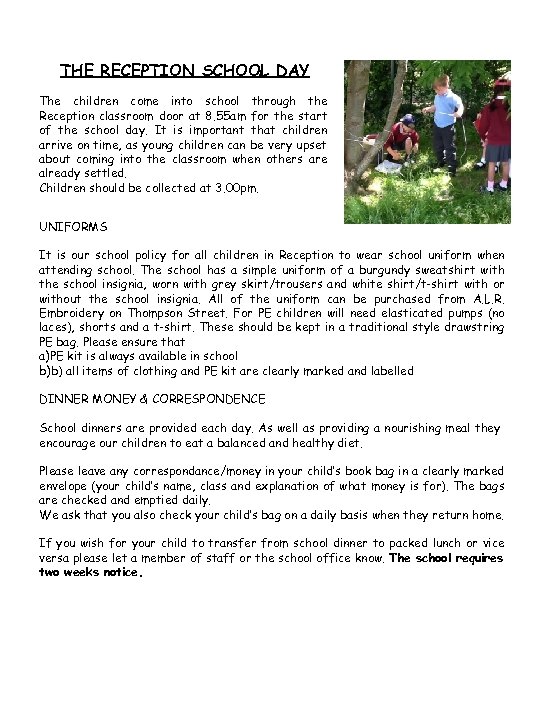
THE RECEPTION SCHOOL DAY The children come into school through the Reception classroom door at 8. 55 am for the start of the school day. It is important that children arrive on time, as young children can be very upset about coming into the classroom when others are already settled. Children should be collected at 3. 00 pm. UNIFORMS It is our school policy for all children in Reception to wear school uniform when attending school. The school has a simple uniform of a burgundy sweatshirt with the school insignia, worn with grey skirt/trousers and white shirt/t-shirt with or without the school insignia. All of the uniform can be purchased from A. L. R. Embroidery on Thompson Street. For PE children will need elasticated pumps (no laces), shorts and a t-shirt. These should be kept in a traditional style drawstring PE bag. Please ensure that a)PE kit is always available in school b)b) all items of clothing and PE kit are clearly marked and labelled DINNER MONEY & CORRESPONDENCE School dinners are provided each day. As well as providing a nourishing meal they encourage our children to eat a balanced and healthy diet. Please leave any correspondance/money in your child’s book bag in a clearly marked envelope (your child’s name, class and explanation of what money is for). The bags are checked and emptied daily. We ask that you also check your child’s bag on a daily basis when they return home. If you wish for your child to transfer from school dinner to packed lunch or vice versa please let a member of staff or the school office know. The school requires two weeks notice.
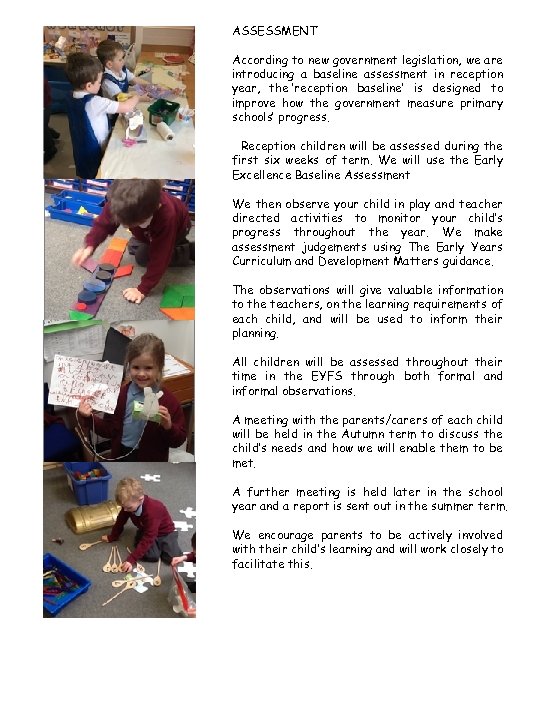
ASSESSMENT According to new government legislation, we are introducing a baseline assessment in reception year, the ’reception baseline’ is designed to improve how the government measure primary schools’ progress. Reception children will be assessed during the first six weeks of term. We will use the Early Excellence Baseline Assessment We then observe your child in play and teacher directed activities to monitor your child’s progress throughout the year. We make assessment judgements using The Early Years Curriculum and Development Matters guidance. The observations will give valuable information to the teachers, on the learning requirements of each child, and will be used to inform their planning. All children will be assessed throughout their time in the EYFS through both formal and informal observations. A meeting with the parents/carers of each child will be held in the Autumn term to discuss the child’s needs and how we will enable them to be met. A further meeting is held later in the school year and a report is sent out in the summer term. We encourage parents to be actively involved with their child’s learning and will work closely to facilitate this.
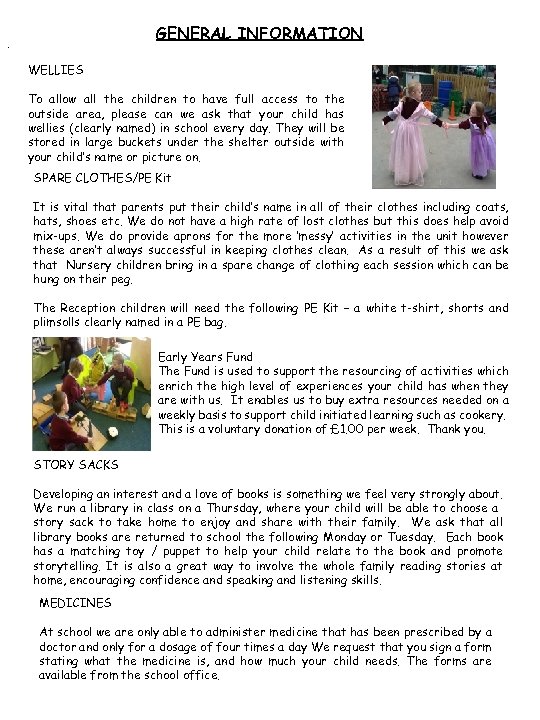
GENERAL INFORMATION . WELLIES To allow all the children to have full access to the outside area, please can we ask that your child has wellies (clearly named) in school every day. They will be stored in large buckets under the shelter outside with your child’s name or picture on. SPARE CLOTHES/PE Kit It is vital that parents put their child’s name in all of their clothes including coats, hats, shoes etc. We do not have a high rate of lost clothes but this does help avoid mix-ups. We do provide aprons for the more ‘messy’ activities in the unit however these aren’t always successful in keeping clothes clean. As a result of this we ask that Nursery children bring in a spare change of clothing each session which can be hung on their peg. The Reception children will need the following PE Kit – a white t-shirt, shorts and plimsolls clearly named in a PE bag. Early Years Fund The Fund is used to support the resourcing of activities which enrich the high level of experiences your child has when they are with us. It enables us to buy extra resources needed on a weekly basis to support child initiated learning such as cookery. This is a voluntary donation of £ 1. 00 per week. Thank you. STORY SACKS Developing an interest and a love of books is something we feel very strongly about. We run a library in class on a Thursday, where your child will be able to choose a story sack to take home to enjoy and share with their family. We ask that all library books are returned to school the following Monday or Tuesday. Each book has a matching toy / puppet to help your child relate to the book and promote storytelling. It is also a great way to involve the whole family reading stories at home, encouraging confidence and speaking and listening skills. MEDICINES At school we are only able to administer medicine that has been prescribed by a doctor and only for a dosage of four times a day We request that you sign a form stating what the medicine is, and how much your child needs. The forms are available from the school office.
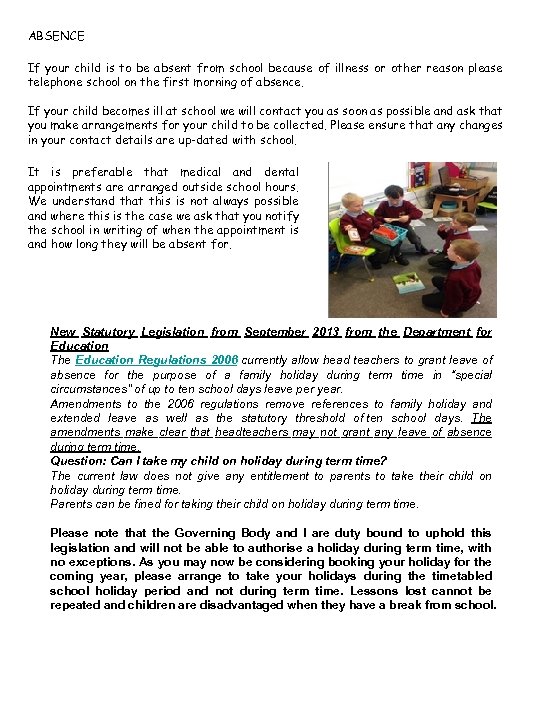
ABSENCE If your child is to be absent from school because of illness or other reason please telephone school on the first morning of absence. If your child becomes ill at school we will contact you as soon as possible and ask that you make arrangements for your child to be collected. Please ensure that any changes in your contact details are up-dated with school. It is preferable that medical and dental appointments are arranged outside school hours. We understand that this is not always possible and where this is the case we ask that you notify the school in writing of when the appointment is and how long they will be absent for. New Statutory Legislation from September 2013 from the Department for Education The Education Regulations 2006 currently allow head teachers to grant leave of absence for the purpose of a family holiday during term time in “special circumstances” of up to ten school days leave per year. Amendments to the 2006 regulations remove references to family holiday and extended leave as well as the statutory threshold of ten school days. The amendments make clear that headteachers may not grant any leave of absence during term time. Question: Can I take my child on holiday during term time? The current law does not give any entitlement to parents to take their child on holiday during term time. Parents can be fined for taking their child on holiday during term time. Please note that the Governing Body and I are duty bound to uphold this legislation and will not be able to authorise a holiday during term time, with no exceptions. As you may now be considering booking your holiday for the coming year, please arrange to take your holidays during the timetabled school holiday period and not during term time. Lessons lost cannot be repeated and children are disadvantaged when they have a break from school.
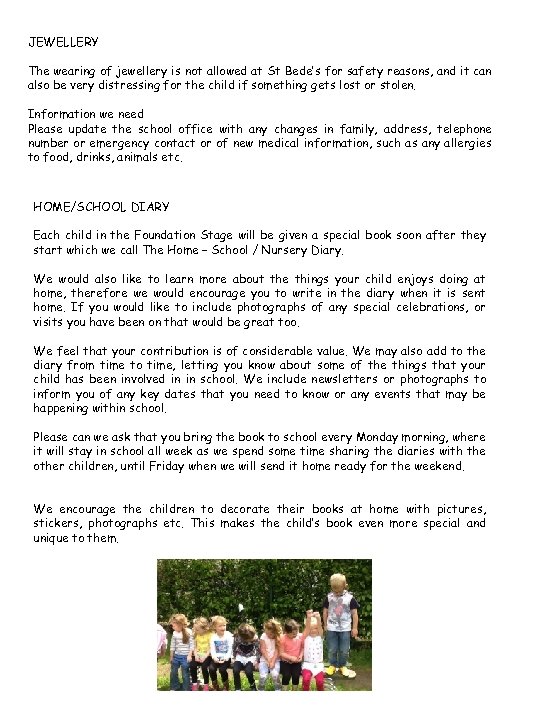
JEWELLERY The wearing of jewellery is not allowed at St Bede’s for safety reasons, and it can also be very distressing for the child if something gets lost or stolen. Information we need Please update the school office with any changes in family, address, telephone number or emergency contact or of new medical information, such as any allergies to food, drinks, animals etc. HOME/SCHOOL DIARY Each child in the Foundation Stage will be given a special book soon after they start which we call The Home – School / Nursery Diary. We would also like to learn more about the things your child enjoys doing at home, therefore we would encourage you to write in the diary when it is sent home. If you would like to include photographs of any special celebrations, or visits you have been on that would be great too. We feel that your contribution is of considerable value. We may also add to the diary from time to time, letting you know about some of the things that your child has been involved in in school. We include newsletters or photographs to inform you of any key dates that you need to know or any events that may be happening within school. Please can we ask that you bring the book to school every Monday morning, where it will stay in school all week as we spend some time sharing the diaries with the other children, until Friday when we will send it home ready for the weekend. We encourage the children to decorate their books at home with pictures, stickers, photographs etc. This makes the child’s book even more special and unique to them.
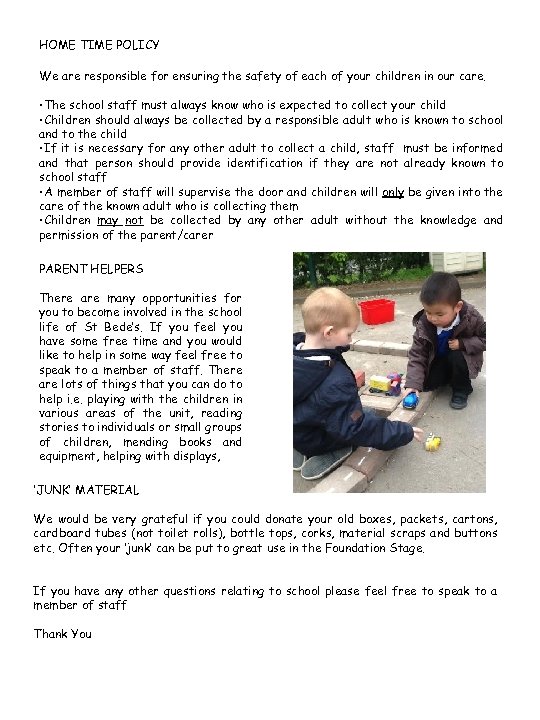
HOME TIME POLICY We are responsible for ensuring the safety of each of your children in our care. • The school staff must always know who is expected to collect your child • Children should always be collected by a responsible adult who is known to school and to the child • If it is necessary for any other adult to collect a child, staff must be informed and that person should provide identification if they are not already known to school staff • A member of staff will supervise the door and children will only be given into the care of the known adult who is collecting them • Children may not be collected by any other adult without the knowledge and permission of the parent/carer PARENT HELPERS There are many opportunities for you to become involved in the school life of St Bede’s. If you feel you have some free time and you would like to help in some way feel free to speak to a member of staff. There are lots of things that you can do to help i. e. playing with the children in various areas of the unit, reading stories to individuals or small groups of children, mending books and equipment, helping with displays, ‘JUNK’ MATERIAL We would be very grateful if you could donate your old boxes, packets, cartons, cardboard tubes (not toilet rolls), bottle tops, corks, material scraps and buttons etc. Often your ‘junk’ can be put to great use in the Foundation Stage. If you have any other questions relating to school please feel free to speak to a member of staff Thank You
Скачать презентацию St Bede s RC Primary School Early Years Brochure
ef477ee98d1fa64deb5a09b5e46f7d89.ppt