


 Скачать презентацию St Andrews Nov 2008 Human Computer Interaction as it
a26e95ca62339385afc746e24250e0e2.ppt
- Количество слайдов: 39
 St Andrews, Nov. 2008 Human–Computer Interaction: as it was, as it is, and as it may be Connected, but Under Control? Big, but Brainy? Alan Dix Info. Lab 21, Lancaster University, UK www. hcibook. com/alan www. alandix. com/blog
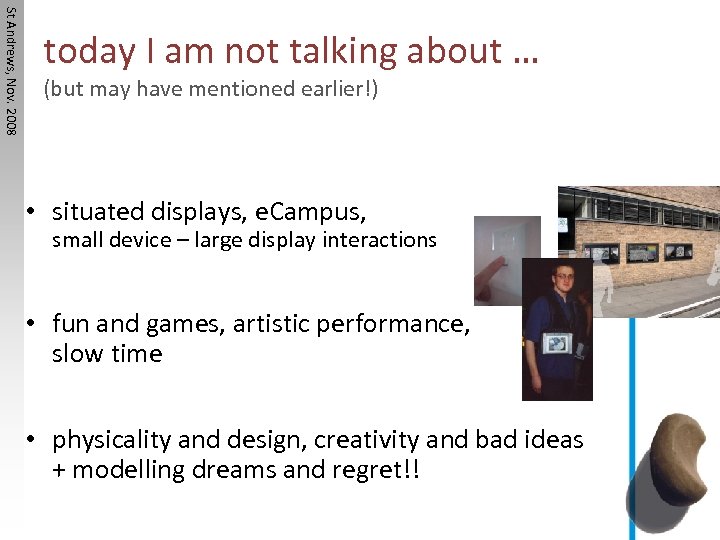 St Andrews, Nov. 2008 today I am not talking about … (but may have mentioned earlier!) • situated displays, e. Campus, small device – large display interactions • fun and games, artistic performance, slow time • physicality and design, creativity and bad ideas + modelling dreams and regret!!
 St Andrews, Nov. 2008 ‘my stuff bit’, but lots of other people Athens: Akrivi, Costas, Giorgos, Yannis, +++ Lancaster: Azrina, Devina, Nazihah, Stavros, +++ Madrid: Estefania, Miguel, Allesio Rome: Antonella, Tiziana, +++ plus the old a. Qtive team
 St Andrews, Nov. 2008 some numbers
 St Andrews, Nov. 2008 back of the envelope … the Dix number how much memory for full AV record of your life? – – – assume ISDN quality (10 Kbytes/sec) 30 million seconds / year => 300 Gbytes/year one hard disk x number of years but Moores Law … size reduces each year max is after 2 years never need more than one big disk baby born today … – the life of man is 3 score and ten = 70 years – 21 tera bytes … but with Moores Law … – memory the size of a grain of dust … from dust we came …
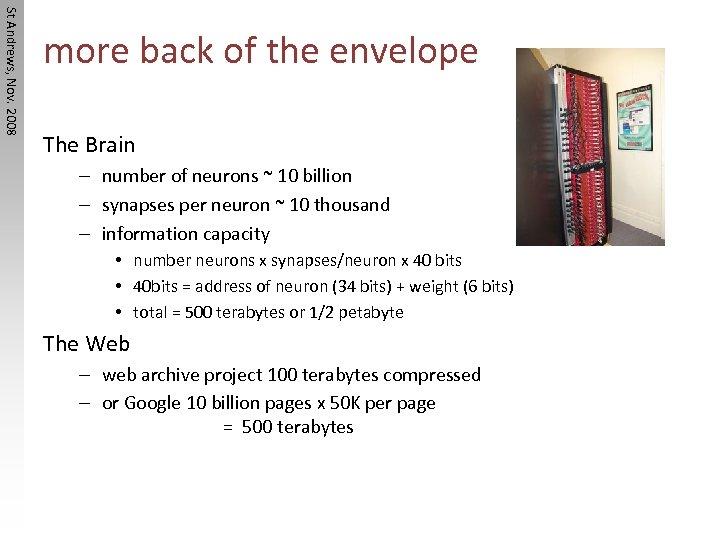 St Andrews, Nov. 2008 more back of the envelope The Brain – number of neurons ~ 10 billion – synapses per neuron ~ 10 thousand – information capacity • number neurons x synapses/neuron x 40 bits • 40 bits = address of neuron (34 bits) + weight (6 bits) • total = 500 terabytes or 1/2 petabyte The Web – web archive project 100 terabytes compressed – or Google 10 billion pages x 50 K per page = 500 terabytes
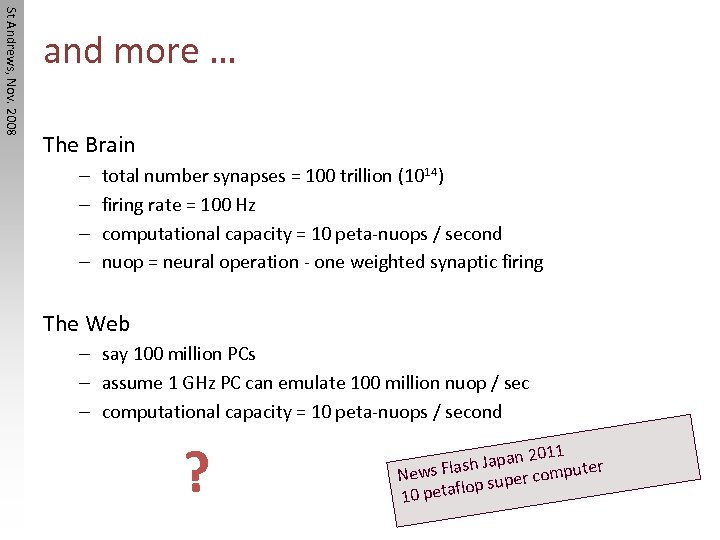 St Andrews, Nov. 2008 and more … The Brain – – total number synapses = 100 trillion (1014) firing rate = 100 Hz computational capacity = 10 peta-nuops / second nuop = neural operation - one weighted synaptic firing The Web – say 100 million PCs – assume 1 GHz PC can emulate 100 million nuop / sec – computational capacity = 10 peta-nuops / second ? 2011 sh Japan mputer News Fla super co lop 10 petaf
 St Andrews, Nov. 2008 so what? • global computing approximating raw power of single human brain • does not mean artificial humans! but does make you think • we live in interesting times an age pregnant for “intelligent” things • but maybe not as we know it … AI … Alien Intelligence = AI = Alien Intelligence
 St Andrews, Nov. 2008 using intelligence on the desktop on. Cue 9
 St Andrews, Nov. 2008 on. Cue origins • dot. company a. Qtive with Russell Beale, Andy Wood, and others • venture capital funding from 3 i … BEFORE dot. com explosion • on. Cue principal product – over 600, 000 copies distributed – 1000 s of registered copies • needed second round funding … … just AFTER dot. com collapse : -(
 St Andrews, Nov. 2008 on. Cue • • intelligent ‘context sensitive’ toolbar sits at side of the screen watches clipboard for cut/copy suggests useful things to do with copied date
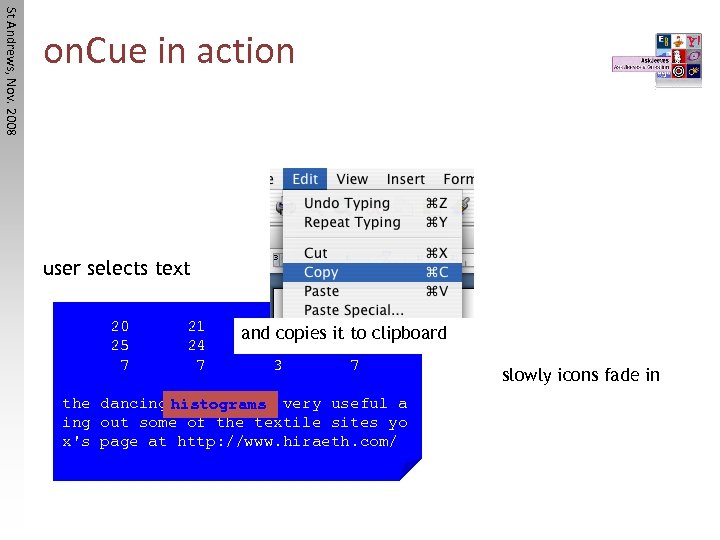 St Andrews, Nov. 2008 on. Cue in action • user selects text • and copies it to clipboard • slowly icons fade in user selects text 20 25 7 21 24 7 22 23 and copies it to clipboard 20 3 17 7 the dancing histograms very useful a histograms ing out some of the textile sites yo x's page at http: //www. hiraeth. com/ slowly icons fade in
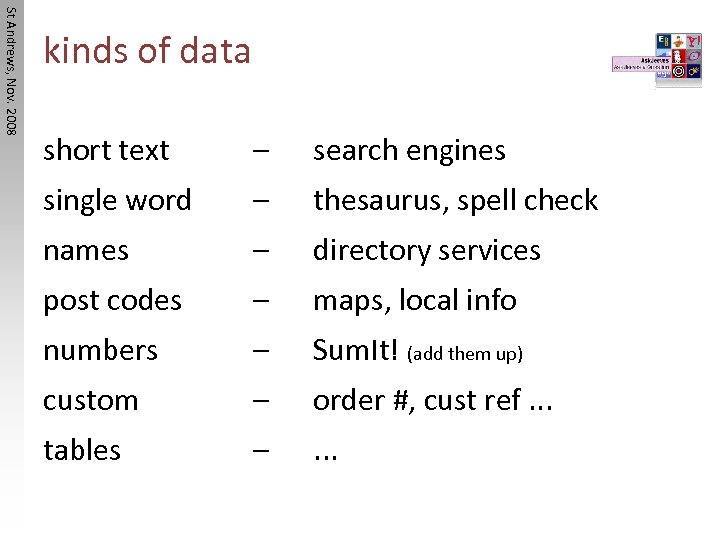 St Andrews, Nov. 2008 kinds of data short text – search engines single word – thesaurus, spell check names – directory services post codes – maps, local info numbers – Sum. It! (add them up) custom – order #, cust ref. . . tables – . . .
 St Andrews, Nov. 2008 issues …
 St Andrews, Nov. 2008 appropriate intelligence • often simple heuristics • combined with the right interaction
 St Andrews, Nov. 2008 rules of standard AI interfaces 1. it should be right as often as possible 2. when it is right it should be good emos t is! for d ver i good w cle ok ho lo
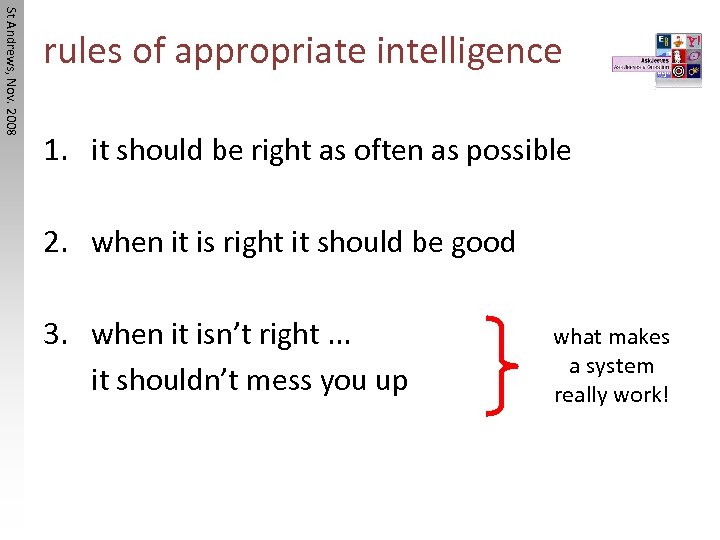 St Andrews, Nov. 2008 rules of appropriate intelligence 1. it should be right as often as possible 2. when it is right it should be good 3. when it isn’t right. . . it shouldn’t mess you up what makes a system really work!
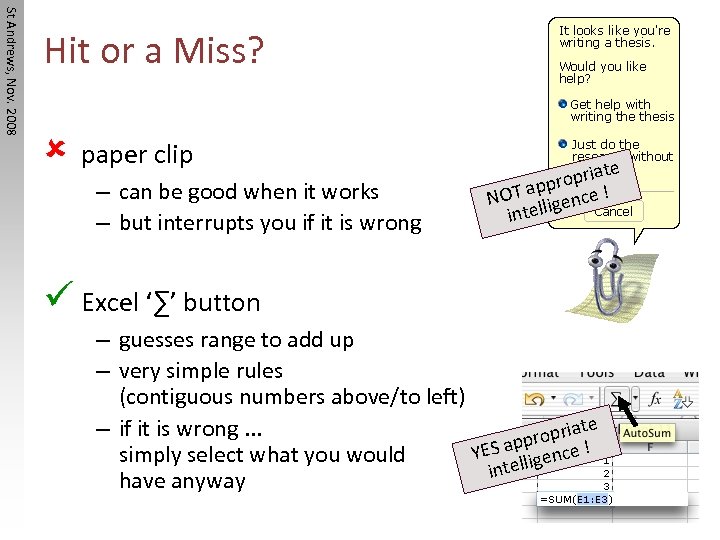 St Andrews, Nov. 2008 Hit or a Miss? paper clip – can be good when it works – but interrupts you if it is wrong te ropria p OT ap gence ! N intelli Excel ‘∑’ button – guesses range to add up – very simple rules (contiguous numbers above/to left) te – if it is wrong. . . opria ppr YES a ligence ! simply select what you would intel have anyway
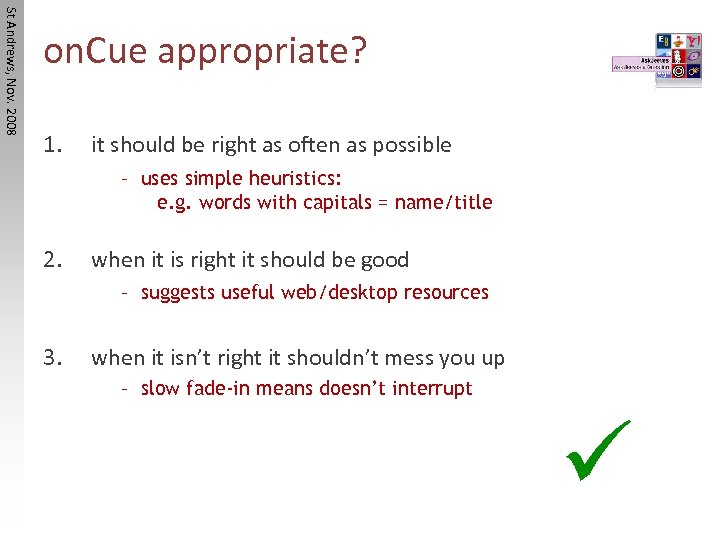 St Andrews, Nov. 2008 on. Cue appropriate? 1. it should be right as often as possible – –uses simple heuristics: e. g. words with capitals = name/title 2. when it is right it should be good – –suggests useful web/desktopresources suggests useful web/desktop resources 3. when it isn’t right it shouldn’t mess you up – –slow fade-in means doesn’t interrupt
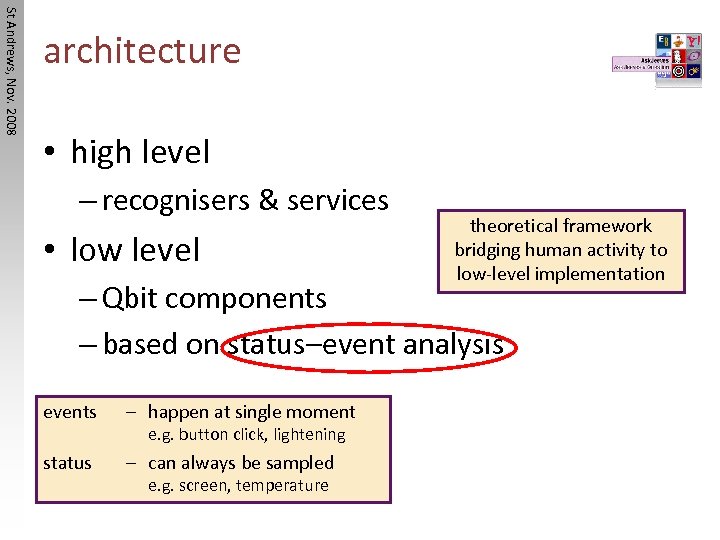 St Andrews, Nov. 2008 architecture • high level – recognisers & services • low level theoretical framework bridging human activity to low-level implementation – Qbit components – based on status–event analysis events – happen at single moment status – can always be sampled e. g. button click, lightening e. g. screen, temperature
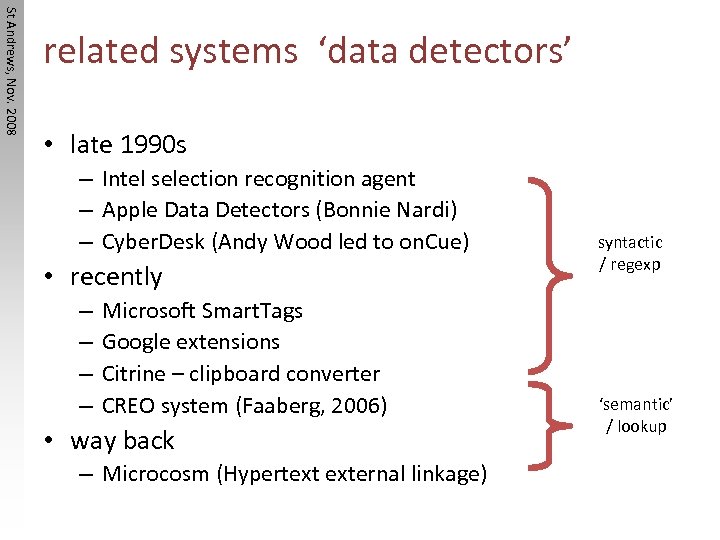 St Andrews, Nov. 2008 related systems ‘data detectors’ • late 1990 s – Intel selection recognition agent – Apple Data Detectors (Bonnie Nardi) – Cyber. Desk (Andy Wood led to on. Cue) • recently – – Microsoft Smart. Tags Google extensions Citrine – clipboard converter CREO system (Faaberg, 2006) • way back – Microcosm (Hypertext external linkage) syntactic / regexp ‘semantic’ / lookup
 St Andrews, Nov. 2008 using intelligence. . . and on the web Snip!t 22
 St Andrews, Nov. 2008 Snip!t origins • MSc project 2002 (Jason Marshall) • studying bookmarking – focus was organisation • exploratory study – found users wanted to bookmark sections • so one evening Alan has a quick hack … and about once or twice a year since • now being used for other projects • live system … try it out
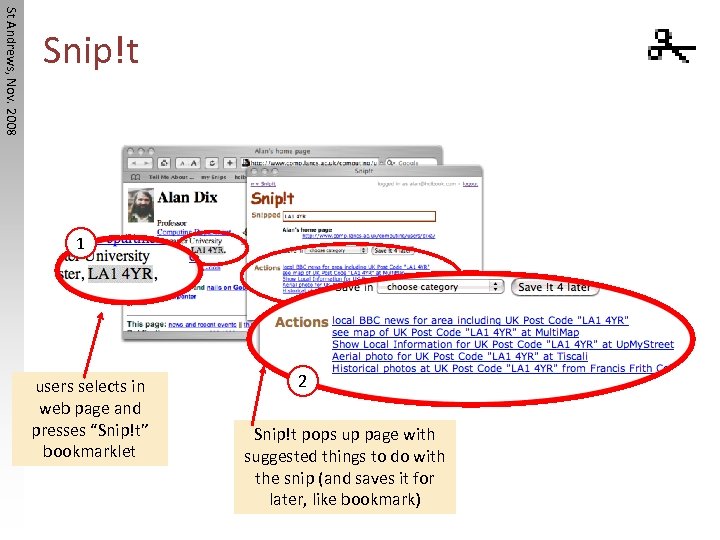 St Andrews, Nov. 2008 Snip!t 1 users selects in web page and presses “Snip!t” bookmarklet 2 Snip!t pops up page with suggested things to do with the snip (and saves it for later, like bookmark)
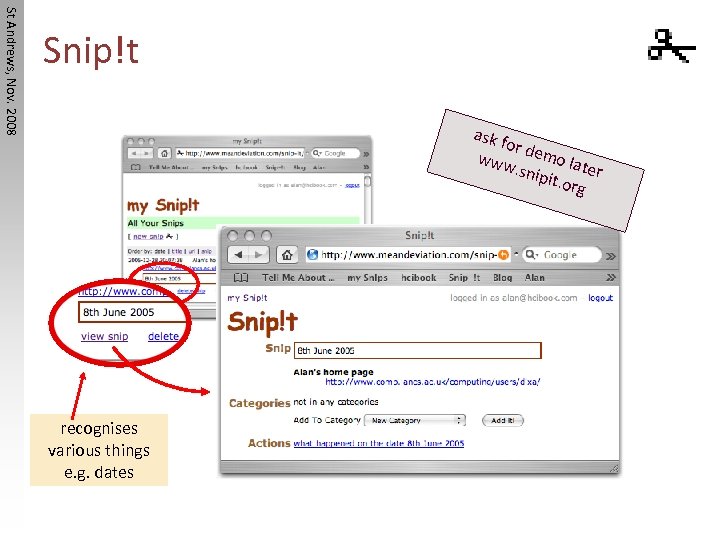 St Andrews, Nov. 2008 Snip!t ask f or www demo la ter. snip it. org recognises various things e. g. dates
 St Andrews, Nov. 2008 issues …
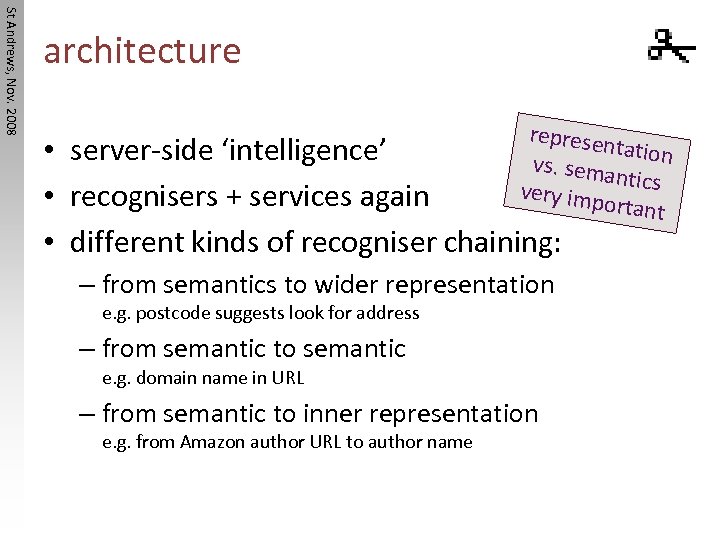 St Andrews, Nov. 2008 architecture represen tation vs. sema ntics very imp ortant • server-side ‘intelligence’ • recognisers + services again • different kinds of recogniser chaining: – from semantics to wider representation e. g. postcode suggests look for address – from semantic to semantic e. g. domain name in URL – from semantic to inner representation e. g. from Amazon author URL to author name
 St Andrews, Nov. 2008 provenance when you have a recognised term: • where did it come from – text char pos 53 -67 – transformed from Amazon book URL • how confident are you – 99% certain Abraham Lincoln is a person • how important – mother-in-law’s birthday
 St Andrews, Nov. 2008 using intelligence the bigger picture. . . 29
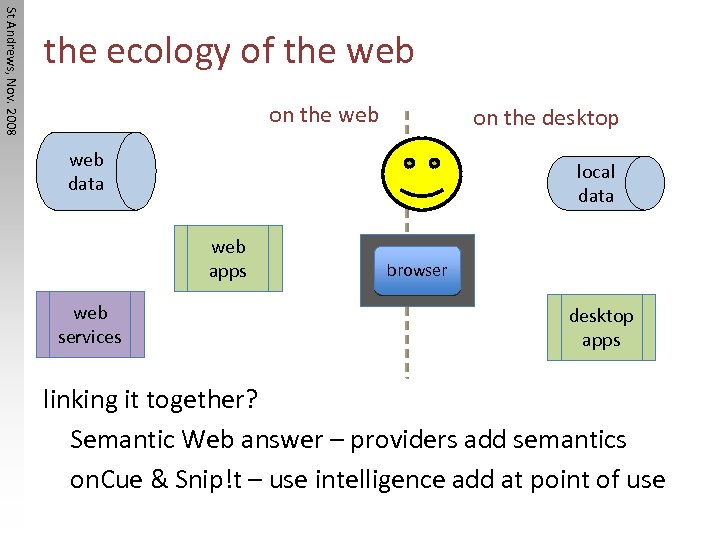 St Andrews, Nov. 2008 the ecology of the web on the desktop web data local data web apps web services browser desktop apps linking it together? Semantic Web answer – providers add semantics on. Cue & Snip!t – use intelligence add at point of use
 St Andrews, Nov. 2008 • on. Cue & Snip!t (data detectors) – semantics for source of interaction • text mining (crawlers) – semantics for target of interaction • other parts of the ecology. . . 31
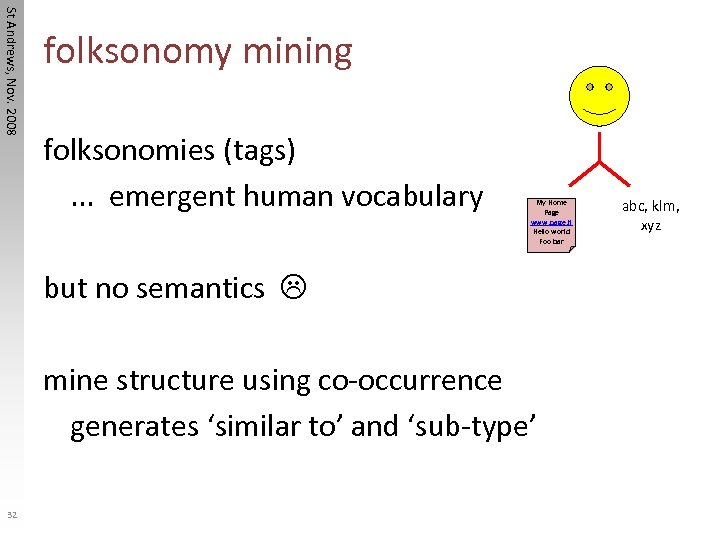 St Andrews, Nov. 2008 folksonomy mining folksonomies (tags). . . emergent human vocabulary My Home Page www. page. it Hello world Foo bar but no semantics mine structure using co-occurrence generates ‘similar to’ and ‘sub-type’ 32 abc, klm, xyz
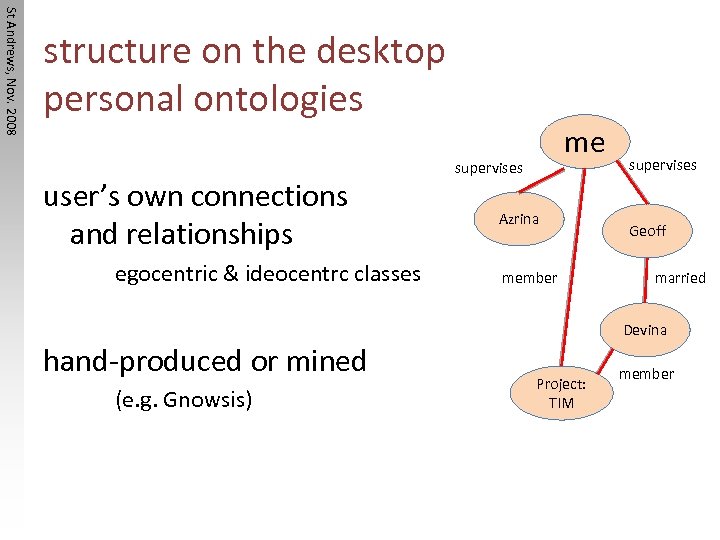 St Andrews, Nov. 2008 structure on the desktop personal ontologies user’s own connections and relationships egocentric & ideocentrc classes me supervises Azrina member supervises Geoff married Devina hand-produced or mined (e. g. Gnowsis) Project: TIM member
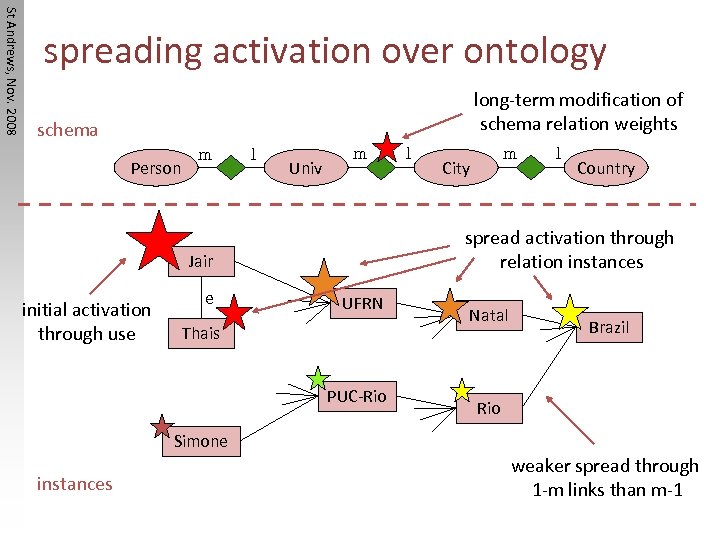 St Andrews, Nov. 2008 spreading activation over ontology long-term modification of schema relation weights schema Person m 1 Univ m initial activation through use m City 1 Country spread activation through relation instances Jair e 1 UFRN Thais PUC-Rio Natal Brazil Rio Simone instances weaker spread through 1 -m links than m-1
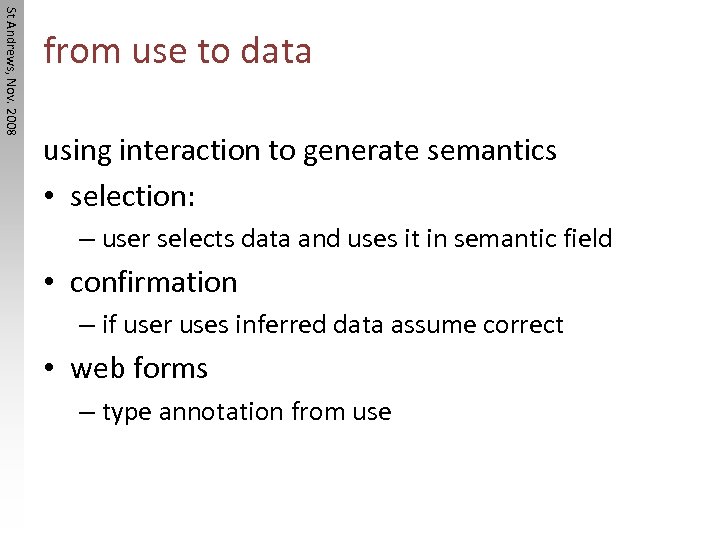 St Andrews, Nov. 2008 from use to data using interaction to generate semantics • selection: – user selects data and uses it in semantic field • confirmation – if user uses inferred data assume correct • web forms – type annotation from use
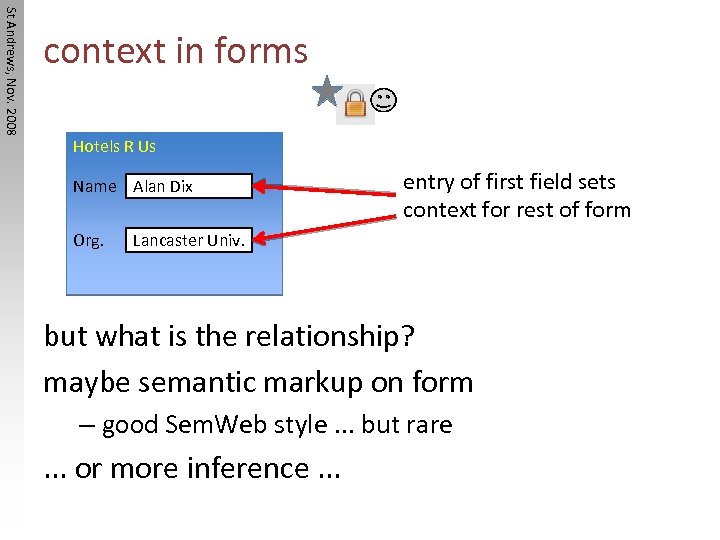 St Andrews, Nov. 2008 context in forms Hotels R Us Name Alan Dix Org. entry of first field sets context for rest of form Lancaster Univ. but what is the relationship? maybe semantic markup on form – good Sem. Web style. . . but rare . . . or more inference. . .
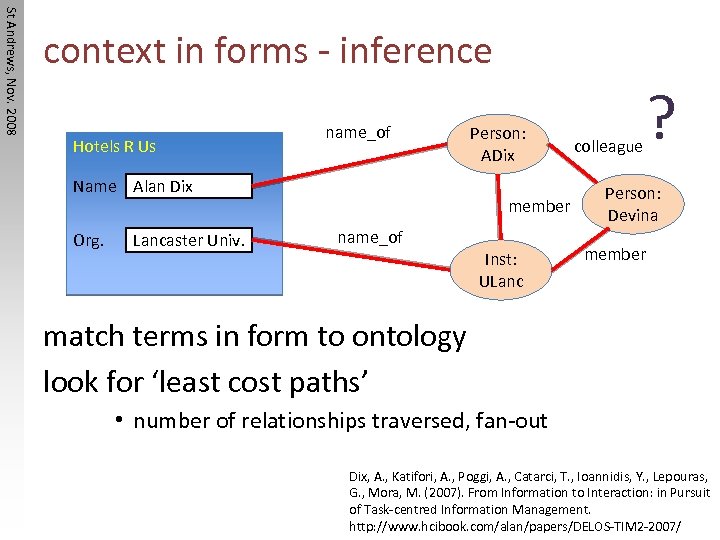 St Andrews, Nov. 2008 context in forms - inference Hotels R Us name_of Name Alan Dix Org. Lancaster Univ. Person: ADix member name_of Inst: ULanc colleague ? Person: Devina member match terms in form to ontology look for ‘least cost paths’ • number of relationships traversed, fan-out Dix, A. , Katifori, A. , Poggi, A. , Catarci, T. , Ioannidis, Y. , Lepouras, G. , Mora, M. (2007). From Information to Interaction: in Pursuit of Task-centred Information Management. http: //www. hcibook. com/alan/papers/DELOS-TIM 2 -2007/
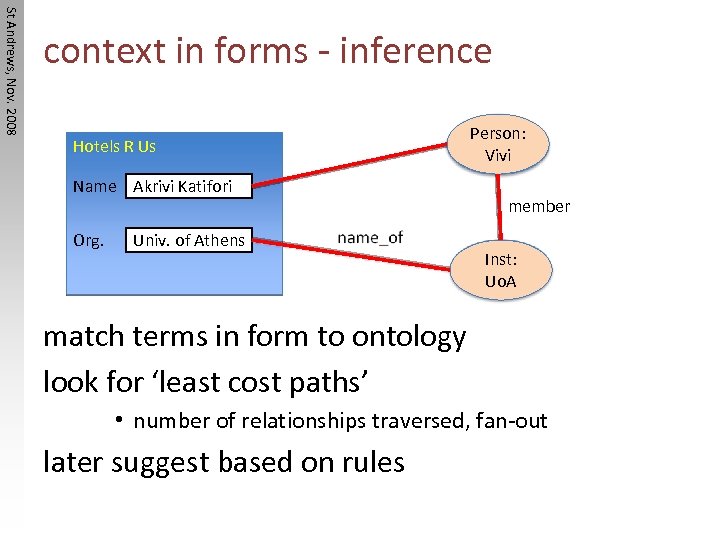 St Andrews, Nov. 2008 context in forms - inference Hotels R Us Name Akrivi Katifori Org. Univ. of Athens Person: Vivi member Inst: Uo. A match terms in form to ontology look for ‘least cost paths’ • number of relationships traversed, fan-out later suggest based on rules
 St Andrews, Nov. 2008 39