


 Скачать презентацию — SST and Ocean Color A NOAA Perspective
5e043892cdc80c4bae2b6d511c1417af.ppt
- Количество слайдов: 27
 - SST and Ocean Color A NOAA Perspective Kenneth S. Casey NOAA National Oceanographic Data Center USA 1 Nov 20 -22, 2007: Oslo, Norway
 With special thanks to… Marcia Weaks NOAA IOOS Program Office Paul Di. Giacomo NOAA/NESDIS Satellite Applications and Research Linda Stathoplos NOAA/NESDIS Office of Satellite Data Production and Distribution The views expressed herein are those of the speaker’s alone and should not be considered official NOAA or US Government policy. 2 Nov 20 -22, 2007: Oslo, Norway
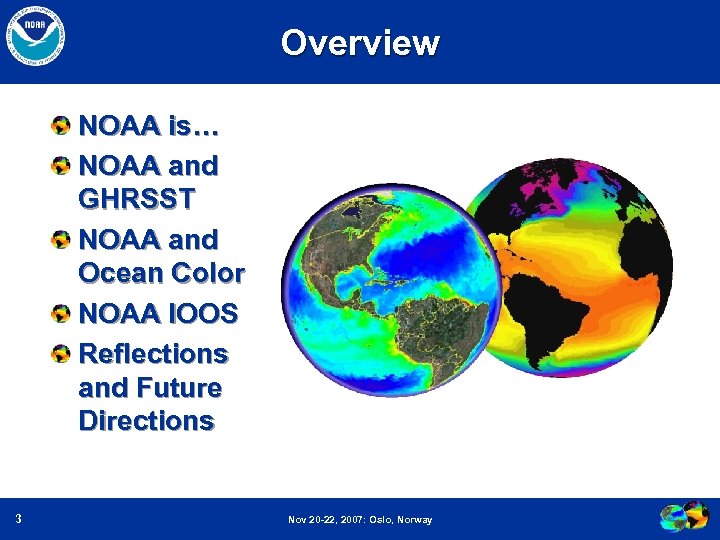 Overview NOAA is… NOAA and GHRSST NOAA and Ocean Color NOAA IOOS Reflections and Future Directions 3 Nov 20 -22, 2007: Oslo, Norway
 NOAA is many things. . Research Operations 4 Applications Data Stewardship Nov 20 -22, 2007: Oslo, Norway
 NOAA is many things. . Research Operations Applications Data Stewardship Often there is no over -arching plan coordinating the related activities across different offices 5 Despite the problems with this approach, there is a certain strength in the diversity Nov 20 -22, 2007: Oslo, Norway
 Strength in Diversity In both SST and Ocean Color, NOAA’s activities have evolved “organically” NOAA groups - regardless of their office face similar obstacles - Limited funding Data availability And they share similar goals - To get data into their users’ hands - To see their products used to societal benefit So there is a (growing) tendency for grassroots coordination 6 Nov 20 -22, 2007: Oslo, Norway
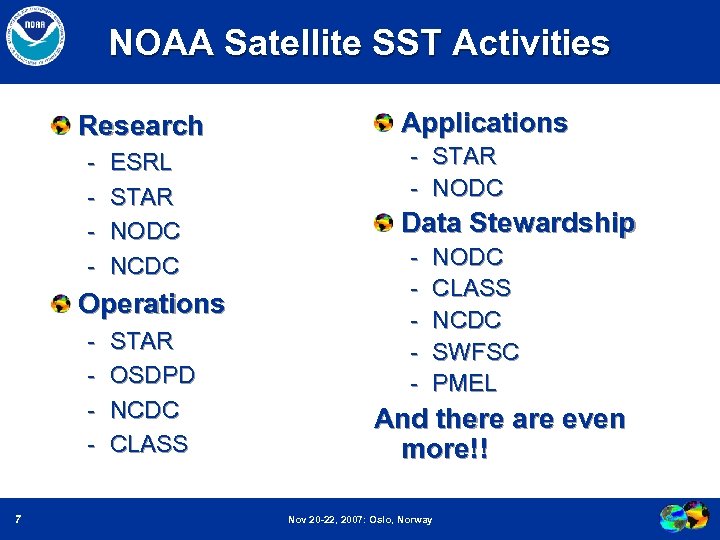 NOAA Satellite SST Activities Research - ESRL STAR NODC NCDC Operations 7 STAR OSDPD NCDC CLASS Applications - STAR - NODC Data Stewardship - NODC CLASS NCDC SWFSC PMEL And there are even more!! Nov 20 -22, 2007: Oslo, Norway
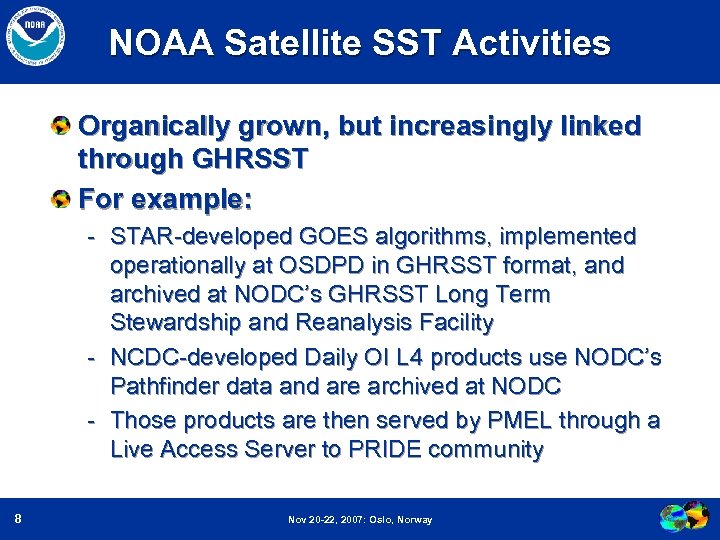 NOAA Satellite SST Activities Organically grown, but increasingly linked through GHRSST For example: - STAR-developed GOES algorithms, implemented operationally at OSDPD in GHRSST format, and archived at NODC’s GHRSST Long Term Stewardship and Reanalysis Facility - NCDC-developed Daily OI L 4 products use NODC’s Pathfinder data and are archived at NODC - Those products are then served by PMEL through a Live Access Server to PRIDE community 8 Nov 20 -22, 2007: Oslo, Norway
 NOAA SST Future Directions Preparations underway for VIIRS on NPP and NPOESS STAR and NOAA NPOESS Data Exploitation team considering making our own GHRSST SSTs and/or converting NPOESS IPOprovided data to GHRSST format Commitments to GHRSST at “grass roots” level remain, and are growing stronger IOOS involvement unclear at moment, but at least will be a major “user” (more later) 9 Nov 20 -22, 2007: Oslo, Norway
 NOAA SST Future Directions NODC will continue as the GHRSST LTSRF NODC is developing AVHRR Pathfinder capability and will provide both “V 6” in GHRSST L 2 P and L 3 formats OSDPD will continue GOES L 2 P OSDPD will create MTSAT L 2 P (May 2008) OSDPD and STAR may create other GHRSST formatted data (e. g. , Met. Op AVHRR, POES-GOES blended L 4, VIIRS, etc. ) 10 Nov 20 -22, 2007: Oslo, Norway
 NOAA and GHRSST Awareness is widespread in NOAA’s SST community Growing need for international partners is broadly understood in NOAA Through office-level efforts, NOAA is taking its roles in GHRSST very seriously We will continue to play in the international arena… whether it is GCOS, or GOOS, or JCOMM, or IOC, or …? 11 Nov 20 -22, 2007: Oslo, Norway
 NOAA and GHRSST The future looks bright for NOAA and GHRSST! 12 Nov 20 -22, 2007: Oslo, Norway
 NOAA and Ocean Color Reliance on foreign sensors is VERY clearly understood - No current NOAA ocean color sensors Outlook for VIIRS is, well, ummmm, errr, hmmm… NOAA is increasingly active in ocean color - Coast. Watch/Ocean. Watch and Okeanos - MERIS operational processing - MOBY and Cal/Val 13 Nov 20 -22, 2007: Oslo, Norway
 Coast. Watch NOAA Ocean Color Data Processing System (Okeanos 1) for NRT Sea. Wi. FS and MODIS data - 40 MODIS granules per day for Atlantic, Pacific, and Caribbean - 4 Sea. Wi. FS Swath Data Files covering US East Coast, West Coast and Gulf of Mexico (For Authorized NOAA users only) Output products published via Web Server and ftp data server - Coast. Watch Web server http: //coastwatch. noaa. gov - FTP server ftp: //ftpoceanwatch. noaa. gov 1 There will be a poster on the NOAA operational Okeanos Ocean Color Processing System at the 2008 Ocean Sciences Meeting in Session #100 on operational oceanography. 14 Nov 20 -22, 2007: Oslo, Norway
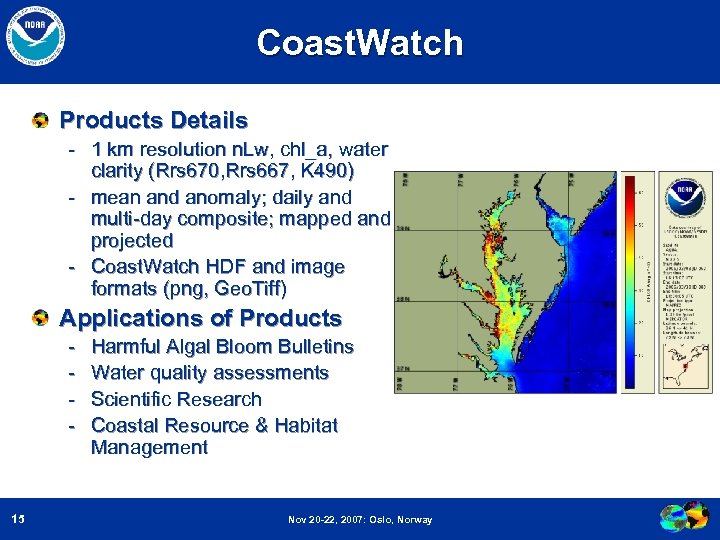 Coast. Watch Products Details - 1 km resolution n. Lw, chl_a, water clarity (Rrs 670, Rrs 667, K 490) - mean and anomaly; daily and multi-day composite; mapped and projected - Coast. Watch HDF and image formats (png, Geo. Tiff) Applications of Products - 15 Harmful Algal Bloom Bulletins Water quality assessments Scientific Research Coastal Resource & Habitat Management Nov 20 -22, 2007: Oslo, Norway
 MERIS at NOAA Coast. Watch An effort has begun to deliver MERIS reduced resolution data products operationally by the end of 2008, toward ensuring ocean color data continuity for U. S. coastal waters Daily download L 2 data for one orbit; plans to process 2 -3 orbits daily for entire CONUS, Create daily mapped Chlorophyll imagery for Coast. Watch regions Plan to use 4 -day composites to create anomaly products for HABs. 4 -day composites provide full coverage of GOM and SE-USA Coastal regions. 16 Nov 20 -22, 2007: Oslo, Norway
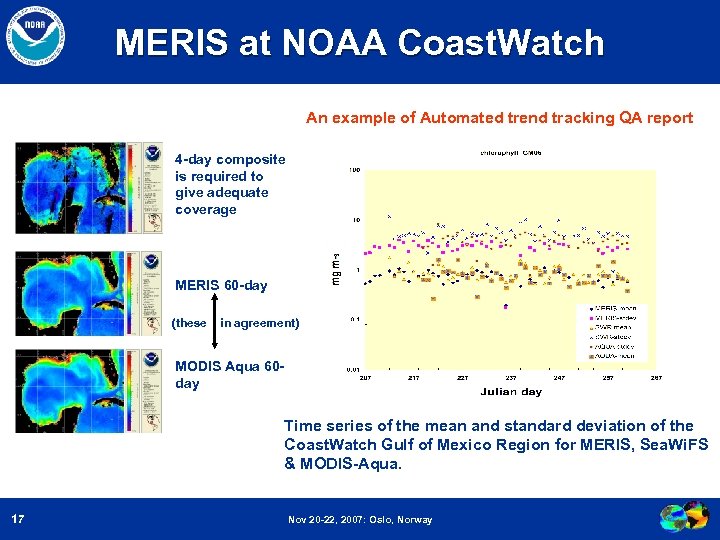 MERIS at NOAA Coast. Watch An example of Automated trend tracking QA report 4 -day composite is required to give adequate coverage MERIS 60 -day (these in agreement) MODIS Aqua 60 day (these in agreement) Time series of the mean and standard deviation of the Coast. Watch Gulf of Mexico Region for MERIS, Sea. Wi. FS & MODIS-Aqua. 17 Nov 20 -22, 2007: Oslo, Norway
 NOAA and MOBY Marine Optical Buo. Y (MOBY) in Hawaii - A Vicarious Calibration Facility On-orbit vicarious calibration with high quality in situ data is necessary for accurate satellite ocean color products, as well as for providing required Climate Quality ocean color products Supported by NASA and NOAA, has been measuring hyperspectral in situ water-leaving radiance since 1997 NOAA has assumed responsibility for MOBY, and is currently funding MOBY operations 18 Nov 20 -22, 2007: Oslo, Norway
 NOAA and MOBY data have significant contributions to ocean science community: - Only in situ data source used to vicariously calibrate Sea. Wi. FS and MODIS for providing global ocean color products - Contributed to assist in calibration and/or validation activities for other ocean color sensors, e. g. , MERIS (ESA), OCTS (Japan), POLDER (France) - Achieved more than ten years high quality in situ ocean optics data for scientific research and applications 19 Nov 20 -22, 2007: Oslo, Norway
 NOAA and MOBY data can also provide links between products derived from various ocean color sensors, and thus help data merging Vicarious calibration facilities such as MOBY (or more advanced instrument) are required for the future ocean color sensors, e. g. , NPOESS/VIIRS 20 Nov 20 -22, 2007: Oslo, Norway
 NOAA OC Future Directions General interest in acquiring high-resolution, wellcharacterized ocean color data from non-U. S. satellite sensors Near-term interest in acquiring MERIS full resolution & raw data (L 1 A) and associated sensor characterization and calibration information New & improved techniques for processing & merging data from different sensors, including detailed error characterization Cal/val and data processing collaborations, particularly toward production of climate quality data records 21 Nov 20 -22, 2007: Oslo, Norway
 IOOS/GOOS Connections And now, for something completely different… 22 Nov 20 -22, 2007: Oslo, Norway
 U. S. Integrated Ocean Observing System Represents a major shift in approach to ocean observing Draws together the vast network of disparate, federal and non-federal observing systems Produces a cohesive suite of data, information, and products at a sufficient geographic and temporal scale to support decision-making IOOS is the US contribution to the Global Ocean Observing System, which is the ocean component of GEOSS 23 Nov 20 -22, 2007: Oslo, Norway
 NOAA IOOS US IOOS has been around for a number of years, but has floundered - NOAA as lead US agency must provide leadership Enter 2007: NOAA creates its own IOOS Program Office NOAA IOOS hopes to provide that leadership, through a rapid demonstration of integrated datasets leading to societal benefit - the “DIF” - Data Integration Framework 24 Nov 20 -22, 2007: Oslo, Norway
 Reflections on NOAA IOOS NOAA’s IOOS Program is a bit like the GMES Marine Core Services, but has some fundamental differences NOAA IOOS (and Coast. Watch) would be interested in something like a “coastal Glob. COLOUR” (beware Tyranny of the “Or”) NOAA IOOS has stated publicly that it would like to “adopt GHRSST” for SSTs There are reasons to be excited, but the future is uncertain… 25 Nov 20 -22, 2007: Oslo, Norway
 Closing Thoughts NOAA and GHRSST - life is good NOAA and Glob. COLOUR? - 26 Hmmm…. Well…. Err…. A proposal: Draft a Submission Agreement Nov 20 -22, 2007: Oslo, Norway
 Takk! Questions? Kenneth. Casey@noaa. gov 27 Nov 20 -22, 2007: Oslo, Norway