


 Скачать презентацию SSL TLS SMU CSE 5349 49 Layers of Security
eb74017308e014d9a67899c428c528c2.ppt
- Количество слайдов: 41
 SSL/TLS SMU CSE 5349/49
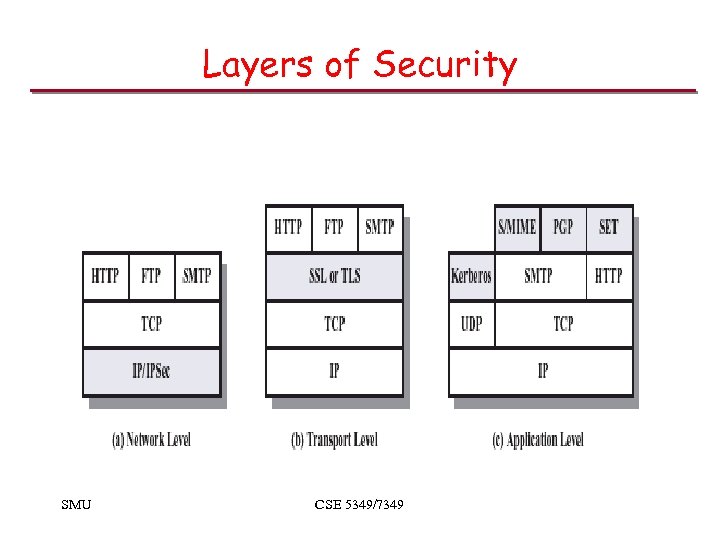 Layers of Security SMU CSE 5349/7349
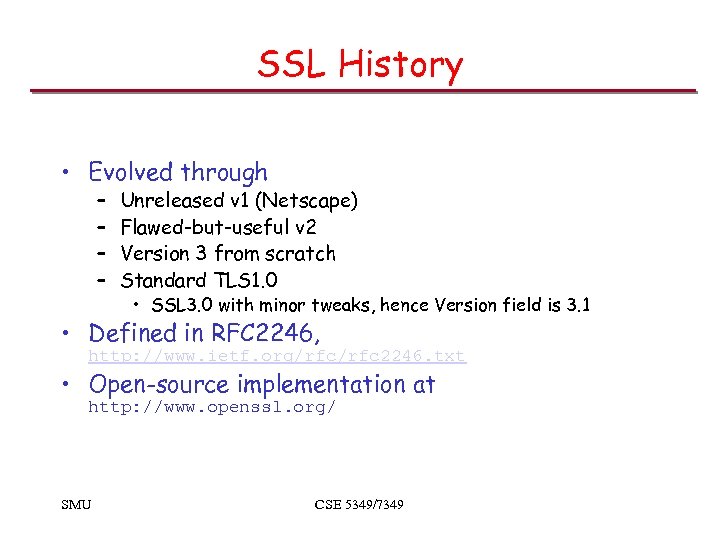 SSL History • Evolved through – – Unreleased v 1 (Netscape) Flawed-but-useful v 2 Version 3 from scratch Standard TLS 1. 0 • SSL 3. 0 with minor tweaks, hence Version field is 3. 1 • Defined in RFC 2246, http: //www. ietf. org/rfc 2246. txt • Open-source implementation at http: //www. openssl. org/ SMU CSE 5349/7349
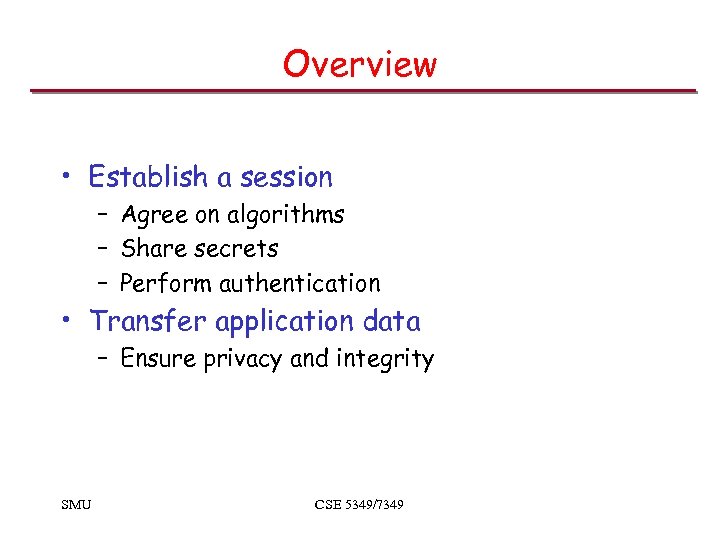 Overview • Establish a session – Agree on algorithms – Share secrets – Perform authentication • Transfer application data – Ensure privacy and integrity SMU CSE 5349/7349
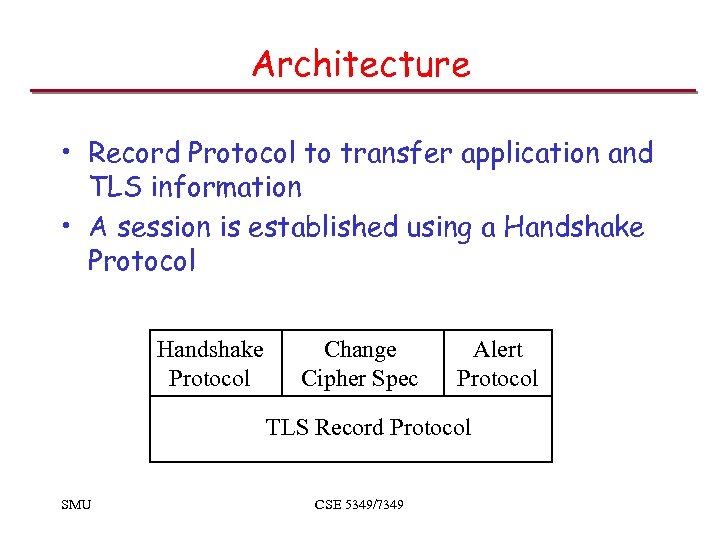 Architecture • Record Protocol to transfer application and TLS information • A session is established using a Handshake Protocol Change Cipher Spec Alert Protocol TLS Record Protocol SMU CSE 5349/7349
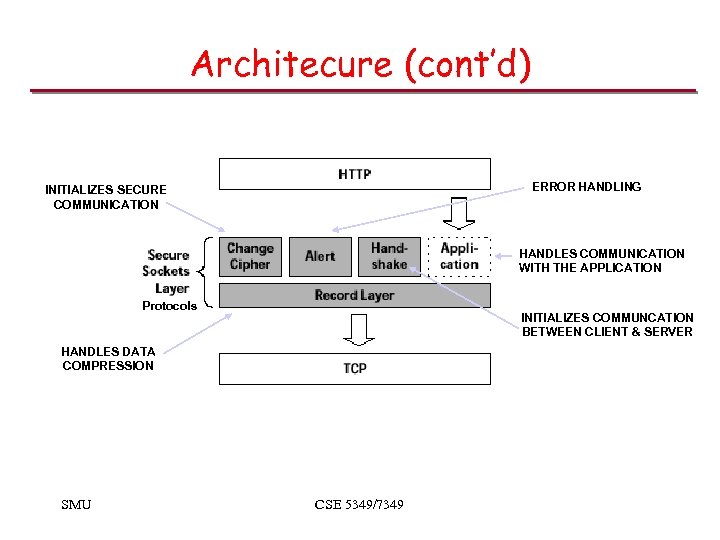 Architecure (cont’d) ERROR HANDLING INITIALIZES SECURE COMMUNICATION HANDLES COMMUNICATION WITH THE APPLICATION Protocols INITIALIZES COMMUNCATION BETWEEN CLIENT & SERVER HANDLES DATA COMPRESSION SMU CSE 5349/7349
 Handshake • Negotiate Cipher-Suite Algorithms – Symmetric cipher to use – Key exchange method – Message digest function • Establish and share master secret • Optionally authenticate server and/or client SMU CSE 5349/7349
 Handshake Phases • Hello messages • Certificate and Key Exchange messages • Change Cipher. Spec and Finished messages SMU CSE 5349/7349
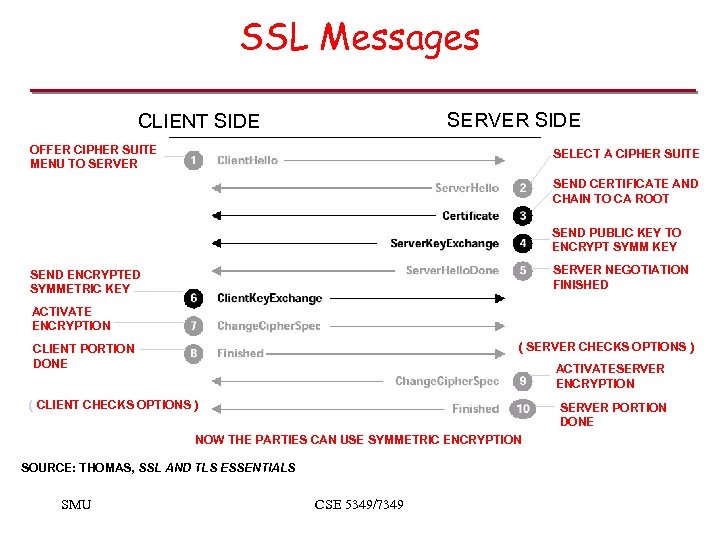 SSL Messages SERVER SIDE CLIENT SIDE OFFER CIPHER SUITE MENU TO SERVER SELECT A CIPHER SUITE SEND CERTIFICATE AND CHAIN TO CA ROOT SEND PUBLIC KEY TO ENCRYPT SYMM KEY SERVER NEGOTIATION FINISHED SEND ENCRYPTED SYMMETRIC KEY ACTIVATE ENCRYPTION ( SERVER CHECKS OPTIONS ) CLIENT PORTION DONE ACTIVATESERVER ENCRYPTION ( CLIENT CHECKS OPTIONS ) SERVER PORTION DONE NOW THE PARTIES CAN USE SYMMETRIC ENCRYPTION SOURCE: THOMAS, SSL AND TLS ESSENTIALS SMU CSE 5349/7349
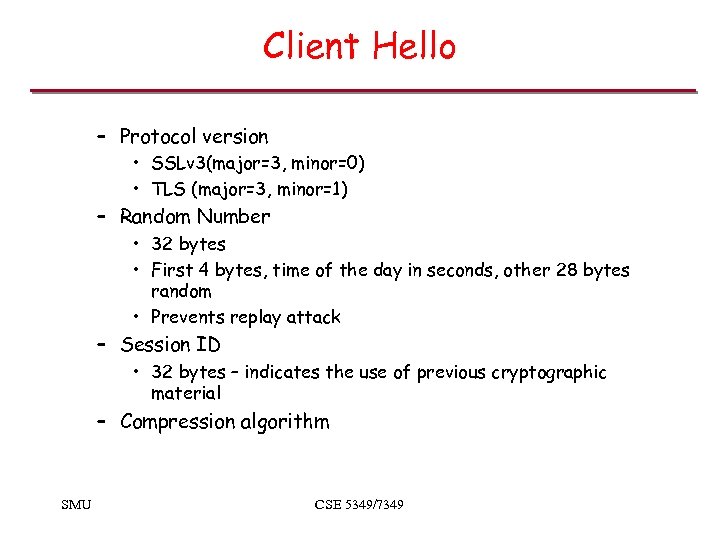 Client Hello – Protocol version • SSLv 3(major=3, minor=0) • TLS (major=3, minor=1) – Random Number • 32 bytes • First 4 bytes, time of the day in seconds, other 28 bytes random • Prevents replay attack – Session ID • 32 bytes – indicates the use of previous cryptographic material – Compression algorithm SMU CSE 5349/7349
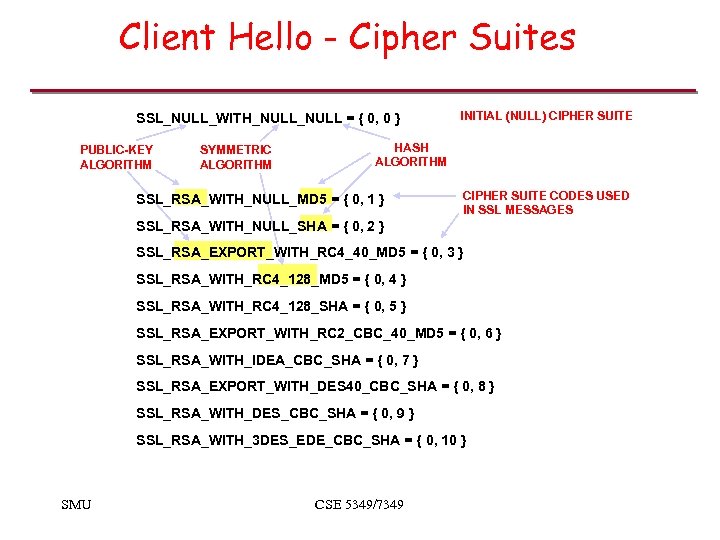 Client Hello - Cipher Suites SSL_NULL_WITH_NULL = { 0, 0 } PUBLIC-KEY ALGORITHM SYMMETRIC ALGORITHM INITIAL (NULL) CIPHER SUITE HASH ALGORITHM SSL_RSA_WITH_NULL_MD 5 = { 0, 1 } CIPHER SUITE CODES USED IN SSL MESSAGES SSL_RSA_WITH_NULL_SHA = { 0, 2 } SSL_RSA_EXPORT_WITH_RC 4_40_MD 5 = { 0, 3 } SSL_RSA_WITH_RC 4_128_MD 5 = { 0, 4 } SSL_RSA_WITH_RC 4_128_SHA = { 0, 5 } SSL_RSA_EXPORT_WITH_RC 2_CBC_40_MD 5 = { 0, 6 } SSL_RSA_WITH_IDEA_CBC_SHA = { 0, 7 } SSL_RSA_EXPORT_WITH_DES 40_CBC_SHA = { 0, 8 } SSL_RSA_WITH_DES_CBC_SHA = { 0, 9 } SSL_RSA_WITH_3 DES_EDE_CBC_SHA = { 0, 10 } SMU CSE 5349/7349
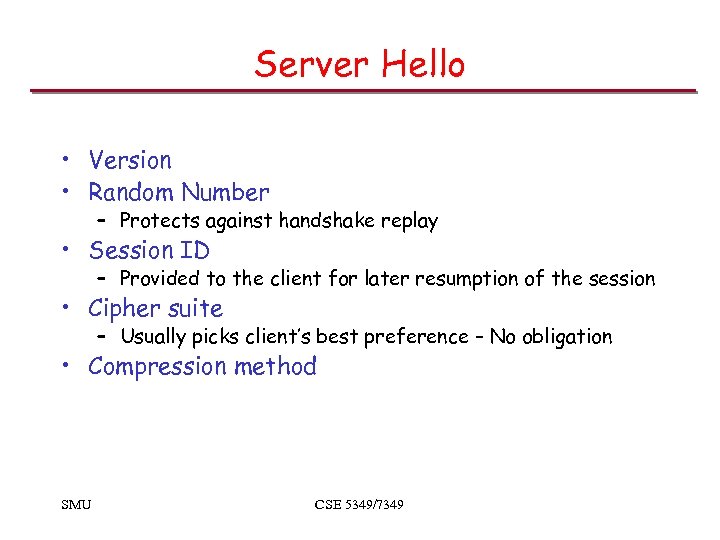 Server Hello • Version • Random Number – Protects against handshake replay • Session ID – Provided to the client for later resumption of the session • Cipher suite – Usually picks client’s best preference – No obligation • Compression method SMU CSE 5349/7349
 Certificates • Sequence of X. 509 certificates – Server’s, CA’s, … • X. 509 Certificate associates public key with identity • Certification Authority (CA) creates certificate – Adheres to policies and verifies identity – Signs certificate • User of Certificate must ensure it is valid SMU CSE 5349/7349
 Validating a Certificate • Must recognize accepted CA in certificate chain – One CA may issue certificate for another CA • Must verify that certificate has not been revoked – CA publishes Certificate Revocation List (CRL) SMU CSE 5349/7349
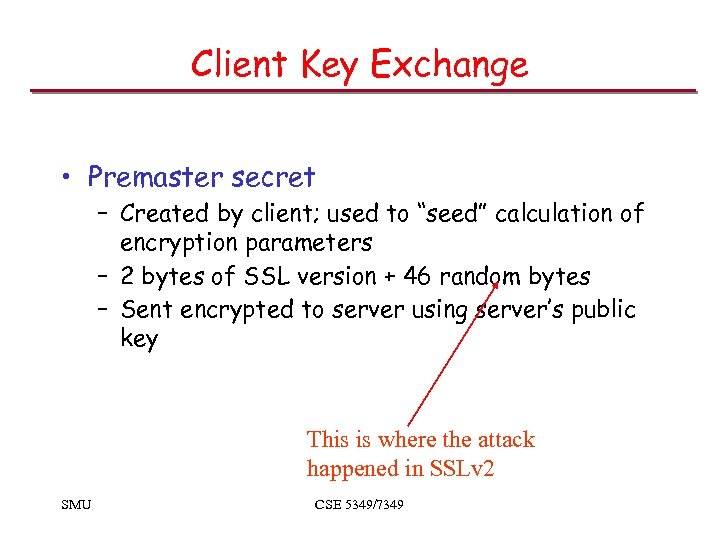 Client Key Exchange • Premaster secret – Created by client; used to “seed” calculation of encryption parameters – 2 bytes of SSL version + 46 random bytes – Sent encrypted to server using server’s public key This is where the attack happened in SSLv 2 SMU CSE 5349/7349
 Change Cipher Spec & Finished Messages • Change Cipher Spec – Switch to newly negotiated algorithms and key material • Finished – First message encrypted with new crypto parameters – Digest of negotiated master secret, the ensemble of handshake messages, sender constant – HMAC approach of nested hashing SMU CSE 5349/7349
 SSL Encryption • Master secret – Generated by both parties from premaster secret and random values generated by both client and server • Key material – Generated from the master secret and shared random values • Encryption keys – Extracted from the key material SMU CSE 5349/7349
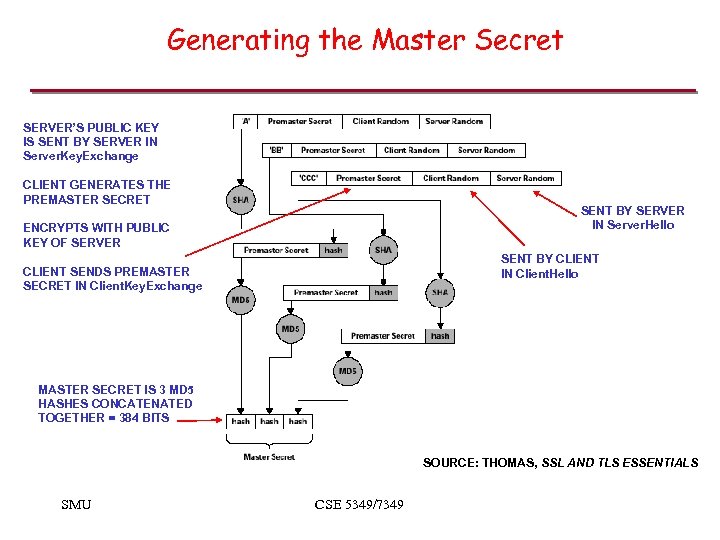 Generating the Master Secret SERVER’S PUBLIC KEY IS SENT BY SERVER IN Server. Key. Exchange CLIENT GENERATES THE PREMASTER SECRET SENT BY SERVER IN Server. Hello ENCRYPTS WITH PUBLIC KEY OF SERVER SENT BY CLIENT IN Client. Hello CLIENT SENDS PREMASTER SECRET IN Client. Key. Exchange MASTER SECRET IS 3 MD 5 HASHES CONCATENATED TOGETHER = 384 BITS SOURCE: THOMAS, SSL AND TLS ESSENTIALS SMU CSE 5349/7349
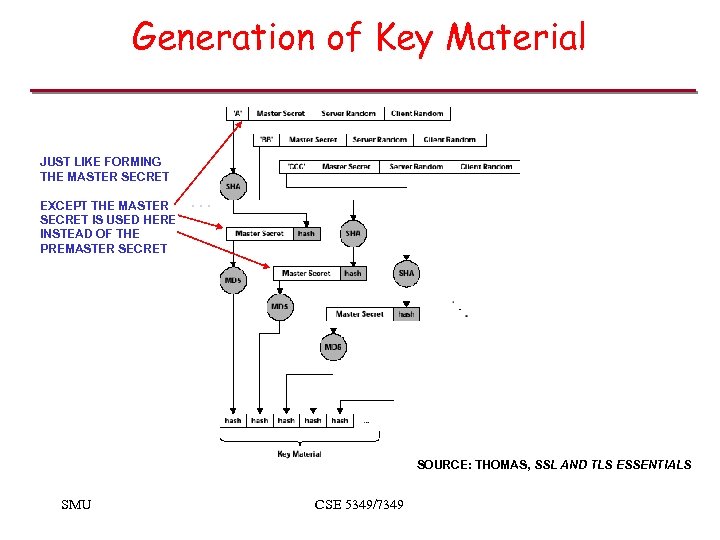 Generation of Key Material JUST LIKE FORMING THE MASTER SECRET EXCEPT THE MASTER SECRET IS USED HERE INSTEAD OF THE PREMASTER SECRET . . . SOURCE: THOMAS, SSL AND TLS ESSENTIALS SMU CSE 5349/7349
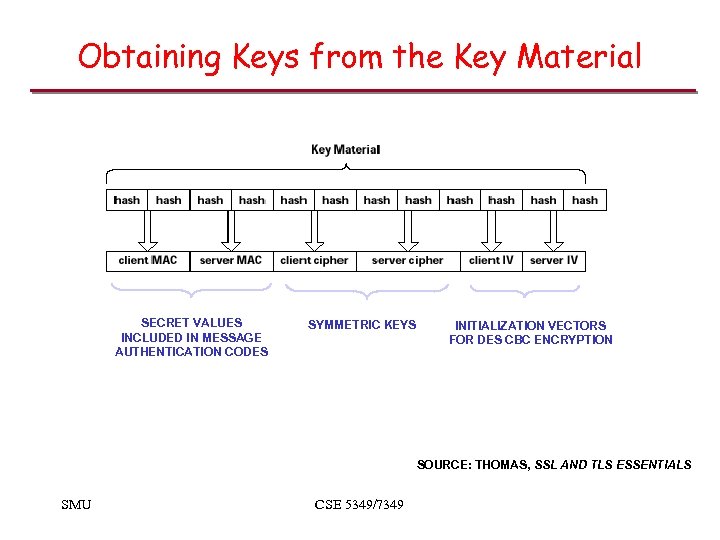 Obtaining Keys from the Key Material SECRET VALUES INCLUDED IN MESSAGE AUTHENTICATION CODES SYMMETRIC KEYS INITIALIZATION VECTORS FOR DES CBC ENCRYPTION SOURCE: THOMAS, SSL AND TLS ESSENTIALS SMU CSE 5349/7349
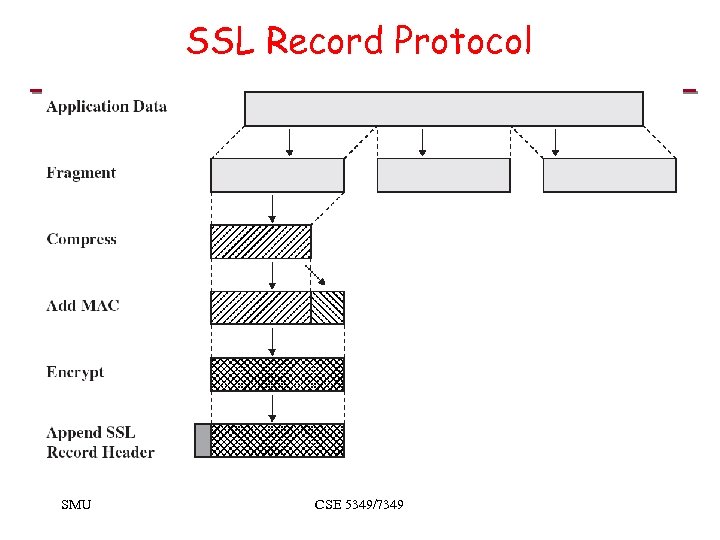 SSL Record Protocol SMU CSE 5349/7349
 Record Header • Three pieces of information – Content type • • Application data Alert Handshake Change_cipher_spec – Content length • Suggests when to start processing – SSL version • Redundant check for version agreement SMU CSE 5349/7349
 Protocol (cont’d) • Max. record length 214 – 1 • MAC – Data – Headers – Sequence number • To prevent replay and reordering attack • Not included in the record SMU CSE 5349/7349
 Alerts and Closure • Alert the other side of exceptions – Different levels – Terminate and session cannot be resumed • Closure notify – To prevent truncation attack (sending a TCP FIN before the sender is finished) SMU CSE 5349/7349
 SSL Sessions • Sessions vs. Connections – Multiple connections within a sessions – One negotiation/session • Session Resumption – – Through session IDs Clients use server IP address or name as index Servers use the session IDs provide by the clients Use of random numbers in resumed session key calculation ensures different keys • Session Re-handshake – Client can initiate a new handshake within a session – Use of Server Gated Cryptography (SGC) for added security SMU CSE 5349/7349
 SSL Overhead • 2 -10 times slower than a TCP session • Where do we lose time – Handshake phase • Client does public-key encryption • Server does private-key encryption (still public-key cryptography) • Usually clients have to wait on servers to finish – Data Transfer phase • Symmetric key encryption SMU CSE 5349/7349
 SSL Applications • HTTP – original application • Secure mail – Server to client connection – SMTP/SSL? • Telnet, ftp. . • Resources: http: //www. openssl. org/related/apps. html SMU CSE 5349/7349
 WTLS SMU CSE 5349/49
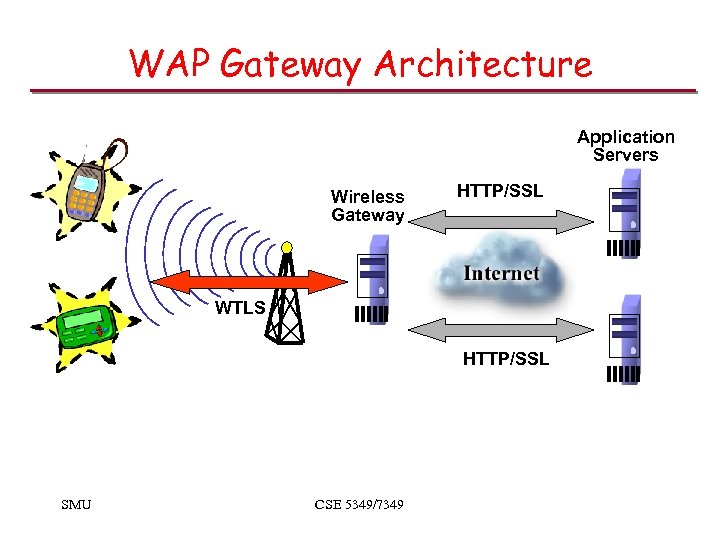 WAP Gateway Architecture Application Servers Wireless Gateway HTTP/SSL WTLS HTTP/SSL SMU CSE 5349/7349
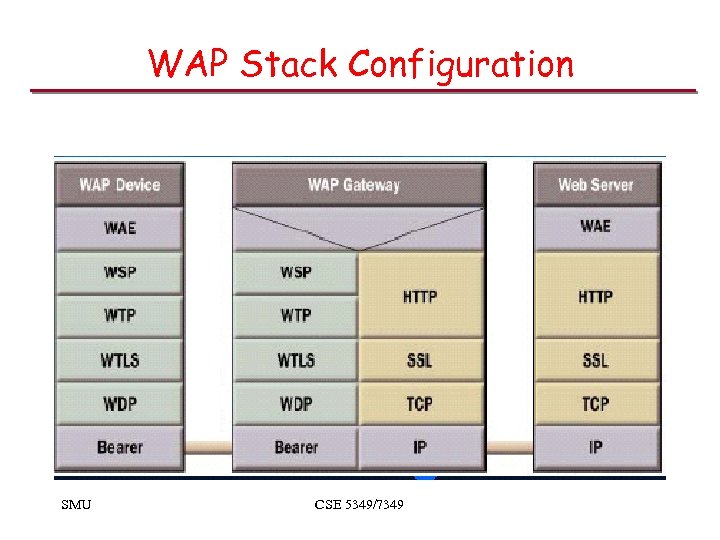 WAP Stack Configuration SMU CSE 5349/7349
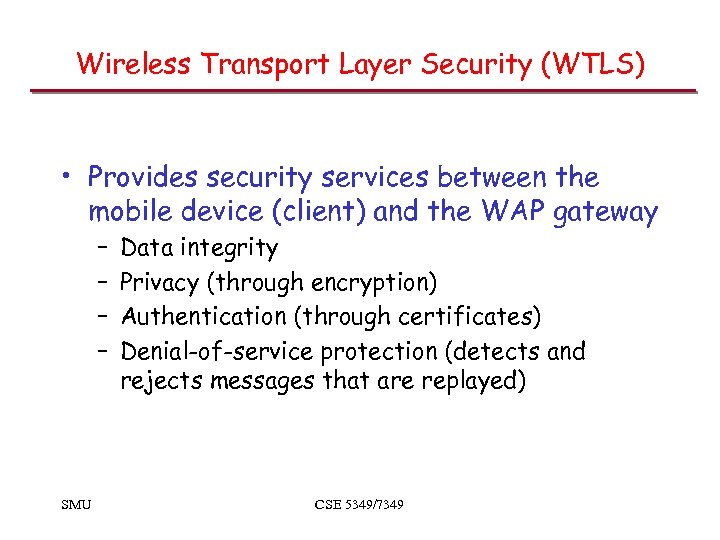 Wireless Transport Layer Security (WTLS) • Provides security services between the mobile device (client) and the WAP gateway – – SMU Data integrity Privacy (through encryption) Authentication (through certificates) Denial-of-service protection (detects and rejects messages that are replayed) CSE 5349/7349
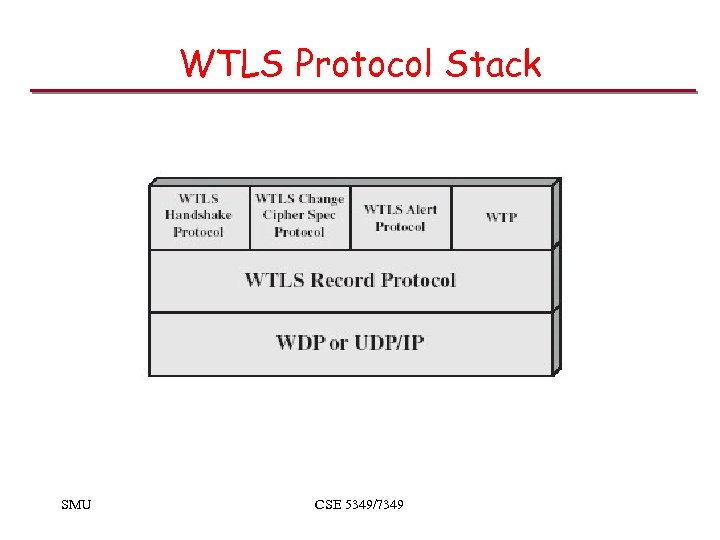 WTLS Protocol Stack SMU CSE 5349/7349
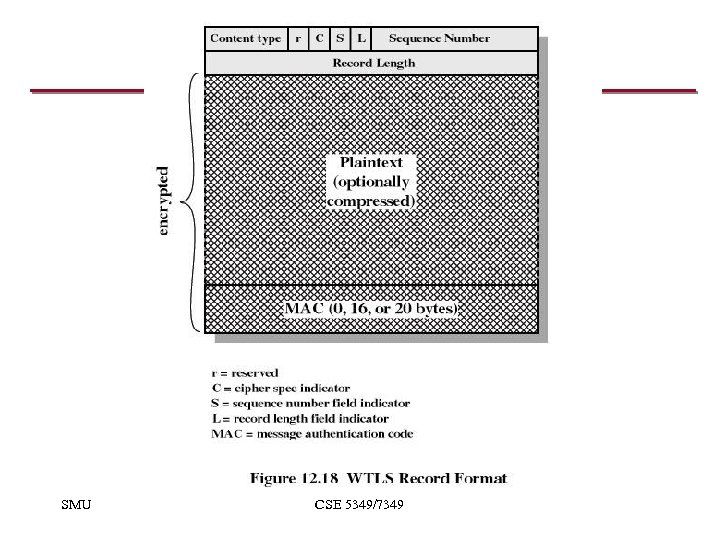
 WTLS Record Protocol • Takes info from the next higher level and encapsulates them into a PDU – – SMU Payload is compressed A MAC is computed Compressed message plus MAC code are encrypted using symmetric encryption Record protocol adds a header to the beginning to encrypted payload CSE 5349/7349
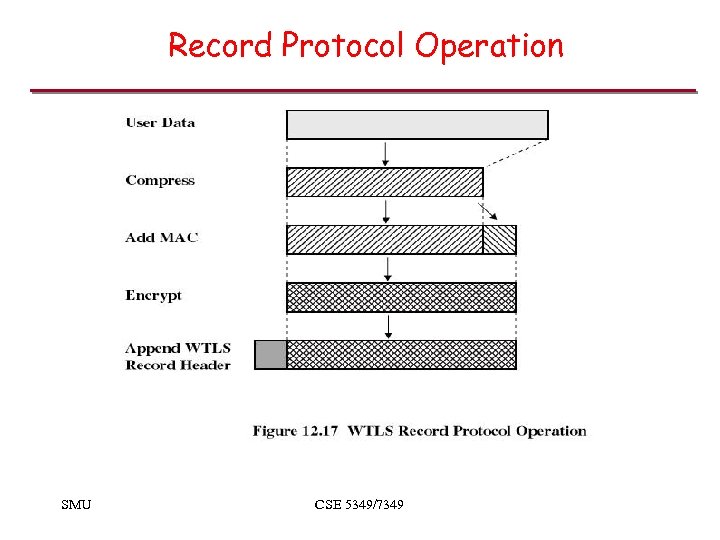 Record Protocol Operation SMU CSE 5349/7349
 SMU CSE 5349/7349
 Alert Protocol • Convey WTLS-related alerts to the peer entity • Alert messages are compressed and encrypted • A fatal warning terminates the connection (i. e. incorrect MAC, unacceptable set of security parameters in the handshake • Certificate problems usually cause a nonfatal error SMU CSE 5349/7349
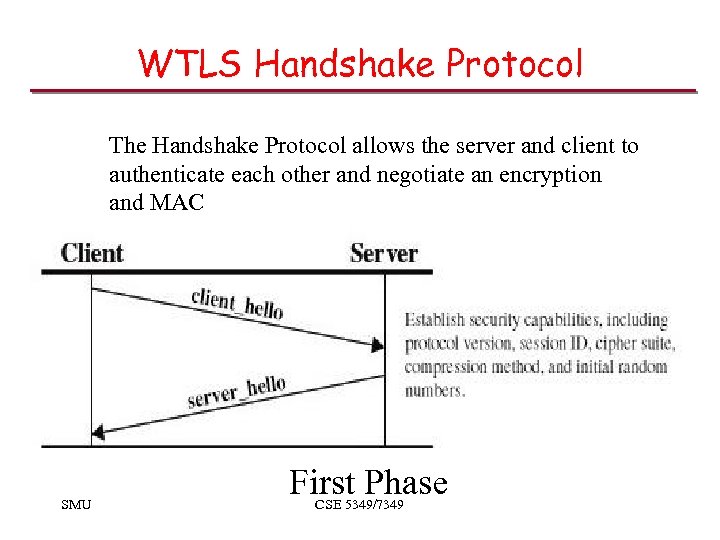 WTLS Handshake Protocol The Handshake Protocol allows the server and client to authenticate each other and negotiate an encryption and MAC SMU First Phase CSE 5349/7349
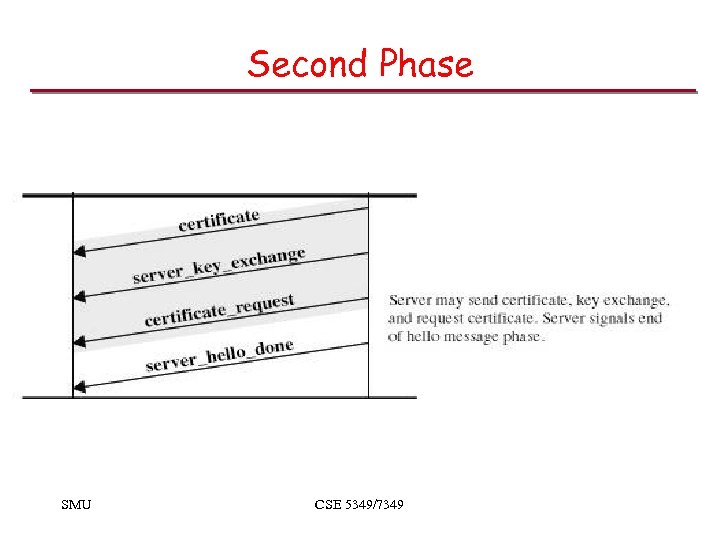 Second Phase SMU CSE 5349/7349
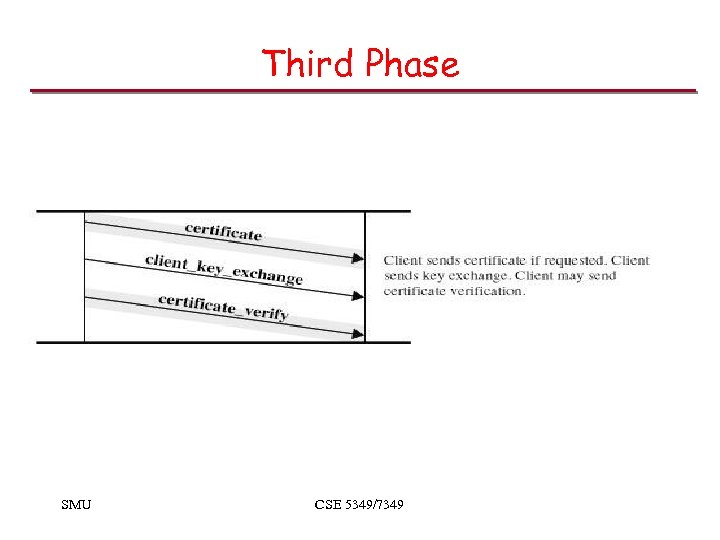 Third Phase SMU CSE 5349/7349
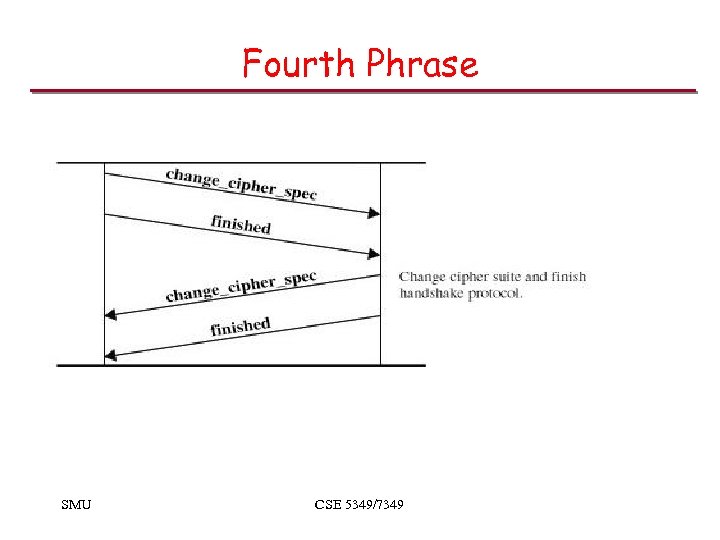 Fourth Phrase SMU CSE 5349/7349
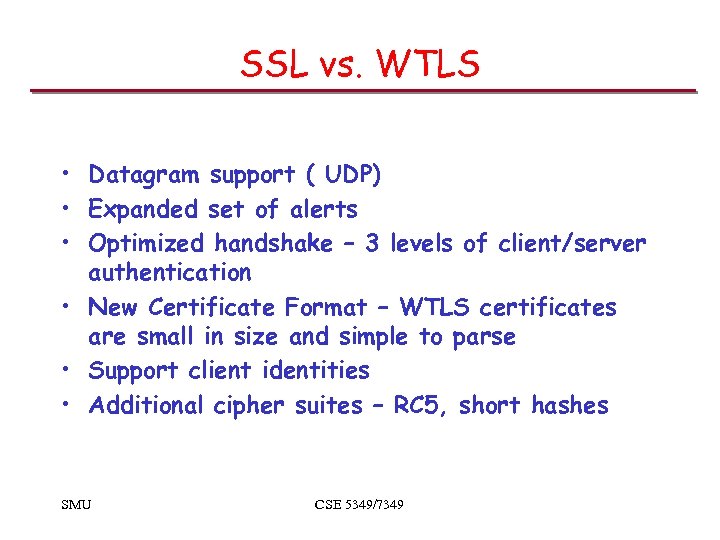 SSL vs. WTLS • Datagram support ( UDP) • Expanded set of alerts • Optimized handshake – 3 levels of client/server authentication • New Certificate Format – WTLS certificates are small in size and simple to parse • Support client identities • Additional cipher suites – RC 5, short hashes SMU CSE 5349/7349