


 Скачать презентацию SRMC CONFERENCE MARINE INSURANCE — CARGO AND CHARTERERS
c0d9807e9c80d40c6142aadebef65282.ppt
- Количество слайдов: 58
 SRMC CONFERENCE MARINE INSURANCE - CARGO AND CHARTERERS 7 OCTOBER 2011 Matthew Yeshin Managing Director Marsh Canada Limited Claudio Verconich Vice President - Marine Liberty International Underwriters
 Marine Insurance Presentation Agenda • Terms of Sale/Contracts of Carriage – Incoterms and Purchase Agreements – Contracts of Carriage • Marine Insurance – Basics – Cargo Insurance – Charterers Liability Insurance • Risks and Claims – General Average – Piracy • Marine Insurance Market • Sanctions, Restrictive Legislation, and Global Placements MARSH 3/16/2018 1
 Terms of Sale/Contracts of Carriage Creating the need for Marine Insurance 3/16/2018 2
 Incoterms 2010 Overview • International Commercial Terms (Incoterms) are a uniform set of trade terms developed by the International Chamber of Commerce that govern international contracts of sale. • The official terms were first published in 1936, with periodic updates being made with changes in transportation and documentation. The latest version was released in 2010. • They are used to define the costs, risks, and obligations of buyers and sellers in international transactions. • Incoterms are not implied, they must be specifically stated in the contract. • They assist in standardizing sale purchase agreements by allowing parties to incorporate standardized responsibilities for each party. MARSH 3/16/2018 3
 Incoterms 2010 Overview • The terms set out the obligations, but the specific manner of performance is left open to the parties. • Parties may vary or make an addition to the Incoterm. • Incoterms are not binding—they do not have the force of law or legislation in imposing upon the parties how a sales contract is conducted. • Seller need only provide “minimum cover” when insurance forms part of the sales contract. MARSH 3/16/2018 4
 Incoterms 2010 Overview What Incoterms can do for you: • Detail what the parties should do with respect to: – Arranging carriage of goods from seller to buyer; and – Export and import clearance responsibilities. • Explain division of costs and risks between the parties. MARSH 3/16/2018 5
 Incoterms 2010 Overview What Incoterms cannot do for you: • They do not deal with: – Transfer of property rights in the goods; – Relief from obligations and exemptions from liability in case of unexpected or unforseeable events; or – Consequences of various breaches of contract, except those relating to the passing of risks and costs when the buyer is in breach of his obligation to accept the goods or to nominate the carrier. MARSH 3/16/2018 6
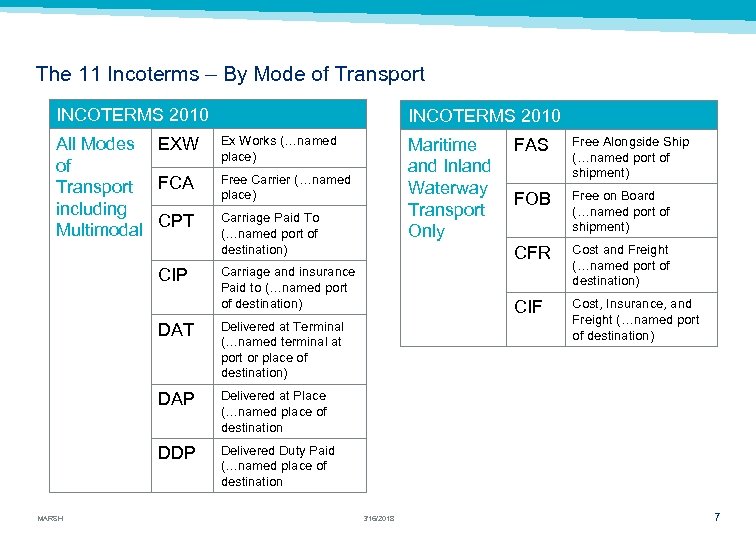 The 11 Incoterms – By Mode of Transport INCOTERMS 2010 All Modes EXW of Transport FCA including CPT Multimodal CIP INCOTERMS 2010 Ex Works (…named place) Free Carrier (…named place) Carriage Paid To (…named port of destination) Carriage and insurance Paid to (…named port of destination) DAT Free Alongside Ship (…named port of shipment) Free on Board (…named port of shipment) Cost and Freight (…named port of destination) Cost, Insurance, and Freight (…named port of destination) Delivered at Place (…named place of destination DDP CIF Delivered at Terminal (…named terminal at port or place of destination) DAP MARSH Maritime FAS and Inland Waterway FOB Transport Only CFR Delivered Duty Paid (…named place of destination 3/16/2018 7
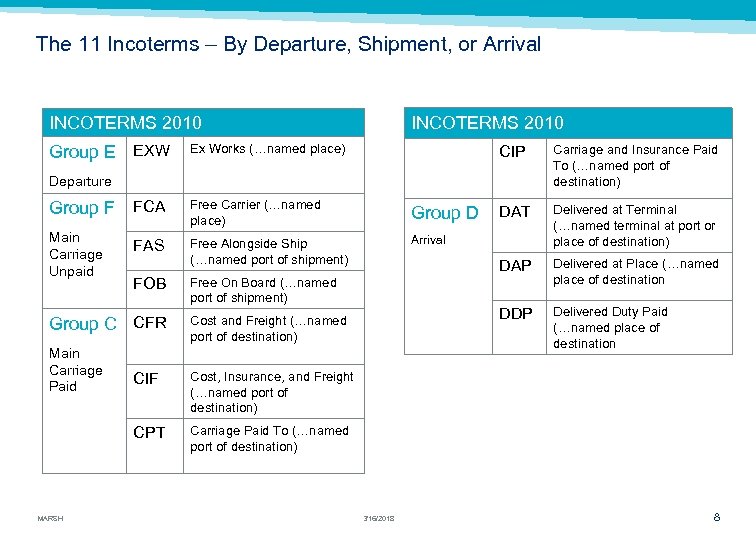 The 11 Incoterms – By Departure, Shipment, or Arrival INCOTERMS 2010 Group E EXW Ex Works (…named place) CIP Carriage and Insurance Paid To (…named port of destination) DAT Delivered at Terminal (…named terminal at port or place of destination) DAP Delivered at Place (…named place of destination DDP Delivered Duty Paid (…named place of destination Departure Group F Main Carriage Unpaid FCA Free Carrier (…named place) Group D FAS Free Alongside Ship (…named port of shipment) Arrival FOB Group C CFR Main Carriage Paid Free On Board (…named port of shipment) Cost and Freight (…named port of destination) Cost, Insurance, and Freight (…named port of destination) CPT MARSH CIF Carriage Paid To (…named port of destination) 3/16/2018 8
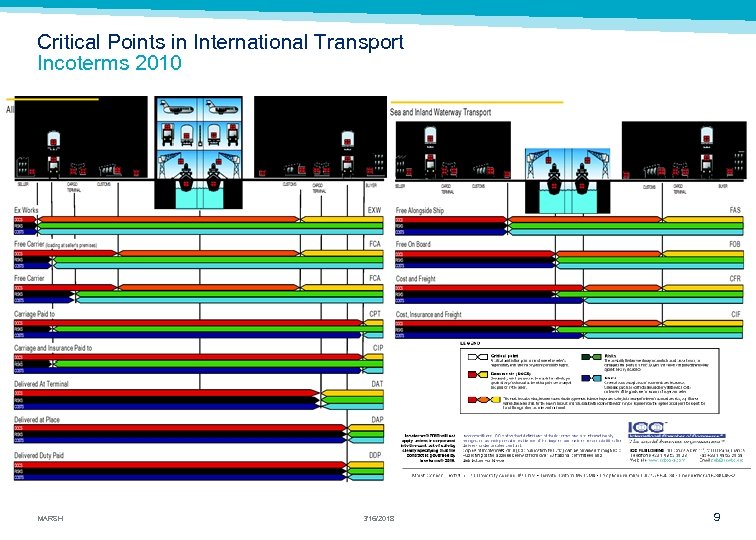 Critical Points in International Transport Incoterms 2010 MARSH 3/16/2018 9
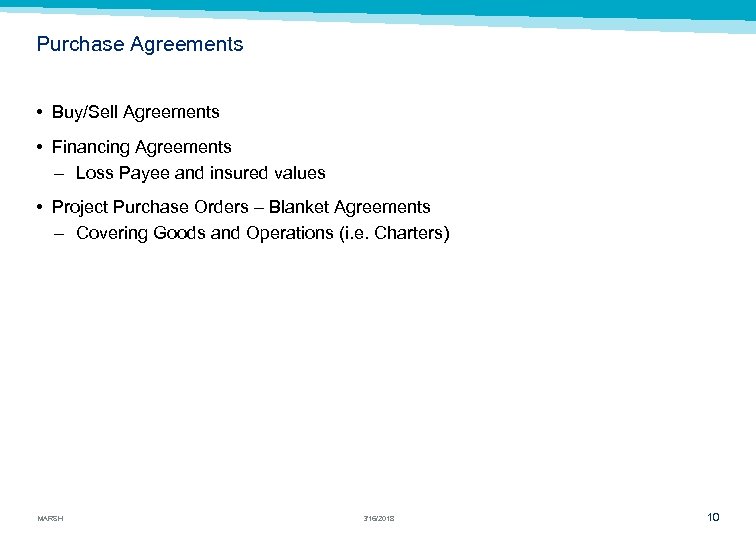 Purchase Agreements • Buy/Sell Agreements • Financing Agreements – Loss Payee and insured values • Project Purchase Orders – Blanket Agreements – Covering Goods and Operations (i. e. Charters) MARSH 3/16/2018 10
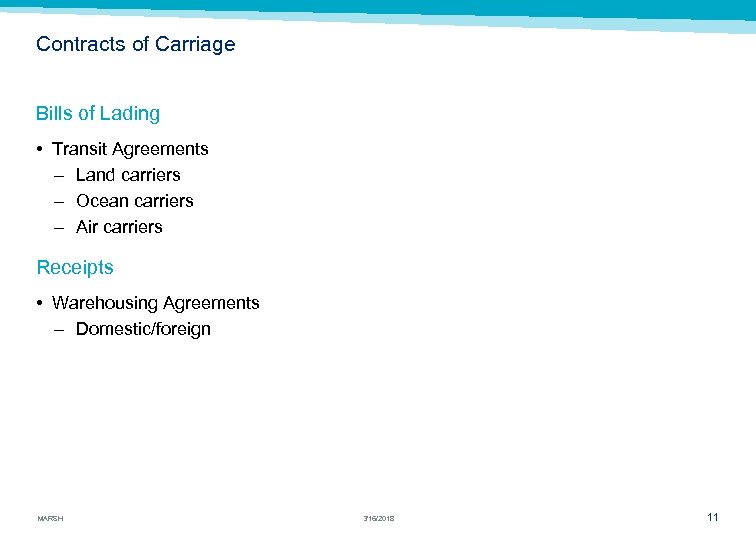 Contracts of Carriage Bills of Lading • Transit Agreements – Land carriers – Ocean carriers – Air carriers Receipts • Warehousing Agreements – Domestic/foreign MARSH 3/16/2018 11
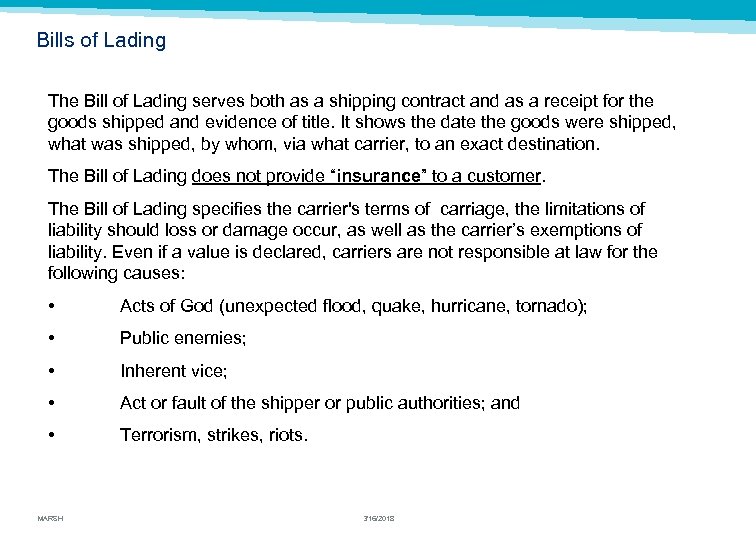 Bills of Lading The Bill of Lading serves both as a shipping contract and as a receipt for the goods shipped and evidence of title. It shows the date the goods were shipped, what was shipped, by whom, via what carrier, to an exact destination. The Bill of Lading does not provide “insurance” to a customer. The Bill of Lading specifies the carrier's terms of carriage, the limitations of liability should loss or damage occur, as well as the carrier’s exemptions of liability. Even if a value is declared, carriers are not responsible at law for the following causes: • Acts of God (unexpected flood, quake, hurricane, tornado); • Public enemies; • Inherent vice; • Act or fault of the shipper or public authorities; and • Terrorism, strikes, riots. MARSH 3/16/2018
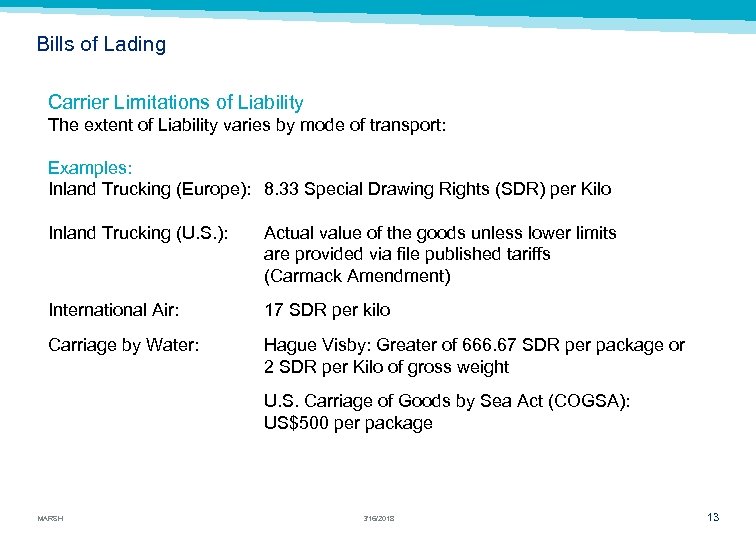 Bills of Lading Carrier Limitations of Liability The extent of Liability varies by mode of transport: Examples: Inland Trucking (Europe): 8. 33 Special Drawing Rights (SDR) per Kilo Inland Trucking (U. S. ): Actual value of the goods unless lower limits are provided via file published tariffs (Carmack Amendment) International Air: 17 SDR per kilo Carriage by Water: Hague Visby: Greater of 666. 67 SDR per package or 2 SDR per Kilo of gross weight U. S. Carriage of Goods by Sea Act (COGSA): US$500 per package MARSH 3/16/2018 13
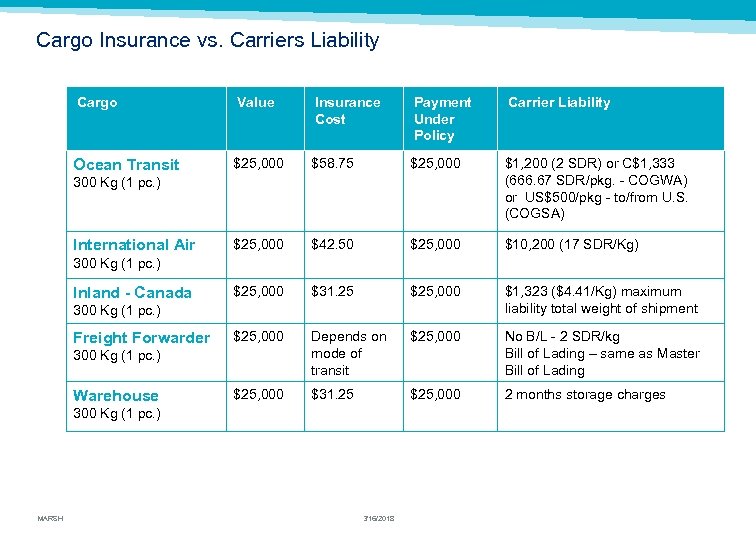 Cargo Insurance vs. Carriers Liability Cargo Value Insurance Cost Payment Under Policy Carrier Liability Ocean Transit $25, 000 $58. 75 $25, 000 $1, 200 (2 SDR) or C$1, 333 (666. 67 SDR/pkg. - COGWA) or US$500/pkg - to/from U. S. (COGSA) $25, 000 $42. 50 $25, 000 $10, 200 (17 SDR/Kg) $25, 000 $31. 25 $25, 000 $1, 323 ($4. 41/Kg) maximum liability total weight of shipment $25, 000 Depends on mode of transit $25, 000 No B/L - 2 SDR/kg Bill of Lading – same as Master Bill of Lading $25, 000 $31. 25 $25, 000 2 months storage charges 300 Kg (1 pc. ) International Air 300 Kg (1 pc. ) Inland - Canada 300 Kg (1 pc. ) Freight Forwarder 300 Kg (1 pc. ) Warehouse 300 Kg (1 pc. ) MARSH 3/16/2018
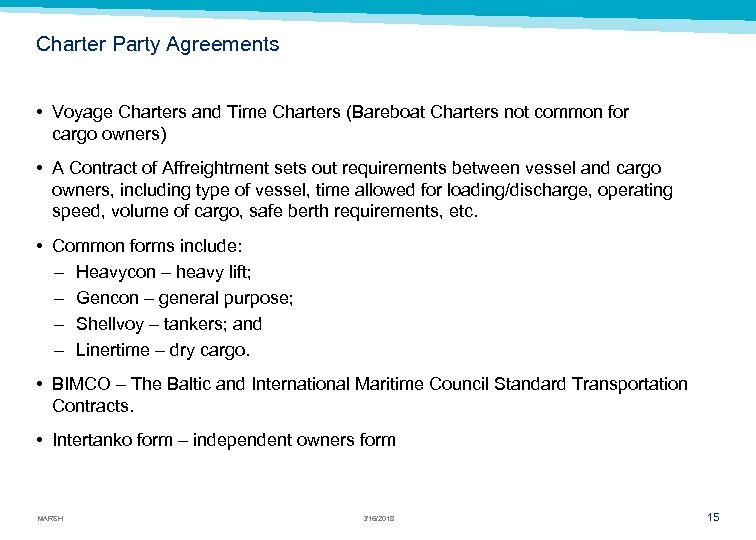 Charter Party Agreements • Voyage Charters and Time Charters (Bareboat Charters not common for cargo owners) • A Contract of Affreightment sets out requirements between vessel and cargo owners, including type of vessel, time allowed for loading/discharge, operating speed, volume of cargo, safe berth requirements, etc. • Common forms include: – Heavycon – heavy lift; – Gencon – general purpose; – Shellvoy – tankers; and – Linertime – dry cargo. • BIMCO – The Baltic and International Maritime Council Standard Transportation Contracts. • Intertanko form – independent owners form MARSH 3/16/2018 15
 Marine Insurance 3/16/2018 16
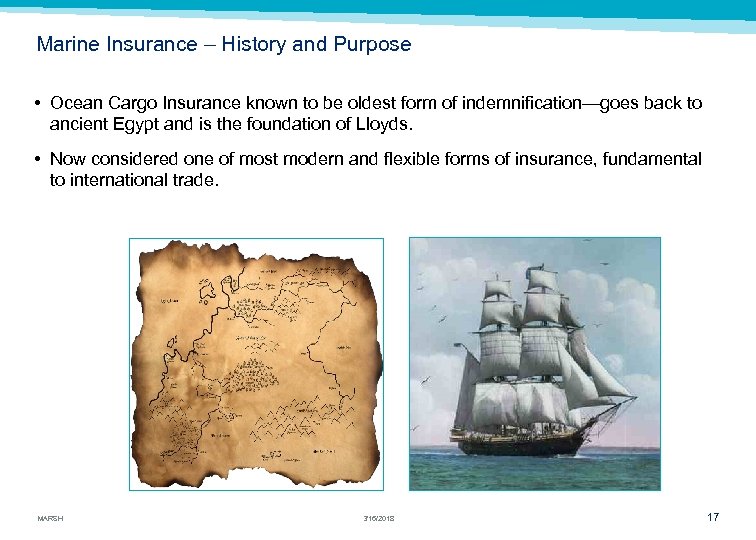 Marine Insurance – History and Purpose • Ocean Cargo Insurance known to be oldest form of indemnification—goes back to ancient Egypt and is the foundation of Lloyds. • Now considered one of most modern and flexible forms of insurance, fundamental to international trade. MARSH 3/16/2018 17
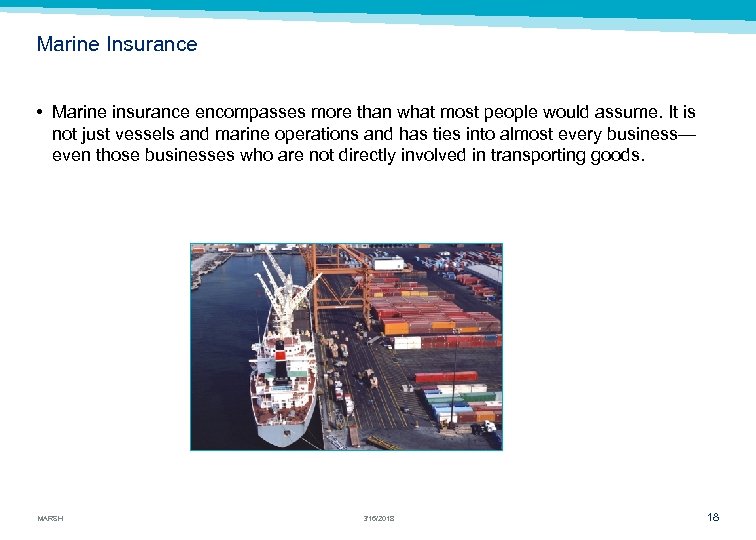 Marine Insurance • Marine insurance encompasses more than what most people would assume. It is not just vessels and marine operations and has ties into almost every business— even those businesses who are not directly involved in transporting goods. MARSH 3/16/2018 18
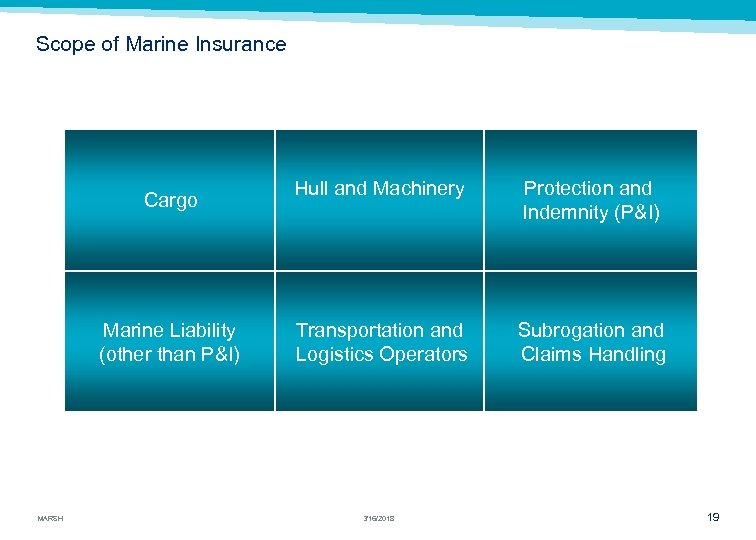 Scope of Marine Insurance Cargo Marine Liability (other than P&I) MARSH Hull and Machinery Protection and Indemnity (P&I) Transportation and Logistics Operators Subrogation and Claims Handling 3/16/2018 19
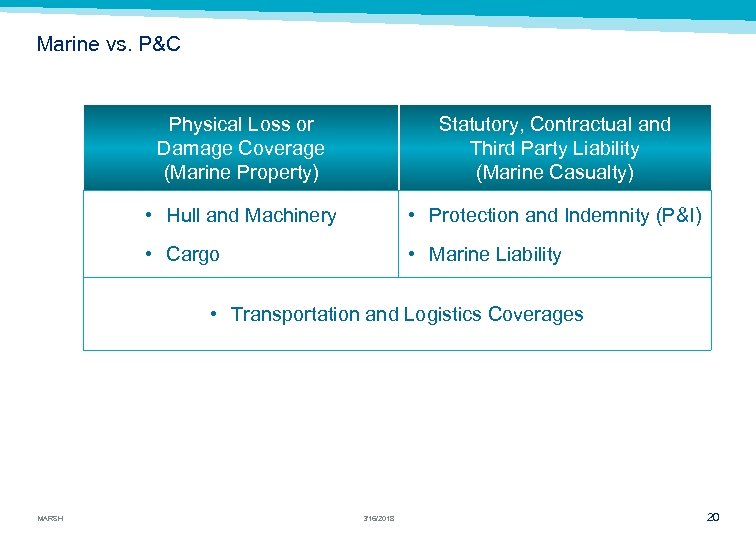 Marine vs. P&C Physical Loss or Damage Coverage (Marine Property) Statutory, Contractual and Third Party Liability (Marine Casualty) • Hull and Machinery • Protection and Indemnity (P&I) • Cargo • Marine Liability • Transportation and Logistics Coverages MARSH 3/16/2018 20
 What is Cargo Insurance? • It is physical loss or damage insurance of goods carried by vessel, road, rail, aircraft, post, or by any other conveyance. • This insurance protects those who have an insurable/financial interest in the cargo (buyer or seller). The coverage ranges from All Risks to Named Perils. • The most common form of Cargo Insurance is the Open Cargo Policy. An Open Policy is designed to cover the full range of a client’s trading operations, whatever the variations in interests, voyages, or conditions. Once arranged the insured is guaranteed protection on all shipments falling within the policy’s provisions subject to all shipment details being reported during the period of insurance. MARSH 3/16/2018 21
 What is Hull and Machinery Insurance? • It is insurance against physical loss or damage to the insured vessel arising out of named marine perils. – Hull and Machinery policies are necessary for vessels because physical assets require coverage, but clients’ property policies exclude coverage on most watercraft. • Who buys Hull and Machinery insurance? ─ A vessel owner/operator looking to protect themselves from financial loss (should something happen to their vessel). ─ Banks can take out a hull policy to protect their mortgage interest in a vessel. MARSH 3/16/2018 22
 What is Protection and Indemnity Insurance? • Provides indemnification to ship owners for their legal liability arising out of their ownership or operation of their vessel. • Who buys Protection and Indemnity insurance? – Ship owners and operators • Examples of Risks Covered: – Crew and/or third party loss of life or personal injury; – Liability to cargo owners; – Pollution damage, clean-up expenses, and fines; – Loss of, or damage to docks, buoys, cranes, cables, etc. ; – Removal of wreck liabilities; and – Fines imposed by Customs, Immigration, or other government or local authorities. MARSH 3/16/2018 23
 What is Marine Liability Insurance? • It is insurance against statutory, contractual, and/or third party liability arising out of marine operations (other than Protection and Indemnity). • Who buys Marine Liability Insurance? – Charterers – Stevedores – Cargo owners – Wharfingers – Port authorities – Terminal operators – Salvors – Ship repairers MARSH 3/16/2018 24
 Transportation and Logistics Providers Arrange for the transportation of customers’ goods and can involve all modes of transit (ocean, air, rail, and truck). • Freight forwarder: someone who carries on the business of arranging the carriage of goods for other people. – Agent vs. Principal • Logistics provider (Freight Forwarder or Third Party Logistics (3 PLs)): Arranges for the transportation of goods and provides inventory management and distribution services to customers. – (Fourth Party Logistics (4 PLs) are consultants who evaluate a client’s supply and demand chain, but unlike a 3 PL, do not perform any of the actual logistics. ) • Other parties with liability and/or goods in their care, custody, and control include warehousemen, stevedores, terminal operators, and carriers. MARSH 3/16/2018 25
 Contracting with a Freight Forwarders or 3 PL Freight forwarders require two types of insurance: 1) Cargo Legal Liability which covers: – Their legal and/or contractual liability for their insured services; – Their legal/defense costs; and – Consequential loss resulting from such loss or damaged cargo. 2) Errors and Omissions which covers: – The client from the financial loss incurred by their customers resulting from breach of duties, acts of neglect, and/or errors or omissions. Optional insurance they may offer: • Marine Cargo (Shipper’s Interest) covers customer’s cargo in transit against “all risks” of physical loss or damage. MARSH 3/16/2018 26
 Marine Claims and Subrogation • Marine claims historically have been handled differently to property and casualty lines—with a surveyor reporting on the incidents giving rise to a loss, and a claims broker presenting to underwriters why that loss is covered under the policy. • However, more often claims are essentially being adjusted, with the surveyor acting as a representative of the underwriter and giving an opinion on how coverage applies as well as settling the claim. • Subrogation and the rights provided to underwriters after paying a claim that will allow them to go after carriers for their contribution under legal or contractual liability. • Traditionally subrogation was ignored by cargo interests, or batched by underwriters, however good subrogation results can be important when looking at overall margins, and is something that underwriters now expect cargo interests to actively protect. • Waivers of Subrogation should not be allowed without giving consideration to the impact they will have on the carrier’s actions. MARSH 3/16/2018 27
 Types of Losses 3/16/2018 28
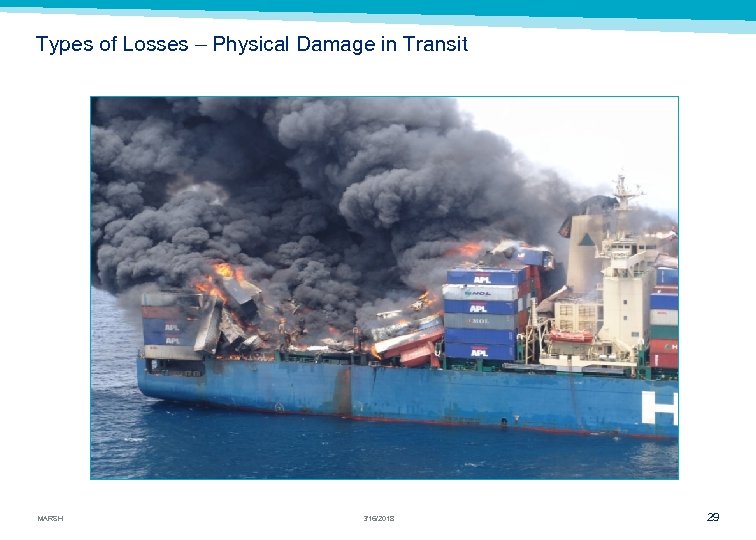 Types of Losses – Physical Damage in Transit MARSH 3/16/2018 29
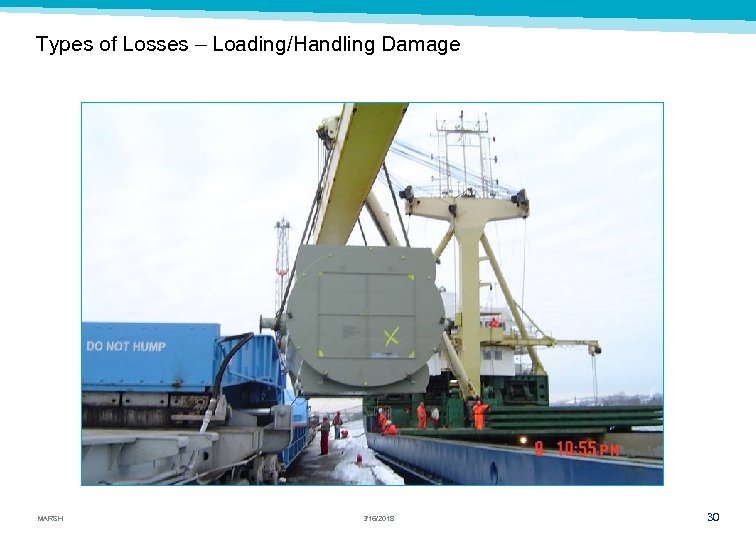 Types of Losses – Loading/Handling Damage MARSH 3/16/2018 30
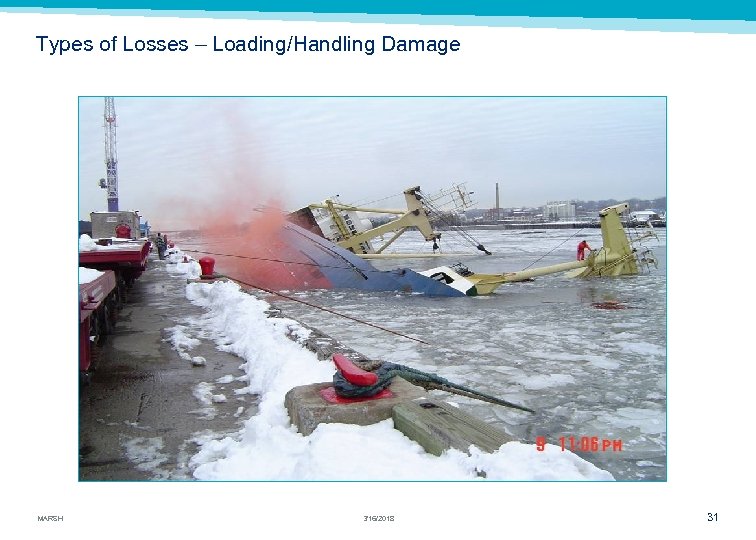 Types of Losses – Loading/Handling Damage MARSH 3/16/2018 31
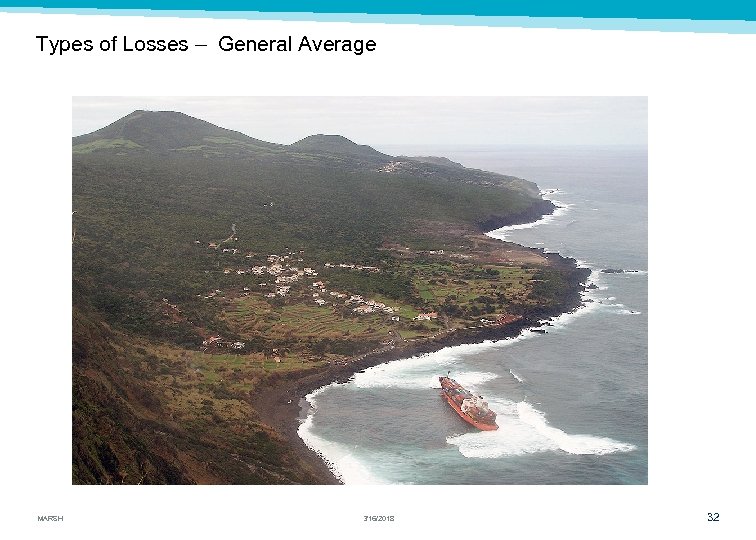 Types of Losses – General Average MARSH 3/16/2018 32
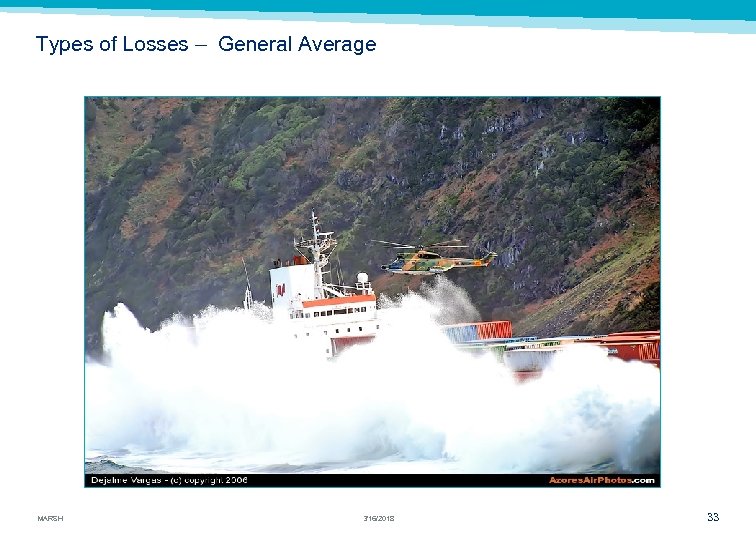 Types of Losses – General Average MARSH 3/16/2018 33
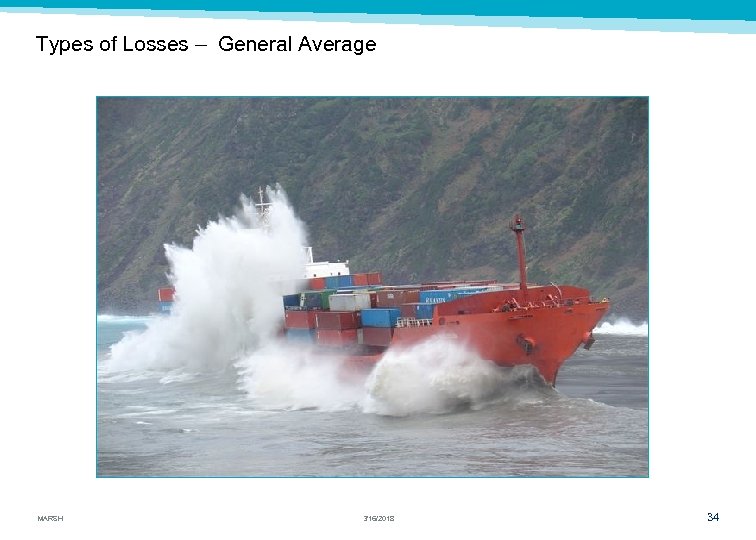 Types of Losses – General Average MARSH 3/16/2018 34
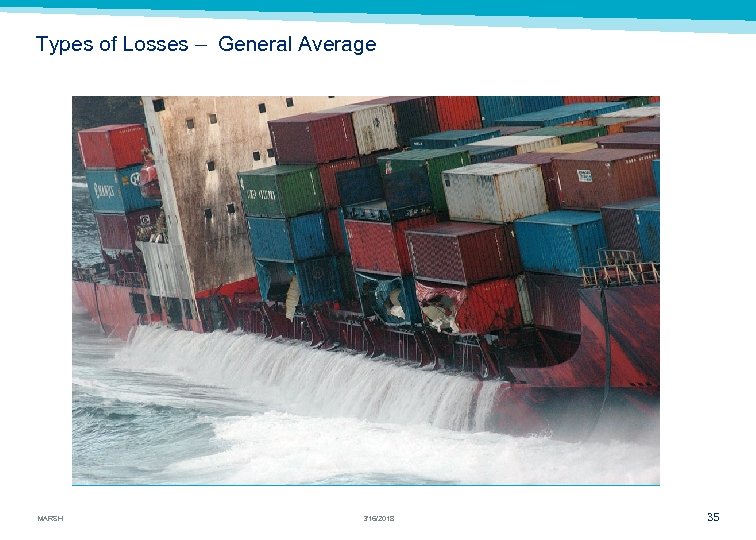 Types of Losses – General Average MARSH 3/16/2018 35
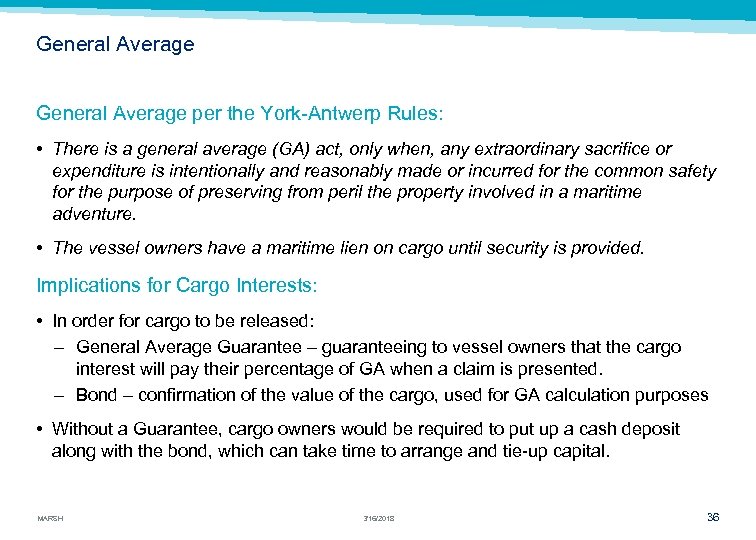 General Average per the York-Antwerp Rules: • There is a general average (GA) act, only when, any extraordinary sacrifice or expenditure is intentionally and reasonably made or incurred for the common safety for the purpose of preserving from peril the property involved in a maritime adventure. • The vessel owners have a maritime lien on cargo until security is provided. Implications for Cargo Interests: • In order for cargo to be released: – General Average Guarantee – guaranteeing to vessel owners that the cargo interest will pay their percentage of GA when a claim is presented. – Bond – confirmation of the value of the cargo, used for GA calculation purposes • Without a Guarantee, cargo owners would be required to put up a cash deposit along with the bond, which can take time to arrange and tie-up capital. MARSH 3/16/2018 36
 Types of Losses – Piracy MARSH 3/16/2018 37
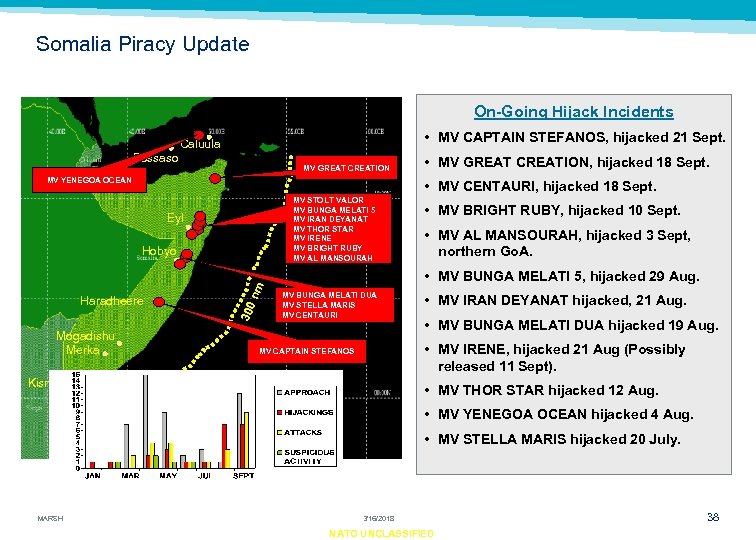 Somalia Piracy Update On-Going Hijack Incidents • MV CAPTAIN STEFANOS, hijacked 21 Sept. Caluula Bossaso MV GREAT CREATION MV YENEGOA OCEAN • MV GREAT CREATION, hijacked 18 Sept. • MV CENTAURI, hijacked 18 Sept. MV STOLT VALOR MV BUNGA MELATI 5 MV IRAN DEYANAT MV THOR STAR MV IRENE MV BRIGHT RUBY MV AL MANSOURAH Eyl Hobyo • MV BRIGHT RUBY, hijacked 10 Sept. • MV AL MANSOURAH, hijacked 3 Sept, northern Go. A. Mogadishu Merka Kismayo 300 Haradheere nm • MV BUNGA MELATI 5, hijacked 29 Aug. MV BUNGA MELATI DUA MV STELLA MARIS MV CENTAURI • MV IRAN DEYANAT hijacked, 21 Aug. • MV BUNGA MELATI DUA hijacked 19 Aug. • MV IRENE, hijacked 21 Aug (Possibly released 11 Sept). MV CAPTAIN STEFANOS Piracy Incidents off Somalia – 2008 • MV THOR STAR hijacked 12 Aug. • MV YENEGOA OCEAN hijacked 4 Aug. • MV STELLA MARIS hijacked 20 July. Piracy Incidents off Somalia – 2008 MARSH 3/16/2018 NATO UNCLASSIFIED 38
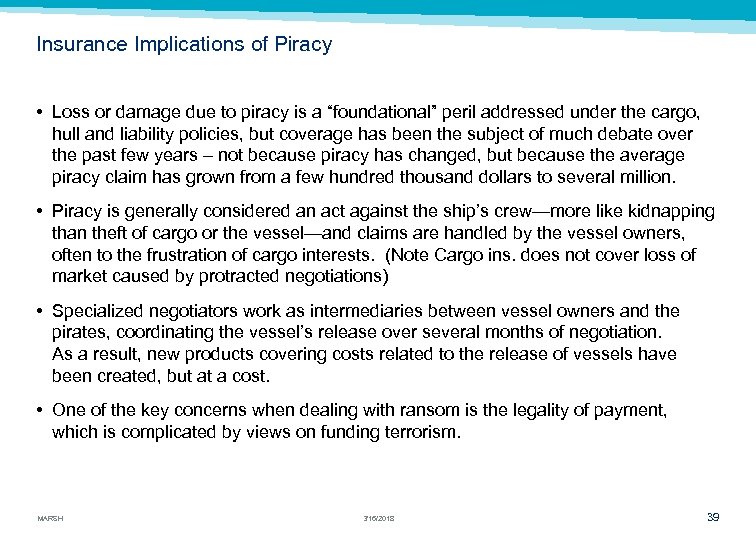 Insurance Implications of Piracy • Loss or damage due to piracy is a “foundational” peril addressed under the cargo, hull and liability policies, but coverage has been the subject of much debate over the past few years – not because piracy has changed, but because the average piracy claim has grown from a few hundred thousand dollars to several million. • Piracy is generally considered an act against the ship’s crew—more like kidnapping than theft of cargo or the vessel—and claims are handled by the vessel owners, often to the frustration of cargo interests. (Note Cargo ins. does not cover loss of market caused by protracted negotiations) • Specialized negotiators work as intermediaries between vessel owners and the pirates, coordinating the vessel’s release over several months of negotiation. As a result, new products covering costs related to the release of vessels have been created, but at a cost. • One of the key concerns when dealing with ransom is the legality of payment, which is complicated by views on funding terrorism. MARSH 3/16/2018 39
 Insurance Implications of Piracy • Underwriters expect vessel owners to have a plan for transiting high risk areas— with consideration being given to: – Routing; – Vessel’s average speed; – Freeboard; – Weather; – Escorts Available; – Additional Protection – razor wire, water guns, sonic protection, on-board security; and – NATO’s Best Management Practices is a good guide for vessel owners. MARSH 3/16/2018 40
 Marine Insurance Market 3/16/2018 41
 Cargo Insurance • Limits – as required – range from $1 million to $100 million+, with market capacity of over $1. 5 billion. • Deductibles – generally low, even on high limit shipments • Markets – various including North American, U. K. , European, Asian – plus emerging markets – all using similar forms so they are able to compete globally. • Coverage – per Institute Cargo Clauses (A, B, or C) with extensions per Marsh Manuscript form. This is a physical damage form intended for ocean transits, but can be extended to land transit and storage exposures. MARSH 3/16/2018 42
 Cargo Insurance Coverage • Key Extensions: – Classification Clause – Insolvency Clause – Packing Clause – Control of Damaged Goods Clause/Brands and Labels • Key Exclusions: – Inherent Vice – Delay/Loss of Market – Radioactive Contamination • Key Restrictions: – Joint Cargo Committee (JCC) Cargo Watch List – United Nations (UN) and Office of Foreign Assets Control (OFAC) Sanctions – Local Legislation/Tax Issues MARSH 3/16/2018 43
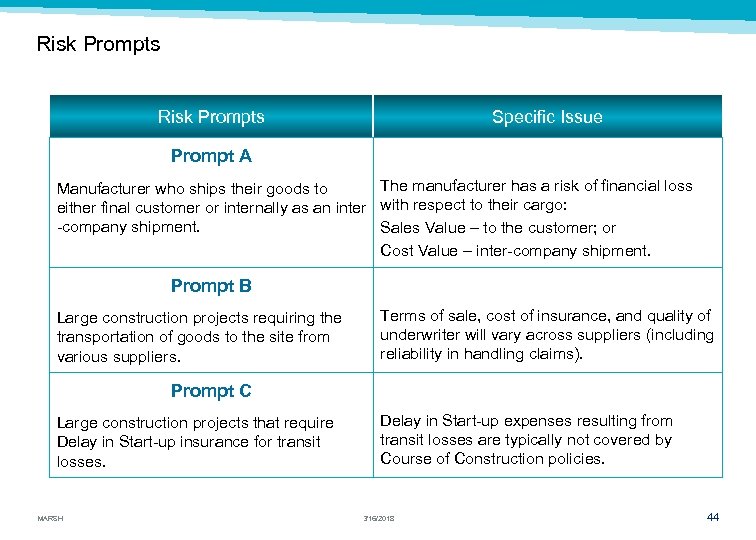 Risk Prompts Specific Issue Prompt A The manufacturer has a risk of financial loss Manufacturer who ships their goods to either final customer or internally as an inter with respect to their cargo: -company shipment. Sales Value – to the customer; or Cost Value – inter-company shipment. Prompt B Large construction projects requiring the transportation of goods to the site from various suppliers. Terms of sale, cost of insurance, and quality of underwriter will vary across suppliers (including reliability in handling claims). Prompt C Large construction projects that require Delay in Start-up insurance for transit losses. MARSH Delay in Start-up expenses resulting from transit losses are typically not covered by Course of Construction policies. 3/16/2018 44
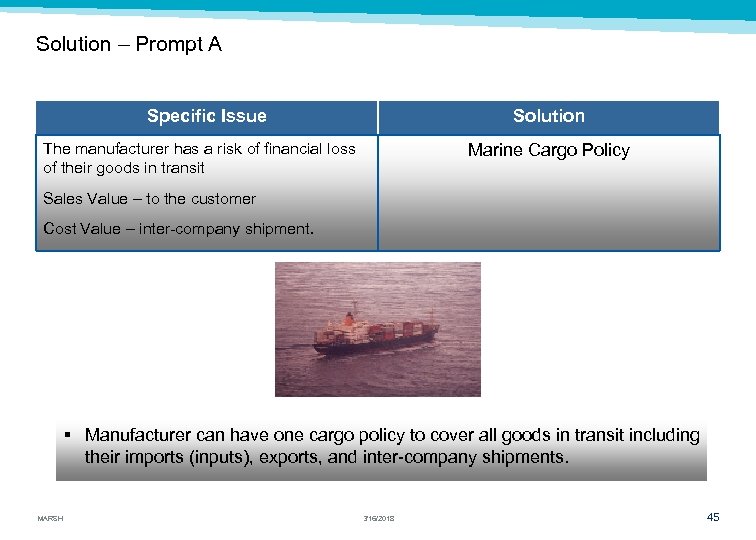 Solution – Prompt A Specific Issue Solution The manufacturer has a risk of financial loss of their goods in transit Marine Cargo Policy Sales Value – to the customer Cost Value – inter-company shipment. § Manufacturer can have one cargo policy to cover all goods in transit including their imports (inputs), exports, and inter-company shipments. MARSH 3/16/2018 45
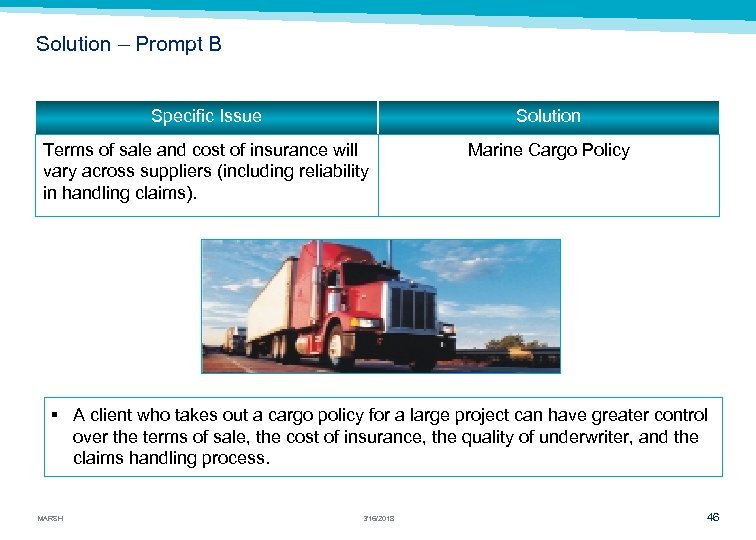 Solution – Prompt B Specific Issue Solution Terms of sale and cost of insurance will vary across suppliers (including reliability in handling claims). Marine Cargo Policy § A client who takes out a cargo policy for a large project can have greater control over the terms of sale, the cost of insurance, the quality of underwriter, and the claims handling process. MARSH 3/16/2018 46
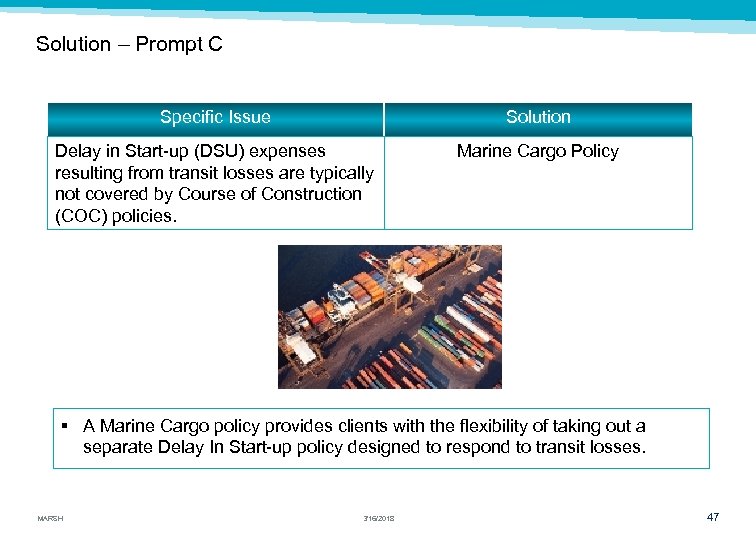 Solution – Prompt C Specific Issue Solution Delay in Start-up (DSU) expenses resulting from transit losses are typically not covered by Course of Construction (COC) policies. Marine Cargo Policy § A Marine Cargo policy provides clients with the flexibility of taking out a separate Delay In Start-up policy designed to respond to transit losses. MARSH 3/16/2018 47
 Who has a cargo exposure? • Manufacturers • Mining companies • Retailers • Forestry industry • Transportation companies • Freight forwarders • Importers/exporters • Construction projects • Personal effects moves • Anyone involved in the transportation of physical goods has a potential cargo insurance requirement. MARSH 3/16/2018 48
 Project Cargo • Project Cargo – Project cargo for most companies is a non-standard transit exposure related to the construction of a new operation or expansion of an existing one. Exposing an operational transit policy to project cargo may not be ideal with: – Limits too low; – Scope of coverage too limited; – Deductible not suitable; and – Market not suitable. • Delay in Start-Up/Advance Loss of Profits – Covers the loss of anticipated revenue as a result of loss or damage to insured project cargo. While some projects may be able to recover from a loss by expediting replacement of damage goods, long lead time items, or bank financing requirements may require that delay in start-up coverage be evaluated. MARSH 3/16/2018 49
 Charterers Liability • Limits – Vary, but we recommend arranging primary limits to a level where a corporate excess/umbrella will attach. – Considerations: Vessel value, cargo of others, liability to third parties, pollution exposure, demurrage costs, etc. • Deductibles - $25, 000 to $100, 000 • Claims Frequency - Low • Covered – Liability of the charterer arising under contract or charter party. This may also include protection from liability arising out of damage done to the vessel by stevedores contracted by the charterer or cargo owner to off load the vessel. • Cargo Owners Pollution Liability - Which is not covered under the cargo policy, and may be a gray area under a GL Sudden and Accidental (S&A) Pollution extension. • Not Covered – Contract disputes or demurrage incurred as a result of commercial issues encountered with the voyage. MARSH 3/16/2018 50
 Sanctions, Restrictive Legislation and Global Placements • Joint Cargo Committee (JCC) Global Cargo Watch List • Sanctions – Office of Foreign Assets Control (OFAC) restrictions – United Nations (UN) Sanctions – European Sanctions • Country Specific Insurance Restrictions (International Union of Marine Insurance (IUMI) or AXCO) • Implications… – Fines, penalties, imprisonment. MARSH 3/16/2018 51
 About Marsh’s Global Marine Practice consists of more than 550 specialists in 30 countries with the ability to respond rapidly to the continuous change of the industry they support. By combining international expertise with local delivery, we offer every client the personal and flexible service of an accessible team backed by the high level skills, broad experience, and market intelligence that only a brokerage with Marsh’s depth of resources can deliver. We have deep practical experience working across the maritime world. Our clients include ship owners, charterers, cargo owners, traders, contractors to the offshore oil and gas and construction industries, port authorities, terminal operators, and shipyards. Because of this experience, we are acknowledged as the world’s leading risk advisor to companies operating in this industry. MARSH 3/16/2018 52
 About Liberty International Underwriters (LIU) • As a respected industry leader, LIU offers coverage with a variety of benefits that can help you most effectively protect your client's assets during transport. • Experienced underwriting team • International and domestic risks of clients worldwide • Worldwide claims and subrogation network • Coverage can be tailored to meet the insured's needs • US$70, 000 for any one conveyance capacity • Marine risk engineering/surveying staff • Financial security provided by Liberty Mutual Insurance Company MARSH 3/16/2018 53
 Incoterms 2010 Sources: • Incoterms Web site: http: //www. iccwbo. org/index_incoterms. asp • ICC Guide to Incoterms 2010, ICC rules for the use of domestic and international trade terms”; International Chamber of Commerce; ICC Publication 715 • Guide to INCOTERMS 2000; “Dictionary of International Trade Handbook of the Global Trade Community”, 4 th Edition; Edward G. Hinkelman; pages 275 – 303. • “ICC Guide to Incoterms 2000, Understanding and Practical Use”; International Chamber of Commerce; Professor Jan Ramberg. • Note that the charts for the terms DES, DEQ, DDU, and DDP are incorrect on pages 147, 155, 163, and 171 in the above book. Reference should be made to the complete chart at the end of the book (page 180). MARSH 3/16/2018 54
 Legal The information contained herein is based on sources we believe reliable, but we did not verify nor do we guarantee its accuracy. It should be understood to be general risk management and insurance information only. Marsh makes no representations or warranties, expressed or implied, concerning the financial condition, solvency, or application of policy wordings of insurers or reinsurers nor does Marsh make any representations or warranty that coverages may be placed on terms acceptable to you. The information contained in this presentation provides only a general overview of subjects covered, is not intended to be taken as advice regarding any individual situation, and should not be relied upon as such. Statements concerning tax and/or legal matters should be understood to be general observations based solely on our experience as risk consultants and insurance brokers and should not be relied upon as tax and/or legal advice, which we are not authorized to provide. Insureds should consult their own qualified insurance, tax and/or legal advisors regarding specific risk management and insurance coverage issues. Marsh assumes no responsibility for any loss or damage sustained in reliance of this presentation. Marsh is one of the Marsh & Mc. Lennan Companies, together with Guy Carpenter, Mercer, and Oliver Wyman. The materials, data and/or methodologies used in this presentation are proprietary to Marsh. This document or any portion of the information it contains may not be copied or reproduced in any form without the permission of Marsh Canada Limited, except that clients of any of the companies of Marsh & Mc. Lennan Companies need not obtain such permission when using this report for their internal purposes, so long as this page is included with all such copies or reproductions. Copyright 2011 Marsh Canada Limited and its licensors. All rights reserved. www. marsh. ca | www. marsh. com MARSH 3/16/2018 55
 Thank You! Questions? M 110907 : 2011/09/27 3/16/2018 56
 3/16/2018 57