


 Скачать презентацию SRI International Reverse Engineering Malware Hassen Saidi Computer
3936646b0c47b75b38ddb9f64cf33804.ppt
- Количество слайдов: 67
 SRI International Reverse Engineering Malware Hassen Saidi Computer Science Laboratory SRI International Hassen. Saidi@sri. com
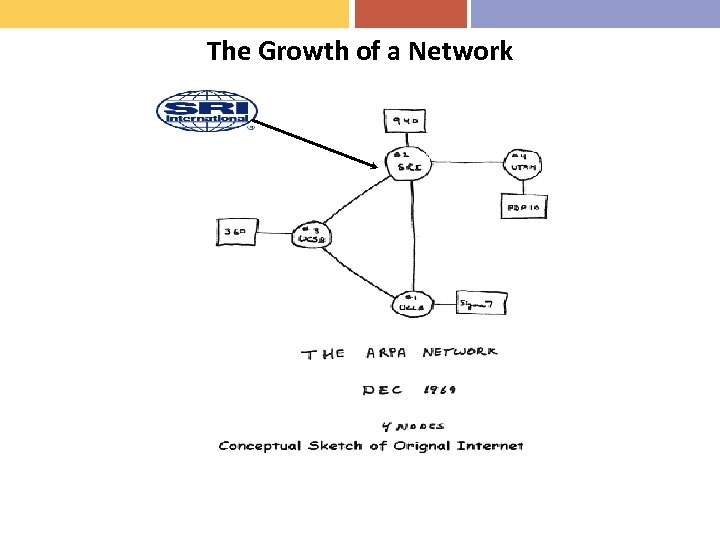 The Growth of a Network
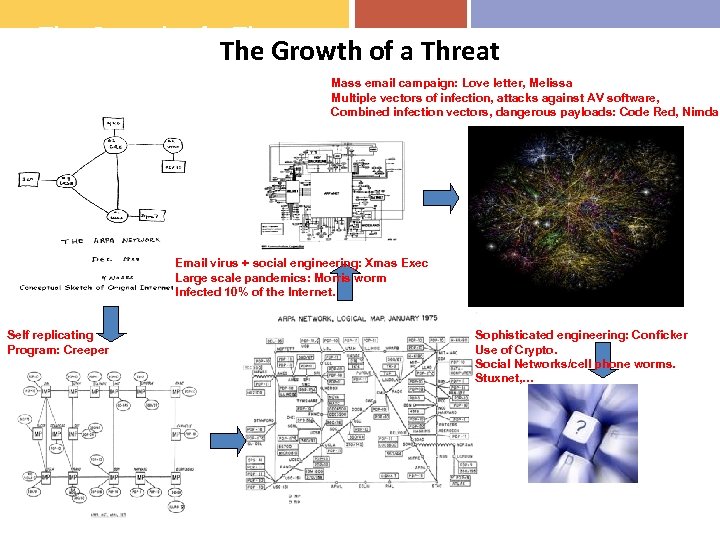 The Growth of a Threat Mass email campaign: Love letter, Melissa Multiple vectors of infection, attacks against AV software, Combined infection vectors, dangerous payloads: Code Red, Nimda Email virus + social engineering: Xmas Exec Large scale pandemics: Morris worm Infected 10% of the Internet. Self replicating Program: Creeper Sophisticated engineering: Conficker Use of Crypto. Social Networks/cell phone worms. Stuxnet, …
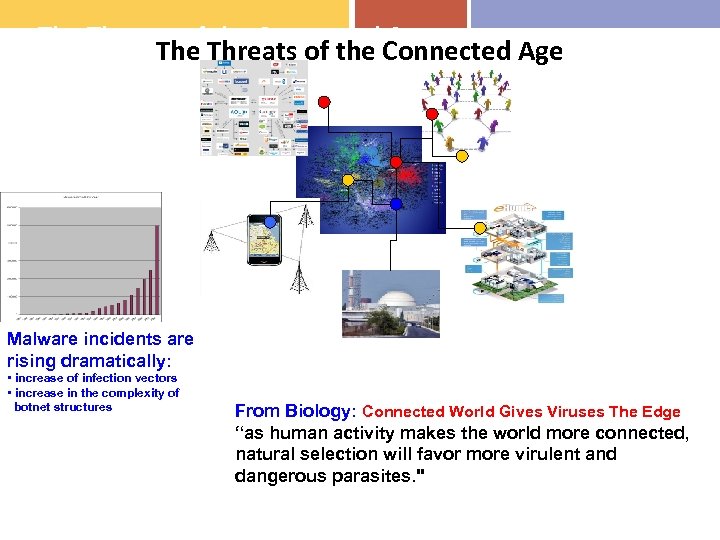 The Threats of the Connected Age Malware incidents are rising dramatically: • increase of infection vectors • increase in the complexity of botnet structures From Biology: Connected World Gives Viruses The Edge “as human activity makes the world more connected, natural selection will favor more virulent and dangerous parasites. "
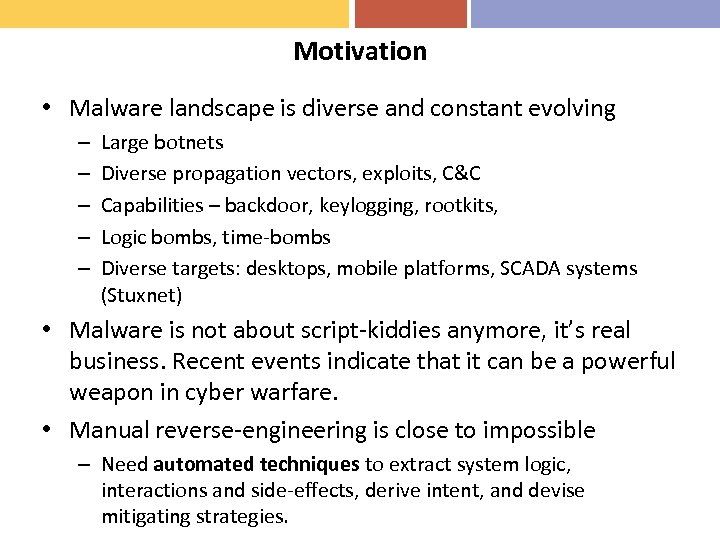 Motivation • Malware landscape is diverse and constant evolving – – – Large botnets Diverse propagation vectors, exploits, C&C Capabilities – backdoor, keylogging, rootkits, Logic bombs, time-bombs Diverse targets: desktops, mobile platforms, SCADA systems (Stuxnet) • Malware is not about script-kiddies anymore, it’s real business. Recent events indicate that it can be a powerful weapon in cyber warfare. • Manual reverse-engineering is close to impossible – Need automated techniques to extract system logic, interactions and side-effects, derive intent, and devise mitigating strategies.
 Outline • Review of the workflow of binary program analysis • Review of the challenges in binary program analysis: – Obfuscation Techniques • Techniques for reverse engineering stripped binaries: – Systematic deobfuscation • Examples of obfuscation: Conficker, Hydrac (Google attack), Stuxnet, …
 Capturing Malware • Honeynets: Capture malware that scans the Internet for vulnerable targets • Mining SPAM for attachments • Mining SPAM for malicious URLs, and capturing drive-by downloads • AV heuristics
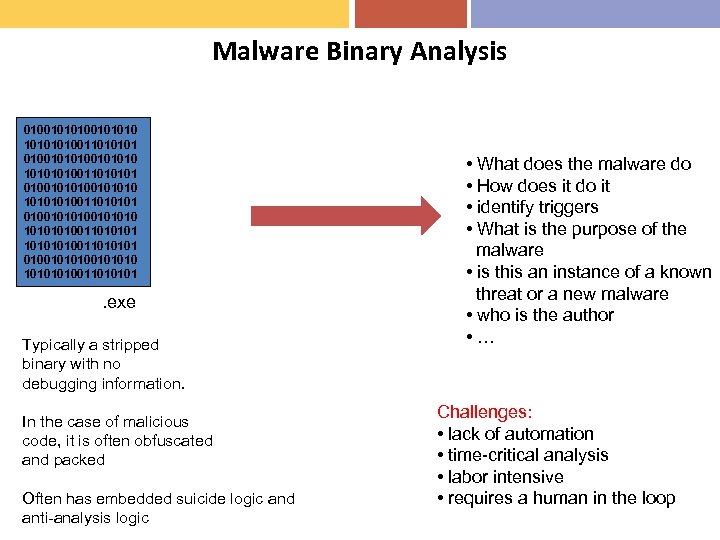 Malware Binary Analysis 01001010100101010 10101010011010101 1010011010101 0100101010011010101 . exe Typically a stripped binary with no debugging information. In the case of malicious code, it is often obfuscated and packed Often has embedded suicide logic and anti-analysis logic • What does the malware do • How does it do it • identify triggers • What is the purpose of the malware • is this an instance of a known threat or a new malware • who is the author • … Challenges: • lack of automation • time-critical analysis • labor intensive • requires a human in the loop
 Dynamic vs Static Malware Analysis • Dynamic Analysis – Techniques that profile actions of binary at runtime – More popular • CWSandbox, TTAnalyze, multipath exploration • Only provides partial ``effects-oriented profile’’ of malware potential • Static Analysis – Can provide complementary insights – Potential for more comprehensive assessment
 Malware Evasions and Obfuscations • To defeat signature based detection schemes – Polymorphism, metamorphism: started appearing in viruses of the 90’s primarily to defeat AV tools • To defeat Dynamic Malware Analysis – Anti-debugging, anti-tracing, anti-memory dumping – VMM detection, emulator detection • To defeat Static Malware analysis – Encryption (packing) – API and control-flow obfuscations – Anti-disassembly • The main purpose of obfuscation is to slow down the security community
 My Personal Philosophy • Push the limits of static analysis as much as possible. • Rebuild the binary in its original form prior to obfuscation. • Recover a higher level description of the malware binary that makes deriving the purpose of the malware atteingnable: I want to stare at C code as opposed to staring at assembly code
 Malware Revere Engineering System Goals • Desiderata for a Static Analysis Framework Unpack most of contemporary malware Handle most if not all packers Deobfuscate API references Automate identification of capabilities Provide feedback on unpacking success Simplify and annotate call graphs to illustrate interactions between key logical blocks – Enable decompilation of assemply code into a higher-level language – Identify key logical blocks (crypto for instance) – – –
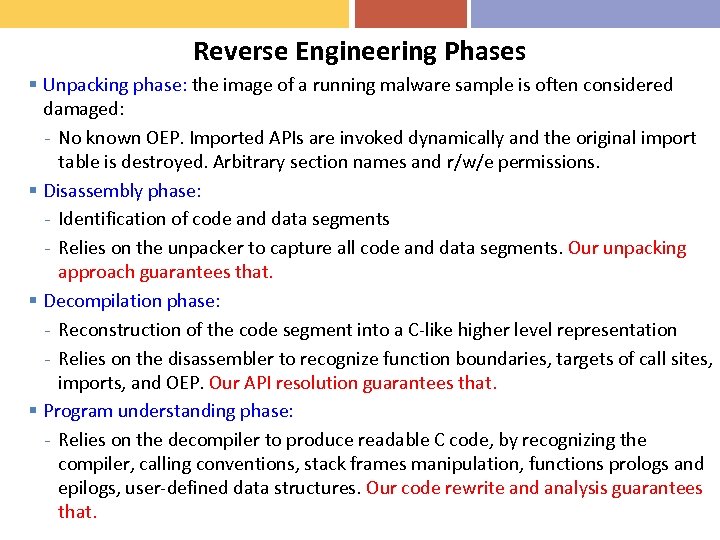 Reverse Engineering Phases § Unpacking phase: the image of a running malware sample is often considered damaged: - No known OEP. Imported APIs are invoked dynamically and the original import table is destroyed. Arbitrary section names and r/w/e permissions. § Disassembly phase: - Identification of code and data segments - Relies on the unpacker to capture all code and data segments. Our unpacking approach guarantees that. § Decompilation phase: - Reconstruction of the code segment into a C-like higher level representation - Relies on the disassembler to recognize function boundaries, targets of call sites, imports, and OEP. Our API resolution guarantees that. § Program understanding phase: - Relies on the decompiler to produce readable C code, by recognizing the compiler, calling conventions, stack frames manipulation, functions prologs and epilogs, user-defined data structures. Our code rewrite and analysis guarantees that.
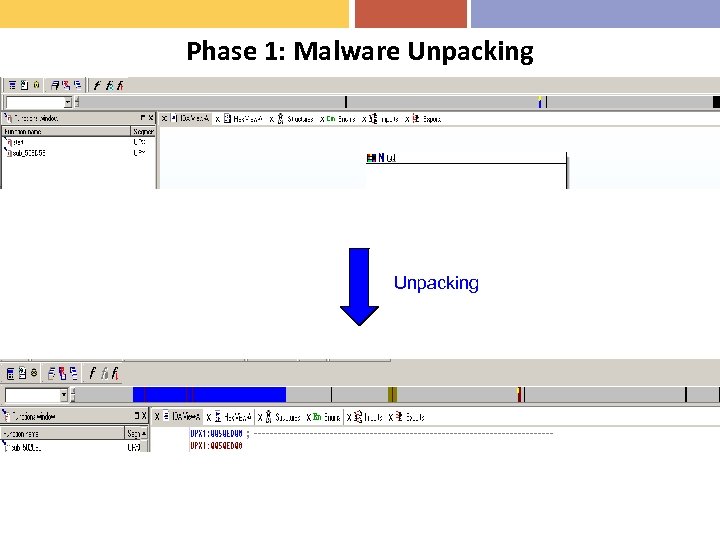 Phase 1: Malware Unpacking
 Example of Packed Code
 The Eureka Framework • Novel unpacking technique based on coarse grained execution tracing • Heuristic-based and statistic-based upacking • Implements several techniques to handle obfucated API references • Multiple metrics to evaluate unpack success • Annotated call graphs provide bird’s eye view of system interaction
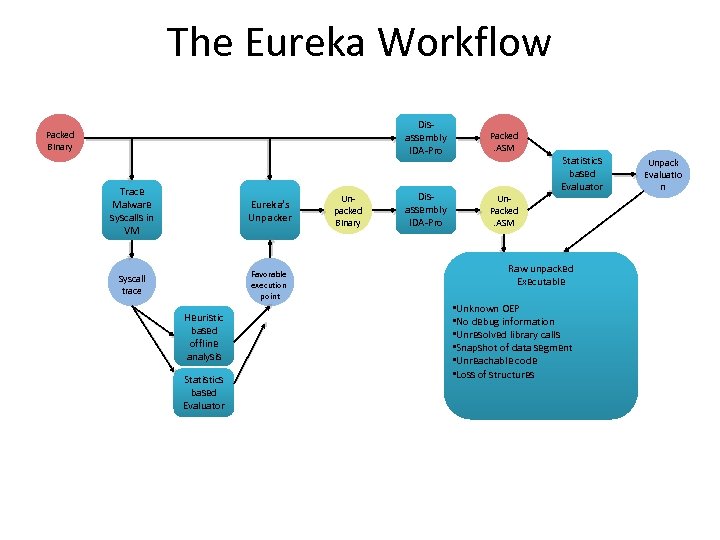 The Eureka Workflow Disassembly IDA-Pro Packed Binary Trace Malware syscalls in VM Eureka’s Unpacker Syscall trace Favorable execution point Heuristic based offline analysis Statistics based Evaluator Unpacked Binary Packed. ASM Disassembly IDA-Pro Un. Packed. ASM Statistics based Evaluator Raw unpacked Executable • Unknown OEP • No debug information • Unresolved library calls • Snapshot of data segment • Unreachable code • Loss of structures Unpack Evaluatio n
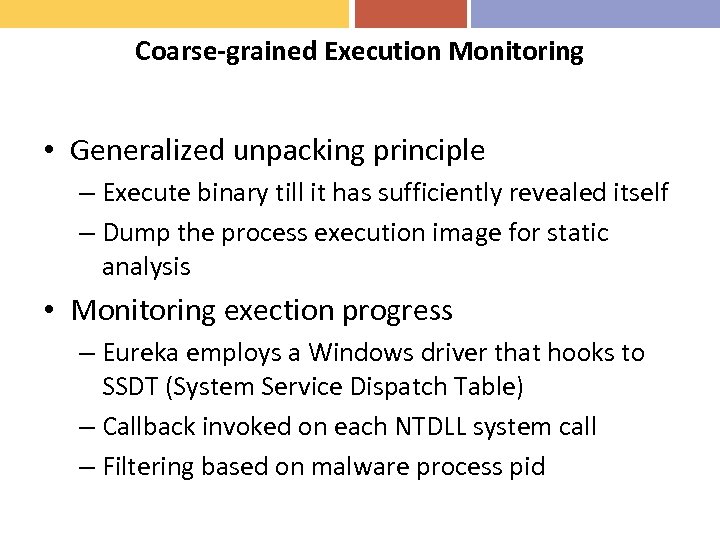 Coarse-grained Execution Monitoring • Generalized unpacking principle – Execute binary till it has sufficiently revealed itself – Dump the process execution image for static analysis • Monitoring exection progress – Eureka employs a Windows driver that hooks to SSDT (System Service Dispatch Table) – Callback invoked on each NTDLL system call – Filtering based on malware process pid
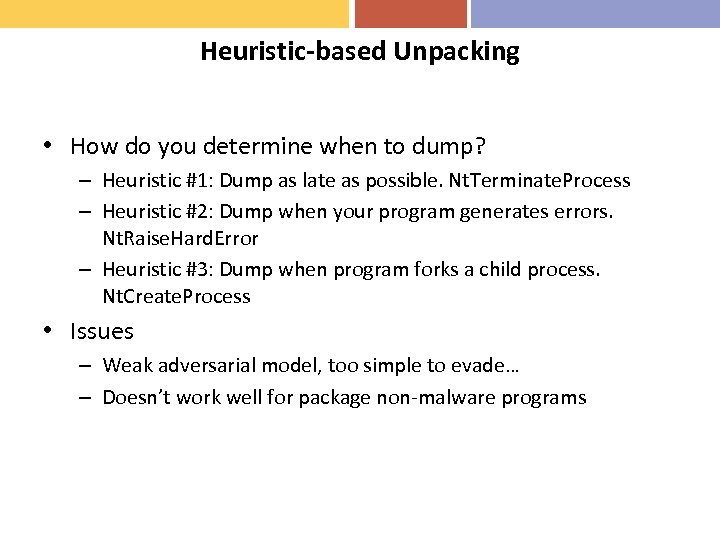 Heuristic-based Unpacking • How do you determine when to dump? – Heuristic #1: Dump as late as possible. Nt. Terminate. Process – Heuristic #2: Dump when your program generates errors. Nt. Raise. Hard. Error – Heuristic #3: Dump when program forks a child process. Nt. Create. Process • Issues – Weak adversarial model, too simple to evade… – Doesn’t work well for package non-malware programs
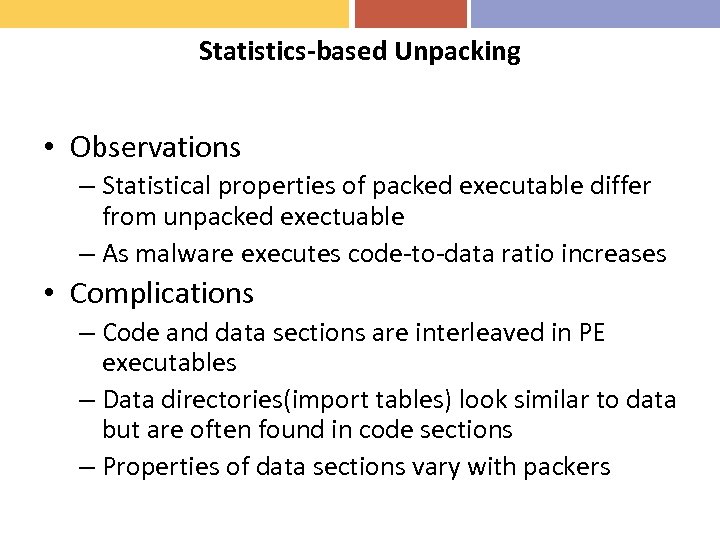 Statistics-based Unpacking • Observations – Statistical properties of packed executable differ from unpacked exectuable – As malware executes code-to-data ratio increases • Complications – Code and data sections are interleaved in PE executables – Data directories(import tables) look similar to data but are often found in code sections – Properties of data sections vary with packers
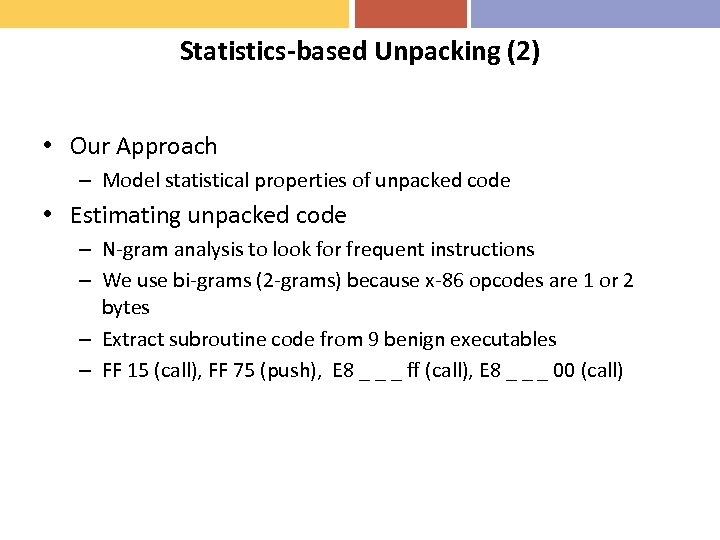 Statistics-based Unpacking (2) • Our Approach – Model statistical properties of unpacked code • Estimating unpacked code – N-gram analysis to look for frequent instructions – We use bi-grams (2 -grams) because x-86 opcodes are 1 or 2 bytes – Extract subroutine code from 9 benign executables – FF 15 (call), FF 75 (push), E 8 _ _ _ ff (call), E 8 _ _ _ 00 (call)
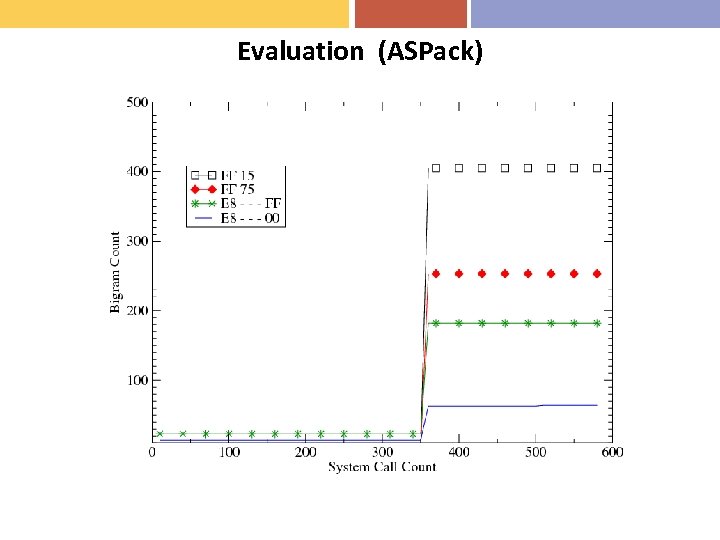 Evaluation (ASPack)
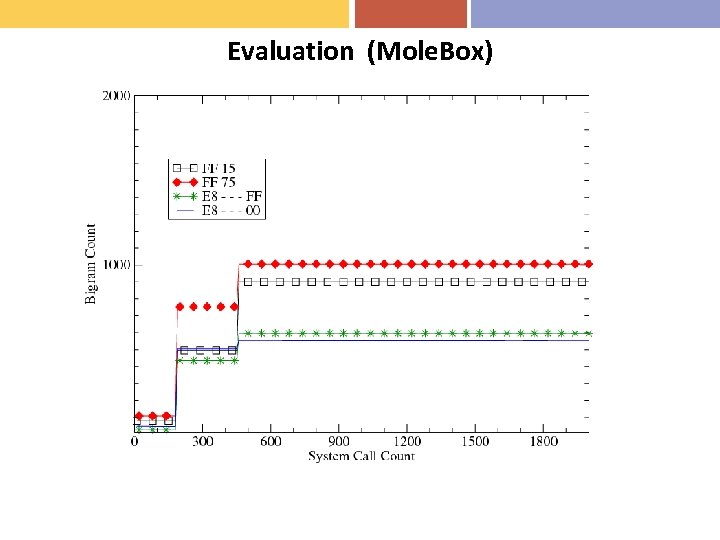 Evaluation (Mole. Box)
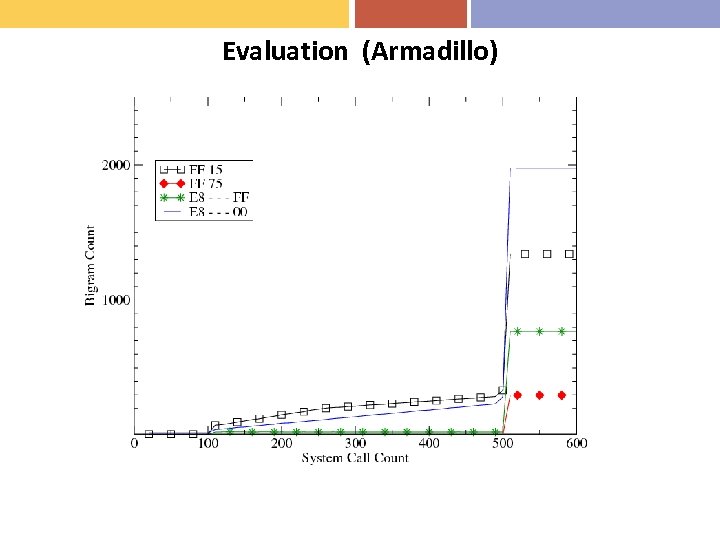 Evaluation (Armadillo)
 Systematic Approach to Code Deobfuscation: Unpacking • Automatic Unpacking: involves running the malware and capturing its memory image. • Monitoring the execution of the malware is an intrusive process and is often detected using anti-tracing and antidebugging techniques embedded in the malware. • Our multi-strategy approach consists of minimal monitoring and capturing the process image at key events: – – Exit. Process Byte bigram monitoring: call, push instructions for instance Number of seconds elapsed Run the malware without monitoring and suspend its execution and perform memory inspection • In practice, we always manage to get a dump (memory snapshot) of the running process: no OEP and no Import table
 Phase 2: Disassembly • The disassembler reads the PE data structure in order to: 1. Determine the different sections of the file and separate code from data and identifies resource information such as import tables – The disassembler relies on the PE data structure (could be corrupt) – The disassembler translates into code, any referenced address from known code location 2. Translate code segments into assembly language – The disassembler relies on the hardware instruction set documentation 3. Interpret data according to identified types 1. A data referenced by code can be of any type: integer, string, struct, etc. Integer: 0 x 0040 F 45 C dword_40 F 45 C dd 0 E 06 D 7363 h, 1, 2 dup(0) ; DATA XREF: 408 C 98 String: 0 x 0040 F 45 C unk_40 F 45 C db 63 h ; c ; DATA XREF: sub_408 C 98 0 x 0040 F 45 D db 73 h ; s 0 x 0040 F 45 E db 6 Dh ; m 0 x 0040 F 45 F db 0 E 0 h ; a
 IDA Pro Disassembler • http: //www. hex-rays. com/idapro/ – It supports a variety of executable formats for different processors and operating systems. It also can be used as a debugger for Windows PE, Mac OS X, and Linux ELF executables. – IDA performs a large degree of automatic code analysis to a certain extent, leveraging cross-references between code sections, knowledge of parameters of API calls, limited dataflow analysis, and recognition of standard libraries. • Hashes of known statically linked libraries are compared to hashes of identified subroutines in the code – Provides scripting languages to interact with the system to improve the analysis. – Support plug-ins: The IDA decompiler is the most impressive plug-in.
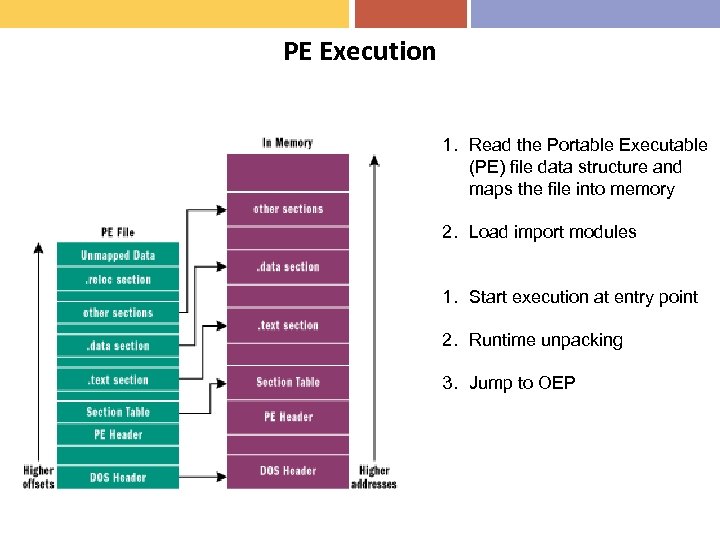 PE Execution 1. Read the Portable Executable (PE) file data structure and maps the file into memory 2. Load import modules 1. Start execution at entry point 2. Runtime unpacking 3. Jump to OEP
 Phase 3: Fixing the Disassembled Code • Unpacked & disassembled code does not have an OEP. • Import tables are rebuilt dynamically and there are no static references to dynamically loaded libraries • Header information is not reliable • Data is not typed
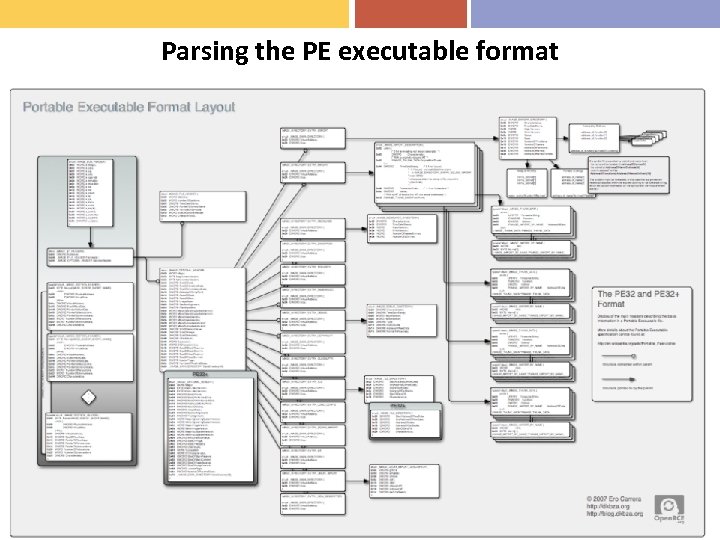 Parsing the PE executable format
 Challenges in Binary Code Disassembly • Disassembly is not an exact science: On CISC platforms with variable-width instructions, or in the presence of selfmodifying code, it is possible for a single program to have two or more reasonable disassemblies. Determining which instructions would actually be encountered during a run of the program reduces to the proven-unsolvable halting problem. • Bad disassembly because of variable length instructions • Jumps into middle of instructions • No reachability analysis: Unreachable code can hide data.
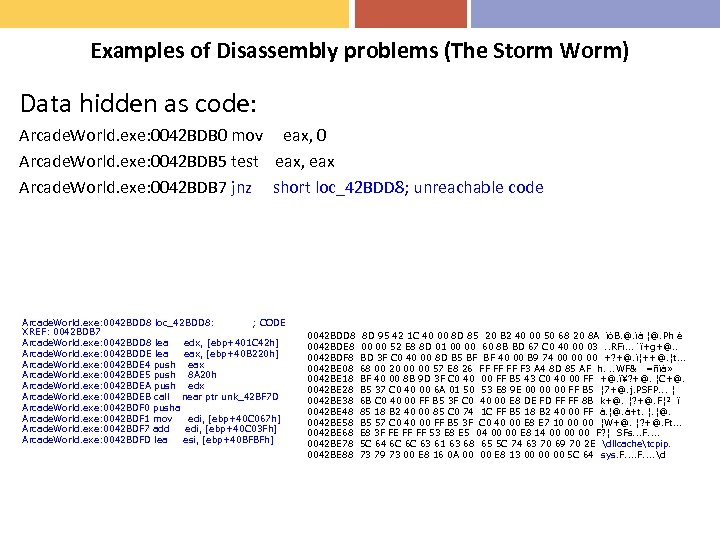 Examples of Disassembly problems (The Storm Worm) Data hidden as code: Arcade. World. exe: 0042 BDB 0 mov eax, 0 Arcade. World. exe: 0042 BDB 5 test eax, eax Arcade. World. exe: 0042 BDB 7 jnz short loc_42 BDD 8; unreachable code Arcade. World. exe: 0042 BDD 8 loc_42 BDD 8: ; CODE XREF: 0042 BDB 7 Arcade. World. exe: 0042 BDD 8 lea edx, [ebp+401 C 42 h] Arcade. World. exe: 0042 BDDE lea eax, [ebp+40 B 220 h] Arcade. World. exe: 0042 BDE 4 push eax Arcade. World. exe: 0042 BDE 5 push 8 A 20 h Arcade. World. exe: 0042 BDEA push edx Arcade. World. exe: 0042 BDEB call near ptr unk_42 BF 7 D Arcade. World. exe: 0042 BDF 0 pusha Arcade. World. exe: 0042 BDF 1 mov edi, [ebp+40 C 067 h] Arcade. World. exe: 0042 BDF 7 add edi, [ebp+40 C 03 Fh] Arcade. World. exe: 0042 BDFD lea esi, [ebp+40 BFBFh] 0042 BDD 8 8 D 95 42 1 C 40 00 8 D 85 20 B 2 40 00 50 68 20 8 A ìòB. @. ìà ¦@. Ph è 0042 BDE 8 00 00 52 E 8 8 D 01 00 00 60 8 B BD 67 C 0 40 00 03 . . RFì. . . `ï+g+@. . 0042 BDF 8 BD 3 F C 0 40 00 8 D B 5 BF BF 40 00 B 9 74 00 00 00 +? +@. ì¦++@. ¦t. . . 0042 BE 08 68 00 20 00 00 57 E 8 26 FF FF FF F 3 A 4 8 D 85 AF h. . . WF& =ñìà» 0042 BE 18 BF 40 00 8 B 9 D 3 F C 0 40 00 FF B 5 43 C 0 40 00 FF +@. ï¥? +@. ¦C+@. 0042 BE 28 B 5 37 C 0 40 00 6 A 01 50 53 E 8 9 E 00 00 00 FF B 5 ¦ 7+@. j. PSFP. . . ¦ 0042 BE 38 6 B C 0 40 00 FF B 5 3 F C 0 40 00 E 8 DE FD FF FF 8 B k+@. ¦? +@. F¦² ï 0042 BE 48 85 18 B 2 40 00 85 C 0 74 1 C FF B 5 18 B 2 40 00 FF à. ¦@. à+t. ¦. ¦@. 0042 BE 58 B 5 57 C 0 40 00 FF B 5 3 F C 0 40 00 E 8 E 7 10 00 00 ¦W+@. ¦? +@. Ft. . . 0042 BE 68 E 8 3 F FE FF FF 53 E 8 E 5 04 00 00 E 8 14 00 00 00 F? ¦ SFs. . . F. . 0042 BE 78 5 C 64 6 C 6 C 63 61 63 68 65 5 C 74 63 70 69 70 2 E dllcachetcpip. 0042 BE 88 73 79 73 00 E 8 16 0 A 00 00 E 8 13 00 00 00 5 C 64 sys. F. . . . d
 API Resolution • User-level malware programs require system calls to perform malicious actions • Use Win 32 API to access user level libraries • Obufscations impede malware analysis using IDA Pro or Olly. Dbg – Packers use non-standard linking and loading of dlls – Obfuscated API resolution
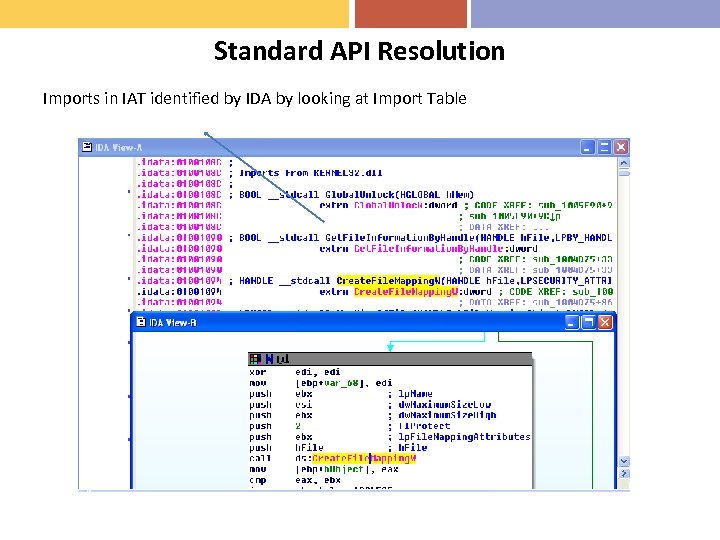 Standard API Resolution Imports in IAT identified by IDA by looking at Import Table
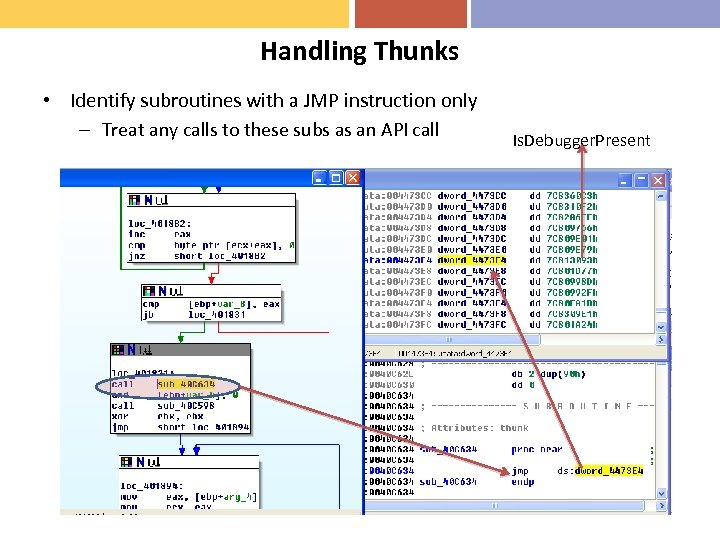 Handling Thunks • Identify subroutines with a JMP instruction only – Treat any calls to these subs as an API call Is. Debugger. Present
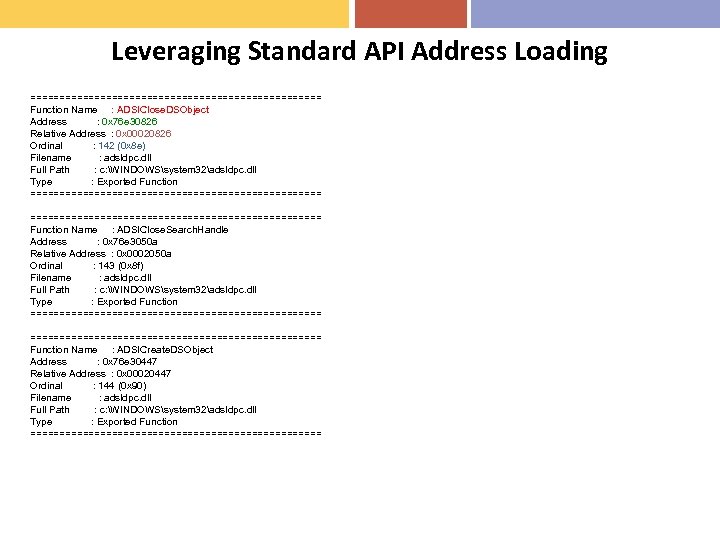 Leveraging Standard API Address Loading ========================= Function Name : ADSIClose. DSObject Address : 0 x 76 e 30826 Relative Address : 0 x 00020826 Ordinal : 142 (0 x 8 e) Filename : adsldpc. dll Full Path : c: WINDOWSsystem 32adsldpc. dll Type : Exported Function ================================================== Function Name : ADSIClose. Search. Handle Address : 0 x 76 e 3050 a Relative Address : 0 x 0002050 a Ordinal : 143 (0 x 8 f) Filename : adsldpc. dll Full Path : c: WINDOWSsystem 32adsldpc. dll Type : Exported Function ================================================== Function Name : ADSICreate. DSObject Address : 0 x 76 e 30447 Relative Address : 0 x 00020447 Ordinal : 144 (0 x 90) Filename : adsldpc. dll Full Path : c: WINDOWSsystem 32adsldpc. dll Type : Exported Function =========================
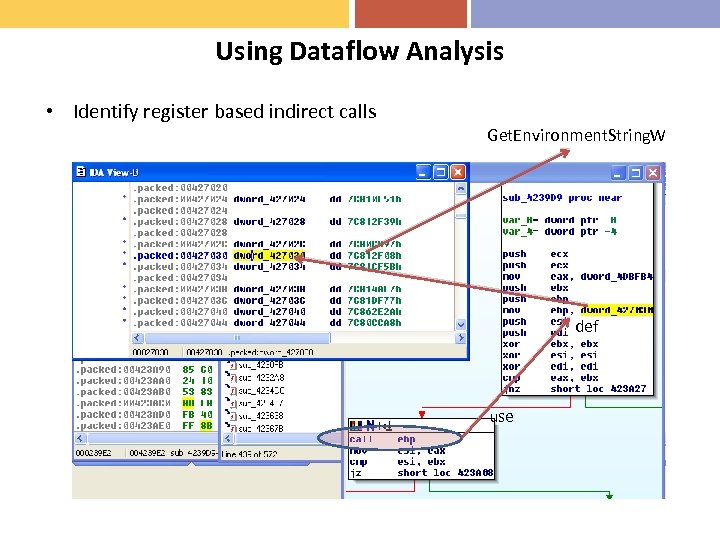 Using Dataflow Analysis • Identify register based indirect calls Get. Environment. String. W def use
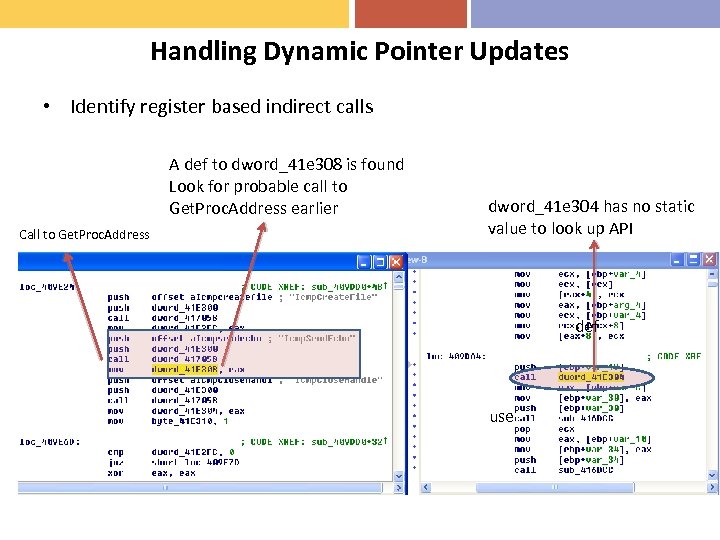 Handling Dynamic Pointer Updates • Identify register based indirect calls A def to dword_41 e 308 is found Look for probable call to Get. Proc. Address earlier Call to Get. Proc. Address dword_41 e 304 has no static value to look up API def use
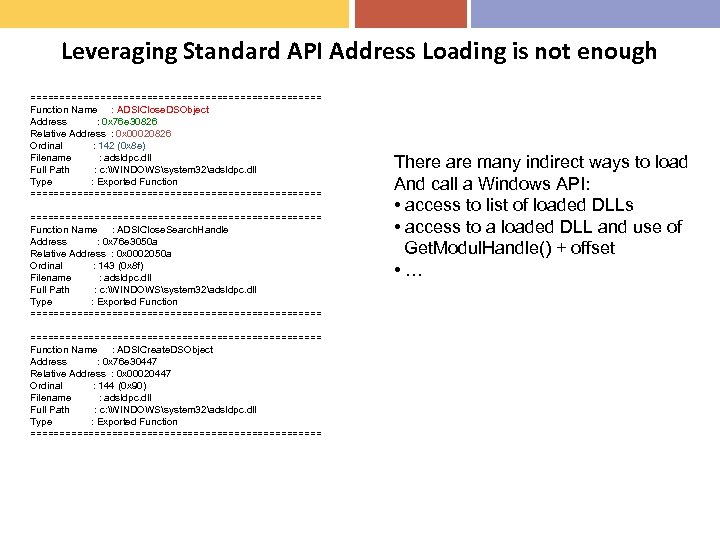 Leveraging Standard API Address Loading is not enough ========================= Function Name : ADSIClose. DSObject Address : 0 x 76 e 30826 Relative Address : 0 x 00020826 Ordinal : 142 (0 x 8 e) Filename : adsldpc. dll Full Path : c: WINDOWSsystem 32adsldpc. dll Type : Exported Function ================================================== Function Name : ADSIClose. Search. Handle Address : 0 x 76 e 3050 a Relative Address : 0 x 0002050 a Ordinal : 143 (0 x 8 f) Filename : adsldpc. dll Full Path : c: WINDOWSsystem 32adsldpc. dll Type : Exported Function ================================================== Function Name : ADSICreate. DSObject Address : 0 x 76 e 30447 Relative Address : 0 x 00020447 Ordinal : 144 (0 x 90) Filename : adsldpc. dll Full Path : c: WINDOWSsystem 32adsldpc. dll Type : Exported Function ========================= There are many indirect ways to load And call a Windows API: • access to list of loaded DLLs • access to a loaded DLL and use of Get. Modul. Handle() + offset • …
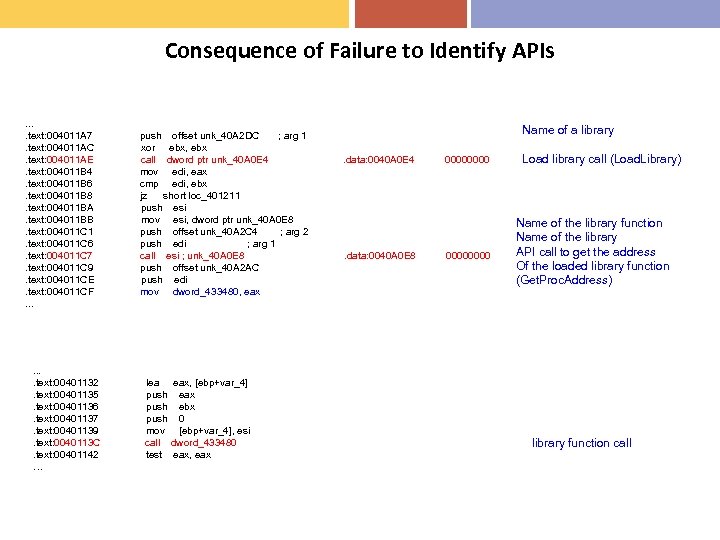 Consequence of Failure to Identify APIs. . text: 004011 A 7. text: 004011 AC. text: 004011 AE. text: 004011 B 4. text: 004011 B 6. text: 004011 B 8. text: 004011 BA. text: 004011 BB. text: 004011 C 1. text: 004011 C 6. text: 004011 C 7. text: 004011 C 9. text: 004011 CE. text: 004011 CF. . . . text: 00401132. text: 00401135. text: 00401136. text: 00401137. text: 00401139. text: 0040113 C. text: 00401142 … push offset unk_40 A 2 DC ; arg 1 xor ebx, ebx call dword ptr unk_40 A 0 E 4 mov edi, eax cmp edi, ebx jz short loc_401211 push esi mov esi, dword ptr unk_40 A 0 E 8 push offset unk_40 A 2 C 4 ; arg 2 push edi ; arg 1 call esi ; unk_40 A 0 E 8 push offset unk_40 A 2 AC push edi mov dword_433480, eax lea eax, [ebp+var_4] push eax push ebx push 0 mov [ebp+var_4], esi call dword_433480 test eax, eax Name of a library. data: 0040 A 0 E 4 . data: 0040 A 0 E 8 00000000 Load library call (Load. Library) Name of the library function Name of the library API call to get the address Of the loaded library function (Get. Proc. Address) library function call
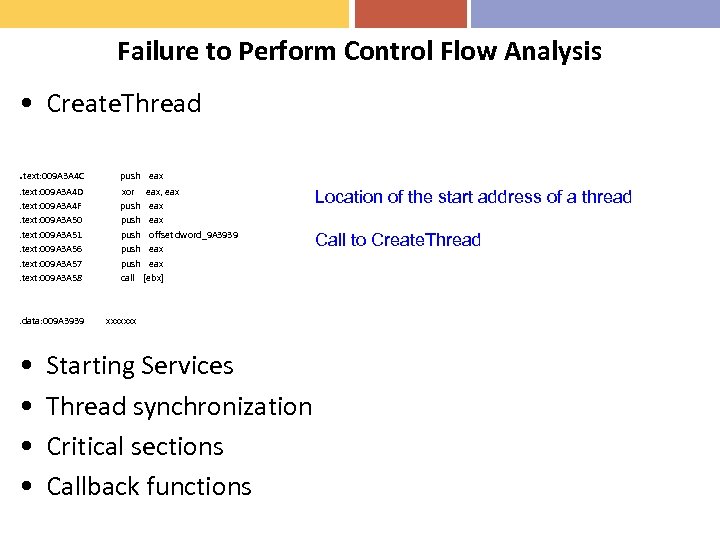 Failure to Perform Control Flow Analysis • Create. Thread. text: 009 A 3 A 4 C push eax . text: 009 A 3 A 4 D. text: 009 A 3 A 4 F. text: 009 A 3 A 50. text: 009 A 3 A 51. text: 009 A 3 A 56. text: 009 A 3 A 57. text: 009 A 3 A 58 xor eax, eax push offset dword_9 A 3939 push eax call [ebx] . data: 009 A 3939 • • xxxxxxx Starting Services Thread synchronization Critical sections Callback functions Location of the start address of a thread Call to Create. Thread
 Advanced API Resolution • There are many ways in which a library or API can be invoked. • There are many ways an API call can be obfuscated • But there is one invariant associated to each API and library: its signature – i. e; number of arguments, type of arguments, and type of return value if any.
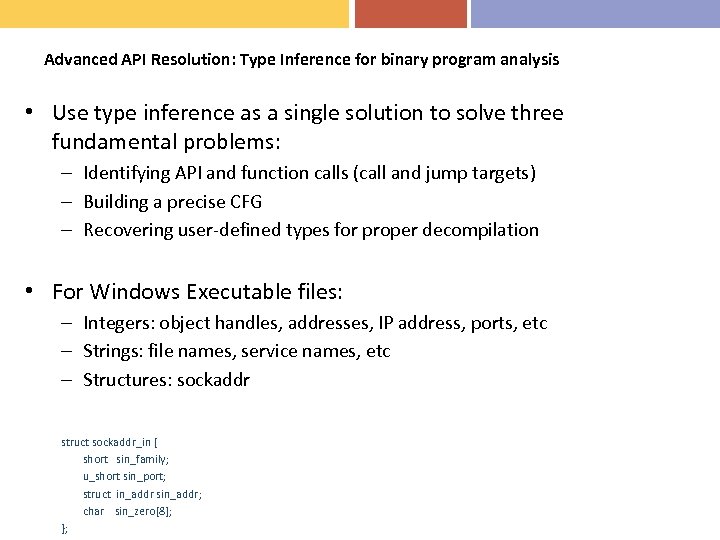 Advanced API Resolution: Type Inference for binary program analysis • Use type inference as a single solution to solve three fundamental problems: – Identifying API and function calls (call and jump targets) – Building a precise CFG – Recovering user-defined types for proper decompilation • For Windows Executable files: – Integers: object handles, addresses, IP address, ports, etc – Strings: file names, service names, etc – Structures: sockaddr struct sockaddr_in { short sin_family; u_short sin_port; struct in_addr sin_addr; char sin_zero[8]; };
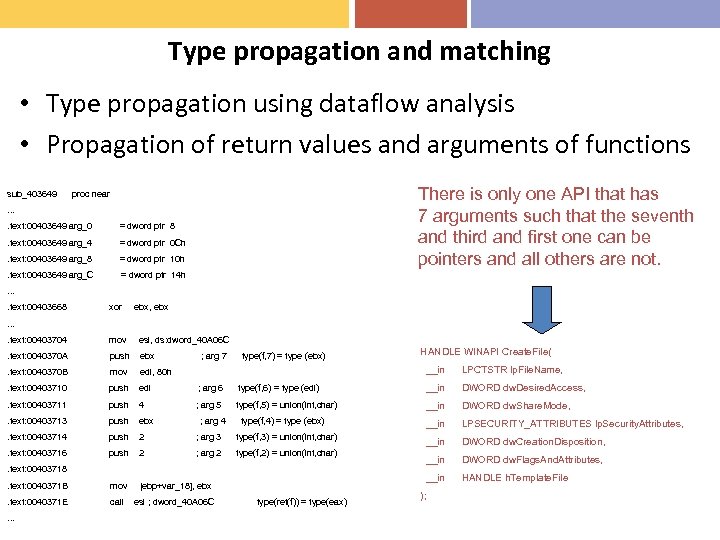 Type propagation and matching • Type propagation using dataflow analysis • Propagation of return values and arguments of functions sub_403649 There is only one API that has 7 arguments such that the seventh and third and first one can be pointers and all others are not. proc near . . text: 00403649 arg_0 = dword ptr 8 . text: 00403649 arg_4 = dword ptr 0 Ch . text: 00403649 arg_8 = dword ptr 10 h . text: 00403649 arg_C = dword ptr 14 h . . text: 00403668 xor ebx, ebx . . text: 00403704 mov esi, ds: dword_40 A 06 C . text: 0040370 A push ebx . text: 0040370 B mov edi, 80 h . text: 00403710 push edi ; arg 6 . text: 00403711 push 4 ; arg 5 . text: 00403713 push ebx . text: 00403714 push 2 ; arg 3 type(f, 3) = union(int, char) . text: 00403716 push 2 ; arg 2 type(f, 2) = union(int, char) . text: 00403718 push [ebp+arg_4] . text: 0040371 B mov [ebp+var_18], ebx . text: 0040371 E call esi ; dword_40 A 06 C . . . ; arg 7 type(f, 7) = type (ebx) HANDLE WINAPI Create. File( __in LPCTSTR lp. File. Name, type(f, 6) = type (edi) __in DWORD dw. Desired. Access, type(f, 5) = union(int, char) __in DWORD dw. Share. Mode, __in LPSECURITY_ATTRIBUTES lp. Security. Attributes, __in DWORD dw. Creation. Disposition, __in DWORD dw. Flags. And. Attributes, __in HANDLE h. Template. File ; arg 4 type(f, 4) = type (ebx) ; arg 1 type(f, 1) = type([ebp+arg_4]) type(ret(f)) = type(eax) );
 Advantages of type Inference Analysis • Programmers data structures and types are going to be based on known data structures and types provided by the libraries • Identifying API calls and type information help capture better the semantics of the program execution • Not restricted to Windows but require knowledge of the libraries and their documentation • Can deal with some of the widely used obfuscation techniques – Import table obfuscation – Code rewrite: code rewrite preserves the types!
 Phase 3: Rebuilding the unpacked executable • From a damaged dumped image of a running malware to a PE executable: – Knowing all APIs allows us to identify the OEP. – Semantic approach: Exit. Process, Create. Mutex, Get. Command. Line, Get. Modula. Handle, etc are close to OEP. There about 20 API are often called at the beginning of the execution of the code. – Structural approach: find sources of call graphs in the binary – Rebuilding in import table with all references to identified APIs • The disassembly of the reconstructed PE is often of better quality than the disassembly of the dumped process image – The new PE code bypasses the unpacking routine embedded in the packed code – The new PE contains the original code
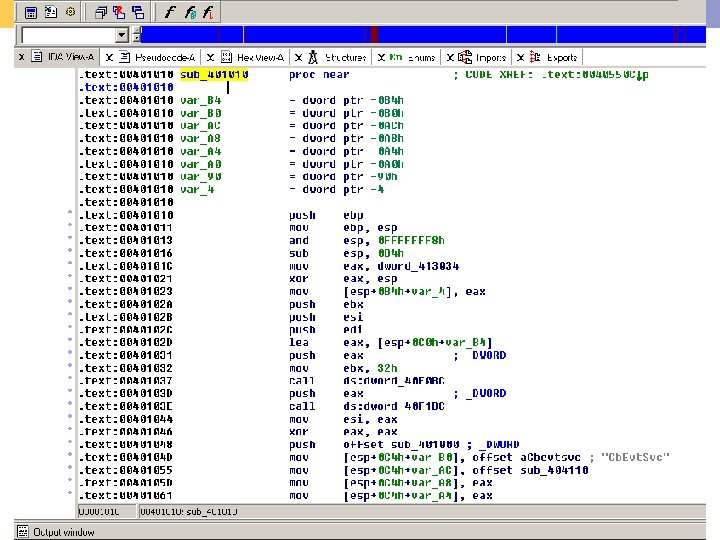
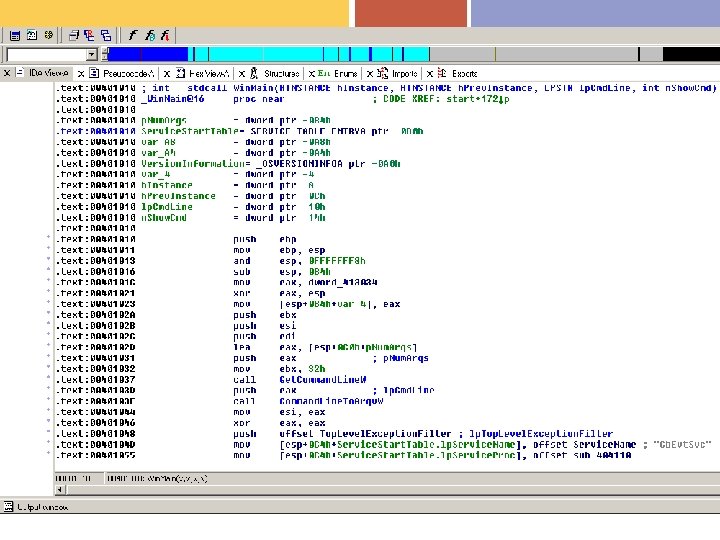
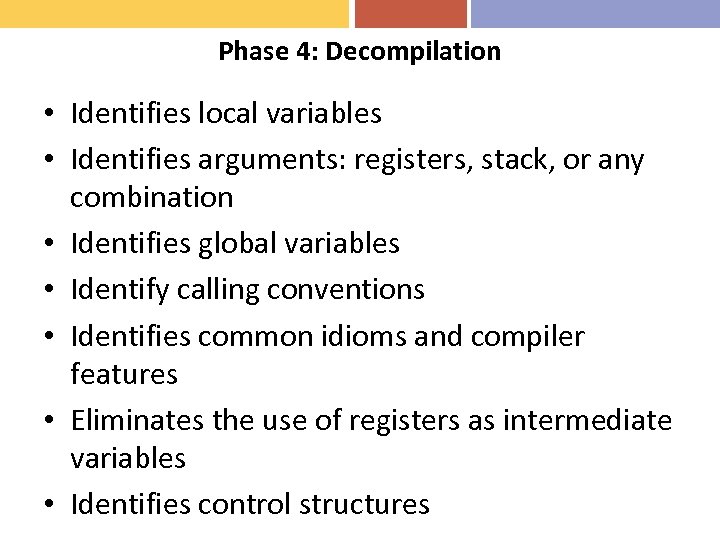 Phase 4: Decompilation • Identifies local variables • Identifies arguments: registers, stack, or any combination • Identifies global variables • Identify calling conventions • Identifies common idioms and compiler features • Eliminates the use of registers as intermediate variables • Identifies control structures
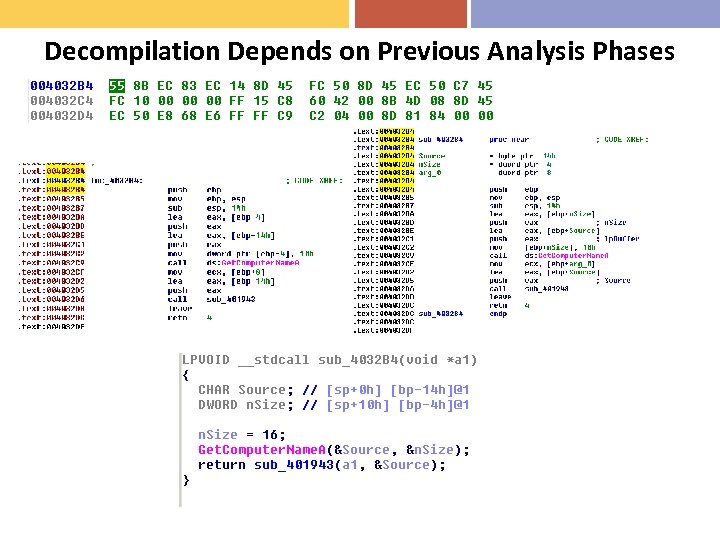 Decompilation Depends on Previous Analysis Phases
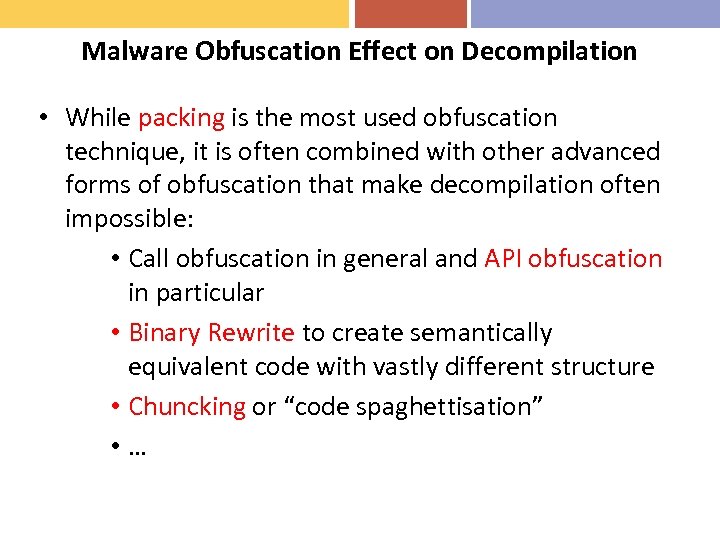 Malware Obfuscation Effect on Decompilation • While packing is the most used obfuscation technique, it is often combined with other advanced forms of obfuscation that make decompilation often impossible: • Call obfuscation in general and API obfuscation in particular • Binary Rewrite to create semantically equivalent code with vastly different structure • Chuncking or “code spaghettisation” • …
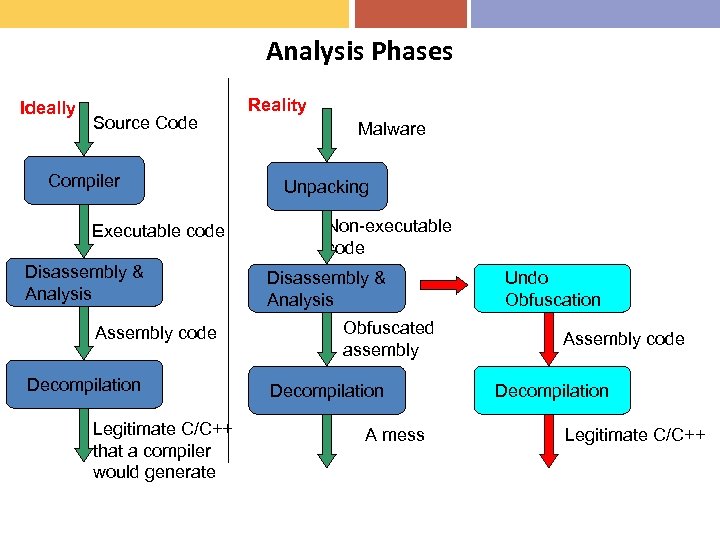 Analysis Phases Ideally Source Code Compiler Executable code Disassembly & Analysis Assembly code Decompilation Legitimate C/C++ that a compiler would generate Reality Malware Unpacking Non-executable code Disassembly & Analysis Obfuscated assembly Decompilation A mess Undo Obfuscation Assembly code Decompilation Legitimate C/C++
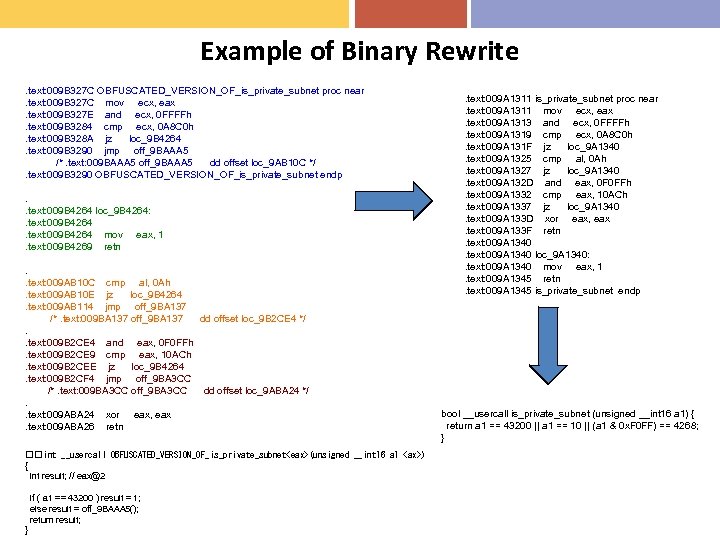 Example of Binary Rewrite. text: 009 B 327 C OBFUSCATED_VERSION_OF_is_private_subnet proc near. text: 009 B 327 C mov ecx, eax. text: 009 B 327 E and ecx, 0 FFFFh. text: 009 B 3284 cmp ecx, 0 A 8 C 0 h. text: 009 B 328 A jz loc_9 B 4264. text: 009 B 3290 jmp off_9 BAAA 5 /*. text: 009 BAAA 5 off_9 BAAA 5 dd offset loc_9 AB 10 C */. text: 009 B 3290 OBFUSCATED_VERSION_OF_is_private_subnet endp. . text: 009 B 4264 loc_9 B 4264: . text: 009 B 4264 mov eax, 1. text: 009 B 4269 retn. . text: 009 AB 10 C cmp al, 0 Ah. text: 009 AB 10 E jz loc_9 B 4264. text: 009 AB 114 jmp off_9 BA 137 /*. text: 009 BA 137 off_9 BA 137 dd offset loc_9 B 2 CE 4 */. . text: 009 B 2 CE 4 and eax, 0 F 0 FFh. text: 009 B 2 CE 9 cmp eax, 10 ACh. text: 009 B 2 CEE jz loc_9 B 4264. text: 009 B 2 CF 4 jmp off_9 BA 3 CC /*. text: 009 BA 3 CC off_9 BA 3 CC dd offset loc_9 ABA 24 */. . text: 009 ABA 24 xor eax, eax. text: 009 ABA 26 retn int __usercall OBFUSCATED_VERSION_OF_is_private_subnet
 Systematic Approach to Code Deobfuscation: Binary Rewriting • Dechunking: The control flow of Conficker's P 2 P module has been significantly obfuscated to hinder its disassembly and decompilation. Specifically, the contents of code blocks from each subroutine have been extracted and relocated throughout different portions of the executable. These different blocks (or chunks) are then referenced through unconditional and conditional jump instructions. In effect, the logical control flow of the P 2 P module has been obscured (spaghetti-code) to a degree that the module cannot be decompiled into coherent C-like code, which typically drives more in-depth and accurate code interpretation. Move all blocks to a contiguous memory block. • Normalize x 86 instructions: push followed by a pop is a mov • Normalize calling convention: cdecl, fastcall, stdcall, instead of user-defined.
 Conficker and Hydrac Dechunking • Identify all chunks in a function and rewrite the function • Applied to all Conficker C P 2 P Protocol subroutines • Unlike the Conficker P 2 P logic, Hydraq did not exhibit the same level of obfuscation. It did, however, share some obfuscation features with Conficker. The functions of the Hydraq binary have been subjected to chunking, which renders decompilation difficult. We applied our transformations to automatically generate the C-like code for each subroutine and build a complete CFG of the binary. The IDA disassembler identified 185 subroutines in the binary prior to our analysis. After running the dechunking transformation, only 141 subroutine remained and were decompiled.
 Purpose of code obfuscation • While packing is often used to reduce the size of binaries and to create polymorphic malware samples, the more advanced obfuscation techniques are designed to slow down reverse engineering efforts and to prevent: – the identification of API calls: identify the basic building blocks of the malware – the control-flow reconstruction of the malware: follow and reconstruct the logic flow – static analysis: determine the full functionality, triggers, hidden logic, time bombs, etc. – timely reverse engineering and mitigation of the threat
 Why Code Obfuscation is not Easy • Malware authors can design binary code that is extremely difficult to analyze. Using advanced programming languages knowledge, it is possible to create such code. • Malware authors do not feel the need to always obfuscated their code. Can easily defeat signature-based detection. Overwhelm analysts and tools with large numbers of samples. • Malware code should be able to run in a reliable manner. Obfuscation should not compromise this important requirement and should maintain the reliability of the initial code. This requires a proof or guarantee of some sort. • Malware deobfuscation is therefore a more attainable than you might think. Systematic obfuscation informs systematic deobfuscation.
 Our Approach • Because obfuscation is introduced in a rather systematic way, there is a hope that it can be dealt with in an automated way. • Systematically identifying an obfuscation step and undoing its effect. • Focus on generic approaches as opposed to packer/obfuscator specifics
 Example: Static Analysis of Conficker • Conficker appeared on November 20 th, 2008 • Infected millions of machines worldwide • Millions of machines still infected despite an extensive news coverage about the threat • Four versions have been released: A, B, B++, and C • It is a sophisticated piece of malicious code created by professionals who have extensive knowledge about networking, cryptography, system and network programming, and security • Managed to defeat the security community in stopping its progression by using strong crypto, code obfuscation, aggressive propagation strategies, and constantly monitoring the security community actions • Dynamic analysis provided a limited understanding of the threat: • Identification of what appears to be a P 2 P protocol • Identification of ports opened by the malware • Deobfuscation and static analysis were the only techniques that were able to uncover the full capability of the malware. SRI Technical Report (http: //mtc. sri. com/Conficker)
 Example: Static Analysis of Conficker Code: – Domain generation algorithm: provided a list of daily domains to be blocked – Quarter of the Internet scanned: Understand what part of the Internet was targeted for scanning and what infections were due to USB ports and mobile devices – List of disabled security products: detection – Ukrainian keyboard avoidance: Geo-location database poisoning – Use of MD 6 and related crypto algorithms: Attribution – DNS APIs patching to disable list of websites (including SRI!): detection – Distribute a number of modified versions of the binary – TCP and UDP ports based on the IP address of the infected machine: detection
 Deobfuscation of the Conficker C P 2 P protocol • • Heavily obfuscated protocol code 88 APIs obfuscated Use of chunking lead to poor decompilation Benefits of the deobfuscation – P 2 P Protocol description: protocol understanding and P 2 P structure – Peer selection algorithm: proved the peer poisoning approach useless – Possibility to hot patch code without DGA updates: proved C&C domains obsolete The P 2 P protocol was not just a mechanism for distributing PE executable files but also digitally signed sets of x 86 instructions that are executed in a separate thread and take as argument the IP address of the sender. This would provide a hot patch mechanism for all data manipulated by Conficker: list of peers, encryption/decryption keys, the Conficker code it self, etc.
 Stuxnet: Keeping it “relatively” simple • Stuxnet does not use advanced binary obfuscation techniques. • The analysis of the code is challenging nevertheless • Stuxnet Code Characteristics: – Use of C++ exception handling – Use of C++ classes – Use of simple data encoding (encryption) – Use of C structures for all data passed to the main subroutines: • Over 40 user-defined structures • Not recognized by disassemblers and decompilers
 Phase 5: Program Understanding • Need to identify higher-level concepts from the deobfuscated code • Need to interpret the code into a higher-level malware objective • Need to indentify particular features: crypto: – Functions that use crypto-related opcode, loops, etc – Known constants in crypto algorithms
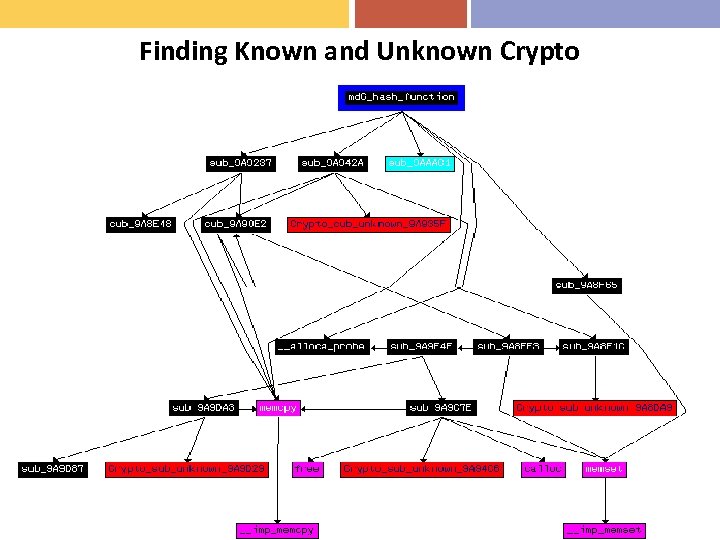 Finding Known and Unknown Crypto
 Conclusions • It is always desirable to recover from the malware a description that is as close as possible to the original code produced by the authors. • It is often possible to do that in practice • It is often the only way to really determine the full capability of the malware • The benefits are important when it comes to highprofile targets • Easily integrated in common analysis tools: disassembler (IDA), Decompilers.
 Daily Malware Capture and Analysis • http: //mtc. sri. com/