 Скачать презентацию SPTI Int l Networks Review of Current Distribution
18657edf611fbe3e5b2b20490daede70.ppt
- Количество слайдов: 20



SPTI Int’l Networks – Review of Current Distribution Infrastructure, and the “New Vision” for Distribution
What are the International Networks? A portfolio of branded, satellite delivered linear cable television networks: Ø Viewed throughout Europe, Asia, The Middle East and Latin America. Ø Reaching over 400 million households, in 21 languages and in over 135 countries, 24 hours a day, 7 days a week. Pursuing an aggressive development strategy, SPE’s international networks portfolio has grown exponentially since the introduction of the first two networks in 1995 to more than 56 linear networks (40 wholly-owned and controlled) around the world in just 14 years, with more to come.
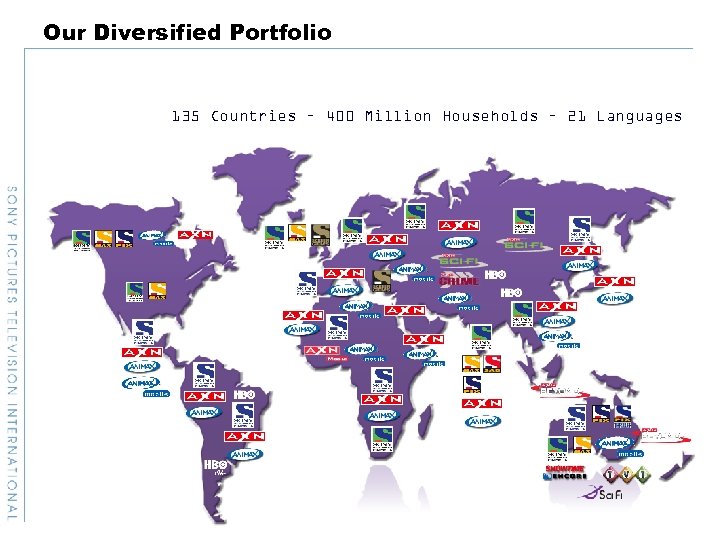
Our Diversified Portfolio 135 Countries – 400 Million Households – 21 Languages
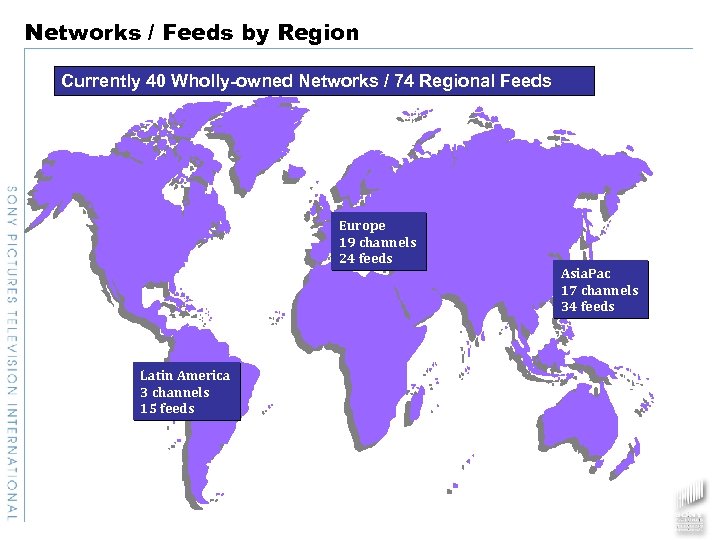
Networks / Feeds by Region Currently 40 Wholly-owned Networks / 74 Regional Feeds Europe 19 channels 24 feeds Latin America 3 channels 15 feeds Asia. Pac 17 channels 34 feeds
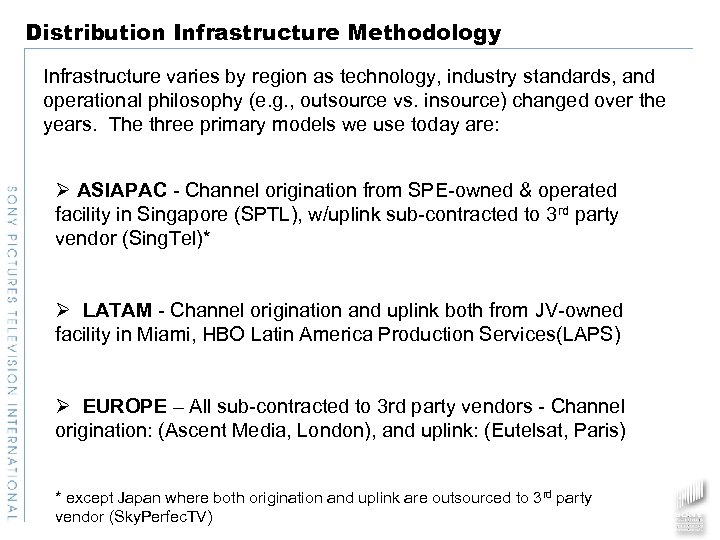
Distribution Infrastructure Methodology Infrastructure varies by region as technology, industry standards, and operational philosophy (e. g. , outsource vs. insource) changed over the years. The three primary models we use today are: Ø ASIAPAC - Channel origination from SPE-owned & operated facility in Singapore (SPTL), w/uplink sub-contracted to 3 rd party vendor (Sing. Tel)* Ø LATAM - Channel origination and uplink both from JV-owned facility in Miami, HBO Latin America Production Services(LAPS) Ø EUROPE – All sub-contracted to 3 rd party vendors - Channel origination: (Ascent Media, London), and uplink: (Eutelsat, Paris) * except Japan where both origination and uplink are outsourced to 3 rd party vendor (Sky. Perfec. TV)
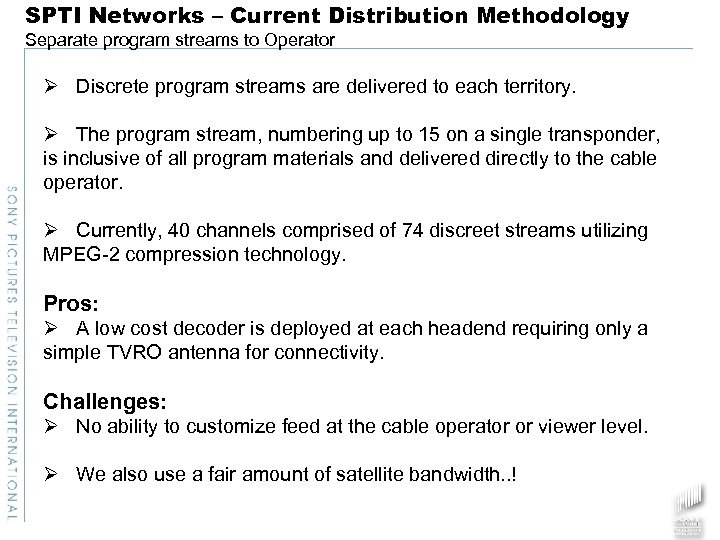
SPTI Networks – Current Distribution Methodology Separate program streams to Operator Ø Discrete program streams are delivered to each territory. Ø The program stream, numbering up to 15 on a single transponder, is inclusive of all program materials and delivered directly to the cable operator. Ø Currently, 40 channels comprised of 74 discreet streams utilizing MPEG-2 compression technology. Pros: Ø A low cost decoder is deployed at each headend requiring only a simple TVRO antenna for connectivity. Challenges: Ø No ability to customize feed at the cable operator or viewer level. Ø We also use a fair amount of satellite bandwidth. . !
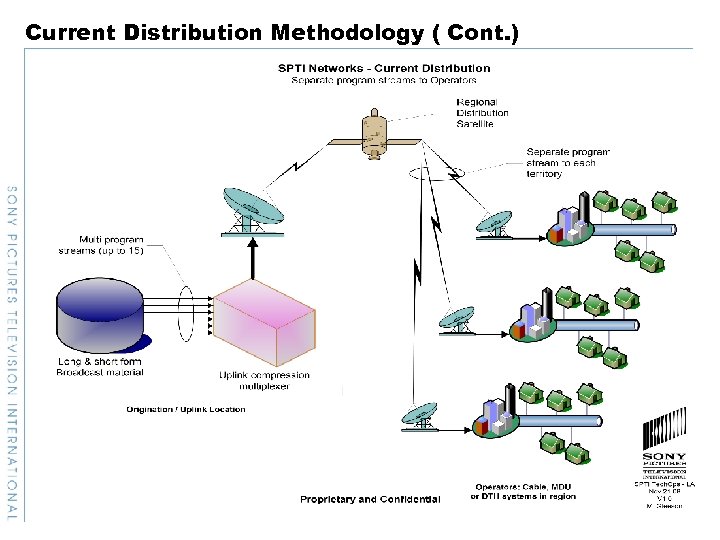
Current Distribution Methodology ( Cont. )
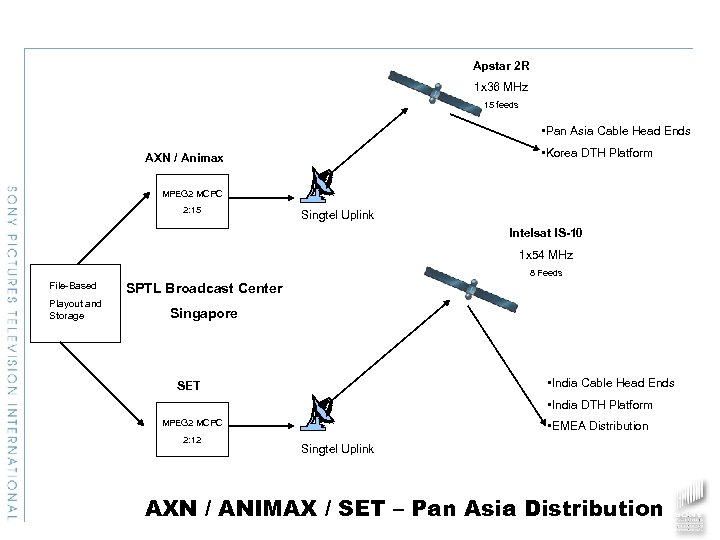
Apstar 2 R 1 x 36 MHz 15 feeds • Pan Asia Cable Head Ends • Korea DTH Platform AXN / Animax MPEG 2 MCPC 2: 15 Singtel Uplink Intelsat IS-10 1 x 54 MHz 8 Feeds File-Based SPTL Broadcast Center Playout and Storage Singapore • India Cable Head Ends SET • India DTH Platform MPEG 2 MCPC 2: 12 • EMEA Distribution Singtel Uplink AXN / ANIMAX / SET – Pan Asia Distribution
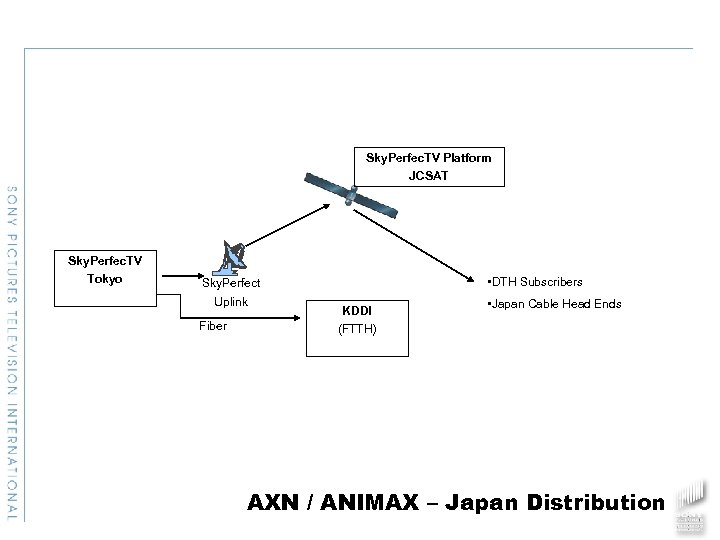
Sky. Perfec. TV Platform JCSAT Sky. Perfec. TV Tokyo • DTH Subscribers Sky. Perfect Uplink Fiber KDDI (FTTH) • Japan Cable Head Ends AXN / ANIMAX – Japan Distribution
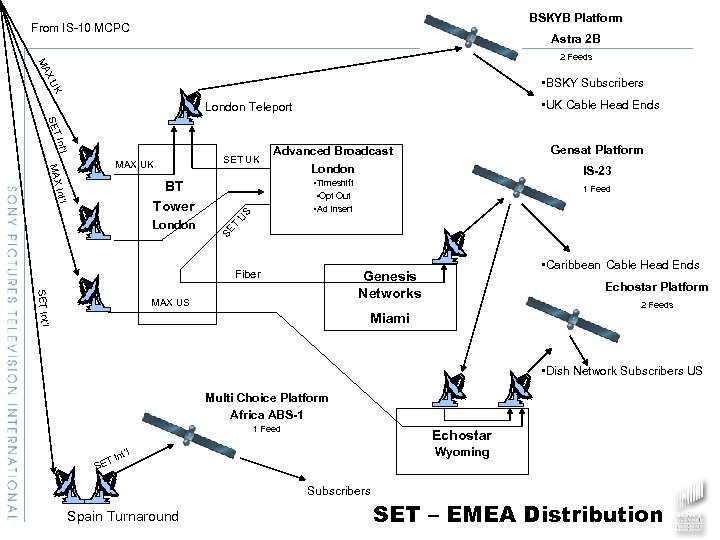
BSKYB Platform From IS-10 MCPC Astra 2 B MA 2 Feeds XU K • BSKY Subscribers • UK Cable Head Ends London Teleport SET Int’l London IS-23 • Timeshift • Opt Out • Ad Insert U S Int’l BT Tower Gensat Platform Advanced Broadcast London 1 Feed SE T MAX UK SET UK Fiber • Caribbean Cable Head Ends SET Int’l Genesis Networks MAX US Echostar Platform 2 Feeds Miami • Dish Network Subscribers US Multi Choice Platform Africa ABS-1 1 Feed Echostar Wyoming l Int’ ET S Subscribers Spain Turnaround SET – EMEA Distribution
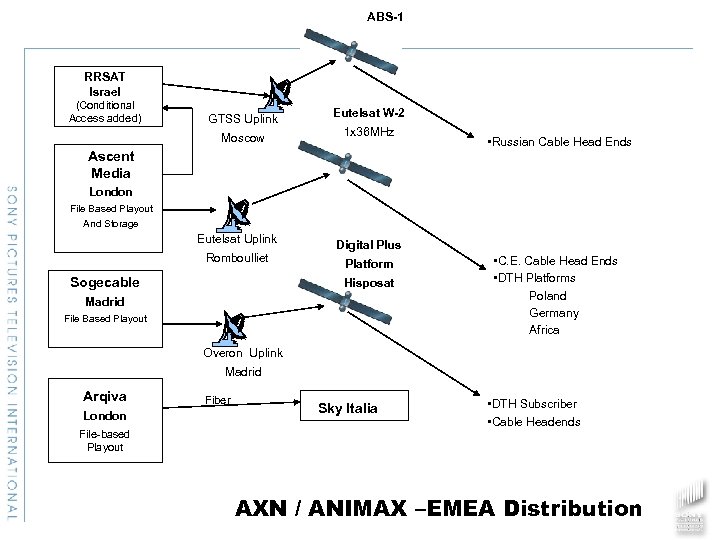
ABS-1 RRSAT Israel (Conditional Access added) GTSS Uplink Moscow Eutelsat W-2 1 x 36 MHz Ascent Media • Russian Cable Head Ends London File Based Playout And Storage Eutelsat Uplink Romboulliet Sogecable Digital Plus Platform Hisposat Madrid File Based Playout • C. E. Cable Head Ends • DTH Platforms Poland Germany Africa Overon Uplink Madrid Arqiva London File-based Playout Fiber Sky Italia • DTH Subscriber • Cable Headends AXN / ANIMAX –EMEA Distribution
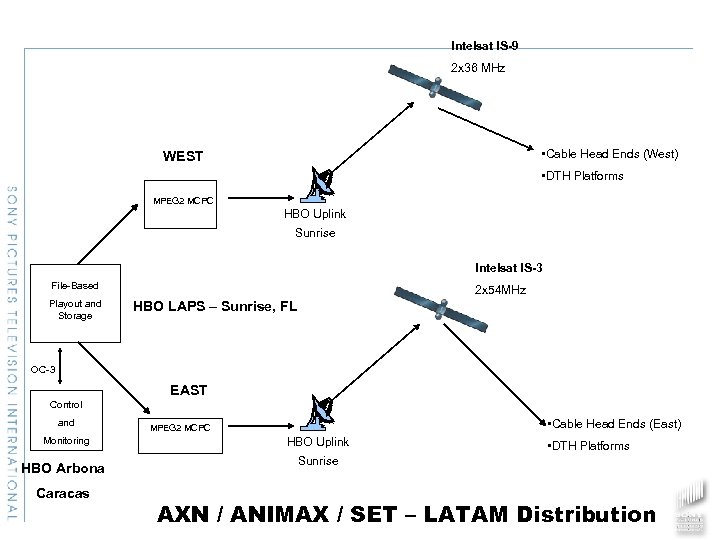
Intelsat IS-9 2 x 36 MHz • Cable Head Ends (West) WEST • DTH Platforms MPEG 2 MCPC HBO Uplink Sunrise Intelsat IS-3 File-Based Playout and Storage 2 x 54 MHz HBO LAPS – Sunrise, FL OC-3 EAST Control and Monitoring HBO Arbona Caracas • Cable Head Ends (East) MPEG 2 MCPC HBO Uplink • DTH Platforms Sunrise AXN / ANIMAX / SET – LATAM Distribution

“New Vision” Distribution Infrastructure Project Drivers
Fun Facts ØWe currently originate and distribute some 40 wholly-owned branded channels comprised of 74 discreet real-time, linear SD regional streams to cable headends and DTH platforms globally. We utilize an aggregate of approx. 220 MHZ of leased satellite and fiber optic bandwidth for this distribution. ØIf all of our feeds were converted to HD, even utilizing MPEG 4 as opposed to the current MPEG 2 distribution technology, we would need to acquire approx. 350 MHZ of additional satellite and fiber bandwidth (assuming no further growth and expansion, which is unlikely). Cost aside, that quantity of satellite bandwidth would be difficult if not impossible to acquire due to limitations of marketplace supply and demand. ØWe distribute in aggregate to approx. 6000 headends and DTH platforms globally which, across all channel brands and regions, translates to approx. 36, 000 individual Integrated Receiver/Decoders (IRDs) in our receive universe (including backup units and spares). For reference, the average cost of a single IRD is approx. USD 1200. ØWe compete against at least 5 marquis brands (e. g. , Disney, Fox, MTV, Nickelodeon, Discovery, etc. ) in each market; each in turn having their own breakout of discreet regional feeds. If we assume each marquis brand has a similar distribute infrastructure, then the total number of IRDs deployed (just for the marquis brands) could be in the range of 180, 000+. ØAcross ALL channel brands in all markets globally, that number could conceivably be as large as 500, 000 individual headend IRDs. ØIt is conceivable and probable that all of our competitors are facing a similar challenge with respect to conversion to HD, and will also need a more bandwidth-efficient solution for distribution.
Fun Facts ØThe most practical approach to solving the bandwidth dilemma would be to utilize a non-real-time, lower bitrate distribution methodology that downloads program files on demand as opposed to sending out continuous streams. ØThe files would then be assembled into a linear stream and played out “at the edge” utilizing “station-in-a-box” server technology at each headend location as opposed to linearly from a centralized location. ØThe legacy regional (Asia, Latam, EMEA) broadcast origination “hubs” would be converted to content aggregation and storage centers that “serve” files to the remote edge servers on request. ØThe reduction in required distribution bandwidth (i. e. , continuous linear streams vs. on demand file download), could be sufficient to allow current bandwidth to handle the increased load of HD, negating the need to acquire additional satellite bandwidth. ØThe key to the success of this project is the development of a robust, feature filled edge server at a modest price point which is comparable to the current IRD.
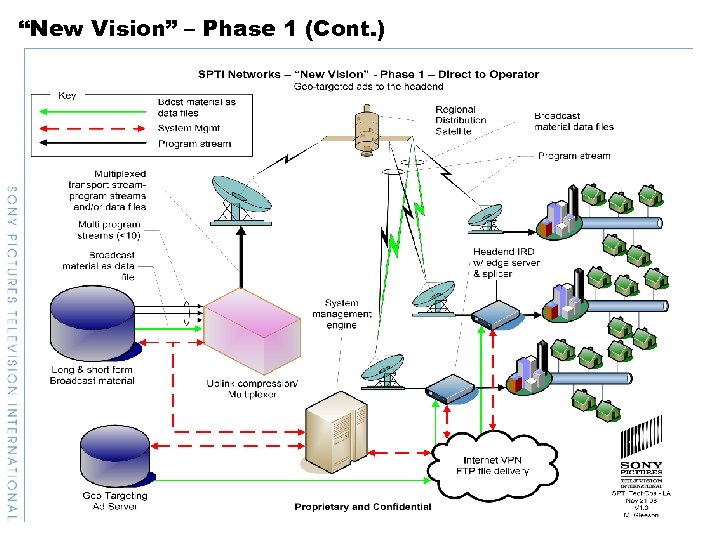
SPTI Networks - “New Vision” Distribution – Phase 1 Ø A hybrid delivery model utilizing both program streams and file-based transport of broadcasting materials to cable operators. ØPrimary broadcast material continues to reside at the main repository at the regional broadcast center. “Geo-targeted” ads would be stored at an off-site location or at the broadcast center as well. ØThe uplink would continue to provide “core” program streams to locations in the regional footprint in addition to providing delivery of “regional” material as files. ØAt the affiliate (i. e. , cable/DTH) headend a specialized IRD with HD storage and graphics capability would be under the control of a MAM engine located at the regional broadcast center.
“New Vision” – Phase 1 (Cont. ) Ø The system provides the capability of “Geo-targeted” ad sales to cable operators and the territories they serve. Ø A typical scenario would be the operator taking the primary program “stream” from satellite. Customized ads for that market along with other short- form interstitial material (promos, targeted marketing elements or even alternate long-form programming) would be “pushed” via Internet based VPN/FTP connection and/or a data stream from the existing satellite transponder and stored within the IRD/Edge server. Ø On cue, via a pre-loaded playlist or by internal synchronized clock control, the ads/long-form would be “spliced” into the feed under control of the MAM. Ø Ad and program broadcast verification would be fed back to the MAM for billing and reconciliation.
“New Vision” – Phase 1 (Cont. )
“New Vision” – Phase 1 (Cont. ) Challenges: Ø Develop and/or optimize the technical capability of data packet delivery of file-based material via the existing satellite multiplex. Ø Design and develop IRD/Edge Server in a space efficient form -factor to include required connectivity, internal transport stream splicers, internal graphics, audio mapping, subtitle support and playlist control. Ø Engineer and develop a System Management Engine” (SME) and associated protocol and software to oversee the system and interface to existing broadcast business management applications. Ø Need to replace an installed base of nearly 36, 000 legacy IRDs already deployed in the field and cutover to new system without going off air. !

Thank you! Q&A
Скачать презентацию SPTI Int l Networks Review of Current Distribution
18657edf611fbe3e5b2b20490daede70.ppt