


 Скачать презентацию Spring Semester 2005 Experimental Method and Data Process
354160daca5bbf5473a8147225d1cdae.ppt
- Количество слайдов: 25
 Spring Semester 2005 Experimental Method and Data Process Experimental Method Kihyeon Cho Kyungpook National University
 DAQ with VME, CAMAC and NIM What will you do? q What kind of data do you take? Cosmic ray’s count, Energy, momentum, charge etc. Particle’s count, identification, and characteristic. With total charge, signal shape, or time information. q How do you take data? Hardware : VME, CAMAC, NIM, GPIB, and Fast. BUS Software : Dos, Windows, NT, and Linux(Unix) with C, C++, BASIC, or FORTRAN languages.
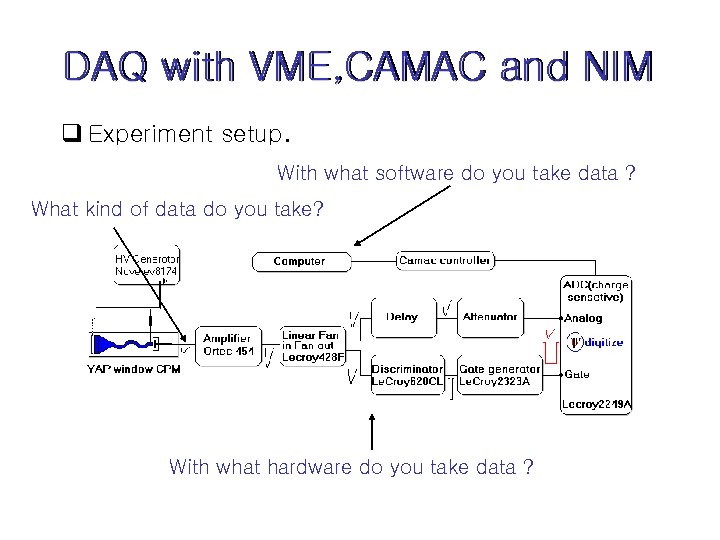 DAQ with VME, CAMAC and NIM q Experiment setup. With what software do you take data ? What kind of data do you take? With what hardware do you take data ?
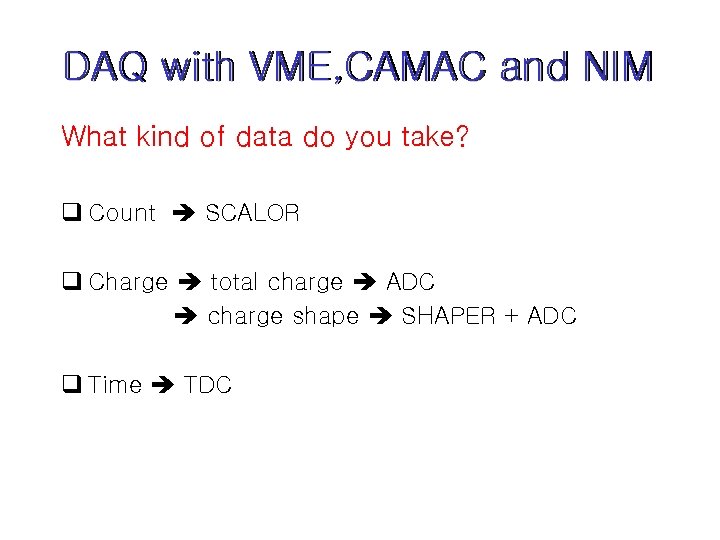 DAQ with VME, CAMAC and NIM What kind of data do you take? q Count SCALOR q Charge total charge ADC charge shape SHAPER + ADC q Time TDC
 DAQ with VME, CAMAC and NIM With what hardware do you take data? q VME Versa Module Eurocard q CAMAC Computer Automated Measurement And Control q NIM Nuclear Instrumentation Modules q GPIB General Purpose Interface Bus
 DAQ with VME, CAMAC and NIM With what software do you take data? q Operating System Driver dependent. q C, C++ Dos, Windows, and Linux(Unix) q Visual Basic, Visual C++ GUI, user friendly. q q-Basic, Fortran Linux, Windows
 DAQ with VME, CAMAC and NIM q NIM modules • Fan-in Fan-out to make several same analog signal • Amplifier to amplify analog input signal • Discriminator to change analog to digital pulse w. r. t threshold • Gate generator gate generating module • Scaler to count input signal • AND or OR unit to calculate logical signal
 DAQ with VME, CAMAC and NIM q VME or CAMAC modules(computer based modules) ADC Analog to Digital converter TDC Time to Digital converter Gate generator gate generating module Scaler to count input signal GPIB to CAMAC interface to take data from CAMAC modules • VMEMM interface to take data from VME modules. • Amplifier to amplify analog input signal • Discriminator to change analog to digital pulse w. r. t threshold • • •
 DAQ with VME, CAMAC and NIM q Programming at CHEP Ø Dos(GPIB and CAMAC) Ø Visual BASIC(GPIB and CAMAC) Ø Linux(VME controller)
 DAQ with VME, CAMAC and NIM q. Linux with VME controller Ø PCIADA and VMEMM card Ø Linux driver install Ø PCIADA and VMEMM Card check. Ø Hardware setup Ø Programming with C or C++ with ROOT library.
 An Experimental Study of Cosmic Rays Spectrum Using a Scintillator Detector by D. Kim
 Contents • • • Introduction Cosmic Rays Simulation DAQ system Data Conclusion & Discussion
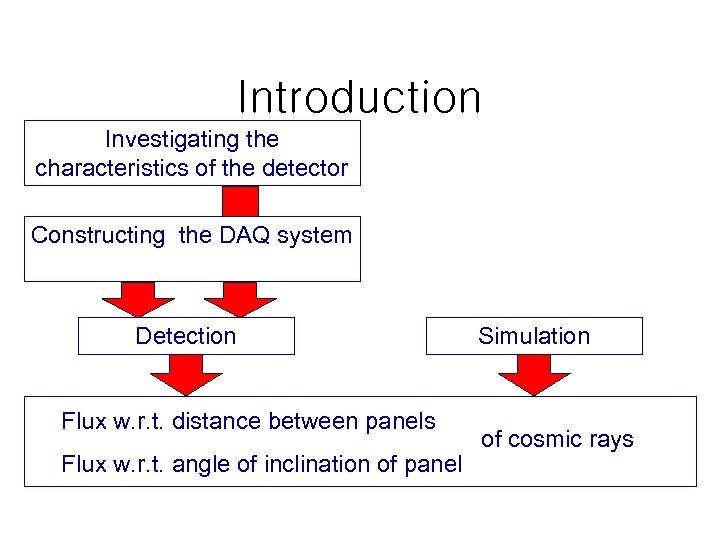 Introduction Investigating the characteristics of the detector Constructing the DAQ system Detection Flux w. r. t. distance between panels Flux w. r. t. angle of inclination of panel Simulation of cosmic rays
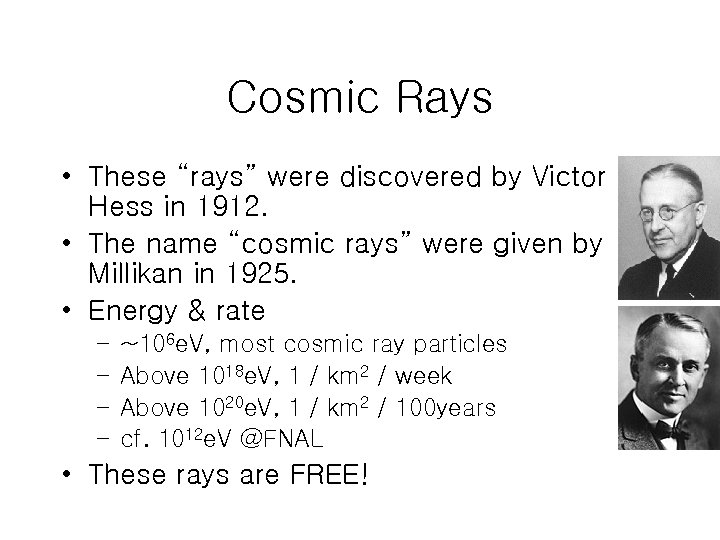 Cosmic Rays • These “rays” were discovered by Victor Hess in 1912. • The name “cosmic rays” were given by Millikan in 1925. • Energy & rate – – ~106 e. V, most cosmic ray particles Above 1018 e. V, 1 / km 2 / week Above 1020 e. V, 1 / km 2 / 100 years cf. 1012 e. V @FNAL • These rays are FREE!
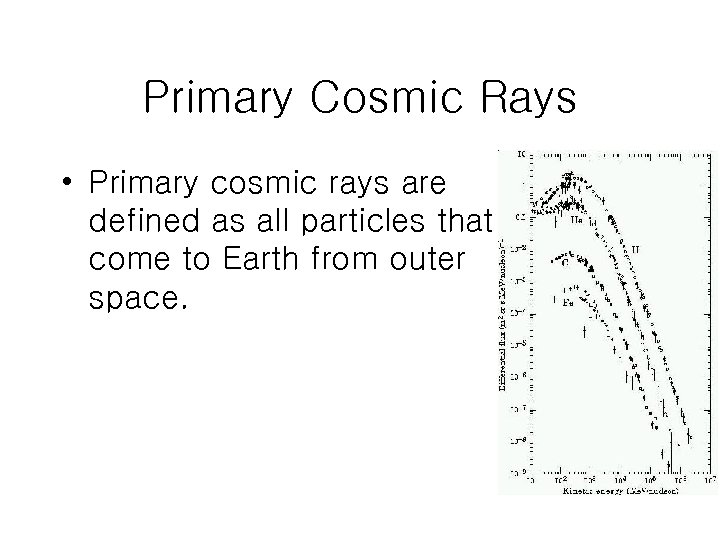 Primary Cosmic Rays • Primary cosmic rays are defined as all particles that come to Earth from outer space.
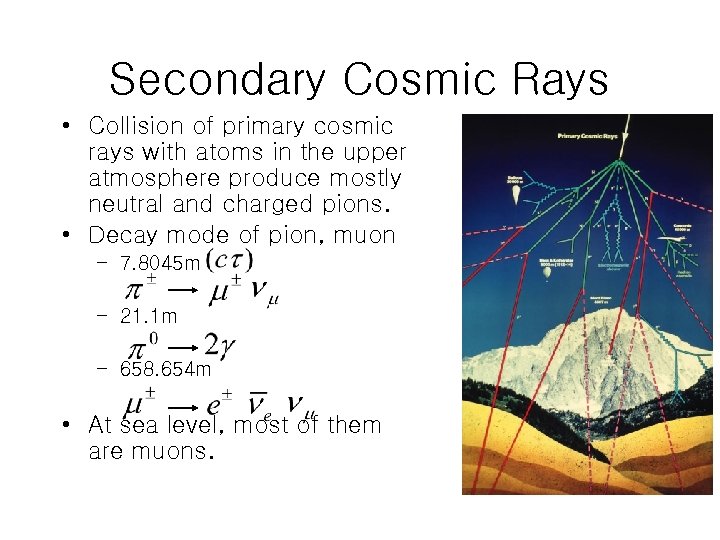 Secondary Cosmic Rays • Collision of primary cosmic rays with atoms in the upper atmosphere produce mostly neutral and charged pions. • Decay mode of pion, muon – 7. 8045 m – 21. 1 m – 658. 654 m • At sea level, most of them are muons.
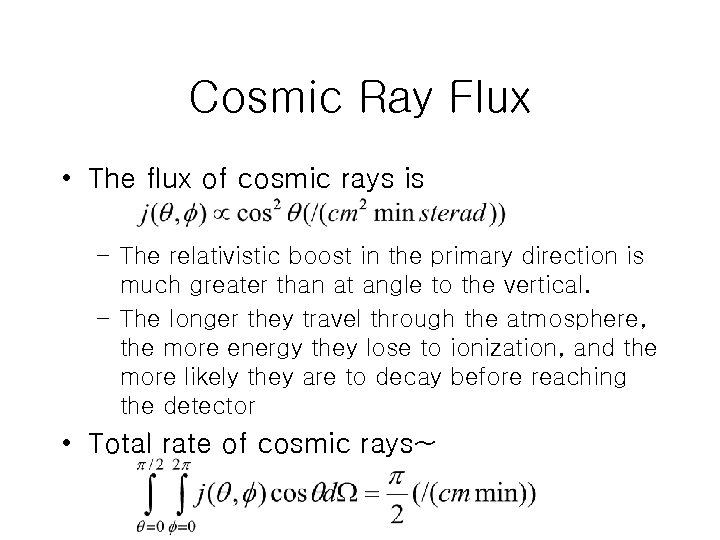 Cosmic Ray Flux • The flux of cosmic rays is – The relativistic boost in the primary direction is much greater than at angle to the vertical. – The longer they travel through the atmosphere, the more energy they lose to ionization, and the more likely they are to decay before reaching the detector • Total rate of cosmic rays~
![Simulation R: an uniform random number on [0, 1] z n: number of event](https://present5.com/presentation/354160daca5bbf5473a8147225d1cdae/image-18.jpg "Simulation R: an uniform random number on [0, 1] z n: number of event") Simulation R: an uniform random number on [0, 1] z n: number of event hit: number of passing through both panels Cosmic rays rate through both panels l (angle, distance) ~ J x hit /n x Simulation Program O w y
Simulation R: an uniform random number on [0, 1] z n: number of event hit: number of passing through both panels Cosmic rays rate through both panels l (angle, distance) ~ J x hit /n x Simulation Program O w y
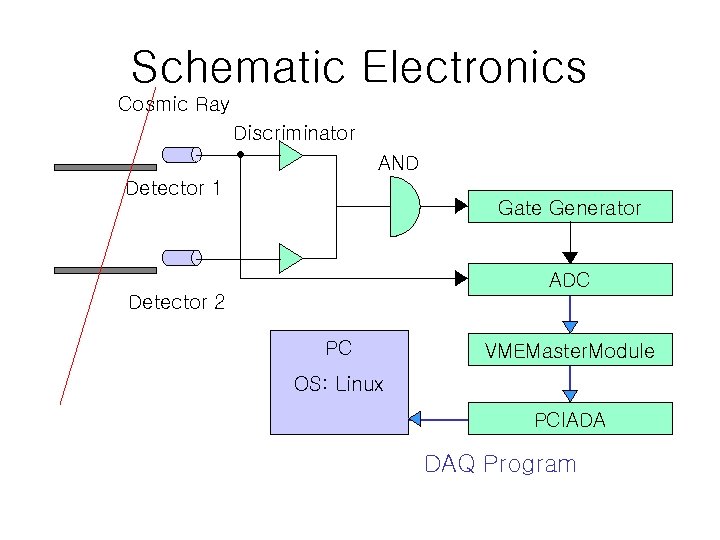 Schematic Electronics Cosmic Ray Discriminator AND Detector 1 Gate Generator ADC Detector 2 PC VMEMaster. Module OS: Linux PCIADA DAQ Program
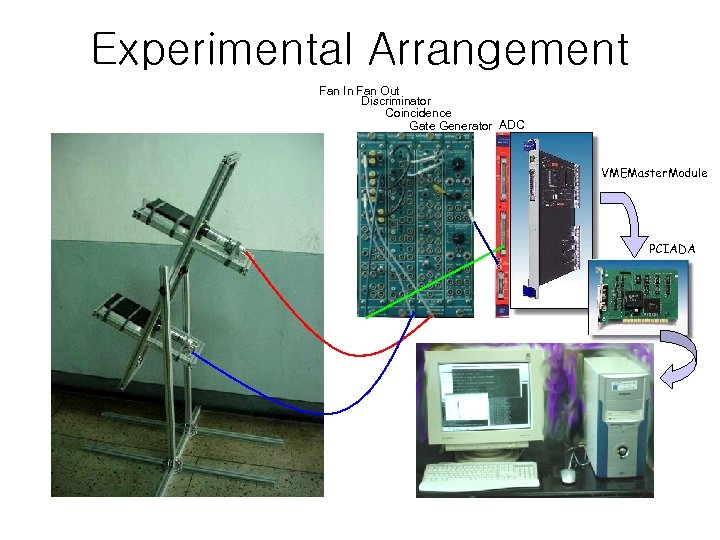 Experimental Arrangement Fan In Fan Out Discriminator Coincidence Gate Generator ADC VMEMaster. Module PCIADA
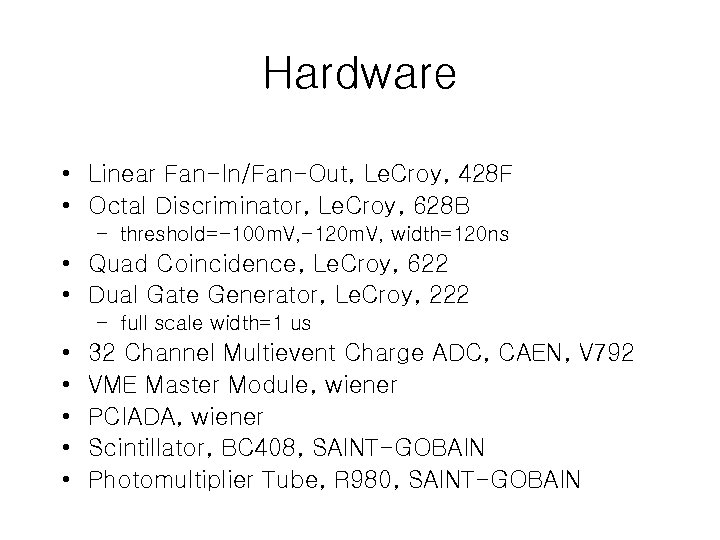 Hardware • Linear Fan-In/Fan-Out, Le. Croy, 428 F • Octal Discriminator, Le. Croy, 628 B – threshold=-100 m. V, -120 m. V, width=120 ns • Quad Coincidence, Le. Croy, 622 • Dual Gate Generator, Le. Croy, 222 – full scale width=1 us • • • 32 Channel Multievent Charge ADC, CAEN, V 792 VME Master Module, wiener PCIADA, wiener Scintillator, BC 408, SAINT-GOBAIN Photomultiplier Tube, R 980, SAINT-GOBAIN
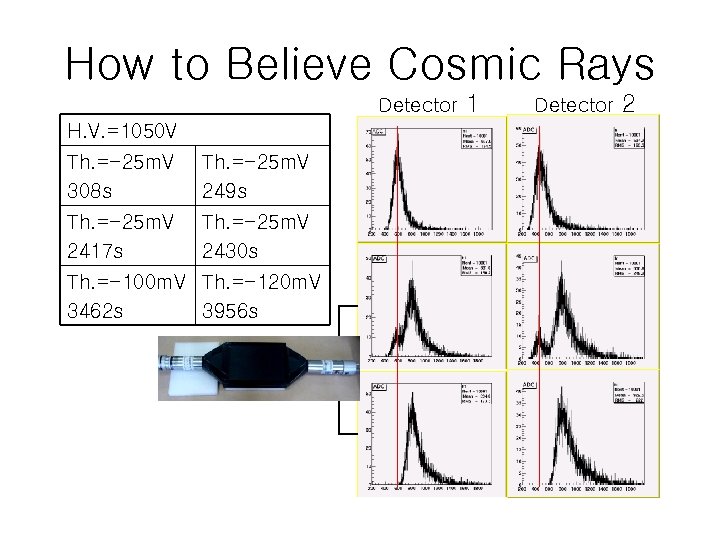 How to Believe Cosmic Rays Detector H. V. =1050 V Th. =-25 m. V 308 s Th. =-25 m. V 249 s Th. =-25 m. V 2417 s Th. =-25 m. V 2430 s Th. =-100 m. V Th. =-120 m. V 3462 s 3956 s 1 Detector 2
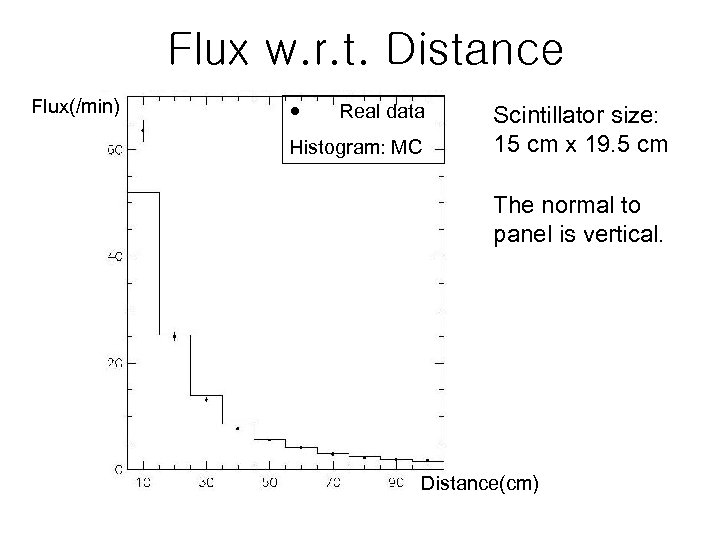 Flux w. r. t. Distance Flux(/min) Real data Histogram: MC Scintillator size: 15 cm x 19. 5 cm The normal to panel is vertical. Distance(cm)
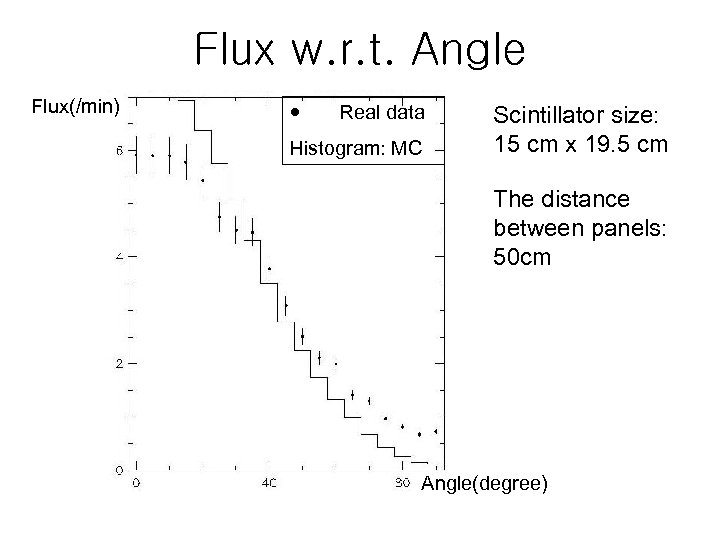 Flux w. r. t. Angle Flux(/min) Real data Histogram: MC Scintillator size: 15 cm x 19. 5 cm The distance between panels: 50 cm Angle(degree)
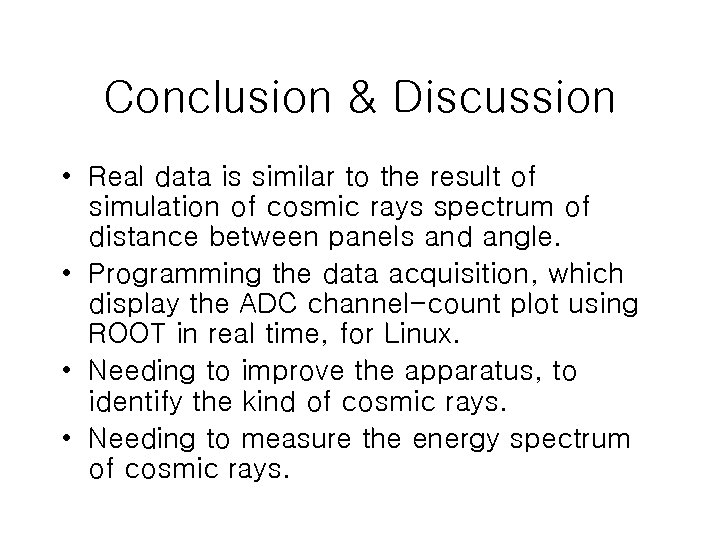 Conclusion & Discussion • Real data is similar to the result of simulation of cosmic rays spectrum of distance between panels and angle. • Programming the data acquisition, which display the ADC channel-count plot using ROOT in real time, for Linux. • Needing to improve the apparatus, to identify the kind of cosmic rays. • Needing to measure the energy spectrum of cosmic rays.