


 Скачать презентацию Spring 2014 Accounting 101 Introduction to Stocks
7e8f1275723353fd7c5d319dd6f4a8eb.ppt
- Количество слайдов: 18
 Spring 2014 Accounting 101 ` Introduction to Stocks Basics of Investing I K. Robinson
 What is a stock? § Common stock § Gives you a “share” of ownership of a publicly traded company § Stock ownership – Voting rights – Claim to assets (behind debt holders) and earnings – Potentially entitled to dividends
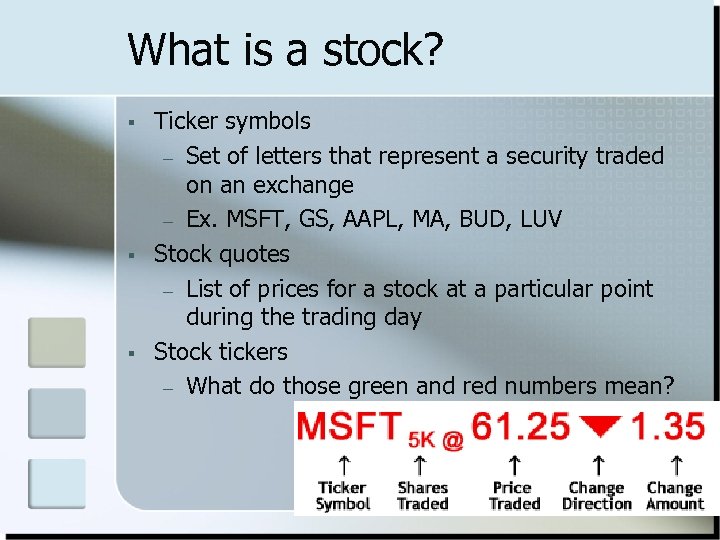 What is a stock? § § § Ticker symbols – Set of letters that represent a security traded on an exchange – Ex. MSFT, GS, AAPL, MA, BUD, LUV Stock quotes – List of prices for a stock at a particular point during the trading day Stock tickers – What do those green and red numbers mean?
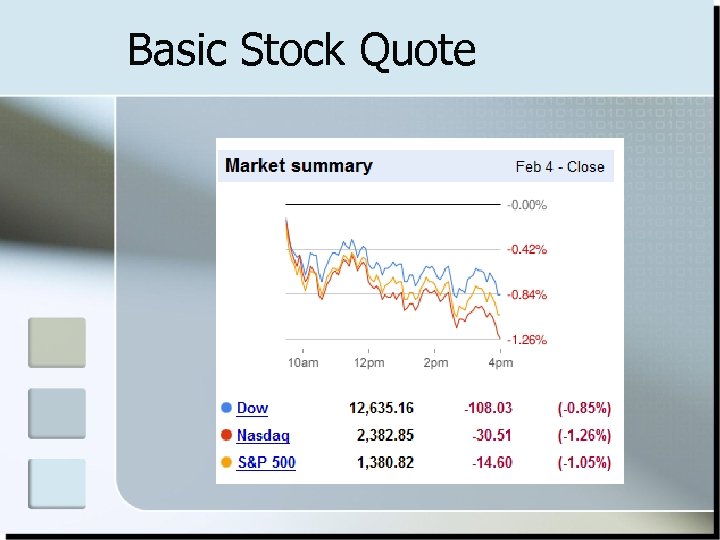 Basic Stock Quote
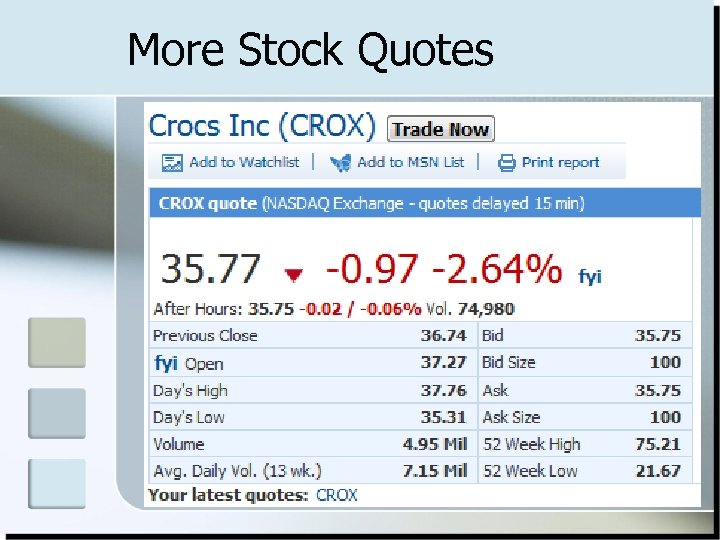 More Stock Quotes
 Different Types of Stock § Preferred Stock – – § Common Stock – – § No voting rights to company issues Issued fixed dividends forever – main form of return Majority of stock we see and hear about in the news Ownership of the company Entitled to portion of the earnings Earn returns mainly through capital gains What are capital gains? – – – Increase in asset value relative to the purchases price Not realized until asset is actually sold Example.
 Stocks vs. Bonds § Stocks are equity – – – § Generally considered riskier Quite possible to lose a significant portion, if not all, of your money Potential for high returns Bonds are debt – – Lower and usually fixed return Higher claim than stockholders § What does this mean?
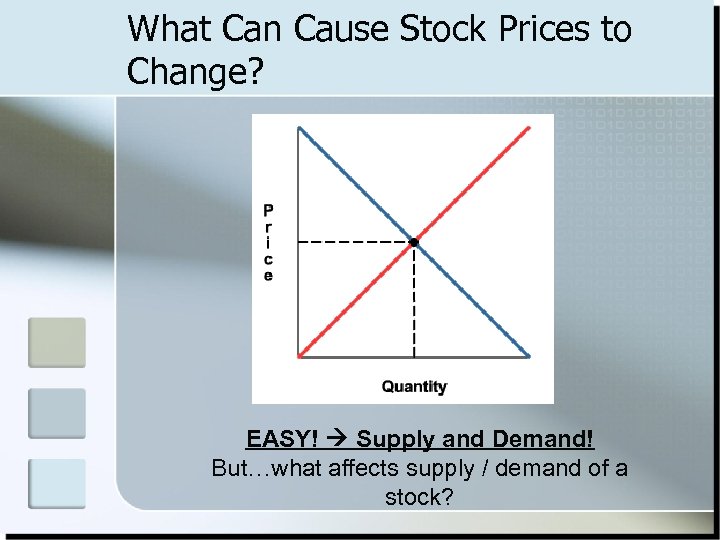 What Can Cause Stock Prices to Change? EASY! Supply and Demand! But…what affects supply / demand of a stock?
 What Can Cause Stock Prices to Change? § Earnings & growth expectations § Positive / negative news § Economy sentiment § Investor sentiments & attitudes
 Two Markets § Primary Market – market in which investors have first opportunity to buy newly issued shares – § Initial Public Offering (IPO) § First time that company offers its shares to public markets (securities bought directly from company) § Where private companies become public Secondary Market – investors trade alreadyissued shares of companies with each other – – Ie. The stock market Trading of a company’s stock DOES NOT DIRECTLY involve the company financially
 How Stocks Are Traded § Major exchanges – Lists stocks (and other securities), sets policies for how stocks are traded § § New York Stock Exchange (NYSE) American Stock Exchange (AMEX) National Association of Securities Dealers Automated Quotation Only “publicly traded companies” are listed
 Markets Indices § S&P 500 – § § 500 stocks chosen by Standard & Poor to represent US stock market NASDAQ Composite--With approximately 3, 700 companies and corporations, it has more trading volume than any other stock exchange in the world, many of which are technology and electronics Dow Jones Industrial Average – 30 most significant stocks traded
 Stocks Markets & Animals § Bull Market – § Bear Market – § When everything in the market is going great and stocks are generally heading upwards When everything is NOT GOOD and stocks are generally headed downward NOTE: Nothing lasts forever! Good times and bad times will end at some point http: //www. investopedia. com/university/stocks 7. asp
 Brokerages § § Need a medium to trade through – this is where brokerages come in Criteria – – Full service vs. discount Fees (commission) Services / tools Minimum balance
 Opening an Account § Not a hard process- most of it just some paperwork and mail – – – § Sign-up online and download forms Mail checks, forms, and copy of ID Accounts created within a couple of days What you will need: a computer, starting capital, and investing know-how
 Brokerages § Some links for brokerage comparisons – – Find something that works for what YOU need No one broker that is best for all investors § http: //www. investingonline. org/gso/broker_ratings. html § http: //www. consumersearch. com/www/internet/onlinebrokers/ § http: //www. stockbrokerguide. com/ § http: //online-stock-trading-review. toptenreviews. com/
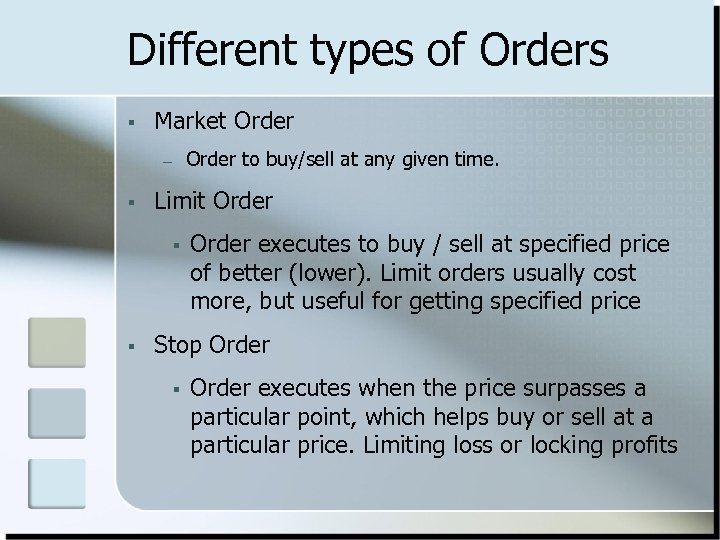 Different types of Orders § Market Order to buy/sell at any given time. – § Limit Order § § Order executes to buy / sell at specified price of better (lower). Limit orders usually cost more, but useful for getting specified price Stop Order § Order executes when the price surpasses a particular point, which helps buy or sell at a particular price. Limiting loss or locking profits
 Basic Idea Behind Investing in Stocks § § Buy your stocks when the prices are low. Sell your stocks when the prices are high.