 Скачать презентацию Spring 2012 Java Script John Mitchell Adapted by
246a243725fdbd03a4c9d398a94ea379.ppt
- Количество слайдов: 43



Spring 2012 Java. Script John Mitchell Adapted by Mooly Sagiv Reading: links on last slide Homework 1: 18/3 – 17/4
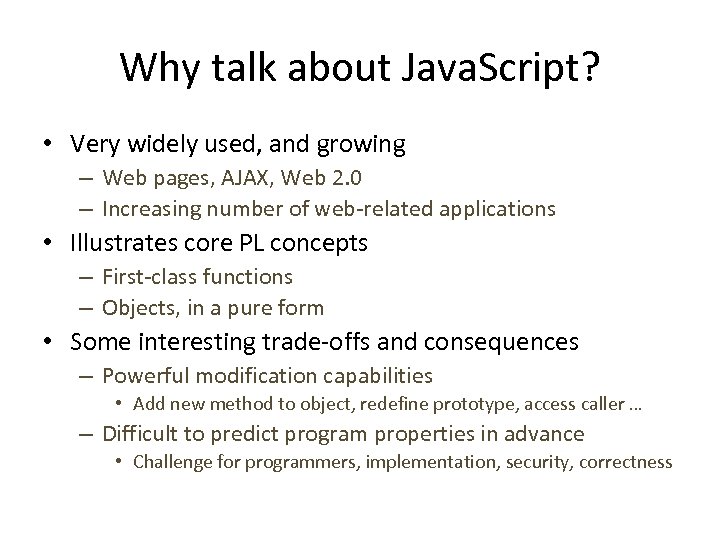
Why talk about Java. Script? • Very widely used, and growing – Web pages, AJAX, Web 2. 0 – Increasing number of web-related applications • Illustrates core PL concepts – First-class functions – Objects, in a pure form • Some interesting trade-offs and consequences – Powerful modification capabilities • Add new method to object, redefine prototype, access caller … – Difficult to predict program properties in advance • Challenge for programmers, implementation, security, correctness
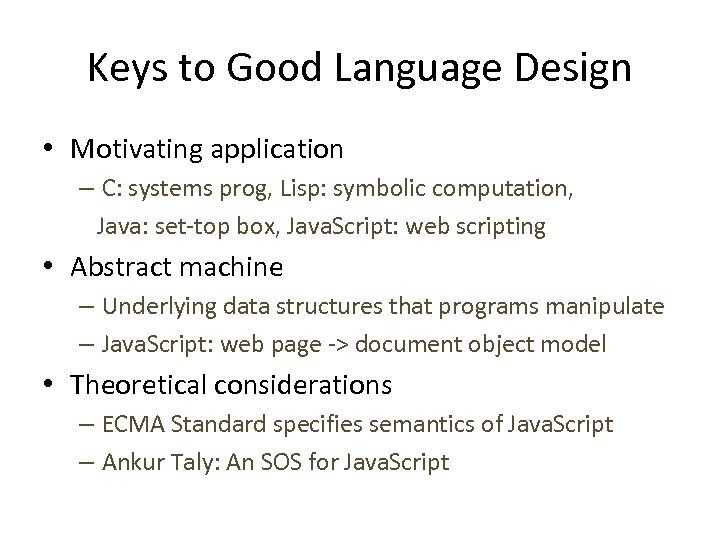
Keys to Good Language Design • Motivating application – C: systems prog, Lisp: symbolic computation, Java: set-top box, Java. Script: web scripting • Abstract machine – Underlying data structures that programs manipulate – Java. Script: web page -> document object model • Theoretical considerations – ECMA Standard specifies semantics of Java. Script – Ankur Taly: An SOS for Java. Script
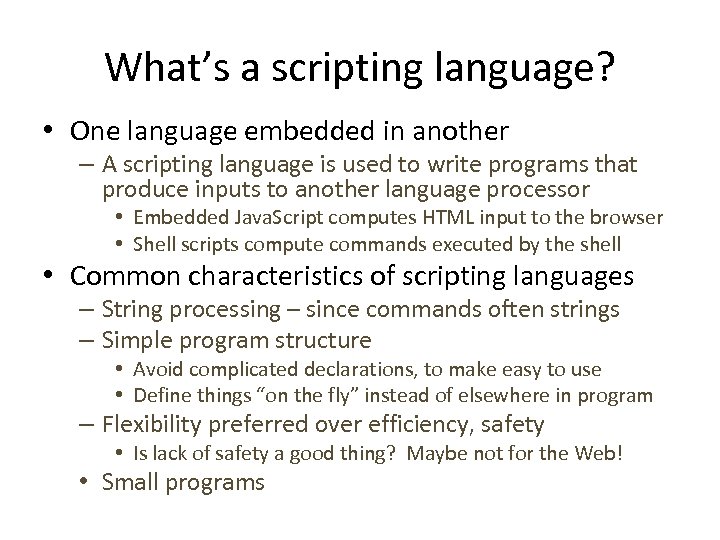
What’s a scripting language? • One language embedded in another – A scripting language is used to write programs that produce inputs to another language processor • Embedded Java. Script computes HTML input to the browser • Shell scripts compute commands executed by the shell • Common characteristics of scripting languages – String processing – since commands often strings – Simple program structure • Avoid complicated declarations, to make easy to use • Define things “on the fly” instead of elsewhere in program – Flexibility preferred over efficiency, safety • Is lack of safety a good thing? Maybe not for the Web! • Small programs
Java. Script History • Developed by Brendan Eich at Netscape, 1995 – Scripting language for Navigator 2 • Later standardized for browser compatibility – ECMAScript Edition 3 (aka Java. Script 1. 5) -> ES 5, … • Related to Java in name only – Name was part of a marketing deal • Various implementations available – Spidermonkey interactive shell interface – Rhino: http: //www. mozilla. org/rhino/ – Browser Java. Script consoles
Motivation for Java. Script • Netscape, 1995 – Netscape > 90% browser market share – Opportunity to do “HTML scripting language” – Brendan Eich I hacked the JS prototype in ~1 week in May And it showed! Mistakes were frozen early Rest of year spent embedding in browser - ICFP talk, 2005 • Common uses of Java. Script have included: – – Form validation Page embellishments and special effects Dynamic content manipulation Web 2. 0: functionality implemented on web client • Significant Java. Script applications: Gmail client, Google maps
Design goals • Brendan Eich’s 2005 ICFP talk – Make it easy to copy/paste snippets of code – Tolerate “minor” errors (missing semicolons) – Simplified onclick, onmousedown, etc. , event handling, inspired by Hyper. Card – Pick a few hard-working, powerful primitives • First class functions for procedural abstraction • Objects everywhere, prototype-based – Leave all else out!
Java. Script design • Functions based on Lisp/Scheme – first-class inline higher-order functions function (x) { return x+1; } • Objects based on Smalltalk/Self – var pt = {x : 10, move : function(dx){this. x += dx}} • Lots of secondary issues … – “In Java. Script, there is a beautiful, elegant, highly expressive language that is buried under a steaming pile of good intentions and blunders. ” Douglas Crockford
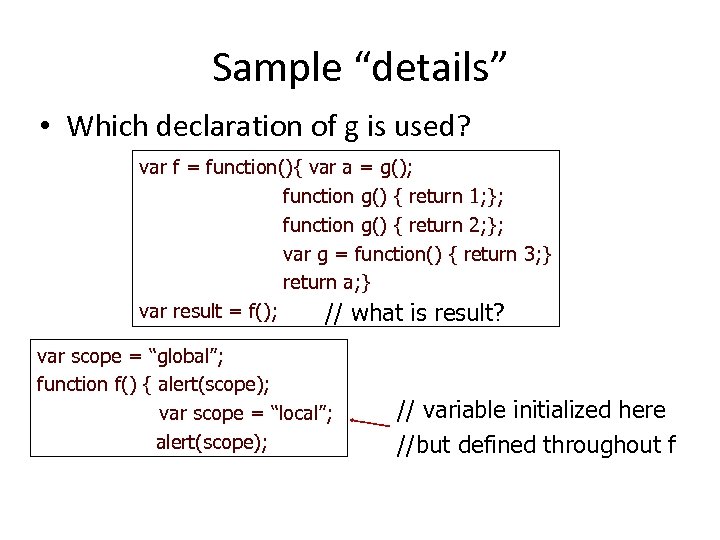
Sample “details” • Which declaration of g is used? var f = function(){ var a = g(); function g() { return 1; }; function g() { return 2; }; var g = function() { return 3; } return a; } var result = f(); // what is result? var scope = “global”; function f() { alert(scope); var scope = “local”; alert(scope); // variable initialized here //but defined throughout f
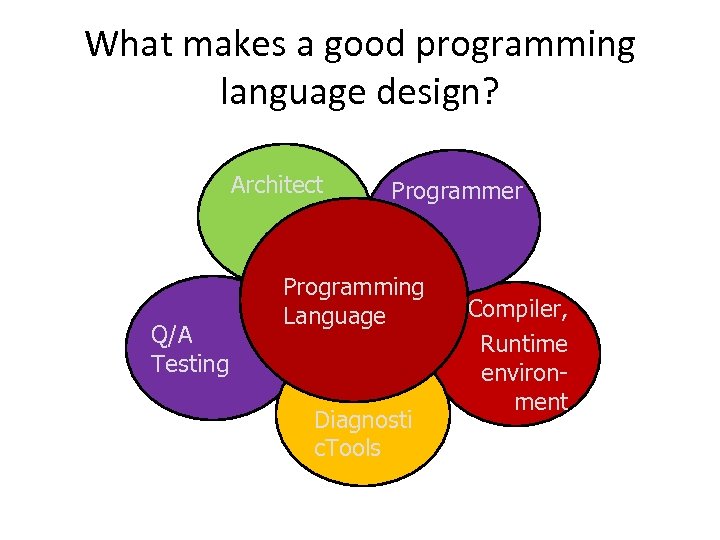
What makes a good programming language design? Architect Q/A Testing Programmer Programming Language Diagnosti c. Tools Compiler, Runtime environment
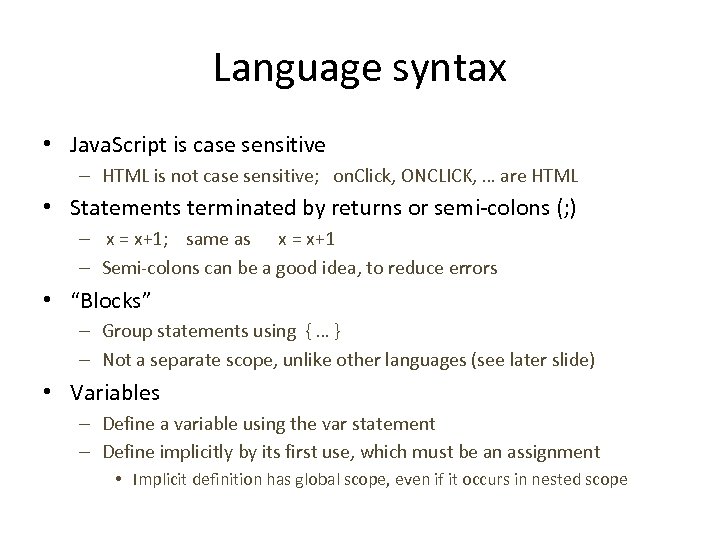
Language syntax • Java. Script is case sensitive – HTML is not case sensitive; on. Click, ONCLICK, … are HTML • Statements terminated by returns or semi-colons (; ) – x = x+1; same as x = x+1 – Semi-colons can be a good idea, to reduce errors • “Blocks” – Group statements using { … } – Not a separate scope, unlike other languages (see later slide) • Variables – Define a variable using the var statement – Define implicitly by its first use, which must be an assignment • Implicit definition has global scope, even if it occurs in nested scope
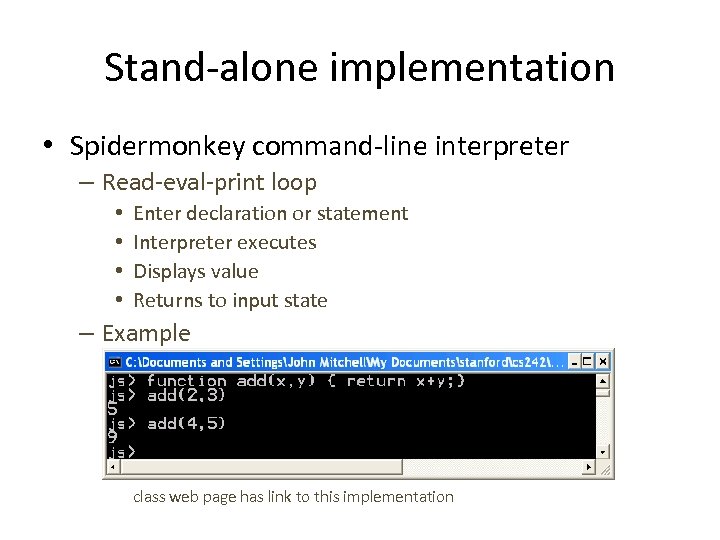
Stand-alone implementation • Spidermonkey command-line interpreter – Read-eval-print loop • • Enter declaration or statement Interpreter executes Displays value Returns to input state – Example class web page has link to this implementation
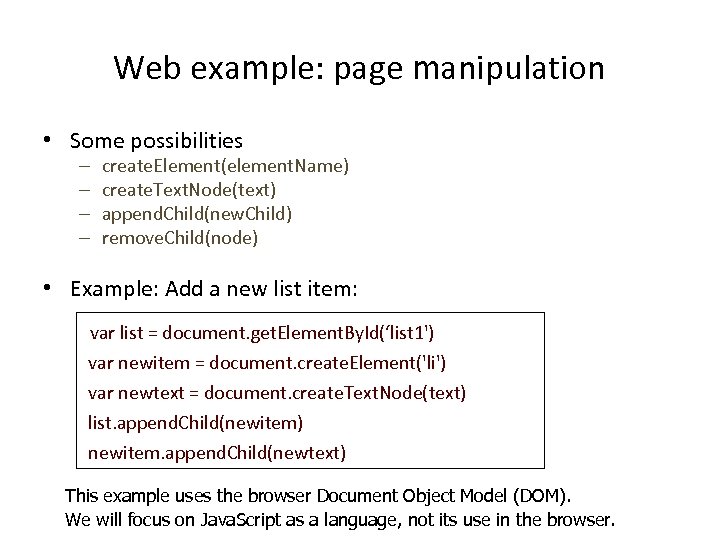
Web example: page manipulation • Some possibilities – – create. Element(element. Name) create. Text. Node(text) append. Child(new. Child) remove. Child(node) • Example: Add a new list item: var list = document. get. Element. By. Id(‘list 1') var newitem = document. create. Element('li') var newtext = document. create. Text. Node(text) list. append. Child(newitem) newitem. append. Child(newtext) This example uses the browser Document Object Model (DOM). We will focus on Java. Script as a language, not its use in the browser.
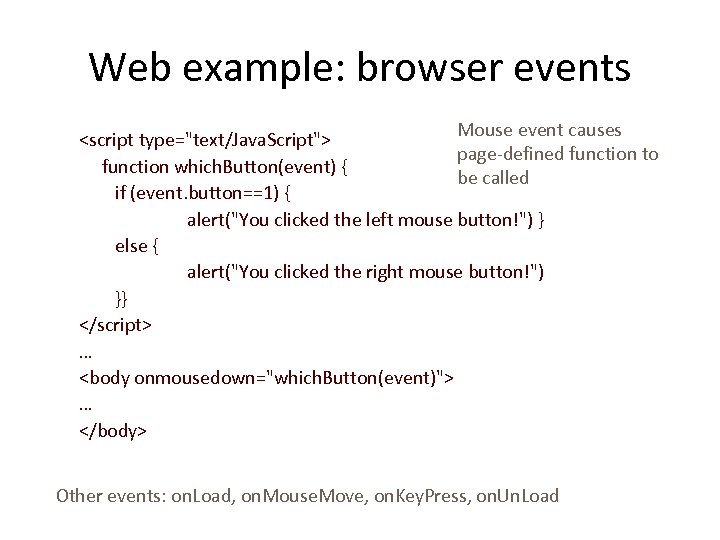
Web example: browser events Mouse event causes <script type="text/Java. Script"> page-defined function to function which. Button(event) { be called if (event. button==1) { alert("You clicked the left mouse button!") } else { alert("You clicked the right mouse button!") }} </script> … <body onmousedown="which. Button(event)"> … </body> Other events: on. Load, on. Mouse. Move, on. Key. Press, on. Un. Load
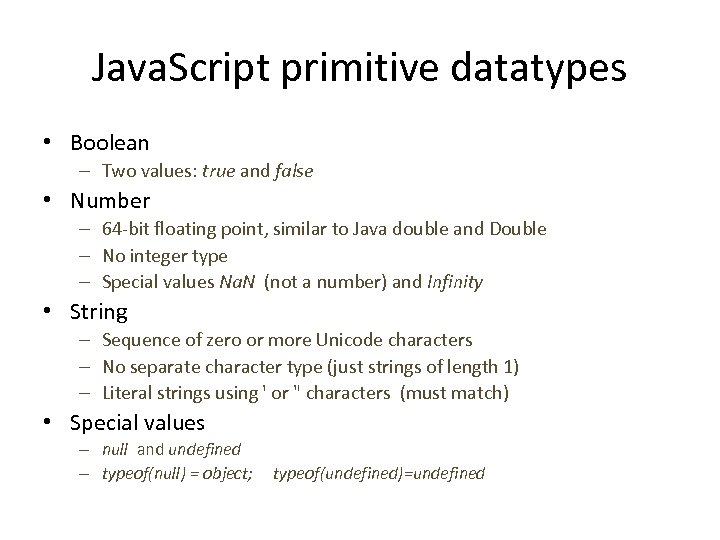
Java. Script primitive datatypes • Boolean – Two values: true and false • Number – 64 -bit floating point, similar to Java double and Double – No integer type – Special values Na. N (not a number) and Infinity • String – Sequence of zero or more Unicode characters – No separate character type (just strings of length 1) – Literal strings using ' or " characters (must match) • Special values – null and undefined – typeof(null) = object; typeof(undefined)=undefined
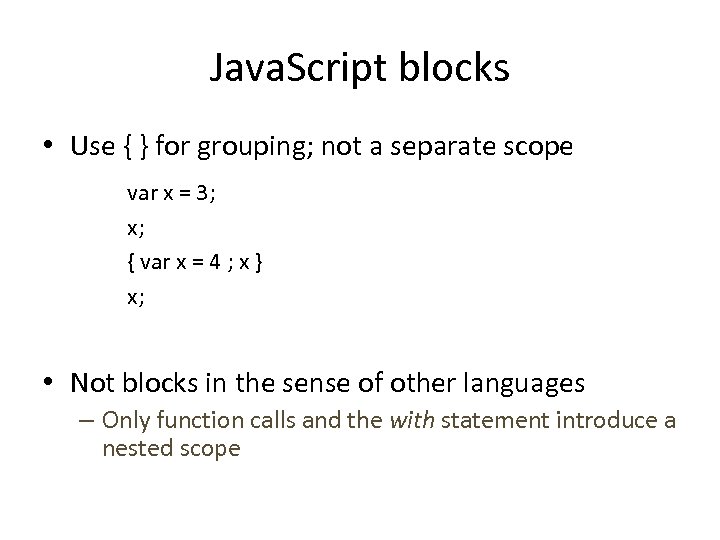
Java. Script blocks • Use { } for grouping; not a separate scope var x = 3; x; { var x = 4 ; x } x; • Not blocks in the sense of other languages – Only function calls and the with statement introduce a nested scope
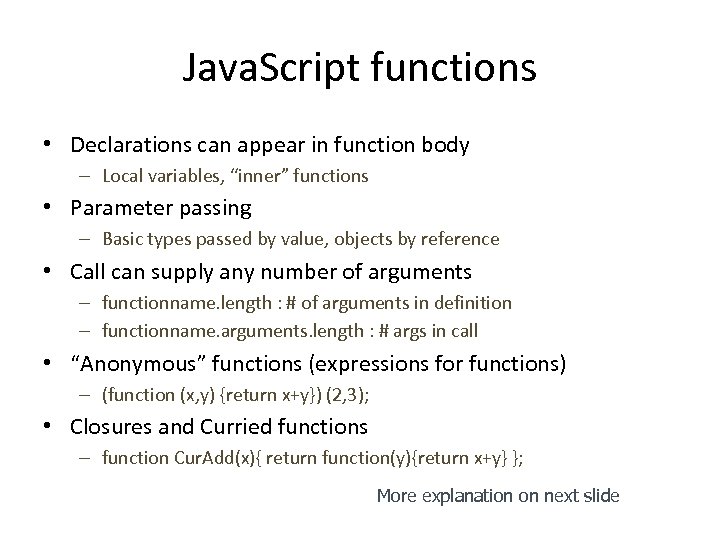
Java. Script functions • Declarations can appear in function body – Local variables, “inner” functions • Parameter passing – Basic types passed by value, objects by reference • Call can supply any number of arguments – functionname. length : # of arguments in definition – functionname. arguments. length : # args in call • “Anonymous” functions (expressions for functions) – (function (x, y) {return x+y}) (2, 3); • Closures and Curried functions – function Cur. Add(x){ return function(y){return x+y} }; More explanation on next slide
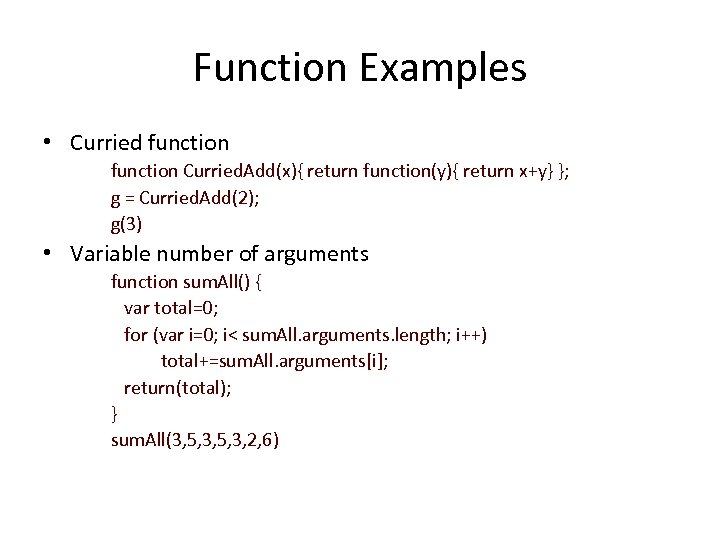
Function Examples • Curried function Curried. Add(x){ return function(y){ return x+y} }; g = Curried. Add(2); g(3) • Variable number of arguments function sum. All() { var total=0; for (var i=0; i< sum. All. arguments. length; i++) total+=sum. All. arguments[i]; return(total); } sum. All(3, 5, 3, 2, 6)
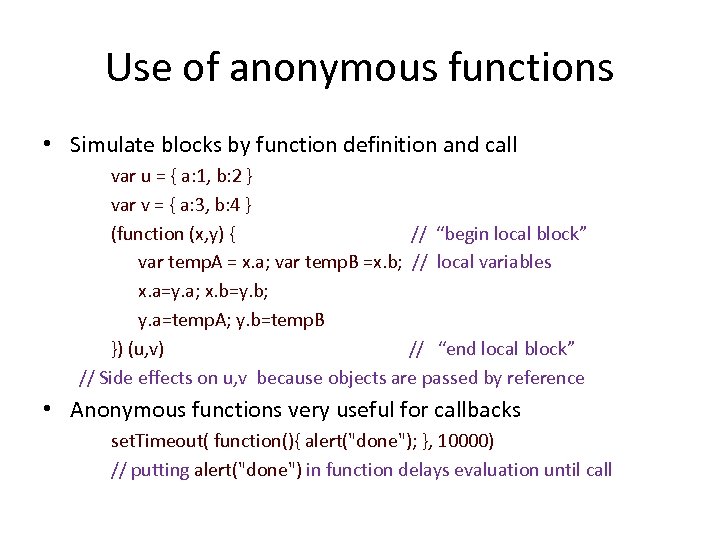
Use of anonymous functions • Simulate blocks by function definition and call var u = { a: 1, b: 2 } var v = { a: 3, b: 4 } (function (x, y) { // “begin local block” var temp. A = x. a; var temp. B =x. b; // local variables x. a=y. a; x. b=y. b; y. a=temp. A; y. b=temp. B }) (u, v) // “end local block” // Side effects on u, v because objects are passed by reference • Anonymous functions very useful for callbacks set. Timeout( function(){ alert("done"); }, 10000) // putting alert("done") in function delays evaluation until call
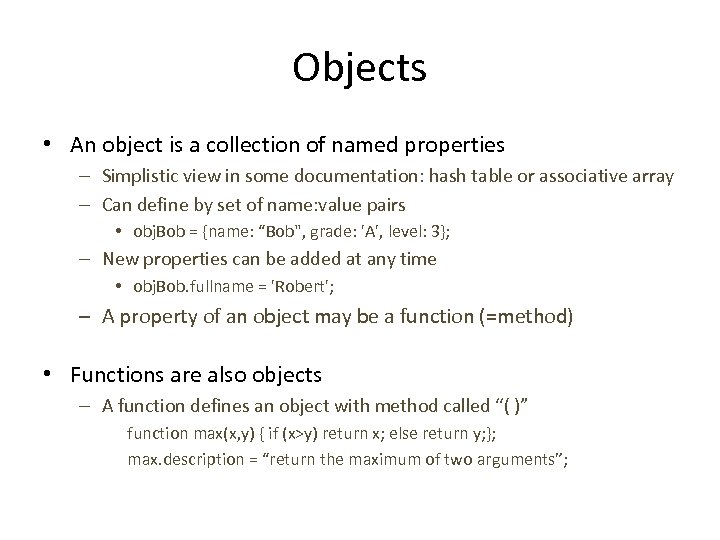
Objects • An object is a collection of named properties – Simplistic view in some documentation: hash table or associative array – Can define by set of name: value pairs • obj. Bob = {name: “Bob", grade: 'A', level: 3}; – New properties can be added at any time • obj. Bob. fullname = 'Robert'; – A property of an object may be a function (=method) • Functions are also objects – A function defines an object with method called “( )” function max(x, y) { if (x>y) return x; else return y; }; max. description = “return the maximum of two arguments”;
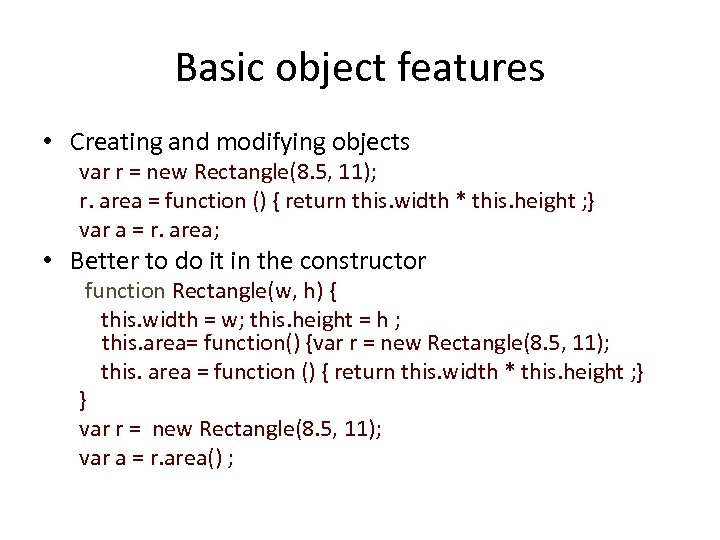
Basic object features • Creating and modifying objects var r = new Rectangle(8. 5, 11); r. area = function () { return this. width * this. height ; } var a = r. area; • Better to do it in the constructor function Rectangle(w, h) { this. width = w; this. height = h ; this. area= function() {var r = new Rectangle(8. 5, 11); this. area = function () { return this. width * this. height ; } } var r = new Rectangle(8. 5, 11); var a = r. area() ;
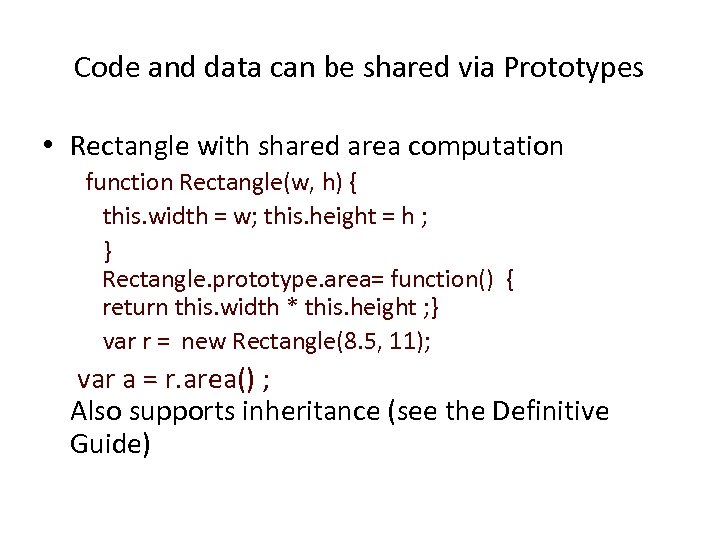
Code and data can be shared via Prototypes • Rectangle with shared area computation function Rectangle(w, h) { this. width = w; this. height = h ; } Rectangle. prototype. area= function() { return this. width * this. height ; } var r = new Rectangle(8. 5, 11); var a = r. area() ; Also supports inheritance (see the Definitive Guide)
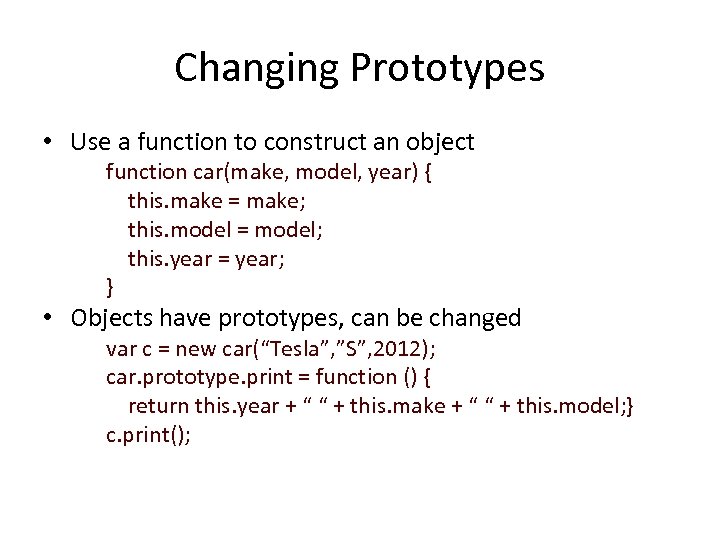
Changing Prototypes • Use a function to construct an object function car(make, model, year) { this. make = make; this. model = model; this. year = year; } • Objects have prototypes, can be changed var c = new car(“Tesla”, ”S”, 2012); car. prototype. print = function () { return this. year + “ “ + this. make + “ “ + this. model; } c. print();
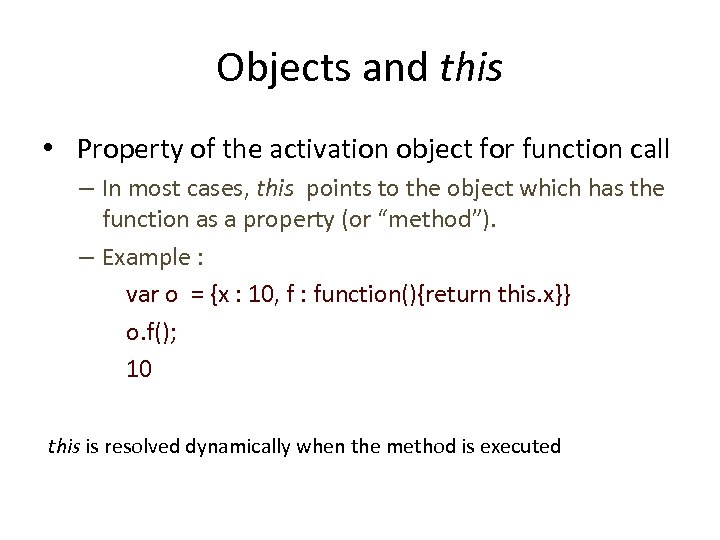
Objects and this • Property of the activation object for function call – In most cases, this points to the object which has the function as a property (or “method”). – Example : var o = {x : 10, f : function(){return this. x}} o. f(); 10 this is resolved dynamically when the method is executed
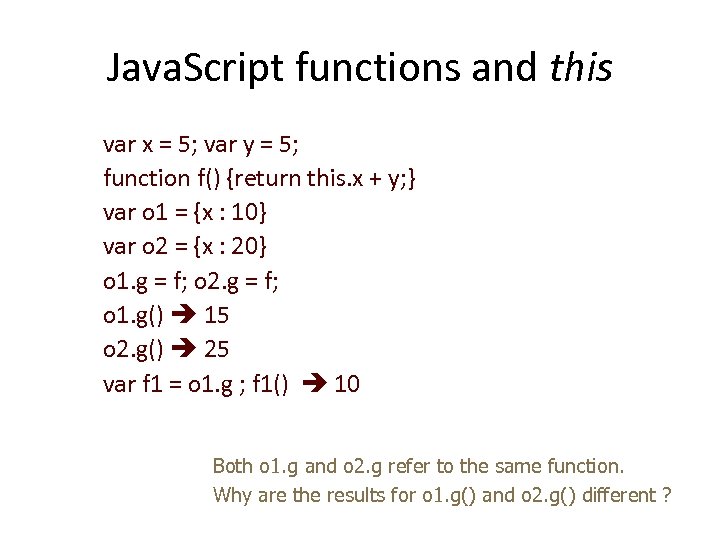
Java. Script functions and this var x = 5; var y = 5; function f() {return this. x + y; } var o 1 = {x : 10} var o 2 = {x : 20} o 1. g = f; o 2. g = f; o 1. g() 15 o 2. g() 25 var f 1 = o 1. g ; f 1() 10 Both o 1. g and o 2. g refer to the same function. Why are the results for o 1. g() and o 2. g() different ?
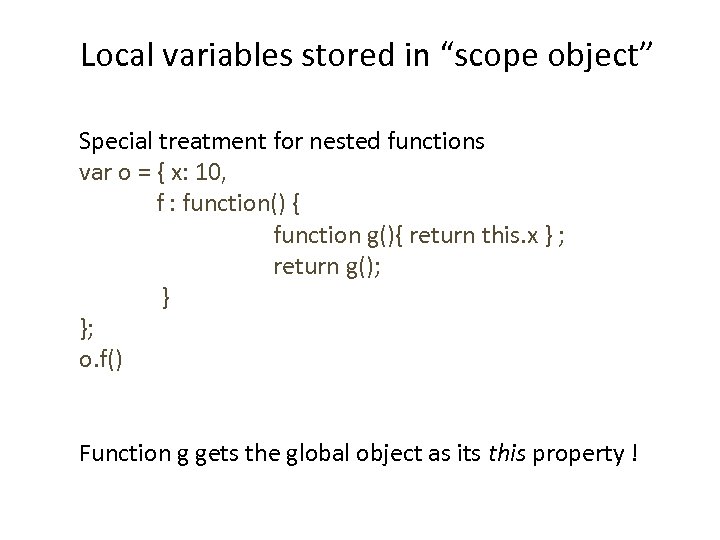
Local variables stored in “scope object” Special treatment for nested functions var o = { x: 10, f : function() { function g(){ return this. x } ; return g(); } }; o. f() Function g gets the global object as its this property !
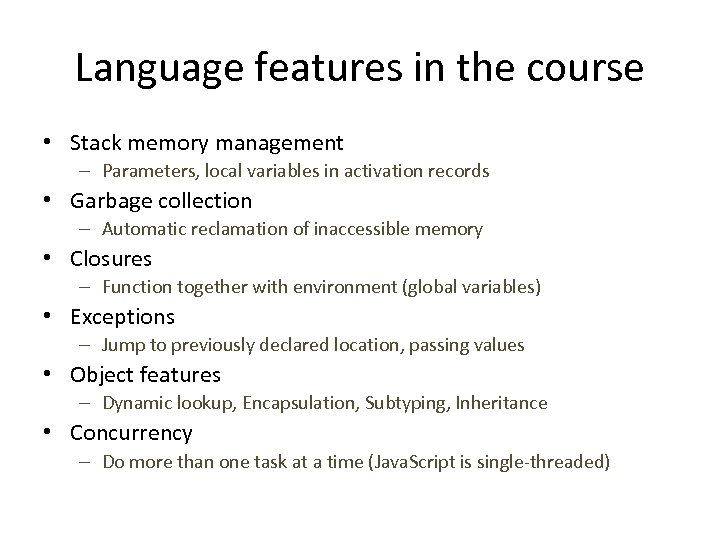
Language features in the course • Stack memory management – Parameters, local variables in activation records • Garbage collection – Automatic reclamation of inaccessible memory • Closures – Function together with environment (global variables) • Exceptions – Jump to previously declared location, passing values • Object features – Dynamic lookup, Encapsulation, Subtyping, Inheritance • Concurrency – Do more than one task at a time (Java. Script is single-threaded)
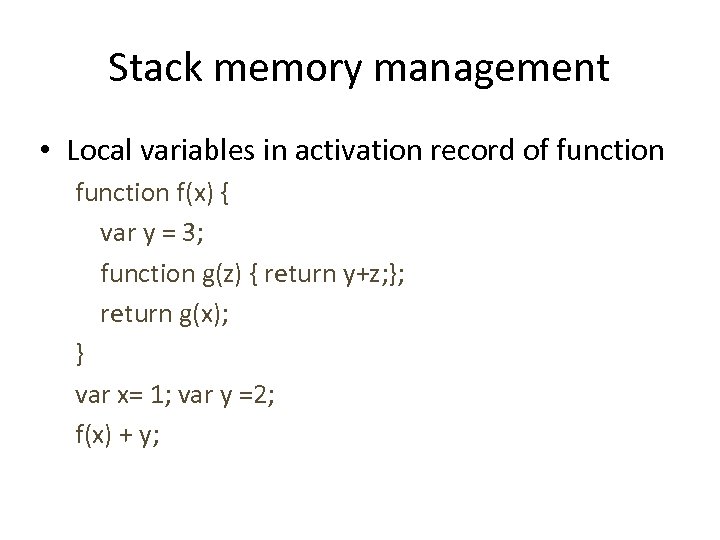
Stack memory management • Local variables in activation record of function f(x) { var y = 3; function g(z) { return y+z; }; return g(x); } var x= 1; var y =2; f(x) + y;
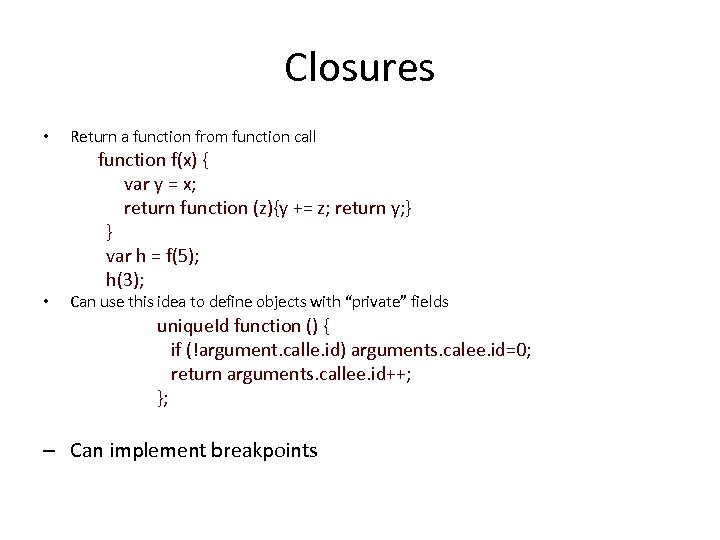
Closures • • Return a function from function call function f(x) { var y = x; return function (z){y += z; return y; } } var h = f(5); h(3); Can use this idea to define objects with “private” fields unique. Id function () { if (!argument. calle. id) arguments. calee. id=0; return arguments. callee. id++; }; – Can implement breakpoints
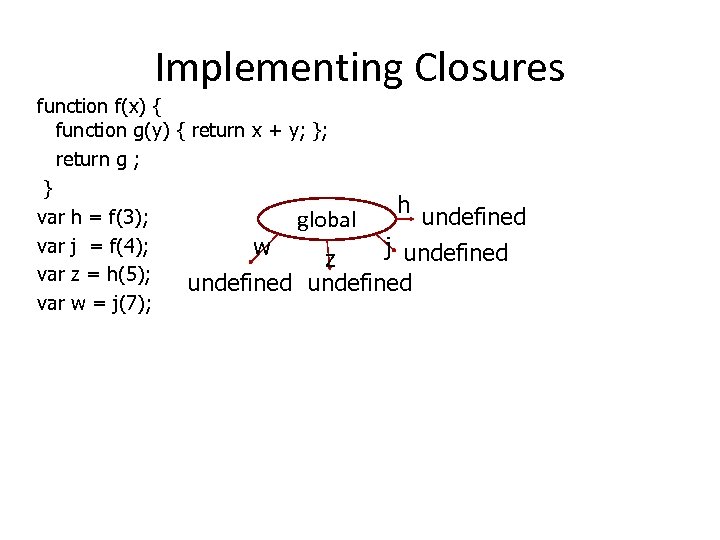
Implementing Closures function f(x) { function g(y) { return x + y; }; return g ; } h undefined var h = f(3); global var j = f(4); j undefined w z var z = h(5); undefined var w = j(7);
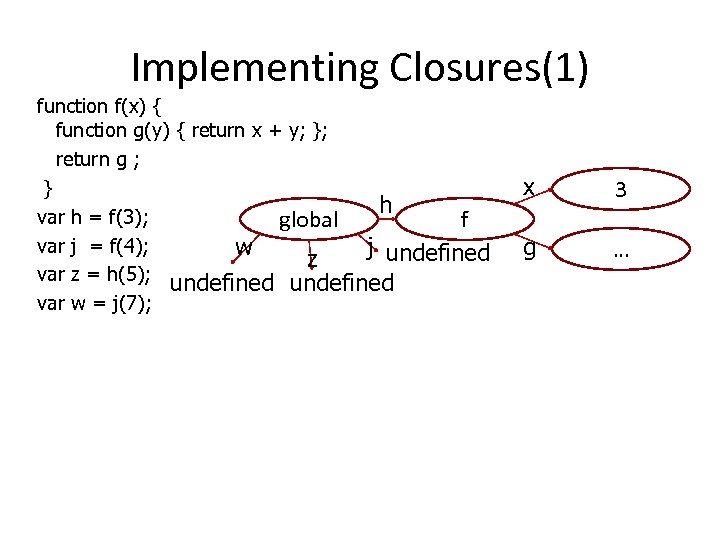
Implementing Closures(1) function f(x) { function g(y) { return x + y; }; return g ; } h var h = f(3); global f var j = f(4); j undefined w z var z = h(5); undefined var w = j(7); x 3 g …
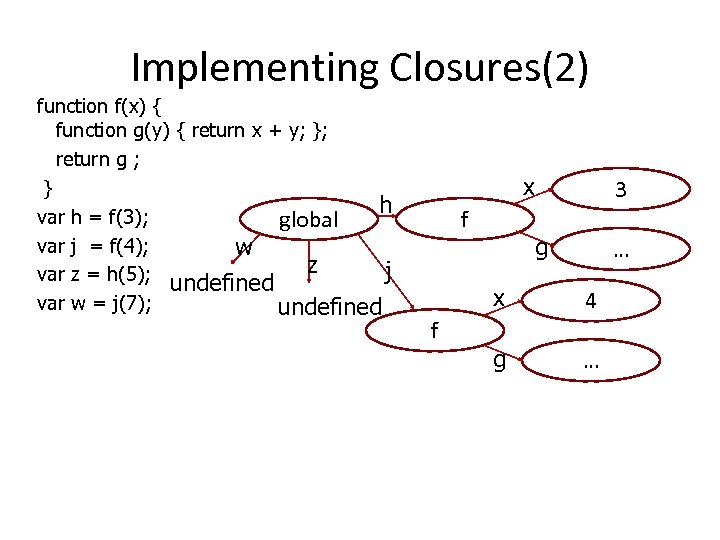
Implementing Closures(2) function f(x) { function g(y) { return x + y; }; return g ; } h var h = f(3); global var j = f(4); w z j var z = h(5); undefined var w = j(7); undefined x f 3 g … x f 4 g …
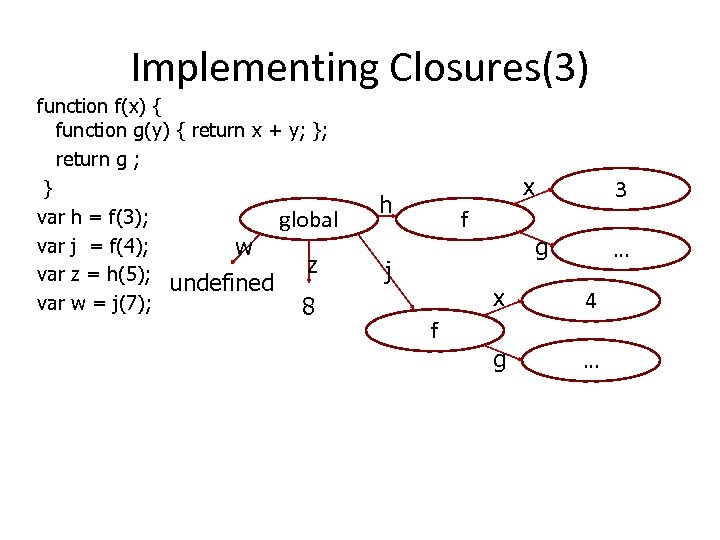
Implementing Closures(3) function f(x) { function g(y) { return x + y; }; return g ; } var h = f(3); global var j = f(4); w z var z = h(5); undefined var w = j(7); 8 x h f j 3 g … x f 4 g …
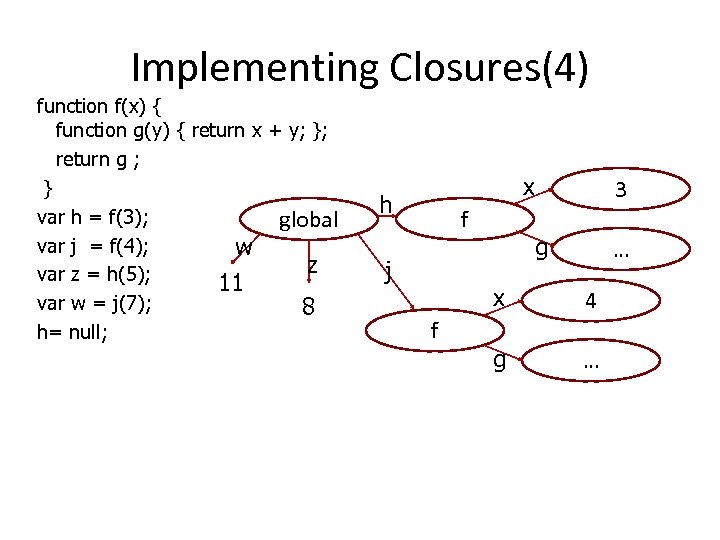
Implementing Closures(4) function f(x) { function g(y) { return x + y; }; return g ; } var h = f(3); global var j = f(4); w z var z = h(5); 11 var w = j(7); 8 h= null; x h f j 3 g … x f 4 g …
Garbage collection • Automatic reclamation of unused memory – Navigator 2: per page memory management • Reclaim memory when browser changes page – Navigator 3: reference counting • Each memory region has associated count • Count modified when pointers are changed • Reclaim memory when count reaches zero – Navigator 4: mark-and-sweep, or equivalent • Garbage collector marks reachable memory • Sweep and reclaim unreachable memory Reference http: //www. unix. org. ua/orelly/web/jscript/ch 11_07. html Discuss garbage collection in connection with memory management
Exceptions • Throw an expression of any type throw "Error 2"; throw 42; throw {to. String: function() { return "I'm an object!"; } }; • Catch try { … } catch (e if e == “First. Exception") { // do something } catch (e if e == “Second. Exception") { // do something else } catch (e){ // executed if no match above } Reference: http: //developer. mozilla. org/en/docs/ Core_Java. Script_1. 5_Guide : Exception_Handling_Statements
Object features • Dynamic lookup – Method depends on run-time value of object • Encapsulation – Object contains private data, public operations • Subtyping – Object of one type can be used in place of another • Inheritance – Use implementation of one kind of object to implement another kind of object
Concurrency • Java. Script itself is single-threaded – How can we tell if a language provides concurrency? • AJAX provides a form of concurrency – Create XMLHttp. Request object, set callback function – Call request method, which continues asynchronously – Reply from remote site executes callback function • Event waits in event queue… – Closures important for proper execution of callbacks • Another form of concurrency – use Set. Timeout to do cooperative multi-tasking • Maybe we will explore this in homework …
Unusual features of Java. Script • Some built-in functions – Eval (next slide), Run-time type checking functions, … • Regular expressions – Useful support of pattern matching • Add, delete methods of an object dynamically – Seen examples adding methods. Do you like this? Disadvantages? – myobj. a = 5; myobj. b = 12; delete myobj. a; • Redefine native functions and objects (incl undefined) • Iterate over methods of an object – for (variable in object) { statements } • With statement (“considered harmful” – why? ? ) – with (object) { statements }
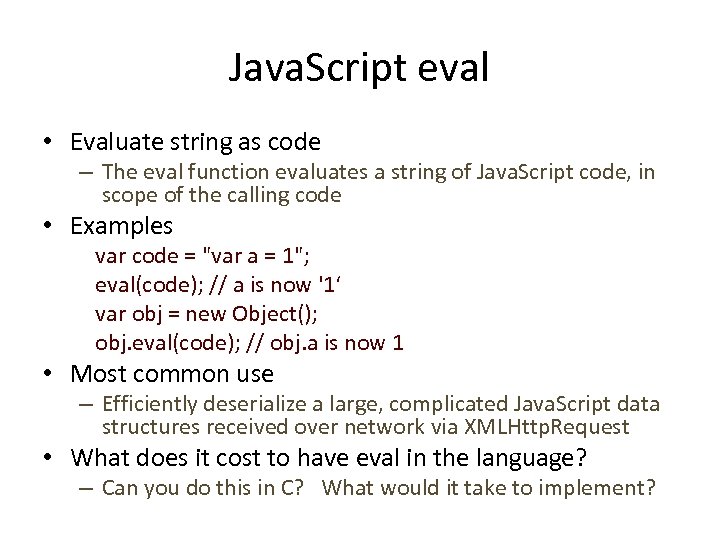
Java. Script eval • Evaluate string as code – The eval function evaluates a string of Java. Script code, in scope of the calling code • Examples var code = "var a = 1"; eval(code); // a is now '1‘ var obj = new Object(); obj. eval(code); // obj. a is now 1 • Most common use – Efficiently deserialize a large, complicated Java. Script data structures received over network via XMLHttp. Request • What does it cost to have eval in the language? – Can you do this in C? What would it take to implement?
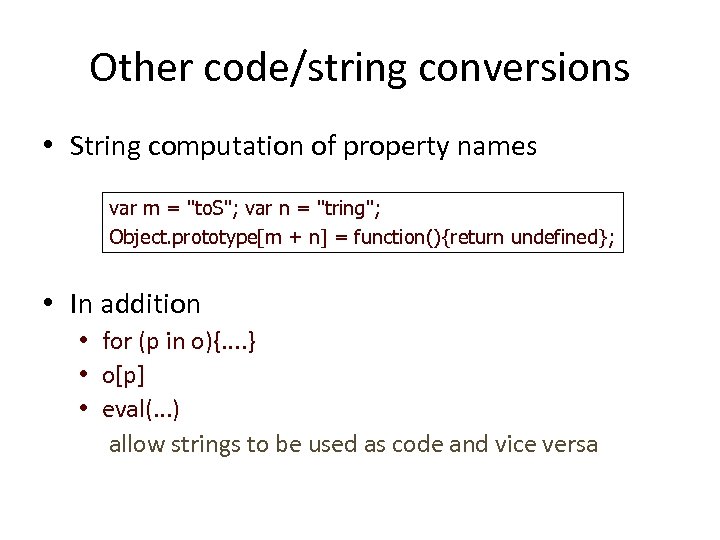
Other code/string conversions • String computation of property names var m = "to. S"; var n = "tring"; Object. prototype[m + n] = function(){return undefined}; • In addition • for (p in o){. . } • o[p] • eval(. . . ) allow strings to be used as code and vice versa
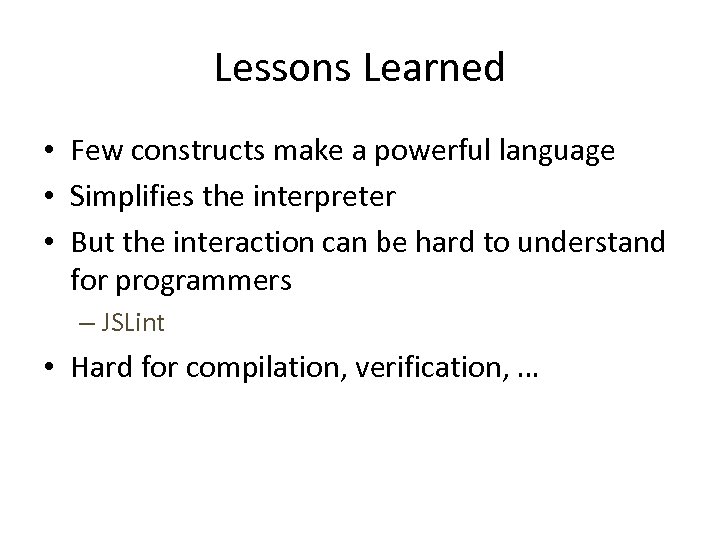
Lessons Learned • Few constructs make a powerful language • Simplifies the interpreter • But the interaction can be hard to understand for programmers – JSLint • Hard for compilation, verification, …
References • Brendan Eich, slides from ICFP conference talk • Tutorial – http: //www. w 3 schools. com/js/ • Java. Script 1. 5 Guide – http: //developer. mozilla. org/en/docs/Core_Java. Script_1. 5_Guide • Douglas Crockford – http: //www. crockford. com/Java. Script/ – Java. Script: The Good Parts, O’Reilly, 2008. (book) – David Flanagan – Java. Script: The Definitive Guide O’Reilly 2006 (book) – Ankur Taly – An Operational Semantics for Java. Script
Скачать презентацию Spring 2012 Java Script John Mitchell Adapted by
246a243725fdbd03a4c9d398a94ea379.ppt