


 Скачать презентацию Spotlights on Innovation and Entrepreneurship Support in Europe
837168010a11f6bdc17927060b44e9a7.ppt
- Количество слайдов: 44
 Spotlights on Innovation and Entrepreneurship Support in Europe by Heinz Fiedler President, SPICE Group
 Spotlights on Business Incubation and Innovation Content SPICE Group - A Short Introduction Business Incubation - Definition & Overview Innovation and Entrepreneurship Examples Summary and Conclusion
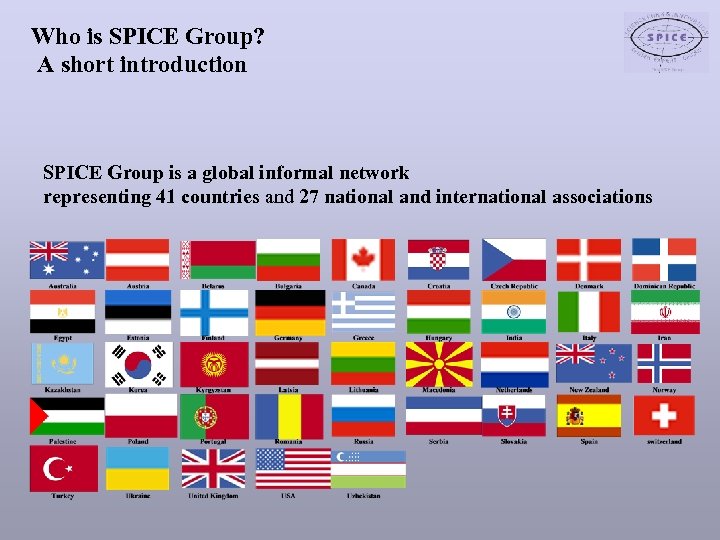 Who is SPICE Group? A short introduction SPICE Group is a global informal network representing 41 countries and 27 national and international associations
 Who is SPICE Group? A short introduction SPICE Group is a global network of experts in business incubation, innovation centers, technology parks, regional economic development, technology transfer and entrepreneurship Members of the SPICE Group come from different professional and organizational backgrounds and therefore combine information, experience and skills from many different areas SPICE Group is a joint initiative of professionals from technology and science parks, business incubators and innovation centers as well as industry, banks and governmental institutions to secure the best possible flow of information SPICE Group brings together the private and the public sector for supporting innovation in economic and social development SPICE Group is based on personal involvement and mutual trust free of political and institutional influence in an open, creative atmosphere SPICE Group is aimed at increasing knowledge and cooperation in business incubation, international business promotion, economic policies and development, entrepreneursh as well as technology transfer
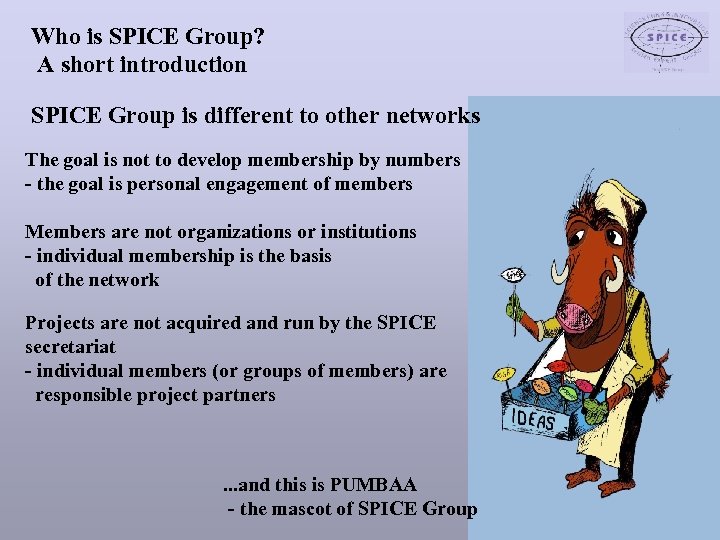 Who is SPICE Group? A short introduction SPICE Group is different to other networks The goal is not to develop membership by numbers - the goal is personal engagement of members Members are not organizations or institutions - individual membership is the basis of the network Projects are not acquired and run by the SPICE secretariat - individual members (or groups of members) are responsible project partners . . . and this is PUMBAA - the mascot of SPICE Group
 Good to know “International Summit of Associations” The “International Summit of Business Incubation Associations” is an informal network of national, regional and international business incubation associations. This network began to develop from dinners hosted by NBIA at their annual conferences. The third Summit, held in San Jose, CA at the NBIA conference 2001 was the first resulting in a resolution. The 10 th Summit in New Delhi, India in October 2004 agreed to develop this initiative toward a Global Network of Business Incubation Associations. The 12 th Summit will be held in Sheffield, United Kingdom, in November 2005. www. spice-group. net/summit
 What is a business incubator ? There is a globally accepted definition. Adopted by the International Summits of Business Incubation Associations www. spice-group. net/summit
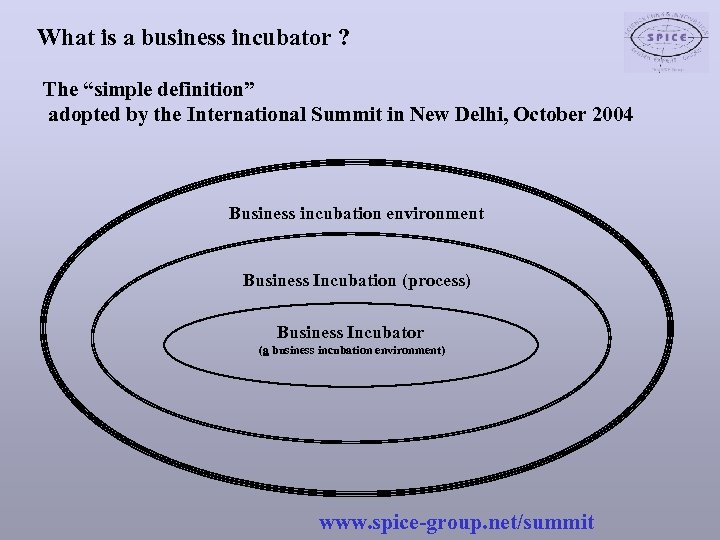 What is a business incubator ? The “simple definition” adopted by the International Summit in New Delhi, October 2004 Business incubation environment Business Incubation (process) Business Incubator (a business incubation environment) www. spice-group. net/summit
 What is a business incubator ? The “simple definition” adopted by the International Summit in New Delhi, October 2004 The (wider) Business Incubation Environment is the wider context which should be conducive to the sustainable nurturing of growth potential and the development of enterprises. Business incubation (process) is a public and/or private, entrepreneurial, economic and social development process designed to nurture business ideas and start-up companies and, through a comprehensive business support program, help them establish and accelerate their growth and success. The Business Incubator is a physical space or facility that accommodates a business incubation process. www. spice-group. net/summit
 Business Incubation - the actual situation Business Incubation Programs O are recognized as efficient tools for promoting entrepreneurship and regional economic development in Europe and the United States of America, Australia, New Zealand, Latin America and Asia O are following same principles - but are different by focusing more - on innovation, technology, and knowledge based businesses in Europe and New Zealand - on general entrepreneurship promotion in Developing Countries O are following same principles - but are different reflecting the economic and political environment with - defined models of business incubation supported by national governments (New Zealand or in Europe e. g. in France or Finland) - a wide variety of approaches (no support of the national governments) (in USA or in Europe e. g. Germany of United Kingdom)
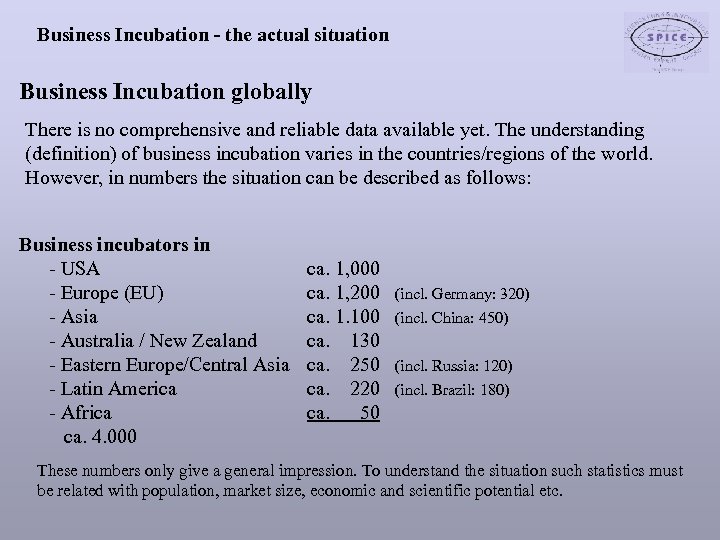 Business Incubation - the actual situation Business Incubation globally There is no comprehensive and reliable data available yet. The understanding (definition) of business incubation varies in the countries/regions of the world. However, in numbers the situation can be described as follows: Business incubators in - USA - Europe (EU) - Asia - Australia / New Zealand - Eastern Europe/Central Asia - Latin America - Africa ca. 4. 000 ca. 1, 200 ca. 1. 100 ca. 130 ca. 250 ca. 220 ca. 50 (incl. Germany: 320) (incl. China: 450) (incl. Russia: 120) (incl. Brazil: 180) These numbers only give a general impression. To understand the situation such statistics must be related with population, market size, economic and scientific potential etc.
 Business Incubation - the basis Business Incubation had different starting points O Business interest - making use of existing (abandoned) facilities (example: first business incubator in the USA) O Economic development through innovation - taking advantage of existing R & D results (example: first business incubators in Germany were based on universities) O Entrepreneurship promotion - increasing the entrepreneurial potential and survival rate (example: business incubators in Central and Eastern Europe) O Supporting specific target groups and needs - specialized business incubation programs, e. g. arts & kitchen incubators (USA), regional revitalization (various regions in Europe)
 Business Incubation - the basis Business Incubation means Innovation O Basis for new businesses: new products and services - referring to local needs and potential - international perspective if technology based O Basis for new products & services: - market demand - research & development O New businesses - transfer inventions to innovations - change use of technology and thereby work patterns and behavior - generate new qualification needs - create wealth and jobs New businesses innovate - they change the economic and social environment
 Innovation & Entrepreneurship Backbones of economic and social development
 Innovation & Entrepreneurship & Innovation Backbones of economic and social development
 Innovation & Entrepreneurship Main components of the “Concept Business Incubation” o Entrepreneurship the potential is determined by many factors, e. g. - attitudes, habits, - laws & regulations, - local / regional potential in economy and science o Innovation - “innovation” - a relative term - technological innovation - prerequisite for one specific type of business incubation - social innovation - impact of the business incubation process
 Innovation & Entrepreneurship Main components of the “Concept Business Incubation” o Market(s) - with the focus on incubating (any) business the local market is sufficient - talking about technology business incubation means aiming at international markets o Networks - functioning local / regional networks are key to success - for technology/knowledge based incubation networks need to be (inter-)national
 Innovation & Entrepreneurship Networking - the key to success of innovation and business incubation Business Incubation & Innovation are based on partnership and cooperation These processes need - people in R & D to generate new products & services (researchers) - people who want to start and develop businesses (entrepreneurs) - people with money to finance innovation & new businesses (financiers) - people to buy the products & services and generate new ideas (customers) - people in politics & administration maintaining a supportive framework . . . and a “mechanism” to make all these people work together Innovation & Business Incubation are based on Networking
 Examples The spectrum is wide - some examples BIG, Berlin Center for Innovation and New Enterprises Technology Center Dortmund, Germany Sophia Antipolis, France
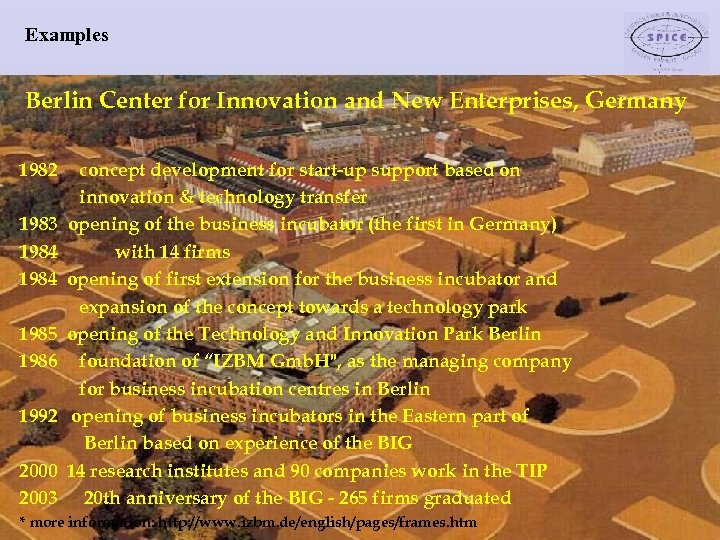 Examples Berlin Center for Innovation and New Enterprises, Germany 1982 1983 1984 1985 1986 1992 2000 2003 concept development for start-up support based on innovation & technology transfer opening of the business incubator (the first in Germany) with 14 firms opening of first extension for the business incubator and expansion of the concept towards a technology park opening of the Technology and Innovation Park Berlin foundation of “IZBM Gmb. H", as the managing company for business incubation centres in Berlin opening of business incubators in the Eastern part of Berlin based on experience of the BIG 14 research institutes and 90 companies work in the TIP 20 th anniversary of the BIG - 265 firms graduated * more information: http: //www. izbm. de/english/pages/frames. htm
 Examples Berlin Center for Innovation and New Enterprises, Germany The concept for the BIG was developed on the basis of experience in technology transfer 1978 concept development for a systematic approach to technology transfer based on a university (Technical University of Berlin) 1979 establishment of “TU-transfer”, the first office for technology transfer of a German university. Main activities: - “market pull” - contract development projects - “technology push” - active marketing for research results - “personnel transfer” - qualified staff for SMEs - “spin-off” - support for potential entrepreneurs
 Examples Berlin Center for Innovation and New Enterprises, Germany 1980 first “spin-off” seminars to support scientists of the university starting their own company 1983 opening of the business incubator of the TU Berlin: BIG, Berlin Center for Innovation and New Enterprises 1986 establishment of IZBM Gmb. H as management company for business incubators in Berlin: - “Berliner Innovations- und Gründerzentrum", BIG, 1983 - “Technologie- und Innovation Park Berlin", TIB, 1985 - “Innovations- und Greünderzentrum Adlershof”, IGZ, 1991 - “East-West Business Incubation Center”, OWZ, 1997
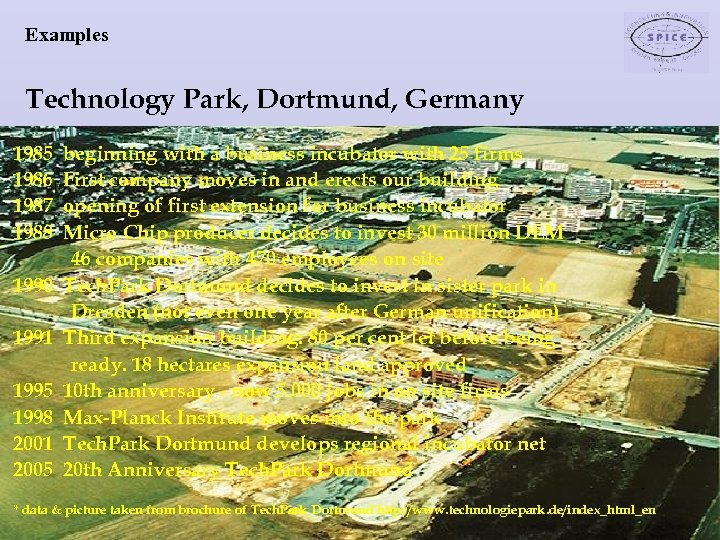 Examples Technology Park, Dortmund, Germany 1985 1986 1987 1988 1990 1991 1995 1998 2001 2005 beginning with a business incubator with 25 firms First company moves in and erects our building opening of first extension for business incubator Micro Chip producer decides to invest 30 million DEM 46 companies with 470 employees on site Tech. Park Dortmund decides to invest in sister park in Dresden (not even one year after German unification) Third expansion building: 80 per cent let before being ready. 18 hectares expansion land approved 10 th anniversary - now 5. 000 jobs in on site firms Max-Planck Institute moves into the park Tech. Park Dortmund develops regional incubator net 20 th Anniversary Tech. Park Dortmund * data & picture taken from brochure of Tech. Park Dortmund http: //www. technologiepark. de/index_html_en
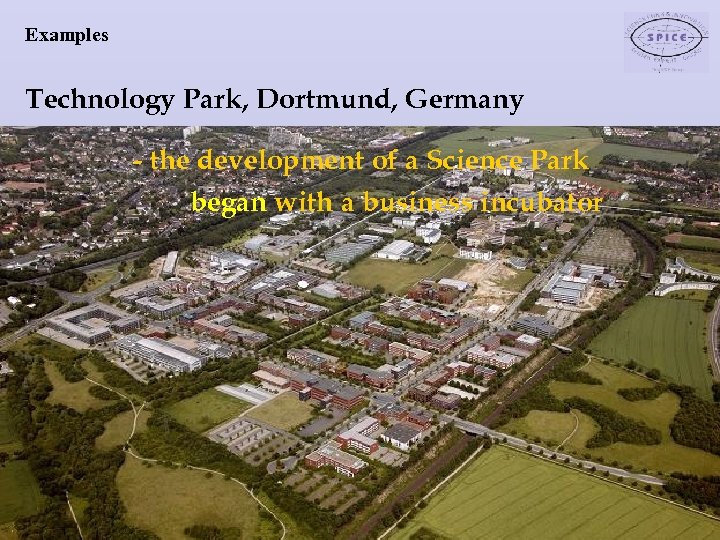 Examples Technology Park, Dortmund, Germany - the development of a Science Park began with a business incubator
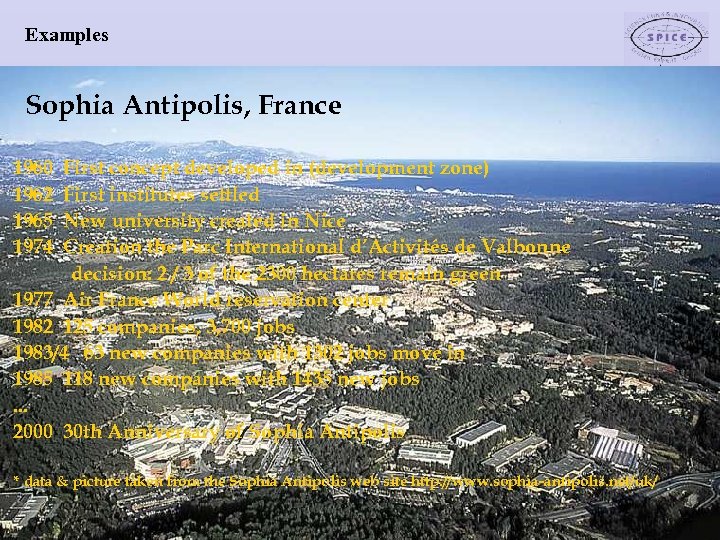 Examples Sophia Antipolis, France 1960 1962 1965 1974 First concept developed in (development zone) First institutes settled New university created in Nice Creation the Parc International d’Activités de Valbonne decision: 2 / 3 of the 2300 hectares remain green 1977 Air France World reservation center 1982 125 companies, 3, 700 jobs 1983/4 63 new companies with 1302 jobs move in 1985 118 new companies with 1435 new jobs. . . 2000 30 th Anniversary of Sophia Antipolis * data & picture taken from the Sophia Antipolis web site http: //www. sophia-antipolis. net/uk/
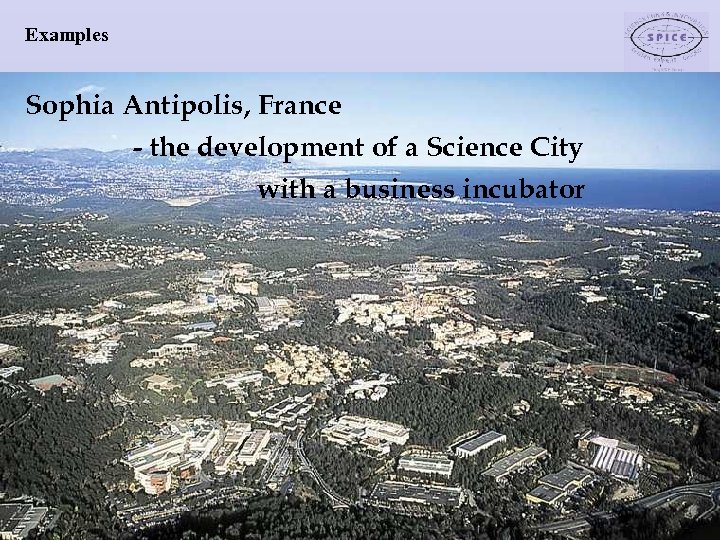 Examples Sophia Antipolis, France - the development of a Science City with a business incubator
 Examples There is more to see. . . business incubation plays an important role in o fostering political and economic change in Central and Eastern Europe (e. g. preparation for and realization of integration into the European Union) o contributing to realizing the political , economic, and social change in Central Asia o helping to create new companies and jobs in Latin America
 Examples There is more to see. . . business incubation plays an important role in o developing new businesses in Asia - think about in China (with it’s unique approach) or the experience developed in Japan and Korea o Africa (led by South Africa and with unique approaches like in Ghana) and other developing countries . . not to speak about the USA with about 1, 000 business incubators or about the same number in the European Union
 Summary & Conclusion There is more to see. . . and much to learn. . . The success of the concept “Business Incubation” o is based on integration and synergy by combining - human, entrepreneurial components with - economic potentials and - innovative approaches (research & development) o and consequently requires cooperation and networking - locally within a city or community - regionally and nationally - internationally - as markets & technology require
 Summary & Conclusion The success of the concept “Business Incubation” o builds on flexibility and continuous development - in adaptation to changing markets - making use of technology based innovation - reflecting social changes and needs o is not possible without understanding, accepting and integrating differences - between the various “players” needed for the process - between the regions of a country - between the countries and nations
 Summary & Conclusion Therefore o there is no “one model fits all” for promotion of innovation and entrepreneurship o concepts need to be adapted - to the specific needs - the existing (and the “to be developed”) potentials - the agreed goals of the given environment
 Summary & Conclusion Business incubation is part of innovation promotion and support systems and has o enhanced entrepreneurship in very different environments, under very different conditions o facilitated cooperation between business & finance, research & development, and administration & politics o enabled its environment by promoting innovation and entrepreneurship
 Summary & Conclusion The variety of existing innovation promotion and business incubation experience in (almost) all regions of the world as well as the duration of successful work of business incubators is evidence and reason for the remaining and growing importance of this concept. If understood as a concept, a state of mind, rather than a mechanism or a building, business incubation is far from having reached its potential.
 Good to know Attachments
 Good to know The comprehensive definition adopted by the International Summit in Richmond, USA, May 2003 A Business Incubation Program is an economic and social development process designed to advise potential start-up companies and, through a comprehensive business assistance program, help them establish and accelerate their growth and success. The main goal is to produce successful businesses that will leave the program, in a timely manner, financially viable and freestanding. These graduates create jobs, revitalize communities, commercialize new technologies and create wealth for local and national economies. Critical to the success of a Business Incubation Program is: · Management that develops and orchestrates business, marketing and management resources and relationships tailored to the needs of the business clients · Shared services, training, technology support and equipment · Selection of clients and an acceleration process by which businesses become more independent and progress to graduation · Assistance in obtaining the financing necessary for business growth Business Incubation Programs gain added value by providing access to appropriate rental space and flexible leases in an incubator facility. Note: In this definition the term ”Business Incubation Program” may be replaced by the words ”Business Incubator”. Furthermore the Summit acknowledged that depending on the specific situation in a country the provision of appropriate rental space may be added to the critical success factors.
 Good to know The Basics: Main mandatory components of Business Incubators are (1) Entrepreneurship promotion and start-up and business planning support (2) Business development consulting, training and support (3) Networks that provide access to specialized business consulting, technology commercialization and business financing resources (4) Physical facilities (buildings, rooms to provide office, production or laboratory space for lease, flexibly according to the demand of client) This statement expressly is not meant to rank business incubators without physical facilities lower than business incubators with them; it is aimed at securing the clear understanding of the concept. (International Summit of Associations, Dortmund, Germany, November 2002)
 Good to know Different Concepts & Approaches Concepts for science & technology parks cover a wide range of different approaches · creation of a new city (e. g. Sophia Antipolis, France) · developing a district of a city (e. g. WISTA Berlin, Germany) · green field development (e. g. Technologie. Park. Dortmund, Germany) · inner city s & t park (e. g. ASTON Science Park Birmingham, UK or BIG/TIB Berlin, Germany or “Svetlana”, St. Petersburg, Russia or Kanagawa, Japan) · company driven project (e. g. the Graphisoft Park, Budapest or busy. Internet, Accra, Ghana)
 Good to know Different Concepts & Approaches Business incubators are organized differently and serve a wide range of purposes · stand-alone incubators - general entrepreneurship promotion · university / science based - technology & innovation focused · science/technology park component - tenant generators · rural incubators - regional development · industry based incubators - innovation, technology transfer · virtual incubators - all purposes Business Incubators are different - and have to be different
 Good to know Different Concepts & Approaches The World is not homogenous. There are many differences in · history · traditions, habits · experience (with economy, industry) · economic, social conditions Not even West European business incubators are the same - Finland, France, United Kingdom, Germany. . . “Eastern Europe” shows many differences too - Central Europe: Poland, Czech Republic. . . - Eastern Europe: Russia, Ukraine. . . - Central Asia: Kazakhstan, Kyrgyzstan, Uzbekistan. . . There is more than one way to do it well !
 Good to know The local environment and the mission (aims) determine the work of a business incubator Everywhere valuable “local” know-how exists. This is the basis to build on. · there is no “best” practice, but good examples · toolkits are needed – not “magic formulas” · tools need instructions for use / adaptability to different environments · training programs must adapt to actual / local level · flexibility and continuous development are key to success “Make is just as we do” does not work !
 Key Factors for Success Clear Mission - and agreement about this mission with local players Local Network - integrating as many support partners as possible People - the right management team Development Potential - room for expansion and development (for graduated companies) Time - business incubation processes need (much) time to generate impact
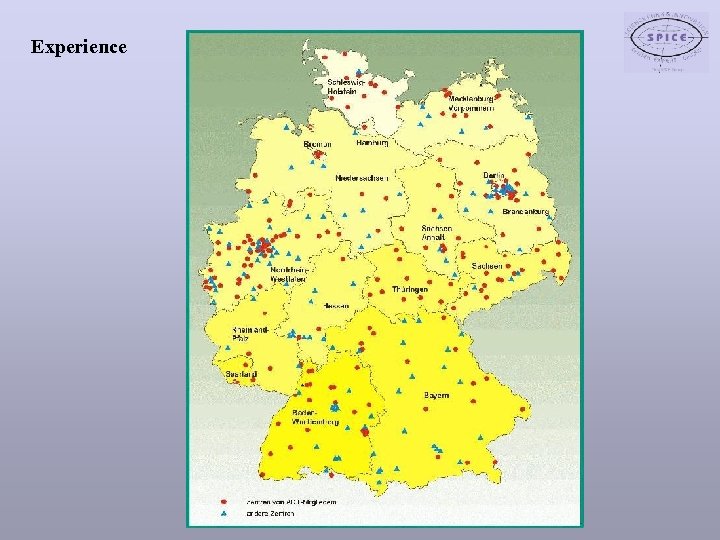
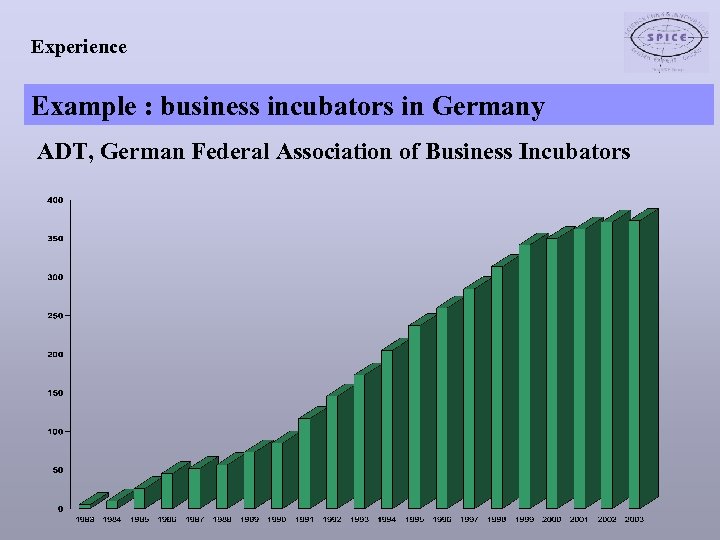
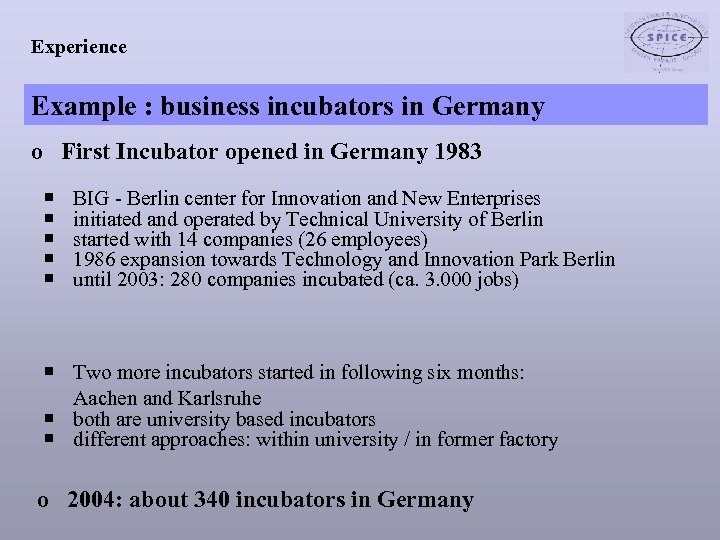 Experience Example : business incubators in Germany o First Incubator opened in Germany 1983 ¡ ¡ ¡ BIG - Berlin center for Innovation and New Enterprises initiated and operated by Technical University of Berlin started with 14 companies (26 employees) 1986 expansion towards Technology and Innovation Park Berlin until 2003: 280 companies incubated (ca. 3. 000 jobs) ¡ Two more incubators started in following six months: Aachen and Karlsruhe ¡ both are university based incubators ¡ different approaches: within university / in former factory o 2004: about 340 incubators in Germany
 Experience
 Experience Example : business incubators in Germany ADT, German Federal Association of Business Incubators