


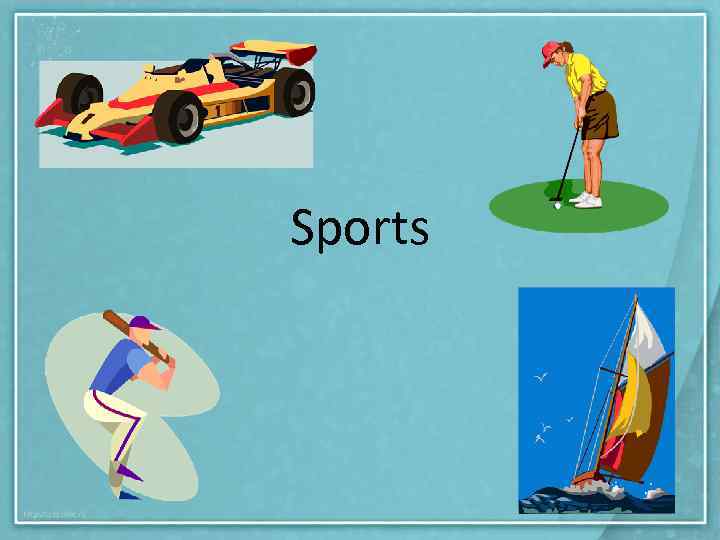
Sports
Nobody will deny the fact that sport is an important part of today’s society and plays an important role in many people’s lives. ü Sport events dominate headlines ü Athletes have become national heroes ü In one way or another, everyone is involved in sports, whether they’re playing or watching or just know someone who goes in for sports
A group of young people were interviewed about their attitude towards sport. Here are their answers: • • Hilary Brown, 17 Well, sport is fun, isn’t it? I couldn’t imagine a life without sport. Could you? Only Maths, English and History – how dull that would be! I love riding, playing volleyball and sailing. It’s wonderful to be in the open and to enjoy the fresh air and the sun! But it’s tennis that I am really keen on. My sports teacher told me that I had a skill for playing tennis and that I should practice it more thoroughly. That’s why I stopped riding and sailing : tennis takes up all my free time now. It would be great if I made it big as a tennis professional. David Harvey, 21 Thank goodness people never try and talk sport to me. I hate sports. What is an endless boring tennis match compared to a good film – nothing, it’s just a waste of time! I think English people’s attitude to sport is so childish! Hundreds of thousands of them listen to cricket commentaries on their radios – for five days. It’s so stupid. They think that the big stars in sport lead a wonderful life. What a load of rubbish! In my opinion these people are poor devils living out of a suitcase. How can they have any social life when they are always away from home? Besides nobody ever mentions the dangers of sport. Just think of the injuries!
A group of young people were interviewed about their attitude towards sport. Here are their answers: • • Tommy Murphy, 22 Well, I consider myself an armchair sportsman. I enjoy sports most when I am at home watching “Grandstand” on TV. It’s cricket that I like in particular. I could watch it for hours on end. I even stopped fixing my motorbike last week to watch England playing Jamaica. And I love my motorbike! You see, it’s not that I am not interested in sports. I’m just too lazy to drag myself to the football ground to kick the ball around. That’s no fun. I’d rather meet my mates and discuss the weekend’s football results with them. This – and reading the sports pages in the paper – is my kind of sports. Tony Rogers, 20 Oh, I love it. I’m very active in sports. I’ve always been like that. I remember spending my days running through the woods and climbing up trees when I was a little boy. Now I go jogging every week, and besides I play tennis every now and then. My favourite sport however is football. My life would be boring without it, I think. I love it because it’s a team game and you need all kinds of skills. You must be fit, you must keep an eye on what your teammates do, and you need a quick brain. I’m a member of our local football team. You see, that’s another thing I like in sports: you make new friends!
Does sport merit this kind of interest and attention? ü From a social standpoint sport plays a positive role in uniting people from different social backgrounds in support of their favourite team. This can aid people’s understanding and tolerance of each other. ü As a communications tool, sport is ideally suited to convey social, health- and peace-related messages. For example, sports events are a good medium for information campaigns and actions. ( It can encourage people to lead a more healthy and peaceful life. )
ü As far as education is concerned, sport is also very beneficial : it is a significant part of every child’s schooling as it influences both their physical and mental development. Sport is a social classroom where the individual can learn in a playful and fun manner basic social skills such as teamwork, dealing with rules, organisational skills, a structured use of leisure time, and handling strong emotions such as victory and defeat in a constructive manner. Sport and physical education are an essential element of quality education. They promote positive values and skills which have a quick but lasting impact on young people.
ü From an economic point of view, sport can be very profitable, as it attracts a lot of sponsorship and advertising. This creates revenue for the sporting industry which allows for improvement and expansion. ü In what way does it affect ( have an impact on) our health/ mood/ self-confidence/ abilities /success? (improve, develop, lift, build, reveal, help to get, keep fit) ü What qualities / skills does sport develop in us? ( strength, stamina, speed, fast reflexes, a good sense of balance, hand-eye coordination, determination, motivation, dedication, courage,
What basic human need (instinct) is driving people to risk their lives for the ultimate experience and go in for ( do) extreme (risk, action) sports? Some people’s lives seem to be dominated by the ‘’thrill factor’’. They crave, seek adventure. ü First of all we can’t but mention an adrenaline buzz. You never feel so alive as when you are risking your life. Picking up new challenges people react against a society which they feel has become dull and constricting (pressurizing). ü In an attempt to guarantee safety our culture has eliminated risk. The world has become a bland safe place. Risk sports are valuable because they let you stay alert. ü Besides people turn to extreme sports as an escape. They help people to overcome fears that affect them in their real lives. They are the best cure for a stressful working life as they carry you over the problems. ü You not only escape from your everyday life, but return to it on a wave of confidence and strength. The reason for it is that extreme sports are a personal test of both nerve and skill. You learn more about yourself. The pride earned through doing risk sports will stay with you for life. ü There is the other spin-off as well : the moment of freedom, during which you can empty the mind and feel the mental calm.
