 Скачать презентацию SPORT IN KAZAKHSTAN Zhanibek Yersayin WHAT IS
Sport_in_Kazakhstan.pptx
- Количество слайдов: 9



SPORT IN KAZAKHSTAN Zhanibek Yersayin
WHAT IS MEAN SPORT? • Sport" comes from the Old French desport meaning "leisure", with the oldest definition in English from around 1300 being "anything humans find amusing or entertaining ". • The modern Olympic Games or Olympics (French: Jeux olympiques[1]) are the leading international sporting event featuring summer and winter sports competitions in which thousands of athletes from around the world participate in a variety of competitions. The Olympic Games are considered to be the world's foremost sports competition with more than 200 nations participating. [2] The Olympic Games are held every four years, with the. Summer and Winter Games alternating by occurring every four years but two years apart. • Their creation was inspired by the ancient Olympic Games, which were held in Olympia, Greece, from the 8 th century BC to the 4 th century AD. Baron Pierre de Coubertin founded the International Olympic Committee(IOC) in 1894. The IOC is the governing body of the Olympic Movement, with the Olympic Charter defi • ning its structure and authority.
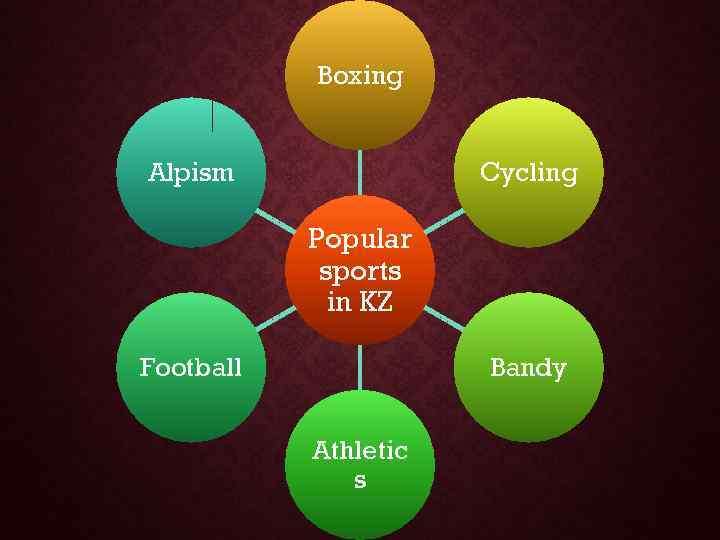
Boxing Alpism Cycling Popular sports in KZ Football Bandy Athletic s
BOXING • Boxing is a martial art and combat sport in which two people throw punches at each other, usually with gloved hands. Historically, the goals have been to weaken and knock down the opponent. • Amateur boxing is both an Olympic and Commonwealth sport and is a common fixture in most international games—it also has its own World Championships. Boxing is supervised by a referee over a series of one- to three-minute intervals called rounds. The result is decided when an opponent is deemed incapable to continue by a referee, is disqualified for breaking a rule, resigns by throwing in a towel, or is pronounced the winner or loser based on the judges' scorecards at the end of the contest. In the event that both fighters gain equal scores from the judges, the fight is considered a draw. • While people have fought in hand-to-hand combat since before the dawn of history, the origin of boxing as an organized sport may be its acceptance by the ancient Greeks as an Olympic game in BC 688. Boxing evolved from 16 th- and 18 th-century prizefights, largely in Great Britain, to the forerunner of modern boxing in the mid-19 th century, again initially in Great Britain and later in the United States.
BOXING IN KZ Kazakh boxers are generally well known in the world. In the last three Olympic Games, their performance was assessed as one of the best and they had more medals than any country in the world, except Cuba and Russia (in all three games). In 1996 and 2004, two Kazakhstani boxers (Vasiliy Jirov in 1996 and Bakhtiyar Artayev in 2004) were recognized as the best boxers for their techniques with the. Val Barker trophy, awarded to the best boxer of the tournament. In boxing, Kazakhstan performed well in the 2000 Summer Olympics in Sydney, Australia. Two boxers, Bekzat Sattarkhanov and Yermakhan Ibraimov, earned gold medals. Another two boxers, Bulat Jumadilov and Mukhtarkhan Dildabekov, earned silver medals. It should also be noted that Oleg Maskaev, born in Zhambyl, representing Russia, was the WBC Heavyweight Champion after knocking out Hasim Rahman on 12 August 2006. The reigning WBA and IBO middleweight champion is Kazakh boxer Gennady Golovkin. Natascha Ragosina, representing Russia, but from Karaganda held seven versions of the women's super middleweight title, and two heavyweight titles during her boxing career. She holds the record as the longest-reigning WBA female super middleweight champion, and the longest-reigning WBC female super middleweight champion. owing year, the Association of Boxing Kazakhstan will celebrate 70 year anniversary

FOOTBALL “Some people think football is a matter of life and death. I assure you, it's much more serious than that. Bill Shankly
The contemporary history of the world's favourite game spans more than 100 years. It all began in 1863 in England, when rugby football and association football branched off on their different courses and the Football Association in England was formed - becoming the sport's first governing body. Both codes stemmed from a common root and both have a long and intricately branched ancestral tree. A search down the centuries reveals at least half a dozen different games, varying to different degrees, and to which the historical development of football has been traced back. Whether this can be justified in some instances is disputable. Nevertheless, the fact remains that people have enjoyed kicking a ball about for thousands of years and there is absolutely no reason to consider it an aberration of the more 'natural' form of playing a ball with the hands. On the contrary, apart from the need to employ the legs and feet in tough tussles for the ball, often without any laws for protection, it was recognised right at the outset that the art of controlling the ball with the feet was not easy and, as such, required no small measure of skill. The very earliest form of the game for which there is scientific evidence was an exercise from a military manual dating back to the second and third centuries BC in China.
This Han Dynasty forebear of football was called Tsu' Chu and it consisted of kicking a leather ball filled with feathers and hair through an opening, measuring only 3040 cm in width, into a small net fixed onto long bamboo canes. According to one variation of this exercise, the player was not permitted to aim at his target unimpeded, but had to use his feet, chest, back and shoulders while trying to withstand the attacks of his opponents. Use of the hands was not permitted. Another form of the game, also originating from the Far East, was the Japanese Kemari, which began some 500600 years later and is still played today. This is a sport lacking the competitive element of Tsu' Chu with no struggle for possession involved. Standing in a circle, the players had to pass the ball to each other, in a relatively small space, trying not to let it touch the ground. . The Greek 'Episkyros' - of which few concrete details survive - was much livelier, as was the Roman 'Harpastum'. The latter was played out with a smaller ball by two teams on a rectangular field marked by boundary lines and a centre line. The objective was to get the ball over the opposition's boundary lines and as players passed it between themselves, trickery was the order of the day. The game remained popular for 700800 years, but, although the Romans took it to Britain with them, the use of feet was so small as to scarcely be of
of Soviet football. After World War II a regular league began in 1946 while a cup competition, previously held sporadically was instituted full-time in 1948. A permanent Kazakh SSR Football Federation was established in 1959. Leading club side FC Kairat Almaty went on to make history in 1960 by becoming the first Kazakh side to compete in the Soviet Top League and made further history in 1963 by reaching the semi-finals of the Soviet Cup, the best performance by a Kazakh team in the competition. They would go on to record Kazakhstan's first triumph in the. Soviet First League in 1976. No Kazakh footballer had represented the USSR until 1977 when FC Kairat defender Seilda Baishakov made his debut in a FIFA World Cup qualifier against Hungary. Later, in 1986, his club would go on to add further to their honours by finishing seventh in the Top League, an all-time best finish for a Kazakh club. The country's Eugeny
Скачать презентацию SPORT IN KAZAKHSTAN Zhanibek Yersayin WHAT IS
Sport_in_Kazakhstan.pptx