


 Скачать презентацию Sponsor Covenants under stress — Assessing sponsor covenants
d6d35b36b3d6c2a7750ea6389132ee17.ppt
- Количество слайдов: 13
 Sponsor Covenants under stress - Assessing sponsor covenants in current conditions Engaged Investor Forum Paul Thornton, Gazelle Corporate Finance Limited 21 Devonshire Street May 2009 41 London W 1 G 7 AJ United Kingdom Telephone: +44 (0) 20 7182 7220 Facsimile: +44 (0) 20 7182 7230 www. gazellegroup. co. uk § § § Client Logo Registered in England No. 3216445 Authorised and regulated by The Financial Services Authority The information and views contained in this document are not intended to be a comprehensive study, nor to provide specific advice, and should not be relied upon nor treated as a substitute for specific advice concerning individual situations.
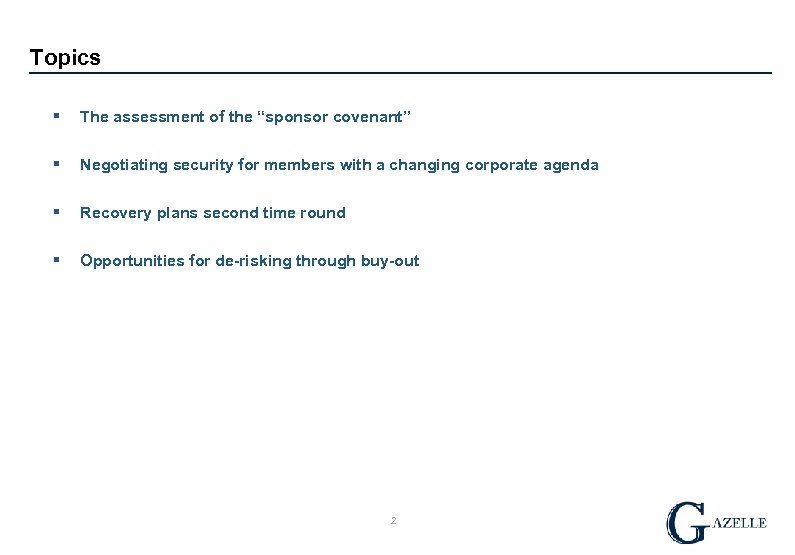 Topics § The assessment of the “sponsor covenant” § Negotiating security for members with a changing corporate agenda § Recovery plans second time round § Opportunities for de-risking through buy-out 2
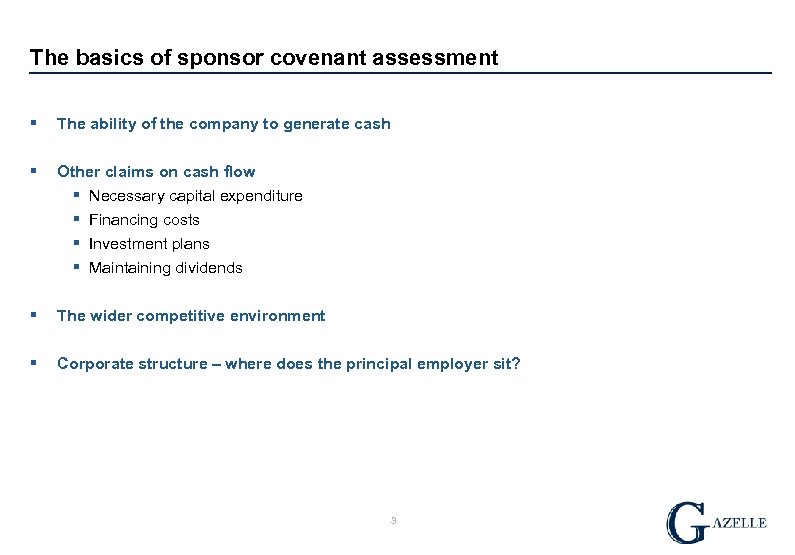 The basics of sponsor covenant assessment § The ability of the company to generate cash § Other claims on cash flow § Necessary capital expenditure § Financing costs § Investment plans § Maintaining dividends § The wider competitive environment § Corporate structure – where does the principal employer sit? 3
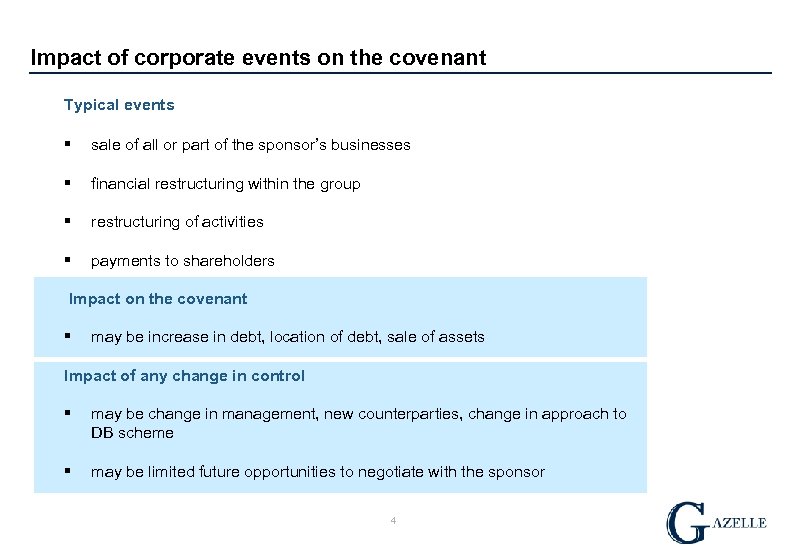 Impact of corporate events on the covenant Typical events § sale of all or part of the sponsor’s businesses § financial restructuring within the group § restructuring of activities § payments to shareholders Impact on the covenant § may be increase in debt, location of debt, sale of assets Impact of any change in control § may be change in management, new counterparties, change in approach to DB scheme § may be limited future opportunities to negotiate with the sponsor 4
 Impact of the credit crunch on the employer and covenant § More difficulty in refinancing, including normal debt rollovers § Higher cost of debt § Knock-on effect of any credit-downgrade § The impact will depend on debt profile and exposure to financial markets 5
 Impact of an economic slowdown on the employer and covenant § More difficult trading conditions § Reduced revenues or rate of growth of revenues § Slow payment by creditors § Delay to capital investment for future growth generation § Not all companies equally affected 6
 How companies are responding Typical corporate responses: Factors / concerns § Maintain liquidity, reduce reliance on bank credit, seek other sources of funding ð Treasury management - alternative funding routes may not be available § Extend debt maturity profile and review debt/equity ratio ð Market increasingly sensitive to loan covenants § Reduce pay-outs to shareholders – dividends and buy-backs ð Dividend yield support for share price? § Sell non-core businesses ð Risk of being seen as forced seller § Manage the credit rating ð Downgrades having magnified impact 7
 Negotiating security for members – setting objectives § Preserving the status quo § Improving the funding position § Improving downside / insolvency exposure § Risk sharing / transfer options 8
 Recovery plans second time round § A closer look at prospects beyond the slowdown § More reliance on covenant assessment § Pension Regulator guidance – too soft or just right? § Negotiation tactics planned in advance 9
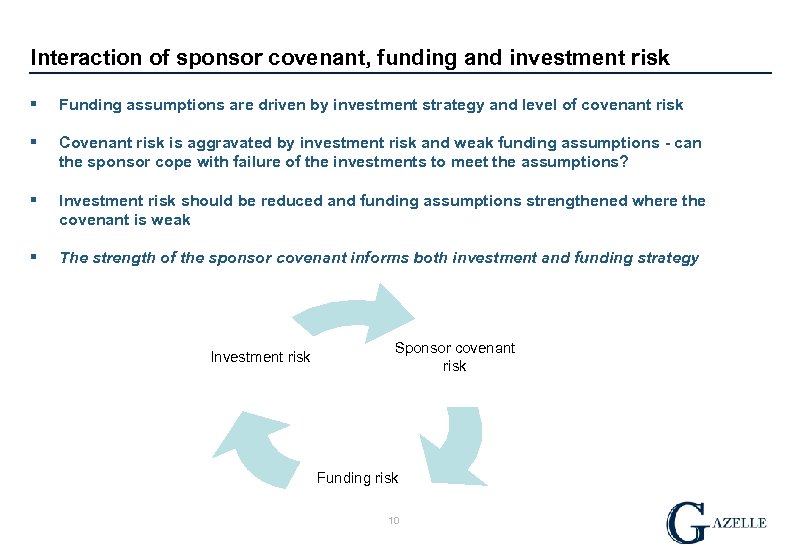 Interaction of sponsor covenant, funding and investment risk § Funding assumptions are driven by investment strategy and level of covenant risk § Covenant risk is aggravated by investment risk and weak funding assumptions - can the sponsor cope with failure of the investments to meet the assumptions? § Investment risk should be reduced and funding assumptions strengthened where the covenant is weak § The strength of the sponsor covenant informs both investment and funding strategy Investment risk Sponsor covenant risk Funding risk 10
 Buy-outs and Buy-ins – an opportunity for de-risking § Provider’s covenant should compare favourably with the sponsor’s § FSA solvency requirements - but appropriate levels and availability of further capital as yet untested § Financial Services Compensation Scheme underpinning – but could this survive systemic failure? § Backed up by continuing employer covenant in case of buy-in 11
 Weighing up the insurance providers How exposed are they as a business? § Traditional insurers - more diversification of risks § New entrants - typically monoline but use additional tools to manage longevity risk § Foreign owned – how strong is “reputational” support? How much capital do they need… and how can they get it if needed? § Where is capital held within the wider group and what restrictions are there on moving it within the group? § Some providers can raise cash from the equity and bond markets…but at what cost? § Some providers are backed by private equity groups…what likelihood / commitment is there for additional capital? 12
 Sponsor Covenants under stress - Assessing sponsor covenants in current conditions Engaged Investor Forum Paul Thornton, Gazelle Corporate Finance Limited 21 Devonshire Street May 2009 41 London W 1 G 7 AJ United Kingdom Telephone: +44 (0) 20 7182 7220 Facsimile: +44 (0) 20 7182 7230 www. gazellegroup. co. uk § § § Client Logo Registered in England No. 3216445 Authorised and regulated by The Financial Services Authority The information and views contained in this document are not intended to be a comprehensive study, nor to provide specific advice, and should not be relied upon nor treated as a substitute for specific advice concerning individual situations.