


 Скачать презентацию Spoken ELF in engineering education in Sweden Code
600d49278da9d53dd2964e4f8f1ef357.ppt
- Количество слайдов: 19
 Spoken ELF in engineering education in Sweden Code and discourse features Recipient reactions Beyza Björkman beyza. bjorkman@english. su. se 1
 Outline • Higher education in Sweden: an ELF setting in respect of oral interaction • The present project: – Research questions and design – Material – The three dimensions of this project • Form: Morphosyntax • Communicativeness: Analyses at discourse level • Attitudes • Results: Back to research questions • Frequently asked questions 2
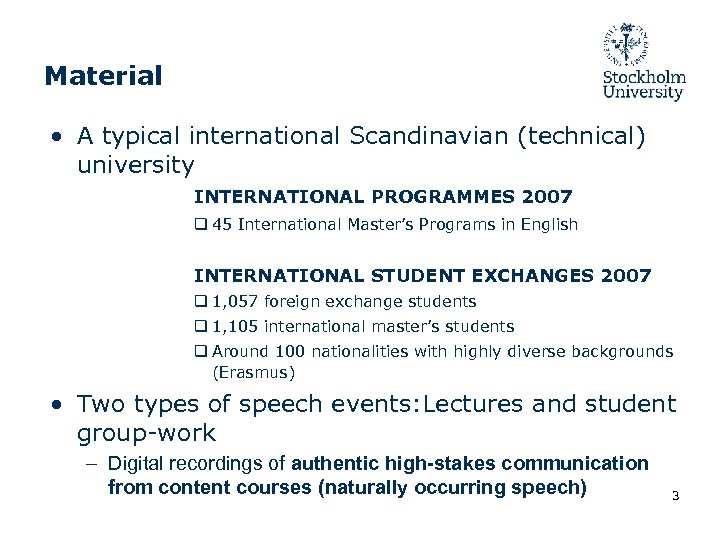 Material • A typical international Scandinavian (technical) university INTERNATIONAL PROGRAMMES 2007 q 45 International Master’s Programs in English INTERNATIONAL STUDENT EXCHANGES 2007 q 1, 057 foreign exchange students q 1, 105 international master’s students q Around 100 nationalities with highly diverse backgrounds (Erasmus) • Two types of speech events: Lectures and student group-work – Digital recordings of authentic high-stakes communication from content courses (naturally occurring speech) 3
 Background Key background literature: – Firth (1990, 1996), Firth and Wagner (1997), Meierkord (1998, 2000, 2004) – Jenkins (2000; 2007) – Seidlhofer (2004), VOICE (Pölzl, 2006; Lichtkoppler, 2005; Breiteneder et al. 2006; Pietzl, 2005; Hülmbauer, 2007) – Cogo and Dewey (2006) – House (2002), Lesnyák (2004), Mauranen (2004, 2006; 2007), ELFA (Ranta, 2006) – Erling (2004) 4
 Research questions 1. What, if any, are the morphosyntactic commonalities of non-standard usage in monologic and dialogic speech events studied in the ELF setting examined? 2. Are the commonalities found the same with those described in the literature? 3. What kind of morphosyntactic non-standard usage results in disturbance in spoken ELF communication? 4. What are the discourse features in the two speech event types in the ELF setting examined? 5. Are the discourse features found the same with those described in the literature? 6. What kind of morphosyntactic non-standard usage is perceived as irritating by speakers in ELF situations? FORM (1, 2), COMMUNICATIVENESS (3, 4, 5), ATTITUDES (6) 5
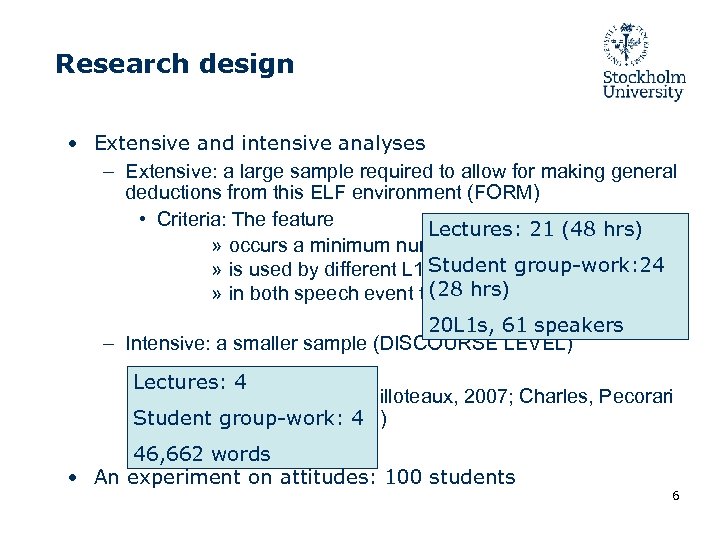 Research design • Extensive and intensive analyses – Extensive: a large sample required to allow for making general deductions from this ELF environment (FORM) • Criteria: The feature Lectures: 21 (48 hrs) » occurs a minimum number of ten times » is used by different L 1 Student group-work: 24 speakers (28 » in both speech event types hrs) 20 L 1 s, 61 speakers – Intensive: a smaller sample (DISCOURSE LEVEL) Lectures: 4 (Dörnyei, 2001; Guilloteaux, 2007; Charles, Pecorari Studentand Hunsten, 2009) group-work: 4 46, 662 words • An experiment on attitudes: 100 students 6
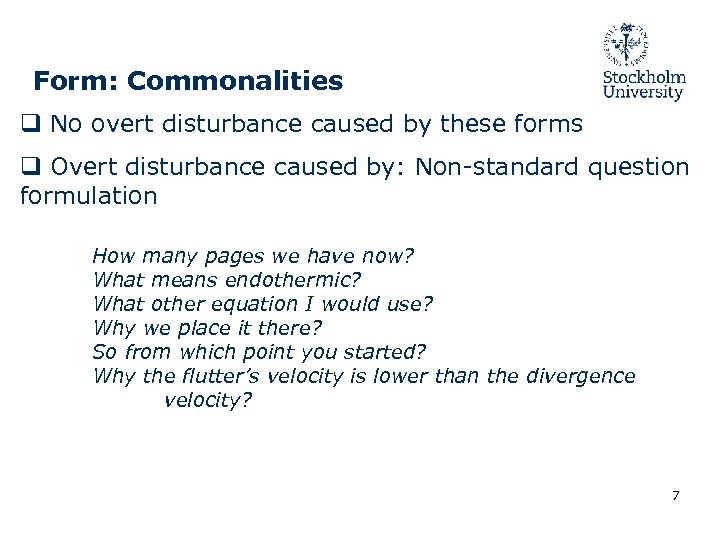 Form: Commonalities q No overt disturbance caused by these forms Non. S word forms discriminization Non. S analytic more big q Overt comparative disturbance caused by: Non-standard question Non. S plural forms/countability How many hydrogen. . . formulation Non. S article usage Anybody can define the renewability? much more now? How many pages we have wider What means endothermic? Lack of subject-verb agreement A catalyst have. . . What other equationwater turbines use? is flowing. . . I would water Tense and aspect issues In Why we place it there? Word order Salinity affects what kind of material can you use. So from which point you started? Not marking the plural flutter’s velocity is lower than the divergence 500 meter, two different reactor, several process Why the Negation velocity? It looks not good. /It’s a not very good generator. Double comparative/superlatives Non. S Passive voice It can be happened that…/ We affect by the flow. . . 7
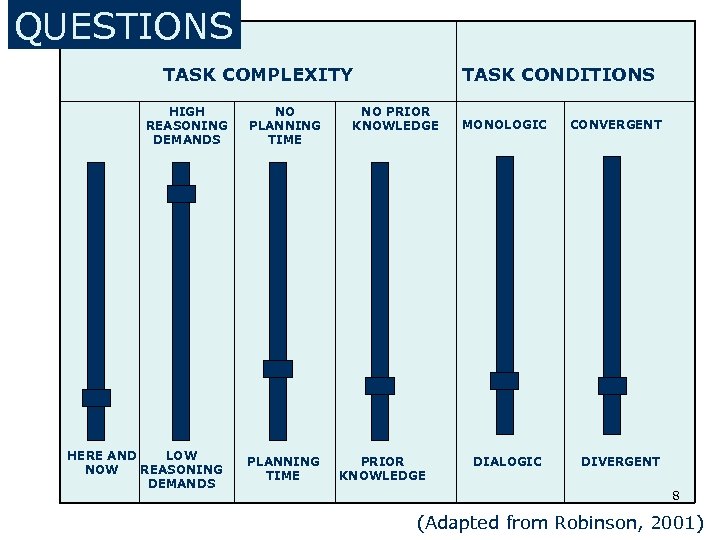 QUESTIONS TASK COMPLEXITY HIGH REASONING DEMANDS HERE AND LOW NOW REASONING DEMANDS NO PLANNING TIME TASK CONDITIONS NO PRIOR KNOWLEDGE MONOLOGIC DIALOGIC CONVERGENT DIVERGENT 8 (Adapted from Robinson, 2001)
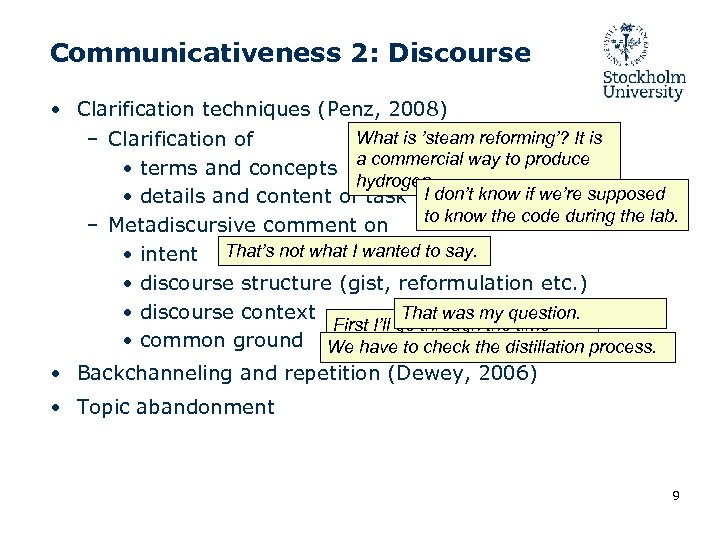 Communicativeness 2: Discourse • Clarification techniques (Penz, 2008) What is ’steam reforming’? It is – Clarification of • terms and concepts a commercial way to produce hydrogen. • details and content of task I don’t know if we’re supposed to know the code during the lab. – Metadiscursive comment on • intent That’s not what I wanted to say. • discourse structure (gist, reformulation etc. ) • discourse context That was my question. First I’ll go through the time • common ground We have to check the distillation process. frame. • Backchanneling and repetition (Dewey, 2006) • Topic abandonment 9
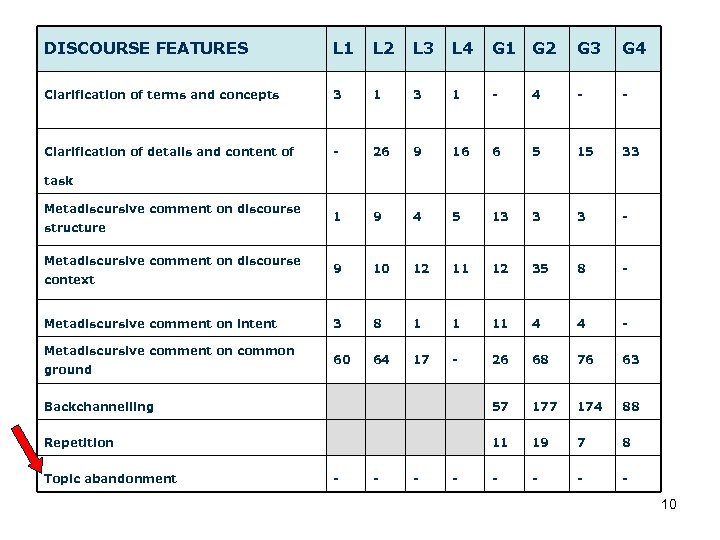 DISCOURSE FEATURES L 1 L 2 L 3 L 4 G 1 G 2 G 3 G 4 Clarification of terms and concepts 3 1 - 4 - - Clarification of details and content of - 26 9 16 6 5 15 33 1 9 4 5 13 3 3 - 9 10 12 11 12 35 8 - 3 8 1 1 11 4 4 - 60 64 17 - 26 68 76 63 Backchannelling 57 174 88 Repetition 11 19 7 8 - - task Metadiscursive comment on discourse structure Metadiscursive comment on discourse context Metadiscursive comment on intent Metadiscursive comment on common ground Topic abandonment - - 10
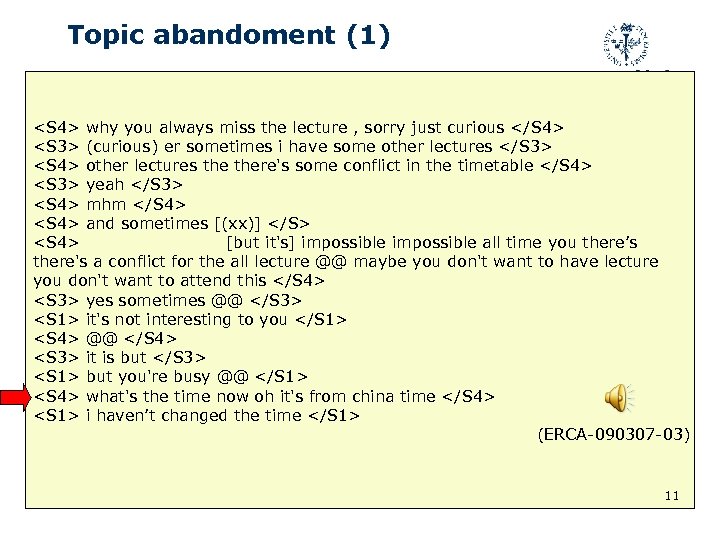 Topic abandoment (1)
 why you always miss the lecture , sorry just curious (curious) er sometimes i have some other lectures other lectures there's some conflict in the timetable yeah mhm and sometimes [(xx)] [but it's] impossible all time you there’s there's a conflict for the all lecture @@ maybe you don't want to have lecture you don't want to attend this yes sometimes @@ it's not interesting to you @@ it is but but you're busy @@ what's the time now oh it's from china time i haven’t changed the time (ERCA-090307 -03) 11
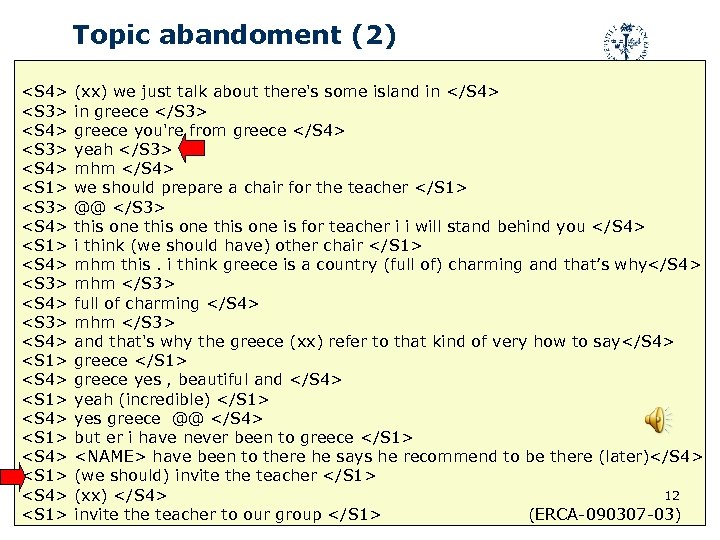 Topic abandoment (2)
 mhm full of charming mhm and that's why the greece (xx) refer to that kind of very how to say greece greece yes , beautiful and yeah (incredible) yes greece @@ but er i have never been to greece mhm this. i think greece is a country (full of) charming and that’s why i think (we should have) other chair this one is for teacher i i will stand behind you @@ we should prepare a chair for the teacher mhm yeah greece you're from greece (xx) we just talk about there's some island in in greece
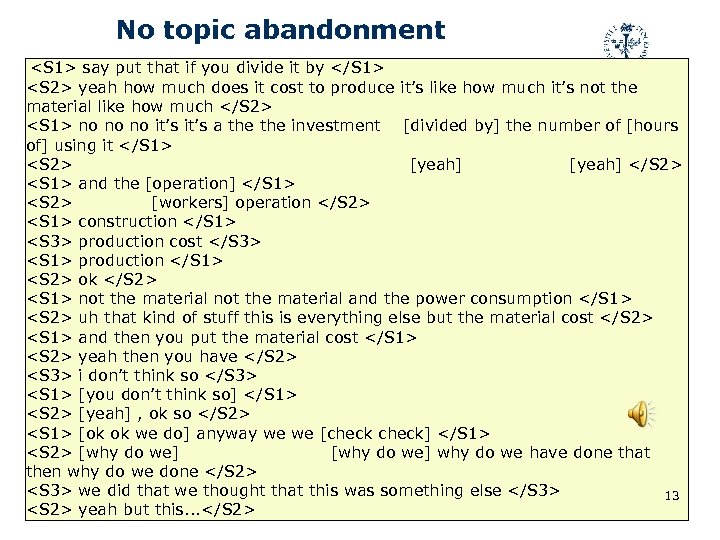 No topic abandonment
 say put that if you divide it by yeah how much does it cost to produce it’s like how much it’s not the material like how much no no no it’s a the investment [divided by] the number of [hours of] using it [yeah] and the [operation] [workers] operation construction production cost production ok not the material and the power consumption uh that kind of stuff this is everything else but the material cost and then you put the material cost yeah then you have i don’t think so [you don’t think so] [yeah] , ok so [ok ok we do] anyway we we [check] [why do we] why do we have done that then why do we done we did that we thought that this was something else 13 13 yeah but this. . .
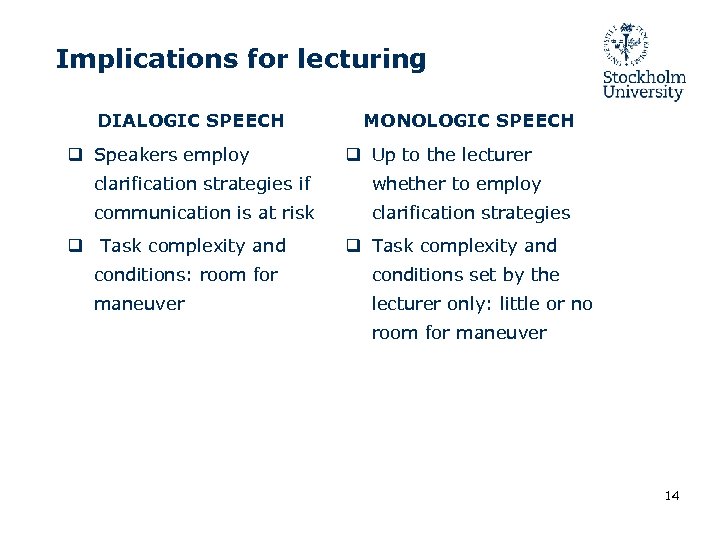 Implications for lecturing DIALOGIC SPEECH q Speakers employ MONOLOGIC SPEECH q Up to the lecturer clarification strategies if whether to employ communication is at risk clarification strategies q Task complexity and conditions: room for conditions set by the maneuver lecturer only: little or no room for maneuver 14
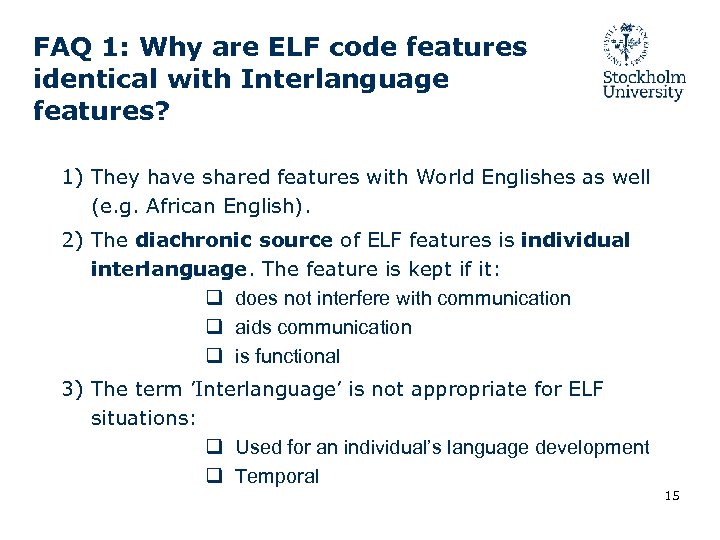 FAQ 1: Why are ELF code features identical with Interlanguage features? 1) They have shared features with World Englishes as well (e. g. African English). 2) The diachronic source of ELF features is individual interlanguage. The feature is kept if it: q does not interfere with communication q aids communication q is functional 3) The term ’Interlanguage’ is not appropriate for ELF situations: q Used for an individual’s language development q Temporal 15
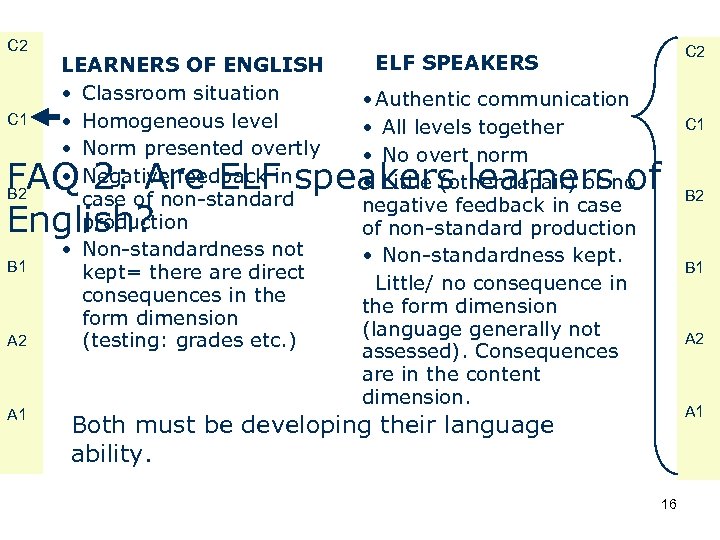 C 2 C 1 LEARNERS OF ENGLISH • Classroom situation • Homogeneous level • Norm presented overtly • Negative feedback in case of non-standard production • Non-standardness not kept= there are direct consequences in the form dimension (testing: grades etc. ) C 2 ELF SPEAKERS • Authentic communication • All levels together • No overt norm • Little (other repair) or no negative feedback in case of non-standard production • Non-standardness kept. Little/ no consequence in the form dimension (language generally not assessed). Consequences are in the content dimension. C 1 FAQ 2: Are ELF speakers learners of B 2 English? B 2 B 1 A 2 A 1 Both must be developing their language ability. 16
 FAQ 3: How often should a feature occur to be a commonality? A large proportion of instances are actually standard. Breiteneder (2005), 20% Ranta (2006), 13% Meierkord (2004), 9% 3% “doubtful constructions” The present study: Low percentage of non-standard features 17
 General conclusions/ answers to RQs • Remarkable commonalities across speech event types. (RQ 1) They do not represent majority usage. • Some shared with previous findings. (RQ 2) – (No who/which, invariable isn’t it tag etc. ) • Little breakdown in communication (breakdown caused only by non. S question formulation). (RQ 3) • Rich discourse: (RQ 4 and 5) – Clarification techniques (unlike Penz) – Increased explicitness (similar to Mauranen, Dewey and Cogo) – Backchanelling, repetition (similar to Dewey and Cogo) – Topic abandonment only in social talk • Irritation at varying degrees toward all features. (RQ 6) 18
 Publications on the present material Björkman, B. (Forthcoming, 2009). ’ From code to discourse in spoken ELF’. In Mauranen, A. and Ranta, E. (Eds. ). English as a Lingua Franca: Studies and findings. Cambridge Scholars Press. Björkman, B. (In press, 2009). ’English as a Lingua Franca at a Swedish Technical University: An Effective Medium? ’ Proceedings of the Annual BALEAP Conference: 'EAP in a globalising world: English as an academic lingua franca‘. Peter Lang. Björkman, B. (2008). ‘English as the Lingua Franca of Engineering: the morphosyntax of academic speech events’. Nordic Journal of English Studies 7(3): 103 -122. Björkman, B. (2008). 'So where we are': Spoken lingua franca English at a Swedish technical university. English Today, 24 (2), 11 -17. Björkman, B. (2008). ‘'We' and 'you': pronouns and genre competence in oral technical descriptions’. In Lainio, J. , & Leppänen, A. (Eds. ), Linguistic Diversity and Sustainable Development (pp. 89 -109). Swedish Science Press. 19