


 Скачать презентацию SPo RT Product Assessments Geoffrey Stano Kevin Fuell
5d4ee14d7c9e14032f5802e6d4cd6982.ppt
- Количество слайдов: 16
 SPo. RT Product Assessments Geoffrey Stano, Kevin Fuell Scientific Services Division Chief Meeting 2 March, 2010 National Space Science and Technology Center, Huntsville, AL transitioning unique NASA data and research technologies to operations
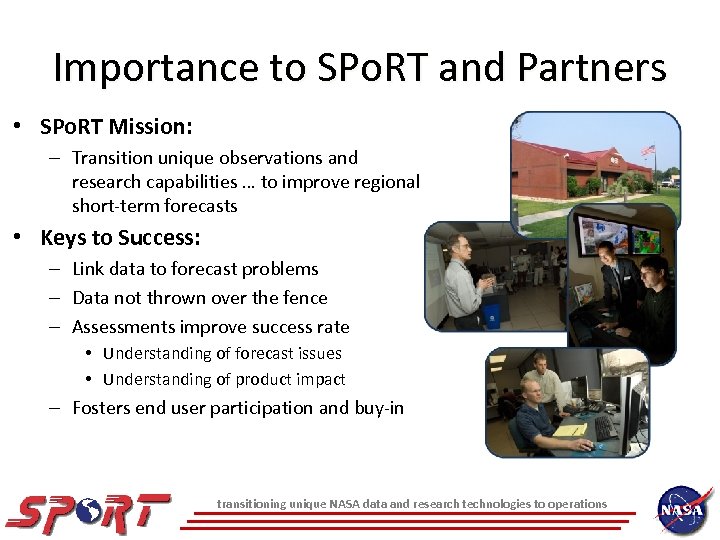 Importance to SPo. RT and Partners • SPo. RT Mission: – Transition unique observations and research capabilities … to improve regional short-term forecasts • Keys to Success: – Link data to forecast problems – Data not thrown over the fence – Assessments improve success rate • Understanding of forecast issues • Understanding of product impact – Fosters end user participation and buy-in transitioning unique NASA data and research technologies to operations
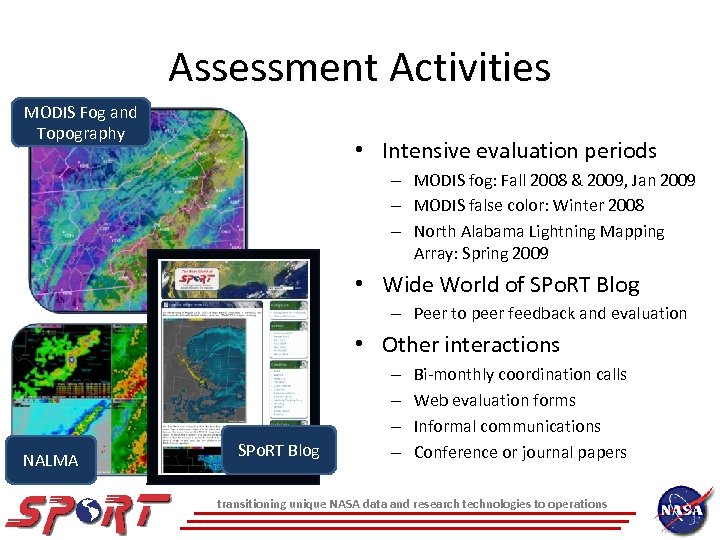 Assessment Activities MODIS Fog and Topography • Intensive evaluation periods – MODIS fog: Fall 2008 & 2009, Jan 2009 – MODIS false color: Winter 2008 – North Alabama Lightning Mapping Array: Spring 2009 • Wide World of SPo. RT Blog – Peer to peer feedback and evaluation • Other interactions NALMA SPo. RT Blog – – Bi-monthly coordination calls Web evaluation forms Informal communications Conference or journal papers transitioning unique NASA data and research technologies to operations
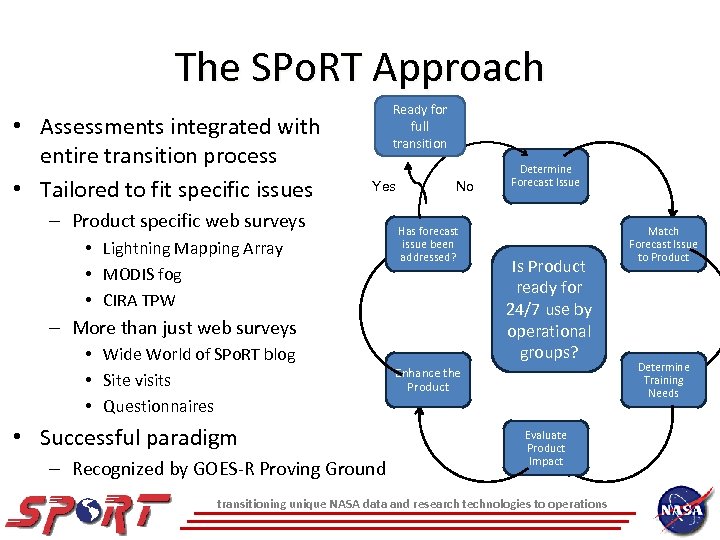 The SPo. RT Approach • Assessments integrated with entire transition process • Tailored to fit specific issues Ready for full transition Yes – Product specific web surveys • Lightning Mapping Array • MODIS fog • CIRA TPW No Has forecast issue been addressed? – More than just web surveys • Wide World of SPo. RT blog • Site visits • Questionnaires • Successful paradigm – Recognized by GOES-R Proving Ground Determine Forecast Issue Is Product ready for 24/7 use by operational groups? Enhance the Product Evaluate Product Impact transitioning unique NASA data and research technologies to operations Match Forecast Issue to Product Determine Training Needs
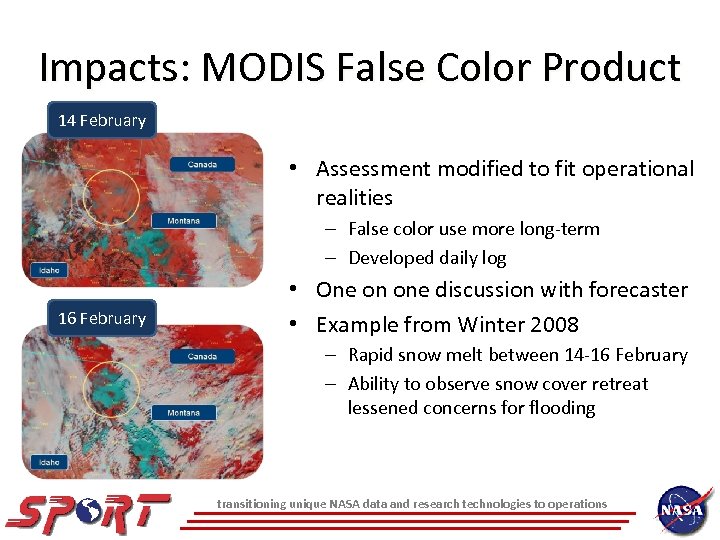 Impacts: MODIS False Color Product 14 February • Assessment modified to fit operational realities – False color use more long-term – Developed daily log 16 February • One on one discussion with forecaster • Example from Winter 2008 – Rapid snow melt between 14 -16 February – Ability to observe snow cover retreat lessened concerns for flooding transitioning unique NASA data and research technologies to operations
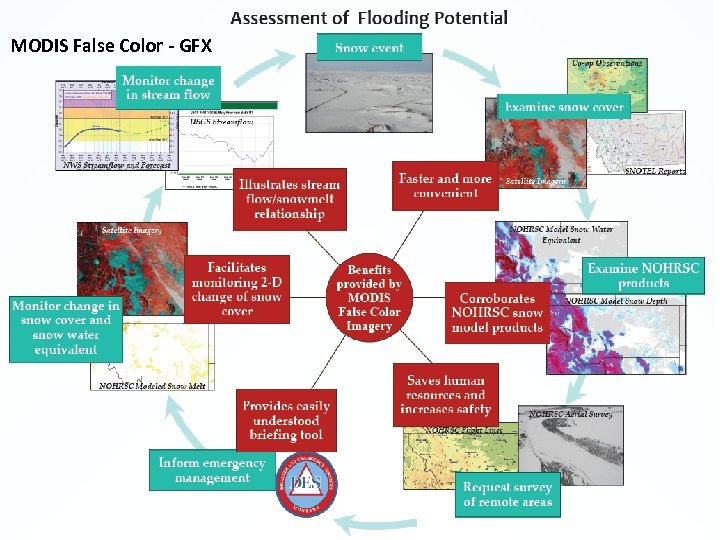 MODIS False Color - GFX • “saves time and resources while complimenting other products”
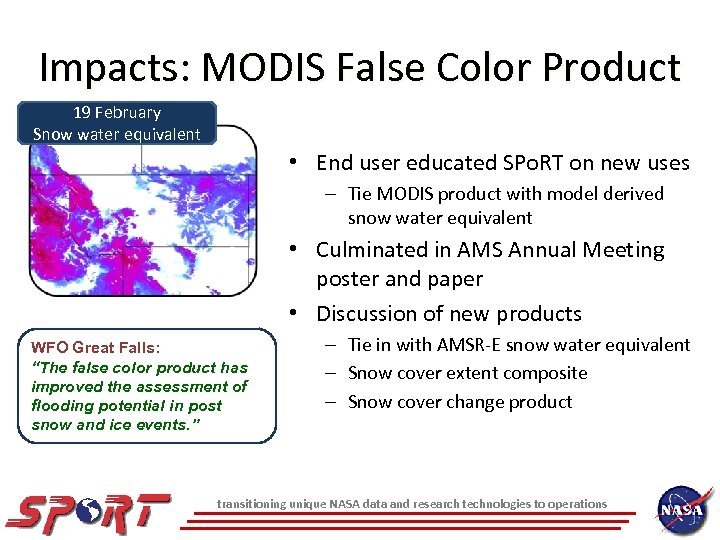 Impacts: MODIS False Color Product 19 February Snow water equivalent • End user educated SPo. RT on new uses – Tie MODIS product with model derived snow water equivalent • Culminated in AMS Annual Meeting poster and paper • Discussion of new products WFO Great Falls: “The false color product has improved the assessment of flooding potential in post snow and ice events. ” – Tie in with AMSR-E snow water equivalent – Snow cover extent composite – Snow cover change product transitioning unique NASA data and research technologies to operations
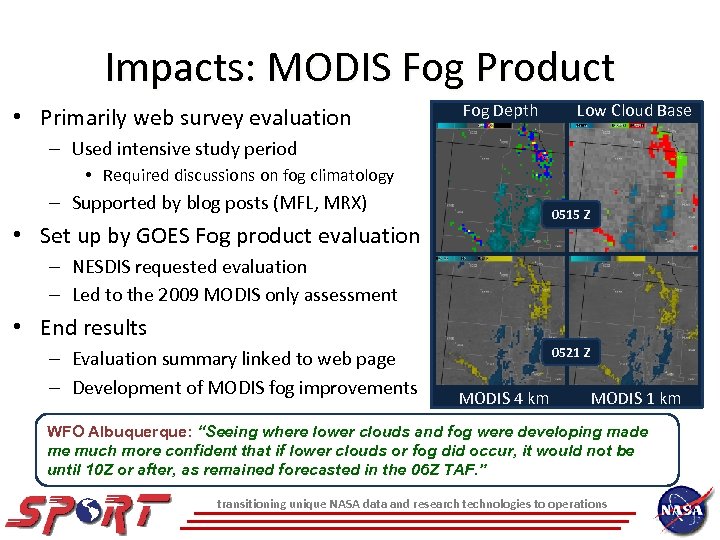 Impacts: MODIS Fog Product • Primarily web survey evaluation Fog Depth Low Cloud Base – Used intensive study period • Required discussions on fog climatology – Supported by blog posts (MFL, MRX) 0515 Z • Set up by GOES Fog product evaluation – NESDIS requested evaluation – Led to the 2009 MODIS only assessment • End results – Evaluation summary linked to web page – Development of MODIS fog improvements 0521 Z MODIS 4 km MODIS 1 km WFO Albuquerque: “Seeing where lower clouds and fog were developing made me much more confident that if lower clouds or fog did occur, it would not be until 10 Z or after, as remained forecasted in the 06 Z TAF. ” transitioning unique NASA data and research technologies to operations
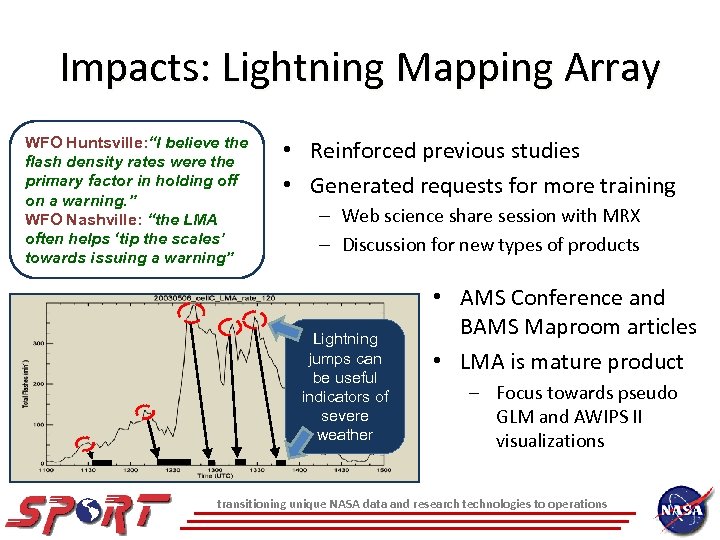 Impacts: Lightning Mapping Array WFO Huntsville: “I believe the flash density rates were the primary factor in holding off on a warning. ” WFO Nashville: “the LMA often helps ‘tip the scales’ towards issuing a warning” • Reinforced previous studies • Generated requests for more training – Web science share session with MRX – Discussion for new types of products Lightning jumps can be useful indicators of severe weather • AMS Conference and BAMS Maproom articles • LMA is mature product – Focus towards pseudo GLM and AWIPS II visualizations transitioning unique NASA data and research technologies to operations
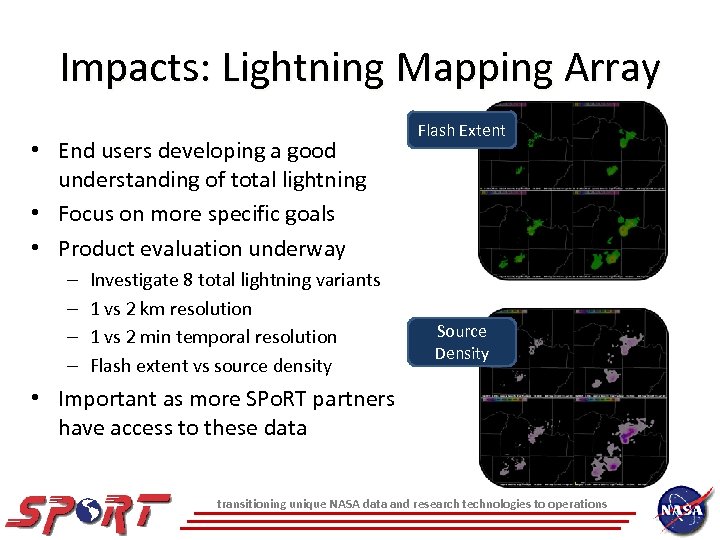 Impacts: Lightning Mapping Array • End users developing a good understanding of total lightning • Focus on more specific goals • Product evaluation underway – – Investigate 8 total lightning variants 1 vs 2 km resolution 1 vs 2 min temporal resolution Flash extent vs source density Flash Extent Source Density • Important as more SPo. RT partners have access to these data transitioning unique NASA data and research technologies to operations
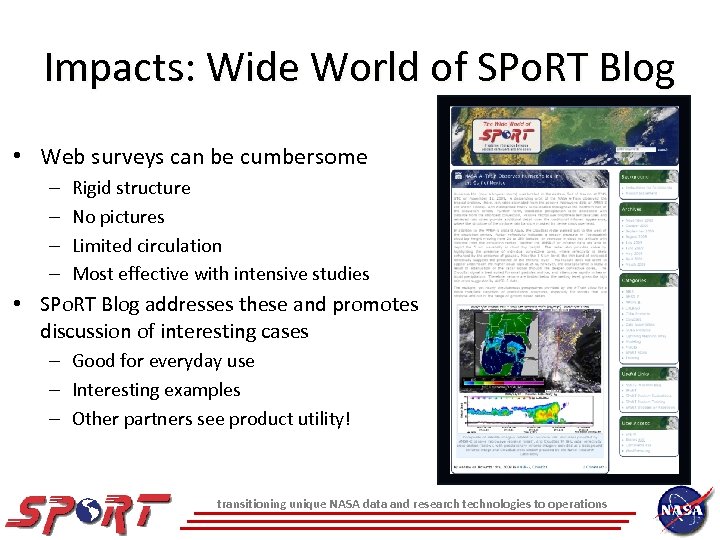 Impacts: Wide World of SPo. RT Blog • Web surveys can be cumbersome – – Rigid structure No pictures Limited circulation Most effective with intensive studies • SPo. RT Blog addresses these and promotes discussion of interesting cases – Good for everyday use – Interesting examples – Other partners see product utility! transitioning unique NASA data and research technologies to operations
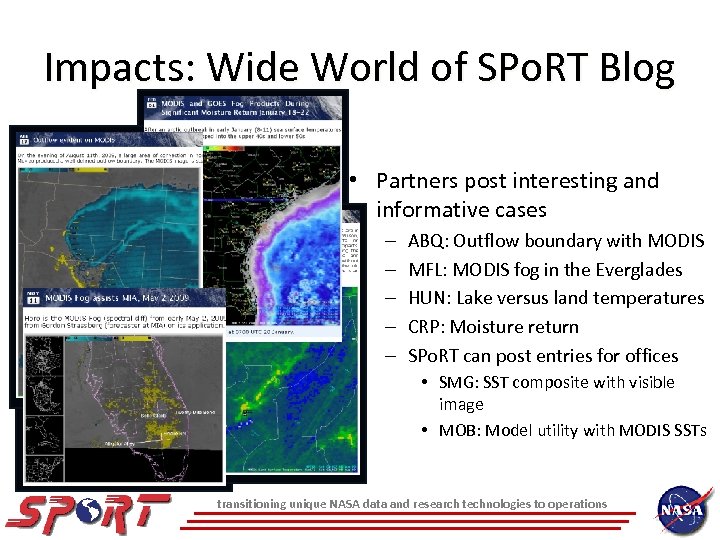 Impacts: Wide World of SPo. RT Blog • Partners post interesting and informative cases – – – ABQ: Outflow boundary with MODIS MFL: MODIS fog in the Everglades HUN: Lake versus land temperatures CRP: Moisture return SPo. RT can post entries for offices • SMG: SST composite with visible image • MOB: Model utility with MODIS SSTs transitioning unique NASA data and research technologies to operations
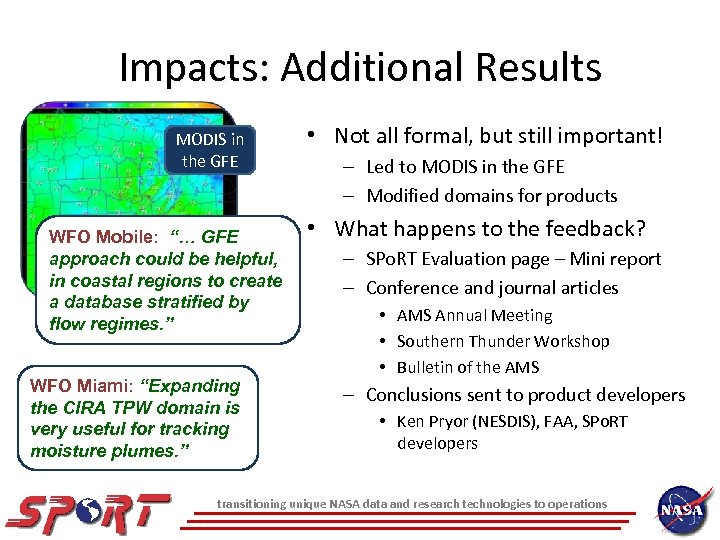 Impacts: Additional Results MODIS in the GFE WFO Mobile: “… GFE approach could be helpful, in coastal regions to create a database stratified by flow regimes. ” WFO Miami: “Expanding the CIRA TPW domain is very useful for tracking moisture plumes. ” • Not all formal, but still important! – Led to MODIS in the GFE – Modified domains for products • What happens to the feedback? – SPo. RT Evaluation page – Mini report – Conference and journal articles • AMS Annual Meeting • Southern Thunder Workshop • Bulletin of the AMS – Conclusions sent to product developers • Ken Pryor (NESDIS), FAA, SPo. RT developers transitioning unique NASA data and research technologies to operations
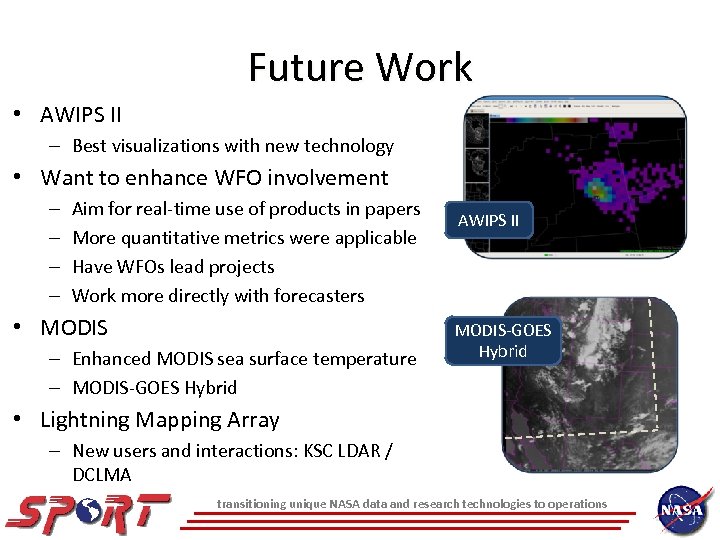 Future Work • AWIPS II – Best visualizations with new technology • Want to enhance WFO involvement – – Aim for real-time use of products in papers More quantitative metrics were applicable Have WFOs lead projects Work more directly with forecasters • MODIS – Enhanced MODIS sea surface temperature – MODIS-GOES Hybrid AWIPS II MODIS-GOES Hybrid • Lightning Mapping Array – New users and interactions: KSC LDAR / DCLMA transitioning unique NASA data and research technologies to operations
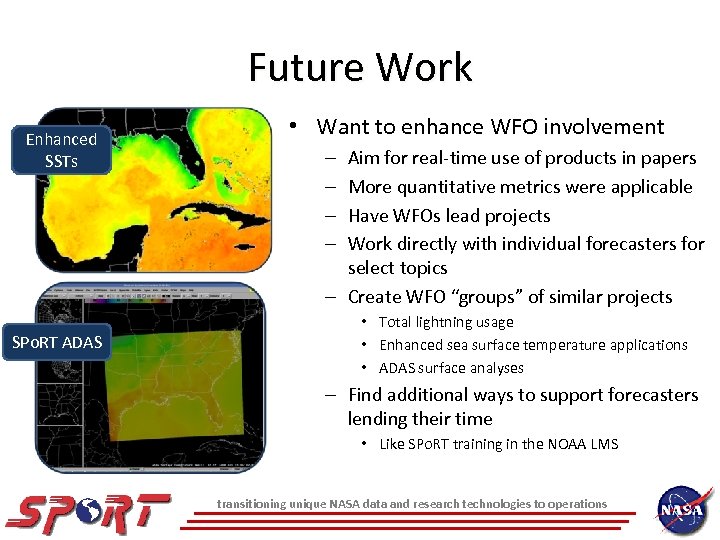 Future Work Enhanced SSTs SPo. RT ADAS • Want to enhance WFO involvement Aim for real-time use of products in papers More quantitative metrics were applicable Have WFOs lead projects Work directly with individual forecasters for select topics – Create WFO “groups” of similar projects – – • Total lightning usage • Enhanced sea surface temperature applications • ADAS surface analyses – Find additional ways to support forecasters lending their time • Like SPo. RT training in the NOAA LMS transitioning unique NASA data and research technologies to operations
 Questions? transitioning unique NASA data and research technologies to operations