


 Скачать презентацию SPL An Overview of the Standard June
eba24423ee6c9994a655a2be5030bbb1.ppt
- Количество слайдов: 41
 SPL – An Overview of the Standard June 2004 Sandy Boyer Co-editor, SPL Co-editor, CDA Co-chair, HL 7 Structured Documents TC slboyer@attglobal. net

 Who I Am n Pharmacist n Drug information specialist n HL 7 modeler
 What Does SPL Mean? SPL stands for Structured Product Labeling n “Labeling” n vs Label l aka Package Insert l aka Prescribing Information l aka Product Information l aka Summary of Product Characteristics l
 What is SPL? n n SPL is an HL 7 standard SPL is a document markup standard that specifies the structure and semantics for the regulatory requirements and content of product labeling l n n n Not just for drugs An SPL document can include text, images, sounds, and other multimedia content SPL is “based on” CDA SPL is intended to be used as the basis for regulatory guidance documents and tooling applications for exchange of product labeling documents
 Purpose of SPL n n Facilitate provision of product labeling content both electronically and in human readable format Improve dissemination of product labeling l n n Timeliness is critical re risk management Facilitate more efficient evaluation of labeling changes, section-by-section Promote more coordinated data collection throughout regulatory agency l l Improve processing, storage, and archiving capabilities Reduce or eliminate redundancies
 Purpose of SPL (cont. ) n Improve access to information and enhance ability to query and report on content of labeling l n n e. g. , for sub-population analysis Improve interoperability of regulatory agency systems with other clinical info systems Use standards to improve integration of data Enhance patient safety by improving provider access to information Support retention of legacy labeling
 Scope of SPL Standardization of the markup of the content of product labeling documents for the purpose of review, editing, storage, dissemination, analysis, decisionsupport, and other re-use n n SPL does not specify the creation of management of documents Although document management is critically interdependent, the specification of document management is outside the scope
 The Problem We’re Trying to Solve n Authoring, updating and storage at manufacturer, regulatory agency n Dissemination n Re-use of labeling content; data analysis
 What is Gained By Adding Markup to Labeling Documents n Allows us to get at the rich data that are buried in the narrative for the purpose of: l l l n Access/portability/exchange l n Re-use Analysis (e. g. , sub-population analysis) Clinical guidelines query/locate by drug name, manufacturer Integration l l multiple products or manufacturers with decision support
 Why XML? n n n Application independent Preserves human readability of documents Semantic markup of documents facilitates machine processability, e. g. : l l l Extraction Storage in a database Re-use (including combination from multiple sources) Interchange Automation Re-ordering
 Adding XML markup is easy – why use information standards? Interoperability
 Why HL 7 and V 3? n Focus on healthcare n Information model n International open standard l Significant international participation n Widespread support by users, policy makers and suppliers n Proven, consensus-based approach to development
 What is HL 7? HL 7 is a volunteer, ANSI-accredited Standards Developing Organization (SDO) that focuses on clinical and administrative healthcare data. Mission: "To provide standards for the exchange, management and integration of data that support clinical patient care and the management, delivery and evaluation of healthcare services. Specifically, to create flexible, cost effective approaches, standards, guidelines, methodologies, and related services for interoperability between healthcare information systems. “ “Health Level Seven develops specifications, the most widely used being a messaging standard that enables disparate healthcare applications to exchange keys sets of clinical and administrative data. ” Website: www. hl 7. org Phone: 734 -677 -7777
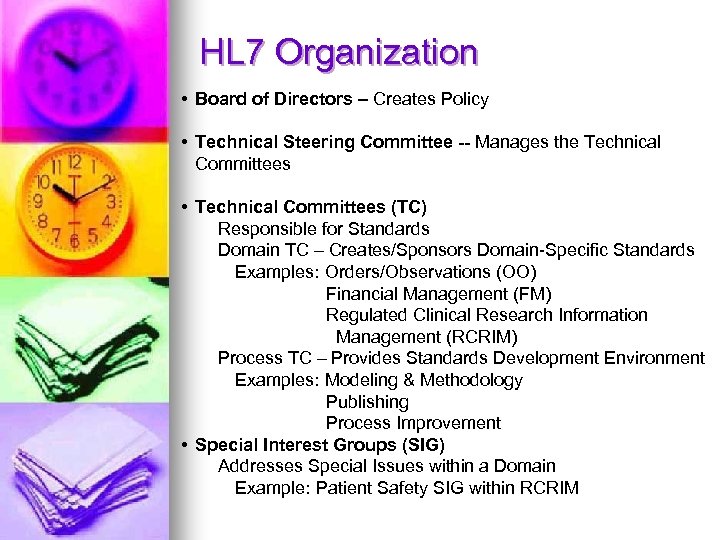 HL 7 Organization • Board of Directors – Creates Policy • Technical Steering Committee -- Manages the Technical Committees • Technical Committees (TC) Responsible for Standards Domain TC – Creates/Sponsors Domain-Specific Standards Examples: Orders/Observations (OO) Financial Management (FM) Regulated Clinical Research Information Management (RCRIM) Process TC – Provides Standards Development Environment Examples: Modeling & Methodology Publishing Process Improvement • Special Interest Groups (SIG) Addresses Special Issues within a Domain Example: Patient Safety SIG within RCRIM
 RCRIM (Regulated Clinical Research Information Management) • Mission “The work of this committee will facilitate the development of common standards for clinical research information management across a variety of organizations -- including government agencies (FDA, CDC, NIH), private research efforts, and sponsored research -- and thus the availability of safe and effective therapies by improving the processes and efficiencies associated with regulated clinical research. ” • Goal Develop standards for interchange of regulated data that are interoperable with general healthcare standards.
 HL 7 has a number of standards to choose from – why choose CDA?
 What is CDA? n HL 7 document markup standard for clinical documents n Exchange standard (“one transformation away from exchange”) n Permits migration to more granular markup as needed and as technology and expertise permits n Supports patient care n Ensures both human readability and machine processability n Facilitates integration with other healthcare documents n Extensive international acceptance
 Why is SPL Based on CDA? n Facilitates exchange of labeling documents n Preserves human readability while adding semantic markup and coding to facilitate machine processability of content n Flexible structure n Extensible to additional document types
 Labeling Requirements Authoring and storage n Dissemination n Standard format – regulations, sample package insert n Document sections l Coded elements l Standard elements and figures within narrative text l Metadata n Modular updating, version tracking n
 The Best Things About SPL n SPL markup maintains human readability while providing machine processability n SPL allows scalable implementation of document markup n SPL is flexible – e. g. , doesn’t impose naming or nesting of sections n SPL markup facilitates exchange of product labeling documents l l n Local tag names can be mapped to SPL “One transformation away from exchange” SPL facilitates modular handling of document sections
 Using SPL allows us to bite off what we can chew Over time, more structured data will be modeled and added (“start simple and build on that”) There is no need to start over every time the markup gets more granular
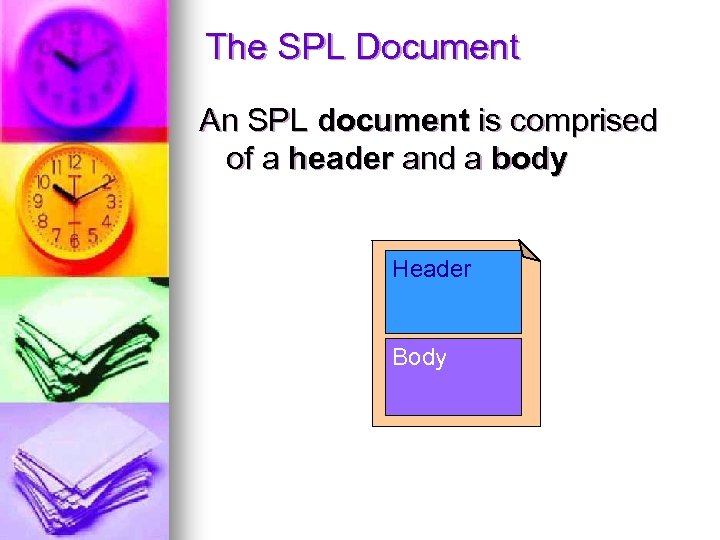 The SPL Document An SPL document is comprised of a header and a body Header Body
 The SPL Document n SPL Header identifies and classifies the document and may provide information on the owner of the marketing authority, the author, legal authenticator, and reviewers n CDA Body contains the product labeling content itself
 SPL Header – Purpose The SPL Header is constant across all SPL documents. Its purpose is to: Enable product labeling storage and exchange across and within institutions l Facilitate document management l Set context for the rest of the document l
 Structured (XML) Body Contains one or more sections n Sections contain the human readable content (called the narrative block) n Sections can contain body structures that encode content for computer processing n Sections can contain multimedia n
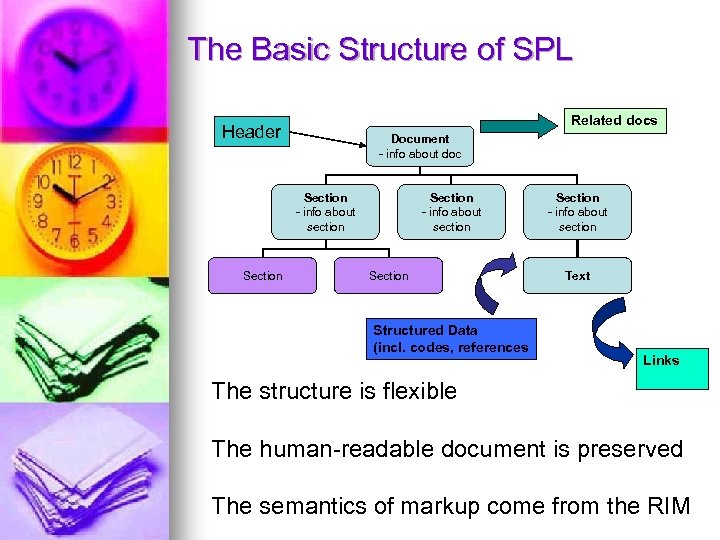 The Basic Structure of SPL Related docs Header Document - info about doc Section - info about section Section Structured Data (incl. codes, references Section - info about section Text Links The structure is flexible The human-readable document is preserved The semantics of markup come from the RIM
 Relationship Between SPL Data Elements and Narrative Block n SPL data elements sit outside the narrative n SPL elements can point into the narrative to which they apply
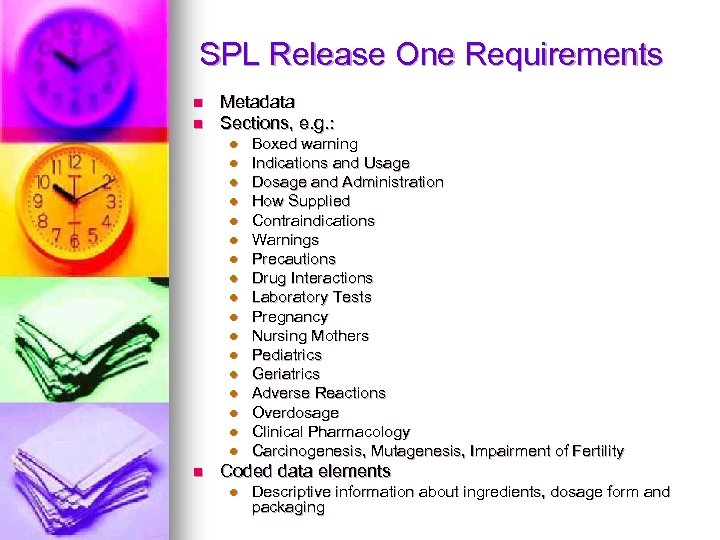 SPL Release One Requirements n n Metadata Sections, e. g. : l l l l l n Boxed warning Indications and Usage Dosage and Administration How Supplied Contraindications Warnings Precautions Drug Interactions Laboratory Tests Pregnancy Nursing Mothers Pediatrics Geriatrics Adverse Reactions Overdosage Clinical Pharmacology Carcinogenesis, Mutagenesis, Impairment of Fertility Coded data elements l Descriptive information about ingredients, dosage form and packaging
 There has been unusually broad input into development of SPL and supporting materials: n Content and technical experts within HL 7 (U. S. and international) n Industry n Vendors n FDA



 Development of SPL n Involved content and technical experts n Document analysis l n Requirements analysis l n e. g. , Sample PIs, Proposed Rule e. g. , Modular updating Model construction, starting with HL 7 RIM l The ballot package n n Schemas (including data types, vocabulary, narrative block, sample) Specification n Balloting n Harmonization
 HL 7 Ballot Process BALLOT (VOTING) PERIODS 3 TIMES PER YEAR BALLOT RECONCILIATION All negatives addressed NORMAL BALLOT PROGRESSION Each Standard is first balloted at “Committee Level” Reballoted at committee level until passed with no substantive changes Each Standard then balloted at “Membership Level” Higher hurdle for passage Reballoted at membership level until passed with no substantive changes Standard submitted to ANSI as an HL 7 Standard
 Status n HL 7 SPL has completed HL 7 membership level ballot l Stylesheet development l Implementation Guide development l n Regulatory l l Final rule re submission of labeling in electronic format – Federal Register, December 11, 2003 Draft guidance re use of SPL for content of labeling – Federal Register, February 5, 2004
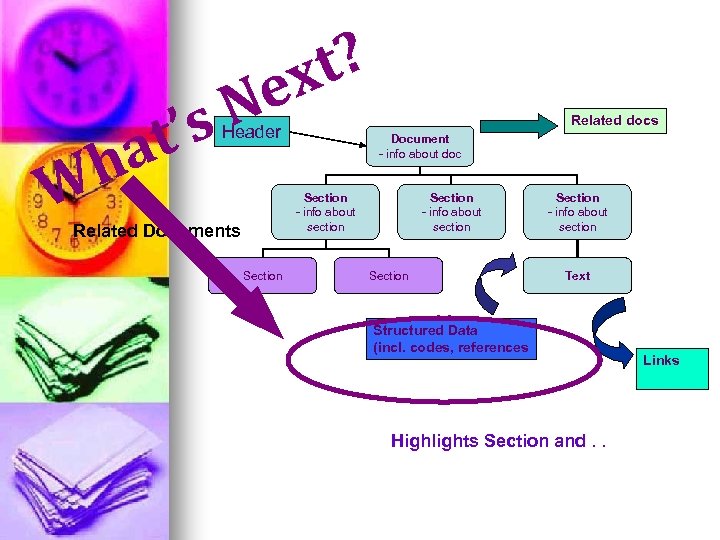 W at h N ’s t? ex Header Related docs Document - info about doc Section - info about section Related Documents Section - info about section Text Structured Data (incl. codes, references Highlights Section and. . Links
 Over time, more structured data will be modeled and added (“start simple and build on that”) There is no need to start over every time the markup gets more granular
 For More Details n Latest working draft of CDA; minutes of meetings; other documents l Structured Documents Technical Committee page on HL 7 web site (www. hl 7. org) n SPL and CDA ballots and other HL 7 V 3 ballots l www. hl 7. org
 An Invitation n How to get involved: l SPL: n Ph. RMA working group (Kris Spahr) n Contact editor (Sandy Boyer) n HL 7 RCRIM Technical Committee listserv CDA teleconferences l HL 7 listservs and meetings (see www. hl 7. org) l
 . . . thank you for your time (and your interest)