


 Скачать презентацию SPJ TONIGHT 7 p m Shoup Hall 207
03164e1c8972cd89fdd07cc36a22ff6b.ppt
- Количество слайдов: 46
 SPJ TONIGHT! 7 p. m. Shoup Hall 207 Tom Henderson, speaker JAMM 100 1
 Movies: Part II From Flickering Images to Hollywood Studios & Stars JAMM 100 2
 Technology Motion pictures combine: 1. Still photography 2. Persistence of vision 3. Projection of images JAMM 100 3
 Early technologies n Celluloid film stock – Goodwin, 1889, who sold patents to Eastman n Kinetograph and kinetoscope – Dickson and Edison, 1890 s n Projection system – Lumiere Brothers, 1895 n Vitascope – Edison, 1896 n Nickelodeons boomed 1907 - 10 JAMM 100 4
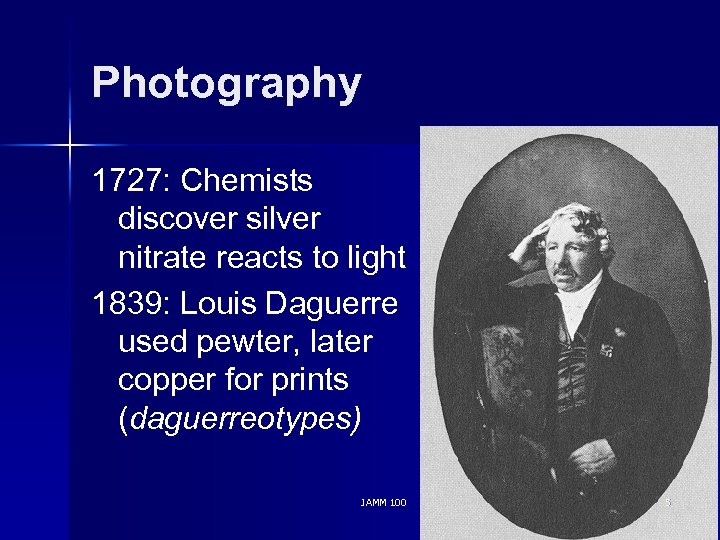 Photography 1727: Chemists discover silver nitrate reacts to light 1839: Louis Daguerre used pewter, later copper for prints (daguerreotypes) JAMM 100 5
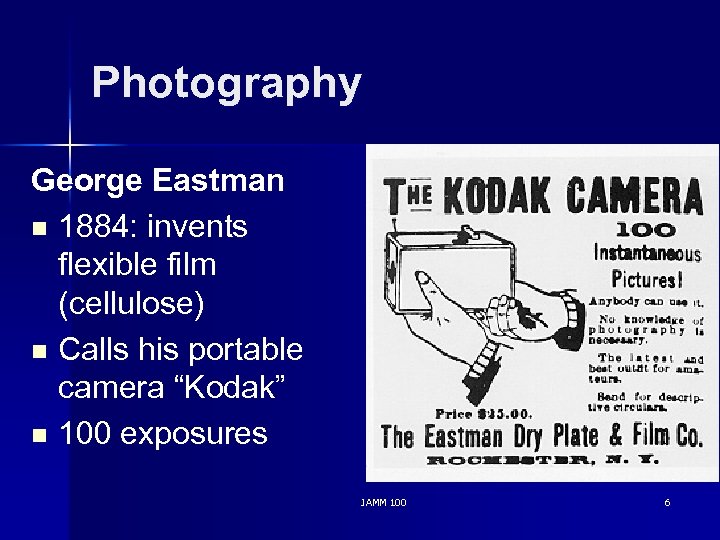 Photography George Eastman n 1884: invents flexible film (cellulose) n Calls his portable camera “Kodak” n 100 exposures JAMM 100 6
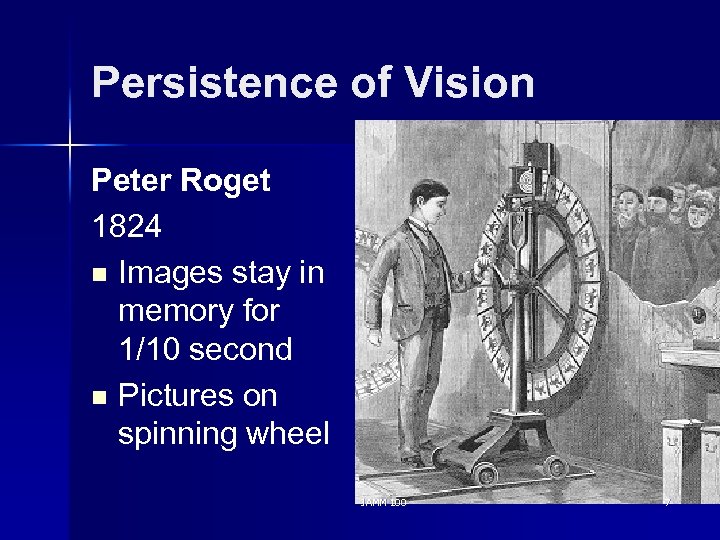 Persistence of Vision Peter Roget 1824 n Images stay in memory for 1/10 second n Pictures on spinning wheel JAMM 100 7
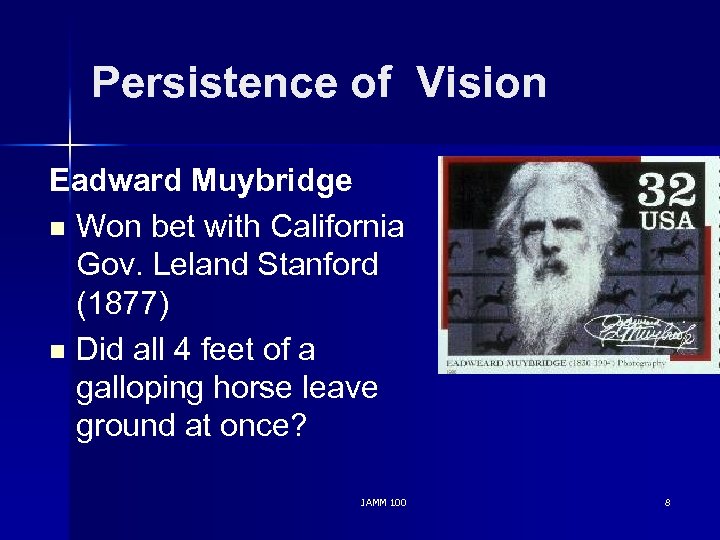 Persistence of Vision Eadward Muybridge n Won bet with California Gov. Leland Stanford (1877) n Did all 4 feet of a galloping horse leave ground at once? JAMM 100 8
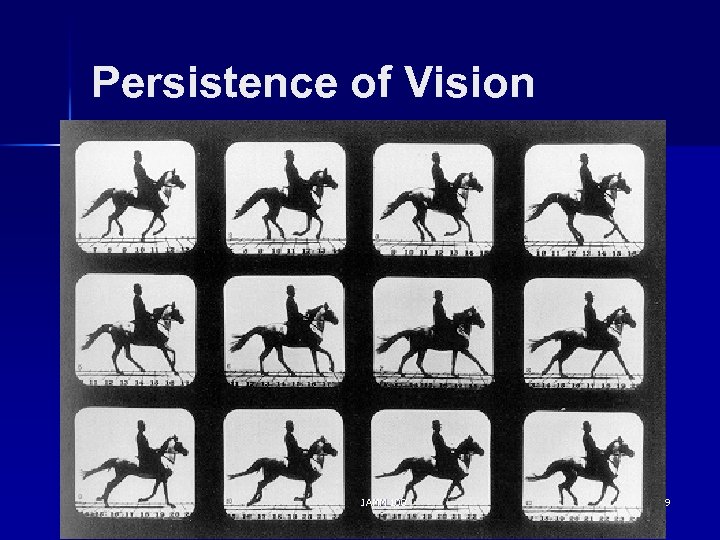 Persistence of Vision JAMM 100 9
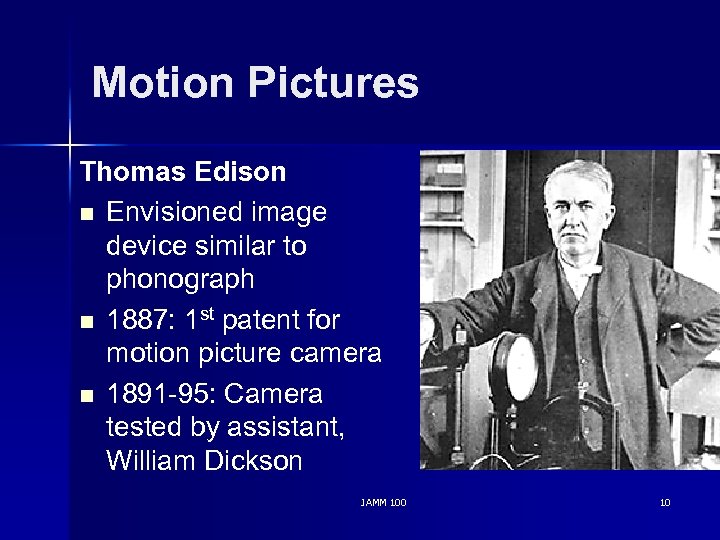 Motion Pictures Thomas Edison n Envisioned image device similar to phonograph n 1887: 1 st patent for motion picture camera n 1891 -95: Camera tested by assistant, William Dickson JAMM 100 10
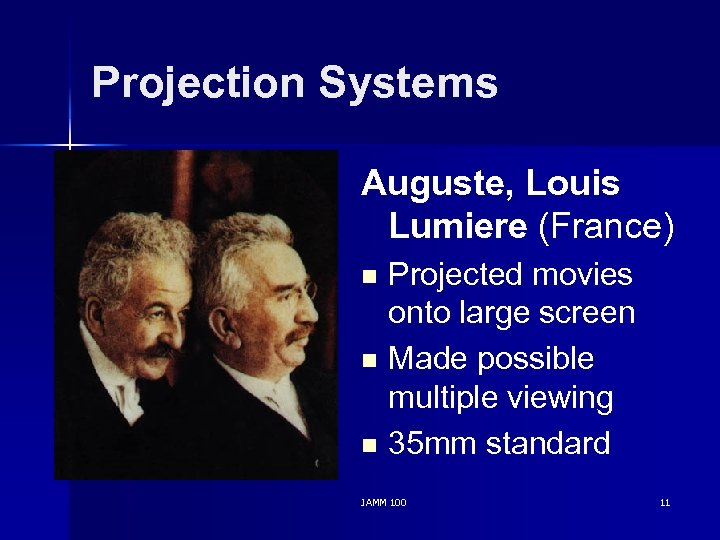 Projection Systems Auguste, Louis Lumiere (France) Projected movies onto large screen n Made possible multiple viewing n 35 mm standard n JAMM 100 11
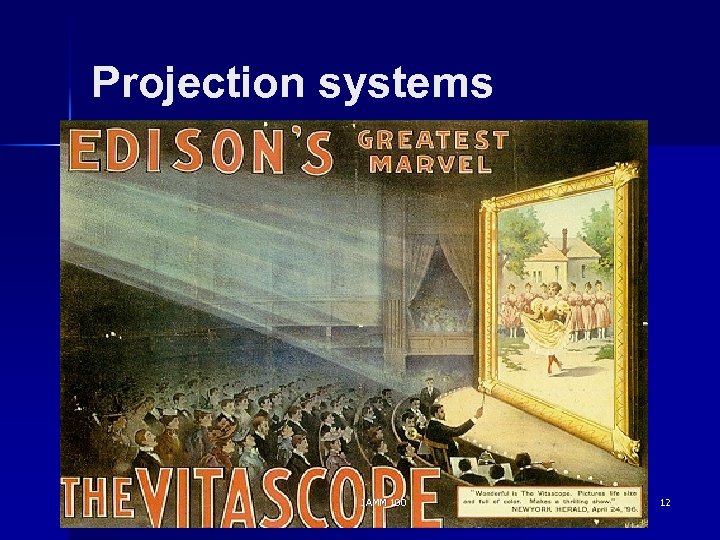 Projection systems JAMM 100 12
 Early film styles Lumiere Brothers in Paris shot documentary scenes of everyday life. n French magician Georges Melies: fairy tales and science fiction stories n American cameraman Edwin S. Porter created early narrative structures. n JAMM 100 13
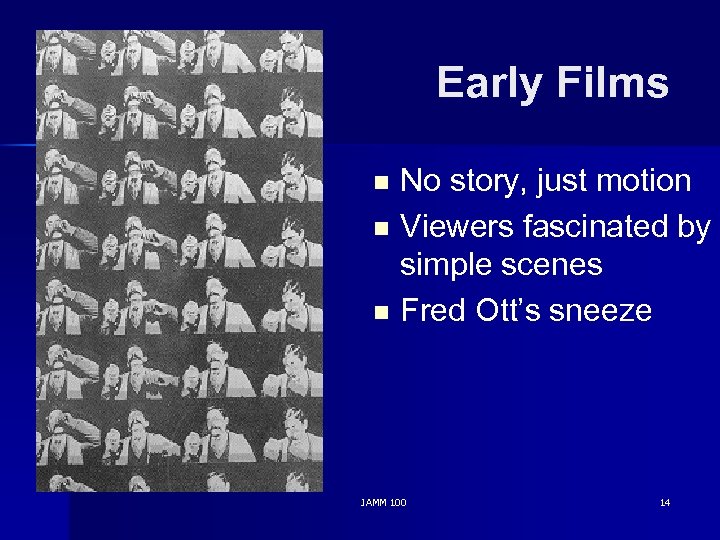 Early Films No story, just motion n Viewers fascinated by simple scenes n Fred Ott’s sneeze n JAMM 100 14
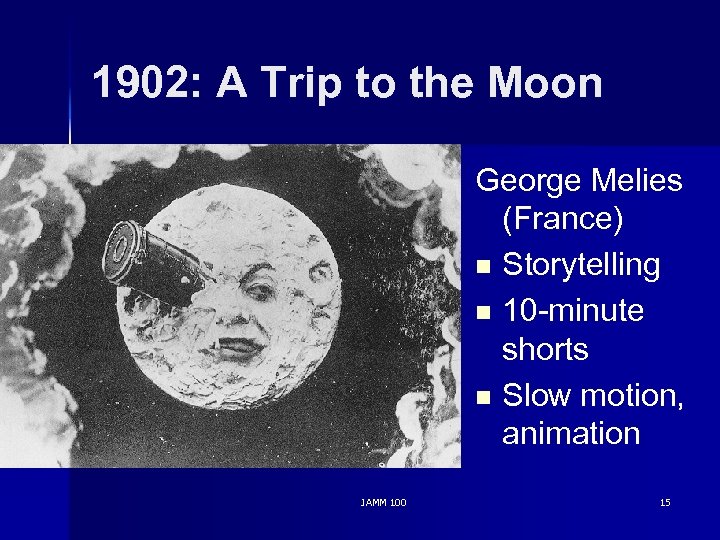 1902: A Trip to the Moon George Melies (France) n Storytelling n 10 -minute shorts n Slow motion, animation JAMM 100 15
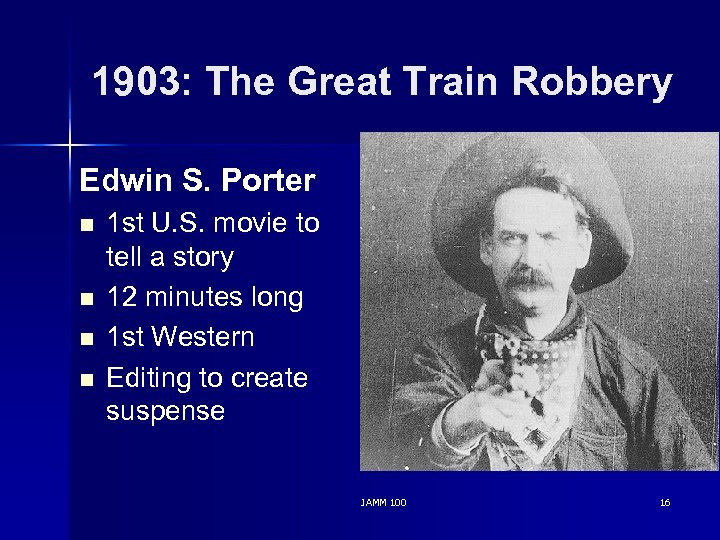 1903: The Great Train Robbery Edwin S. Porter n n 1 st U. S. movie to tell a story 12 minutes long 1 st Western Editing to create suspense JAMM 100 16
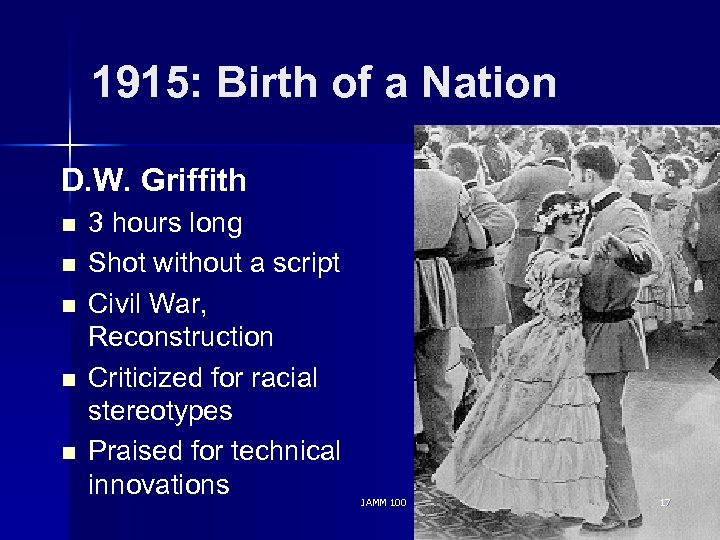 1915: Birth of a Nation D. W. Griffith n n n 3 hours long Shot without a script Civil War, Reconstruction Criticized for racial stereotypes Praised for technical innovations JAMM 100 17
 Three basic economic divisions of the movie industry PRODUCTION: camera and projector technology, scripting, filming n DISTRIBUTION: marketing and delivering films into theaters n EXHIBITION: theater industry that delivers movies to the public n JAMM 100 18
 Thomas Alva Edison, Inventor and Entrepreneur Desired control over all three facets of the motion picture industry-production, distribution, exhibition n His strategy: to gain control over n PATENTS to movie technology n How? Accused other inventors of violating his patents to tie them up in lawsuits. JAMM 100 19
 THE MOTION PICTURE PATENTS COMPANY (MPPC) Thomas Edison formed MPPC (the “Trust”) in 1908 as a Patents Pool. n Cooperative of leading U. S. and French film companies n Dominated the film industry from 1908 -1915 n JAMM 100 20
 How MPPC controlled the industry n Controlled (but did not own) means of production, distribution, and exhibition. n The MPPC was a monopoly (also called a trust), and excluded other film studios from the available technology. n Eastman sold film only to members JAMM 100 21
 WHY did the MPPC fail? n n n Could not meet product demand Independent producers bought film stock from overseas. Independent producers attracted viewers with longer feature films and recognizable stars. Independent distributors set up a non-MPPC distribution network. 1912 Antitrust case in Supreme Court (Fox) JAMM 100 22
 In 1915, by Supreme Court order, the MPPC disbanded. However, by that time, it had already fallen apart due to challenges of “independents. ” JAMM 100 23
 Who were these “independents”? n Ironically, the very same people who would institute a far more effective and longlived oligopoly to control the industry--the Hollywood Studio System JAMM 100 24
 THE RISE OF THE HOLLYWOOD STUDIO SYSTEM (1925 -1948) From Monopoly (the MPCC) to Oligopoly (the Studio System) JAMM 100 25
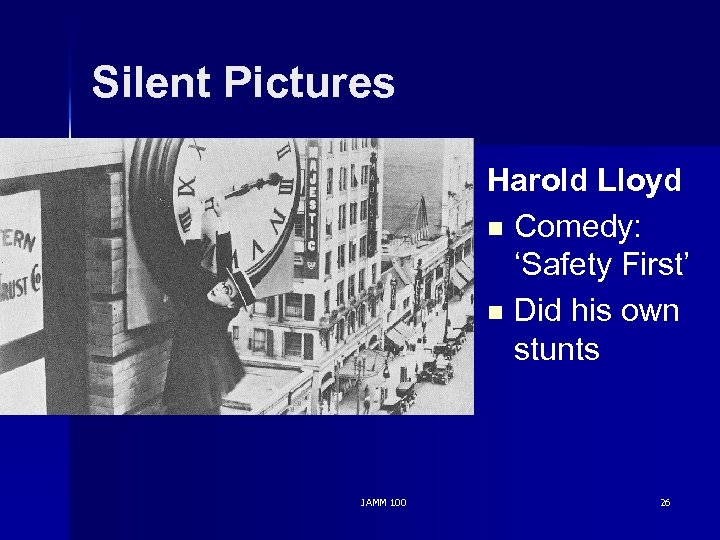 Silent Pictures Harold Lloyd n Comedy: ‘Safety First’ n Did his own stunts JAMM 100 26
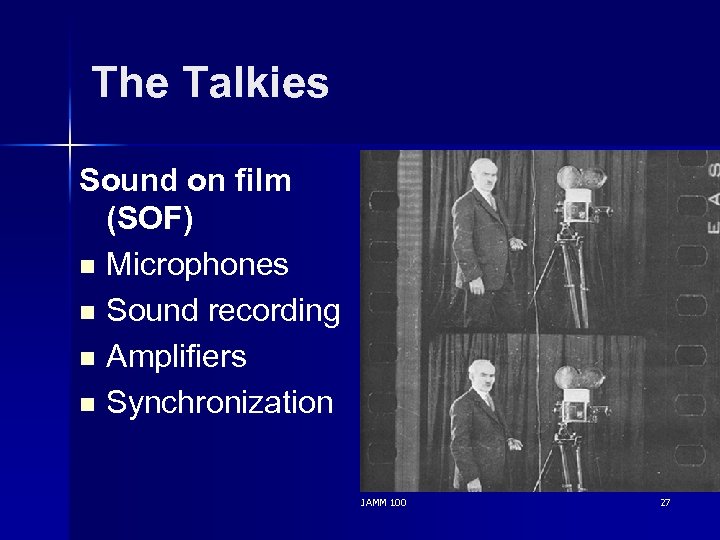 The Talkies Sound on film (SOF) n Microphones n Sound recording n Amplifiers n Synchronization JAMM 100 27
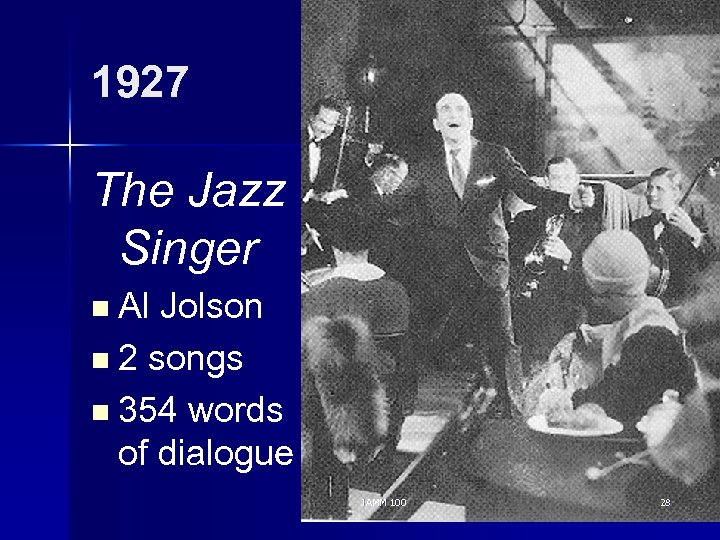 1927 The Jazz Singer n Al Jolson n 2 songs n 354 words of dialogue JAMM 100 28
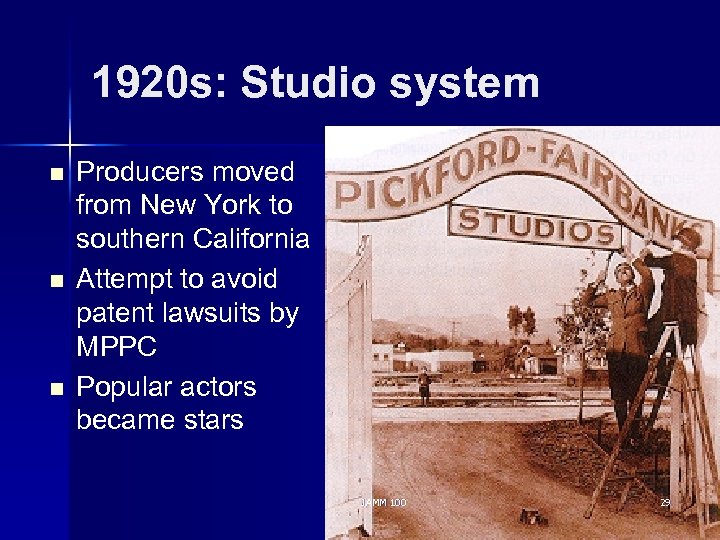 1920 s: Studio system n n n Producers moved from New York to southern California Attempt to avoid patent lawsuits by MPPC Popular actors became stars JAMM 100 29
 The “Big Five” and the “Little Three” n The “Big Five” or the Majors: – Warner Brothers – Paramount – 20 th Century Fox – Loew's (MGM) – RKO (owned by RCA) JAMM 100 n The “Little Three” or the Minors: – United Artists – Columbia – Universal 30
 Control over Production n Produced 60 percent of all U. S. feature films. n Produced 75 percent of "A" films (blockbusters). n Each of these studios produced about fifty movies a year. JAMM 100 31
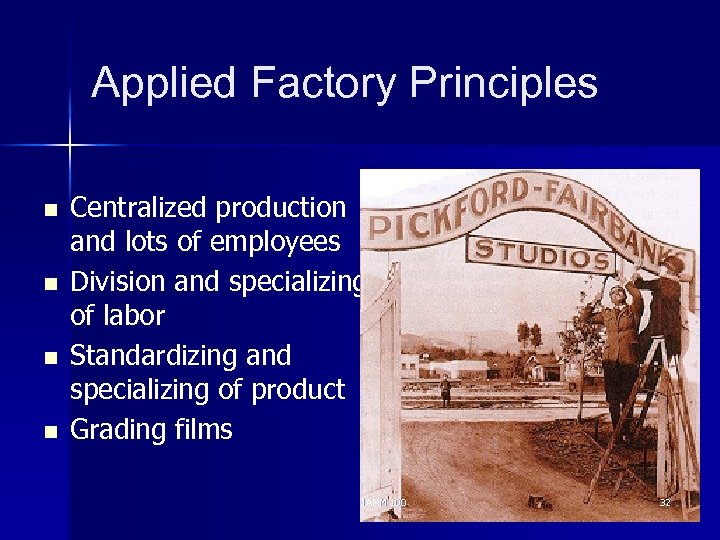 Applied Factory Principles n n Centralized production and lots of employees Division and specializing of labor Standardizing and specializing of product Grading films JAMM 100 32
 Control Over Distribution n Eight studios collected 95 percent of all national film rental fees. n Trade practices effectively closed the market to films made outside the studio system. n Block booking n Marketing U. S. films in Europe JAMM 100 33
 Control over exhibition n Studio ownership of theaters created a need for studios to produce films for them. n Much money was invested in the building of theaters themselves, especially movie palaces. JAMM 100 34
 How’d studios control exhibition? Studio-owned theaters (first-run): the studios owned only 15 percent of U. S. theaters, but 90 percent of nation's box office receipts n Movie palaces n Mid-city theatres n JAMM 100 35
 What went wrong? n No one reason : four large factors came together in late 1940 s – The Red Scare (The Hollywood Ten) – The Paramount Decision of 1948 – Postwar Changes in Society – The Rise of Television JAMM 100 36
 Red Scare and HUAC Hearings Cold War paranoia about Communist messages in mass entertainment n Congress formed House Un. American Activities Committee (HUAC) n 1941 and 1947 HUAC hearings were "witch hunts" to remove so-called subversives from the industry (led by Senator Joseph Mc. Carthy). n JAMM 100 37
 EFFECT OF HUAC HEARINGS Blacklisting of talented members of Hollywood community n Tarnished the Hollywood “Dream Machine” image n Created a climate of fear and dampened creativity within the industry n Wounds continue even today n JAMM 100 38
 THE PARAMOUNT DECISION In 1948, Supreme Court ruled studio violation of Sherman Anti-trust Act, restricting fair trade. n Court ordered the Big Five studios to divest their theater chains. n EFFECTS: studios cut their film production by half; opened the way for independent producers. * n JAMM 100 39
 Postwar changes in society Returning soldiers n Baby boom n Suburbanization and new lifestyle n Nuclear families with young children n Changing patterns of consumption n Less disposable income n Decreased attendance at downtown movie palaces n JAMM 100 40
 THE RISE OF TELEVISION Decline in motion picture attendance n Film industry’s technological gimmicks to emphasize the spectacle of the big screen n Film industry cooperation with TV n Movies on TV became a continuous competitor with theatre for film customers n JAMM 100 41
 HOLLYWOOD TODAY Marriage of TV and movies: watching movies now takes place on the home VCR and DVD player as well as at the box office. n New Hollywood studios produce TV shows as well as feature films. n Most new movies flop at the box office, but losses are recouped through video and DVD market. n JAMM 100 42
 Sources of studio income today n Box office revenues n Video/DVD sales and rentals n Distribution of films globally n Studio distribution of independent films n Product placement in movies JAMM 100 43
 The Modern Movie Oligopoly Warner Brothers n Paramount n Twentieth Century Fox n Universal n Columbia n Walt Disney n JAMM 100 44
 Concept of SYNERGY n n Synergy = the promotion and sale of a media product through the various subsidiaries of a media conglomerate. Movies, books, soundtrack CDs, magazine reviews, toy action figures, Tshirts, posters, web sites, newspapers, TV interviews, cartoons, etc. * JAMM 100 45
 For next class Television & the Power of Visual Culture n Read Chapters 5 & 6 n Complete Chapter 5 Review Questions 12 15, Questioning the Media 1, 3 & 5 n Complete Chapter 6 all Review Questions n Take online quizzes n Complete The Ratings Game exercise JAMM 100 46