


 Скачать презентацию Spin physics at PHENIX K Tanida RIKEN for
7690136feb542666bf33e731186bf7c8.ppt
- Количество слайдов: 21
 Spin physics at PHENIX K. Tanida (RIKEN) for the PHENIX collaboration 05/16/03 RHIC/AGS users meeting • • • Outline The goals of spin physics at PHENIX experiment Past: summary of the first run Present: status of the ongoing run Summary
 University of São Paulo, Brazil Academia Sinica, Taipei 11529, China Institute of Atomic Energy (CIAE), Beijing, P. R. China Laboratoire de Physique Corpusculaire (LPC), Universite de Clermont-Ferrand, F-63170 Aubiere, Clermont-Ferrand, France Dapnia, CEA Saclay, Bat. 703, F-91191, Gif-sur-Yvette, France IPN-Orsay, Universite Paris Sud, CNRS-IN 2 P 3, BP 1, F-91406, Orsay, France LPNHE-Palaiseau, Ecòle Polytechnique, CNRS-IN 2 P 3, Route de Saclay, F-91128, Palaiseau, France SUBATECH, Ecòle des Mines at Nantes, F-44307 Nantes, France University of Muenster, Germany Banaras Hindu University, Banaras, India Bhabha Atomic Research Centre (BARC), Bombay, India Weizmann Institute, Rehovot, Israel Center for Nuclear Study (CNS-Tokyo), University of Tokyo, Tanashi, Tokyo 188, Japan Hiroshima University, Higashi-Hiroshima 739, Japan KEK, Institute for High Energy Physics, Tsukuba, Japan Kyoto University, Kyoto, Japan Nagasaki Institute of Applied Science, Nagasaki-shi, Nagasaki, Japan RIKEN, Institute for Physical and Chemical Research, Hirosawa, Wako, Japan University of Tokyo, Bunkyo-ku, Tokyo 113, Japan Tokyo Institute of Technology, Ohokayama, Meguro, Tokyo, Japan University of Tsukuba, Japan Waseda University, Tokyo, Japan Cyclotron Application Laboratory, KAERI, Seoul, South Korea Kangnung National University, Kangnung 210 -702, South Korea University, Seoul, 136 -701, Korea Myong Ji University, Yongin City 449 -728, Korea System Electronics Laboratory, Seoul National University, Seoul, South Korea Yonsei University, Seoul 120 -749, KOREA Institute of High Energy Physics (IHEP-Protvino or Serpukhov), Protovino, Russia Joint Institute for Nuclear Research (JINR-Dubna), Dubna, Russia Kurchatov Institute, Moscow, Russia PNPI, St. Petersburg Nuclear Physics Institute, Gatchina, Leningrad, Russia Lund University, Lund, Sweden Abilene Christian University, Abilene, Texas, USA Brookhaven National Laboratory (BNL), Upton, NY 11973 University of California - Riverside (UCR), Riverside, CA 92521, USA Columbia University, Nevis Laboratories, Irvington, NY 10533, USA Florida State University (FSU), Tallahassee, FL 32306, USA Georgia State University (GSU), Atlanta, GA, 30303, USA Iowa State University (ISU) and Ames Laboratory, Ames, IA 50011, USA Los Alamos National Laboratory (LANL), Los Alamos, NM 87545, USA Lawrence Livermore National Laboratory (LLNL), Livermore, CA 94550, USA University of New Mexico, Albuquerque, New Mexico, USA New Mexico State University, Las Cruces, New Mexico, USA Department of Chemistry, State University of New York at Stony Brook (USB), Stony Brook, NY 11794, USA Department of Physics and Astronomy, State University of New York at Stony Brook (USB), Stony Brook, NY 11794, USA Oak Ridge National Laboratory (ORNL), Oak Ridge, TN 37831, USA University of Tennessee (UT), Knoxville, TN 37996, USA Vanderbilt University, Nashville, TN 37235, USA
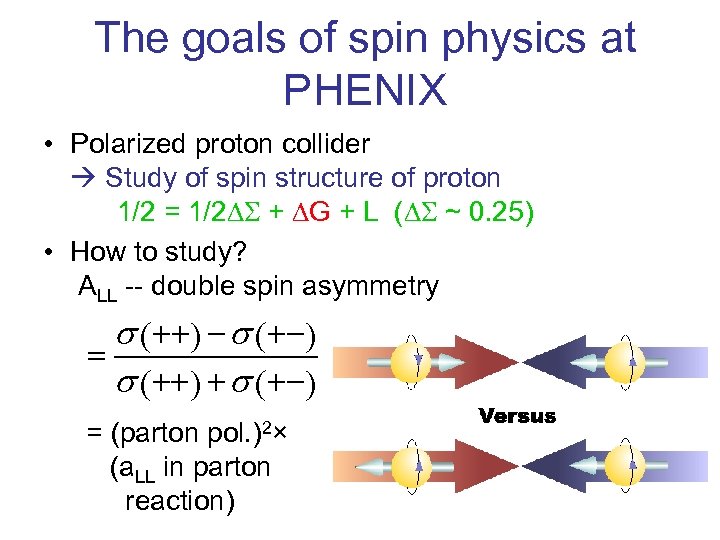 The goals of spin physics at PHENIX • Polarized proton collider Study of spin structure of proton 1/2 = 1/2 DS + DG + L (DS ~ 0. 25) • How to study? ALL -- double spin asymmetry s (++) - s (+-) = s (++) + s (+-) = (parton pol. )2× (a. LL in parton reaction)
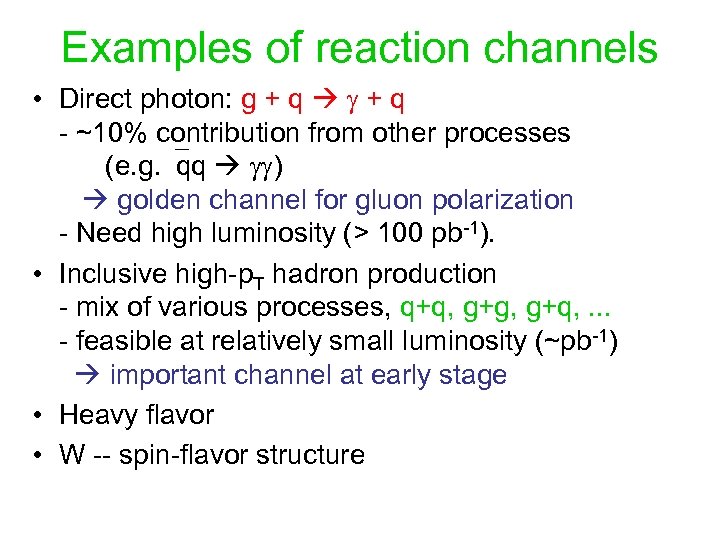 Examples of reaction channels • Direct photon: g + q - ~10% contribution from other processes (e. g. `qq gg) golden channel for gluon polarization - Need high luminosity (> 100 pb-1). • Inclusive high-p. T hadron production - mix of various processes, q+q, g+g, g+q, . . . - feasible at relatively small luminosity (~pb-1) important channel at early stage • Heavy flavor • W -- spin-flavor structure
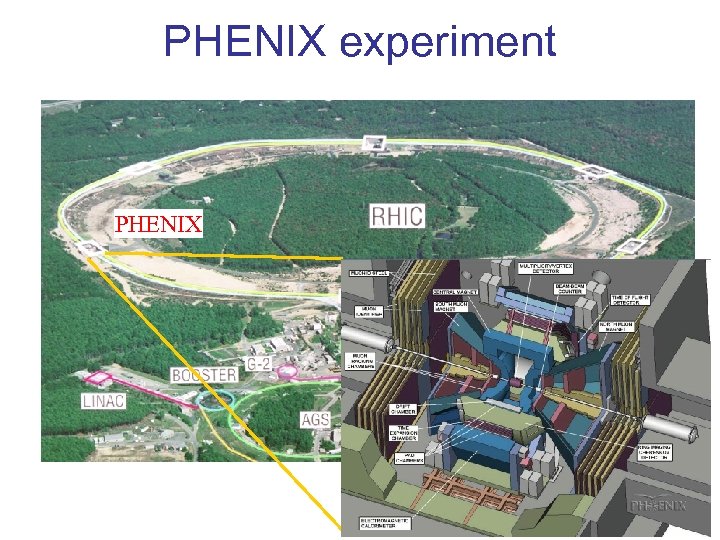 PHENIX experiment PHENIX
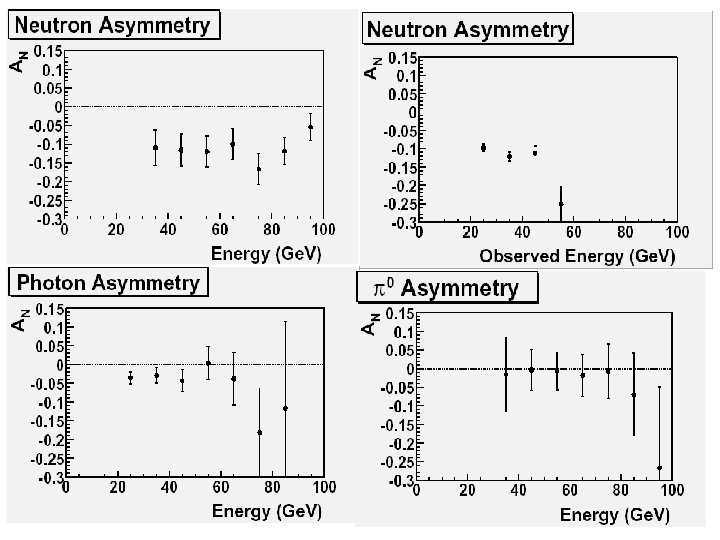
 Summary of the first run • Dec. 2001 - Jan. 2002 • sqrt(s) = 200 Ge. V • Beam polarization: ~15% ran with transverse polarization to measure AN • Integrated luminosity: 150 nb-1 • Development of Local Polarimeter - discovery of large AN in forward neutron production • Physics outputs: - p 0 cross section measurement - J/y cross section measurement -. . .
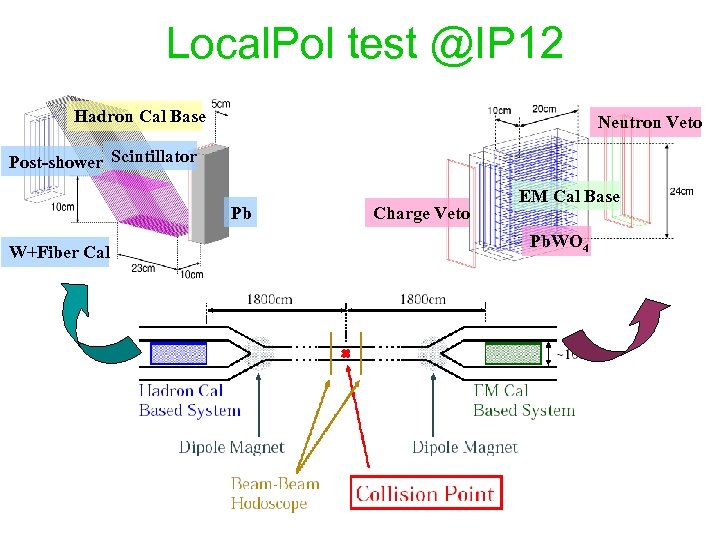 Local. Pol test @IP 12 Hadron Cal Base Neutron Veto Post-shower Scintillator Pb W+Fiber Cal Charge Veto EM Cal Base Pb. WO 4
 12 O’clock
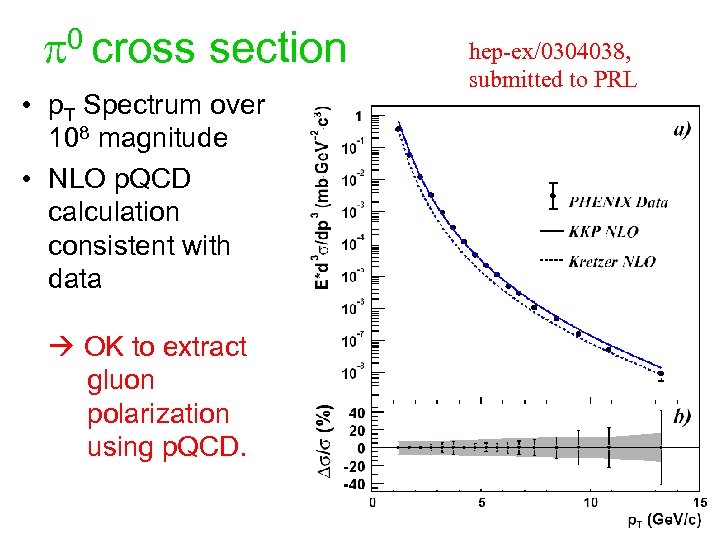 p 0 cross section • p. T Spectrum over 108 magnitude • NLO p. QCD calculation consistent with data OK to extract gluon polarization using p. QCD. hep-ex/0304038, submitted to PRL
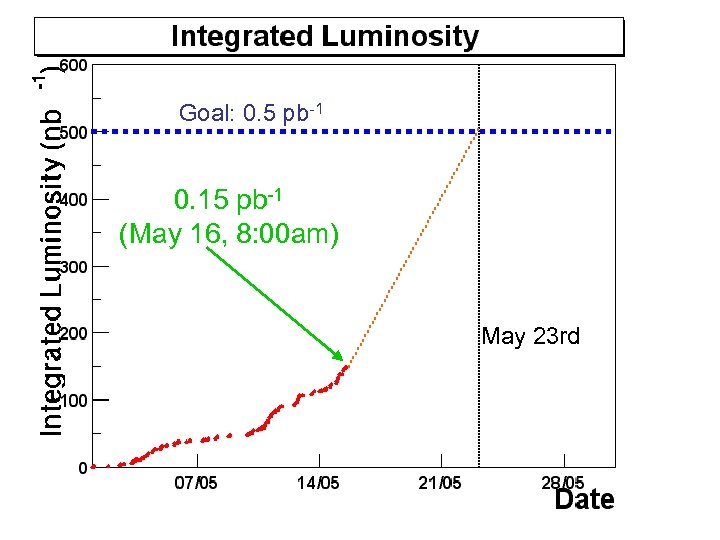
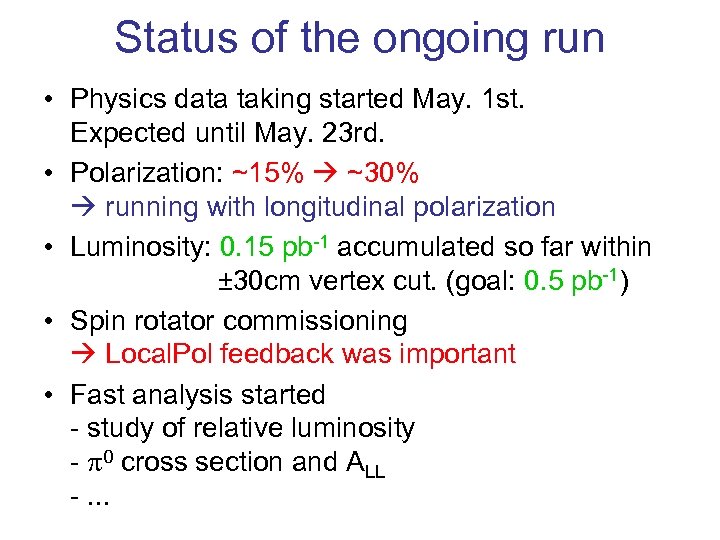 Status of the ongoing run • Physics data taking started May. 1 st. Expected until May. 23 rd. • Polarization: ~15% ~30% running with longitudinal polarization • Luminosity: 0. 15 pb-1 accumulated so far within ± 30 cm vertex cut. (goal: 0. 5 pb-1) • Spin rotator commissioning Local. Pol feedback was important • Fast analysis started - study of relative luminosity - p 0 cross section and ALL -. . .
 Goal: 0. 5 pb-1 0. 15 pb-1 (May 16, 8: 00 am) May 23 rd
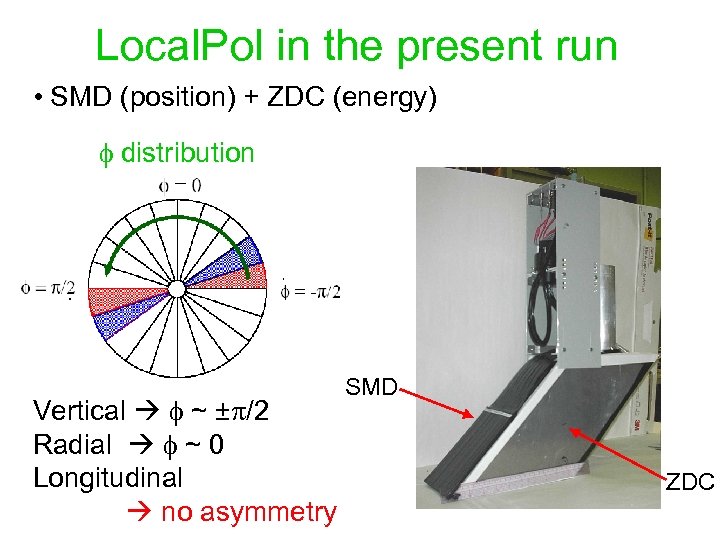 Local. Pol in the present run • SMD (position) + ZDC (energy) f distribution Vertical f ~ ±p/2 Radial f ~ 0 Longitudinal no asymmetry SMD ZDC
![Spin rotator commisioning Yellow Physics asymmetry [A. u. ] Blue f [rad] Vertical w/](https://present5.com/presentation/7690136feb542666bf33e731186bf7c8/image-13.jpg "Spin rotator commisioning Yellow Physics asymmetry [A. u. ] Blue f [rad] Vertical w/") Spin rotator commisioning Yellow Physics asymmetry [A. u. ] Blue f [rad] Vertical w/ rotator off (Apr. 12 th) f [rad]
Spin rotator commisioning Yellow Physics asymmetry [A. u. ] Blue f [rad] Vertical w/ rotator off (Apr. 12 th) f [rad]
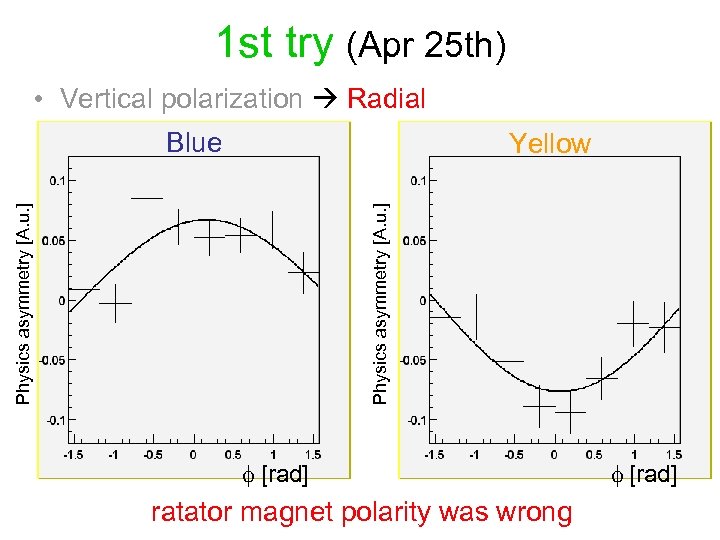 1 st try (Apr 25 th) • Vertical polarization Radial Blue Physics asymmetry [A. u. ] Yellow f [rad] ratator magnet polarity was wrong f [rad]
![4 th try (May. 1 st) Physics asymmetry [A. u. ] • Vertical polarization](https://present5.com/presentation/7690136feb542666bf33e731186bf7c8/image-15.jpg "4 th try (May. 1 st) Physics asymmetry [A. u. ] • Vertical polarization") 4 th try (May. 1 st) Physics asymmetry [A. u. ] • Vertical polarization Radial . . . Longitudinal Blue Yellow f [rad] PL/|P|=0. 99± 0. 01 OK f [rad]
4 th try (May. 1 st) Physics asymmetry [A. u. ] • Vertical polarization Radial . . . Longitudinal Blue Yellow f [rad] PL/|P|=0. 99± 0. 01 OK f [rad]
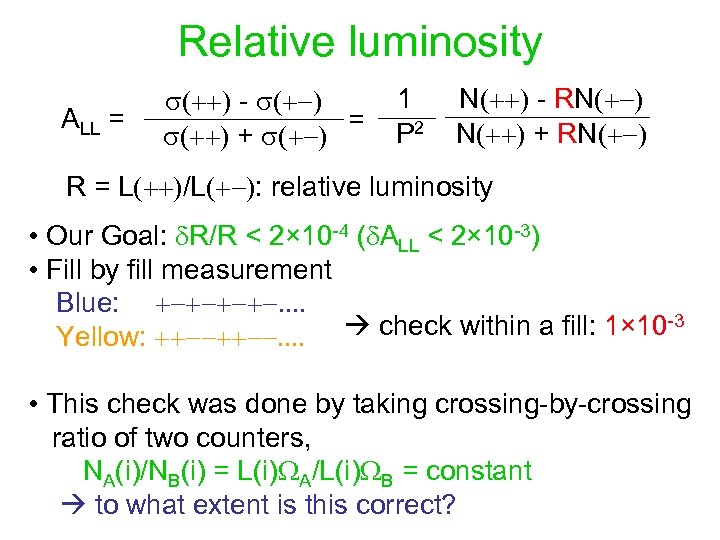 Relative luminosity ALL = s(++) - s(+-) = s(++) + s(+-) 1 P 2 N(++) - RN(+-) N(++) + RN(+-) R = L(++)/L(+-): relative luminosity • Our Goal: d. R/R < 2× 10 -4 (d. ALL < 2× 10 -3) • Fill by fill measurement Blue: +-+-. . check within a fill: 1× 10 -3 Yellow: ++--. . • This check was done by taking crossing-by-crossing ratio of two counters, NA(i)/NB(i) = L(i)WA/L(i)WB = constant to what extent is this correct?
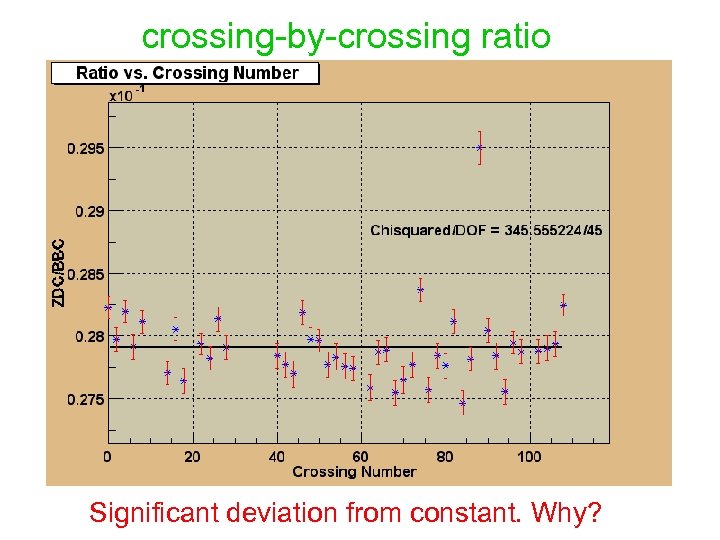 crossing-by-crossing ratio Significant deviation from constant. Why?
![Correlation with Z-vertex width [cm] We understand the reason now correction](https://present5.com/presentation/7690136feb542666bf33e731186bf7c8/image-18.jpg "Correlation with Z-vertex width [cm] We understand the reason now correction") Correlation with Z-vertex width [cm] We understand the reason now correction
Correlation with Z-vertex width [cm] We understand the reason now correction
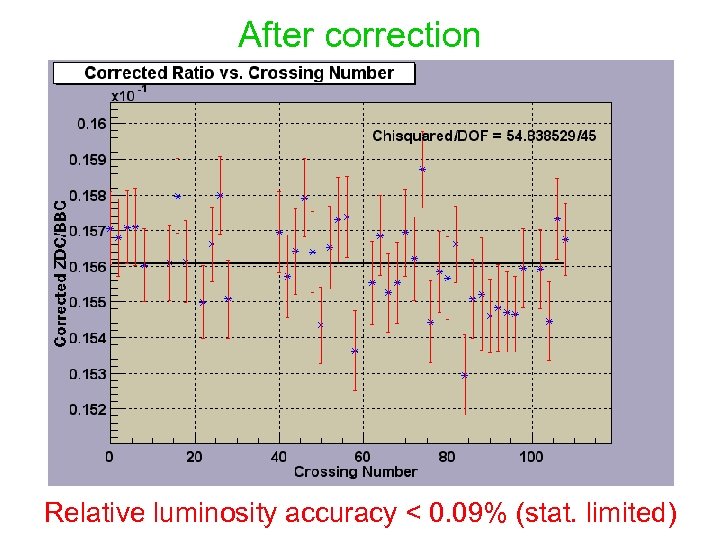 After correction Relative luminosity accuracy < 0. 09% (stat. limited)
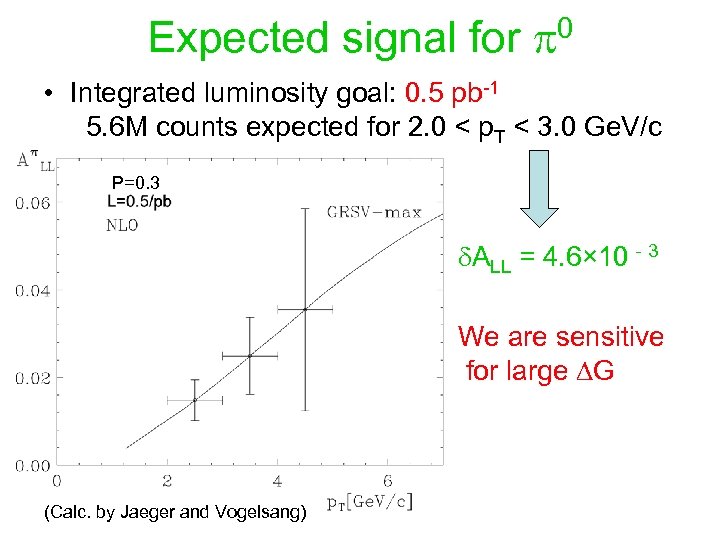 Expected signal for p 0 • Integrated luminosity goal: 0. 5 pb-1 5. 6 M counts expected for 2. 0 < p. T < 3. 0 Ge. V/c P=0. 3 d. ALL = 4. 6× 10‐ 3 We are sensitive for large DG (Calc. by Jaeger and Vogelsang)
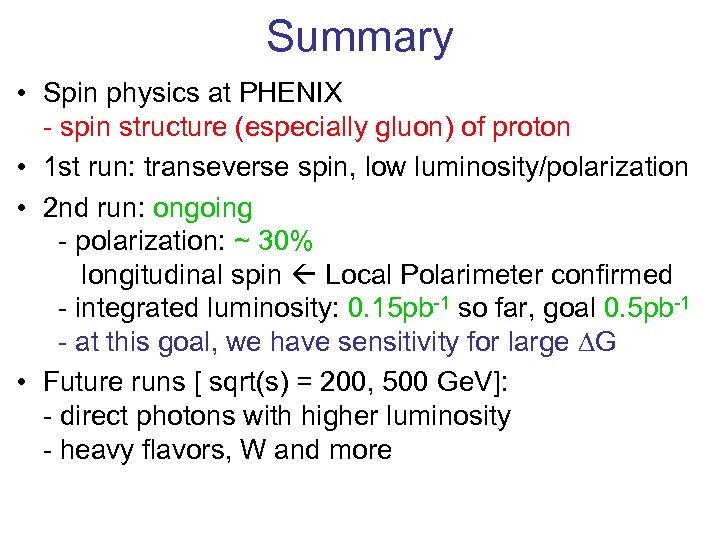 Summary • Spin physics at PHENIX - spin structure (especially gluon) of proton • 1 st run: transeverse spin, low luminosity/polarization • 2 nd run: ongoing - polarization: ~ 30% longitudinal spin Local Polarimeter confirmed - integrated luminosity: 0. 15 pb-1 so far, goal 0. 5 pb-1 - at this goal, we have sensitivity for large DG • Future runs [ sqrt(s) = 200, 500 Ge. V]: - direct photons with higher luminosity - heavy flavors, W and more