


 Скачать презентацию SPICA Status in Japan April 6 2010 T
dfde0a8aed4da7d8f063b1324f73faba.ppt
- Количество слайдов: 52
 SPICA Status in Japan April 6, 2010 T. Nakagawa (ISAS/JAXA)
 Goals of the meeting l To set up a common strategy to promote the assessment study of US-led instrument(s) efficiently l Key issues to be addressed l Unique capability to be enabled by US-led instrument(s) l l Especially complementarity with SAFARI Compatibility with stringent resource allocation
 Status of SPICA in Japan JAXA (and ISAS) regards SPICA as a very important mission which must be realized in the near future. l SPICA is officially in the "pre-project phase" at JAXA. This "pre-project" phase started in July 2008 with a period of three years. l Following reviewing and judgement processes by ISAS, JAXA plans to have a " SPICA phase up review “ toward the next phase(“ Project phase”) in FY 2011. l JAXA is planning to submit a budgetary proposal for SPICA with the target of launch in FY 2018 to the government this summer. l
 Our Scientific Goals Where are we from ? Are we alone ?
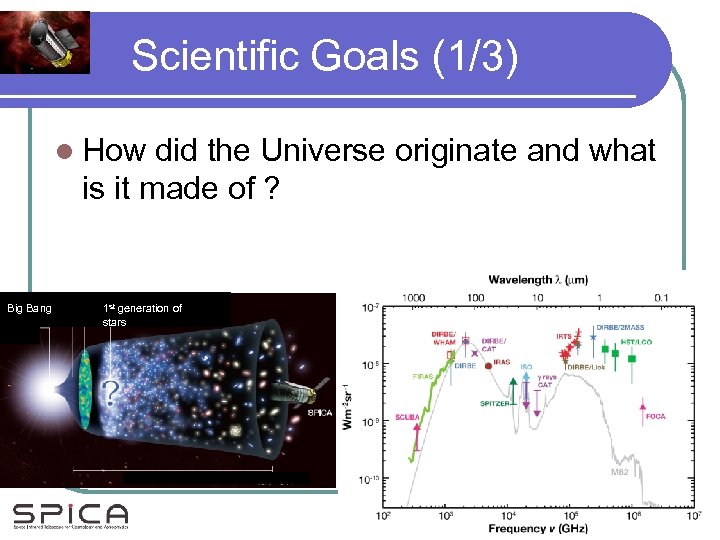 Scientific Goals (1/3) l How did the Universe originate and what is it made of ? Big Bang 1 st generation of stars
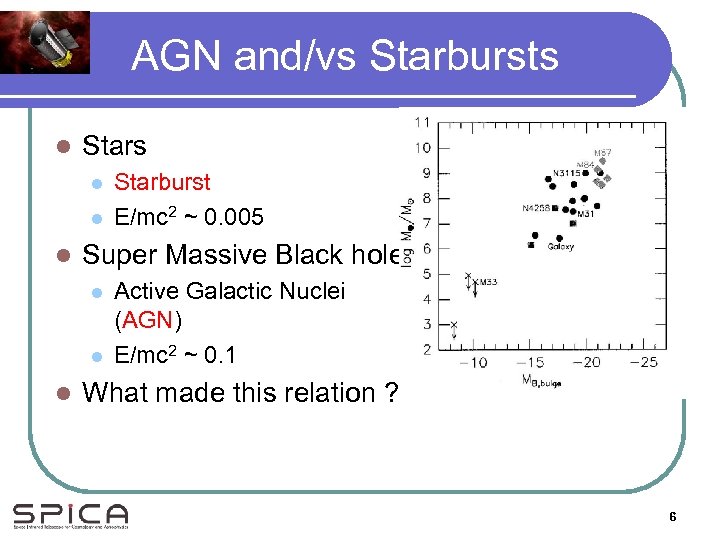 AGN and/vs Starbursts l Stars l l l Super Massive Black hole l l l Starburst E/mc 2 ~ 0. 005 Active Galactic Nuclei (AGN) E/mc 2 ~ 0. 1 What made this relation ? 6
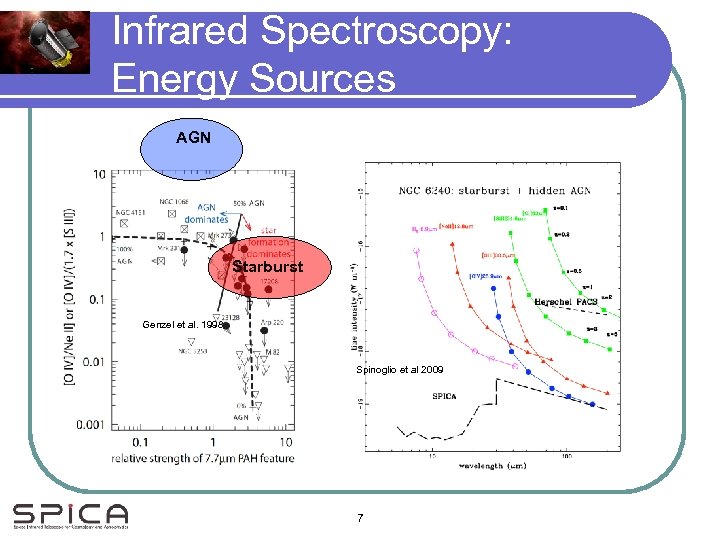 Infrared Spectroscopy: Energy Sources AGN Starburst Genzel et al. 1998 Spinoglio et al 2009 7
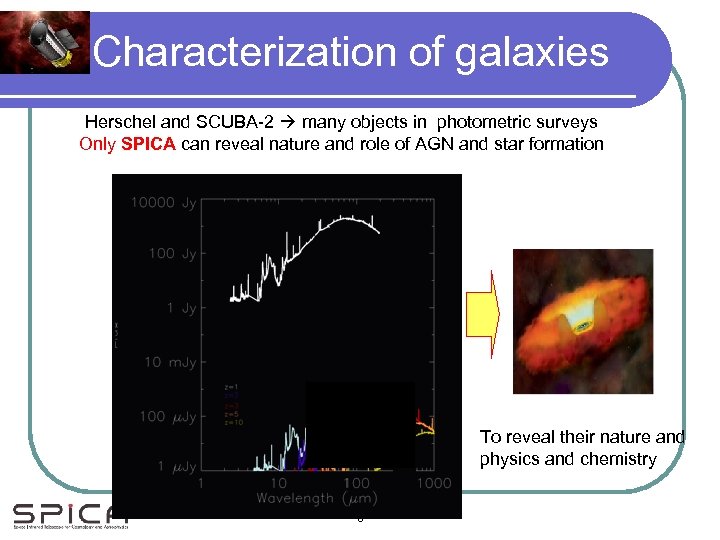 Characterization of galaxies Herschel and SCUBA-2 many objects in photometric surveys Only SPICA can reveal nature and role of AGN and star formation To reveal their nature and physics and chemistry 8
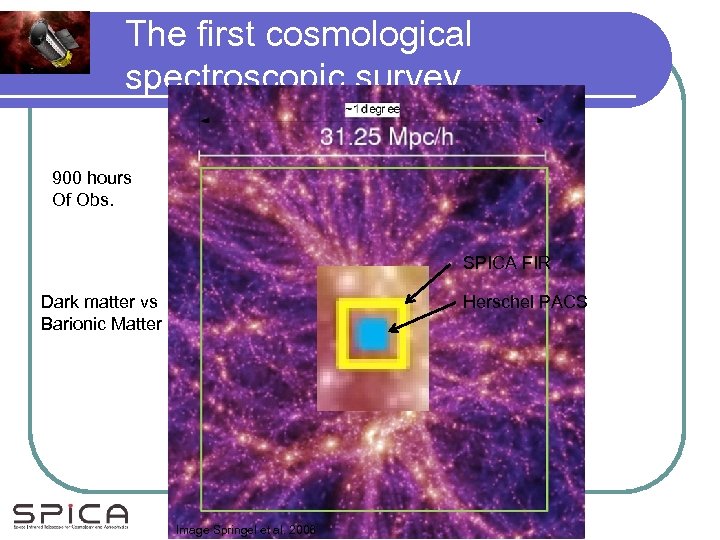 The first cosmological spectroscopic survey 900 hours Of Obs. SPICA FIR Dark matter vs Barionic Matter Herschel PACS Image Springel et al. 2006 9
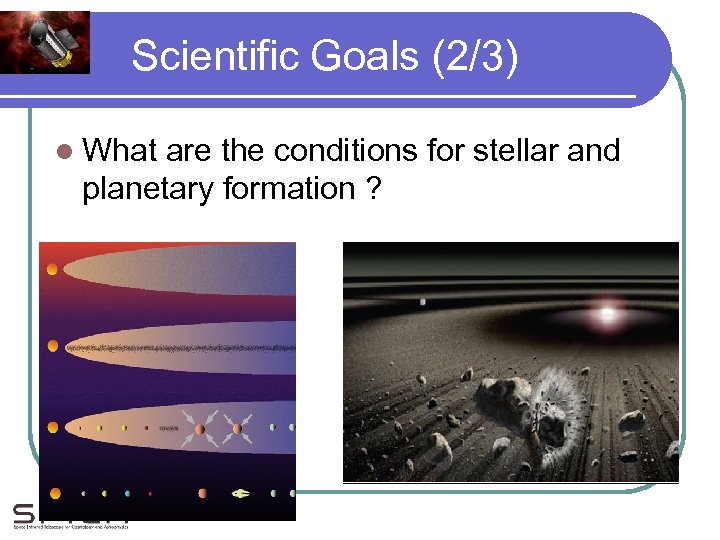 Scientific Goals (2/3) l What are the conditions for stellar and planetary formation ?
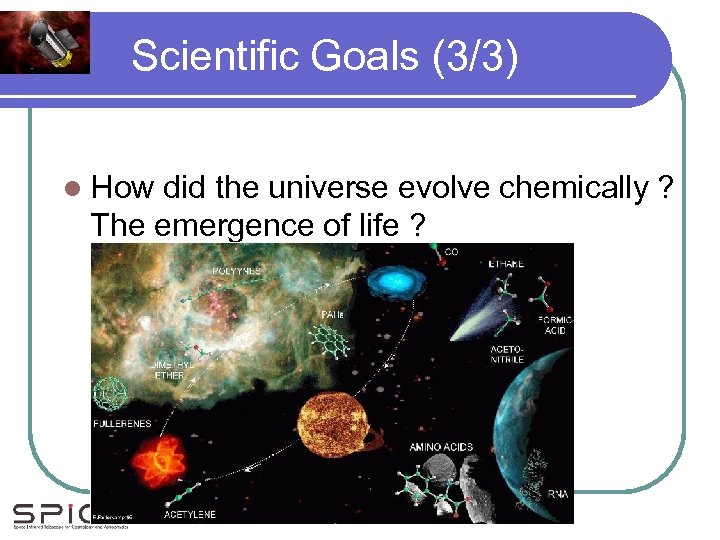 Scientific Goals (3/3) l How did the universe evolve chemically ? The emergence of life ?
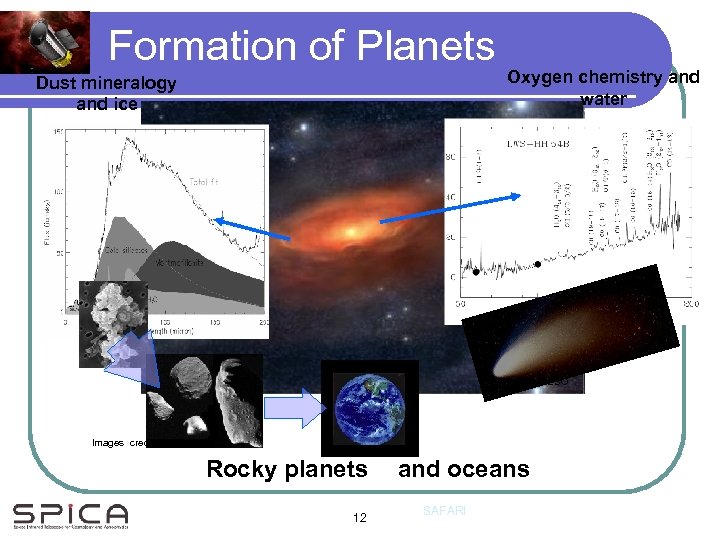 Formation of Planets Dust mineralogy and ice Oxygen chemistry and water ESO Images credit NASA Rocky planets 12 and oceans SAFARI
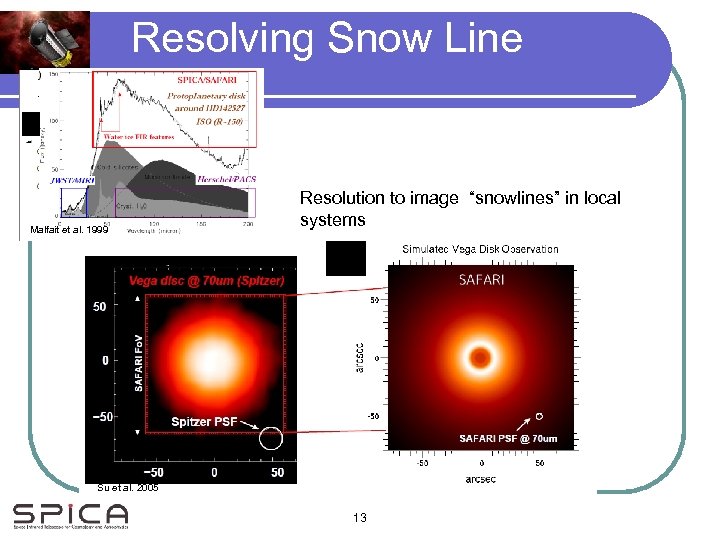 Resolving Snow Line Crystalline Amorphous Malfait et al. 1999 Resolution to image “snowlines” in local systems Su et al. 2005 13
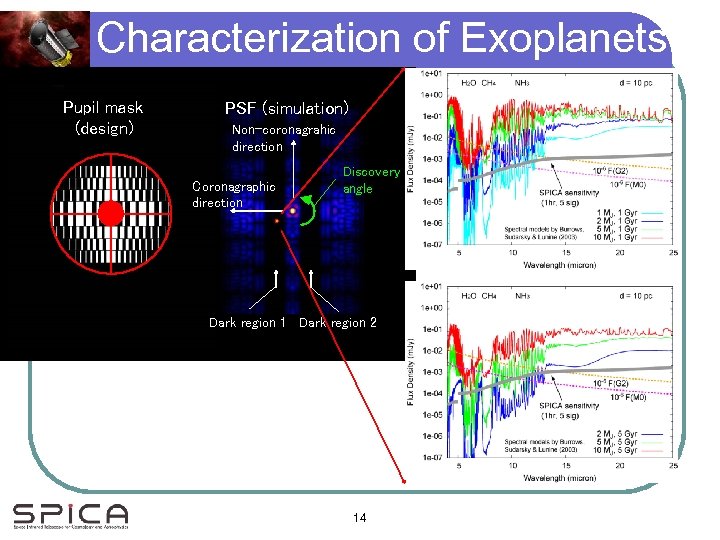 Characterization of Exoplanets Pupil mask (design) PSF (simulation) Non-coronagrahic direction Coronagraphic direction Discovery angle Dark region 1 Dark region 2 14
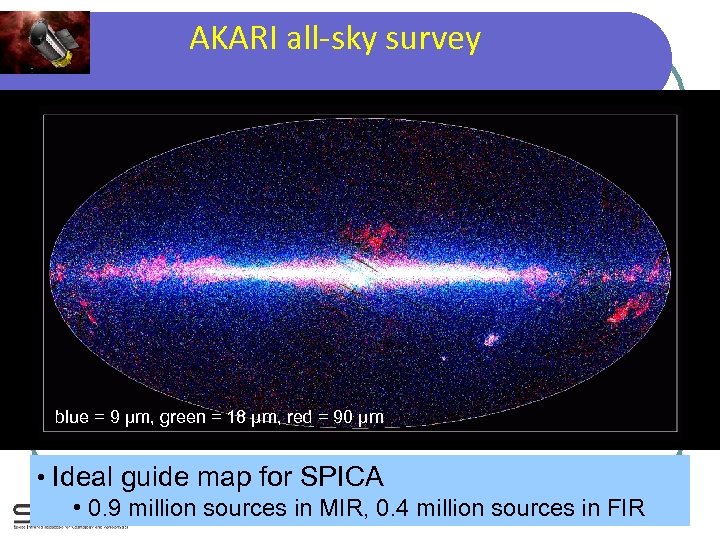 AKARI all-sky survey blue = 9 µm, green = 18 µm, red = 90 µm • Ideal guide map for SPICA • 0. 9 million sources in MIR, 0. 4 million sources in FIR
 Overview of SPICA
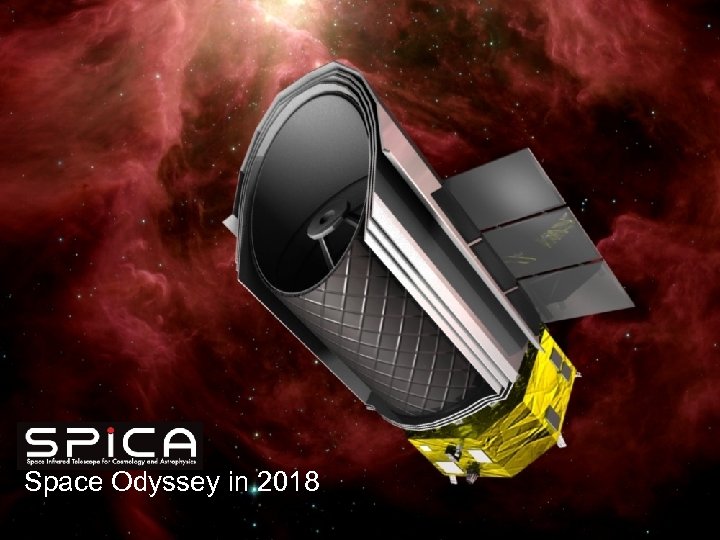
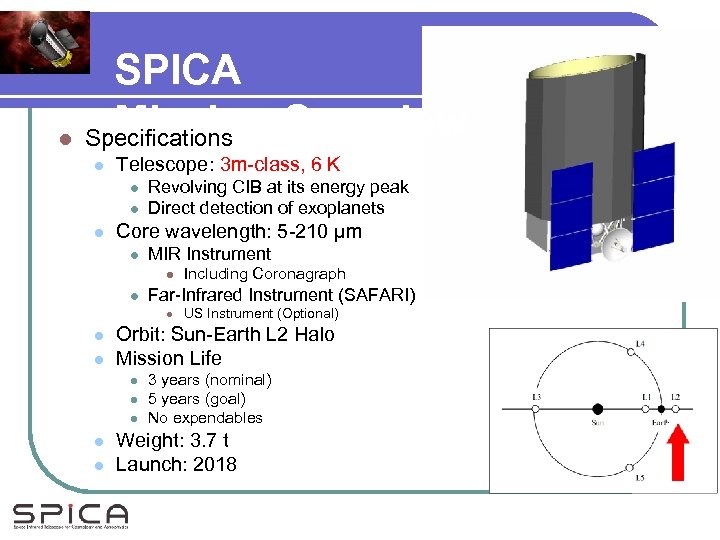 SPICA Mission Overview l Specifications l Telescope: 3 m-class, 6 K l l l Revolving CIB at its energy peak Direct detection of exoplanets Core wavelength: 5 -210 μm l MIR Instrument l l Far-Infrared Instrument (SAFARI) l l l US Instrument (Optional) Orbit: Sun-Earth L 2 Halo Mission Life l l Including Coronagraph 3 years (nominal) 5 years (goal) No expendables Weight: 3. 7 t Launch: 2018
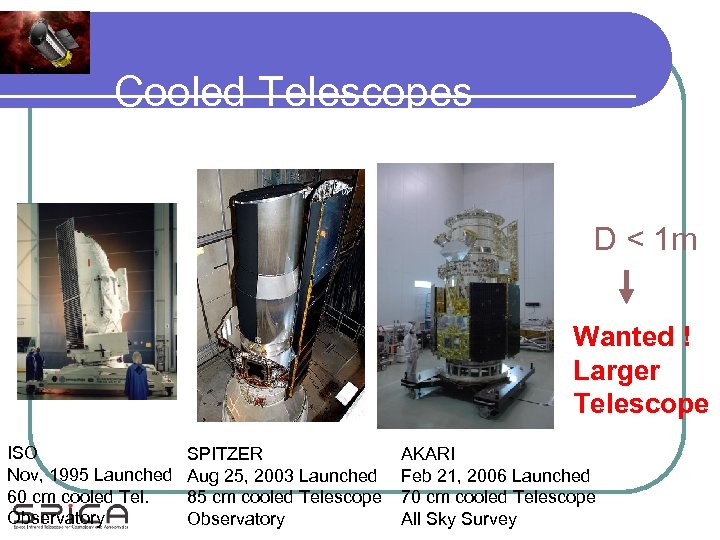 Cooled Telescopes D < 1 m Wanted ! Larger Telescope ISO Nov, 1995 Launched 60 cm cooled Tel. Observatory SPITZER Aug 25, 2003 Launched 85 cm cooled Telescope Observatory AKARI Feb 21, 2006 Launched 70 cm cooled Telescope All Sky Survey
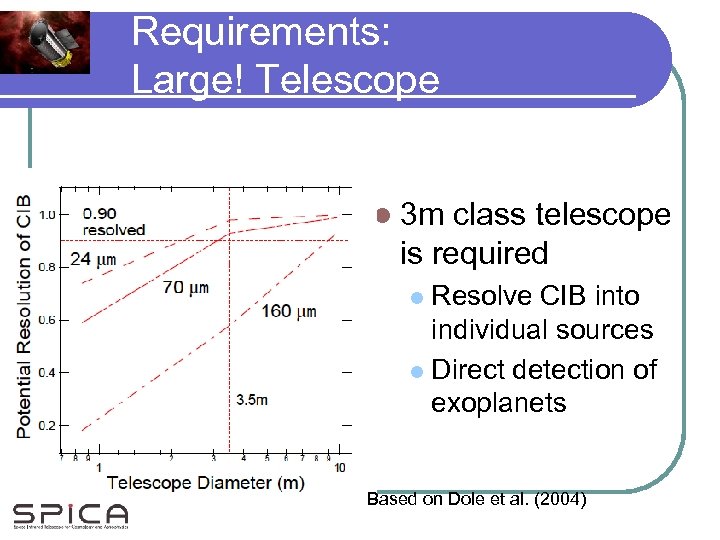 Requirements: Large! Telescope l 3 m class telescope is required Resolve CIB into individual sources l Direct detection of exoplanets l Based on Dole et al. (2004)
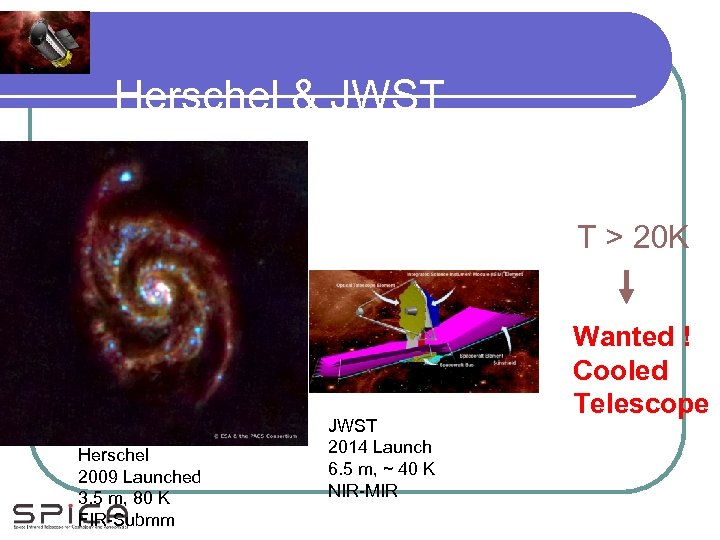 Herschel & JWST T > 20 K Herschel 2009 Launched 3. 5 m, 80 K FIR-Submm JWST 2014 Launch 6. 5 m, ~ 40 K NIR-MIR Wanted ! Cooled Telescope
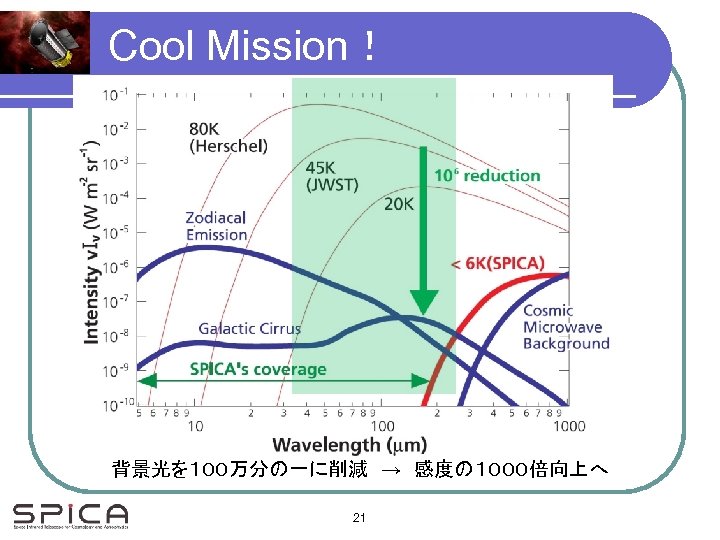 Cool Mission! 背景光を100万分の一に削減 → 感度の1000倍向上へ 21
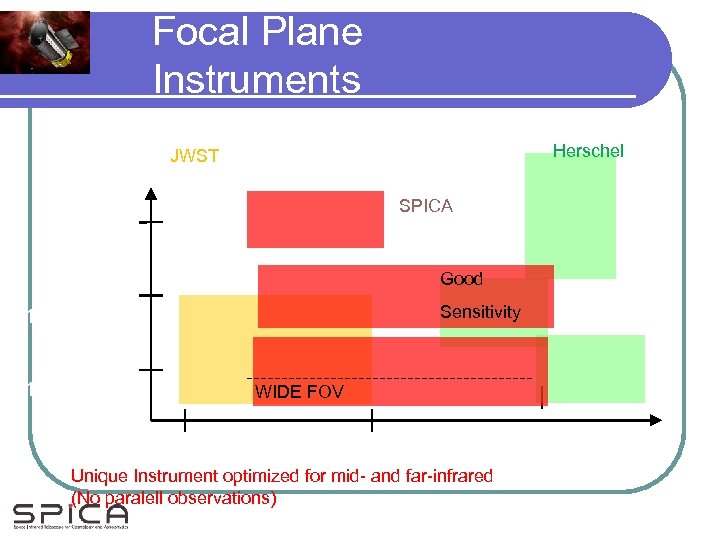 Focal Plane Instruments Herschel JWST l/dl (dv) SPICA 30000 (10 km s-1) Good 3000 (100 km s-1) Sensitivity λ 300 (100 km s-1) WIDE FOV 2 mm 20 mm Unique Instrument optimized for mid- and far-infrared (No paralell observations) 200 mm
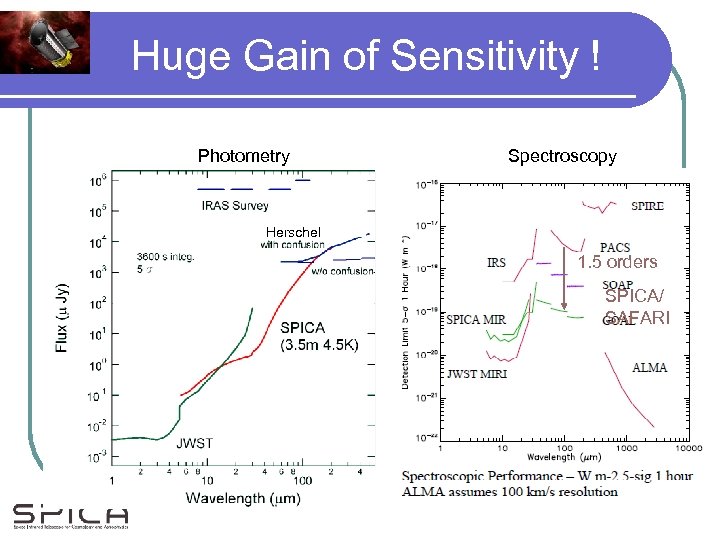 Huge Gain of Sensitivity ! Photometry Spectroscopy Herschel 2. 5 orders SPICA 1. 5 orders SPICA/ SAFARI
 Make it Feasible !
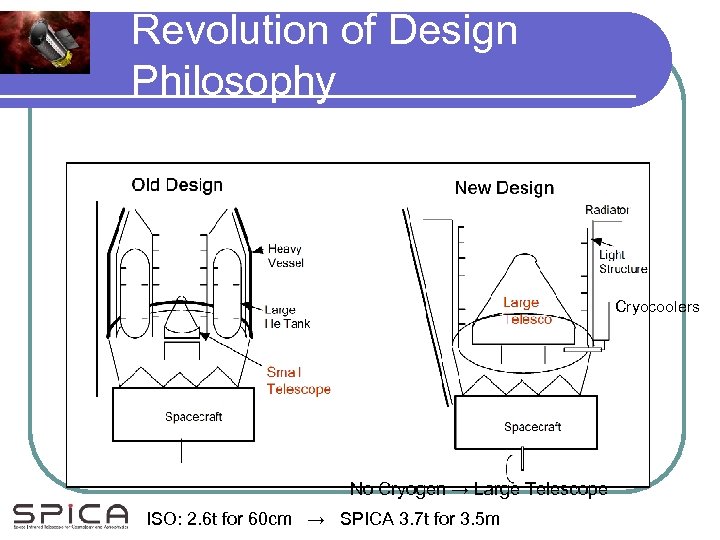 Revolution of Design Philosophy Cryocoolers No Cryogen → Large Telescope ISO: 2. 6 t for 60 cm → SPICA 3. 7 t for 3. 5 m
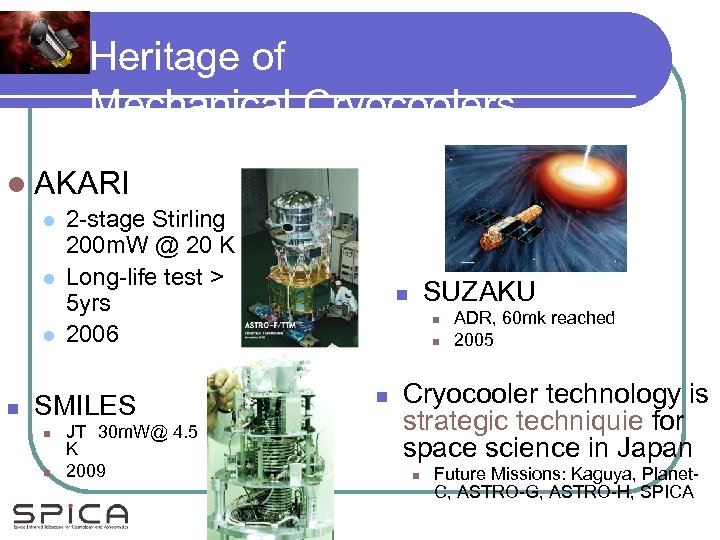 Heritage of Mechanical Cryocoolers l AKARI l l l n 2 -stage Stirling 200 m. W @ 20 K Long-life test > 5 yrs 2006 SMILES n n JT 30 m. W@ 4. 5 K 2009 SUZAKU n n ADR, 60 mk reached 2005 Cryocooler technology is strategic techniquie for space science in Japan n Future Missions: Kaguya, Planet. C, ASTRO-G, ASTRO-H, SPICA
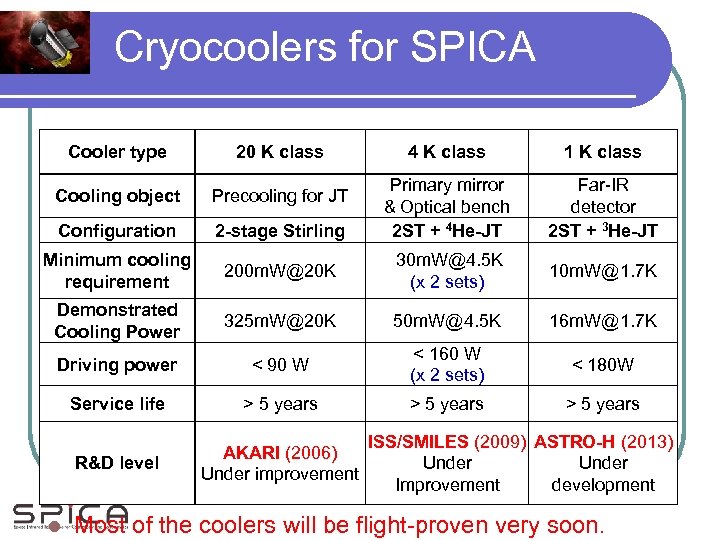 Cryocoolers for SPICA Cooler type 20 K class 4 K class 1 K class Cooling object Precooling for JT Primary mirror & Optical bench 2 ST + 4 He-JT Far-IR detector 2 ST + 3 He-JT Configuration 2 -stage Stirling Minimum cooling requirement 200 m. W@20 K 30 m. W@4. 5 K (x 2 sets) 10 m. W@1. 7 K Demonstrated Cooling Power 325 m. W@20 K 50 m. W@4. 5 K 16 m. W@1. 7 K Driving power < 90 W < 160 W (x 2 sets) < 180 W Service life > 5 years R&D level AKARI (2006) Under improvement l ISS/SMILES (2009) ASTRO-H (2013) Under Improvement development Most of the coolers will be flight-proven very soon.
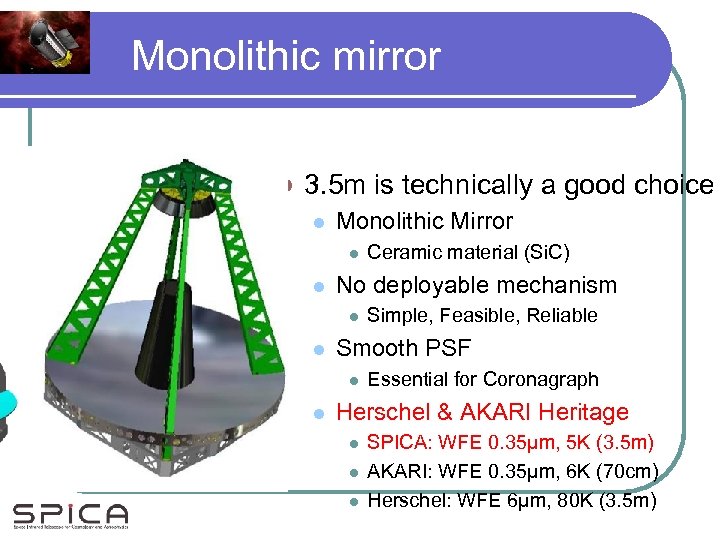 Monolithic mirror l 3. 5 m is technically a good choice l Monolithic Mirror l l No deployable mechanism l l Simple, Feasible, Reliable Smooth PSF l l Ceramic material (Si. C) Essential for Coronagraph Herschel & AKARI Heritage l l l SPICA: WFE 0. 35μm, 5 K (3. 5 m) AKARI: WFE 0. 35μm, 6 K (70 cm) Herschel: WFE 6μm, 80 K (3. 5 m)
 SPICA as an International Mission
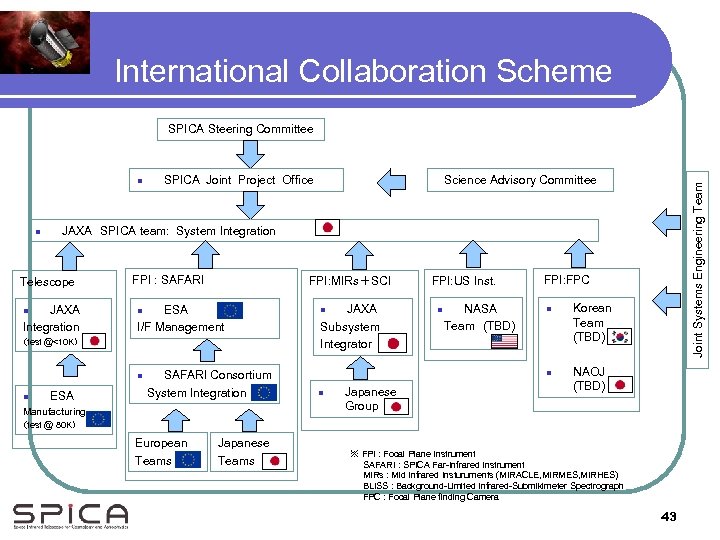
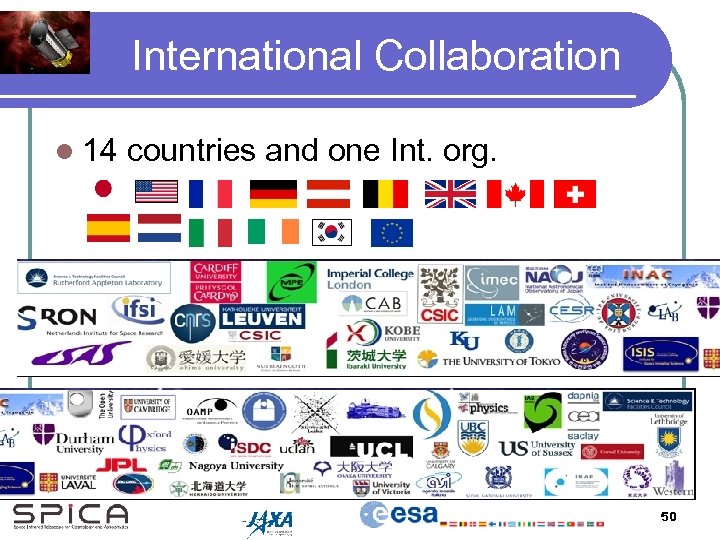
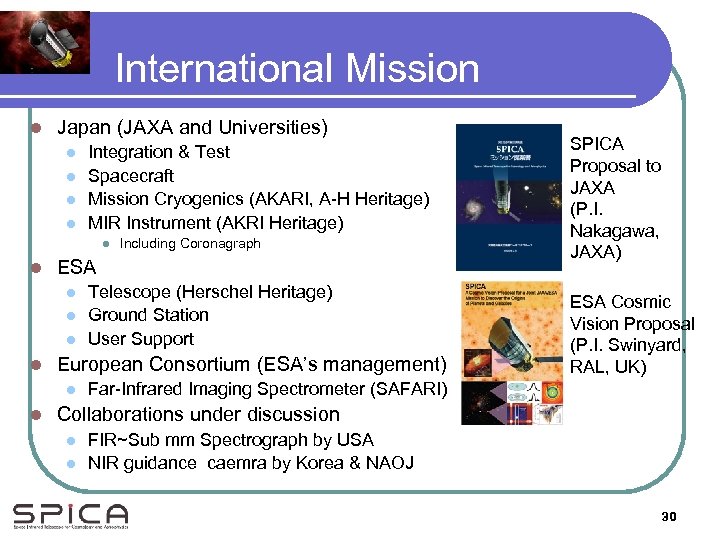 International Mission l Japan (JAXA and Universities) l l Integration & Test Spacecraft Mission Cryogenics (AKARI, A-H Heritage) MIR Instrument (AKRI Heritage) l l ESA l l Telescope (Herschel Heritage) Ground Station User Support European Consortium (ESA’s management) l l Including Coronagraph SPICA Proposal to JAXA (P. I. Nakagawa, JAXA) ESA Cosmic Vision Proposal (P. I. Swinyard, RAL, UK) Far-Infrared Imaging Spectrometer (SAFARI) Collaborations under discussion l l FIR~Sub mm Spectrograph by USA NIR guidance caemra by Korea & NAOJ 30
 Official Statement by SPC on SPICA l At the occasion of its 128 th meeting, the SPC decided to postpone its decision regarding the participation of ESA to the definition phase of SPICA, while expressing its strong support to the mission scientific goals as stated by the SSAC. It invites the Executive to pursue discussions with JAXA and clarify the framework of the proposed cooperation and come back with a more detailed proposal, if feasible already at the June 2010 SPC meeting. 31
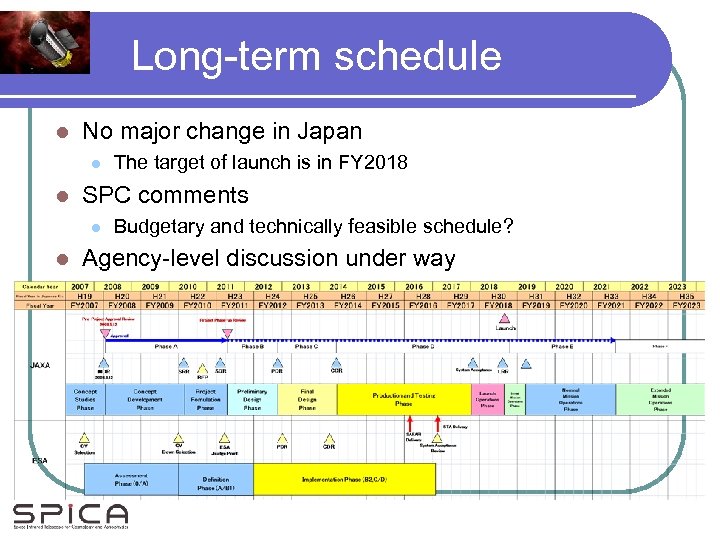 Long-term schedule l No major change in Japan l l SPC comments l l The target of launch is in FY 2018 Budgetary and technically feasible schedule? Agency-level discussion under way
 Short-term schedule (draft) Details of short-term schedule under discussion l Major Reviews and related issues l l l SRR (Q 1 FY 2010, TBC) RFP (Q 2 -Q 3 FY 2010, TBC) SDR (Q 4 FY 2010 (-11), TBC) Project Review (in FY 2011) Other Reviews l FPI review l l l April – July 2010: Domestic review on Japanese-led instruments Late 2010: International Review of whole FPI STA Specifications Discussion l l Scientific Assessment by SPICA Task force (Japan) in 2009 ESA-JAXA review/agreement: (by AWG in May)
 Issues that could affect the schedule Budgetary Issues l Technical Issues l l STA Delivery Time l l l FPI Delivery Time l l Current schedule: end of 2016 Tight schedule for assembly and test of the whole system after the STA delivery Current schedule: mid 2016 for FM Comments from ESA on a tight schedule for SAFARI Technical uncertainty in some of FPIs (e. g. Coronagraph) Technical critical areas l Attitude and pointing control (including isolation of vibration) Thermal design and verification l Cryocooler validation (long-life test) l
 Nominal/ Cost Reduction Plan
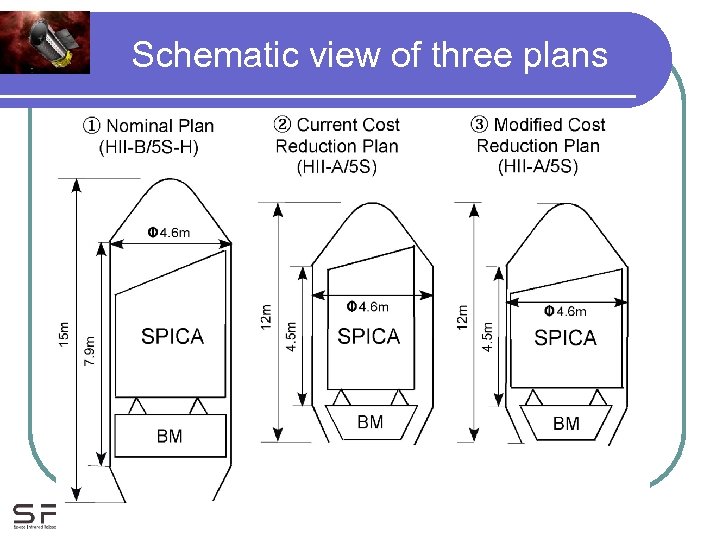
 Summary Due to the budgetary constraint, JAXA proposes to change the launching vehicle from HIIB (5 S-H fairing) to HIIA (5 S fairing). l To accommodate SPICA in a shorter fairing (5 S), JAXA proposes to change the optical parameters of STA as follows (see proposal for details): l l l M 1: 3. 5 → 3. 2 m (EPD 3. 35 → 3. 0 m) Short M 1 -M 2 distance (2986 mm → 2511 mm) SPICA Task Force evaluated that the new STA can meet most of scientific requirements ESA and JAXA are now making discussions on STA size toward the agreement.
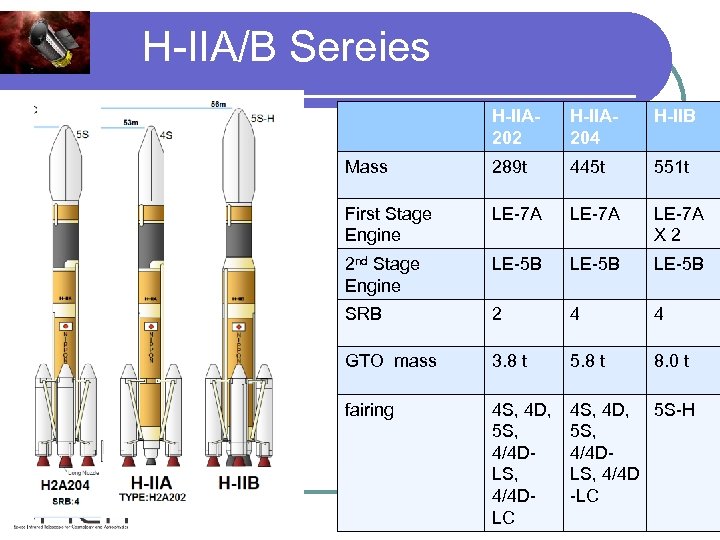 H-IIA/B Sereies H-IIA 202 H-IIA 204 H-IIB Mass 289 t 445 t 551 t First Stage Engine LE-7 A X 2 2 nd Stage Engine LE-5 B SRB 2 4 4 GTO mass 3. 8 t 5. 8 t 8. 0 t fairing 4 S, 4 D, 5 S, 4/4 DLS, 4/4 DLC 4 S, 4 D, 5 S-H 5 S, 4/4 DLS, 4/4 D -LC
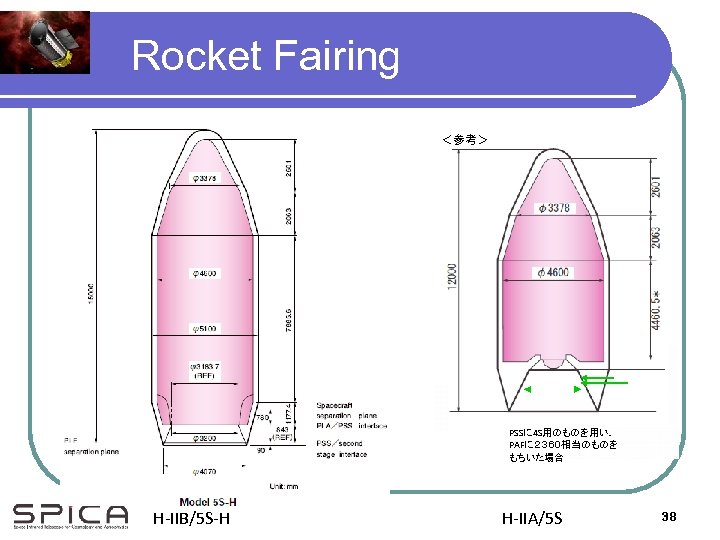 Rocket Fairing <参考> PSSに 4 S用のものを用い、 PAFに2360相当のものを もちいた場合 H-IIB/5 S-H H-IIA/5 S 38
 Schematic view of three plans
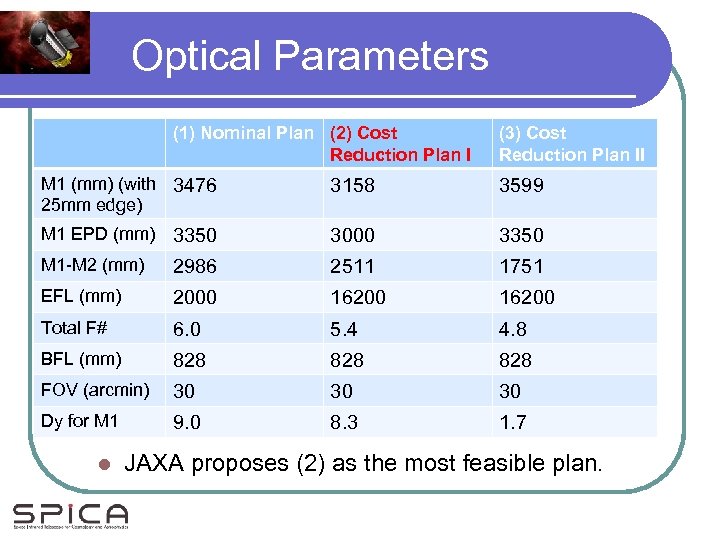 Optical Parameters (1) Nominal Plan (2) Cost Reduction Plan I (3) Cost Reduction Plan II M 1 (mm) (with 3476 25 mm edge) 3158 3599 M 1 EPD (mm) 3350 3000 3350 M 1 -M 2 (mm) 2986 2511 1751 EFL (mm) 2000 16200 Total F# 6. 0 5. 4 4. 8 BFL (mm) 828 828 FOV (arcmin) 30 30 30 Dy for M 1 9. 0 8. 3 1. 7 l JAXA proposes (2) as the most feasible plan.
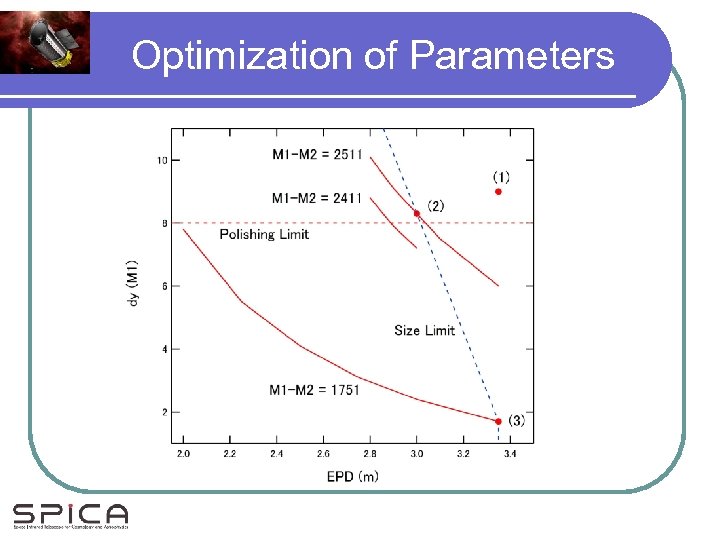 Optimization of Parameters
 SPICA management matters
 International Collaboration Scheme SPICA Steering Committee n SPICA Joint Project Office Science Advisory Committee JAXA SPICA team: System Integration Telescope JAXA Integration n FPI : SAFARI FPI: MIRs+SCI ESA I/F Management n (test @<10 K) SAFARI Consortium System Integration JAXA Subsystem Integrator n ESA Manufacturing FPI: US Inst. NASA Team (TBD) n FPI: FPC n n Joint Systems Engineering Team n n Japanese Group Korean Team (TBD) NAOJ (TBD) (test @ 80 K) European Teams Japanese Teams ※ FPI : Focal Plane Instrument SAFARI : SPICA Far-Infrared Instrument MIRs : Mid Infrared Insturuments (MIRACLE, MIRMES, MIRHES) BLISS : Background-Limited Infrared-Submikimeter Spectrograph FPC : Focal Plane finding Camera 43
 Two-level management l Agency-Level Management (Steering Committee) l Manage the overall financial and programmatic issues l l Authority to make the top-level decisions when required (impacting the whole cost, schedule, major risks, and scientific performance) Project-Level Management l Technical Issues, Schedule, Reviews l l l SPICA JOINT PROJECT OFFICE Joint Systems Engineering Team Scientific Issues l Science Advisory Committee
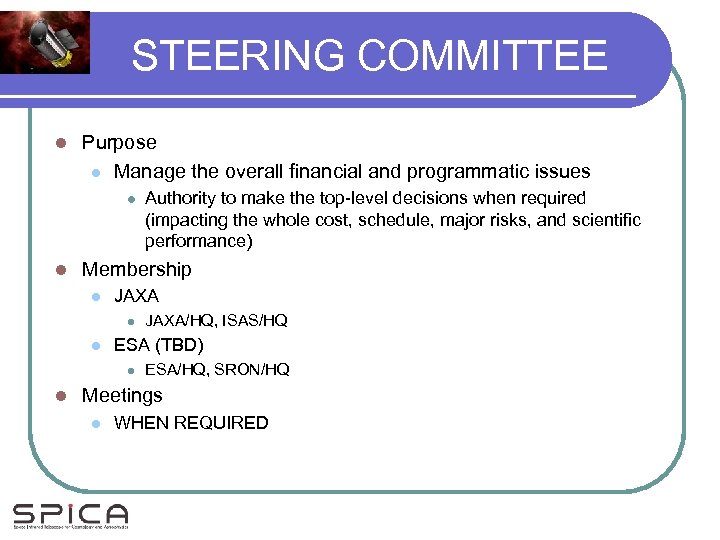 STEERING COMMITTEE l Purpose l Manage the overall financial and programmatic issues l l Membership l JAXA l l JAXA/HQ, ISAS/HQ ESA (TBD) l l Authority to make the top-level decisions when required (impacting the whole cost, schedule, major risks, and scientific performance) ESA/HQ, SRON/HQ Meetings l WHEN REQUIRED
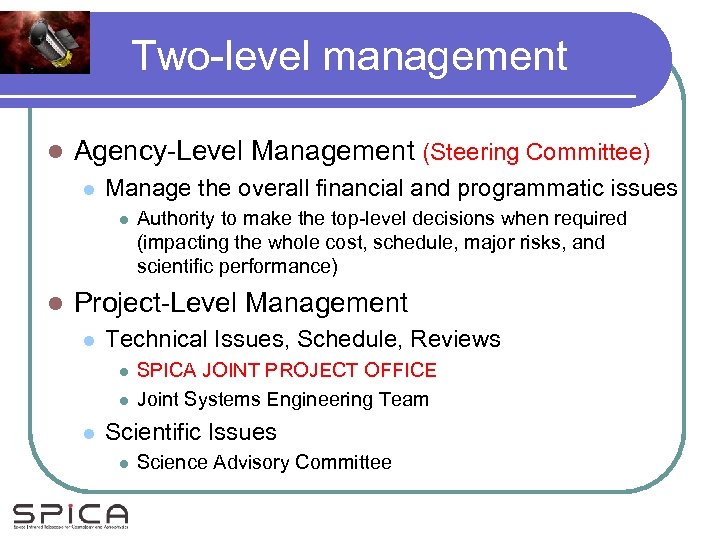
 JOINT PROJECT OFFICE l Purpose l To manage the whole project efficiently l l Membership l JAXA l l SPICA PI, PM, SE, FPI chair, Each FPI PI, chair of STF ESA (TBD) l l Technical issues, Detailed Schedule, Detailed Financial Issues, performance check SPICA PM, PS, SAFARI Scientist, SAFARI PI, SAFARI PM Meetings l l Monthly Report to agency-level management structure
 Joint Systems Engineering Team (draft) l Purpose l To check technical issues focusing on I/Fs between subgroups l l Membership l JAXA l l SPICA PM, SE, FPI chair, Technical experts (including members from industry partners) ESA l l To avoid any “hidden gap” TBD (SPICA PM, experts, …) Meetings l l Every three months (together with design meeting) Report to Steering committee
 Science Advisory Committee (draft) l Purpose l l Membership l l To review the scientific objectives and to check if the specifications and performance of SPICA is compatible with scientific requirements Japan: Project Scientist, (SPICA PI as an observer) ESA: Project Scientist International member: scientist representing all relevant fields of astronomy (including SPICA Task Force in Japan) Meetings l l Every two months Report to SPICA Steering Committee
 Key documents l SPICA Yellow Book (Dec. 2009) l Summary of the whole SPICA mission with the emphasis on European contributions l l SPICA Mission Requirements Documents (MRD) l l Summary of scientific objectives and requirements to the mission SPICA Mission Definition Documents (MDD, Sep. 2009) l l One of the inputs to the ESA CV selection process Summary of the current specifications of the spacecraft system System Engineerings Management Plan (SEMP) l Summary of Development and Review processes
 International Collaboration l 14 countries and one Int. org. 50
 Space Odyssey in 2018
 JAXA International Top Young Fellowship FY 2010 Dead Line: April 20, 2010