


 Скачать презентацию SPHERES Design Principles for the Development of Space
ce9062e2b8715e1a8ba4126114020b5b.ppt
- Количество слайдов: 52
 SPHERES Design Principles for the Development of Space Technology Maturation Laboratories Aboard the International Space Station Thesis Defense Alvar Saenz-Otero May 4, 2005 Space Systems Laboratory Massachusetts Institute of Technology
 SPHERES • Prof. David W. Miller Committee Members Chair – MIT Space Systems Laboratory • Prof. Jonathan P. How Member – MIT Space Systems Laboratory • Prof. Eric Feron Member – MIT Laboratory for Information & Decision Systems • Javier de Luis, Ph. D Member – Payload Systems Inc. • Prof. Brian Williams Member/Minor Advisor – MIT Space Systems Laboratory / Minor Advisor • Prof. Jeffrey A. Hoffman Reader – MIT Man Vehicle Laboratory • Prof. Dava Newman Reader – MIT Man Vehicle Laboratory/Technology Policy Program Space Systems Laboratory Massachusetts Institute of Technology
 SPHERES Motivation • Extract the design methodologies behind two decades of research at the MIT SSL in the design of facilities for dynamics and control experiments – – What are the common design elements? Which elements eased the technology maturation process? Can these apply to future experiments? Is there a facility for microgravity research equivalent to wind-tunnels for aeronautics research? • National Research Council calls for the institutional management of science aboard the ISS in 1999 – Promote the infusion of new technology for ISS research – Provide scientific and technical support to enhance research activities – Selected science use on the basis of their scientific and technical merit by peer review Space Systems Laboratory Problem Statement Massachusetts Institute of Technology
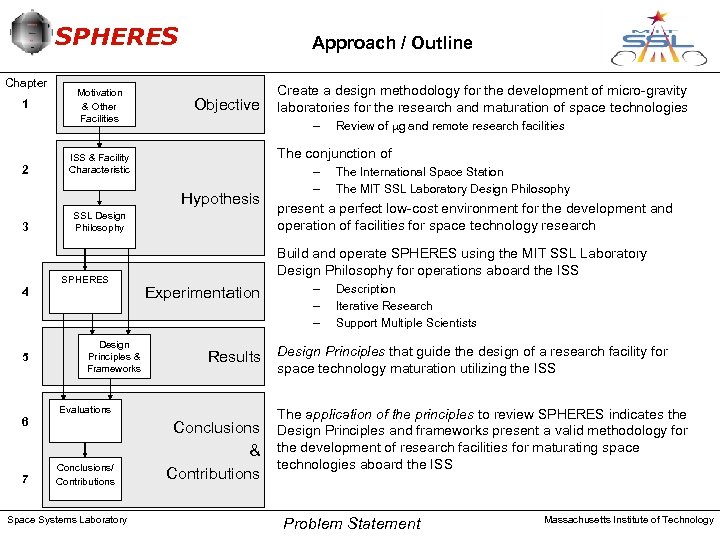 SPHERES Chapter 1 2 Motivation & Other Facilities Approach / Outline Objective – 4 5 6 7 SSL Design Philosophy SPHERES Design Principles & Frameworks Space Systems Laboratory – – The International Space Station The MIT SSL Laboratory Design Philosophy present a perfect low-cost environment for the development and operation of facilities for space technology research Build and operate SPHERES using the MIT SSL Laboratory Design Philosophy for operations aboard the ISS Experimentation – – – Description Iterative Research Support Multiple Scientists Results Design Principles that guide the design of a research facility for space technology maturation utilizing the ISS Evaluations Conclusions/ Contributions Review of g and remote research facilities The conjunction of ISS & Facility Characteristic Hypothesis 3 Create a design methodology for the development of micro-gravity laboratories for the research and maturation of space technologies Conclusions & Contributions The application of the principles to review SPHERES indicates the Design Principles and frameworks present a valid methodology for the development of research facilities for maturating space technologies aboard the ISS Problem Statement Massachusetts Institute of Technology
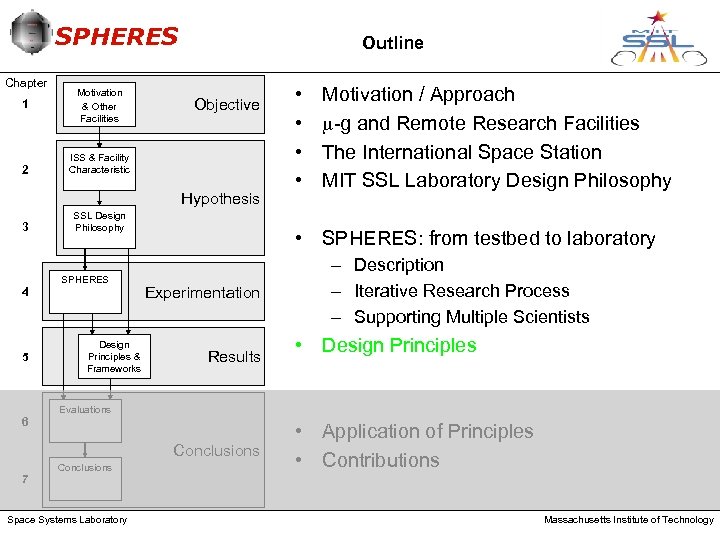
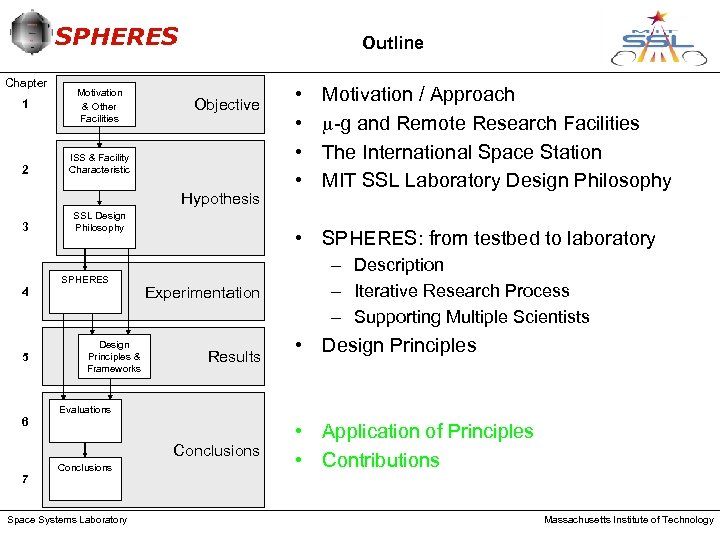
 SPHERES Chapter 1 2 Motivation & Other Facilities Outline Objective ISS & Facility Characteristic Hypothesis 3 4 5 6 SSL Design Philosophy SPHERES Design Principles & Frameworks Motivation / Approach -g and Remote Research Facilities The International Space Station MIT SSL Laboratory Design Philosophy • SPHERES: from testbed to laboratory Experimentation Results – Description – Iterative Research Process – Supporting Multiple Scientists • Design Principles Evaluations Conclusions 7 • • Conclusions Space Systems Laboratory • Application of Principles • Contributions Massachusetts Institute of Technology
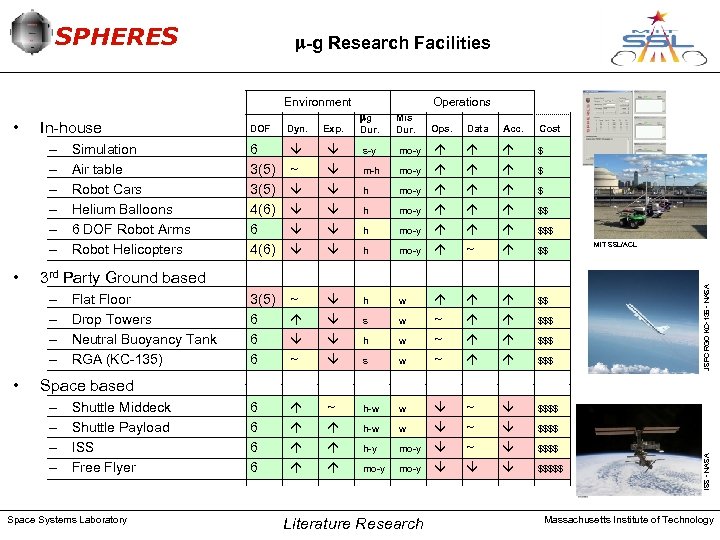 SPHERES -g Research Facilities In-house – – – • Mis Dur. s-y mo-y m-h mo-y h mo-y ~ ~ h w s w ~ h-w w h-y mo-y Dyn. Exp. 6 3(5) 4(6) 6 4(6) ~ 3(5) 6 6 6 6 Ops. Data Acc. Cost ~ $ ~ ~ ~ $$ ~ ~ ~ $$$$ $ $ $$ $$ 3 rd Party Ground based – – • Simulation Air table Robot Cars Helium Balloons 6 DOF Robot Arms Robot Helicopters g Dur. DOF Flat Floor Drop Towers Neutral Buoyancy Tank RGA (KC-135) $$$ $$$ MIT SSL/ACL Space based – – Shuttle Middeck Shuttle Payload ISS Free Flyer Space Systems Laboratory Literature Research $$$$$ ISS - NASA • Operations JSFC RGO KC-135 - NASA Environment Massachusetts Institute of Technology
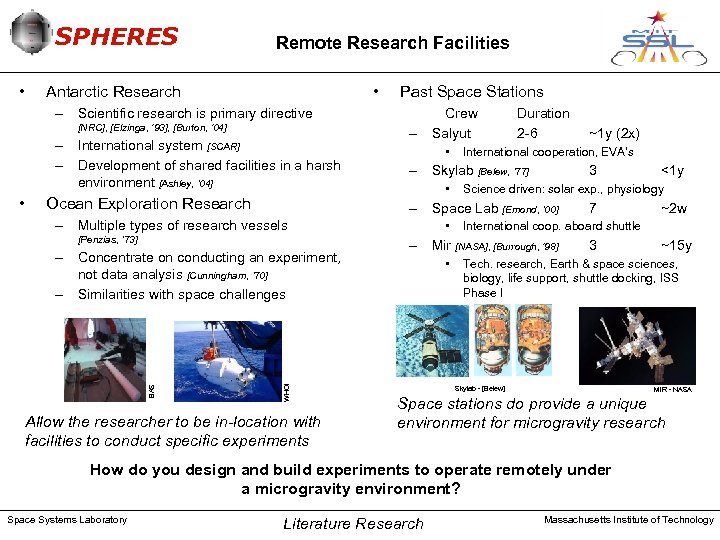 SPHERES • Remote Research Facilities • Antarctic Research Past Space Stations – Scientific research is primary directive [NRC], [Elzinga, ‘ 93], [Burton, ‘ 04] – International system [SCAR] – Development of shared facilities in a harsh environment [Ashley, ’ 04] • Ocean Exploration Research – • Duration 2 -6 • 3 WHOI – Concentrate on conducting an experiment, not data analysis [Cunningham, ’ 70] – Similarities with space challenges Allow the researcher to be in-location with facilities to conduct specific experiments • 7 ~2 w International coop. aboard shuttle – Mir [NASA], [Burrough, ‘ 98] • <1 y Science driven: solar exp. , physiology – Space Lab [Emond, ’ 00] [Penzias, ’ 73] ~1 y (2 x) International cooperation, EVA’s – Skylab [Belew, ’ 77] – Multiple types of research vessels BAS Crew Salyut 3 ~15 y Tech. research, Earth & space sciences, biology, life support, shuttle docking, ISS Phase I Skylab - [Belew] MIR - NASA Space stations do provide a unique environment for microgravity research How do you design and build experiments to operate remotely under a microgravity environment? Space Systems Laboratory Literature Research Massachusetts Institute of Technology
 SPHERES Chapter 1 2 Motivation & Other Facilities Outline Objective ISS & Facility Characteristic Hypothesis 3 4 5 6 SSL Design Philosophy SPHERES Design Principles & Frameworks Motivation / Approach -g and Remote Research Facilities The International Space Station MIT SSL Laboratory Design Philosophy • SPHERES: from testbed to laboratory Experimentation Results – Description – Iterative Research Process – Supporting Multiple Scientists • Design Principles Evaluations Conclusions 7 • • Conclusions Space Systems Laboratory • Application of Principles • Contributions Massachusetts Institute of Technology
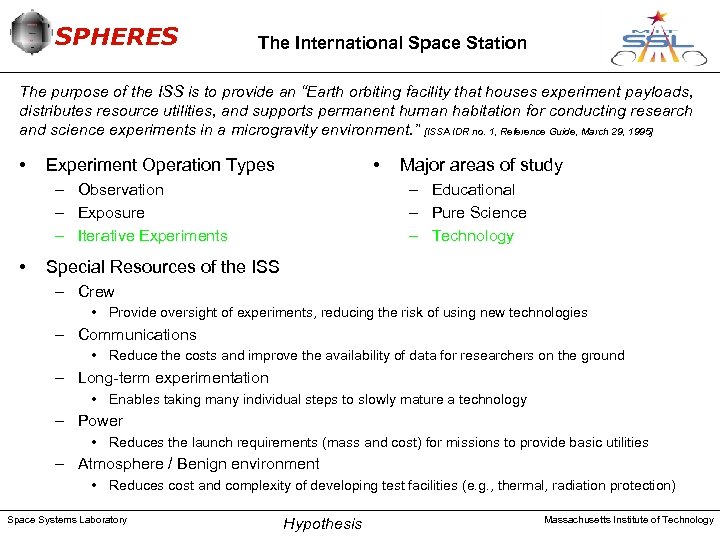 SPHERES The International Space Station The purpose of the ISS is to provide an “Earth orbiting facility that houses experiment payloads, distributes resource utilities, and supports permanent human habitation for conducting research and science experiments in a microgravity environment. ” [ISSA IDR no. 1, Reference Guide, March 29, 1995] • • Experiment Operation Types – Observation – Exposure – Iterative Experiments • Major areas of study – Educational – Pure Science – Technology Special Resources of the ISS – Crew • Provide oversight of experiments, reducing the risk of using new technologies – Communications • Reduce the costs and improve the availability of data for researchers on the ground – Long-term experimentation • Enables taking many individual steps to slowly mature a technology – Power • Reduces the launch requirements (mass and cost) for missions to provide basic utilities – Atmosphere / Benign environment • Reduces cost and complexity of developing test facilities (e. g. , thermal, radiation protection) Space Systems Laboratory Hypothesis Massachusetts Institute of Technology
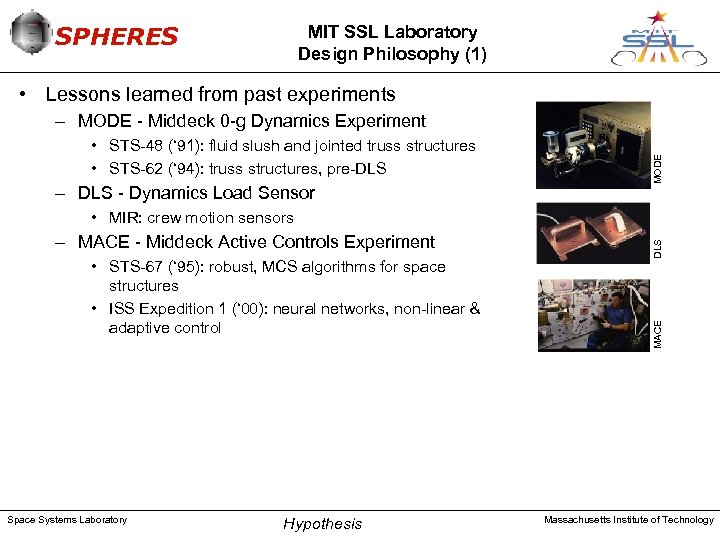 SPHERES MIT SSL Laboratory Design Philosophy (1) • Lessons learned from past experiments • STS-48 (‘ 91): fluid slush and jointed truss structures • STS-62 (‘ 94): truss structures, pre-DLS – DLS - Dynamics Load Sensor MODE – MODE - Middeck 0 -g Dynamics Experiment • STS-67 (‘ 95): robust, MCS algorithms for space structures • ISS Expedition 1 (‘ 00): neural networks, non-linear & adaptive control Space Systems Laboratory Hypothesis MACE – MACE - Middeck Active Controls Experiment DLS • MIR: crew motion sensors Massachusetts Institute of Technology
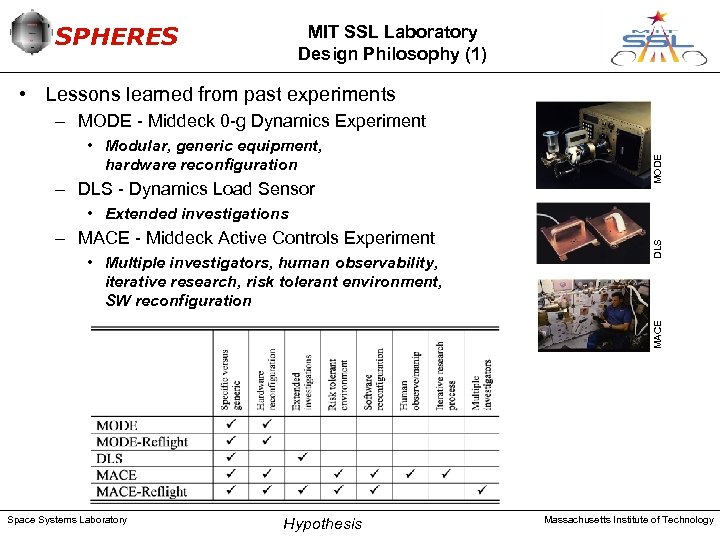 SPHERES MIT SSL Laboratory Design Philosophy (1) • Lessons learned from past experiments • Modular, generic equipment, hardware reconfiguration – DLS - Dynamics Load Sensor MODE – MODE - Middeck 0 -g Dynamics Experiment – MACE - Middeck Active Controls Experiment MACE • Multiple investigators, human observability, iterative research, risk tolerant environment, SW reconfiguration DLS • Extended investigations Space Systems Laboratory Hypothesis Massachusetts Institute of Technology
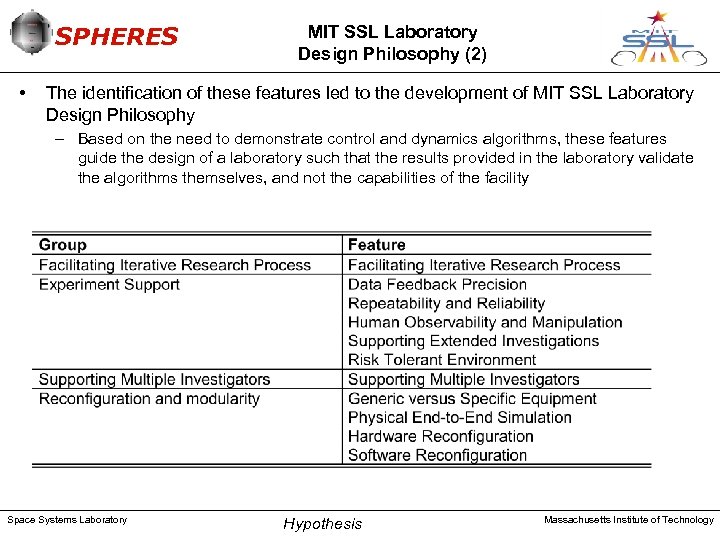 SPHERES • MIT SSL Laboratory Design Philosophy (2) The identification of these features led to the development of MIT SSL Laboratory Design Philosophy – Based on the need to demonstrate control and dynamics algorithms, these features guide the design of a laboratory such that the results provided in the laboratory validate the algorithms themselves, and not the capabilities of the facility Space Systems Laboratory Hypothesis Massachusetts Institute of Technology
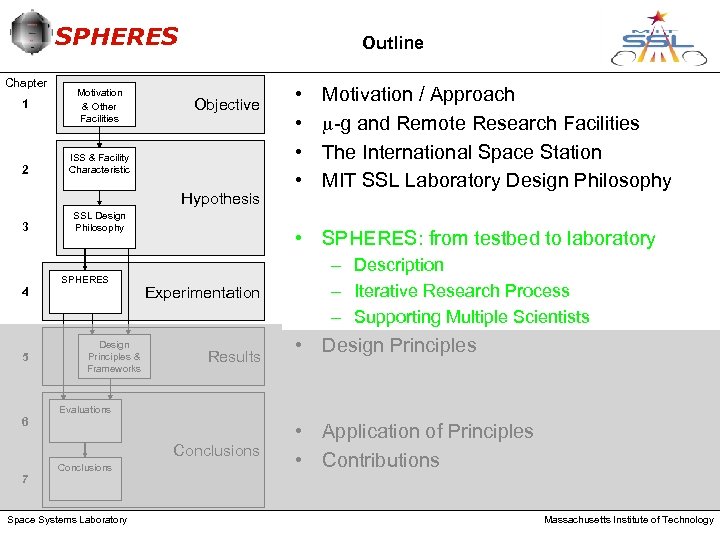 SPHERES Chapter 1 2 Motivation & Other Facilities Outline Objective ISS & Facility Characteristic Hypothesis 3 4 5 6 SSL Design Philosophy SPHERES Design Principles & Frameworks Motivation / Approach -g and Remote Research Facilities The International Space Station MIT SSL Laboratory Design Philosophy • SPHERES: from testbed to laboratory Experimentation Results – Description – Iterative Research Process – Supporting Multiple Scientists • Design Principles Evaluations Conclusions 7 • • Conclusions Space Systems Laboratory • Application of Principles • Contributions Massachusetts Institute of Technology
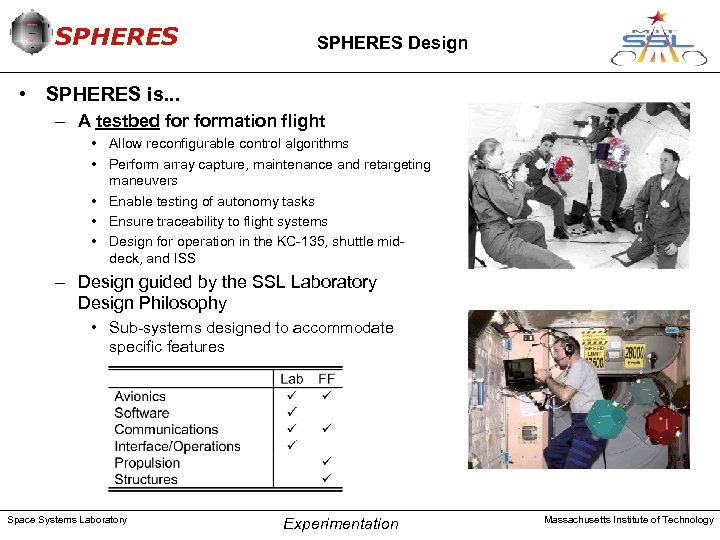 SPHERES Design • SPHERES is. . . – A testbed formation flight • Allow reconfigurable control algorithms • Perform array capture, maintenance and retargeting maneuvers • Enable testing of autonomy tasks • Ensure traceability to flight systems • Design for operation in the KC-135, shuttle middeck, and ISS – Design guided by the SSL Laboratory Design Philosophy • Sub-systems designed to accommodate specific features Space Systems Laboratory Experimentation Massachusetts Institute of Technology
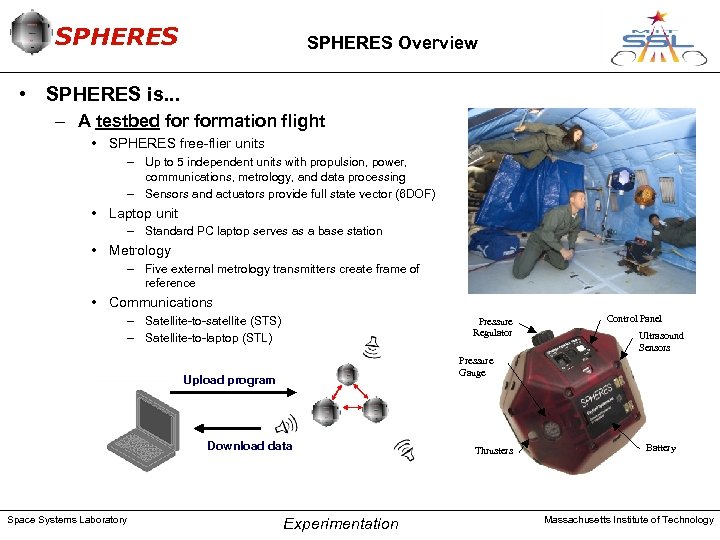 SPHERES Overview • SPHERES is. . . – A testbed formation flight • SPHERES free-flier units – Up to 5 independent units with propulsion, power, communications, metrology, and data processing – Sensors and actuators provide full state vector (6 DOF) • Laptop unit – Standard PC laptop serves as a base station • Metrology – Five external metrology transmitters create frame of reference • Communications – Satellite-to-satellite (STS) – Satellite-to-laptop (STL) Pressure Regulator Ultrasound Sensors Pressure Gauge Upload program Download data Space Systems Laboratory Control Panel Experimentation Thrusters Battery Massachusetts Institute of Technology
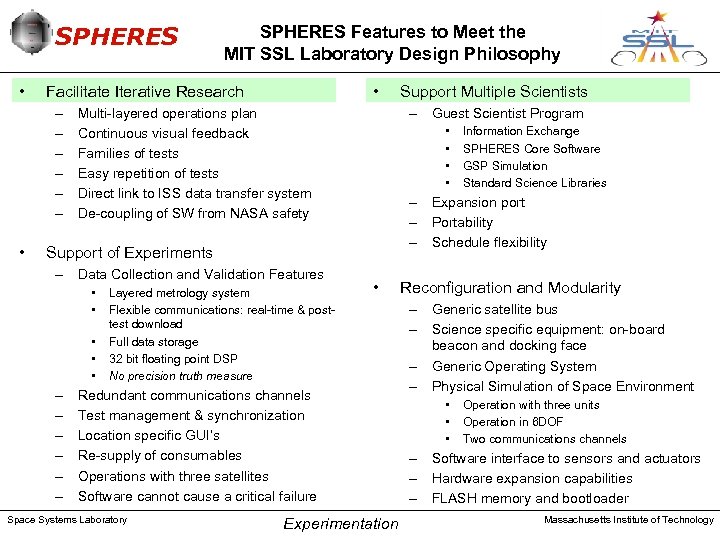 SPHERES • • Facilitate Iterative Research – – – • SPHERES Features to Meet the MIT SSL Laboratory Design Philosophy – Guest Scientist Program Multi-layered operations plan Continuous visual feedback Families of tests Easy repetition of tests Direct link to ISS data transfer system De-coupling of SW from NASA safety • • • – – – Layered metrology system Flexible communications: real-time & posttest download Full data storage 32 bit floating point DSP No precision truth measure • Redundant communications channels Test management & synchronization Location specific GUI’s Re-supply of consumables Operations with three satellites Software cannot cause a critical failure Space Systems Laboratory Information Exchange SPHERES Core Software GSP Simulation Standard Science Libraries – Expansion port – Portability – Schedule flexibility Support of Experiments – Data Collection and Validation Features Support Multiple Scientists Experimentation Reconfiguration and Modularity – Generic satellite bus – Science specific equipment: on-board beacon and docking face – Generic Operating System – Physical Simulation of Space Environment • • • Operation with three units Operation in 6 DOF Two communications channels – Software interface to sensors and actuators – Hardware expansion capabilities – FLASH memory and bootloader Massachusetts Institute of Technology
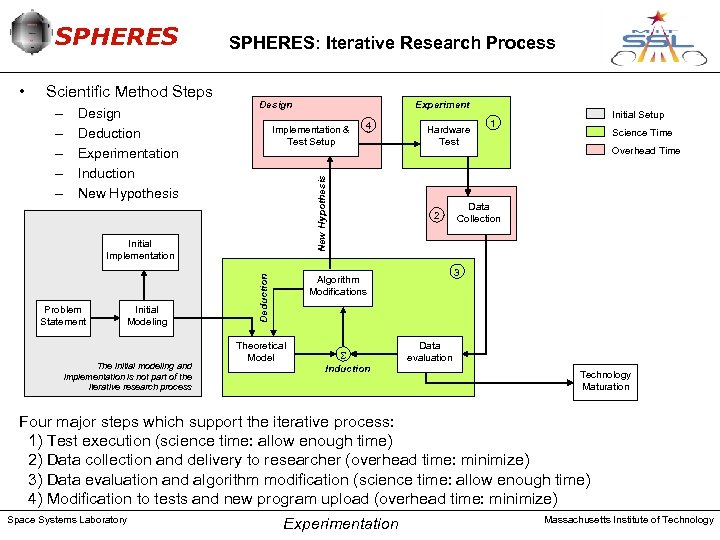 SPHERES Scientific Method Steps – – – Design Deduction Experimentation Induction New Hypothesis Design Experiment Implementation & Test Setup Design 4 New Hypothesis • SPHERES: Iterative Research Process Previous Data Initial Implementation Initial Modeling The initial modeling and implementation is not part of the iterative research process Hardware Test Experiment 2 New Data Science Time + True State of Overhead Time Nature Data Collection New Hypothesis Hi+1 Induction Hypothesis Hi Deduction Problem Statement Initial Setup Noise 1 Algorithm Modifications Deduction Theoretical Model Induction 3 Model of Hi Data evaluation Technology Maturation [Gauch] "Research is the methodical procedure for satisfying human curiosity. It is more than merely reading the Four major steps which support the iterative process: results of others' work; it is more than just observing one's surroundings. The element of research that 1) Test descriptive power is time: allow enough time) imparts itsexecution (sciencethe analysis and recombination, the "taking apart" and "putting together in a 2) Data collection and delivery to researcher observations. " [Beach] new way, " of the information gained from one's (overhead time: minimize) 3) Data evaluation and algorithm modification (science time: allow enough time) 4) Modification to tests and new program upload (overhead time: minimize) Space Systems Laboratory Experimentation Massachusetts Institute of Technology
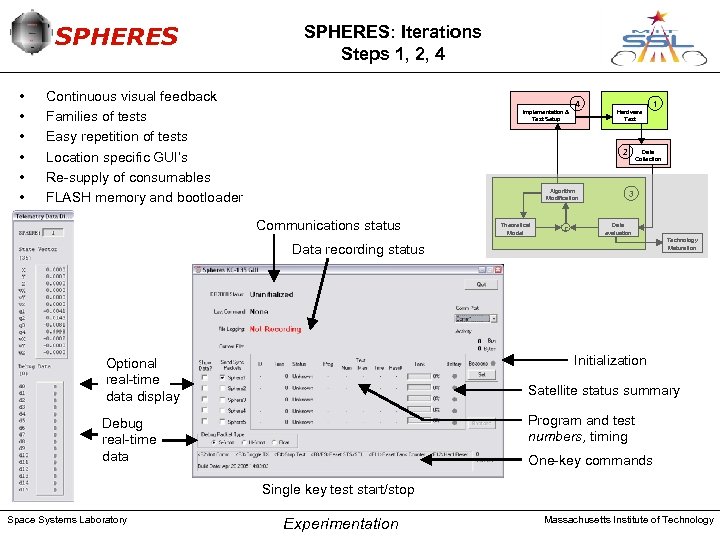 SPHERES • • • SPHERES: Iterations Steps 1, 2, 4 Continuous visual feedback Families of tests Easy repetition of tests Location specific GUI’s Re-supply of consumables FLASH memory and bootloader Implementation & Test Setup 4 Hardware Test 2 Algorithm Modification Communications status Theoretical Model 1 Data Collection 3 Data evaluation Technology Maturation Data recording status Initialization Optional real-time data display Satellite status summary Program and test numbers, timing Debug real-time data One-key commands Single key test start/stop Space Systems Laboratory Experimentation Massachusetts Institute of Technology
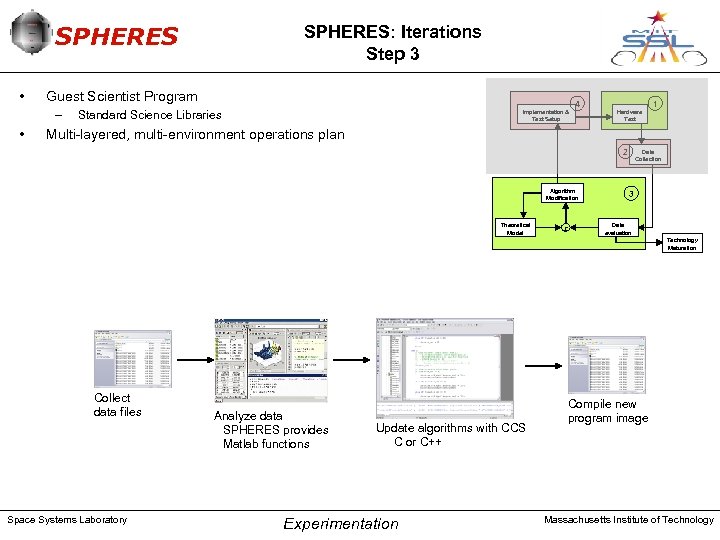 SPHERES • Guest Scientist Program – • SPHERES: Iterations Step 3 Standard Science Libraries Implementation & Test Setup 4 Hardware Test 1 Multi-layered, multi-environment operations plan 2 Algorithm Modification Theoretical Model Data Collection 3 Data evaluation Technology Maturation Collect data files Space Systems Laboratory Analyze data SPHERES provides Matlab functions Update algorithms with CCS C or C++ Experimentation Compile new program image Massachusetts Institute of Technology
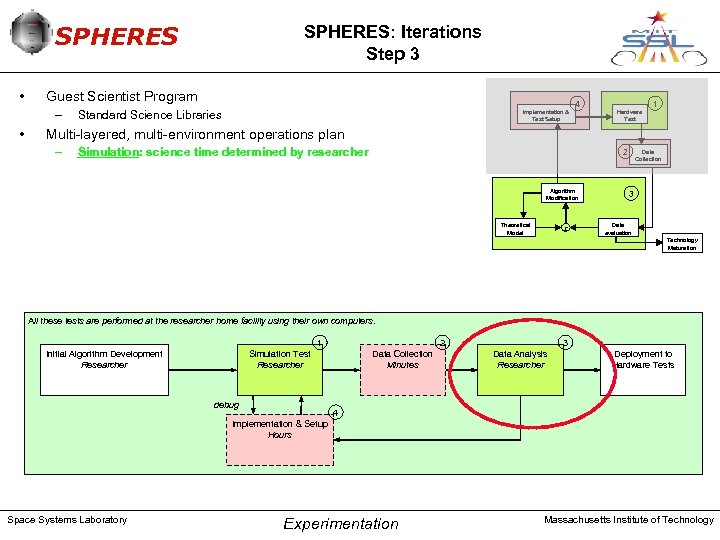 SPHERES • Guest Scientist Program – • SPHERES: Iterations Step 3 Standard Science Libraries Implementation & Test Setup 4 Hardware Test 1 Multi-layered, multi-environment operations plan – Simulation: science time determined by researcher 2 Algorithm Modification Theoretical Model Data Collection 3 Data evaluation Technology Maturation All these tests are performed at the researcher home facility using their own computers. 1 Initial Algorithm Development Researcher 2 Simulation Test Researcher debug Data Collection Minutes 3 Data Analysis Researcher Deployment to Hardware Tests 4 Implementation & Setup Hours Space Systems Laboratory Experimentation Massachusetts Institute of Technology
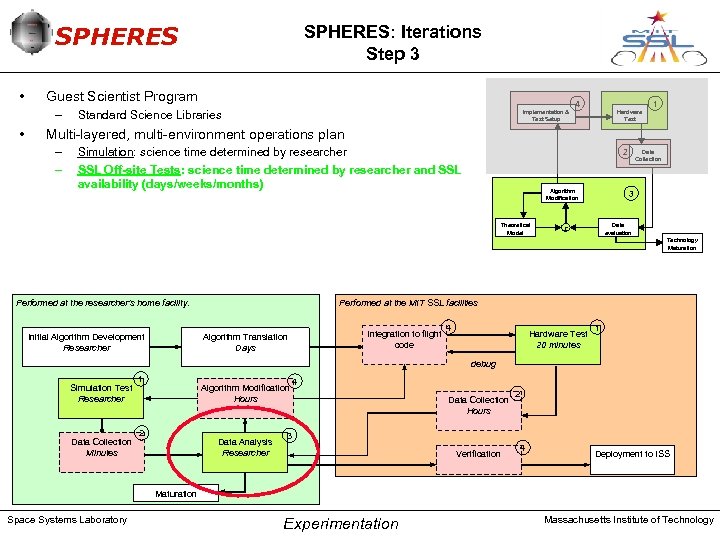 SPHERES • Guest Scientist Program – • SPHERES: Iterations Step 3 Standard Science Libraries Implementation & Test Setup 4 Hardware Test 1 Multi-layered, multi-environment operations plan – – Simulation: science time determined by researcher SSL Off-site Tests: science time determined by researcher and SSL availability (days/weeks/months) 2 Algorithm Modification Theoretical Model Data Collection 3 Data evaluation Technology Maturation Performed at the researcher’s home facility. Initial Algorithm Development Researcher Performed at the MIT SSL facilities Integration to flight code Algorithm Translation Days 4 Hardware Test 20 minutes 1 debug Simulation Test Researcher Data Collection Minutes 1 Algorithm Modification Hours 2 Data Analysis Researcher 4 Data Collection Hours 2 3 Verification 4 Deployment to ISS Maturation Space Systems Laboratory Experimentation Massachusetts Institute of Technology
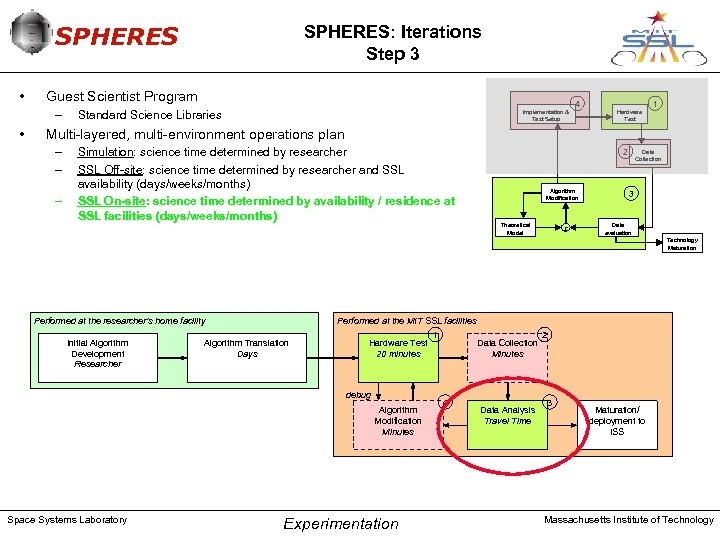 SPHERES • Guest Scientist Program – • SPHERES: Iterations Step 3 Standard Science Libraries Implementation & Test Setup 4 Hardware Test 1 Multi-layered, multi-environment operations plan – – – Simulation: science time determined by researcher SSL Off-site: science time determined by researcher and SSL availability (days/weeks/months) SSL On-site: science time determined by availability / residence at SSL facilities (days/weeks/months) 2 Algorithm Modification Theoretical Model Data Collection 3 Data evaluation Technology Maturation Performed at the researcher’s home facility Initial Algorithm Development Researcher Performed at the MIT SSL facilities Algorithm Translation Days Hardware Test 20 minutes debug Algorithm Modification Minutes Space Systems Laboratory Experimentation 1 Data Collection Minutes 4 Data Analysis Travel Time 2 3 Maturation/ deployment to ISS Massachusetts Institute of Technology
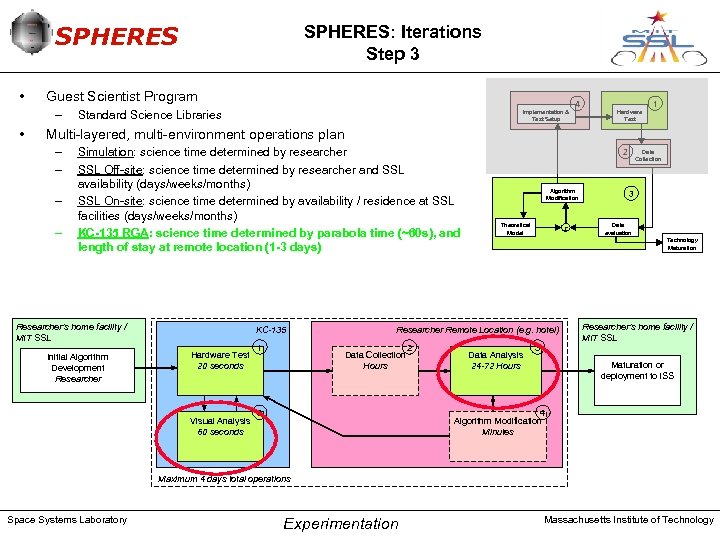 SPHERES • Guest Scientist Program – • SPHERES: Iterations Step 3 Standard Science Libraries Implementation & Test Setup 4 Hardware Test 1 Multi-layered, multi-environment operations plan – – Simulation: science time determined by researcher SSL Off-site: science time determined by researcher and SSL availability (days/weeks/months) SSL On-site: science time determined by availability / residence at SSL facilities (days/weeks/months) KC-135 RGA: science time determined by parabola time (~60 s), and length of stay at remote location (1 -3 days) Researcher’s home facility / MIT SSL Initial Algorithm Development Researcher KC-135 Hardware Test 20 seconds Visual Analysis 60 seconds 1 2 Algorithm Modification Theoretical Model 3 2 3 Data evaluation Technology Maturation Researcher Remote Location (e. g. hotel) Data Collection Hours Data Collection Data Analysis 24 -72 Hours 3 Researcher’s home facility / MIT SSL Maturation or deployment to ISS 4 Algorithm Modification Minutes Maximum 4 days total operations Space Systems Laboratory Experimentation Massachusetts Institute of Technology
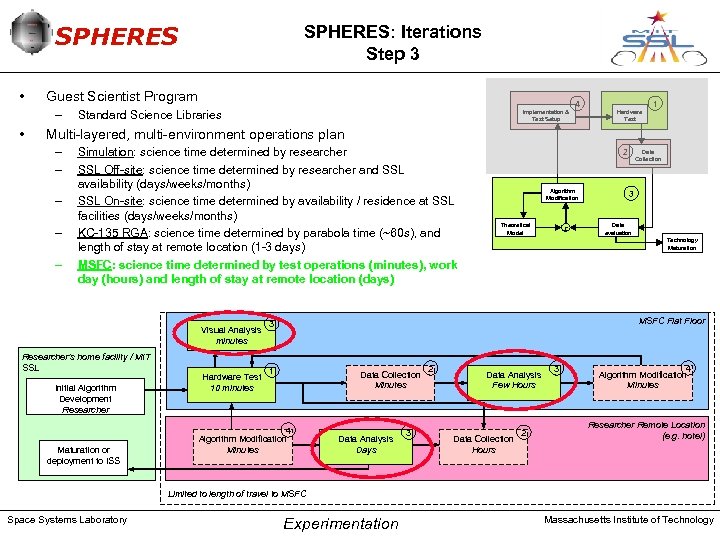 SPHERES • Guest Scientist Program – • SPHERES: Iterations Step 3 Standard Science Libraries Implementation & Test Setup 4 Hardware Test 1 Multi-layered, multi-environment operations plan – – – Simulation: science time determined by researcher SSL Off-site: science time determined by researcher and SSL availability (days/weeks/months) SSL On-site: science time determined by availability / residence at SSL facilities (days/weeks/months) KC-135 RGA: science time determined by parabola time (~60 s), and length of stay at remote location (1 -3 days) MSFC: science time determined by test operations (minutes), work day (hours) and length of stay at remote location (days) Visual Analysis minutes Researcher’s home facility / MIT SSL Initial Algorithm Development Researcher Maturation or deployment to ISS Hardware Test 10 minutes 2 Algorithm Modification Theoretical Model Data Collection 3 Data evaluation Technology Maturation MSFC Flat Floor 3 1 Data Collection Minutes 4 Algorithm Modification Minutes Data Analysis Days 3 2 Data Analysis Few Hours Data Collection Hours 2 3 4 Algorithm Modification Minutes Researcher Remote Location (e. g. hotel) Limited to length of travel to MSFC Space Systems Laboratory Experimentation Massachusetts Institute of Technology
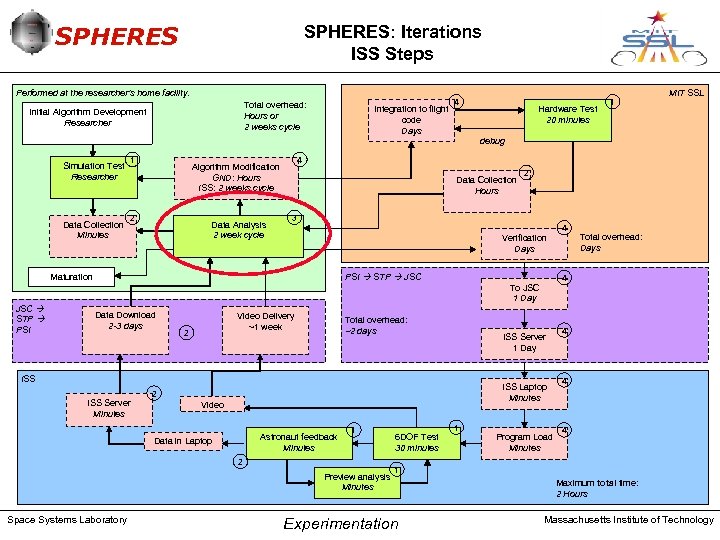 SPHERES: Iterations ISS Steps Performed at the researcher’s home facility. Total overhead: Hours or 2 weeks cycle Initial Algorithm Development Researcher Simulation Test Researcher Data Collection Minutes 1 Data Analysis 2 week cycle 2 3 Verification Days PSI STP JSC Video Delivery ~1 week 2 Total overhead: ~2 days ISS Server 1 Day ISS Server Minutes ISS Laptop Minutes 2 Video Astronaut feedback Minutes Data in Laptop 1 2 Preview analysis Minutes Space Systems Laboratory 6 DOF Test 30 minutes 1 4 Total overhead: Days 4 To JSC 1 Day Data Download 2 -3 days MIT SSL debug Data Collection Hours Maturation JSC STP PSI Hardware Test 20 minutes 1 4 Algorithm Modification GND: Hours ISS: 2 weeks cycle 2 Integration to flight code Days 4 Program Load Minutes 4 4 4 1 Experimentation Maximum total time: 2 Hours Massachusetts Institute of Technology
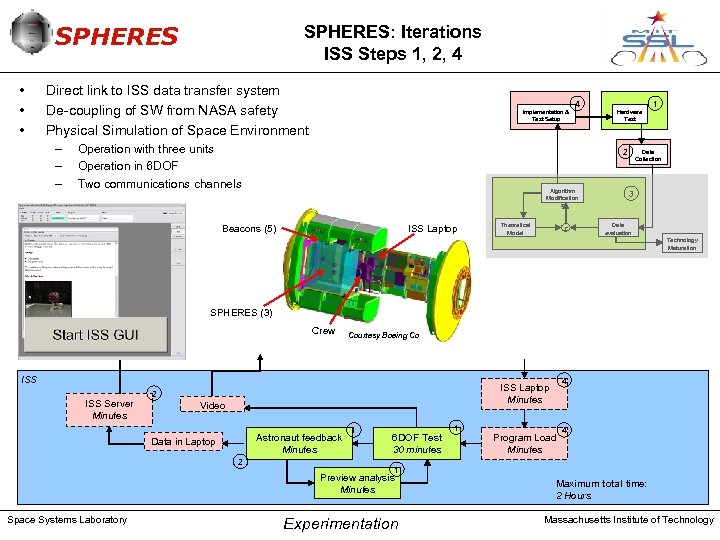 SPHERES • • • SPHERES: Iterations ISS Steps 1, 2, 4 Direct link to ISS data transfer system De-coupling of SW from NASA safety Physical Simulation of Space Environment – – – Implementation & Test Setup Operation with three units Operation in 6 DOF Two communications channels 4 Hardware Test 2 Algorithm Modification s Beacons (5) ISS Laptop Theoretical Model 1 Data Collection 3 Data evaluation Technology Maturation SPHERES (3) Crew Courtesy Boeing Co ISS Server Minutes 2 Video Astronaut feedback Minutes Data in Laptop 2 1 6 DOF Test 30 minutes 1 Program Load Minutes 4 1 Preview analysis Minutes Space Systems Laboratory 4 ISS Laptop Minutes Experimentation Maximum total time: 2 Hours Massachusetts Institute of Technology
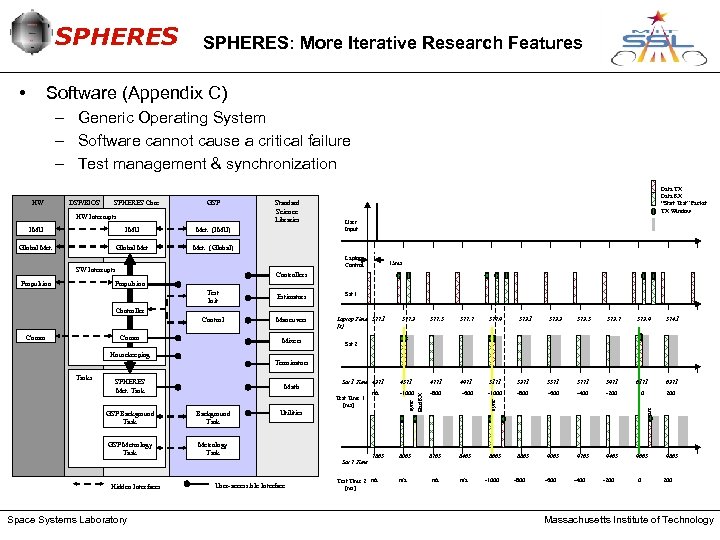 SPHERES • SPHERES: More Iterative Research Features Software (Appendix C) – Generic Operating System – Software cannot cause a critical failure – Test management & synchronization HW DSP/BIOS SPHERES Core GSP HW Interrupts IMU Met. (IMU) Global Met Standard Science Libraries Data TX Data RX “Start Test” Packet TX Window User Input Met. (Global) Laptop Control SW Interrupts Propulsion 15 ms Controllers Propulsion Test Init Estimators Control Maneuvers Sat 1 Controller Comm Mixers Laptop Time 572. 1 [s] 572. 3 572. 5 572. 7 572. 9 573. 1 573. 3 573. 5 573. 7 573. 9 574. 1 5121 5321 -1000 -800 5521 5721 5921 6121 6321 -600 -400 -200 0 200 8865 9065 9265 9465 9665 Sat 2 Housekeeping Terminators GSP Background Task GSP Metrology Task Utilities Sat 1 Time 4321 Test Time 1 [ms] Metrology Task Sat 2 Time Hidden Interfaces Space Systems Laboratory User-accessible Interface 4521 4721 4921 n/a -1000 -800 -600 7865 8065 Test Time 2 n/a [ms] n/a 8265 8465 n/a 8665 -1000 start Math sync SPHERES Met. Task sync Bad RX Tasks -800 -600 -400 -200 0 9865 200 Massachusetts Institute of Technology
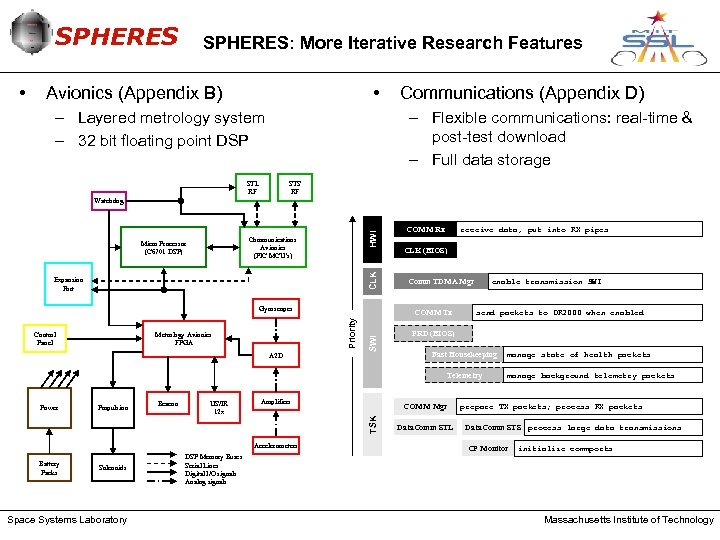 SPHERES • SPHERES: More Iterative Research Features • Avionics (Appendix B) – Layered metrology system – 32 bit floating point DSP Communications (Appendix D) – Flexible communications: real-time & post-test download – Full data storage STL RF STS RF HWI Watchdog Communications Avionics (PIC MCU’s) CLK Micro Processor (C 6701 DSP) Expansion Port Gyroscopes A 2 D SWI Metrology Avionics FPGA receive data, put into RX pipes CLK (BIOS) Comm TDMA Mgr COMM Tx Priority Control Panel COMM Rx enable transmission SWI send packets to DR 2000 when enabled PRD (BIOS) Fast Housekeeping Telemetry Propulsion Beacon US/IR 12 x Amplifiers Accelerometers Battery Packs Solenoids Space Systems Laboratory DSP Memory Buses Serial Lines Digital I/O signals Analog signals COMM Mgr TSK Power Data. Comm STL manage state of health packets manage background telemetry packets prepare TX packets; process RX packets Data. Comm STS process large data transmissions CP Monitor initialize commports Massachusetts Institute of Technology
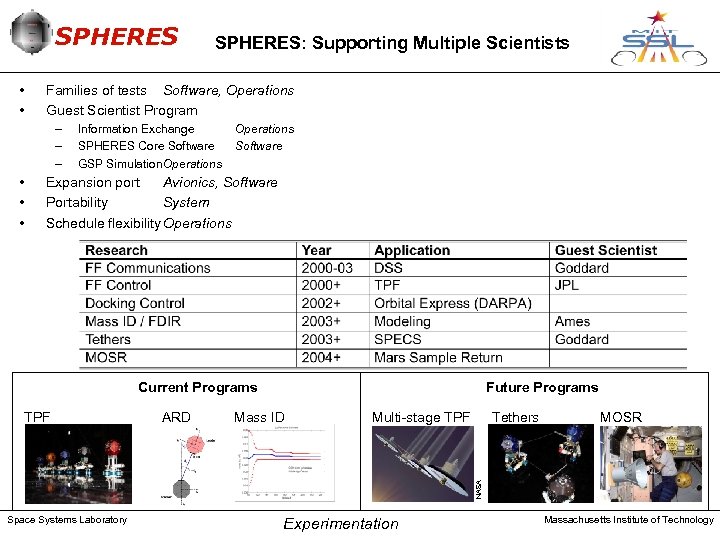 SPHERES • • Families of tests Software, Operations Guest Scientist Program – – – • • • SPHERES: Supporting Multiple Scientists Information Exchange SPHERES Core Software GSP Simulation. Operations Software Expansion port Avionics, Software Portability System Schedule flexibility Operations Current Programs ARD Mass ID Multi-stage TPF Tethers MOSR NASA TPF Future Programs Space Systems Laboratory Experimentation Massachusetts Institute of Technology
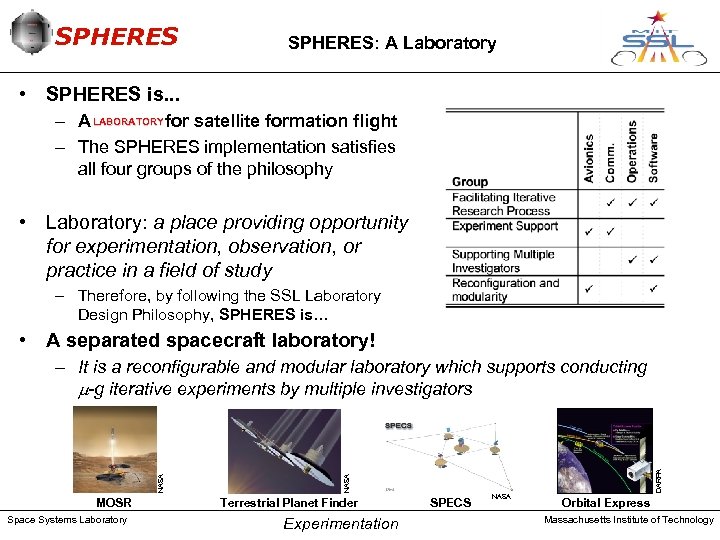 SPHERES: A Laboratory • SPHERES is. . . – A LABORATORY for satellite formation flight testbed – The SPHERES implementation satisfies all four groups of the philosophy • Laboratory: a place providing opportunity for experimentation, observation, or practice in a field of study – Therefore, by following the SSL Laboratory Design Philosophy, SPHERES is… • A separated spacecraft laboratory! MOSR Space Systems Laboratory Terrestrial Planet Finder Experimentation SPECS NASA DARPA NASA – It is a reconfigurable and modular laboratory which supports conducting -g iterative experiments by multiple investigators Orbital Express Massachusetts Institute of Technology
 SPHERES Chapter 1 2 Motivation & Other Facilities Outline Objective ISS & Facility Characteristic Hypothesis 3 4 5 6 SSL Design Philosophy SPHERES Design Principles & Frameworks Motivation / Approach -g and Remote Research Facilities The International Space Station MIT SSL Laboratory Design Philosophy • SPHERES: from testbed to laboratory Experimentation Results – Description – Iterative Research Process – Supporting Multiple Scientists • Design Principles Evaluations Conclusions 7 • • Conclusions Space Systems Laboratory • Application of Principles • Contributions Massachusetts Institute of Technology
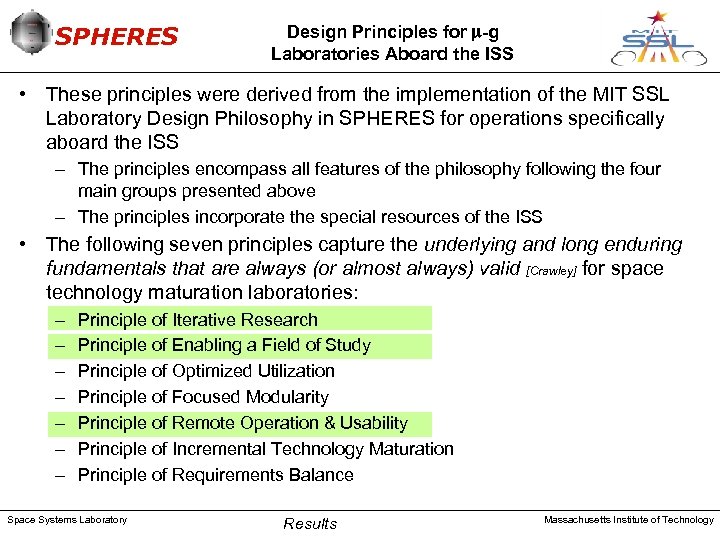 SPHERES Design Principles for -g Laboratories Aboard the ISS • These principles were derived from the implementation of the MIT SSL Laboratory Design Philosophy in SPHERES for operations specifically aboard the ISS – The principles encompass all features of the philosophy following the four main groups presented above – The principles incorporate the special resources of the ISS • The following seven principles capture the underlying and long enduring fundamentals that are always (or almost always) valid [Crawley] for space technology maturation laboratories: – – – – Principle of Iterative Research Principle of Enabling a Field of Study Principle of Optimized Utilization Principle of Focused Modularity Principle of Remote Operation & Usability Principle of Incremental Technology Maturation Principle of Requirements Balance Space Systems Laboratory Results Massachusetts Institute of Technology
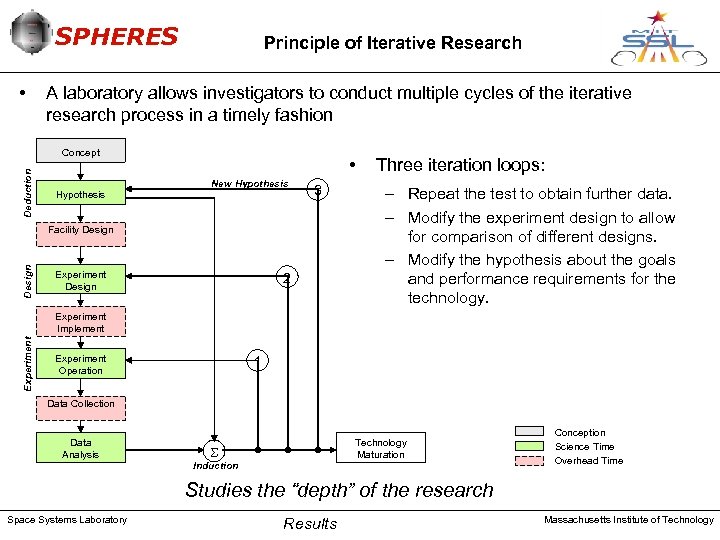 SPHERES • Principle of Iterative Research A laboratory allows investigators to conduct multiple cycles of the iterative research process in a timely fashion Deduction Concept Hypothesis • New Hypothesis 3 Design Facility Design Experiment Design 2 Three iteration loops: – Repeat the test to obtain further data. – Modify the experiment design to allow for comparison of different designs. – Modify the hypothesis about the goals and performance requirements for the technology. Experiment Implement Experiment Operation 1 Data Collection Data Analysis Technology Maturation Induction Conception Science Time Overhead Time Studies the “depth” of the research Space Systems Laboratory Results Massachusetts Institute of Technology
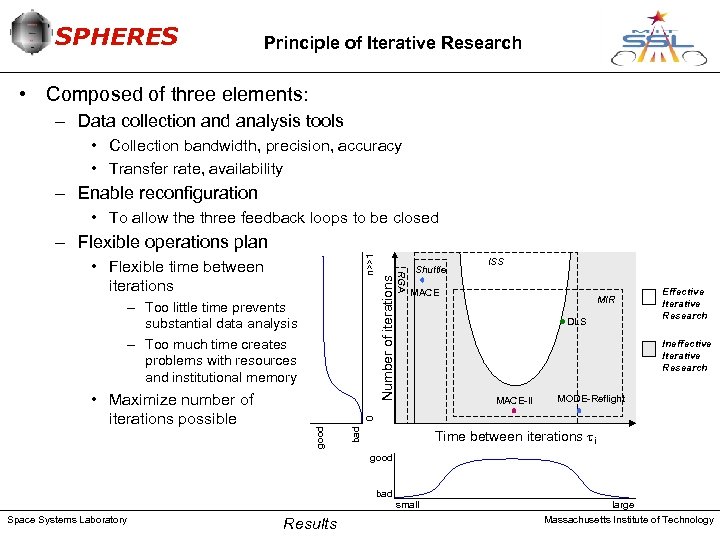 SPHERES Principle of Iterative Research • Composed of three elements: – Data collection and analysis tools • Collection bandwidth, precision, accuracy • Transfer rate, availability – Enable reconfiguration • To allow the three feedback loops to be closed ISS MACE MIR DLS Effective Iterative Research Ineffective Iterative Research MACE-II bad good • Maximize number of iterations possible Shuttle MODE-Reflight 0 – Too little time prevents substantial data analysis – Too much time creates problems with resources and institutional memory Number of iterations • Flexible time between iterations RGA n>>1 – Flexible operations plan Time between iterations ti good bad Space Systems Laboratory Results small large Massachusetts Institute of Technology
 SPHERES Principle of Enabling a Field of Study • A laboratory provides the facilities to study a substantial number of the research areas which comprise a field of study – Every facility must be part of a clearly defined field of study • The objective of a facility must clearly indicate what field of study it will cover – The study of multiple topics requires multiple experiments to be performed • Individual scientists perform research on one or a few areas • The work on individual topics collectively covers the field of study • Therefore multiple investigators, who perform experiments in their specific area of expertise within the field, must be supported – The laboratory must facilitate bringing together the knowledge from the specific areas to mature understanding of the field of study • Enable collaborative research Covers the “breath” of the research, how much of a field of study can be covered by the facility Space Systems Laboratory Results Massachusetts Institute of Technology
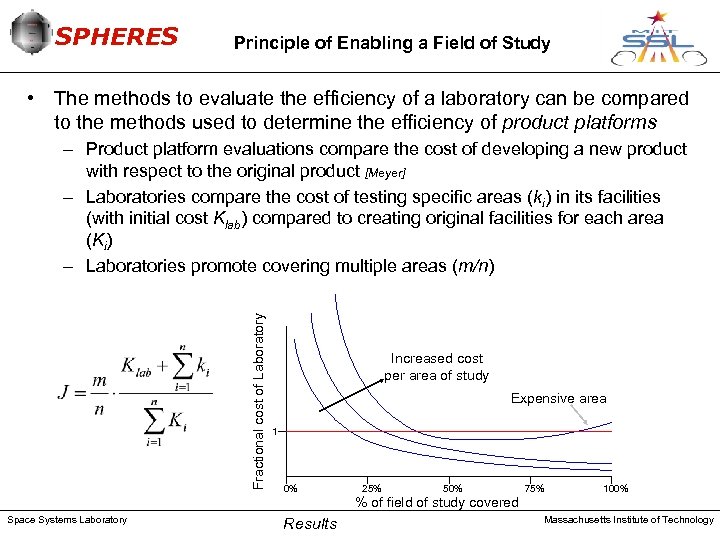 SPHERES Principle of Enabling a Field of Study • The methods to evaluate the efficiency of a laboratory can be compared to the methods used to determine the efficiency of product platforms Fractional cost of Laboratory – Product platform evaluations compare the cost of developing a new product with respect to the original product [Meyer] – Laboratories compare the cost of testing specific areas (ki) in its facilities (with initial cost Klab) compared to creating original facilities for each area (Ki) – Laboratories promote covering multiple areas (m/n) Increased cost per area of study Expensive area 1 0% 25% 50% 75% 100% % of field of study covered Space Systems Laboratory Results Massachusetts Institute of Technology
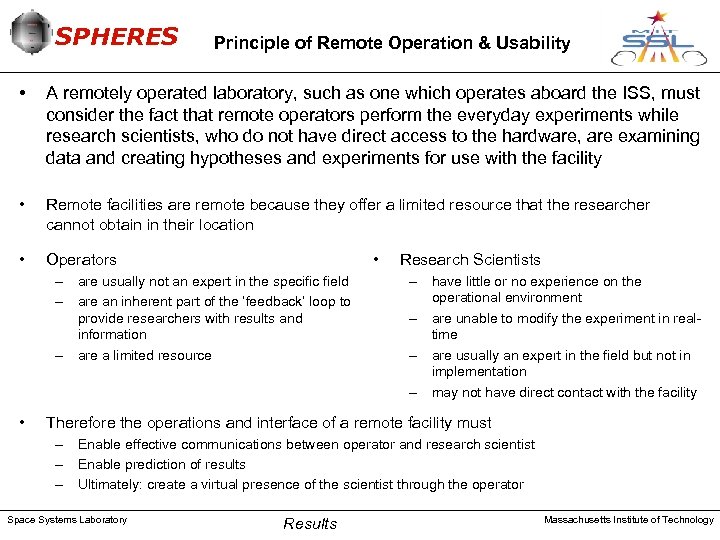 SPHERES Principle of Remote Operation & Usability • A remotely operated laboratory, such as one which operates aboard the ISS, must consider the fact that remote operators perform the everyday experiments while research scientists, who do not have direct access to the hardware, are examining data and creating hypotheses and experiments for use with the facility • Remote facilities are remote because they offer a limited resource that the researcher cannot obtain in their location • Operators • – are usually not an expert in the specific field – are an inherent part of the ‘feedback’ loop to provide researchers with results and information – are a limited resource • Research Scientists – have little or no experience on the operational environment – are unable to modify the experiment in realtime – are usually an expert in the field but not in implementation – may not have direct contact with the facility Therefore the operations and interface of a remote facility must – Enable effective communications between operator and research scientist – Enable prediction of results – Ultimately: create a virtual presence of the scientist through the operator Space Systems Laboratory Results Massachusetts Institute of Technology
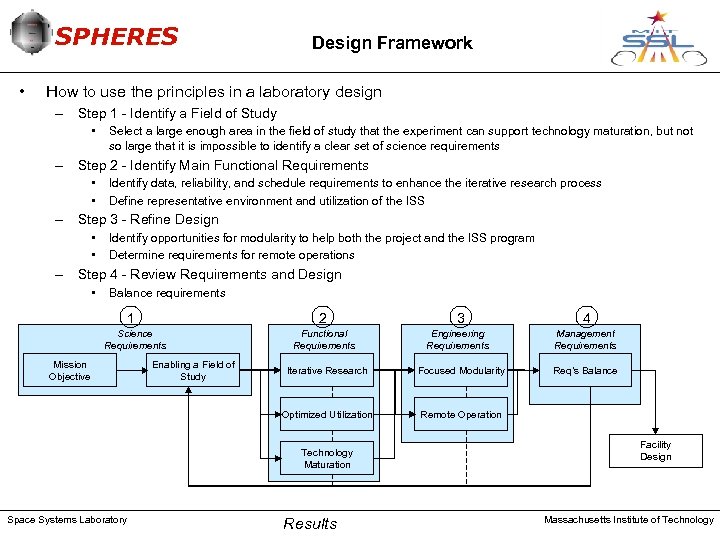 SPHERES • Design Framework How to use the principles in a laboratory design – Step 1 - Identify a Field of Study • Select a large enough area in the field of study that the experiment can support technology maturation, but not so large that it is impossible to identify a clear set of science requirements – Step 2 - Identify Main Functional Requirements • • Identify data, reliability, and schedule requirements to enhance the iterative research process Define representative environment and utilization of the ISS – Step 3 - Refine Design • • Identify opportunities for modularity to help both the project and the ISS program Determine requirements for remote operations – Step 4 - Review Requirements and Design • Balance requirements 1 2 Science Requirements Mission Objective Enabling a Field of Study Functional Requirements 3 Engineering Requirements Iterative Research Focused Modularity Optimized Utilization Management Requirements Remote Operation Technology Maturation Space Systems Laboratory 4 Results Req’s Balance Facility Design Massachusetts Institute of Technology
 SPHERES Chapter 1 2 Motivation & Other Facilities Outline Objective ISS & Facility Characteristic Hypothesis 3 4 5 6 SSL Design Philosophy SPHERES Design Principles & Frameworks Motivation / Approach -g and Remote Research Facilities The International Space Station MIT SSL Laboratory Design Philosophy • SPHERES: from testbed to laboratory Experimentation Results – Description – Iterative Research Process – Supporting Multiple Scientists • Design Principles Evaluations Conclusions 7 • • Conclusions Space Systems Laboratory • Application of Principles • Contributions Massachusetts Institute of Technology
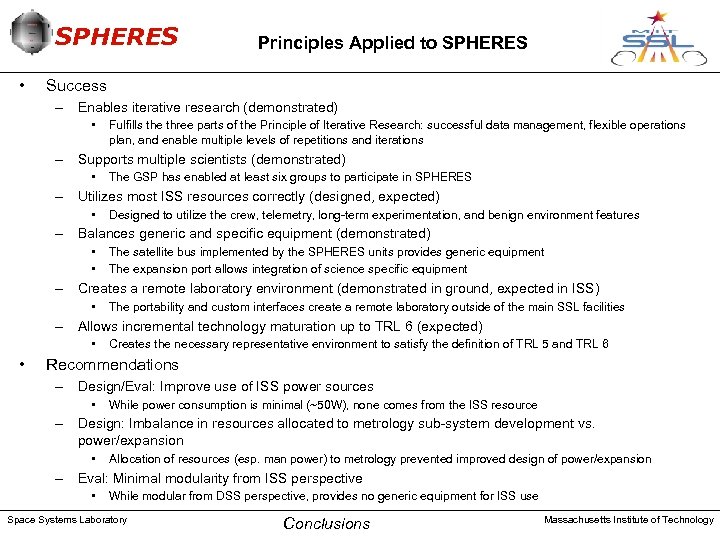 SPHERES • Principles Applied to SPHERES Success – Enables iterative research (demonstrated) • Fulfills the three parts of the Principle of Iterative Research: successful data management, flexible operations plan, and enable multiple levels of repetitions and iterations – Supports multiple scientists (demonstrated) • The GSP has enabled at least six groups to participate in SPHERES – Utilizes most ISS resources correctly (designed, expected) • Designed to utilize the crew, telemetry, long-term experimentation, and benign environment features – Balances generic and specific equipment (demonstrated) • • The satellite bus implemented by the SPHERES units provides generic equipment The expansion port allows integration of science specific equipment – Creates a remote laboratory environment (demonstrated in ground, expected in ISS) • The portability and custom interfaces create a remote laboratory outside of the main SSL facilities – Allows incremental technology maturation up to TRL 6 (expected) • • Creates the necessary representative environment to satisfy the definition of TRL 5 and TRL 6 Recommendations – Design/Eval: Improve use of ISS power sources • While power consumption is minimal (~50 W), none comes from the ISS resource – Design: Imbalance in resources allocated to metrology sub-system development vs. power/expansion • Allocation of resources (esp. man power) to metrology prevented improved design of power/expansion – Eval: Minimal modularity from ISS perspective • While modular from DSS perspective, provides no generic equipment for ISS use Space Systems Laboratory Conclusions Massachusetts Institute of Technology
 SPHERES • Contributions: Principles Identified the fundamental characteristics of a laboratory for space technology maturation – Formalized the need for a laboratory to support iterative research • Based on the definition of the scientific method • Called for reduced dependency on DOE – Identified the need to enable research on a field of study • Requires support of multiple scientists in most cases – Advocate the use of the ISS as a wind-tunnel-like environment for g research • Established a set of principles to guide the design of research laboratories for space technology maturation aboard the International Space Station – Enables the use of the ISS to incrementally mature space technologies – Developed a design framework – Developed an evaluation framework to respond in part to the NRC institutionalization of science aboard the ISS • Calls for a change in attitude towards the use of resources aboard the ISS: don’t treat as costs to minimize; treat as added value, so maximize their correct use Space Systems Laboratory Conclusions Massachusetts Institute of Technology
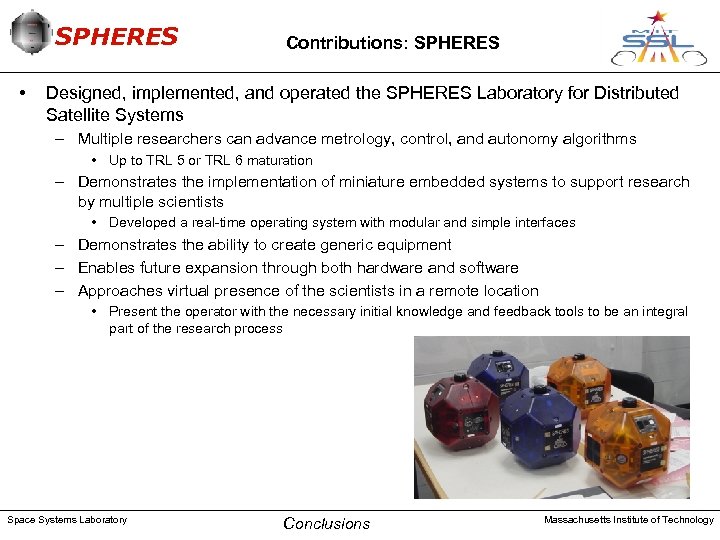 SPHERES • Contributions: SPHERES Designed, implemented, and operated the SPHERES Laboratory for Distributed Satellite Systems – Multiple researchers can advance metrology, control, and autonomy algorithms • Up to TRL 5 or TRL 6 maturation – Demonstrates the implementation of miniature embedded systems to support research by multiple scientists • Developed a real-time operating system with modular and simple interfaces – Demonstrates the ability to create generic equipment – Enables future expansion through both hardware and software – Approaches virtual presence of the scientists in a remote location • Present the operator with the necessary initial knowledge and feedback tools to be an integral part of the research process Space Systems Laboratory Conclusions Massachusetts Institute of Technology
 SPHERES Questions? Space Systems Laboratory Massachusetts Institute of Technology
 SPHERES Principle of Optimized Utilization • A well-designed laboratory considers all the resources available and optimizes their use with respect to the research needs • Understand the resources and limitations of the ISS – – – • Crew Power sources Data telemetry Long-term experimentation Benign Environment / Atmosphere Determine the needs of the research – Allow flexibility in the needs of the laboratory; maximize the ability to use available resources • • Realize which resources do not provide a benefit to the research Iterate this process to ensure all available resources are utilized as best as possible Space Systems Laboratory Results Massachusetts Institute of Technology
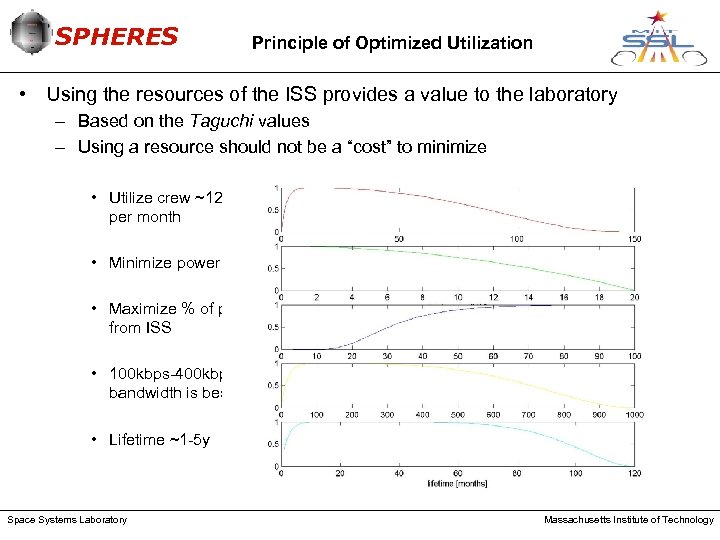 SPHERES Principle of Optimized Utilization • Using the resources of the ISS provides a value to the laboratory – Based on the Taguchi values – Using a resource should not be a “cost” to minimize • Utilize crew ~12 h per month • Minimize power req. • Maximize % of power from ISS • 100 kbps-400 kbps bandwidth is best • Lifetime ~1 -5 y Space Systems Laboratory Massachusetts Institute of Technology
 SPHERES Principle of Focused Modularity • A modular facility identifies those aspects of specific experiments that are generic in nature and allows the use of these generic components to facilitate as yet unforeseen experiments. Such a facility is not designed to support an unlimited range of research, but is designed to meet the needs of a specific research area. • During development of a facility identify the generic components but ensure that the initial research goals are met – The original immediate research should not be compromised – The experiment generic components can become part of a larger array of generic elements that brought together create a laboratory environment • Do not try to design a “do-everything” system – The generic equipment should be identified after the design of the original experiment; the original design should not be to create generic equipment Space Systems Laboratory Results Massachusetts Institute of Technology
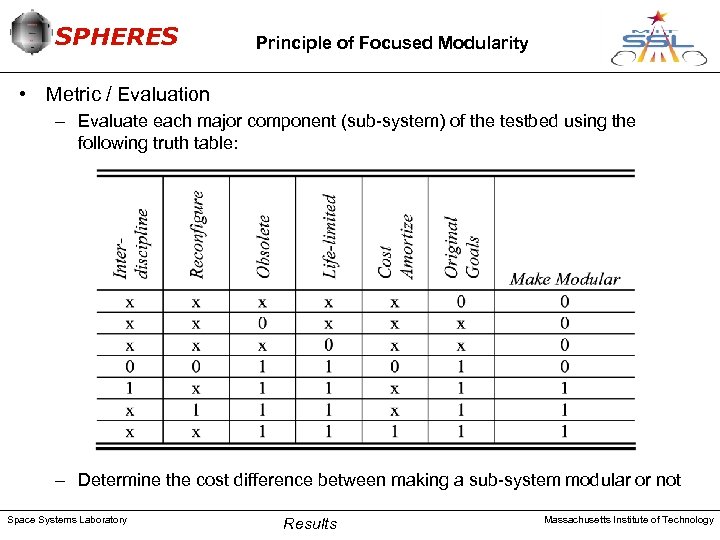 SPHERES Principle of Focused Modularity • Metric / Evaluation – Evaluate each major component (sub-system) of the testbed using the following truth table: – Determine the cost difference between making a sub-system modular or not Space Systems Laboratory Results Massachusetts Institute of Technology
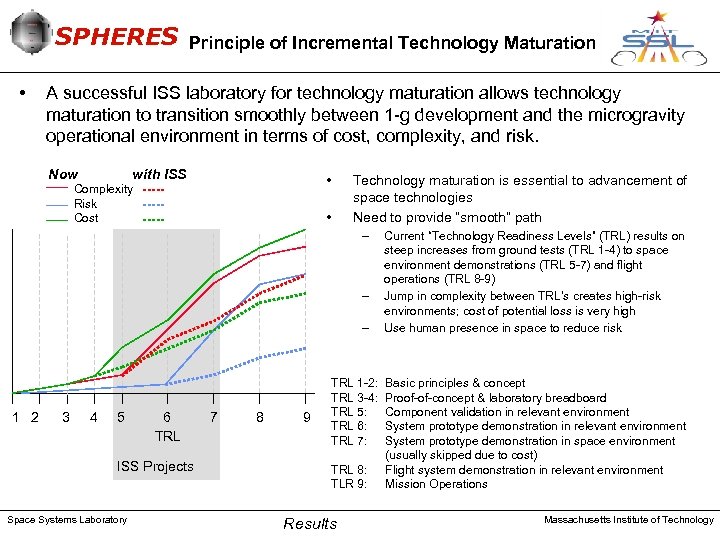 SPHERES • Principle of Incremental Technology Maturation A successful ISS laboratory for technology maturation allows technology maturation to transition smoothly between 1 -g development and the microgravity operational environment in terms of cost, complexity, and risk. Now with ISS • Complexity Risk Cost Technology maturation is essential to advancement of space technologies Need to provide “smooth” path • – – – 1 2 3 4 5 6 TRL ISS Projects Space Systems Laboratory 7 8 9 TRL 1 -2: TRL 3 -4: TRL 5: TRL 6: TRL 7: TRL 8: TLR 9: Results Current “Technology Readiness Levels” (TRL) results on steep increases from ground tests (TRL 1 -4) to space environment demonstrations (TRL 5 -7) and flight operations (TRL 8 -9) Jump in complexity between TRL’s creates high-risk environments; cost of potential loss is very high Use human presence in space to reduce risk Basic principles & concept Proof-of-concept & laboratory breadboard Component validation in relevant environment System prototype demonstration in space environment (usually skipped due to cost) Flight system demonstration in relevant environment Mission Operations Massachusetts Institute of Technology
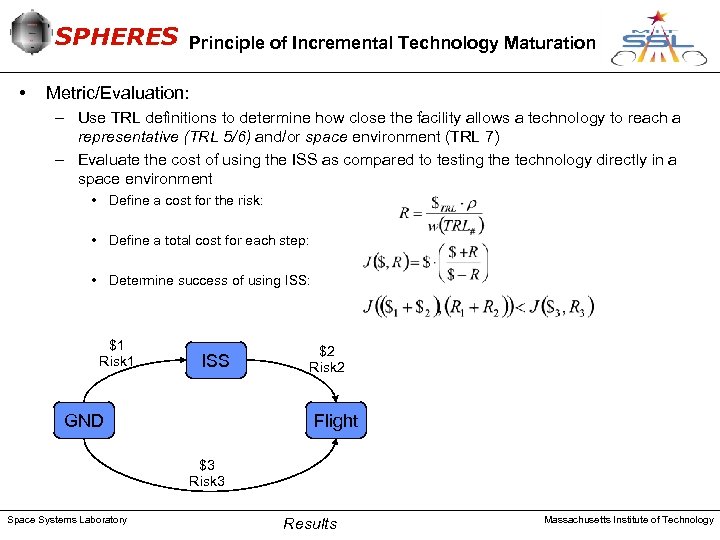 SPHERES • Principle of Incremental Technology Maturation Metric/Evaluation: – Use TRL definitions to determine how close the facility allows a technology to reach a representative (TRL 5/6) and/or space environment (TRL 7) – Evaluate the cost of using the ISS as compared to testing the technology directly in a space environment • Define a cost for the risk: • Define a total cost for each step: • Determine success of using ISS: $1 Risk 1 ISS GND $2 Risk 2 Flight $3 Risk 3 Space Systems Laboratory Results Massachusetts Institute of Technology
 SPHERES Principle of Requirements Balance • The requirements of a laboratory are balanced such that one requirement does not drive the design in a way that it hinders the ability to succeed on other requirements; further, the hard requirements drive the majority of the design, while soft requirements enhance the design only when possible. – All the previous principles will create different, but not necessarily independent, requirements • A successful project balances all its requirements so that no single one overshadows all others • Balancing the requirements ensures that all the other principles are accounted for and met as best as possible/viable – There are hard and soft requirements • Hard requirements are usually set at the start of a project to determine the goals that must be met; they are mostly quantitative • Soft requirements are features desired by the scientists but which do not necessarily have a specific value or which are not essential for the success of the mission – Maximize the ratio of hard requirements to soft requirements • Minimize the chance of bloating the facility with unused features Space Systems Laboratory Results Massachusetts Institute of Technology
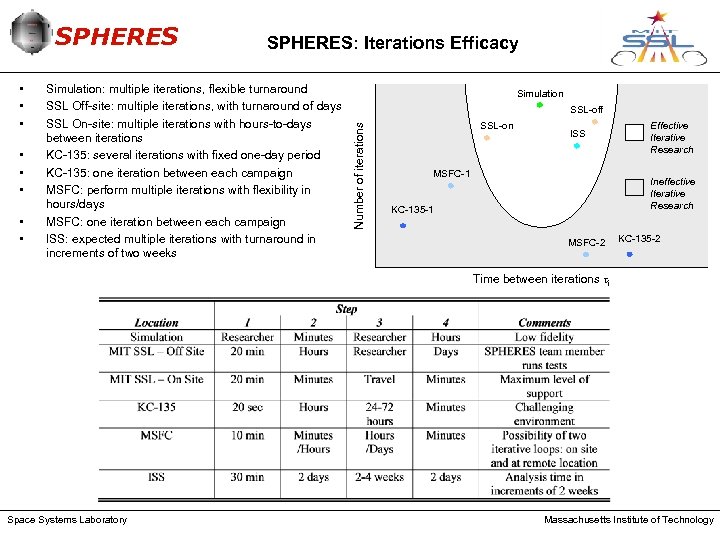 • • SPHERES: Iterations Efficacy Simulation: multiple iterations, flexible turnaround SSL Off-site: multiple iterations, with turnaround of days SSL On-site: multiple iterations with hours-to-days between iterations KC-135: several iterations with fixed one-day period KC-135: one iteration between each campaign MSFC: perform multiple iterations with flexibility in hours/days MSFC: one iteration between each campaign ISS: expected multiple iterations with turnaround in increments of two weeks Simulation SSL-off Number of iterations SPHERES SSL-on ISS MSFC-1 Effective Iterative Research Ineffective Iterative Research KC-135 -1 MSFC-2 KC-135 -2 Time between iterations ti Space Systems Laboratory Massachusetts Institute of Technology
 SPHERES • Evaluation Framework – Created to allow a member of the NGO or NASA team to evaluate a design to determine: • Correct utilization of the ISS • Technology advancement • Mission scope – Based on six principles: • • Iterative Research Enabling a Field of Study Optimized Utilization Requirements Balance solely part of the design framework Space Systems Laboratory Massachusetts Institute of Technology