


 Скачать презентацию Speech discrimination with FM Radio Aid Systems and
526123f296e723862a47a1db72c42502.ppt
- Количество слайдов: 1
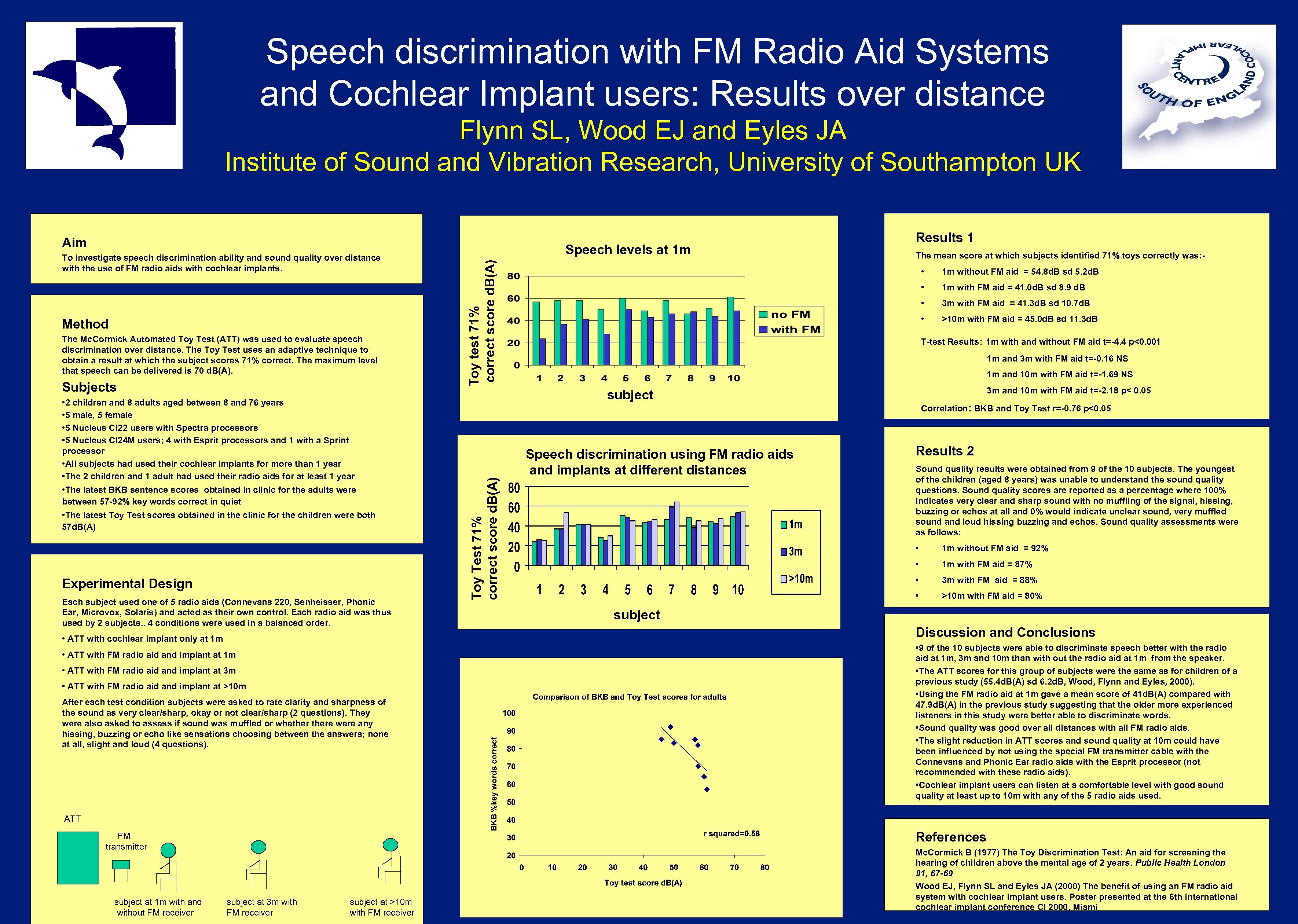 Speech discrimination with FM Radio Aid Systems and Cochlear Implant users: Results over distance Flynn SL, Wood EJ and Eyles JA Institute of Sound and Vibration Research, University of Southampton UK Aim The Mc. Cormick Automated Toy Test (ATT) was used to evaluate speech discrimination over distance. The Toy Test uses an adaptive technique to obtain a result at which the subject scores 71% correct. The maximum level that speech can be delivered is 70 d. B(A). Subjects • 2 children and 8 adults aged between 8 and 76 years • 5 male, 5 female • 5 Nucleus CI 22 users with Spectra processors • 5 Nucleus CI 24 M users; 4 with Esprit processors and 1 with a Sprint processor • All subjects had used their cochlear implants for more than 1 year • The 2 children and 1 adult had used their radio aids for at least 1 year • The latest BKB sentence scores obtained in clinic for the adults were between 57 -92% key words correct in quiet • The latest Toy Test scores obtained in the clinic for the children were both 57 d. B(A) Experimental Design Each subject used one of 5 radio aids (Connevans 220, Senheisser, Phonic Ear, Microvox, Solaris) and acted as their own control. Each radio aid was thus used by 2 subjects. . 4 conditions were used in a balanced order. • ATT with cochlear implant only at 1 m • ATT with FM radio aid and implant at 3 m • ATT with FM radio aid and implant at >10 m After each test condition subjects were asked to rate clarity and sharpness of the sound as very clear/sharp, okay or not clear/sharp (2 questions). They were also asked to assess if sound was muffled or whethere were any hissing, buzzing or echo like sensations choosing between the answers; none at all, slight and loud (4 questions). Toy test 71% correct score d. B(A) Method The mean score at which subjects identified 71% toys correctly was: - • 1 m without FM aid = 54. 8 d. B sd 5. 2 d. B • 1 m with FM aid = 41. 0 d. B sd 8. 9 d. B • 3 m with FM aid = 41. 3 d. B sd 10. 7 d. B • >10 m with FM aid = 45. 0 d. B sd 11. 3 d. B T-test Results: 1 m with and without FM aid t=-4. 4 p<0. 001 1 m and 3 m with FM aid t=-0. 16 NS 1 m and 10 m with FM aid t=-1. 69 NS 3 m and 10 m with FM aid t=-2. 18 p< 0. 05 subject Correlation: BKB and Toy Test r=-0. 76 p<0. 05 Toy Test 71% correct score d. B(A) To investigate speech discrimination ability and sound quality over distance with the use of FM radio aids with cochlear implants. Speech levels at 1 m Results 1 Speech discrimination using FM radio aids and implants at different distances Results 2 Sound quality results were obtained from 9 of the 10 subjects. The youngest of the children (aged 8 years) was unable to understand the sound quality questions. Sound quality scores are reported as a percentage where 100% indicates very clear and sharp sound with no muffling of the signal, hissing, buzzing or echos at all and 0% would indicate unclear sound, very muffled sound and loud hissing buzzing and echos. Sound quality assessments were as follows: • 1 m without FM aid = 92% • 1 m with FM aid = 87% • 3 m with FM aid = 88% • >10 m with FM aid = 80% subject Discussion and Conclusions • 9 of the 10 subjects were able to discriminate speech better with the radio aid at 1 m, 3 m and 10 m than with out the radio aid at 1 m from the speaker. • The ATT scores for this group of subjects were the same as for children of a previous study (55. 4 d. B(A) sd 6. 2 d. B, Wood, Flynn and Eyles, 2000). • Using the FM radio aid at 1 m gave a mean score of 41 d. B(A) compared with 47. 9 d. B(A) in the previous study suggesting that the older more experienced listeners in this study were better able to discriminate words. • Sound quality was good over all distances with all FM radio aids. • The slight reduction in ATT scores and sound quality at 10 m could have been influenced by not using the special FM transmitter cable with the Connevans and Phonic Ear radio aids with the Esprit processor (not recommended with these radio aids). • Cochlear implant users can listen at a comfortable level with good sound quality at least up to 10 m with any of the 5 radio aids used. ATT References FM transmitter subject at 1 m with and without FM receiver subject at 3 m with FM receiver subject at >10 m with FM receiver Mc. Cormick B (1977) The Toy Discrimination Test: An aid for screening the hearing of children above the mental age of 2 years. Public Health London 91, 67 -69 Wood EJ, Flynn SL and Eyles JA (2000) The benefit of using an FM radio aid system with cochlear implant users. Poster presented at the 6 th international cochlear implant conference CI 2000, Miami